INTRODUCTION
Sepiolid cuttlefish (commonly known as ‘bobtail squids’) are benthic neritic cephalopod molluscs distributed in tropical, temperate and polar waters of all oceans (Reid & Jereb, Reference Reid, Jereb, Jereb and Roper2005). Reproduction in many species is quite well studied both in the field and the laboratory (Mangold-Wirz, Reference Mangold-Wirz1963; Boletzky, Reference Boletzky1975, Reference Boletzky and Boyle1983; Summers, Reference Summers1985; Gabel-Deickert, Reference Gabel-Deickert1995). Sepiolids are intermittent terminal spawners. They produce relatively large eggs that the female lays on the bottom in batches, laying each egg individually (Gabel-Deickert, Reference Gabel-Deickert1995; Boletzky, Reference Boletzky1998; Rocha et al., Reference Rocha, Guerra and Gonzalez2001). However, most of the information on fecundity and spawning is based on investigations of the relatively warm-water inshore subfamily Sepiolinae. Among representatives of the cold-water and deep-sea subfamily Rossiinae only three species from the northern hemisphere (Rossia macrosoma, R. pacifica and Neorossia caroli) have been studied to date. All three are ‘giant’ species attaining 85–90 mm ML and producing 85–600 eggs of 7–10 mm in size. Bobtail squid of the subfamily Rossiinae deposit their eggs as small clusters on bivalve shells and other solid substrates or into sponges (Mangold-Wirz, Reference Mangold-Wirz1963; Gabel-Deickert, Reference Gabel-Deickert1995; Boletzky, Reference Boletzky1998; Nesis, Reference Nesis2001; Reid & Jereb, Reference Reid, Jereb, Jereb and Roper2005; Cuccu et al., Reference Cuccu, Mereu, Cannas, Follesa, Cau and Jereb2007; Okutani & Sasaki, Reference Okutani and Sasaki2007). Neither the small-sized representatives of this subfamily nor any other species from the southern hemisphere have been studied at all.
The small cuttlefish, Semirossia patagonica (Smith, 1881), locally known as the Mickey Mouse squid (here we use ‘bobtail squid’ henceforward), is distributed throughout the south-west Atlantic and the south-east Pacific (Rocha, Reference Rocha1997; Reid & Jereb, Reference Reid, Jereb, Jereb and Roper2005). It is a poorly known species, and its biology has never been investigated. This study was aimed at describing its distribution and the reproduction of this species around the Falkland Islands.
MATERIALS AND METHODS
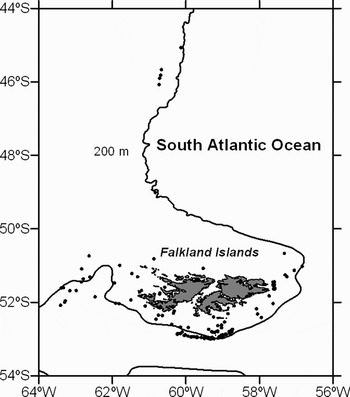
To investigate the species distribution, data on catch composition were collected between 1988 and 2007 (including all months) onboard the different fishing vessels (18,168 hauls) and RV ‘Dorada’ (542 hauls). These vessels operated with different types of bottom and semipelagic trawls between 27 and 1097 m bottom depth. Semirossia patagonica were recorded in 137 hauls (Figure 1). A total of 155 hauls using an Isaacs–Kidd midwater trawl were conducted to sample planktonic cephalopods and fish paralarvae all year round except in March–May and August above depths of 19–1000 m (including 141 hauls shallower than a bottom depth of 300 m). These resulted in capture of five S. patagonica hatchlings.
Occurrence of Semirossia patagonica in the south-west Atlantic (research and commercial hauls combined).

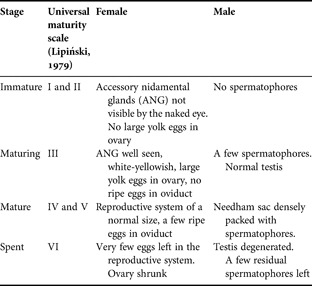
A total of 104 animals (39 females and 65 males) were collected and investigated onshore. Sampling was carried out in all months except December. Bobtail squids were preserved in a 10% buffered formalin solution and then investigated onshore. The dorsal mantle length (ML) was measured within 1 mm, and total body mass (BM) was estimated within 0.1 g. Animals were assigned as immature, maturing, mature and spent (Table 1).
Maturity scale for Semirossia patagonica.

In females, the ovary and accessory glands were weighed within 0.0001 g. All oocytes from the ovary and the oviduct were counted and measured along the major axis to the nearest 0.1 mm. In males, spermatophoric complex of organs (SCO) and testis were weighed to the nearest 0.0001 g. Spermatophores were counted and spermatophore length measured within 0.1 mm in 17 males (a total of 406 spermatophores). Gonadosomatic index (GSI) was calculated as a ratio between the gonad mass (GM) to the BM (GSI = (GM/BM) ×100) (Bakhayokho, Reference Bakhayokho and Caddy1983; Gabr et al., Reference Gabr, Hanlon, Hanafy and El Etreby1998). Reproductive system index (RSI) was calculated as a ratio between reproductive system mass (RSM) and BM (RSI = (RSM/BM) ×100). Relative fecundity (RF) was calculated as a ratio of fecundity (F) to BM (RF = F/BM).
RESULTS
Distribution
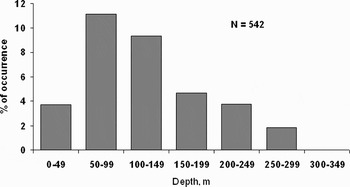
Semirossia patagonica were found all over the Falkland shelf between 47 and 295 m with the maximum abundance between 50 and 150 m (Figures 1 & 2). The maximum occurrence of the species was observed on the southern part of the shelf. Hatchlings of about 5 mm ML (it was impossible to measure the ML precisely in live animals) were caught above depths of 44–84 m (horizon 10–50 m). Mature males were caught between 46 m and 270 m, mature females between 56 m to 208 m depth. Females represented 36.0% of the animals studied.
Occurrence of Semirossia patagonica in research hauls of RV ‘Dorada’ over the different depth ranges.

Body size and mass
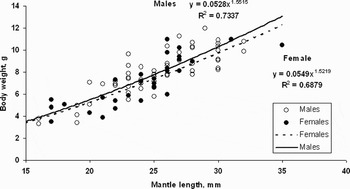
Mature female size in catches varied from 10 to 35, mean 24.0 mm ML (BM of bobtail squid of 17–35 mm was 3.5–11.0 g). Mature male size was 16–32, mean 25.5 mm ML (BM 3.3–12.0 g) (Figure 3). The largest maturing female was 23 mm ML (5.9 g BM); the largest maturing male was of 26 mm ML (7.7 g BM). Differences in mature animal size were not significant between sexes (t = 1.48, P = 0.143; F-test F = 1.63, P = 0.07).
Length–weight relations in male and female Semirossia patagonica.

Male reproductive system
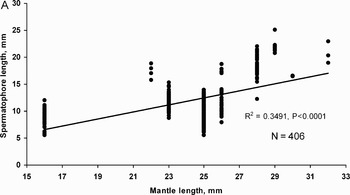
As in other sepiolid squids, the male reproductive system consists of the testis and spermatophoric gland with Needham sac. The spermatophore length ranged between 5.6 mm and 25.1 mm (mean 11.9 mm) and increased with increasing male size (Figure 4); the relative spermatophore size was 22.4–86.6 (mean 49.0) %ML and was not related to the ML (R2 = 0.01, P = 0.02). Total number of spermatophores varied from 13 to 229 in mature animals, spent males had 6–11 spermatophores. The relative weight of reproductive system in mature males ranged from 3.1% to 14.9% BM (mean 6.7% BM), the testis index was 0.95–6.1 (mean 2.75) % BM.
Spermatophore length in Semirossia patagonica.

Copulation
As in other species of the Rossiinae, there is no well defined bursa copulatrix in S. patagonica. Males attach spermatophores in the females' mantle cavity using their hectocotylized left first arm, mostly nearby the oviducal gland opening. The spermatangia numbers in mated females ranged between 2 and 19 (mean 9). Occasionally, they could be placed in a different place: one mature female (26 mm ML, 11 g BM) had 3 spermatangia attached to the surface of visceropericardial coelom covering the ovary.
Female reproductive system and fecundity
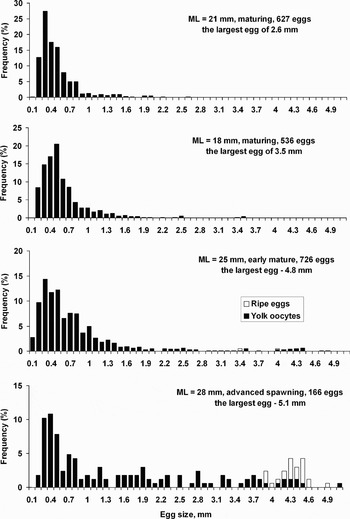
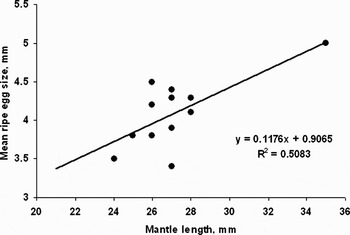
The morphology of the reproductive system is similar to that in other Sepiolidae—it consists of the ovary, an oviduct with an oviducal gland, a pair of nidamental glands, and a pair of accessory nidamental glands. The RSI in mature females ranged from 23.0% to 41.7% BM (mean 29.7%), including GSI of 13.0–29.4 (mean 19.5) % BM. Oocyte growth occurs asynchronously, small protoplasmic oocytes of 0.2–0.5 mm predominate during most of the ontogeny (Figure 5). Resorbing post-ovulatory follicles were obvious in mature females. Their number varied from 2 to 196 (mean 60), which is much higher than the number of ripe eggs found in an oviduct (maximum 29). Ripe egg size was 3.4–5.0 mm (mean 4.2 mm), which is 12.6–17.3% ML. Egg weight was 24.8–58.9 mg (mean 43.4 mg), which is 0.4–0.8% BM. There was a weak positive correlation between mean ripe egg size and female ML (r = 0.71, P = 0.009) (Figure 6).
Changes in oocyte length–frequencies at maturation in Semirossia patagonica.

Mean ripe egg size in the oviduct in Semirossia patagonica (only females with >10 eggs taken into account).

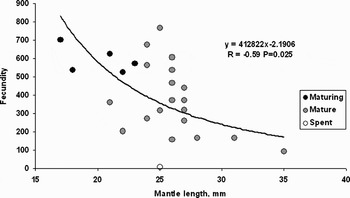
Potential fecundity in pre-spawning females ranged between 527 and 766 eggs, mean 622 (Figure 7), RF was 63.8–200.9 (average 106.9) egg/g. The average number of oocytes found in a mature female was 218 only. The number of ripe eggs in the oviduct varied between 2 and 29. Potential fecundity decreased with female size, and the minimum fecundity (94 eggs) was found in the largest animal of 35 mm ML (Figure 7). This female also had 129 resorbing residual oocytes demonstrating that actual fecundity is probably about 80% of the potential fecundity. In the spent female (25 mm ML, GSI 0.22) only 7 eggs were left: 5 yolk oocytes of 1.8–4.1 mm in the ovary and two ripe eggs in the oviduct.
Changes in fecundity with the squid growth.

Seasonality of reproduction
Most of the bobtail squid (82.0% females and 86.2% males) were mature. Mature animals were found in every month studied (January–November) which suggests that the spawning occurs all year round. One spent female and one spent male were caught on 9 March 2004 in the same haul on the south-eastern shelf (52°48′5 S 59°16′5 W, 108 m). Another spent male was caught on 23 April 1993 (52°59S, 59°07 W, 167 m). Hatchlings of S. patagonica of 5 mm ML were caught in spring and summer (October–February).
DISCUSSION AND CONCLUSIONS
Semirossia patagonica is a typical shelf dweller that penetrates onto the upper part of the continental slope and occurs mostly on the southern Falkland shelf. Possibly pelagic bobtail squid hatchlings could be easily transported from the northern shelf into open oceanic waters by the Falkland Current, and because of this the species probably cannot reproduce there. It is a small-sized bobtail squid in contrast to other Rossiinae from temperate and polar latitudes (Rossia and Neorossia spp), in which the maximum size typically varies between 45 and 90 mm ML (Reid & Jereb, Reference Reid, Jereb, Jereb and Roper2005). Semirossia patagonica probably evolved in the south-west Atlantic as an ecological sibling of temperate Sepiola and Sepietta (Sepiolinae) that are absent on the Patagonian shelf. Representatives of these two genera also inhabit shelf waters and are characterized by an egg size of 2.3–4.9 mm (Bergstrom & Summers, Reference Bergstrom, Summers and Boyle1983; Boletzky, Reference Boletzky and Boyle1983; Gabel-Deickert, Reference Gabel-Deickert1995; Yau & Boyle, Reference Yau and Boyle1996; Salman, Reference Salman1998; Salman & Onsoy, Reference Salman and Önsoy2004), which is similar to that in S. patagonica. In contrast to this, the egg size in ‘normal’ rossiin cephalopod genera Rossia and Neorossia from temperate and polar latitudes (Rossia australis, R. mastigophora, R. macrosoma, R. megaptera, R. moelleri, R. mollicella, R. palberosa, R. pacifica, R. sp.1, Neorossia leptodons and N. caroli) is 7–12 mm (Mangold-Wirz, Reference Mangold-Wirz1963; Reid, Reference Reid1991; Nesis, Reference Nesis2001; Cuccu et al., Reference Cuccu, Mereu, Cannas, Follesa, Cau and Jereb2007; Okutani & Sasaki, Reference Okutani and Sasaki2007; H. Hoving, personal communication).
As with much of the other representatives of the subfamily Sepiolinae (Gabel-Deickert, Reference Gabel-Deickert1995), S. patagonica is likely to exhibit a very long continuous (Rocha et al., Reference Rocha, Guerra and Gonzalez2001) spawning. Spermatangia numbers found in mated females are about 10 times lower than spermatophore numbers found in mature males. Moreover, the number of spermatophores found in a mature male probably is much lower than its total spermatophore production during the ontogenesis. Males with full spermatophoric sacs still have large functioning testes and spermatophoric production was still ongoing. This indicates a protracting promiscuous copulation.
A distinctive trait of male S. patagonica is production of extremely large spermatophores, in which the relative size is bigger than in any other species of Sepiolinae and Rossiinae (review: H. Hoving et al., in press). There might be many explanations of this phenomenon. The most probable reason is that S. patagonica is a dwarf sepiolin species that inherited a large spermatophore size from its large-sized ancestors.
A big difference between high fecundity and low oviduct capacity indicates continuous spawning with an extended egg production as occurs in other species of family Sepiolidae. A decrease in female fecundity with an increase in mature bobtail squid size also could be explained by animal growth during spawning. The number of batches laid by a female could be roughly estimated as a ratio between fecundity (400–700 eggs taking into account that probably not all fecundity is going to be released) and ripe egg number in females with full oviducts (20–30). Therefore it is likely that each female releases 20–25 egg batches. So, males probably also spend their spermatophores by 20–25 portions and actual male fecundity is about 2–2.5 times the Needham sac capacity. This is true if natural sex ratio in the population is about 1:1. However, in our collection females represented only 37.5% of a total population, so if this is not a sampling bias, the actual male fecundity is only 50% higher than the Needham sac capacity. A big difference between sizes of the largest maturing and the largest mature female (>50% of ML) as well as a wide range of sizes in mature bobtail squids indicate a possible intensive growth during a long individual reproductive season.
Because of a continuous spawning with the production of a number of very large eggs, the total mass of female ontogenetic reproductive output will exceed her own body mass by 4–8 times. To produce such an amount of generative material, an animal has to exhibit a very long individual reproductive period. Reproduction in S. patagonica is likely to occur all year round and all over the species range, with no obvious long-distance migrations between spawning and foraging grounds. In this study hatchlings were found in spring– summer, which is consistent with literature (Rodhouse et al., Reference Rodhouse, Symon and Hatfield1992). The ML of cephalopod hatchlings is similar to the size of a fertilized egg (various published data), which means that those juvenile S. patagonica hatched recently. However, it does not allow us to make any assumption about a spawning peak, because a collection of early stages of development of cephalopods was not the result of intensive all year round sampling. Only 16 hauls with an Isaacs–Kidd midwater trawl were conducted by the Falkland Islands Fisheries Department on the Falkland shelf between April and August. The embryonic development in S. patagonica in winter is probably very long. In another sepiolid species, Sepietta oweniana, with much smaller eggs (2.7 mm), embryonic development takes about 160 days at 7°C (Bergstrom & Summers, Reference Bergstrom, Summers and Boyle1983). Embryonic development of S. patagonica is likely to occur at temperatures of about 5–7°C that predominate in bottom layers at depth of about 100 m. In this case bobtail squid hatched in October–February probably appeared from eggs laid in the previous autumn–winter. We suppose that the entire post-hatching life cycle of the species is probably about one year.
ACKNOWLEDGEMENTS
We are grateful to John Barton and Dr Alexander Arkhipkin for supporting this work. We would also like to thank Joost Pompert and the scientific observers for their help in sample collection, Dr Paul Brickle for improving the English and four anonymous referees.