Carbapenem-resistant Acinetobacter baumannii (CRA) is a critical pathogen on the World Health Organization (WHO) Global Priority Pathogen list for of research and development of new antibiotics. Reference Asokan, Ramadhan, Ahmed and Sanad1 Due to the expression of multiple antibiotic-resistance mechanisms, therapeutic options for CRA are few and suboptimal. As a common cause of nosocomial pneumonia and bacteremia, CRA poses significant challenges to infection prevention and control. Reference Cheon, Kim, Yun, Moon and Kim2 Acinetobacter baumannii is an environmental saprophyte found in soil and water that can survive in harsh environments. Acinetobacter baumannii has been identified in treated water, such as drinking water and chlorinated water, Reference Bergogne-Berezin3–Reference Karumathil, Yin, Kollanoor-Johny and Venkitanarayanan5 and in multiple healthcare outbreaks worldwide. Reference Aygun, Demirkiran, Utku, Mete, Urkmez and Yilmaz6–Reference La Forgia, Franke, Hacek, Thomson, Robicsek and Peterson8 In most outbreaks, the main route of transmission is contact transmission through contaminated surfaces or hands, Reference Wilson, Livermore and Otter9 but novel studies point toward airborne transmission. Reference Wong, Lam and Chen10
Multilocus sequence typing (MLST) is widely used to type Acinetobacter baumannii. Previous studies have indicated that the predominant strains in the locality of the present study include ST195 and ST457. Reference Cheng, Wong and Chen11,Reference Leung, Leung and Lai12 In this study, we used MLST to investigate the source of an outbreak of carbapenem-resistant Acinetobacter baumannii (CRA) due to contamination of the laundry evaporative cooler and laundry environment in a general hospital.
We hypothesized that the hospital outbreak was due to contamination of the laundry evaporative cooler and the laundry environment and, hence, that the sequence types of environmental and clinical isolates would be identical.
Methods
Setting
This CRA outbreak occurred in July–October 2019 in an acute-care district general hospital in Hong Kong with medical and surgical specialties serving inpatients and outpatients. An upsurge in CRA hospital-acquired infections (HAIs), defined by an acquisition time of over 48 hours, was noted in 2019. The HAI rate increased from 0.265 patient per 1,000 patient days in the first quarter of 2019 to 0.366 patient per 1,000 patient days in the second quarter of 2019, which translated to a 43.1% increase in HAIs caused by CRA.
Infection control policy for carbapenem-resistant Acinetobacter spp
CRA screening was performed on admission for all patients with a history of hospitalization within the past month and on all patients admitted to an intensive care unit. CRA screening was conducted using a pooled swab of nostrils, axillae, groins, wounds, tracheal aspirate, and catheter urine. CRA-colonized or infected patients were preferably housed in single rooms. If single rooms were not available, CRA cases were placed in cohorts. Contact precautions were applied. Dedicated use of noncritical items to index patient, including sphygmomanometers, stethoscopes, tourniquet, were required as far as possible. Shared equipment was disinfected with 1,000 ppm Actichlor (Ecolab, Northwich, England) and disposable wipes. Routine environmental cleaning was performed twice daily with 1,000 ppm Actichlor and disposable wipes.
For CRA patients in open cubicles, the affected cubicles were disinfected with Clinell sporicidal wipes (GAMA Healthcare, Hemel Hempstead, England) after the index cases were transferred from the cubicle. Curtains of the cubicle were changed. Surveillance environmental sampling was obtained from beds of the affected cubicle, common shared-care equipment, nursing station, and keyboards.
For CRA patients staying in isolation rooms, terminal disinfection was performed with 1,000 ppm Actichlor disposable wipes when the index cases were discharged. Environmental sampling was performed after terminal disinfection. Infection control measures were intensified when CRA clusters were identified. A cluster of CRA cases was operationally defined as CRA detected in 2 or more patients in either clinical or screening samples from the same cubicle at the same time.
When a cluster of cases occurred, environmental decontamination procedures were performed twice daily. Additional CRA screening of patients upon admission and discharge was then applied to all patients in the ward. Additional surveillance environmental samples were obtained from clean areas such as the linen room and pantry. Positive environmental screening samples from wards prompted further enhanced environmental cleaning, contact tracing, and resampling. Environmental screening was performed by trained staff, who aseptically used a premoistened sponge (3M, Saint Paul, MN) directly inoculated into Acinetobacter enrichment broth (AEB) at the bedside.
Laboratory methods
Microbiological methods
Pooled swab samples, environmental screening samples, and clinical specimens (including sputum, urine, and wound swab) were first enriched by AEB at 30°C for 18–24 hours, then were subcultured to the in-house selective multidrug-resistant Acinetobacter agar (MRA) at 37°C in air for 48 hours. MRA contains meropenem at a final concentration of 6 µg/mL to select CRA, which appear as pink colonies.
Identification was performed using matrix-assisted laser desorption/ionization–time-of-flight (MALDI-TOF) to the level of Acinetobacter calcoacetius–Acinetobacter baumannii complex (ACBC). All isolates identified as ACBC by MALDI-TOF were subjected to bla OXA-51 polymerase chain reaction (PCR). The gene bla OXA-51 encodes an oxacillinase specific to Acinetobacter baumannii. Reference Turton, Woodford, Glover, Yarde, Kaufmann and Pitt13 Isolates positive for the bla OXA-51 gene were identified as Acinetobacter baumannii.
In total, 24 representative CRA isolates from clinical samples of the 3 different medical wards were identified in this outbreak, and 10 representative CRA isolates were identified from environmental samples of the laundry were selected for further microbiological and genomic analyses.
Susceptibility testing was performed using disc diffusion testing in accordance with Clinical and Laboratory Standards Institute M100 guidance. 14 Antibiotics tested include imipenem, ceftazidime, gentamicin, minocycline, cefoperazone-sulbactam, ampicillin-sulbactam, piperacillin-tazobactam, ticarcillin-clavulanate, sulfamethoxazole-trimethoprim, ciprofloxacin, and levofloxacin.
Molecular characterization of carbapenemases
Genotypic detection of OXA-type carbapenemases in CRA, including bla OXA-23, bla OXA-24, bla OXA-58, and bla OXA-143, was performed as previously described. Reference Leung, Leung and Lai12,Reference Higgins, Lehmann and Seifert15,Reference Woodford, Ellington and Coelho16
Molecular typing by multilocus sequence typing (MLST)
MLST for Acinetobacter baumannii was performed using the Oxford schedule. Reference Bartual, Seifert, Hippler, Luzon, Wisplinghoff and Rodriguez-Valera17 Using PCR, we first amplified 7 housekeeping genes in Acinetobacter baumannii: gltA, gyrB, gdhB, recA, cpn60, gpi, and rpoD. The PCR products were then sequenced for each CRA isolate using Sanger sequencing (Applied Biosystems 3500 Genetic Analyzer, Thermo Fisher Scientific, Waltham, MA). Reference Bartual, Seifert, Hippler, Luzon, Wisplinghoff and Rodriguez-Valera17 The corresponding sequence of each gene was queried through the Acinetobacter baumannii MLST (Oxford) database to obtain the corresponding allele number. Each specific combination of allele number corresponded to a specific sequence type. CRA isolates with an identical sequence type were considered epidemiologically linked and attributable to the same source.
Data analysis
Descriptive statistics were used to summarize antimicrobial resistance, presence of carbapenemase genes, and MLST patterns. Categorical variables were compared using the Fisher exact test. Cluster analysis was used to analyze the genetic distance between clinical and environmental isolates. R version 4.1.2 software (R Foundation for Statistical Computing, Vienna, Austria, 2020) was used for statistical analyses.
Ethics board approval
For this study, institutional review board ethics approval was obtained from the Joint Chinese University of Hong Kong-New Territories East Cluster Clinical Research Ethics Committee. The requirements in Declaration of Helsinki were observed and complied with throughout the study.
Results
Outbreak situation and control
Between July 20 and August 5, 2019, 4 patients in a medical ward of the hospital were infected or colonized with CRA. One patient developed respiratory deterioration due to CRA pneumonia and passed away despite invasive mechanical ventilation in the intensive care unit. Environmental sampling revealed environmental contamination, with 4 (24%) of 17 sampled sites (involving patient beds, sphygmomanometers, and trolleys) positive for CRA. Immediate ward-based screening, infection control measures, and an enhanced environmental disinfection regimen were deployed.
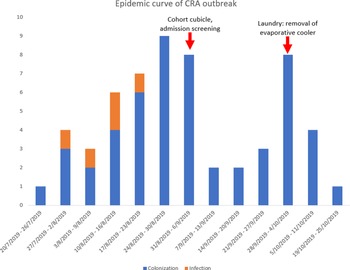
In the subsequent 3 months, 54 more patients from additional medical wards were affected. Among 58 patients, 53 were colonized and 5 were infected (3 with sacral sore infections and 2 with pneumonia). Of 58 patients, 27 belonged to a cluster. Figure 1 depicts the epidemic curve of this outbreak.
Epidemic curve for the outbreak.

Further environmental sampling was conducted to search for the source of outbreak. In the medical ward most affected by the outbreak, extensive environmental contamination was noted. CRA were recovered from environmental samples from keyboards, window blinds, water trolleys, Kardex trolleys, patient hoists, and medicine dispensing carts. The extensive contamination of the immediate surrounding was attributed to a case of active bullous pemphigoid and superimposed MDRA infection. Environmental samples from clean and unused linens for patient use were also positive for CRA in multiple wards because clean linen was processed in the central hospital laundry facility. Thus, further investigations were performed in the laundry facility to identify the source of the outbreak.
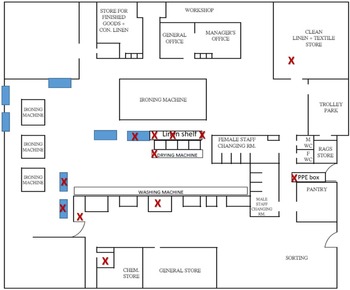
Figure 2 illustrates the floor plan of the laundry facility. Moreover, 4 rounds of extensive environmental sampling in the laundry revealed multiple sites positive for CRA (Fig. 2, red crosses). Sites sampled in the laundry facility included clean linen, linen shelves and trolleys in the clean area, the personal protective equipment (PPE) storage box, chemical storage shelves; the evaporative cooler (water samples), laundry washer surfaces, laundry dryer surfaces, and high-touch areas in the staff pantry. Among these sites, several were positive for CRA: water samples from evaporative cooler and a swab from the filter surface, shelves in the clean linen storage and chemical storage areas, the PPE storage box, and surfaces of washers and dryers.
Floor plan of the central hospital laundry. Blue rectangles indicate the location of evaporative coolers in the laundry. Red crosses indicate positive environmental sample for carbapenem-resistant Acinetobacter spp.

Inspection of the central hospital laundry facility revealed several factors that likely contributed to contamination:
-
1. Breaches were identified between clean and dirty zones through mixing of trolleys and carts from these 2 areas, a potential vector to contaminate clean linen.
-
2. Wait times for fouled linen to be laundered were long, and the number of washers was insufficient. Existing washers were also overloaded in each cycle.
-
3. Conditions in the clean linen and textile storage areas were humid and hot (>30°C), which can promote microbial growth after cleaning.
-
4. Unclean evaporative coolers were used to cool the environment. Filters in the cooler were not changed regularly. Water tanks in the coolers were not regularly emptied or topped off. Tap water was used to fill the water tanks of evaporative coolers.
In view of problems identified, the following corrective measures were implemented in the laundry facility:
-
1. A system was set up to identify carts and trolleys within a dirty zone and a clean zone. Dedicated and separate parking areas were assigned to store clean-zone trolleys and dirty-zone trolleys.
-
2. The frequency of deep cleaning of the environment was increased from every 6 months to every 3 months.
-
3. External laundry service for curtains was arranged to lighten the workload of the central laundry.
-
4. Contaminated evaporative coolers were removed. Easy-to-clean new coolers without water tanks were installed in the laundry. A schedule for regular cleaning and filter exchange was introduced for these new coolers.
Since the implementation of new laundry practice and enhanced infection control measures, no new clusters of CRA have been identified. The hospital-acquired CRA infection rate dropped from 0.366 patient per 1,000 patient days in the second quarter back to 0.259 cases per 1,000 patient bed days in the third quarter of 2019. For comparison, the overall baseline rate for CRA HAI across all hospitals in the territory was 0.262 per 1,000 patient bed days.
Baseline epidemiology of affected patients
In total, 58 patients were infected or colonized by CRA in this outbreak. The ratio of male to female patients was 1:1, and their mean age was 75.3 years (SD, 14.8). Of these 58 patients, 26 (44.8%) were residents of elder-care homes. Also, 13 patients (22.4%) passed away during their hospital admission, and 1 death was directly related to CRA infection (pneumonia). The most common diagnoses at admission were skin and soft-tissue infection (n = 12, 20.7%) and chest infection (n = 12, 20.7%). Other common diagnoses of admission included neurological disease (n = 5, 8.6%) and malignancy (n = 4, 6.9%).
Antimicrobial susceptibility pattern of isolates
The most common antibiotic to which environmental and clinical isolates of CRA were susceptible was ceftazidime. Among clinical isolates, 54% were susceptible to ceftazidime; among environmental isolates, 40% were susceptible to ceftazidime. No isolates were susceptible to ticarcillin-clavulanate, piperacillin-tazobactam, or levofloxacin. We did not detect a statistically significant difference between the susceptibility distributions of clinical and environmental CRA isolates (Fisher exact test, P = .43).
Molecular characterization of carbapenemases
The gene bla OXA-23 was positive by PCR in 15 clinical CRA isolates (62.5%) and in 7 environmental isolates (70%). None carried bla OXA-24, bla OXA-58, or bla OXA-143.
Molecular typing by MLST
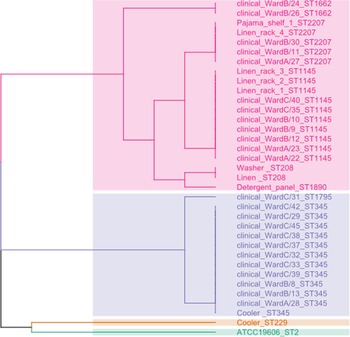
The largest sequence-type cluster belonged to ST345 (Fig. 3, bottom, in green). This cluster contained the environmental isolate from the culprit laundry evaporative cooler, and clinical isolates from 11 patients across the 3 wards (wards A, B and C). The second-largest cluster sequence type was ST1145 (Fig, 3, middle, in orange). This cluster contained environmental sampling isolates from 3 different linen racks in the laundry and clinical isolates from 7 patients across the 3 wards (wards A, B and C). The last cluster sequence type was ST2207, situated above the ST1145 cluster (Fig. 3 in orange). This cluster contained environmental isolates from a linen rack in the laundry and a pajama shelf in ward B, as well as 3 clinical isolates from 2 wards (wards A and B). Furthermore, 2 other clinical isolates were classified as ST1662, and 4 other environmental isolates were classified as ST208, ST1890, or ST229.
Cluster analysis of sequence types of clinical and environmental CRA isolates.

We did not detect a significant difference in sequence-type distribution in clinical and environmental isolates (P = .12), indicating identical origin.
Discussion
To our knowledge, this is the first study showing the role of contaminated laundry evaporative coolers and the laundry environment leading to a hospital-wide CRA outbreak. Previous epidemiological studies have shown that the prevailing local CRA strains in healthcare settings in this locality were ST195 and ST457. Reference Cheng, Wong and Chen11,Reference Leung, Leung and Lai12 In our study, the CRA strains leading to this outbreak were ST345, ST1145, and ST2207. Identical strains were identified in both laundry samples and patient samples. In particular, the most prevalent strain (ie, ST345) was isolated in the evaporative cooler in the laundry facility, used for cooling all processed linen as well as multiple patient across different wards. These wards were situated on different floors of the hospital, with infrequent mixing of medical and nursing staff, so the chance of cross contamination between the different wards was limited.
Our results demonstrate that inappropriate hospital laundry practice, including the use of an evaporative cooler in laundry, leads to the contamination of linen. In turn, the linens lead to colonization and infection of patients in multiple wards of the hospital.
Affected patients in our cohort were elderly, with a mean age of 75.3 years. Many of these patients were also dependent in activities of daily living, and 44.8% lived in care homes. The main route of CRA transmission is through contact transmission through contaminated surfaces and hands. Breaches in skin integrity and clinical procedures in these patients serve as entry sites of colonization and subsequent infection, and contaminated linen serves as the source of bacteria.
Evaporative coolers are widely used in households due to their low setup cost and energy efficiency. They are compact, mobile, and can be deployed in many situations, but because they rely on water to cool air, there is a risk of spreading waterborne pathogens in healthcare environment, classically Legionella pneumophila. Reference Crook, Willerton and Smith18 Other significant organisms similarly transmitted include Pseudomonas aeruginosa and nontuberculous mycobacteria. Reference Costa, Bousseau and Thevenot19,Reference Schreiber, Kohl, Kuster, Niemann and Sax20 Waterborne outbreaks of CRA have also been described, for example, in contaminated tap water. Reference Umezawa, Asai and Ohshima21
Not all mobile cooling units are suitable for use in hospitals. A risk assessment should take place before purchasing and installing these units. As with other forms of specialized ventilation systems in healthcare, this risk assessment should include the environment, patients, staff, and the type of cooler machine. In clinical areas, the use of such coolers is best avoided.
Hospital laundry facilities are typically considered a nonclinical environment from an infection control aspect. However, contamination in any step of linen processing can pose significant ramifications. Examples of linen-related hospital outbreaks include Bacillus spp Reference Barrie, Hoffman, Wilson and Kramer22–Reference Itoga, Inoue, Saito and Kayaba25 and Mucorales. Reference Cheng, Chen and Wong26,Reference Sundermann, Clancy and Pasculle27 Before this study, the role of linen contamination in Acinetobacter baumannii outbreaks was limited to contamination of curtains close to patients or inadequately decontaminated items. Reference Das, Lambert, Hill, Noy, Bion and Elliott28,Reference Weernink, Severin, Tjernberg and Pillows29 Our results show the role of inappropriate laundry practice in spreading CRA to different wards.
Microbiological testing of healthcare linen is not mandatory in Hong Kong, the United Kingdom, or the United States. Reference Sundermann, Clancy and Pasculle27,30,31 Existing tests for quality assurance in hospital laundries include laundry test pieces, pH, inspection for breaks or stains, and process controls that promote growth and improve practice. Given the importance of clean linen, microbiological testing of processed linen can be considered in epidemic or high-level endemic situations. Microbiological standards are available in Australia, Europe, and the United States. Reference Sundermann, Clancy and Pasculle27 An important future direction is standardized testing and interpretation in linen management.
This study had several limitations. The main limitation stems from microbiological sampling. CRA isolates from a minority of the linen belonged to ST208, which was not found in clinical isolates. Other positive linen samples yielded carbapenem-resistant Acinetobacter spp other than A. baumannii and hence were excluded from MLST analysis. The lack of linen samples with identical sequence type with clinical isolates is likely due to sampling limitations. A. baumannii and other non-baumannii Acinetobacter spp have similar appearance on agar plates. While reading these agar plates, often only 1 bacterial colony from each morphotype was chosen for further analysis. Therefore, A. baumannii of different sequence types but with similar colonial morphology may not have been picked up.
In this epidemiological study, we investigated the source of a CRA outbreak in a hospital. In such epidemiological investigations, causality cannot be directly proven. Another limitation lies in the setup of MLST. MLST is validated only for the species of Acinetobacter baumannii but not other members in the Acinetobacter genus. In this study, isolates were classified as Acinetobacter baumannii by a positive OXA-51 PCR. Reference Turton, Woodford, Glover, Yarde, Kaufmann and Pitt13 Also, 9 isolates in our collection of CRA from this outbreak were negative for OXA-51 PCR and were disregarded in the MLST analysis. Among these 9 isolates, 5 were from clinical samples and 4 were from environmental samples. Most of these were from the patients and environment of the same ward; hence, it was possible that these were other clones of Acinetobacter spp. In the future, these isolates should be processed with whole-genome sequencing (WGS). WGS increases the amount of genomic information available for analysis and allows the analysis of resistomes and virulomes. However, further standardization of methods and interpretation is required before the widespread use of WGS is possible. Reference Jia, Chen, Wang, Xie and Ruan32
The evidence from our study offers good support for our conclusions. We confirmed the presence of 3 genotypic clusters of organisms in both laundry environment and patients from different wards across different times in the hospital. The outbreak strains (ST345, ST1145, ST2206) were different from the predominant strains found in our locality (ST195, ST457). Control measures in the laundry facility led to a reduction in CRA colonization.
Acknowledgments
The authors express their gratitude to staff in the microbiology laboratory and the infection control team for their ceaseless support in outbreak investigations and control measures.
Financial support
No financial support was provided relevant to this article.
Conflicts of interest
All authors report no conflicts of interest relevant to this article.