A frequently investigated domain in early language acquisition is the formation of wh-questions. Such interest is stirred up by the complexity of this syntactic structure involving knowledge of movement operations, processing of syntactic dependencies, interpretation, and reconstruction of the moved elements in the sentence. One of the main findings of such investigations is a marked cross-linguistic preference for subject over object questions. This is expressed in an earlier and more accurate production/comprehension of subject over object questions. This subject/object asymmetry is also attested in online and offline studies on the comprehension of wh-questions in adults and is expressed through a more accurate and faster comprehension of subject over object questions (e.g., De Vincenzi, Reference De Vincenzi1991; Fiebach, Schlesewsky, & Friederici, Reference Fiebach, Schlesewsky and Friederici2002; Frazier & Flores D'Arcais, Reference Frazier and Flores d'Arcais1989; Penolazzi, De Vincenzi, Angrilli, & Job, Reference Penolazzi, Vincenzi, Angrilli and Job2005; Schlesewsky, Fanselow, Kliegl, & Krems, Reference Schlesewsky, Fanselow, Kliegl, Krems, Hemforth and Konieczny2000; for contrasting findings, see also Stowe, Reference Stowe1986). Finally, it is observed in the comprehension and production of adult agrammatic patients (Dickey, Choy, & Thompson, Reference Dickey, Choy and Thompson2007; Garaffa & Grillo, Reference Grillo2008; Grillo, Reference Grillo2008; Hickock & Avrutin, Reference Hickok and Avrutin1995; Neuhaus & Penke, Reference Neuhaus and Penke2008; Salis & Edwards, Reference Salis and Edwards2008). Although knowledge of wh-questions is mastered relatively early cross-linguistically (in children wh-movement is already operative at age 1 year, 7 months [1;7]–3;8; see Clahsen, Kursawe, & Penke, Reference Clahsen, Kursawe and Penke1995, for German; Guasti, Reference Guasti and Clahsen1996a, for Italian; Santelmann, Reference Santelmann, Adger, Pintzuk, Plunkett and Tsoulas1998, for Swedish) and notwithstanding an earlier or contemporary appearance of object over subject who-questions at least in English (Stromswold, Reference Stromswold1995), object who-questions, like in (2), pose a greater challenge than subject who-questions, like in (1). First, the latter are more frequently produced than the former in English (Stromswold, Reference Stromswold1995).
(1) Who hugs the woman?
(2) Who does the woman hug?
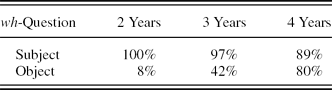
Second, in elicited production studies, children are more accurate on subject than on object questions from an early age (Ervin-Tripp, Reference Ervin-Tripp and Hayes1970). O'Grady (Reference O'Grady2005), citing Yoshinaga (Reference Yoshinaga1996), reports that English learners fully master the production of subject who-questions by age 2 (100%), whereas they have many difficulties with object who-questions (8% of correct responses). By age 4, the production of object almost equals that of subject questions with 80% and 89% of correct responses, respectively (for similar results, see also van der Lely & Battell, Reference Van Der Lely and Battell2003; Wilhelm & Hanna, Reference Wilhelm and Hanna1992).
Third, the subject/object asymmetry is found not only in production, but also in comprehension. By testing both who- and which-questions in comprehension, it has become apparent that the type of wh-element also contributes to the aforementioned asymmetry (Ervin Tripp, Reference Ervin-Tripp and Hayes1970; Tyack & Ingram, Reference Tyack and Ingram1977). Avrutin (Reference Arosio, Guasti and Stucchi2000) found that English-speaking children aged 3;5 to 5;2 (mean age = 4;3) comprehend object which-questions less than subject which-questions (48% correct vs. 86% correct responses), whereas such an asymmetry was not attested for who-questions (80% correct responses in both cases); this lack of asymmetry with who-questions in 4.5-year-old English learners is also documented in Hirsch and Hartman (Reference Hirsch, Hartman, Belletti, Bennati, Chesi, Domenico and Ferrari2006). More recently, similar results were found by Friedmann, Belletti, and Rizzi (Reference Friedmann, Belletti and Rizzi2009) with Hebrew-speaking children aged 3;7 to 4;10 (mean age = 4;3). These children scored significantly lower in the comprehension of object which-questions, 58%, than in that of subject which-questions 78%, but they were equally good in the comprehension of subject and object who-questions (around 80% correct responses). Philip, Coopmans, van Atteveldt, and van der Meer (Reference Philip, Coopmans, van Atteveldt, van der Meer, Do, Dominguez and Johansen2001), by testing the comprehension of long-distance who-questions in Dutch-speaking children aged 4;1–6;9 (Dutch embedded sentences display a subject–object–verb [SOV] word order), established that children interpret embedded questions, which are ambiguous between a subject or an object reading, as subject questions more often than adults do, choosing this interpretation 70% versus 45% of the time. Carrying out a comprehension experiment of wh-questions in Italian learners, De Vincenzi, Arduino, Ciccarelli, and Job (Reference De Vincenzi, Arduino, Cicarelli and Job1999) found out that although at age 3–4 children do not show any significant asymmetry in the comprehension of subject versus object questions (scoring 64% and 53%, respectively), by age 4 they experience difficulties with object questions, while rapidly improving in subject questions, an asymmetry lasting until age 10. In contrast to previous studies on comprehension, this asymmetry was evident both in who- and in which-questions, but in the last case it was more marked, at least until age 7. Another notable aspect of De Vincenzi et al. (Reference De Vincenzi, Arduino, Cicarelli and Job1999) is that the asymmetry seems to last longer than in English, given that an adultlike performance is reached at about 10–11 years. Thus, all studies examined so far find an asymmetry between subject and object questions, both in production and in comprehension. However, although both who- and which-questions were investigated in comprehension, generally only who-questions were examined in production. From the Italian study, it appears that the asymmetry in comprehension is evident both in who- and which-questions, with different degrees; from studies in other languages, it seems that it is only evident in which-questions, at least at the age tested. At the same time, the developmental pattern seems to differ across languages: in English and Hebrew the asymmetry is evident for a shorter time than in Italian. All in all, although there is a large consensus on the existence of a subject/object asymmetry, there are aspects of this asymmetry that deserve further scrutiny. Toward this end, our paper investigates the production of wh-questions in early learners of Italian, comparing it to the production of adults, by employing an elicited production experiment. Our study will complement the comprehension study carried out by De Vincenzi et al. (Reference De Vincenzi, Arduino, Cicarelli and Job1999), and from these two angles we will try to better characterize the nature of the subject/object asymmetry and the differences in the developmental course across languages. By focusing on these issues, we attempt to gain insight into the way the acquisition process unfolds, which mechanisms are employed to parse the input and which features are exploited more effectively during acquisition. Putting it in a cross-linguistic perspective, we will argue that the specific features involved in the formation of wh-questions across languages are to be held responsible for the different developmental patterns. This line of investigation raises the question of whether children's difficulties have to do with their competence or whether they are a matter of performance. Although we will not be able to do full justice to this debate, we will depart from the current wisdom and argue that this dichotomy needs to be reexamined (see also Friedemann et al., Reference Friedmann, Belletti and Rizzi2009, for an approach that has the same consequences) and restated.
The paper is organized as follows: we discuss the problem for Italian subject and object questions; then we offer a detailed description of the experiment carried out; the results are then presented and analyzed. In the Discussion Section we discuss our results and put our account in a cross-linguistic perspective.
ITALIAN wh-QUESTIONS AND THEIR ACQUISITION
Italian wh-questions are peculiar in that subject and object questions display the same order of elements, wh, verb (V), and noun phrase (NP), an order often found in verb–subject (VS) languages, such as Arabic languages and Irish. It is only through agreement with the verb that the sentence is disambiguated: a subject question (3), if the verb agrees with the copy of the wh-operator, an object question (4), if it agrees with the postverbal NP subject. It is possible that prosody can also determine disambiguation, although the issue has not been investigated so far. There is evidence that the postverbal subject in questions is not in the same position in which it is found in declarative sentences, but in a marginalized position (Antinucci & Cinque, Reference Antinucci and Cinque1977; Cardinaletti, Reference Cardinaletti2007; Guasti, Reference Guasti1996b). Its status is not of new information, but of familiar information, much as the topicalized subject in (6) below.
NP-final
(3) Chi colpisce i bambini?
Who hit-3SG the children?
Who hits the children?
(4) Chi colpiscono i bambini?
Who hit-3PL the children?
Who do the children hit?
It follows that a wh-question displaying a singular overt NP, as in (5), is potentially ambiguous between a subject or an object interpretation because the singular verb can agree either with the wh-operator or with the overt singular NP.
(5) Chi colpisce il bambino?
Who hit-SG the child?
The surface word order wh V NP displayed by both subject and object questions is made possible by the fact that subjects can occur in a postverbal position. Beyond this strategy, which we call NP-final and which is the more common one, there are alternative ways to express subject and object questions. One is through NP-topicalization whereby the subject or the object is preposed to a preverbal dislocated position, as in (6). When the preposed NP is an object (in subject questions), a resumptive clitic must be used within the question. There is no resumptive pronoun when the preposed NP is the subject.
NP-topicalization
- (6)
a. I bambini, chi colpiscono?
The children, who hit-PL?
The children, who do (they) hit?
b. I bambini, chi li colpisce?
The children, who them hits?
The children, who hits them?
Another alternative is through argument drop, which yields object questions with a phonologically null subject (7a), an option that is legitimate in Italian, or subject questions with the lexical object NP replaced by a clitic pronoun, as in (7b).
Argument drop
- (7)
a. Chi colpiscono?
Who hit-PL?
Who do (they) hit?
b. Chi li colpisce?
Who them hits?
Who hits them?
A cleft is used in spoken language (although sounding somehow substandard).Footnote 1
Cleft
- (8)
a. Chi è che (i bambini) colpiscono (i bambini)?
Who is it that (the children) hit-PL (the children)?
b. Chi è che colpisce i bambini?
Who is it that hits the children?
Finally, it is possible to turn object questions into subject questions through passivization, as in (9):
Passivization
(9) Chi è colpito dai bambini?
Who is hit by the children?
We should thus conclude the description of Italian wh-questions by emphasizing that Italian subject and object questions may have the same surface order; therefore, agreement with the verb is crucial for disambiguating the structure.
AN ELICITED PRODUCTION EXPERIMENT
Subjects
One group of 35 children aged 3;11 to 5;11 (M = 4;10, SD = 0;6) and one group of adult controls (N = 20) participated in the experiment. Five more children were discarded because they did not complete the experiment or did not understand the task. Children were tested in school and parent consent forms were previously collected. Teachers and parents were invited to a presentation of the results.Footnote 2
One reviewer pointed out that the age range of the children is wide. However, as illustrated in the presentation, adopting a wide age range is not uncommon and may be related to the goals of the study or to the phenomenon investigated. In our case, the study is concerned with the differences between preschool children and adults and not with the whole course of development from 3 to 11, as was for example in De Vincenzi et al. (Reference De Vincenzi, Arduino, Cicarelli and Job1999). In addition, if we look at De Vincenzi et al.'s (Reference De Vincenzi, Arduino, Cicarelli and Job1999) study, there is no major change in the comprehension of wh-questions in the age range considered, just a general improvement. For these reasons, we grouped the children together. At the same time, we took account of the reviewer's concern and we also divided our child subjects into two groups, one group of 17 children with a mean age of 4;6 (SD = 0;4) and another of 18 children with a mean age of 5;4 (SD = 0;3).
Procedure and materials
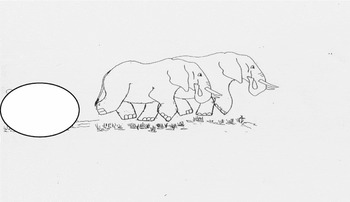
During a collective warm-up session, children were familiarized with a male puppet. The experiment itself was carried out in a quiet room in which children were tested individually and were invited to ask questions of the puppet. The questions produced by the children were transcribed by the experimenter on a score sheet and tape recorded for further examination. Adults were tested with the same procedure except that they were expected to ask questions to an imaginary person. The experiment was presented using a portable computer and stimuli were displayed through a PowerPoint presentation. The technique is an adaptation of the one used by Yoshinaga (Reference Yoshinaga1996) and reported in O'Grady (Reference O'Grady2005). Subjects were shown a picture displaying some character(s) doing or participating as patients in an action. The agent or the patient was hidden depending on whether a subject or an object question was aimed. For example in Figure 1 the agent is hidden, as with this picture we aimed at eliciting a subject question.
A picture for eliciting a subject who-question.

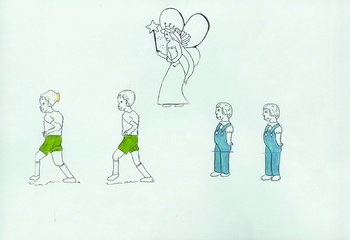
As the picture in Figure 1 was shown, a prerecorded voice delivered through loudspeakers connected to the portable computer described what was happening. For the figure, the voice said “Someone is chasing the elephants (the experimenter pointed to the ellipsis). The puppet knows who. Ask him who.” The action or its results were clearly depicted on the picture. After hearing the voice the child was expected to ask the puppet a question, that in this case was “Who is chasing the elephants?” The puppet, manipulated by the experimenter, had to guess who was hidden underneath the ellipsis, which then disappeared revealing the mysterious character. The child would finally judge the correctness of the puppet's guess. We elicited subject and object questions introduced by who or by which NP. In the latter case, in order to make the context felicitous for the use of a which-question, we had to use two pictures. In the first picture, the relevant characters were presented. For example, the picture in Figure 2 was shown accompanied by a prerecorded voice saying: “There are two boys with blue pants, two with green pants and a fairy. Let's see what happens.”
The first picture used in the elicitation of a which-question. [A color version of this figure can be viewed online at journals.cambridge.org/aps]

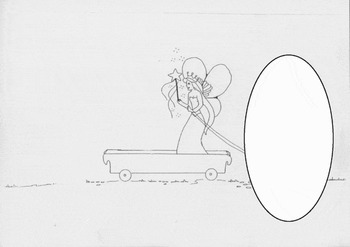
Then Figure 3 appeared, depicting the fairy pulling someone hidden under the ellipsis. Children were told “The fairy is pulling two boys. The puppet knows which ones. Ask him which boys.”
The second picture used in the elicitation of an object which-question.

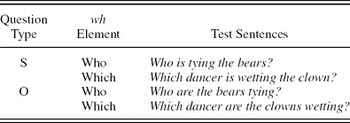
As with the wh-trials, the child had to ask the puppet a question (which boys is the fairy pulling?), thus awaiting his answer. Before starting the experimental session, children were exposed to two practice trials eliciting questions introduced by what. The structure of these trials was the same as that of the stimuli used for the experiment described above. During the practice children received feedback to make sure they understood that a question was expected from them. We manipulated two factors, each one comprising two levels: question type (subject, object); wh-element (who, which NP). Thus, four conditions were tested, as summarized in Table 1.
Experimental design

Note: S, subject; O, object.
There were six trials for each condition, for a total of 24 questions. Eighteen different transitive verbs, all reversible, were used (bite, chase, caress, catch, dip, dirty, dream, follow, frighten, greet, hit, leak, pull, push, run after, tie, wash, and wake up) with different nouns. The verbs dip, pull, run after, tie, and wash were used twice, but with different nouns. Some of the pictures were taken from De Vincenzi (Reference De Vincenzi1996) and adapted to the task. We may notice that who-subject questions always feature a singular verb, whereas who-object questions invariably employ a plural verb. This was inevitable for eliciting unambiguous questions, given the grammar of Italian wh-questions (see above). Had a singular verb been used, Italian questions would have been ambiguous between a subject or an object interpretation. We counterbalanced for this bias in which-questions, where we had three subject questions with singular verbs (which cook is greeting the football players?) and three with plural verbs (which children are pulling the fairy?) as well as three object questions with singular verbs (which horses is the lion chasing?) and three with plural ones (which child are the smurfs dreaming of?). From the first list of stimuli a second list was created by using pictures with the same characters and actions, but reversing the direction of the actions. For example, in one list we used the picture displaying a hidden animal chasing the elephants and we elicited a subject question (who is chasing the elephants?). In the other list the corresponding picture displayed two elephants chasing some other character in order to elicit an object question (who are the elephants chasing?). In this way, all children viewed the same actions and characters, with only the direction of the action changing. The presentation order was randomized and the same order set was used for each participant. Children and adults were randomly assigned to one of the two lists. All stimuli were prerecorded by a native speaker of Italian. A list of experimental stimuli can be found in Appendix A.
RESULTS
Scoring and error coding
Children's and adults’ responses were first scored for correctness. Correct responses were then categorized into different types, as reported in the second section of this paper. Responses were considered correct when they matched the target question. Responses substituting which NP with who were scored as who questions, responses substituting which NP with which (corresponding to English which one) were scored as which-questions and responses substituting who with what were scored as who-questions (in these questions what stands for an animate entity being questioned; this change occurred only in object questions as can be seen from a later table). A separate analysis was conducted to analyze these changes.Footnote 3 Errors included subject questions produced when an object question was targeted or vice versa, production of the wh-element alone (i.e., who?), transformation of the wh-question into a yes/no question, irrelevant responses. Some adults produced incorrect passive subject questions in which the theta roles were reversed, that is, rather than Chi lava gli orsi? (Who washes the bears?), they produced Chi è lavato dagli orsi? (Who is washed by the bears?). Such responses are classified as errors. As mentioned above, correct responses were categorized according to their structure or to the strategy underlying their formation. In (10) we summarize the strategies employed (see the second section of this paper for exemplification).
(10) NP-final: wh V NP
NP-preposing: NP wh V
Argument dropFootnote 4
Cleft
PassivizationFootnote 5
Although these strategies could be used to produce both subject and object questions, as exemplified in the second section of the paper, they were almost exclusively employed to produce object questions (except for the first one). They can be classified into two main categories: those in which the subject occupies a postverbal position (wh V NP and clefts) and those in which it occupies a preverbal position (NP-topicalization, null arguments, and passivization). In some cases, participants, especially children, produced questions combining two of the strategies listed in (10). For example, in the case of object questions, they combined a cleft with NP-topicalization thus producing gli orsi, chi è che lavano? (the bears, who is it that [they] wash?). These latter questions were classified as NP-topicalization questions, because our classification aimed at setting object questions with pre- and postverbal subject apart.
Statistical analyses
General linear models (such as analyses of variance [ANOVAs]) are generally employed in the analysis of response accuracy, ignoring the categorical nature of the data being measured and justifying the choice by appealing to the robustness of this analysis. However, the prerequisites for using such analyses are not met as the dependent variable, response accuracy, is not continuous, but discrete, and the distribution of the responses is not normal (being either correct or incorrect) and “this can lead to averaging artefacts and distortion in the means, standard errors” (Dixon, Reference Dixon2008, p. 1). An alternative analysis of accuracy data is logistic regression, which will be used in the present study. We used a repeated-measure logistic regression analysis, as all variables except for group (which is between subjects) are within subjects with subjects as random factor (the generalized estimation equation methodology was employed as implemented by the SAS system; Liang & Zeger, Reference Liang and Zeger1986). The dependent variable (response), which is categorical, producing a target question or producing an error, is rescaled “in terms of a logit (or log odds) response-strength measure” (Dixon, Reference Dixon2008, p. 1); in other words, while the ANOVA calculates the experimental factor effects (in our case group, sentence, type of wh-) on means, logistic models do this on the logit, that is, the logarithm of the ratio between the event probability (e.g., producing an incorrect response) and the nonevent probability (producing a correct response).Footnote 6 The output they give are the main effects and the interactions, such as the ANOVA. For each factor they also provide us with the direction or the strength of the effects through the contrast estimate analyses. These tell us whether from one condition, say A, to the other, say B, the odds ratio error/correct increases or decreases and at which rate it does.
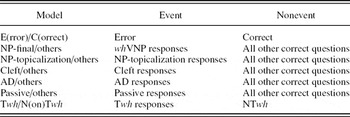
We estimated seven repeated measure logistic models reported in Table 2, along with the response categories expressed in terms of event/nonevent distinction.
Models estimated with the logistic regression analysis

Note: NP, noun phrase; V, verb; AD, argument drop; T, target.
As described in Section 4.1, the age range of our group is large. We took account of this fact and we ran two sets of analyses: one set in which the whole group is treated as homogeneous and one set in which the two age groups of children were separated. As we did not find any major difference and as the the goal of our study does not include tracking the developmental course of acquisition, something that would require us to consider other age groups as well, we report only the first set of analysis. When differences between the two age groups are found, these will be reported in notes.
First, we compared the response accuracy between the two lists: χ2 (1) = 2.60, p = .10. Because we did not find any significant difference or interaction, we collapsed the data together for all further analyses. We examined whether there was an effect of learning, so that the last three trials of each type of question were responded to more accurately than the first three ones, but we did not find any, in children, χ2 (5) = 9.040, p = .10, or in adults, χ2 (1) = 6.43, p = .26.
The analysis of correct questions versus errors
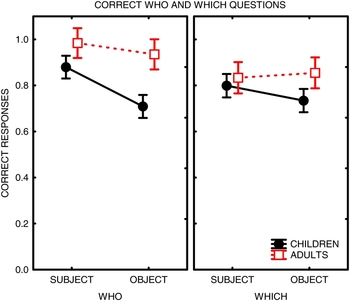
In the first analysis, we contrasted all correct responses (656 for children, 434 for adults) versus all incorrect ones (183 for children, 46 for adults). Incorrect questions comprise reversal errors, failure to answer and irrelevant responses (e.g., yes/no questions or use of only the wh-element). Figure 4 reports the mean of correct responses for each age group and for each type of question. The analysis of correct versus incorrect responses revealed that adults were generally more accurate than children in producing all questions, except for subject which-questions (where no difference was observed between children and adults), that the rate of correct subject questions was higher than that of correct object questions but only for who-questions, that who-questions were easier to produce than which-questions for adults, but this held only for subject questions in children.
The mean of correct responses for each question type as a function of wh-element in children and adults. Vertical bars indicate the error means at a confidence interval of 0.95. [A color version of this figure can be viewed online at journals.cambridge.org/aps]

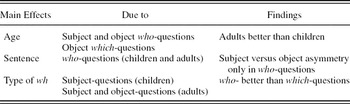
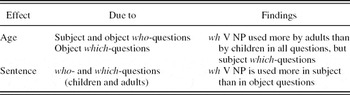
These findings are supported by the statistical analysis calculating the change in probability of producing an error rather than a correct question, for each factor (sentence and type of wh-element) and for each age group. A main effect of age, χ2 (1) = 13.60, p = .0002, of sentence, χ2 (1) = 7.80, p = .005, and of type of wh-element, χ2 (1) = 11.79, p = .0006, was found. In addition, two interactions were found: one between sentence and type of wh-element, χ2 (1) = 5.05, p = .02, and one between age and type of wh-element, χ2 (1) = 9.05, p = .002. For age, contrast estimate results show that, from children to adults, the odds error/correct significantly decreases at a 0.98 rate (p < .0001), that is, the errors are 1.02 times more frequent in children than in adults.Footnote 7 For sentence, contrast estimate results show that from subject to object questions the odds error/correct significantly increases at a 1.99 rate (p = .001), that is, the errors are 1.99 times more frequent for object than for subject questions. For type of wh-element, from who- to which-questions, the odds error/correct (and the frequency of errors) increases at a 2.69 rate (p < .0001).Footnote 8 As for the first interaction (Sentence×Type of wh-element), who-questions elicit higher correct responses (subject = 92%, object = 79%) than which-questions (subject = 81%, object = 77%). Concerning the second interaction (Age×Type of wh-element), we observe that who-questions elicit higher correct responses (children = 79%, adults = 96%) than which-questions (children = 76%, adults = 84%). Thus, the two interactions do not affect the interpretation of the three main effects (age, sentence, and type of wh-element). To unpack these interactions we carried out separate analyses. We found a main effect of age for subject who-questions, χ2 (1) = 11.35, p = .008, for object who-questions, χ2 (1) = 16.72, p < .0001, and for object which-questions, χ2 (1) = 4.05, p = .04,Footnote 9 but not for subject which-questions, χ2 (1) = 0.34, ns. Contrast estimate analysis shows that from children to adults the odds error/correct significantly decreases at a 0.11 rate (p = .003) for subject who-questions, at a rate of 0.17 (p < .0001) for object who-questions and at a rate of 0.47 (p = .03) for object which-questions, that is, errors are 9.09, 5.88, and 2.12 times more frequent in children than in adults. Thus, the main effect of age is due to who-questions (subject and object) and to object which-questions (see Note 6). Then, we found a main effect of sentence for who-questions in children, χ2 (1) = 19.62, p < .0001, and in adults, χ2 (1) = 4.16, p = .04. Contrast estimate analysis shows that from subject to object questions the odds error/correct significantly increases at a 3.0 rate (p < .0001) for children and at a rate of 4.31 (p = .06) for adults (with errors being more frequent with object than with subject questions). Thus, the effect of sentence is due to who-questions. Finally, we found a main effect of type of wh-element in children for subject questions, χ2 (1) = 5.23, p = .02,Footnote 10 but not for object questions χ2 (1) = 0.27, ns, as both types of object questions were difficult. Contrast estimate analysis shows that from who- to which-subject questions the odds error/correct (and the frequency of errors) significantly increases at a 1.91 rate (p = .006). For adults, we found a main effect of type of wh-element both for subject, χ2 (1) = 6.05, p = .01, and for object questions, χ2 (1) = 5.81, p = .01. Contrast estimate analysis shows that for subject questions from who- to which-questions the odds error/correct (and the frequency of errors) increases at a 12.57 rate (p = .002); for object questions, from who- to which-questions the odds error/correct increases at a 2.45 rate (p = .001). Thus, the main effect of type of wh-element is due to subject questions for children (see Note 7) and to both subject and object questions for adults. Table 3 summarizes the main results.
Summary of the results analyzing correct responses versus noncorrect ones

The analysis of the strategies used to form correct questions
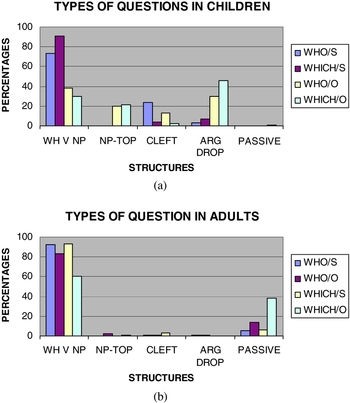
Correct questions displayed different kinds of structures, especially in children's production. The different structures produced reveal which strategies speakers use when they have to produce a question. Figure 5 reports the usage percentages of the different structures employed by children and by adults, as a function of the type of question and of wh-element. These percentages are calculated by considering only correct questions.
Percentages of correct questions produced by (a) children and (b) adults broken down by structures employed and by type of wh-element. [A color version of this figure can be viewed online at journals.cambridge.org/aps]

As we can observe in these two figures there is a lot of variation in the formation of object questions, and this is particularly evident in children. Let us now move on and analyze the structures in more detail.
Questions with the wh V NP structure
The wh V NP structure is potentially ambiguous, unless agreement on the verb disambiguates it. This structure is more commonly used by adults than by children, as the latter opted for other structures presented in Section 2. Its use was more frequent in subject than in object questions, in both adults and children and for both types of wh-element. These findings are corroborated by the logistic regression analysis in which, for each factor (Sentence, Type of wh-, Age Group), we calculated the change of probability of producing a question with the wh V NP structure rather than a question with one of the other correct structures in Section 2. We found an effect of age, χ2 (1) = 52.41, p < .0001, and of sentence, χ2 (1) = 128.89, p < .0001, and three interactions: one between sentence and type of wh, χ2 (1) = 16.34, p < .0001, a second between age and type of wh-element, χ2 (1) = 7.62, p = .005, and the third between age and sentence, χ2 (1) = 4.62, p = .03. For age, contrast estimate results show that, from children to adults, the odds NP-final/others increases at a 3.47 rate (p = .0003). This means that questions with the wh V NP order are 3.47 times more frequent in adults than in children. For sentence, contrast estimate results show that, from subject to object, the odds NP-final/others decreases at a 0.15 rate (p < .0001), that is, the order wh V NP is 6.6 times more frequent in subject than in object questions. This reflects the fact that for object questions various structures were used while less variation was observed in the case of subject questions. To unpack the three interactions, we carried out separate analyses. First, we compared sentence and type of wh-element in the two age groups. For subject and object who-questions, we found an effect of age, χ2 (1) = 7.61, p = .005, χ2 (1) = 21.23, p < .0001.Footnote 11 Contrast estimate results show that, from children to adults the odds NP-final/others for subject who-questions increases at a 4.06 rate (p = .001), that is, in subject who-questions the wh V NP structure is much more frequent in adults than in children. For object who-questions, the odds NP-final/others from children to adults increases at an 8.02 rate (p < .0001). No difference was found for subject which-questions, χ2 (1) = 0.09, ns, whereas a difference was found for object which-questions, χ2 (1) = 9.35, p = .002. Contrast estimate results show that from children to adults the odds NP-final/others for object which-questions increases at a 3.68 rate (p = .001), that is, adults employ the wh V NP structure more than children to form object which-questions. Next, we compared subject and object questions in children. Both for who- and for which-questions, we found a type of sentence effect, χ2 (1) = 18.33, p < .0001, and χ2 (1) = 24.78, p < .0001, respectively. Contrast estimate results show that, from subject to object questions the odds NP-final/others decreases at a 0.2 rate (p < .0001) in who-questions and at a 0.04 (p < .0001) rate in which-questions, that is, the wh V NP structure is 5 and 25 times, respectively, more frequent in subject than in object questions. Then, we did the same for adults and again we found a type of sentence effect for who-questions, χ2 (1) = 5.35, p = .02, and for which-questions, χ2 (1) = 9.91, p = .001. Contrast estimate results show that from subject to object questions the odds NP-final/others decreases at a 0.12 rate (p < .0001) in who-questions and at a 0.4 (p = .0008) rate in which-questions; that is, the wh V NP structure is 8.3 and 2.5 times more frequent in subject than in object who- and which-questions, respectively. Thus, the main effect of sentence is due to both who- and which-questions. Table 4 summarizes the main results.
Summary of the results from the analysis investigating the use of the structure wh V NP versus all of the other structures

Note: V, verb; NP, noun phrase.
Questions with NP topicalization
Children often produced object questions with the NP subject topicalized to a left peripheral position, before the wh-element, and they did so equally often with both who- and which-questions. They never used NP topicalization of the object to form subject questions. Adults also used NP topicalization but only in object questions; their frequency is, however, very low (between 1% and 2% of the target structures). Therefore, the logistic regression analysis was only conducted on object questions with factors age and type of wh-element and it revealed only a main effect of age, χ2 (1) = 12.38, p = .0004.Footnote 12 Contrast analysis shows that from children to adults the odds NP-top/others decreases at a 0.05 rate (p > .0001); that is, NP topicalization is 20 times more frequent in children's object questions than in those of adults.
Cleft questions
Both adults and children produced subject and object cleft questions, but adults did so much less frequently than children. As in the case of adults, one cell was empty (adults never produced which-object cleft questions); the logistic regression analysis was conducted only on children with sentence and type of wh as factors. Only a main effect of type of wh-element, χ2 (1) = 8.42, p = .003, was found.Footnote 13 Contrast estimate results showed that, from who- to which-questions, the odds cleft questions/others significantly decreases at a 0.61 rate (p = .01). This means that cleft who-questions are 1.6 times more frequent than cleft which-questions.
Questions with argument drop
Another structure employed by children, essentially in the case of object questions, features the omission of the subject, which amounts to the formation of a question with a null pronominal subject. Of interest, the option of expressing the object through a (lexical or null) pronoun in subject questions is rare. This is supported by the logistic regression analysis in which, for each factor (type of question, wh-element), we calculated the change of probability of producing a null argument (subject or object) question rather than a question with another correct structure. This analysis was only conducted on children's responses, as adults never produced questions with null arguments. A main effect of sentence, χ2 (1) = 19.66, p < .0001, and of type of wh-element, χ2 (1) = 5.60, p = .01, was found. Contrast estimate results show that, from subject to object questions, the odds AD/Others significantly increases at a 12.96 rate (p < .0001). This means that object questions with a null pronominal subject are 12.96 more frequent than subject questions with a pronominal object. From who- to which-questions, the odds increases at a 1.96 rate (p = 9.01). This means that which-questions with argument drop are 1.96 times more frequent than who-questions.
Passive questions
When faced with an object question, children used the different structures analyzed above. Adults displayed less variation, but they also had an avoidance structure. Besides the structure with a postverbal subject, they often turned an active object question into a passive subject question. Sometimes this also happened for subject questions, but much less frequently. Thus, passivization was mostly used when the target was an object question and when the operator was which NP rather than who. Only one child adopted the passive strategy for a which NP object question. Thus, the statistical analysis is carried out on the adults’ responses only. We found a main effect of type of sentence, χ2 (1) = 8.33, p = .003, of type of wh-element, χ2 (1) = 3.71, p = .054, and an interaction between sentence and type of wh-element, χ2 (1) = 3.72, p = .05. Contrast estimate results show that from subject to object questions the odds pass/others significantly increases at a 5.30 rate (p < .0001) and from who- to which-questions the odds pass/others significantly increases at a 2.38 rate (p = .004). Separate analyses were conducted to study the interaction between sentence and type of wh. We found an effect of type of wh, χ2 (1) = 8.36, p = .003, for object, but not for subject questions, χ2 (1) = 0.73, ns. Contrast estimate results show that, from object who- to object which-questions the odds pass/others increases at a 3.93 rate (p < .0001). Hence, the main effect of wh-element previously observed is due to object questions only. Thus, the use of passivization is more frequent when the target is an object than when it is a subject question and when the target is an object which-question than when it is an object who-question.
Substitutions of wh-element
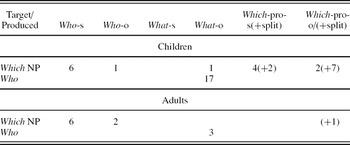
Children and adults sometimes turned the target wh-element into another one, but this occurred rarely, as displayed in Table 5, where we report the frequency for the type of changes we observed.
Number of questions in which the wh-element was changed

Note: NP, noun phrase. Which-pro means that which was not accompanied by an overt NP.
As already discussed, who was sometimes substituted with what by children and adults, but only in object questions and which NP was replaced with who, what, or simply which (a grammatical option in Italian corresponding to the English which one). Although the changes occurred both in subject and object questions, they were more frequent in the latter case, at least for children. We may also note that some rare cases of which-questions featured the split between the which-element and its nominal restriction, with the latter being stranded: seven were object questions and two were subject questions. In some of these cases, which was changed into another wh-word (as already discussed above). Some examples are reported below
- (11)
a. Quale stanno leccando di cane?
Which are (they) licking of dog?
Which are they licking of the dogs?
b. Il leone chi sta prendendo dei due cavalli?
The lion, who is (he) capturing of the two horses?
These findings are confirmed by the statistical analysis carried out on the children's production with the factor sentence (we collapsed who and which-questions as the cell of subject who-question was empty). A main effect of sentence, χ2 (1) = 10.77, p = .001, was found. Contrast estimate shows that from subject to object questions the odds change/no change significantly increases at a 3.00 rate (p = .007), that is, changes are more frequent in object than in subject questions.
Summary of the results
Our study was based on an elicited production experiment of wh-questions by Italian-speaking children and adults. In our view, two important and correlated findings emerge. First, as in other studies, we found a subject/object asymmetry in the production of wh-questions, both in children and in adults, although the asymmetry is larger in the former than in the latter population. Second, a new finding emerged: children and adults faced the challenge posed by the formation of object wh-questions by resorting to various strategies. Concerning the first result, we notice that the percentage of correct questions is higher when the subject is extracted than when the object is extracted, but this holds only for who-questions. The picture is more complex for which-N questions. On the one hand, in terms of correct responses, no subject/object asymmetry is evident, in children or in adults. On the other hand, children drop the subject more in object which-questions than in object who-questions and similarly, adults use passivization more in the former than in the latter case. In addition, adults are better than children (specifically than 4-year-olds) in the production of object which-questions. Furthermore, in 4-year-olds, subject who-questions are better than subject which-questions. Thus, the picture that seems to emerge is that which-questions pose additional problems with respect to who-questions.
A second result concerns the strategies adopted to face the difficulty posed by the production of object wh-questions. Apart from the cleft strategy, which was used both in subject and in object questions, the other two strategies, NP-topicalization and argument drop are specifically employed in object questions and essentially by children. Adults also adopt a strategy when faced with object questions, namely, passivization.
DISCUSSION
We found a subject/object asymmetry in the production of (who-)questions as was found in the comprehension of questions by De Vincenzi et al. (Reference De Vincenzi, Arduino, Cicarelli and Job1999). However, unlike De Vincenzi et al., we found a higher rate of correct responses (70%) than in comprehension (about 50% of correct responses at 4–5 years). Still, our results confirm that there are the cross-linguistic differences, as Yoshinaga (Reference Yoshinaga1996) for English and Friedmann et al. (Reference Friedmann, Belletti and Rizzi2009) for Hebrew found that children speaking these languages have overcome the subject/object asymmetry in the case of who-questions at the age investigated. In the processing literature, the subject/object asymmetry is explained as an effect of the length between the wh-element and its copy, an intuition, known as the minimal chain principleFootnote 14 (De Vincenzi, Reference De Vincenzi1991; see also the active filler hypothesis; Frazier & Flores D'Arcais, Reference Frazier and Flores d'Arcais1989). Along these lines, De Vincenzi et al. (Reference De Vincenzi, Arduino, Cicarelli and Job1999) suggest that the preference for subject over object questions derives from the less complex structure of the former in terms of chains, thus reducing the memory load of the parser. Although this account fares well with the main finding, it fails to explain why object questions are particularly delayed in Italian and an adultlike performance is reached much later than it is in English or in Hebrew. The length of the “object” chain is the same in both sets of languages. De Vincenzi et al. have nothing to say about the specific strategies adopted by Italian-speaking children to form object questions, as in all these structures the length of the chain is the same.
To overcome these weaknesses, we need to recognize that the subject/object asymmetry is modulated by the specific features or mechanisms that are employed in a given language to express questions, and consequently, by the surface form that these questions take. At a descriptive level, the source of the problem in Italian questions is that disambiguation comes from verb agreement, as the subject may stay in a postverbal position. To move beyond the descriptive level and account for what underlies the difficulty, we will offer a new proposal that builds on research by Guasti and Rizzi (Reference Guasti, Rizzi and Cinque2002) and by Franck, Lassi, Frauenfelder, and Rizzi (Reference Franck, Lassi, Frauenfelder and Rizzi2006). In this proposal, the subject–verb (SV) agreement relation is attributed a central role, as it is agreement with the verb that tells one whether a subject or an object question will ensue in Italian. To introduce this proposal, we first need to consider experimental work on the production of SV agreement by adults. These studies show that attraction errors occur more frequently in VS than in SV configurations. With the term attraction we refer to a phenomenon whereby speakers produce sentences like in (12), where the verb erroneously agrees with the more local noun neighbors (a modifier of the subject), rather than with its subject son. Essentially, attraction errors originate when some NP intervenes between the subject and the inflected verb.
(12) *The son of the neighbors always come back late
Through a series of experiments, Franck et al. (Reference Franck, Lassi, Frauenfelder and Rizzi2006) have shown that attraction errors come about at different rates depending on the structural configuration (e.g., linear precedence, c-command) entertained by the elements involved. In particular, in one experiment they tested French object cleft sentences illustrated in (13) with the embedded subject either in the preverbal or in the postverbal position. In both configurations, attraction errors were found, that is, in both cases, participants produced the verb seduce with a singular rather than a plural inflection and thus agreeing with the object, the singular noun the adolescent, rather than with its plural subject, the boxers. Of interest, the rate was significantly higher in the VS configuration in (13b) totaling to 29% than in the SV configuration in (13a) totaling to 15%.
- (13)
a. C'est l'adolescent que les boxeurs seduisent
It is the adolescent that the boxers seduce
b. C'est l'adolescent que seduisent les boxeurs
It is the adolescent that seduce the boxers
To explain this asymmetry, Franck et al. (Reference Franck, Lassi, Frauenfelder and Rizzi2006) proposed that agreement, a process at the interface between syntax and morphology, consists of two subprocesses: AGREE and Spec-Head agreement. AGREE is the operation whereby the subject initially merged as the specifier of the lexical verb in the VP (see Koopman & Sportiche, Reference Koopman and Sportiche1991) and endowed with person and number features values the feature of the inflectional node AgrS above it. This is a feature copying operation whereby the subject copies its features onto the AgrS under c-command and in a local configuration, as displayed in the lower portion of (14a). Spec-Head agreement is the additional operation that originates if and when the subject moves out of VP (and leaves a copy there) to Spec AgrS and enters into a local Spec-head relation with the AgrS head, where the verb may have previously moved to receive its morphological specification, as displayed in the upper part of (14b). This is a verification operation that makes sure the subject and the verb have the same features. Broadly speaking, this happens in SV sentences in which agreement is obtained by AGREE, MOVE, and Spec-Head while in VS sentences it results solely from AGREE.
- (14)
a.

b.

This two-step conception of morphological agreement is the key to understanding the different rate of attraction errors occurring during spontaneous speech production as a function of the configuration between the subject and the inflected verb. It is assumed that object movement to the left periphery (namely, to the complementizer phrase [CP]), as in cleft sentences and in wh-questions in general, is stepwise and involves a preliminary movement to an intermediate projection, Agr Agr object phrase (AgrOP; Chomsky, Reference Chomsky1995; Kayne, Reference Kayne1989) immediately dominating the VP, plus a final movement to the left periphery, as in (15). Hence, when AgrS, the probe, looks for a goal in its c-commanding domain, it first finds the object (or the object copy) in Spec AgrOP. Thus, the object interferes in the AGREE relation between the thematic subject in Spec VP and AgrS and induces attraction errors, whereby the object, rather than the subject, may sometimes value AgrS.
(15)
In object clefts with postverbal subjects (object–verb–subject [OVS] cleft), nothing else happens. In cleft sentences with preverbal subjects (OSV cleft), however, the subject moves out of the VP to Spec AgrSP and agreement is checked in the Spec-head configuration. This further step makes the agreement relation stronger and purges (most of) the attraction errors originated during the AGREE operation, by verifying the match in agreement feature between the subject in Spec AgrS and AgrS itself.Footnote 15 Thus, despite the fact that the object (or the object copy) intervenes in both OVS and OSV clefts with the AGREE relation, the different rate of attraction errors in the two constructions depends on the fact that agreement is checked only once in the former case and twice in the latter, with the second step essentially correcting the interference effect originated in the previous AGREE relation.
Extending this account to our data, we claim that the locus of the difficulties that children (and adults) experience when producing wh-questions stems from interference of the object copy in the AGREE relation between the postverbal subject in Spec vP (little vP is above VP and hosts the subject) and AgrS. Furthermore, we argue that the different strategies adopted to form object questions are various attempts to correct the attraction errors originated during the AGREE relation. Let us make the proposal more explicit. When children (and adults) have to produce an object question (or a cleft in the Franck et al., Reference Franck, Lassi, Frauenfelder and Rizzi2006, study), they plan a hierarchical structure such as the one in (15). In the structure in (15), the wh-object (or a copy), on its way to Spec CP, interferes in the AGREE relation between the thematic subject in Spec vP and AgrS and may sometimes erroneously transfer their own features into AgrS, giving rise to an attraction error. When this happens, the verb ends up agreeing with the copy of the logical object, which is then coindexed with the fronted wh-element and the result is a subject question rather than an object question. This is precisely one of the errors that participants in our experiment made when an object question was targeted. Alternatively, because of the interfering object, participants may get stuck and be unable to produce a relevant response. In that case, they may not answer or they may repeat the sentence heard during the lead in. Franck et al. (Reference Franck, Lassi, Frauenfelder and Rizzi2006) showed that attraction errors in object cleft sentences are reduced when the subject is preverbal, because the Spec-Head relation purges the errors ensuing through the previously established operation AGREE. In Italian wh-questions, Spec AgrSP is banned to lexical subjects; that is, the question in (16) is out in Italian.
(16) *Chi i cavalli mordono?
Who the horses bite?
However, Spec AgrS is not banned to phonologically null subjects. We argue that questions featuring null subject or NP-topicalization represent various attempts to correct the attraction errors created during the AGREE relation. The claim that these two types of questions are the result of an avoidance strategy and not just of a preference is supported by the fact that they were essentially used (by children) in the case of object questions, but not in the case of subject questions, although being fully grammatical options also in this case. Second, the cleft, which cannot be considered an avoidance strategy, because it features a postverbal subject, is used in both subject and object questions. Therefore, we think that the use of the cleft is the result of a preference.
We return to the relevant structures and consider first the null subject question illustrated in (17).
(17) Chi [AgrSP pro mordono]?
Who bite-PL?
Who do they bite?
Null subjects, although generated in Spec vP, have to move to Spec AgrSP in order to be licensed, as argued by Cardinaletti (Reference Borer and Wexler1997). Thus, they enter into a Spec-Head relation with AgrS and check agreement for a second time, thus allowing the correction of attraction errors created during AGREE. Questions with NP-topicalization exemplified in (18) are like those with null subjects and, in addition, they include a lexical NP dislocated in the left periphery (see also Cardinaletti, Reference Cardinaletti2007; see Cecchetto, Reference Cardinaletti, Cabrera, Camacho, Déprez, Flores Ferran and Sanchez2000, for an analysis of left dislocation).
(18) I cavalli, chi [pro mordono]?
The horses, Who bite?
The horses, Who do they bite?
In this case, the errors originated during AGREE are corrected thanks to the second step of agreement checking occurring between pro in Spec AgrSP and the inflected verb. Because morphological agreement is an operation occurring at the syntax–morphology interface, the use of null subjects (or NP topicalization as a subcase) is an option that also occurs at this interface.
In addition to these two structures, children formed questions using the cleft structure. Unlike in the previous cases, this strategy was not adopted for object questions only, but for subject questions as well. Thus, it is not an attempt to face the challenge posed by object questions. In this respect, we may note that the cleft is commonly used in the spoken variety of northern Italian to form questions. Adults did not use cleft questions to the extent that children did, likely because it is considered a substandard structure, although a legitimate possibility. Even though adults performed better than children and produced more target questions, they too were more accurate in producing subject than object questions. The most parsimonious account of this asymmetry is that adults too experience the same problems that children do, but to a lesser extent and that the difference is quantitative. This is plausible given that various studies, including the one by Franck et al. (Reference Franck, Lassi, Frauenfelder and Rizzi2006) discussed above, have shown that adults are prone to attraction errors in various contexts. Thus adults sometimes failed to produce object questions, because of interference of the object (copy) in the AGREE relation. In a similar way as children, adults attempted to remove the problems caused by interference of the object copy, but they did so through a different strategy than those employed by children. They turned an object question into a subject question through passivization as shown in (19).
(19) Chi è rincorso dai cavalli?
Who is chased by the horses?
Passive is a radical way of getting rid of the interference effect in the AGREE relation; under any theory of passive (Baker, Johnson, & Roberts, Reference Baker, Johnson and Roberts1989; Collins, Reference Collins2005; Gehrke & Grillo, Reference Gehrke, Grillo and Grohmann2008; Jaeggli, Reference Jaeggli1986) the logical object becomes the subject and the logical subject is demoted to an adjunct status. This means that when the probe, AgrS, looks for a goal, it finds the internal argument, expressed by chi “who” in (19), that copies its features into AgrS, and then moves to CP. In this way, a subject rather than an object question is produced. We conjecture that passivization was not used by our children, as it is known that young children (4–5 years) have troubles with passive (Borer & Wexler, Reference Belletti1992; Hyams, Ntelitheos, & Manorohanta, Reference Hyams, Ntelitheos and Manorohanta2006). We expect that older children, who are over the age in which passive is problematic will use it in the production of object questions. Indirect confirmation for this conjecture comes from the production of object relative clauses in Italian, whose structure shares similarities with object wh-questions. Belletti (Reference Belletti2008) found that passivization is used by 6-year-old Italian-speaking children when an object relative clause is targeted. At first sight, our results stand in contrast with the wisdom from the literature showing that children have no particular problems in forming wh-questions (for a review, see Guasti, Reference Guasti2002). Guasti (Reference Guasti and Clahsen1996a) showed that 4- to 5-year-old Italian-speaking children did not experience any problem in the formation of subject and object wh-questions. Of interest, in this last study, the object wh-questions elicited featured nonreversible verbs with the two subjects differing in terms of animacy and the object being introduced by che cosa (what), which is lexically inanimate; see (20a). In the hierarchical structure of the question in (20a), reported in (20b), the object copy intervenes in the AGREE relation between AgrS and the thematic subject, but apparently it does not disrupt the production of the target questions, as this kind of question is routinely produced by children.
- (20)
a. Cosa compera il bambino?
What buys the child?
What does the child buy?
b. [CP Cosai [AgrSP compera [AgrOP <cosa>i [vP il bambino]]]]?
We conjecture that the object copy does not interfere in the AGREE relation, as it and the target are distinct along the animacy dimension. This means that an intervention effect is canceled when the intervener and the goal differ along the lexical/semantic feature of animacy (see Arosio, Guasti, & Stucchi, Reference Arosio, Guasti and Stucchi2011). In this connection, it is tempting to consider the replacement of who with what (see Table 5 and the surrounding discussion), the former being +animate, the latter –animate, as an attempt to avoid interference. The use of what demotes the object from being an eligible intervener. The same asymmetry between object who- and what-questions has been observed by Garaffa and Grillo (Reference Grillo2008) in the production of an agrammatic patient. This patient did not produce any object who-questions, whereas he produced 75% of object what-questions. In the first case, the main error was agreement substitution that resulted in the production of a subject question rather than an object question. This confirms the fact that interference is effective only when the intervener and the goal are both animate.
Another point we would like to briefly address is the status of which-questions. The absence of a subject/object asymmetry in this case is due to the fact that by and large both subject and object questions elicit more errors than who-questions in adults and children.Footnote 16 This weakness may be due either to the structural complexity of the which NP phrase or to the fact that which NPs involve syntactic and discourse related operations, as suggested by Avrutin (Reference Arosio, Guasti and Stucchi2000). In this respect, it is interesting to notice that which-questions require pied piping of the NP component and sometimes children fail in this operation and leave the NP in situ or simplify the which NP into who. This may happen because in this way they reduce the complexity and at the same time they are allowed to elude the discourse conditions for the use of which NP questions.Footnote 17 In other words, it is possible that there is also interference in the AGREE relation in object which-questions, but there are additional difficulties. We think that further investigation is needed to clarify these issues and to foster our understanding of which-questions.
In summary, we argued for an account of the subject/object asymmetry in the production of wh-questions that capitalizes on the role of agreement relationships. Object questions are more difficult to produce because in the hierarchical structure planned during the production, the object copy interferes in the AGREE relation between the probe, AgrS, and the goal, the subject in the thematic position. Furthermore, interference may induce attraction errors that result in the production of subject rather than object questions or may block the production of object questions altogether. The interference effect is observed both in children and in adults, but to a different extent. To overcome this effect, children and adults appeal to various strategies that result in the production of correct questions displaying a variety of forms. Hence, more variation is observed in object than in subject questions. Of interest, the strategies used by children and adults differ: children use NP-topicalization and null subjects, whereas adults use passivization. Finally, we showed that our results are compatible with the observation in the literature that object questions introduced by what are not problematic, as the object (copy) is distinct along the animacy dimension from the goal of the AGREE relation.
Question formation in other early languages
In this section we evaluate our approach against the results found for other early languages and we shall see how the different timing in the acquisition of object questions across languages can be explained. One prediction of our approach is that, other things being equal, languages in which the subject occurs in a postverbal position, as in Italian, should display the same pattern and time course of development, as Italian; that is, a marked subject/object asymmetry that disappears or reduces with age—as our adult subjects still experienced problems in forming object questions. In addition, we anticipate that different strategies should be pursued to overcome the difficulties arising during AGREE. A second prediction is that in languages in which agreement is checked twice for independent reasons (and thus the subject occurs in a preverbal position), a subject/object asymmetry should display a different pattern than in languages in which only AGREE occurs. Either such an asymmetry should be less evident or it should last for a shorter time. Remember that attraction errors arise during AGREE and are mostly or all corrected if the additional Spec-Head relation between the subject and AgrS is established. Let us consider the first prediction. In Greek, the order of words in subject and object questions is the same, as in Italian, as shown in (21) (example from Stavrakaki, Reference Stavrakaki2006).
- (21)
a. Pios pithkos kinigise ton elefanta? (subject which-question)
Who-monkey-nom-chased-3s-the-elephant-acc
Which monkey chased the elephant?
b. Pion pithko kinigise o elefantas? (object which-question)
Who-monkey-acc-chased-3s-the-elephant-nom
Which monkey did the elephant chase?
c. Pios kinigise ton elefanta? (subject who-question)
Who-nom-chased-3s-the-elephant-acc
Who chased the elephant?
d. Pion kinigise o elefantas? (object who-question)
Who-acc-chased-3s-the-elephant-nom
Who did the elephant chase?
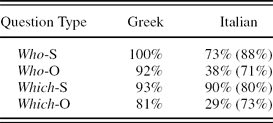
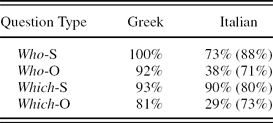
Based on our account, we would expect Greek-speaking children to perform similarly to Italian-speaking children, but this is not the case. Stavrakaki elicited the four types of wh-questions in (21) from 16 Greek-speaking children aged 3;4–5;2 (M = 4.1, SD = 0.58) with a task similar to ours. Her results are reported in Table 6, where the percentages of correct questions with the structure wh V NP are indicated. For comparison, in Table 6, we report the percentages of target questions with the wh V NP structure for Italian and specify the percentages of all correct questions featuring different structures within parentheses.
Percentages of correct questions with the wh verb noun phrase structures produced by Greek speaking children (Stavrakaki) and by Italian speaking children
Note: S, subject; O, object. The values in parentheses are the percentages of all correct questions displaying different structures for Italian.
Although a small difference in favor of subject questions is observed (but we do not know whether it is statistically significant), the most astonishing fact is that Greek-speaking children produce more correct object questions than Italian-speaking children. We conjecture that this remarkable difference between Italian and Greek stems from the fact that in Greek the wh-expressions and the NPs are morphologically case marked, as the glosses above show. It has been observed that there is a close relationship between agreement and overt nominative case (Schuetze, Reference Schuetze1997). For example, in European Portuguese (Raposo, Reference Raposo1987) inflected infinitives have nominative subjects, and expletives morphologically marked with nominative case, such as the French il, determine agreement with the verb in construction with postverbal subjects in French, as in (22), whereas expletives, which do not overtly express nominative, such as ce, can or cannot agree with the verb, as shown in (23) (Cardinaletti, Reference Borer and Wexler1997). In some central varieties of Italian, agreement with a postverbal subject is not compulsory, as in (24). However, if the postverbal subject is univocally nominative and this is so only with first and second person pronouns, agreement is mandatory, as in (25) (Anna Cardinaletti, personal communication).
(22) Il est/*sont venu beaucoup d'étudiants
It is/*are come many students
(23) C'est/ce sont des étudiants
There is/there are the students
(24) Ieri ha telefonato degli studenti
Yesterday has phoned some students
(25) Ieri abbiamo/*ha telefonato noi
Yesterday have-1-PL/has phoned us-NOM
In our approach, the Greek data suggest two possibilities: (a) that morphological case matters and the object copy does not count as an intervener in the AGREE relation or (b) the nominative subject makes the presence of the object copy vacant as an intervener.Footnote 18 Therefore, attraction errors are rare and, in our terms, errors in the production of object questions arise less frequently in Greek than in Italian. Support for our approach comes from the observation that attraction errors in adults’ production are observed to a lesser extent in languages with morphological case making. Badecker and Kuminiak (Reference Avrutin, Grodzinsky, Shapiro and Swinney2007) showed that in Slovak the proportion of attraction errors was higher when the subject was case-ambiguous than when it was unambiguously morphologically marked with nominative case. Data from Greek are available from about age 3;4. What about an earlier age? Suppose that before age 3;4 children have troubles with case. Then, we would expect a rise in attraction errors and a decrease in correct object questions, a prediction that needs to be tested.
We move now to the second prediction concerning languages in which the two steps of agreement take place. In this case, the subject/object asymmetry should display different properties than in languages in which only AGREE can occur and this seems to bear out. In the production of English who-questions, a subject/object asymmetry is found from 2 to 3 years, but not at age 4, as shown in Table 7 (data from Yoshinaga, Reference Yoshinaga1996).
Percentages of subject and object wh-questions produced by English speaking children
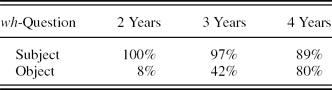
Note: The values are according to Yoshinaga (Reference Yoshinaga1996) as reported in O'Grady (Reference O'Grady2005).
In English object questions both steps of the agreement process occur: AGREE and Spec-Head, the second process occurring after the subject has moved to the preverbal position, where it is located. Therefore, the attraction errors, ensuing from the first step of the agreement process (AGREE), can be corrected during the second step. We conjecture that up to the age of 4 interference ensuing from AGREE is so disruptive that the additional Spec-Head checking has little effect; alternatively, it is possible that simply no Spec-Head checking occurs and children produce subject rather than object questions. With age, fewer attraction errors occur during AGREE (and this is likely to also be the case in Italian, although we do not have developmental data yet), the Spec-Head checking process becomes more effective and fewer errors are produced, up to a point where errors disappear. This is what happens at age 3 and then 4 in Table 7.Footnote 19 A similar pattern is observed in Hebrew. As in English, in Hebrew object questions the subject occurs in a preverbal position, as shown in (26); that is, it has moved to Spec AgrSP and has entered into a Spec-Head relation with the agreement features, thus checking agreement twice, just like in English.
(26) Et mi ha-xatul noshex?
ACC Who the-cat bites
Whom does the cat bite?
Similar to English, comprehension of subject and object who-questions in Hebrew is unproblematic at the age of 4;3 and no asymmetry is found in this case either (subject = 81%, object = 75%; Friedmann et al., Reference Friedmann, Belletti and Rizzi2009). This replicates what was found in English (comprehension and production) with children of the same age (about 4 years). No data are available from younger children, but, based on English, we anticipate a subject/object asymmetry in who-questions at an earlier age in Hebrew.Footnote 20 In conclusion, the subject/object asymmetry is evident during the course of acquisition, but it disappears at different ages and this depends on the specific mechanism/features involved in the formation of questions in a language. Starting from the hypothesis that interference of the object in the AGREE relation is the locus of the difficulty, we have claimed that in English and Hebrew the interference effects are removed earlier, as subjects must move to the preverbal position and check agreement twice. Although in Greek only AGREE occurs, the presence of morphological case nullifies the interference effect, as does the presence of inanimate objects in Italian. In other words, interference arises mostly when the two candidates in a local relation differ only in number features (see Acuna-Farina, Reference Acuna-Farina2009, on the robustness of number in this respect). It is an empirical question to establish whether other features, such as person or gender give rise to interference (see Garaffa & Grillo, Reference Grillo2008, for some evidence for interference because of the person feature).
Comprehension and production
Our study complements the one carried out years ago by De Vincenzi et al. (Reference De Vincenzi, Arduino, Cicarelli and Job1999) on the comprehension of Italian subject and object wh-questions. According to De Vincenzi et al. (Reference De Vincenzi, Arduino, Cicarelli and Job1999), comprehension of subject questions was not problematic from age 4 (although it was somewhat between the ages of 3 and 4), but comprehension of object questions did not improve much between the ages of 3 and 9 (being correct in 50% of the cases) and it was only between 10 and 11 that the scores raised to 80%. This is in sharp contrast with our results, as at age 4–5 children produce correct object questions 70% of the time. We think that the discrepancy is an artefact. Children, in our task, produced a range of grammatical structures to form object questions and this fact was taken as an indication that the structure wh V NP (with the postverbal subject) is problematic. The structure wh V NP was the only one used in De Vincenzi et al.'s comprehension study. Of interest, the percentages of production of this structure in our study were 38% and 30% for object who- and which-questions, respectively. These scores are not much different from those found in comprehension (around 50%). This means that comprehension and production of object questions with the structure wh V NP are more or less on a par. But although children have the situation under their control in production and can adopt strategies to overcome the difficulties that the wh V NP structure creates, this was impossible in comprehension. Thus, there is no asymmetry between comprehension and production: the discrepancy disappears once when we compare comprehension and production of the same structure wh V NP. Thus, we expect that testing comprehension with structures other than wh V NP could improve children's performance.
Competence or performance or both?
Children and adults find it difficult (to different degrees) to form object-questions because their formation may be disrupted by interference of the object copy in the AGREE relation between AgrS and the postverbal subject. AGREE is a process at the interface between syntax and morphology; it is part of the computational component and is responsible for the morphological expression of agreement. As stated, our proposal raises the questions of whether the difficulty has to do with competence or performance (Chomsky, Reference Chomsky1965), as clearly the concepts we adopted come from the realm of what is classically called competence. In what follows, we will argue that the facts accumulated call for a reexamination of the competence/performance dichotomy and a reformulation of such model.Footnote 21 Although we cannot do justice to this in a single paper, we will discuss the reasons that lead us to this conclusion and we will offer some insight that could be followed toward such a reevaluation. On the one hand, it is certainly not economical to assume different principles to explain similar phenomena. As we showed at the beginning, the subject/object asymmetry in wh-questions is evident across various populations and more to the point has a conventionalized expression in some languages. For example, in Indonesian the object cannot be extracted when the active voice is used (while the subject can). To extract an object the passive voice (or an object voice that makes the object behave like a subject) must be used (Cole, Hermon, & Yanti, Reference Cole, Hermon and Yanti2008). This linguistic fact is very similar to what our adult subjects did: they used passive when they had to express an object question. On the other hand, the current linguistic theory has adopted some concepts of economy, of shorter movement that have clearly a processing flavor; shorter movement and the minimal chain principle are very close concepts, although they have been formulated inside different domains: competence and performance/processing. Why should concepts be reduplicated? Similar concerns are widely discussed in Hawkins (Reference Hawkins2004), who pointed out that a correlation is clearly emerging between data from studies on grammar and data from psycholinguistic research in various syntactic and morphosyntactic areas. One case he discusses is relative clauses. Object relative clauses are more difficult than subject relative clauses to process in a variety of languages. At the same time, there are languages in which only subject relative clauses can be formed and languages in which both subject and object can (see Keenan & Comrie's, Reference Keenan and Comrie1977, accessibility hierarchy); that is, the difficulty in processing with one structure has a correlation in the (non)realization of the very same structure in some of the world languages. Although our view is different from Hawkins’, we share the idea that the similarities we see between what is found in grammar and what is found in performance/processing cannot be an accident. If languages are biologically determined, it is expected that what we see across different populations is what is allowed by the linguistic capacity and has a grammatical expression in some of the world languages. Therefore, we assume that the same principles are operative in the computational system and in production, as the former is part of the latter. This statement accounts for facts discussed in previous sections, that morphological agreement determined only by AGREE in clefts OVS sentences is prone to attraction errors, a phenomenon observed during speech production (Franck et al., Reference Franck, Lassi, Frauenfelder and Rizzi2006). It is also at the basis of Guasti and Rizzi's (Reference Guasti2002) generalization reformulated in Franck et al. that in various languages morphological agreement determined solely by AGREE (i.e., with a postverbal subject) is unstable; some languages display morphological agreement, for example, Italian in (26a), and some do not, for example, Standard Arabic in (26b) and (26c) (from Aoun, Benmamoun, & Sportiche, Reference Aoun, Benmamoun and Sportiche1994).
- (26)
a. Hanno dormito i bambini
b. * Naamuu l-?awlaad-u
Slept-3-PL the children
c. Naama l-?awlaad-u
Slept-3-SG the children
By contrast, morphological agreement determined by the additional step of Spec-Head is cross-linguistically stable and its expression is compulsory in every language examined, as it is apparent from Italian and Standard Arabic in (27).
- (27)
a. I bambini hanno dormito
b. ?Al-awlaad-u naamuu
He children slept-3-PL
c. * ?Al-?awlaad-u naama
The children slept-3-SG
Similarly, but in the realm of production, attraction errors diminish when Spec-Head occurs (Franck et al., Reference Franck, Lassi, Frauenfelder and Rizzi2006). We claimed that the production of object questions is problematic when only AGREE (i.e., when the order is wh V NP) is applied, because of the attraction errors, and that these problems may be alleviated by performing the additional step of Spec-Head. Linguistic facts as in (26) and (27) and production facts come from two domains that are classically kept separate: grammar/competence and performance/production, but they are clearly connected. Attraction errors or difficulties in question production are not ubiquitous, that is, AGREE alone may sometimes lead to an error but most of the time it does not. In Italian question formation, intervention of the object copy creates difficulties and sometimes leads adults to use passive to express object questions; but object questions featuring only AGREE are possible. By contrast, in Indonesian, object questions with the active voice are not possible, that is, in our terms, intervention blocks the formation of object questions altogether and the passive voice must be used. Therefore, passive is an option in Italian, but an obligation in Indonesian. Why does a given process have a certain conventionalized expression in some languages, whereas in other languages it only has an occasional expression? To account for this difference, we assume that there are some constraints (whose form we will not spell out here) in Italian that remove the intervention effect on AGREE and allow the formation of questions with the order wh V NP, but these constraints are not operative in Indonesian and passive must be used there. A last concern we would like to address is why children seem to be more affected than adults in the production of correct object questions, that is, why are they more prone to attraction errors than adults? We think that as a system becomes more familiar with a task, in our case with the production of questions, it performs this task more automatically and better, possibly because part of this familiarity includes being less prone to disturbing factors, such as interference.Footnote 22 In turn, this may depend on general improvement in various cognitive capacities. The difficulties, however, are not eliminated, as proven by the fact that our adults have problems with object question formation, although to a lesser extent than children. In summary, we think that it is misleading to conceive the problem in terms of the dichotomy competence and performance/production. Children and adults have difficulties because the origin of these lies in the computation system that supports their production.
CONCLUSIONS
In this study, we investigated the production of Italian wh-questions. Although we found a subject/object asymmetry as in other studies, we were able to gather different kinds of information that have shed light on the cross-linguistic differences in the acquisition of wh-questions and on the differences between comprehension and production. Starting from this last point, our study shows that limiting the investigation to a single modality may offer an incomplete picture. Although Italian speaking children are at chance in the comprehension of object questions at the age of 4–5, their production is far ahead. This asymmetry is spurious. In production, children invoke different avoidance strategies to get around interference in the AGREE relation. Although object questions elicit more errors, their shape is more varied than that of subject questions, but one common feature characterizes the avoidance strategies, some way or another, an additional Spec-Head checking is performed. Putting our approach in a cross-linguistic perspective, we have seen that languages in which only AGREE can occur may create more troubles for the production of object questions and for a longer period (unless other features such as morphological case are present): hence, Italian-speaking children still display a subject/object asymmetry where such an asymmetry is overcome in English and Hebrew (at least for who-questions), where the additional Spec-Head step must occur. This conclusion is in line with a generalization based on child language and on comparative data proposed by Guasti and Rizzi (Reference Guasti, Rizzi and Cinque2002) according to which morphological agreement is more stable when it is realized in a Spec-Head configuration (SV) than when it results from a VS configuration (involving AGREE only).
APPENDIX A
Elicited questions
List 1
Subject who-questions
Chi acchiappa i fantasmi?
Who catches the ghosts?
Chi insegue gli elefanti?
Who chases the elephants?
Chi cattura gli gnomi?
Who captures the dwarves?
Chi lega gli orsi?
Who ties the bears?
Chi tira i cavalli?
Who pulls the horses?
Chi spinge i soldati?
Who pushes the soldiers?
Object who-questions
Chi accarezzano i conigli?
Who do the rabbits caress?
Chi sporcano gli elefanti?
Who do the elephants dirty?
Chi colpiscono i bambini?
Who do the children hit?
Chi svegliano i gatti?
Who do the cats wake up?
Chi mordono i cavalli?
Who do the horses bite?
Chi lavano gli orsi?
Who do the bears wash?
Subject which-questions
Singular
Quale cuoco saluta i calciatori?
Which cook greets the soccer players?
Quale gatto lava le scimmie?
Which cat washes the apes?
Quale ballerina bagna i pagliacci?
Which dancer wets the clowns?
Plural
Quali streghe bagnano il signore?
Which witches wet the man?
Quali grilli legano l'ape?
Which crickets tie the bee?
Quali bambine rincorrono la signora?
Which girls chase the woman?
Object which-questions
Singular
Quali mucche insegue il cavallo?
Which cows does the horse chase?
Quali bambini tira la fatina?
Which children does the fairy pull?
Quali cavalli rincorre il leone?
Which horses does the lion chase?
Plural
Quale bambino sognano i puffi?
Which child do the smurfs dream of?
Quale cane leccano i gatti?
Which dog do the cats lick?
Quale fantasma spaventano le streghe?
Which ghost do the witches frighten?
List 2
Subject who-questions
Chi lava gli orsi?
Who washes the bears?
Chi morde i cavalli?
Who bites the horses?
Chi sveglia i gatti?
Who wakes the cats up?
Chi colpisce i bambini?
Who hits the children?
Chi sporca gli elefanti?
Who dirties the elephants?
Chi accarezza i conigli?
Who caresses the rabbits?
Object who-questions
Chi spingono i soldati?
Who do the soldiers push?
Chi tirano i cavalli?
Who do the horses draw?
Chi legano gli orsi?
Who do the bears tie?
Chi catturano gli gnomi?
Who do the dwarves capture?
Chi inseguono gli elefanti?
Who do the elephants chase?
Chi acchiappano i fantasmi?
Who do the ghosts catch?
Subject which-questions
Singular
Quale fantasma spaventa le streghe?
Which ghost frightens the witches?
Quale cane lecca i gatti?
Which dog licks the cats?
Quale bambino sogna i puffi?
Which child dreams of the smurfs?
Plural
Quali cavalli rincorrono il leone?
Which horses chase the lion?
Quali bambini tirano la fatina?
Which children pull the fairy?
Quali mucche inseguono il cavallo?
Which cows chase the horse?
Object which-questions
Singular
Quali bambine rincorre la signora?
Which girls does the woman chase?
Quali grilli lega l'ape?
Which crickets does the bee tie?
Quali streghe bagna il signore?
Which witches does the man wet?
Plural
Quale ballerina bagnano i pagliacci?
Which dancer do the clows wet?
Quale gatto lavano le scimmie?
Which cat do the apes wash?
Quale cuoco salutano i calciatori?
Which cook do the soccer players greet?
ACKNOWLEDGMENTS
This paper was presented at Going in Romance 2008; at the Diagnosis Syntax Colloquium, Utrecht 2009; and at the 35th Incontro of Grammatica Generativa 2009. We thank the audience of the events. We also thank Carlo Cecchetto, Matteo Forgiarini, Maria Garaffa, Carlo Geraci, Terje Lohndal, and Francesca Panzeri for comments on this work. Although this paper has been written jointly, for the purposes of the Italian Academy, Maria Teresa Guasti takes responsibility for five parts (first section; fifth through seventh subsections of the fourth section; fifth section), Chiara Branchini for six parts (second and third sections; first, eighth, and ninth subsections of the fourth section; first subsection of the fifth section), and Fabrizio Arosio for seven parts (second through fourth and tenth subsections of the fourth section; second and third subsections of the fifth section; sixth section). The research reported in this paper has been partly supported by Grant PRIN 2007 (to M.T.G.).