Introduction
In some plant species, the dispersal unit is a dry indehiscent fruit. To understand the germination ecology of species with such fruits, the role of the pericarp in delaying and/or promoting germination must be considered. The Brassicaceae includes many species with dry dehiscent as well as those with dry indehiscent fruits, and previous research on the effect of the pericarp on germination reveals that it may prevent germination in this family (Mekenian and Willemsen, Reference Mekenian and Willemsen1975; Cheam, Reference Cheam1986; Cousens et al., Reference Cousens, Armas and Baweja2010; Lu et al., Reference Lu, Tan, Baskin and Baskin2010; Ohadi et al., Reference Ohadi, Mashhadi and Tavakol-Afshari2011; Mamut et al., Reference Mamut, Tan, Baskin and Baskin2014). In the cold deserts of Central Asia and in particular the Gurbantunggut Desert in the Junggar Basin of Xinjiang Uyghur Autonomous Region of north-west China, the Brassicaceae is an important family. In the Gurbantunggut Desert, there are 16 genera and 22 species in this family (Zhang and Chen, Reference Zhang and Chen2002). At least 11 of these species have dry indehiscent silicles or siliques (Liu and Tan, Reference Liu and Tan2007), but seed dormancy and germination have been studied in only two of them (Lu et al., Reference Lu, Tan, Baskin and Baskin2010; Mamut et al., Reference Mamut, Tan, Baskin and Baskin2014). Thus, additional studies are needed to gain a better understanding of the role of the pericarp in seed dormancy of cold desert Brassicaceae with indehiscent fruits, as well as of the family in general.
Since it is known that non-deep physiological dormancy (PD) occurs in seeds of the Brassicaceae, and that the embryo will grow and produce a normal seedling if all embryo-covering structures/tissues are removed from the dispersal unit (fruit or seed) (Baskin and Baskin, Reference Baskin and Baskin2014), we hypothesized that the pericarp intensifies dormancy in the seeds. That is, presence of the pericarp reduces germination percentages and prolongs the dormancy-breaking period required for high germination percentages. Thus, the aim of our study was to determine whether the pericarp reduces seed germination percentages of six cold desert species of Brassicaceae with indehiscent fruits and, if so, whether the inhibition is due to restriction of water uptake or to mechanical restriction and/or possibly chemical inhibition. Further, we determined whether seed dormancy could be broken via afterripening in dry storage. That is, when PD is broken, can seeds germinate inside the fruit? The species selected for this study were Chorispora sibirica (L.) DC., Euclidium syriacum (L.) R. Br., Goldbachia laevigata (M. Bieb.) DC., Spirorrhynchus sabulosus Kar. et Kir., Sterigmostemum fuhaiense H. L. Yang and Tauscheria lasiocarpa Fisch. ex DC.; they represent indehiscent fruits of different sizes and shapes, and occur in four different taxonomic tribes (sensu Al-Shehbaz et al., Reference Al-Shehbaz, Beilstein and Kellogg2006).
Materials and methods
Field site description and fruit collection
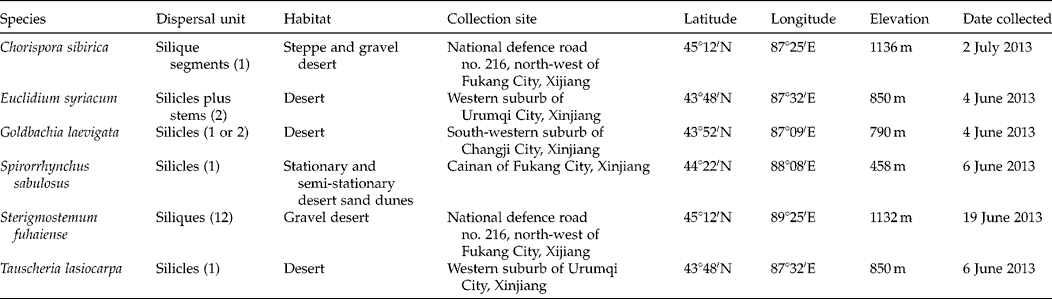
Freshly matured dispersal units (siliques, segments or silicles) (Fig. 1) were collected from several hundred individuals in natural populations of each of the six Brassicaceae species growing in the Gurbantunggut Desert of Xinjiang Province, China. Information on habitat and collection site and dispersal unit of each species is presented in Table 1. In the laboratory, dispersal units were separated from other plant material and stored in paper bags at room temperature and humidity (16–30°C, 10–40% RH) until used. Generally, a silique is a kind of dry, two-valved capsule that is three or more times longer than wide, and a silique segment is a portion of the silique that contains one seed (Zhou et al., Reference Zhou, Lu, Yang, Ihsan, Wu, Raven and Hong2011). Shorter fruits with the same structure are referred to as silicles.
Silicle/silique (first column), seed (second column) and embryo (third column) of the six study species.

Type of dispersal unit (number of seeds per unit is shown in parentheses), habitat site and date of collection of the six study species in the Gurbantunggut Desert

The area of the Junggar Basin where the seeds were collected has a temperate continental climate. Mean annual temperature is 6.8–8.3°C, and the mean temperatures of the coldest (January) and hottest (July) months are − 32.8 to − 15.0°C and 25.0–40.5°C, respectively. Average annual precipitation (including rain and snow) is 194–234 mm, about two-thirds of which falls in spring and summer, and the snow that falls in winter begins to melt in March or April (National Meteorological Information Center, China Meteorological Administration, http://cdc.nmic.cn). Annual potential evaporation is >2000 mm (Wei et al., Reference Wei, He, Liu and Gao2003).
Effect of dry storage (afterripening) on germination
When freshly matured dispersal units were collected from the field, seeds were separated from some of the dispersal units of each of the six study species, and both dispersal units and seeds were stored in the lab until used. After 0 (fresh), 2, 6 and 12 months of storage, dispersal units and isolated seeds were used in germination tests. Dispersal units were soaked in 70% ethanol for 1 min followed by washing in distilled water, in order to control growth of fungi during germination tests. For each storage period, four replicates of five siliques, 25 silicles/segments or 25 seeds of each species were incubated on two layers of Whatman No.1 filter paper moistened with 2.5 ml of distilled water in 9-cm-diameter Petri dishes. Dispersal units and seeds were incubated at daily (12/12 h) temperature regimes of 5/2, 15/2 and 30/15°C in light (12 h of ≈ 100 μmol m− 2s− 1, 400–700 nm, cool white fluorescent light each day) and constant darkness (Petri dishes placed in lightproof black bags). The two higher temperature regimes approximate the mean daily maximum and minimum monthly temperatures in the Gurbantunggut Desert during the growing season: 15/2°C (spring and autumn) and 30/15°C (summer). The criterion of germination was emergence of the radicle from the dispersal unit or seed. Germination in light was examined daily for 28 d, and water was added as needed during the experiments to keep the paper moist; germinated seeds were removed at each counting. Seeds incubated in dark were checked only after 28 d; thus, water was not added to seeds incubated in darkness in order not to expose them to light. The filter paper in dishes incubated in dark remained moist during the experiment.
After the germination trials were completed, dispersal units were cut open, and the non-germinated seeds were removed. The number of non-germinated seeds removed from fruit tissue, as well as that of the non-germinated isolated seeds, were recorded and each seed tested for viability. Each seed was cut open and the embryo observed. Seeds with white, firm embryos were counted as viable, and those with tan, soft embryos were considered to be non-viable and were excluded from the calculations of germination percentages. Only a very few seeds were non-viable.
The rate (speed) of germination in light at the optimum temperature regime was estimated using t 20 for S. sabulosus and T. lasiocarpa, t 30 for E. syriacum and t 50 for C. sibirica, G. laevigata and S. fuhaiense. Values of t 20, t 30 and t 50 are mean time (d) to reach 20%, 30% and 50% germination of the total number of viable seeds, respectively. Here, time to 20% (t 20) and 30% (t 30) germination is used, because the highest germination percentage was 20–30% and 30–40%, respectively, at the optimum temperature regime (Bewley et al., Reference Bewley, Bradford, Hilhorst and Nonogaki2013).
Mechanical versus chemical role of pericarp in seed germination
Seeds of C. sibirica, E. syriacum, S. fuhaiense and T. lasiocarpa stored under laboratory conditions for 0 (fresh) and 12 months were used to test mechanical versus possible chemical effects of the pericarp on germination. For each storage period, four replicates of five siliques, 25 silicles/segments or 25 seeds of each species were subjected to the following treatments (or control) and then incubated on two layers of Whatman No.1 filter paper moistened with 2.5 ml of distilled water in 9-cm-diameter Petri dishes.
A preliminary experiment showed that 30/15°C was optimal for germination of seeds of C. sibirica and S. fuhaiense and 15/2°C for E. syriacum and T. lasiocarpa. Thus, 30/15°C was used to test 0- and 12-month-old seeds of C. sibirica and S. fuhaiense and 15/2°C to test 0- and 12-month-old seeds of E. syriacum and T. lasiocarpa. In this experiment, control and treatment seeds were incubated in Petri dishes on moist filter paper in light and checked daily for radicle protrusion (germination) for 28 d; water was added as needed to keep the filter paper moist.
The treatments and control were as follows:
-
(1) Control: non-manipulated dispersal units (pericarps with seeds inside them) were placed in Petri dishes.
-
(2) Isolated seeds without pericarp were placed in Petri dishes to determine whether the pericarp inhibited germination, i.e. a comparison of (1) and (2): if (2) > (1), yes; (2) = (1), no; (1) > (2), pericarp promotes germination.
-
(3) Isolated seeds and detached pericarps were placed together in each Petri dish to test whether soluble chemicals that would inhibit germination might be leached from the pericarps, i.e. a comparison of (2) and (3): if no inhibition and (2) > (1), then mechanical inhibition; if inhibition and (2) > (1), then both chemical and mechanical inhibition by pericarp.
Imbibition by indehiscent dispersal units and of seeds within them
After dispersal units had been stored dry at laboratory conditions for 1 month, four replicates of five intact siliques of S. fuhaiense, 25 silique segments of C. sibirica and 25 silicles of E. syriacum, G. laevigata, T. lasiocarpa and S. sabulosus were placed on Whatman No.1 filter paper moistened with distilled water in 9-cm-diameter Petri dishes and kept on a laboratory bench at room conditions. At time 0 and at 1-hour intervals until maximum water absorption (i.e. constant mass), the dispersal units (i.e. siliques, segments or silicles) were removed from the dishes, blotted dry with filter paper and weighed. Percentage increase in mass (% W r) of dispersal units was calculated as % W r= [(W i – W d)/W d] × 100, where W i and W d = mass of imbibed and air-dry dispersal units, respectively. The dispersal units of C. sibirica, E. syriacum, G. laevigata, S. sabulosus, S. fuhaiense and T. lasiocarpa were fully imbibed after 180 min, 780 min, 220 min, 360 min, 330 min and 300 min, respectively. The fully imbibed dispersal units were cut open, and seeds were removed from each of them and weighed. Also, dry mass of non-imbibed seeds removed from fruits stored dry in the laboratory for 1 month was determined (n= 100) and compared to the mass of seeds inside fully imbibed dispersal units.
Data analysis
All data were analysed for normality and homogeneity of variance prior to further analysis, to fulfil requirements of t-tests, one-way analysis of variance (ANOVA) and four-way ANOVA. If data were normal and homogeneous, they were subjected to further analysis. If data were not normally distributed or if variances were not homogeneous, they were arcsine (square-root %) transformed (germination percentage data) or log10 transformed (germination time and dry and imbibed mass) before further analysis, to ensure homogeneity of variance. Non-transformed data appear in all tables and figures.
Independent-sample t-tests were used to compare time to reach t 20, t 30 or t 50 between the two storage times. Paired-sample t-tests were used to compare mass of dispersal units and seeds inside the dispersal units before and after imbibition. When variances of non-transformed or transformed data were homogeneous, a one-way ANOVA was used to determine differences in germination percentage of dispersal units and of seeds among the treatments. Four-way ANOVA was used to test for significance of main effects (light, storage time, temperature and pericarp removal) on germination in the ‘Effect of dry storage (afterripening) on germination’ experiment. When the variance of logarithmically transformed data was still not homogeneous, differences among treatments in these characteristics were determined by the non-parametric Kruskal–Wallis test.
Tukey's HSD test was performed for multiple comparisons to determine significant differences among the treatments. Statistical tests were conducted at P= 0.05. All data analyses were performed with the software SPSS 13.0 (SPSS Inc., Chicago, Illinois, USA). Values are means ± SE (Sokal and Rohlf, Reference Sokal and Rohlf1995).
Results
Effect of dry storage (afterripening) on germination
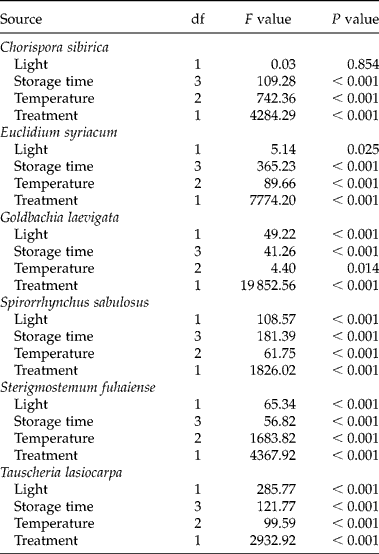
Except for light for C. sibirica (P= 0.85), a four-way ANOVA showed that germination of the six species was significantly affected by light condition (P < 0.05), storage time (P < 0.05), temperature (P < 0.05) and pericarp removal (P < 0.05) (Table 2). Seeds in freshly harvested dispersal units of the six species germinated to 0–5% regardless of temperature regime and light or darkness (Fig. 2). After 12 months of dry storage (afterripening), germination of seeds inside dispersal units of C. sibirica, E. syriacum, G. laevigata, S. sabulosus, S. fuhaiense and T. lasiocarpa were 1, 3, 13, 50, 0 and 26%, respectively.
A four-way ANOVA of effects of light, storage time, temperature and treatment (pericarp removal) on germination of the six study species stored dry under laboratory conditions

Final germination percentages (mean ± SE) of seeds inside dispersal units and of isolated seeds of the six study species incubated in light and in darkness at three temperature regimes following 0, 2, 6 and 12 months of dry storage under laboratory conditions. Error bars are ± 1 SE.

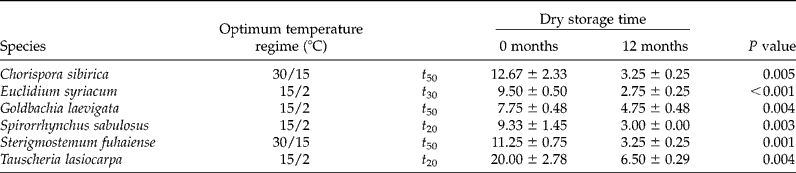
Isolated fresh seeds of C. sibirica, E. syriacum, G. laevigata, S. sabulosus, S. fuhaiense and T. lasiocarpa germinated to 0–55%, 0–39%, 75-82%, 13–39%, 0–60% and 13–27%, respectively, in light at three temperature regimes, and to 3–62%, 1–84%, 84–94%, 19–66%, 1–73% and 34–95%, respectively, in darkness at the three temperatures (Fig. 2). Germination of seeds of all six species gradually increased with increasing duration of storage, and after 12 months of dry storage seeds of all the six species germinated to ≥ 94% at one or more test conditions. Germination rate of isolated seeds of the six species increased significantly with storage time, i.e. decrease in the t 20, t 30 or t 50 of 12-month-old seeds compared to fresh ones (Table 3).
Time (d, mean ±1 SE) to reach 20% (t 20), 30% (t 30) or 50% (t 50) germination of the total number of viable seeds tested for the six study species incubated in the light at the optimum temperature regime (15/2 or 30/15°C) for germination following 0 and 12 months of dry storage under laboratory conditions. A t-test was used to test significant differences between the two storage times

Mechanical versus chemical role of pericarp in seed germination
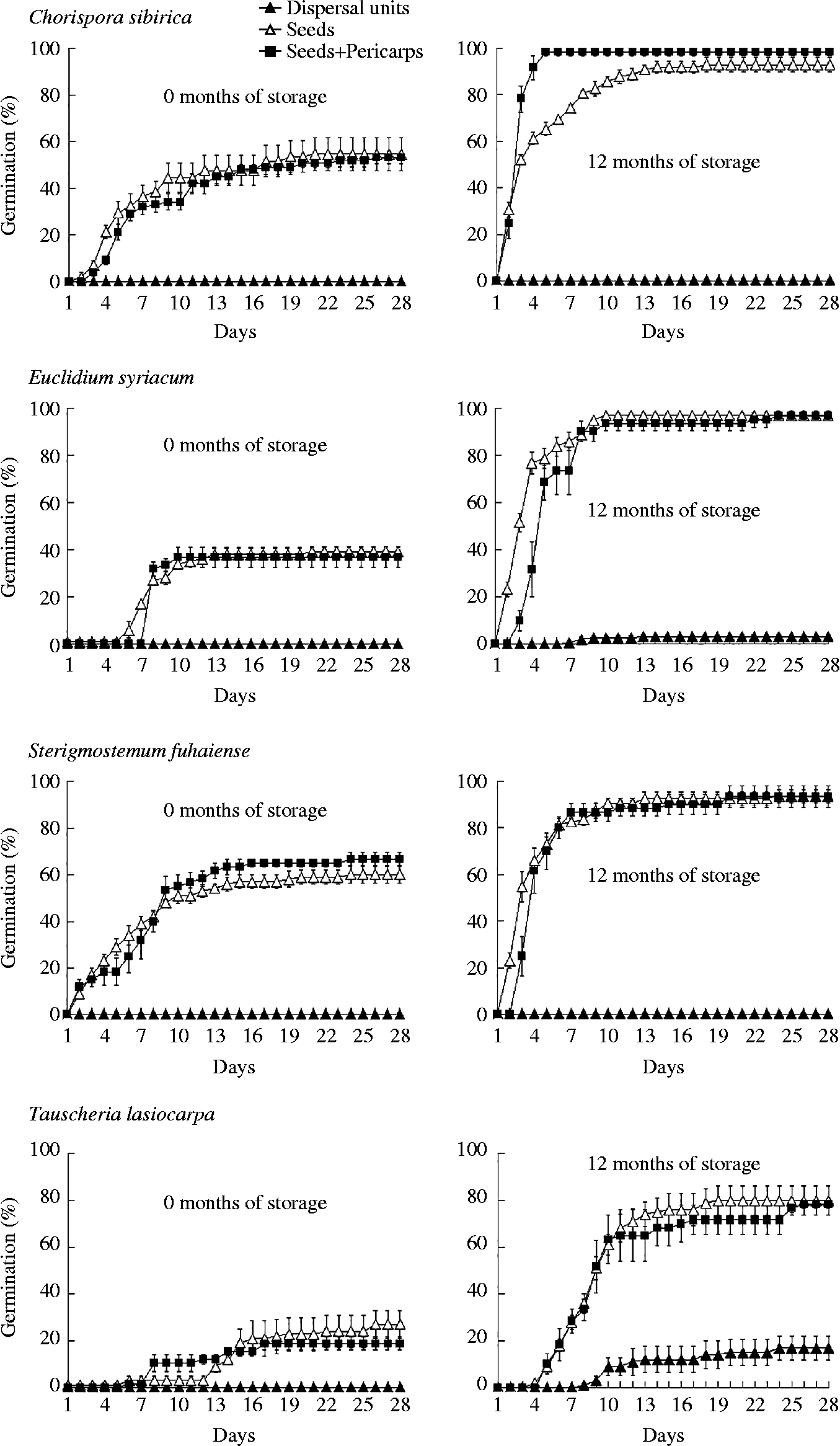
None of the non-treated freshly matured seeds of C. sibirica, E. syriacum, S. fuhaiense or T. lasiocarpa germinated while they were inside the fruits; however, removing the pericarp increased germination to 54.7, 39.0, 60.0 and 27.0%, respectively (Fig. 3). There were no significant differences in final germination percentages for any of the species between isolated seeds and seeds removed from pericarp and incubated in the presence of pericarps (all P > 0.05).
Effects of pericarp on germination percentages (mean ± 1 SE) of fresh and 12-month-old seeds of four Brassicaceae species incubated in light at the optimum temperature regime for germination (15/2°C for Euclidium syriacum and Tauscheria lasiocarpa and 30/15°C for Chorispora sibirica and Sterigmostemum fuhaiense).

Twelve months of storage did not promote germination of seeds of C. sibirica and S. fuhaiense while they were inside the dispersal units (i.e. intact silicle, segment or silique), and only 3 and 17% of the seeds of E. syriacum and T. lasiocarpa, respectively, germinated. However, removing the pericarp was very effective in promoting germination of 12-month-old seeds, but there were no significant differences (P>0.05) in germination percentages between isolated seeds and those incubated in the presence of pericarps (Fig. 3).
Imbibition by indehiscent dispersal units and of seeds within them
There were significant differences (P< 0.05) in mass of dry dispersal units before and after imbibition of water. Mass of dispersal units of C. sibirica, E. syriacum, G. laevigata, S. sabulosus, S. fuhaiense and T. lasiocarpa increased by 37, 53, 57, 89, 110 and 35%, respectively. Also, seeds inside dispersal units of C. sibirica, E. syriacum, G. laevigata, T. lasiocarpa, S. sabulosus and S. fuhaiense imbibed water, and the increase in seed mass was 87, 45, 21, 52, 17 and 39%, respectively.
Discussion
Based on the following results, we conclude that seeds of the six Brassicaceae species have PD. Germination percentages (Fig. 2) and rates (Table 3) increased after dry storage, embryos are fully developed (Fig. 1) and seed coat and pericarp are water permeable. Further, the breaking of dormancy during dry storage (afterripening) indicates that the level of PD is non-deep, which is consistent with the kind of dormancy reported in other species of Brassicaceae (Baskin and Baskin, Reference Baskin and Baskin2014).
Our hypothesis that the pericarp intensifies dormancy in the seeds and consequently reduces germination percentages and prolongs the dormancy-breaking period is strongly supported. Presence of the pericarp: (1) completely inhibited germination of S. fuhaiense and reduced germination percentages of the other five species (Fig. 2); (2) delayed the time when the first seeds of a species germinated while they were in the fruits in light for 1 (G. laevigata), 3 (E. syriacum and C. sibirica) and 6 (S. sabulosus and T. lasiocarpa) months; and (3) delayed the time when the first seeds of a species germinated in fruits in darkness for 0 (G. laevigata and T. lasiocarpa), 2 (S. sabulosus) and 3 (E. syriacum and C. sibirica) months (Fig. 2; Lu et al., unpublished data). Thus, the pericarp enhances the depth of PD. That is, although isolated seeds have non-deep PD, the presence of the pericarp around them results in dormancy that was not broken even after 12 months of dry storage, raising the possibility that the intact dispersal units have intermediate PD. The non-deep PD of seeds of Lachnoloma lehmannii (Brassicaceae) was broken by afterripening or treatment with gibberellic acid (GA3), but no seeds germinated while inside the indehiscent fruits, regardless of the dormancy-breaking treatment (Mamut et al., Reference Mamut, Tan, Baskin and Baskin2014).
The pericarp inhibited seed germination of the six species, but inhibition was not due to lack of water uptake by the seeds. Of the four species studied in detail, possible chemical inhibition was detected only in E. syriacum, i.e. presence of pericarps in Petri dishes with seeds significantly inhibited germination in 1-, 2- and 3-month-old seeds. However, pericarp leachate did not inhibit germination in 6-, 9- and 12-month-old seeds of this species (Fig. 3; Lu et al., unpublished data). Removal of the pericarp significantly increased seed germination percentage of all six species (Fig. 2), suggesting that the embryo lacked enough growth potential (push power) to overcome the mechanical resistance of the pericarp. Although no fresh seeds germinated inside the fruits, germination percentages of seeds in fruits of five species increased with dry storage, which suggests that as seeds afterripened the growth potential of the embryo increased enough to overcome the mechanical resistance of the pericarp (Baskin and Baskin, Reference Baskin and Baskin2014). However, even after 12 months, isolated seeds germinated over a wider range of conditions and to much higher percentages than those in dispersal units (Fig. 2).
The pericarp has also been shown to inhibit germination of seeds while inside the indehiscent fruits of other species of Brassicaceae. A combination of mechanical resistance and chemical inhibitors was responsible for the low germination percentages of seeds of Raphanus raphanistrum inside the indehiscent fruits (Mekenian and Willemsen, Reference Mekenian and Willemsen1975). However, Cousens et al. (Reference Cousens, Armas and Baweja2010) concluded that the seed coat was more important than the pericarp in causing seed dormancy in this species. In Rapistrum rugosum, Ohadi et al. (Reference Ohadi, Mashhadi and Tavakol-Afshari2011) reported that dormancy was caused by the pericarp, but Cousens et al. (1994) concluded that dormancy in distal seeds (in the fruit of this species) may also, at least in part, be due to the seed coat and/or embryo. In Diptychocarpus strictus, the thick, rigid, indehiscent pericarp of the lower siliques in this diaspore heteromorphic species restricts germination of seeds enclosed by the fruit (Lu et al., Reference Lu, Tan, Baskin and Baskin2010). In Lachnoloma lehmannii germination of seeds while inside the indehiscent fruits was prevented primarily by mechanical restriction of the pericarp, but chemical inhibitors in the pericarp may also play a small role in preventing germination. Germination of isolated seeds of this species was significantly inhibited in the presence of the pericarp with trichomes removed and in the presence of trichomes only (Mamut et al., Reference Mamut, Tan, Baskin and Baskin2014). In Cakile maritima (Binet, Reference Binet1960) and Crambe maritima (Baron, 1960, cited in Binet, Reference Binet1960), inhibition of germination of seeds inside the indehiscent pericarp was attributed to effects of the pericarp and seed coat, while in Zilla macroptera inhibition was attributed to the pericarp (Binet, 1959, cited in Binet, Reference Binet1960). In all these studies, lack of water uptake was not a factor in preventing germination.
Another factor related to germination of seeds in the fruits is that the pericarp may become less restrictive, i.e. it softens. For example, the indehiscent lower siliques of D. strictus (Brassicaceae) began to soften, and seeds to germinate, in the field the second spring after dispersal, but pericarp softening and germination continued for at least another 2 years (Lu et al., Reference Lu, Tan, Baskin and Baskin2015). In the laboratory, however, fruits of the six Brassicaceae were kept dry, and weakening of the pericarp did not occur.
The pericarp reduces the number of seeds that can germinate in freshly matured/dispersed fruits. Even if the fruits are maintained in moist conditions for up to 28 d, few or no seeds germinate. Thus, summer rains in the cold desert habitat of the six study species are highly unlikely to promote many, if any, seeds inside the fruits to germinate. In contrast, isolated seeds can germinate to high percentages. Afterripening occurs in seeds inside the fruits, as evidenced by increased germination percentages for five of the six species, but even after 12 months of storage germination percentage of seeds inside the fruits was significantly less than that of isolated seeds. The non-deep PD in isolated seeds of the six species is broken relatively quickly via afterripening. Consequently, the time required for dormancy break to occur in seeds of these species is not an important mechanism per se for delaying/preventing germination. In contrast, the pericarp not only prevents germination of most fresh seeds, but it has the potential to spread the germination of seeds of a cohort of indehiscent dispersal units over an extended period of time.
Acknowledgements
We thank the National Meteorological Information Center, China Meteorological Administration, for providing the weather data.
Financial support
This work was supported in part by the Key Project of Chinese Ministry of Education (213038A), the National Natural Science Foundation of China (41361011, 31160063) and the Special Foundation for State Basic Research Program of China (2011FY110200-8).
Conflicts of interest
None.