

In the context of cultural resource management, site documentation too often becomes a rote process. Smaller and less complex sites are well recorded, but those with increasing complexity are less so. This is often true with historic sites such as industrial plants, municipal facilities, and railroads. It is important that these types of sites be well recorded. In a regulatory context, an archaeologist's and historian's site evaluation are often the most important sources of information considered for the preservation or the mitigation of effects of a project on a site.
At the inception of the railroad in England in the 1820s and its introduction shortly thereafter to the United States, the locomotive and the pocket watch represented the most sophisticated technologies on the planet. In the United States, by the 1850s, railroads existed in every state east of the Mississippi River (densest in the upper Midwest and Northeast), and by the twentieth century, railroads crisscrossed the entire nation. Railroads have particularly vexed archaeologists because of their complexity as well as their extent. As a result, their significance is sometimes overlooked or misinterpreted. Added to this is the daunting task of trying to identify appropriate archival resources in the quest to interpret railroad sites.
There are four core characteristics to understanding railroads and how understanding these can aid in more accurate recording and interpretation. The characteristics include economics, operations, infrastructure, and regulation. The point here is not that one needs to understand and use of all these contexts to document a railroad site but that gaining a general sense of them provides conceptual understanding to help in the process.
Before moving on to definitions, one daunting aspect of railroad research and recordation should be mentioned: frequent changes in ownership. Many, if not most, railroads have been sold or merged into other railroads, and others have been abandoned. Changes in ownership is one of the more difficult issues to untangle, but it is one that can greatly aid in interpreting and tracing a railroad's history. A railroad's chain of ownership is important to establish, particularly when documenting and applying a name and owner. I say this having seen many site records and reports with incorrect information. Such misinformation may confuse subsequent researchers, compounding the initial error.
FOUR KEY CHARACTERISTICS
It is vitally important for cultural resource professionals to understand the basic characteristics of railroads, several of which leave archaeological footprints that can be key to understanding and interpreting a site. A researcher should try to understand how a particular line fits within the history of an area, how it might interface economically with other industries, and what its connection might be—both economically and politically—with communities, cities, states, and the federal government. The four key characteristics below apply to most railroads in the United States and often those in other countries.
There are exceptions to a discussion of railway characteristics, however. These include railways constructed and operated by and for the military and government entities. Primarily starting in the early twentieth century, such lines (often short) were established to support the transportation needs of military facilities and specialized municipal, state, and federal government operations. For this reason, the characteristics described do not always apply.
1. Economics. No one in the United States has built a privately operated railroad without the potential to generate a profit. Consequently, one needs to assume that a railroad has commerce and, in most cases, patronage in the form of passengers. There must be capital available to build and maintain a railroad, and a railroad must pay attention to outside forces, such as other railroads competing for the same revenues. In sum, a railroad will always have customers in the form of industries, commercial establishments, and, often, passengers. Many books illustrate this effect, but one that captures the agonizing struggle to deal with economic realities in railroading in the nineteenth century is Pioneering the Union Pacific by Charles Ames (Reference Ames1969).
2. Infrastructure. To exist, a railroad must have infrastructure. This includes land ownership and right-of-way development, which always includes berm(s), ballast, ties, track, switches, signs, and signals. Depending on the terrain, it often includes trestles, culverts, bridges, and tunnels. Add to the list yards, maintenance shops, and rolling stock, including locomotives, freight cars, maintenance cars, and, as appropriate, passenger cars. Depending on the time period, railroads—particularly in the nineteenth and early twentieth centuries—also included telegraph stations, section stations, and worker housing. Two comprehensive and authoritative books covering one important aspect of this characteristic are John White's The American Railroad Freight Car (Reference White1993) and The American Railroad Passenger Car (Reference White1978).
3. Operations. Operations include administrators, marketing and clerical staff, telegraph operators, maintenance shop crews, engine crews, and maintenance-of-way crews. It also involves operation of rolling stock with crews, timekeeping, scheduling, and internal coordination as well as connecting with other railroads. A fascinating read about the construction and operation of a railroad empire can be found in The Pennsylvania Railroad by Albert Churella (Reference Churella2013).
4. Regulation. All railroads experience some type of external regulation. This may and usually does include a myriad of federal, state, and local agencies and boards. The most predominant, beginning in 1887 was the Interstate Commerce Commission (ICC), which existed until 1995, when most of its functions were transferred to the Surface Transportation Board. Another federal agency having regulatory authority is the Department of Labor, which over time, increased its control of railroads. In addition, there is state regulation—usually through Public Service Commissions in each state—and cities, counties, and other state authorities. There are also private influencers, including the Brotherhood of Locomotive Engineers and Trainmen and, until 1969, the Brotherhood of Locomotive Firemen. Although this might seem to be a rather obtuse subject, Gabriel Kolko provides surprising clarity of the subject in his book Railroads and Regulations, 1877–1916 (Reference Kolko1965).
All four of these key characteristics define the overall structure of a railroad. Historically, each of them has been the cause for railroads to either prosper or die. They are all fascinating from a historical perspective, but for evaluating sites as archaeologists, all four are not equally essential. The two most useful to archaeology are infrastructure and operations. However, before leaving the topics of economics and regulation, it is important to mention situations in which these may provide historical context for archaeological evaluation of railroad sites.
The importance of economics in this industry is self-evident. Without a source of income, a railroad will not survive. Before a railroad is constructed, investors and builders take a careful look at the long-term economic viability of such a venture. The role of economics in railroad sustainability is complex and may or may not be immediately relevant to archaeological investigations. Identification of local industries served by the railroad and a careful examination of the path of the railroad, its interfaces with other railroads, and its history can provide clues concerning place and function in evaluating stations and other facilities. This becomes even more important when evaluating an entire railroad.
The immediate value of regulatory laws for archaeology has to do with providing the why and when for some important events in a railroad's history. Regulations are sometimes the unanticipated cause for important developments—for instance, the abandonment of stations and branch lines, or retention of lines beyond when one might otherwise think they should have been abandoned.
It is infrastructure and operations that most often provide the best return for effort in research for an archaeologist investigating a railroad site. Infrastructure is the physical evidence archaeologists most often observe when recording railroad sites and their components. Foundations of buildings, industrial trash, privies associated with railroad housing, berms, trestles, culverts, tunnels, bridges, and other structural features provide evidence of what was once a thriving commercial industry. Features and artifacts found and recorded provide clues concerning function, and they help in the interpretation of what was often a complex operation. The location of stations and other facilities often conveys important information about railroad functions and operations.
Operations refers to how a railroad functions within its environment. This will include train scheduling, personnel to operate those trains, maintenance crews, shop crews, and all the supporting staff and facilities to keep the system going. Besides the physical operation of trains, there are a myriad of orders that send locomotives and cars to various parts of a system, which help to avoid collisions and to interface with external railway connections. Operations of railroads are somewhat opaque when it comes to how information from this source may assist with archaeological research, but they are nonetheless vital. Although operations are integral to infrastructure, specific operational documents are generated that are especially valuable for archaeological investigation and interpretation.
HISTORICAL DOCUMENTS OF VALUE IN RAILROAD RESEARCH
Recording material culture encountered at a site is an essential part of an archaeological investigation, but even more important is being able to put it into meaningful context. That context often develops through use of historical resources to help interpret the physical remains.
A good starting place is to locate the railroad on modern US Geological Survey maps and then to access historic US Geological Survey (USGS) maps, some of which extend well back into the nineteenth century. By going to the USGS TopoView site (USDI US Geological Survey 2022), one can find and download both modern and historic topographic maps. These maps can provide a sense of place—the topography and how it relates to communities and industries along or near it—as one views progressively updated maps. Also useful, particularly in western and midwestern states, are General Land Office Plat maps and field notes, which date from the 1850s onward (USDI Bureau of Land Management 2022). In urban contexts, historic Sanborn Fire Insurance maps are particularly helpful, often providing a chronological progression of railroad expansion and changes through time as well as its connections to local industries. They can be found at many libraries and at the Sanborn Maps Collection at the Library of Congress (2020).
Also quite valuable are modern and historic aerial photographs. Railroad alignments can often be observed on such resources. Coupled with topographic maps, they enhance interpretation of railroad operations, and they help one understand why particular routes were taken and why stations were located where they were. They also identify the broader transportation network of wagon and automobile roads and other railroads that linked to the railway under study. Many US government agencies have created and maintain collections of such photographs, some of which can be accessed remotely. A few agencies that hold such photographic collections include the USGS Earth Resources Observation and Science Archive (EROS) aerial photography collection (USDI US Geological Survey 2018), the US Department of Agriculture Farm Service Agency, Aerial Photography Field Office (USDA 2022), and the National Archives and Records Administration's Cartographic and Architectural Records collection (National Archives and Records Administration [NARA] 2022).
For basic understanding of a particular railroad, existing state and regional histories—and especially railroad histories—are essential. Beyond that, railroad company drawings, photographs, and narratives can help provide an understanding of how a particular site functioned and how it related to the larger whole of both the railroad and communities along its route. It is not always easy to find existing materials, but intense public interest in railroads has facilitated the saving and curation of a great deal of data, despite the considerable loss of railroad documents over time.
Railroad companies produced more paper documentation about their operations than most any industry in existence. It was not an altruistic venture but a necessity for efficiency. The paper generated is highly varied and extensive, and what remains after document losses due to company bankruptcies, mergers, fires, and disposal can still be daunting. Finding such historical materials can sometimes result in a treasure trove of information for the archaeologist and, at the least, a reasonable trail of data.
Railroad records make their way into library and museum collections in a variety of ways, so it is always important to look in many places. My research on the Transcontinental Railroad resulted in finding important primary documents in more than 24 different repositories from the west coast of California to as far east as Syracuse University (Polk Reference Polk1998). A current effort on the same topic resulted in finding far more (Polk and Merritt Reference Polk and Merritt2021). Dissertations and master's theses are important sources, and university libraries have begun to list master's theses more frequently than in the past, often online. Online sites of railroad collections have grown dramatically, particularly during the shutdown of facilities during the COVID-19 pandemic. Table 1 has a selected list of online resources. Far more can be found in an internet search of the name of a railroad of interest.
Selected Online Railroad and Railway Collections Sites.

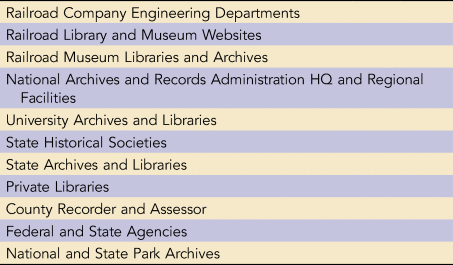
Table 2 is a preliminary and limited list of institutional types that contain the most useful primary documents about railroads. These are listed in order from institutions holding the highest-value documents to those with lower potential. Depending on the state and railroad, more may be found in a lower-order facility.
Institutions with Railroad Documents for Archaeological Projects.

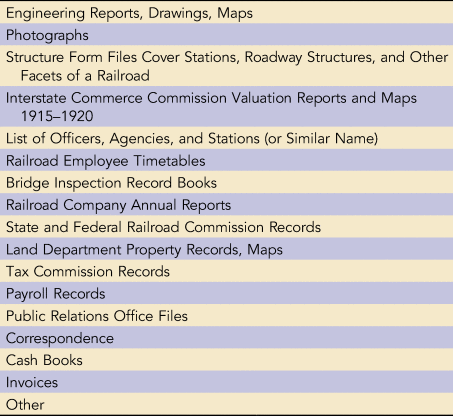
Table 3 identifies what are, generally, the most valuable document types for archaeologists within collections. The document types useful for a particular project will vary widely, even more than the location of the most valuable institutions. The list covers the types of documents likely to be encountered when seeking railroad materials, although exact names may vary. They are listed in order from most to least valuable in site documentation and interpretation.
Valuable Types of Railroad Documents for Archaeological Projects.

One type of document to be singled out as the most important nationally (beyond those of a particular railroad) are materials produced by the ICC. Valuation reports and maps are, perhaps, the most valuable of all. These are all held at the National Archives in College Park in Maryland. Valuation documents were produced by the ICC and railroad companies between 1914 and 1928 as part of a program to value the worth of properties of all railroads in the United States. Several guides about these records are essential. They include Edwards (Reference Edwards2018), National Archives and Records Administration (NARA 2019), and Pfeiffer (Reference Pfeiffer2001). Brauer (Reference Brauer2010) provides a guide specific to the cartographic section of the National Archives.
Published literature about railroads—records produced by railroad companies and by government agencies—are significant resources for interpreting features and artifacts found in the field. They are essential to understanding a railroad under study within the context of the four characteristics of the industry: infrastructure, economics, operations, and regulation.
ARCHAEOLOGICAL INVESTIGATION OF RAILROAD SYSTEMS
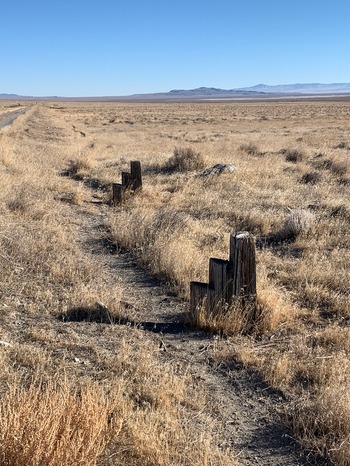
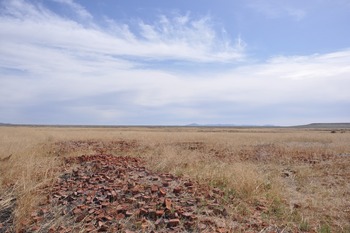
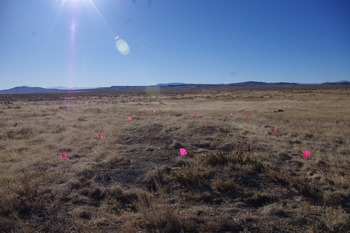
Railroad corridors and facilities are dynamic sites. Identification and recordation of rail systems—or, more often, portions of systems—require more attention to detail than for more passive site types such as roads, pipelines, or transmission lines. Not only do railroads actively move trains along their corridors, but they include a wide variety of activities and features with that movement. Although the activities and features are often obvious when in use, deterioration over time, abandonment, removal of portions of those features, and changes in physical context can make identification quite difficult. A simple example of this in maintenance work are two sets of pilings found near Lucin, Utah. Used up to 1942, the features consist of two multilevel pile features, used to hold the ends of standard 11.89 m (39 ft.) long rail lengths off the ground. They are known as rail rests. Rails set on rail rests would have been located at other select points on the line, providing ready access to replacement rails for ones that were broken and bent (Figure 1).
A rail rest feature located on Central Pacific (CP) line east of Lucin in Box Elder County, Utah. View to the east toward Terrace. Note railroad berm on extreme left of photograph. (Photograph by Chris Merritt, December 2020.)

It is important that archaeologists familiarize themselves with infrastructure elements of railroads. Among the many useful sources to better understand this are The Elements of Railroading by Charles Paine (Reference Paine1885), Railway Track and Track Work by E. E. Russell Tratman (Reference Tratman1909), and Railroad Construction, Theory and Practice by Walter Webb (Reference Webb1922). Examples of more current online resources are the Railway Technical Website (2019), Zwolski's article “Railways Track Elements” (Reference Zwolski2022), and the periodical Railway Age, which began in 1856 and is still published monthly. Many historic era issues of Railway Age can be found in Google Books. For discussions about railroad buildings and various architectural elements, useful resources include Train Depots and Roundhouses by Hans and April Halberstadt (1995), “Historic Railroads” (National Park Service 1999), and Buildings and Structures of American Railroads by Walter Gilman Berg (Reference Berg1893).
Concerning the operational side of railroading, John White's books on the freight and passenger railroad car are excellent (Reference White1978, Reference White1993), as is the Library of Congress's Railroads: Sources for Historical Research (Terrell Reference Terrell2020), and Records Relating to North American Railroads by David Pfeiffer (Reference Pfeiffer2001).
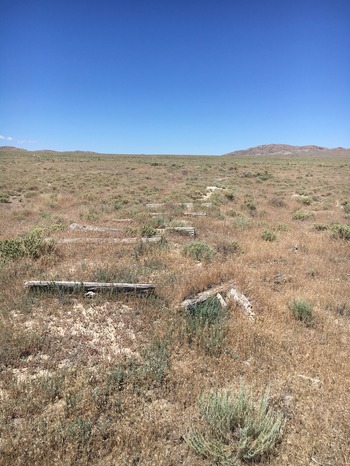
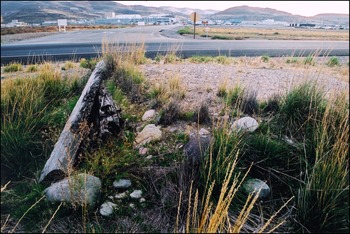
A real-world understanding of a project area is critical, and it is only obtained by walking the railroad lines and yards. In this way, single track or multiple track configurations can be identified and changes noted. Survey can also identify the presence and nature of ephemeral track features such as berms, spurs, or sidings. It can also help verify larger features such as depots, shops, turntables, roundhouses, tunnels, and trestles, and it is essential in identifying minor elements such as signals, culverts, and sign bases (Figures 2 and 3). Depending on the level of documentation required by a particular project, one might only need to describe, measure, map, and photograph a site. If more detail is required—especially for a more complex and/or larger station or facility—use of a laser transit, a drone, or even lidar technology for mapping can be quite useful. A simple example of how helpful this can be is illustrated by a lidar map that was created using an Apple iPad unit during excavation of a small railroad-worker house structure at the nearby Terrace Chinatown site (Merritt and Sheehan Reference Merritt and Sheehan2021). Photogrammetry is also being widely used for accurate mapping through photography. In combination with historic photographs (which may be all that remains of a site), this method can be quite valuable.
Railroad berm on the abandoned railroad wye at Matlin, Utah. The desert environment has preserved many crossties on the berm 79 years after abandonment. (Photograph by the author, 2019.)

Mounded brick remains of the 1881 machine shop at Terrace Station, Utah. (Photograph from Polk and Merritt Reference Polk and Merritt2021:109, Figure 42.)

LAMPO: A CASE STUDY OF A SECTION STATION
Knowing these structural elements of railroading helped archaeologists in my company, Sagebrush Consultants, better understand the sites we were recording in northern Utah in the early 2000s (Polk and Johnson Reference Polk and Johnson2012; Weymouth et al. Reference Weymouth, Pagano and Garrison2006). One of the sites recorded shows how historical research and archaeology both complement one another in interpretation and illustrate key characteristics of railroads. Beginning in the early 1880s, Lampo (42BO1148), known as Kolmar until 1912, was an important stop on the Central Pacific Railroad (CP). Located a few miles east of Promontory, Utah, it was initially only a maintenance station, but early in the twentieth century, it became a major regional wheat shipping center, reflecting the operations, infrastructure, and economic characteristics discussed earlier. Knowing that track maintenance and shipping were important at Lampo helped identify potential types of features and artifacts. In this case, we identified a plan drawing of Lampo, dated 1916 and revised 1924, before fieldwork (Figure 4). The drawing illustrates Lampo's function as a maintenance station, a grain shipping point, and a stock-loading facility.
Lampo Section Plan, redrawn from the Southern Pacific Company's Right of Way and Track Map, 1916/1924. (Taken from Polk and Merritt Reference Polk and Merritt2021:208, Figure 74.)

Primary documents were critical to understanding the Lampo Station. In working on Southern Pacific (SP) lines, three sources were particularly valuable in finding such material. The Central Pacific Railroad Photographic History Museum (cprr.org) has an enormous number of documents and narratives, as does (Utahrails.net), for railroads in Utah. Much SP data was also obtained through Google Books, including CP Annual Reports and Annual Reports of the Commissioner of Railroads to the Secretary of the Interior. These are but a few of hundreds of railroad materials digitized by Google.
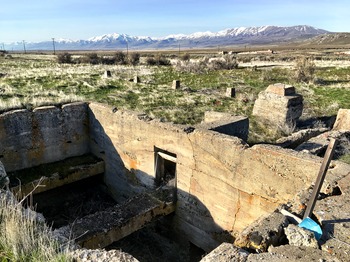
Fieldwork at Lampo consisted of photographing and describing the landscape, features, and artifacts, and mapping the site with a handheld Trimble GPS unit. An attempt to ground truth the listed features was not entirely successful. Previous blading of the area disrupted the location and visibility of features, and some additional features were found which may have predated or even postdated those on the drawing. The 1924 drawing depicts 12 features that could have remnant archaeological footprints. Upon surficial investigation, only six were found: a bunk house, a “vaulted structural foundation,” a warehouse foundation, a scale house foundation, a grain elevator foundation, and displaced grain-elevator superstructure (Weymouth et al. Reference Weymouth, Pagano and Garrison2006:65–67). Subsurface exploration of the site would likely expose evidence for all the buildings (Figures 5 and 6).
North wall of bunk house at Kolmar Station (Lampo). Taken from Lampo Site Form (42BO1148). (Photograph courtesy Commonwealth Heritage Group.)

Warehouse foundation at Lampo Station. (Photograph by Chris Merritt.)

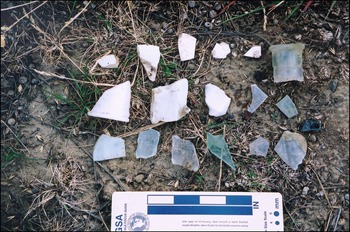
In addition to the structural elements, the archaeological inventory revealed multiple discrete concentrations of both domestic and industrial artifacts. For instance, a large concentration of tin-can and bottle fragments, whiteware ceramics, and metal hardware was found in proximity to the bunk house. A smaller concentration of largely domestic debris was found not only near the former grain elevator but also near the former office, which served as the section station foreman's living quarters as well (Figure 7).
Representative glass and ceramics from Lampo Station Site. Taken from Lampo Site Form (42BO1148). (Photograph courtesy Commonwealth Heritage Group.)

Ethnic Chinese workers were the dominant population at all manned stations on the line from 1869 to about 1890, and at a few even in 1900. Most occupied company-furnished bunk houses (Polk and Merritt Reference Polk and Merritt2021:28–34; Polk et al. Reference Polk, Merritt and Cannon2019; Figure 8). Section houses and Chinese bunk houses were also well separated. Out of 50 stations studied by the author in Utah and Nevada, 68% were separated by between 30 m and 90 m (100–300 ft.), and another 16% were over 90 m (300 ft.) apart (Polk Reference Polk2020). Many stations recorded along this route reveal discrete concentrations of Chinese artifacts of late nineteenth- and early twentieth-century origin, including dinnerware fragments of porcelain and stoneware, some earthenware and stoneware vessels, opium tins, coins, and gaming pieces. Lampo station was first occupied by Chinese workers, but by 1900, the bunk house was primarily occupied by Italians, reflecting a shift in the character of the workforce over time.
Foundation of 1869 China Bunk House at Matlin, Utah. (Photograph by the author, 2018.)

Subsurface exploration would likely reveal in situ artifact concentrations at Lampo. It is also likely that further exploration of the site through controlled scraping with a gradall or similar machine, or through use of GPR or magnetometer, would reveal cultural features not visible on the existing surface nor shown on the 1924 drawing. Examples of similar nearby efforts include the first intensive mapping and artifact plotting of Transcontinental Grade sites at Bovine and Ombey stations (Cannon et al. Reference Cannon, Houston, Peart, Cannon, Blong, Santarone, Selma, Price and Dunker2016), and GPR and magnetometer surveys at Terrace, Matlin, and Bovine stations (Polk and Merritt Reference Polk and Merritt2021:281–282).
In 1942, the ICC granted the SP permission to abandon the Promontory Branch of the Southern Pacific's Salt Lake Division, Lampo Station included. This reflects the regulatory key railroad characteristic discussed previously (Interstate Commerce Commission 1942).
NEXUS OF ARCHAEOLOGY AND HISTORICAL DOCUMENTS
As discussed throughout this article, to establish the nature of a particular railroad site and understand its context, one needs to mesh both archaeological data and appropriate historic documents. It is important to gain a basic understanding of railroads, their features, and artifacts. It is also essential to understand the historical context of the railroad being studied. With that information and understanding in hand, archaeological field recordation of a railroad site will be more accurate and efficient, and it will provide useful information for interpreting and determining the significance of a railroad property as well as tie it to the essential characteristics of a railroad described earlier.
One may not always find what is needed in the historical references and primary documents, just as the condition and integrity of an archaeological site will always present challenges for interpretation. Nevertheless, seeking out and spending adequate time with both written and archaeological resources make successful understanding and interpretation of a site far more likely.
Acknowledgments
I thank Chris Merritt for redrafting the original Lampo station drawing. The recording of Lampo was carried out by Sagebrush Consultants as part of a larger survey done for the National Park Service and Bureau of Land Management in 2002. Work was carried out under Cultural Resources Use Permit No. 02UT54630 and Utah State Antiquities Permit No. U-01-SJ-0647n,p,b.
Data Availability Statement
Site information regarding Lampo Station (42BO1148) can be accessed through the Archaeological Site Records system at the Utah State Historic Preservation Office (https://history.utah.gov/shpo/).
Competing Interests
The author declares none.