





Introduction
In 2025, Susan Carter MLC proposed an amendment to the Births, Deaths and Marriages Registration Act 2014 (NSW) which, had it been successful, would have permitted ministers of religion in New South Wales to access the original birth certificates of individuals who had changed their legal sex or gender.Footnote 1 In support of her amendment, Carter argued that it was necessary to ensure the validity of marriage noting:
It is a matter of fact that under the Commonwealth Marriage Act, if people present themselves to a religious marriage celebrantFootnote 2 for marriage, unless that marriage is valid within the rites of that religious church, they will not be validly married. We could have a situation where people present with altered birth certificates that do not reflect their biological sex, and their partner, who thinks they are married, will not be validly married.Footnote 3
The amendment was opposed by both the Labor Government and the Greens and was ultimately lost 16 votes to 20. Carter’s proposed amendment, however, raises the spectre that marriages conducted by ministers of religion where one of the parties to the marriage is transgender may not be valid. This paper explores this issue in the context of marriages within the Anglican Church of Australia (‘ACA’).Footnote 4
The first Australian same-sex wedding took place in December 2017Footnote 5 following the successful Marriage Equality campaign and the passage of the Marriage Amendment (Definition and Religious Freedom) Act 2017 (Cth). While sex and gender are now irrelevant for the purposes of secular marriage in Australia,Footnote 6 many religious communities, including the ACA continue to only solemnise marriages between a man and a woman. However, questions remain as to how secular laws permitting transgender people to change their sex or gender on their birth certificate and other legal documents intersects with canon law and the Anglican ritual of marriage. Uncertainty remains due to the complex intersection between federal Marriage law, state, territory and federal anti-discrimination law, and Anglican canon law.
Legal uncertainty and conflict surrounding transgender people is not unique to the ACA or religious communities. In 2025, in For Women Scotland Ltd v The Scottish Ministers Footnote 7 the United Kingdom Supreme Court ruled that, in the context of Equality Act 2010, ‘[a] person with a [Gender recognition certificate] in the female gender does not come within the definition of “woman” for the purposes of sex discrimination in … the [Equality Act 2020]. That in turn means that the definition of “woman” in the [Gender Representation on Public Boards (Scotland) Act 2018] … is limited to biological women and does not include trans women with a [Gender recognition certificate]’.Footnote 8 In Australia, an appeal from the finding in Tickle v Giggle for Girld Pty Ltd Footnote 9 that exclusion of trans women from a women’s only social media app amounted to indirect discrimination under the Sex Discrimination Act 1984 (Cth) was recently handed down by the Federal Court of Australia. In the United States of America, President Donald Trump has signed an Executive Order banning trans women and girls from competing in women’s and girl’s sporting events. A number of international and national sporting bodies have also introduced bans and gender testing regimes.Footnote 10
At the heart of these tensions are deep philosophical, theological and personal questions about identity. The analysis set out in this article is largely a legal one, drawing on traditional doctrinal legal methodology, principles of statutory interpretation and comparative legal methods and epistemology.Footnote 11 However, as Tibby enjoined her audience in the 2024 Sharwood Lecture:
Living as Christians in the world, it behoves us to respect the choices people make and to accord each person respect, warmth and kindness, whether or not we agree with their choices, so long as those choices are not exploitative. Sensitivity is also vital.Footnote 12
This analysis has therefore been conducted with as much sensitivity as possible, using, where appropriate, gender affirming language. Remembering that case studies and examples discussed, like For Women Scotland Ltd v The Scottish Ministers Footnote 13 and Tickle v Giggle for Girld Pty Ltd Footnote 14 involve real people. At the same time, this analysis does not seek to critique or criticise theological and doctrinal positions within the ACA, or segments of the ACA, on matters such as gender and sexuality, acknowledging that laity, clergy, theologians and canon lawyers within the ACA genuinely and sincerely hold divergent positions.Footnote 15
In debates about the rights of LGBTIQA+ people and their families, it is common for issues affecting transgender and intersex people to be discussed together. While these two groups face similar legal, social and cultural challenges, they are in fact distinct and separate groups.Footnote 16 This article focuses exclusively on the intersection of secular marriage law and Anglican canon law in relation to transgender individuals. While some of the issues, arguments and proposed solutions may apply to intersex individuals and their families, a specific consideration of the unique challenges faced by intersex individuals is beyond the scope of this article.
The article is structured in five parts. Part 1 outlines the development of Australian law recognising changes of sex and gender. Part 2 examines the legal framework governing marriage, including the interaction between civil regulation and religious exemptions. Part 3 turns to the canon law of marriage within the ACA, while Part 4 explores the challenges that gender identity poses for established doctrine. Part 5 considers the implications of these developments for the recognition of transgender marriages in the Anglican context. The article concludes by identifying the resulting doctrinal gap and its legal and pastoral significance.
From medical transition to legal affirmation: the evolution of gender recognition law in Australia
Estelle AsmodelleFootnote 17 is generally recognised as the first Australian to legally change their sex or gender on their birth certificate in 1986. She was also successful in having her Australian passport amended to reflect her new gender.Footnote 18 Discussion regarding recognition of transgender individuals via amendments to their birth certificates began as early as 1959.Footnote 19 However, progress was slow, and by the mid-1970s, legal authorities were still grappling with how to recognise affirmed gender in key areas such as marriage. In 1976, in response to a query from the New South Wales Attorney General Frank Walker, the Federal Attorney General determined that transgender people who had gender affirming surgery could not marry under their affirmed gender.Footnote 20 This prompted the Family Law Council to issue a report in 1978 titled Birth Certificates Revision of the Sexually Reassigned. Footnote 21 The report noted that the issuing of birth certificates was a state issue and that reform would therefore likely take a long time.Footnote 22
The passage of Australian legislation facilitating changes of gender on birth certificates can be divided into two phases, the ‘medical-certificate model’ and the ‘affirmation-based model’.Footnote 23 Under the medical-certificate model, legislation and administrative process required individuals seeking to change their sex or gender on legal documents to provide evidence that they had undergone medical transition. Early legislative mechanisms for changing a person’s sex or gender on their birth certificates adopted the ‘medical-certificate model’ and often placed additional barriers, such as requiring that individuals who were married at the time of seeking to have their sex or gender changed on the birth certificate to also divorce their spouse.Footnote 24 The first state to pass legislation facilitating the recognition of a transgender individual’s affirmed gender was South Australia with the passage of the Sexual Reassignment Act 1988 (SA). The Act required that people seeking to have the sex or gender on their birth certificate changed must be at least 23 years of age and single. There were multiple steps to the process, including that the person needed to undergo counselling and live in their affirmed gender for at least two years before they could proceed to surgery. It was only after having received gender affirming surgery that they could apply to the Sexual Reassignment Board for a certificate recognising their affirmed gender. This certificate could then be presented to the Register of Births, Deaths and Marriages.Footnote 25
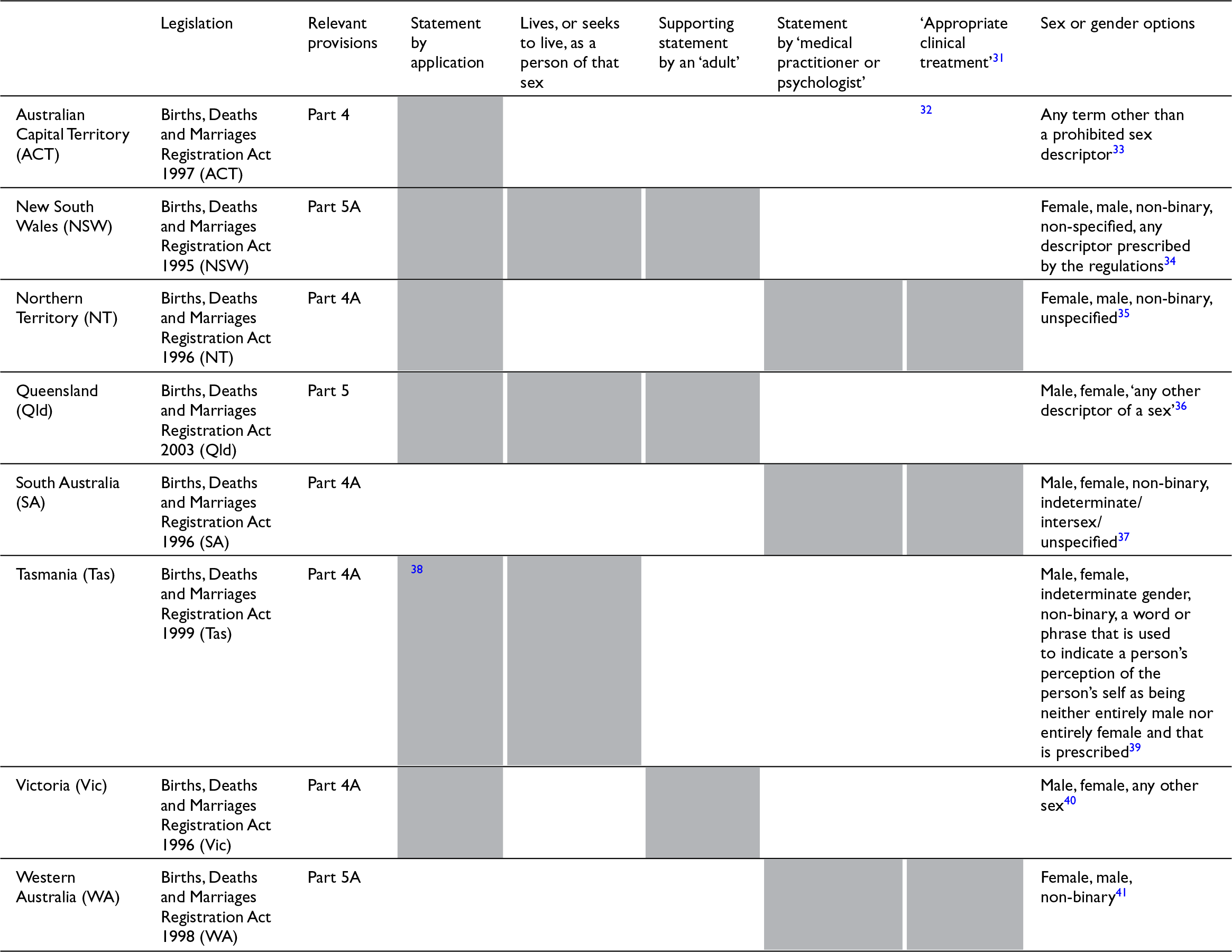
By contrast, the ‘affirmation-based’ model requires individuals to certify that they identify with the sex or gender they are seeking to have placed on their legal documentation. This need not necessarily be binary male or female, with all Australian states and territories now permitting at least some other sex or gender descriptors as shown in Table 1 below. While Australian legislation initially followed the medical-certificate model,Footnote 26 in 2016, South Australia again led the way, becoming the first Australian jurisdiction to move away from this approach, instead requiring only that the person undergo ‘appropriate clinical treatment’.Footnote 27 ‘Clinical treatment’ was defined so as not to require ‘invasive medical treatment (and may include or be constituted by counselling)’.Footnote 28
Legislative requirements for change of sex or gender on birth certificate by jurisdiction.

Table 1 Long description
The table compares Australian states and territories on the legislation used to change the sex or gender recorded on a birth certificate, listing the relevant Act and Part and the types of evidence or declarations referenced. All jurisdictions list multiple sex or gender options rather than only male and female, with non-binary explicitly available in New South Wales, Northern Territory, South Australia, Tasmania, and Western Australia. Several jurisdictions also allow broader descriptors: the ACT permits any term except prohibited descriptors, Queensland allows male, female, and other descriptors with limits on offensive or impractical terms, and Victoria allows male, female, and any other sex subject to prohibited-descriptor rules. Tasmania uniquely highlights a statutory declaration concept tied to identifying as a gender and living, or seeking to live, as that gender. The ACT notes a change in 2024 removing a requirement related to clinical treatment. Many cells for specific evidentiary requirements (such as supporting statements or practitioner statements) are blank in the provided data, so the table should be read as emphasizing legislative references and available sex or gender options rather than a complete checklist of requirements.
All Australian jurisdictions have now moved to an affirmation-based model.Footnote 29 Table 1 below sets out the current legislative requirements in each Australian state and territory for adults seeking to change their sex or gender on their birth certificate.Footnote 30
As Table 1 highlights, while all Australian jurisdictions have now adopted an affirmation-based model, the reality is more complex. The various legislative models in fact exist along a spectrum dependent on the level of ‘evidence’ required. At one end of the spectrum is the Australian Capital Territory which requires only, in addition to jurisdictional and age based requirements, that ‘the person believes their sex to be the sex nominated in the application’.Footnote 42 At the other end are jurisdictions such as the Northern Territory, South Australia and Western Australia which, while no longer requiring medical or surgical transition, still require applicants to have undergone ‘appropriate clinical treatment’ and that this be certified by a medical practitioner or psychologist.Footnote 43 However, despite these differences, it is now possible without undergoing medical or surgical transition for an individual to legally change their gender identity on their birth certificate throughout Australia. It is also possible for individuals to change their sex or gender on their Australian passport. As per the Australian Government Guidelines on the Recognition of Sex and Gender (2013) and other government records recoding their identify as M (male), F (female) or X (indeterminate/intersex/unspecified).Footnote 44 The first person to have the gender category X recorded on their passport was Alex MacFarlane in 2003.Footnote 45
From secular marriage to sacred exemptions: the legal framework of marriage in Australia
While the registration of births, deaths and marriages are governed by state and territory legislation, solemnisation of marriage is regulated by the federal Marriage Act 1961 (Cth). The passage of this Act, along with the Matrimonial Causes Act 1959 (Cth),Footnote 46 created a uniform system for marriage across Australia to, as Barwick CJ put it, ‘solve modern problems in a modern way’.Footnote 47 One modern problem Barwick CJ did not anticipate was the emergence of the Marriage Equality campaign, nor the ability of individuals to change their sex or gender on their birth certificate and other legal documents. When the federal Marriage Act 1961 was initially passed it did not contain a definition of marriage, instead relying on the common law definition of marriage in Hyde v Hyde.Footnote 48 In this 1866 case of the United Kingdom Court of Divorce and Matrimonial Causes Wilde JO noted:
I conceive that marriage, as understood in Christendom, may for this purpose be defined as the voluntary union for life of one man and one woman, to the exclusion of all others.Footnote 49
However, in the 1962 Australian High Court case Windeyer J noted, in the context of considering the constitutional definition of marriage, that limiting the definition of marriage to the monogamous marriage of Christianity was ‘unwarranted’ and that ‘[m]arriage can have a wider meaning for law’.Footnote 50 This opened the door to more inclusive definitions of marriage. However, Windeyer J declined to comment on whether the Australian parliament had the power to legislate to allow polygamous marriages as ‘[t]hat question [had] absolutely no reality’.Footnote 51 He did however confirm that:
… for some purposes, including the legitimacy of children and rights of succession, our law does recognize polygamous, or potentially polygamous, marriages contracted in countries where such marriages are lawful by persons domiciled there … If, instead of leaving the resolution of such matters to the principles of comity and private international law, the Commonwealth Parliament were to legislate expressly for the recognition by Australian courts of such unions when lawful by domiciliary law, such an enactment would, I should think, be within its power. And a law dealing with the tribal marriages of aboriginal inhabitants of Australia might also, I would think, be within power.Footnote 52
In 2013, the High Court confirmed the wide constitutional definition of marriage in Commonwealth v Attorney Capital Territory,Footnote 53 confirming that ‘the federal Parliament has power under s 51(xxi) to make a national law with respect to same sex marriage’.Footnote 54 At the time, the Marriage Act 1961 defined marriage as the union of a man and a woman to the exclusion of all others, voluntarily entered into for life.Footnote 55 In 2004, the Marriage Amendment Act (Cth) inserted this legislative definition of marriage into section 5 of the Marriage Act 1961 in response to the growing number of international jurisdictions legalising same-sex marriage and attempts by same-sex couples to register their foreign marriages in Australia.Footnote 56
The requirement for marriages to be between ‘one man and one woman’ remained until 2017 when it was amended by the Marriage Amendment (Definition and Religious Freedoms) Act 2017 (Cth). This Act followed a successful marriage equality campaign during a national postal survey on the question of whether the definition of marriage should be altered. The new definition substituted one man and one woman for two people, declining the invitation of Windeyer J to explore whether polygamous marriage may be permitted under the Australian constitution definition and confirming his 1962 comments that such a prospect is still unlikely to become a reality. Section 5 of the Marriage Act 1961 now defined marriage as ‘the union of two people to the exclusion of all others, voluntarily entered into for life’.Footnote 57
As a result of the 2017 amendments to the Marriage Act 1961, an individual’s sex or gender is largely irrelevant for the purposes of marriage in Australia. However, sex and gender remain relevant for authorised celebrants who are ministers of religionFootnote 58 who ‘may be solemnised according to any form and ceremony recognised as sufficient for the purpose by the religious body or organisation of which he or she is a minister’.Footnote 59 Whilst at first glance this provision may seem to give ministers of religion wide latitude, unlike other authorised celebrants who must use a specified form of words,Footnote 60 it has the effect of restricting them to the form and ceremony recognised by their religious body or organisation. For the ACA, this means marriage between a man and a woman. It is this interaction between the requirements of the Marriage Act and the forms and ceremonies authorised by religious bodies and organisations which gives rise to the concerns raised by Susan Carter MLC with which this article began.
This is not the first time that questions have been raised about the validity of Australian marriages. In 1820, Governor Macquarie authorised the Roman Catholic colonial chaplains Father Conolly and Father Therry to solemnise marriages between two Catholics. At the time such marriages were prohibited in England under the Clandestine Marriages Act 1753 (Lord Hardwick’s Act). As a result, concern was later raised that marriages conducted under Macquarie’s regulations were in fact invalid.Footnote 61 The controversy was finally brought to an end in 1834 when Governor Bourke passed an Act formally recognising Roman Catholic marriages in the colony.Footnote 62 Two years later the New South Wales Supreme Court confirmed that Hardwick’s Act did not apply in the colony, so as to render invalid non-Anglican marriages.Footnote 63 Despite this, the colonial government decided that for the avoidance of any doubt it would continue to pass validating legislation in respect of other religious denominations.Footnote 64
More recently, in 1979 the Family Court of Australia, in In the Marriage of C and D (Falsely called C),Footnote 65 applying the United Kingdom case of Corbett v Corbett,Footnote 66 found that a marriage where one party was intersex was void ab initio granting the wife a declaration of nullity.Footnote 67 In that case the husband had been born intersex, as Bell J described him ‘a true hermaphrodite’ which was only discovered, diagnosed and treated in his early twenties. Despite the fact he had undergone gender affirmation surgery and possessed male gonads, Bell J found the marriage was void under section 18(1)(d)(ii) of the Matrimonial Causes Act 1959 (Cth) in that the wife was ‘mistaken as to the identity of the other party’ in that she ‘believe[d] that she was marrying, a male. She did not in fact marry a male but a combination of both male and female’.Footnote 68 Bell J went further, applying the judgment of Ormrod J in Corbett v Corbett, finding that ‘I am satisfied on the evidence that the husband was neither man nor woman but was a combination of both, and a marriage in the true sense of the word as within the definition referred to above could not have taken place and does not exist’.Footnote 69
By contrast, in 2001 in Re Kevin the Family Court of Australia upheld the validity of a marriage where one party was a post-operative transgender man. In a lengthy and detailed judgment Chisholm J rejected the approach taken in Corbett v Corbett,Footnote 70 noting ‘I have not found in Corbett any reason of substance to justify the conclusion in that case. If, as I suspect, the decision depends in part on an assumption about the existence of an entity that is a person’s “true sex”, with respect I think the decision takes an approach that is not helpful’.Footnote 71 While Re Kevin opened the door to the recognition of marriages of post-operative transgender people in their affirmed gender, as Chisholm J notes, the court was not required to decide on the validity of a marriage in their affirmed gender of a pre-operative transgender person.Footnote 72 However, in 2011 in AB and AH v Western Australia,Footnote 73 the High Court confirmed, in the context of the Gender Reassignment Act 2000 (WA), that despite retaining a female reproductive system the applicants should be recognised as male and be issued with a recognition certificate. The court commented that the Act did ‘not require that the person undertake every procedure to remove every vestige of the gender which the person denies, including all sexual organs’.Footnote 74 Consequently, even prior to the passage of the amendments in 2017 to the Marriage Act 1961, the door had been opened for Australian transgender people to marry in their affirmed gender.Footnote 75 While the problem of the potential invalidity of secular marriages involving transgender people has now been resolved, the issue of the potential invalidity of their marriages when conducted by ministers of religion remains.
Susan Carter MLC’s proposal – permitting ministers of religion to view the original birth certificate of transgender individuals – might prevent invalid marriages if the relevant minister of religion is on notice as to the possibility that one of the parties presenting for marriage has changed their sex or gender. However, it does nothing where an invalid marriage has already taken place. Indeed, as Emily Sulvaal MLC pointed out, such an amendment is not in fact necessary as:
Where a religious celebrant wishes to know whether a person has altered their sex, nothing prevents the minister from asking whether the person has altered their record of sex or requesting that the person provide their original birth certificate. If the person provides their original birth certificate, or refuses to do so, the celebrant may then agree or refuse to be the person’s marriage celebrant on the basis of their religious belief and traditions.Footnote 76
Indeed, I would argue that, where a minister of religion is on notice that one of the parties presenting for marriage has changed their sex or gender, the correct response is pastoral not legal. If the minister of religion believes that the parties are being less than truthful as to their qualification to marry according to the rituals of the relevant religious tradition, then they should exercise their right under the Marriage Act 1961 to refuse to solemnise that marriage. As discussed in more detail below, ministers of religion have a wide discretion to refuse to solemnise a marriage. Nevertheless, this does not solve the problem mooted by Susan Carter MLC where a potentially invalid marriage has already taken place. Arguably the solution to this problem, if it is a problem at all, is found in section 48(3) of the Marriage Act 1961 which states:
A marriage is not invalid by reason that the person solemnising it was not authorised by this Act to do so, if either party to the marriage, at the time the marriage was solemnised, believed that that person was lawfully authorised to solemnise it, and in such a case the form and ceremony of the marriage shall be deemed to have been sufficient if they were such as to show an intention on the part of each of the parties to become thereby the lawfully wedded spouse of the other.
Consequently, even if a minister of religion is not authorised by ‘any form and ceremony recognised as sufficient for the purpose by the religious body or organisation of which he or she is a minister’Footnote 77 to perform the marriage, it can still be recognised as valid if the parties believe the minister of religion was so authorised. This appears to be the case even if the minister of religion purporting to solemnise the marriage knows or ought to know that they are not authorised. However, if both parties know that the minister of religion is not authorised to solemnise the marriage it will be void.Footnote 78
Before turning to consider the ACA’s canon law and ceremonies for marriage it is worth noting that the Marriage Act 1961 explicitly contemplates exemptions from anti-discrimination law for both ministers of religion and bodies established for a religious purpose. Under section 47 of the Marriage Act 1961, ministers of religion may refuse to solemnise a marriage if the refusal ‘conforms to the doctrines, tenets or beliefs of the religion of the minister’s religious body or religious organisation’ and is either ‘necessary to avoid injury to the religious susceptibilities of adherents of that religion’ or ‘the minister’s religious beliefs do not allow the minister to solemnise the marriage’.Footnote 79 Furthermore, a minister of religion may impose additional formal requirements in addition to those prescribed by the Marriage Act 1961 and refuse to solemnise the marriage if those formalities are not complied with. This would cover, for example, the requirement by the ACA that one of the parties to the marriage be baptised.Footnote 80 It would also, as noted by Emily Sulvaal MLC, cover requests by a minister of religion to be provided with a person’s original birth certificate.
The 2017 amendments also provided additional protection to bodies established for a religious purpose. Under section 47B of the Marriage Act 1961, ‘[a] body established for religious purposes may refuse to make a facility available, or to provide goods or services, for the purposes of the solemnisation of a marriage, or for purposes reasonably incidental to the solemnisation of a marriage’ where that refusal ‘conforms to the doctrines, tenets or beliefs of the religion of the body’ or ‘is necessary to avoid injury to the religious susceptibilities of adherents of that religion’.Footnote 81 The purpose of this provision was to ‘ensure that freedom of religious belief is protected’ by allowing bodies established for a religious purpose lawfully to ‘refuse the use of the church hall or premises or to provide catering for both a wedding ceremony and a wedding reception’.Footnote 82 However, the intent was not to create any ‘new carve-outs from discrimination law for individuals’. As per the Explanatory Memorandum:
a taxi driver, florist, baker or photographer who does not work for a body established for religious purposes cannot lawfully refuse to drive a person to a wedding reception, provide flowers, prepare a wedding cake or take photographs at a wedding ceremony on the basis of their religious or other beliefs about marriage.Footnote 83
The intent of these provisions appears to have been to shore up existing exemptions under federal anti-discrimination legislation. The Sex Discrimination Act 1984 (Cth) prohibits discrimination on the basis of sexual orientation, gender identity, and intersex status. Section 37 provides exemptions for ‘bodies established for religious purposes’ when acts or practices conform to the doctrines or beliefs of that religion or are necessary to avoid injury to religious susceptibilities. State and territory anti-discrimination legislation includes similar exemptions.
While these exemptions offer significant protection for freedom of religion and belief in the context of marriage, their application is contingent on the ability to clearly identify either the ‘doctrines, tenets or beliefs’ of the religious body or to demonstrate that the act of discrimination is ‘necessary to avoid injury to the religious susceptibilities’ of adherents of that religion. As shown in Christian Youth Camps Ltd v Cobaw Community Health Services Ltd,Footnote 84 this relies on having doctrines that are clearly articulated and capable of interpretation and application by secular courts. Relying on vague references to biblical or traditional teachings on marriage, something which Anglicans disagree on,Footnote 85 are unlikely to be sufficient.Footnote 86
From secular law to sacred doctrine: marriage in Anglican Canon Law
Marriage within the ACA is governed by the Solemnization of Matrimony Canon 1981, the Marriage of Divorced Persons Canon 1981, and the Matrimony (Prohibited Relationships) Canon 1981. Together, these canons regulate who may marry, under what circumstances, and in what form. These canons only come into force in a Diocese when ‘the diocese by ordinance adopts it’.Footnote 87 Also relevant are the Canon Concerning Services 1992, the form and ceremony of marriage set out in the Book of Common Prayer (BCP), An Australian Prayer Book (AAPB),Footnote 88 A Prayer Book for Australia (APBA),Footnote 89 as well as the Constitution of the Anglican Church of Australia, relevant opinions of the Appellate Tribunal, and relevant Diocesan Canons.Footnote 90
The ACA definition of marriage, as confirmed by the Appellate Tribunal in Primate’s References re Wangaratta Blessing Service (‘Wangaratta’),Footnote 91 is implicit rather than explicit. While the Solemnization of Matrimony Canon 1981 includes, inter alia, permitted degrees of consanguinityFootnote 92 and the requirements for one party to the marriage to be baptised,Footnote 93 it does not explicitly state that the parties must consist of one man and one woman. This requirement is found in the wording of the forms of service authorised for the celebration of marriage. In the language of the Marriage Act 1961, the only forms and ceremonies recognised as sufficient for the purpose of marriage by the ACA include wording specific to being between one man and one woman.Footnote 94 Under cl 4(2) of the Canon Concerning Services 1992, Anglican clergy are only permitted to use authorised forms of service with variations only permitted where they are ‘not of substantial importance’Footnote 95 or ‘for which no provision is made’.Footnote 96 Such variations must be ‘reverent and edifying and must not be contrary to or a departure from the doctrine of this Church’.Footnote 97 Authorised forms of service can be found in the BCP, as approved by the ‘Liturgy Commission with the concurrence of the Doctrine Commission, by a decision of at least two-thirds of the diocesan bishops including all of the Metropolitans’ or as ‘authorised … pursuant to the Constitution or a canon of the General Synod in force in the diocese’;Footnote 98 this latter criterion covering forms in the AAPB and APBA.Footnote 99 While the wording of the various BCP, AAPB and APBA forms of service for the solmisation of marriage differ, they all assume the marriage will be between one man and one woman. For example, in the second order of service in the APBA marriage is described as ‘a lifelong partnership uniting a woman and a man in heart, mind and body’.Footnote 100
In Wangaratta the Appellate Tribunal considered the definition of marriage within the ACA in the context of a form of service for Blessing of Persons Married According to the Marriage Act made by the Synod of the Diocese of Wangaratta. The form of service was not solely for the purpose of blessing same-sex marriages; however, it was this aspect of the blessing service that attracted the most attention and prompted the referral to the Appellate Tribunal. It was common ground that it was not lawful ‘for a same-sex marriage to be solemnised in the ACA’Footnote 101 and while the Appellate Tribunal explored the basis for this consensus as well as the developments in the understandings of marriage and changes in the permitted and prohibited circumstances of marriage, it did not formulate a single definition or doctrine of marriage within the ACA. Ultimately the majority concluded that there was no doctrine of marriage within the meaning of the word ‘doctrine’ as used in the Constitution of the Anglican Church of Australia.Footnote 102
The General Synod of the ACA has also passed multiple resolutions on the ACA’s understanding of marriage,Footnote 103 most recently in 2022 in GS resolutions 81/18 and 108/18. While this understanding does not constitute a ‘Doctrine’ in the technical sense under the Constitution of the Anglican Church of Australia, the restrictions of the authorised forms of service to being between a man and woman, the consensus as outlined in Wangaratta that same-sex marriage cannot be solemnised in the ACA, alongside multiple General Synod resolutions would meet the requirements of a doctrine for exemptions in the Marriage Act 1961, Sex Discrimination Act 1984 and other relevant anti-discrimination laws of being a ‘doctrines, tenets or belief’.Footnote 104
While the ACA’s definition of marriage may be relatively settled, for now, how this intersects with the sex and gender identities of transgender and intersex people is less clear.
From doctrine to dissonance: gender identity and the Anglican Church of Australia
As Fielder and Ezzy have observed, ‘[t]here remains a public perception in Australia that to be Christian is an impossibility for LGBTQ+ people’.Footnote 105 However, as their research reveals many LGBTIQA+ people are part of Australian Christian communities, with many of their survey participants integrating their LGBTIQ+ identity ‘seamlessly with their faith’Footnote 106 with most ‘[considering] their sexuality and/or gender identities to be compatible with their Christian religiosity’.Footnote 107
In the Australian context, the Reverend Dr Jo Inkpin is recognised as the first transgender Anglican priest.Footnote 108 While she was permitted to continue in ministry, she has subsequently ‘accepted a call to Pitt Street Uniting Church in Sydney, where she felt she could flourish more fully’.Footnote 109 More broadly, responses to married transgender priests across the ACA have been mixed.Footnote 110
In 2020 Archbishop of Adelaide, Geoffrey Smith, during his time as Primate, prohibited a married transgender priest from continuing in ministry, stating:
In my view granting you [permission to officiate] at this time would be to get ahead of where the church currently is on these matters, and for that reason would not be appropriate for me to do, …
If the church’s position on same-sex marriage changes or is further clarified and it becomes appropriate for me to reconsider your request, I will certainly do that.Footnote 111
In this instance the church appears to have viewed the marriage as now being same-sex due to the priest’s transition from male to female in 2014.Footnote 112
In 2017, and again in 2019,Footnote 113 the Anglican Diocese of Syndey affirmed a biological understanding of sex and gender. In 2017, the Diocese explicitly linked this understanding to marriage noting that it is ‘such “heteronormativity” is what makes human marriage, human family and human flourishing possible’.Footnote 114
By contrast, the Reverend Dr Jo Inkpin and her spouse the Reverend Penny Jones were permitted to renew their vows in St John’s Cathedral in Brisbane for their 35th wedding anniversary.Footnote 115 The Archbishop of Brisbane, Jeremy Greaves, in response to comments by the former Archbishop of Sydney, Glenn Davis, ‘reaffirmed his Diocese’s commitment to being a welcoming and safe church for all, acknowledging the complexity of these issues and the diversity of views within the church’.Footnote 116 In this instance either the Diocese of Brisbane explicitly endorsed a same-sex marriage or viewed it, from a canon law perspective, as still being heterosexual, despite Reverend Inkpin’s transition. The Diocese of Brisbane subsequently passed a motion ‘affirming the Anglican tradition’s diversity, and explicitly stating that Anglican schools should be places where all people, including transgender and gender-diverse individuals, are welcomed, loved, and supported’.Footnote 117
For comparison, the position in the Church of England is equally confusing. The Church of England has had transgender clergy for over two decadesFootnote 118 and permits transgender people to participate in the ritual of marriage within a heterosexual context (namely if, at the time of the marriage, the parties to the marriage identify as a man and woman). In 2017, the Church of England’s General Synod passed a motion ‘recognising the need for transgender people to be welcomed and affirmed in their parish Church’ and calling on ‘the House of Bishops to consider whether some nationally commended liturgical materials might be prepared to mark a person’s gender transition’.Footnote 119 However, tensions remain. As McIntosh and Jagger argue, ‘the inclusion of trans people in the ritual of marriage means that their ontology is assured, but only as a mechanism to support the Church’s insistence that marriage is exclusively heterosexual’.Footnote 120
There appears to be three contradictory positions expressed by the ACA, with various degrees of openness and ambiguity:
i. First, that it is someone’s sex assigned at birth that matters for the question of whether the marriage is permissible. This is the view implicit in the actions of Archbishop Jeremy Greaves in supporting Inkpin and Jones renewing their wedding vows following the former’s transition to become female.
ii. Second, that it is someone’s legally recognised sex at the time of marriage (or subsequently in the case of transition after marriage) that determines whether the marriage is permissible, and the marriage will only be permissible in a heterosexual context. This is the view taken by Archbishop Geoffrey Smith (in refusing to grant permission to a transgender priest following her transition, deeming her effectively to now be in a same-sex relationship) and the Church of England.
iii. Third, there is the view that there is only scope for a biological understanding of sex and gender in the context of marriage and that it is impermissible if at any stage the marriage is, or becomes, same sex. This appears to be the view adopted by the Diocese of Sydney.
While these three differing approaches can be seen in the debate and actions of the ACA church leadership and Diocese thus far, the Australian church has never fully debated the issue.Footnote 121 That is not to say that the General Synod of the ACA has never considered the existence of transgender people. In 2022 General Synod passed the following resolution titled Safe Churches:
Deplores and condemns any behaviour that is disrespectful, hurtful, intentionally insensitive, bullying or abusive, and recognises and rejoices in the image of God as reflected in every human being, regardless of race, social circumstances, creed or sexual identity, and apologises to and seeks forgiveness from lesbian, gay, bisexual, transgender or intersex (LGBTI) persons whom we have treated in this way.
Commits itself to fostering churches and fellowships where compassion and grace abound and where the love of God is expressed to all, so that our churches and ministries are welcoming, safe and respectful of all people.
Here transgender people are mentioned alongside ‘lesbian, gay, bisexual, … or intersex (LGBTI) persons’. No other resolution passed by the General Synod refers explicitly to transgender people but there is implicit recognition via their inclusion in the umbrella acronym LGBTIQ+ in a 2017 resolution.Footnote 122 This is, however, a far cry from a full and concluded debate on the issues raised by the divergent pastoral, theological and doctrinal positions adopted by the various church leaders and Diocese. Of course, even if such a debate was to take place, it is indeed possible and likely that, as with the ordination of women,Footnote 123 difference would remain.
From recognition to resolution? Transgender marriage and doctrinal gaps in the Anglican Church of Australia
As outlined above, from the perspective of the couple being married, whether Archbishop Jeremy Greaves, Archbishop Geoffrey Smith or the Diocese of Sydney’s position is correct is largely immaterial as any legal invalidity in their marriage can be saved by section 48(3) of the Marriage Act 1961. Nor does it matter from the perspective of a clergy person wishing to refuse to conduct a marriage involving a transgender person. Their ability to refuse to solemnise such a union is protected by section 47 of the Marriage Act 1961. However, it does matter, from both a canon law and secular law perspective, for Australian Anglican clergy who wish to solemnise a marriage where one or both of the parties to that marriage are transgender. Whether or not this is permissible depends on the ACA’s ‘doctrine of marriage’ and understanding of sex and gender.
Given the reasoning in Wangaratta, it is unlikely that an understanding of sex and gender based solely on sex assigned at birth forms part of a doctrine of marriage in the ACA in a technical constitutional sense. The constitutional meaning of ‘doctrine’ is those things necessary for salvation, which the Tribunal in Wangaratta found (by a majority) did not include a fixed definition of who can marry who. While Wangaratta did not discuss issues of sex or gender, given the narrow technical definition, it is unlikely that a specific understanding of the nature of sex and gender would meet this threshold. However, as with the definition of marriage within the ACA, being between a man and a woman, it may form part of a doctrine of marriage within the meaning of ‘doctrines, tenets or beliefs’ as a matter of secular law, for example, under the Marriage Act 1961, Sex Discrimination Act 1984 and other similar anti-discrimination laws. There appear to be four possibilities:
i. If it is Archbishop Jeremy Greaves’ approach that forms the ACA’s ‘doctrines, tenets or beliefs’ for the purposes of secular legislation, then Anglican clergy can only solemnise marriages where the parties to the marriage were assigned genders at birth as male and female, respectively.
ii. By contrast, if it is Archbishop Geofrey Smith’s approach which forms the ACA’s ‘doctrines, tenets or beliefs’ for the purposes of secular legislation then, as with the Church of England, it is permissible for an Anglican clergy person to solemnise marriages involving parties that are transgender provided that (according to their legally recognised genders) they are within a heterosexual framework.
iii. If it is the Diocese of Sydney’s approach which forms the ACA’s ‘doctrines, tenets or beliefs’ in relation to marriage for the purposes of secular legislation then, if the parties have at any stage been of the same sex from a biological or legal perspective, an Anglican clergy person cannot solemnise their marriage under the Marriage Act 1961.
iv. The fourth option is that, just as there is no constitutional doctrine of marriage that imports a particular understanding of sex and gender into the ACA’s formularies of marriage, there are also no ‘doctrines, tenets or beliefs’ in relation to marriage for the purposes of secular legislation either. Noting that the question of someone’s legal sex or gender is a matter of secular law it is likely that such a possibility would lead to the position that, for the purposes of whether or not an Anglican clergy person could solemnise a marriage involving a transgender individual, it is the legal sex or gender of the parties to the proposed marriage at the point of filling in the relevant marriage paperwork that would count.Footnote 124
As outlined above, the evidence for one approach over the other is mixed. Unlike same-sex marriage there is no General Synod resolution which clearly outline the ACA’s position on sex and gender. Nor do the forms and ceremonies in the BCP, AAPB and APBA make any mention whether the reference to man and woman refer to their sex assigned at birth or legal sex or gender. Practice would also seem to be mixed. It would seem there is a gap, due to the lack of consensus, in the ACA’s ‘doctrines, tenets or beliefs’ on the matter, suggesting that the fourth possibility outlined above is the current position.
If such a gap exists, this poses a number of challenges. It is unclear if, and under which scenario, ACA clergy may solemnise the marriage of a transgender person under the Marriage Act 1961. They would be protected by the exemption clauses in both the Marriage Act 1961 and the Sex Discrimination Act 1984 for refusing to solemnise a marriage in any of the scenarios outlined above. Similarly, should an ACA clergy person solemnise a marriage involving a transgender person it is unclear if that would, or could, be the subject of internal disciplinary proceedings and, if so, what the outcome of any reference to the Appellate Tribunal would be. The marriage itself would, however, be valid, as outlined above, provided the parties believed the clergy person was authorised under the Marriage Act 1961 to solemnise their union.
Another question is whether such a gap, if it exists, should even be filled? It is worth noting that this gap is not new. Estelle Asmodelle changed her legal sex or gender on her birth certificate and passport in 1986. There has not been a flood of transgender individuals presenting at Anglican churches seeking to have their marriages solemnised under the forms or ceremonies of the church. This is not to deny the very real challenges faced by transgender clergy, those seeking ordination, and bishops trying to navigate uncertain theological, legal and pastoral waters. It is just that it is a different issue and question. A hallmark of worldwide Anglicanism has traditionally been unity in diversity: as with the ordination of women, there is room within the ACA and the worldwide Anglican communion for differing approaches to this question. However, with the emergence of the Global Anglican future Conference (GAFCON), the refusal of some Bishops, including Australian Bishops, to attend the Lambeth ConferenceFootnote 125 and the rejection of the appointment of Sarah Mullally as the Archbishop of Canterbury by GAFCONFootnote 126 it is perhaps arguable that this pillar of Anglican identity is beginning to break down.Footnote 127
If the gap must be filled, then an approach similar to that in the Church of England is to be preferred. This could be achieved via a General Synod resolution in a similar vein to the 2022 resolutions regarding marriage. Allowing transgender individuals to marry according to their legal gender respects the accepted position of the ACA that marriage remains, for the purposes of Anglican canon law and non-constitutional doctrine, as being between a man and a woman. It offers the least friction between the canon and secular laws regarding marriage and importantly affirms the chosen gender of transgender people respecting their dignity, identity and bodily autonomy. Insisting on only recognising the sex or gender assigned at birth creates an illogical position where Anglican clergy would be conducting what is, from the secular law’s perspective, a same-sex marriage while trying to proclaim it is otherwise. This of course leaves married transgender clergy, such as the Reverend Dr Jo Inkpin, who transition after marriage and ordination in an unenviable position. While the secular law of Australia may no longer force them to divorce, their status within canon law would remain unclear. This is a compromise, not a solution.
Another option would of course be for the ACA to further explore authorising its clergy to solemnise or bless same-sex marriages. This could either be achieved via blessing services, such as that authorised in Wangaratta or a ‘form of ceremony’ explicitly contemplating same sex unions and those who have transitioned to a new gender. This could be achieved via a canon of General Synod authorising such services which would then be permitted under the same provisions of the Canon Concerning Services 1992 (which authorises the use of the AAPB and APBA).Footnote 128 Alternatively the Liturgical Commission could authorise a service for this purpose under the Canon Concerning Services 1992. The proposed service would then need the approval of all of the Metropolitan Bishops and two-thirds of the Diocesan Bishops.Footnote 129 Noting the current state of the ACA on this matter, both of these options would be challenging to achieve. However, they would provide flexibility as the services could only be used in a specific Diocese if adopted by that Diocese.
With the ACA due to hold a General Synod in August 2026, there is opportunity to more fully reflect on and debate the ACA’s position on gender and sex. I can only reiterate Tibby’s plea that the debate be conducted with sensitivity, respect, warmth and kindness.
Conclusion
The legal recognition of sex and gender in Australia has shifted from a narrow, medicalised model to one grounded in self-identification and affirmation. This change has created increasing divergence between secular law and the canon law of the ACA. While the Church maintains a doctrinal definition of marriage as between a man and a woman, it has not clarified whether those terms refer to sex assigned at birth or legally recognised sex. The absence of such clarification exposes both clergy and couples to uncertainty about the proper application of both the Marriage Act 1961 and the Matrimony Canon 1981. However, the uncertainty is not, as Susan Carter MLC suggested, whether a secular marriage involving a transgender person is valid: section 48(3) of the Marriage Act 1961 largely settles that. The issue is whether, when, and how, Anglican clergy may solemnise such marriages within the Church’s own framework.
The path forward is currently unclear. While there are options available, such as (1) outlining the ACA’s ‘doctrine, tenants or belief’ in relation to sex and gender in a General Synod Canon or alternatively (2) authorising forms of service suitable for the solemnisation of marriages for same-sex couples and couples where one or both parties are transgender or do not identify as binary male or female, divergent positions within the ACA will likely make resolving the present gap challenging.
Acknowledgements
An earlier version of this article was prepared at the request of the Right Reverand Bishop Ian Coutts. I am grateful to the Right Reverend Dr Michael Stead, Dr Carolyn Tan, Aidan Ricciardo, Justice Richard Refshauge, Melville Thomas, the Reverand Chris Bedding and Dr Jenny Richards for providing feedback and comments on early versions of this article. Parts of this article were prepared and edited with the assistance of Generative AI technology.

 Open access

