Introduction
There is growing recognition that silicon (Si) plays an important functional role in many plants, particularly in terms of alleviating biotic and abiotic stresses (Guntzer et al., Reference Guntzer, Keller and Meunier2012; Cooke and Leishman, Reference Cooke and Leishman2016; Debona et al., Reference Debona, Rodrigues and Datnoff2017; Coskun et al., Reference Coskun, Deshmukh, Sonah, Menzies, Reynolds, Ma, Kronzucker and Bélanger2019). Plants acquire Si from the soil in the form of mono-silicic acid, transport it via the xylem and deposit it within and around various plant tissues (Raven, Reference Raven1983; Ma and Yamaji, Reference Ma and Yamaji2015). This silicification is often linked to the mitigation of environmental stresses ranging from metal toxicity to herbivory, although the exact mechanisms are unclear in many situations (Frew et al., Reference Frew, Weston, Reynolds and Gurr2018). For biotic stresses, such as pathogens and insect herbivores, Si is widely reported to confer resistance via plant defences (Reynolds et al., Reference Reynolds, Keeping and Meyer2009; Debona et al., Reference Debona, Rodrigues and Datnoff2017). Moreover, it has been demonstrated that Si is an inducible defence with some plants increasing Si uptake and deposition following herbivore attack (Massey et al., Reference Massey, Ennos and Hartley2007).
In terms of resistance to insect herbivores, Si offers direct physical resistance by making tissues more difficult to crush or penetrate (Clissold, Reference Clissold2008; Hunt et al., Reference Hunt, Dean, Webster, Johnson and Ennos2008). Similarly, Si can be deposited as discrete phytoliths or physical structures (e.g. trichomes) on the leaf surface which can substantially reduce herbivory (Hartley et al., Reference Hartley, Fitt, McLarnon and Wade2015). Si structures may wear down herbivore mouthparts (Massey and Hartley, Reference Massey and Hartley2009) (but see Kvedaras et al., Reference Kvedaras, Byrne, Coombes and Keeping2009) and result in inadequate nutrition if herbivores cannot process ingested food properly. The abrasiveness of these structures can also lacerate herbivore body parts and may even facilitate the transmission of diseases into the herbivore (Lev-Yadun and Halpern, Reference Lev-Yadun and Halpern2019). Si supplementation has also been linked to anti-herbivore phytohormonal signalling (Hall et al., Reference Hall, Waterman, Vandegeer, Hartley and Johnson2019), chemical defences (Reynolds et al., Reference Reynolds, Keeping and Meyer2009) and changes in plant nutritional quality (Frew et al., Reference Frew, Weston and Gurr2019; Moise et al., Reference Moise, McNeil, Hartley and Henry2019). Given that Si has relatively limited chemical reactivity, however, it is likely that such chemical changes arise via indirect mechanisms (Coskun et al., Reference Coskun, Deshmukh, Sonah, Menzies, Reynolds, Ma, Kronzucker and Bélanger2019). These could include, for example, physical interference with the herbivores attempts to suppress plant defensive responses resulting in uninhibited production of anti-herbivore chemicals (Frew et al., Reference Frew, Weston, Reynolds and Gurr2018). Highly silicified plants may also have more resources to devote to defensive responses since the incorporation of Si in the cell wall is metabolically much cheaper than synthesising structural compounds such as lignin (Raven, Reference Raven1983).
Regardless of how Si increases resistance to herbivores, it is certainly true that the vast majority of herbivory studies are concerned with the Poaceae (mostly cereal crops) (Reynolds et al., Reference Reynolds, Keeping and Meyer2009). The main reason is that the Poaceae are typically much higher accumulators of Si than other plant families (Hodson et al., Reference Hodson, White, Mead and Broadley2005) and therefore Si is assumed to have more functional significance in this group. While there are relatively fewer studies, Si has also been shown to alleviate environmental stress in other plant taxa and notably in the Fabaceae (i.e. legumes) (Katz, Reference Katz2014; Zhang et al., Reference Zhang, Xie, Lang, Cui and Zhang2017). Interestingly, one of the most economically important legumes, soybean (Glycine max), possesses functionally similar Si transporters as those characterized in the hyper-accumulating grasses (Deshmukh et al., Reference Deshmukh, Vivancos, Guérin, Sonah, Labbé, Belzile and Bélanger2013). Moreover, Si has been shown to increase resistance to a number of pathogens in soybean (Nolla et al., Reference Nolla, Korndörfer and Coelho2006; Arsenault-Labrecque et al., Reference Arsenault-Labrecque, Menzies and Bélanger2012; Cruz et al., Reference Cruz, Rodrigues, Diniz, Moreira and Barros2014; Nascimento et al., Reference Nascimento, Debona, França, Gonçalves, DaMatta and Rodrigues2014; Rasoolizadeh et al., Reference Rasoolizadeh, Labbé, Sonah, Deshmukh, Belzile, Menzies and Bélanger2018), so it clearly has the potential to increase resistance to antagonists. To our knowledge, however, there has only been one study to address whether Si supplementation of soybean affects resistance to insect herbivores (Ferreira et al., Reference Ferreira, Moraes and Antunes2011). In this instance, Si increased resistance to the silver leaf whitefly (Bemisia tabaci) despite Si supplementation reducing concentrations of phenolic compounds (Ferreira et al., Reference Ferreira, Moraes and Antunes2011).
Soil-based experiments that investigate the effects of plant Si defences on insect herbivores typically use one of three types of silicon supplementation: (1) potassium silicate (K2O3Si), (2) sodium silicate (Na2SiO3) or (3) calcium silicate (Ca2O4Si), with the first two being applied in liquid form and the latter in granular form (Reynolds et al., Reference Reynolds, Keeping and Meyer2009). In this study, we tested all three to determine if Si supplementation affected soybean defence against the soybean pest, the native budworm Helicoverpa punctigera Wallengren (Lepidoptera: Noctuidae). Helicoverpa punctigera is native to Australia and a pest of a range of broadleaf crops. We further aimed to determine whether Si was an inducible defence and whether there was a correlation between Si accumulation and diminished growth rates of H. punctigera.
Materials and methods
Plant material and growing conditions
One hundred and twenty soybean plants (G. max, cultivar Richmond; pbAgrifood, Toowoomba, QLD, Australia) were germinated from seed in 1 litre pots (35.6 cm deep, 6.9 cm diameter; fig. S1). Plants were grown in ca. 1.5 kg of field soil recovered from the Hawkesbury Campus of Western Sydney University (33.6138°S, 150.7500°E). A 50:50 composite of a loam and sandy loam soil with low bioavailable Si (16.00 ± 3.46 mg kg−1) was used (full details in Rowe et al., Reference Rowe, Trębicki, Gherlenda and Johnson2019). Seeds were inoculated with Bradyrhizobium japonicum according to supplier's instructions (New Edge Microbials Pty, Albury, NSW, Australia) in order to improve root nodulation. Plants were watered with either 60 ml of tap water (for calcium silicate and calcium carbonate treatments) or 60 ml of the treatment solutions described below (see table S1 for full details) three times a week. This maintained a gravimetric soil water content of ca. 20%. Plants were grown in a sunlit glasshouse maintained at 24 and 18°C and 60% humidity conditions (12:12 h for day:night) for 5 weeks.
Si supplementation
Three Si supplementation regimes (+Si plants) were applied to half (60) of the plants (selected at random) when they were 10 days old. Si supplementation comprised (1) potassium (K) silicate, (2) sodium (Na) silicate or (3) calcium (Ca) silicate with 20 replicates of each. Potassium and sodium silicate treatments were applied dissolved in water at a concentration of 4 mM (Si equivalent). The calcium silicate treatment used was in granular form, containing 12.4% SiO2. Each +Si pot received the equivalent to approximately 1.6 g Si (kg soil)−1 (application rates calculated from Haynes et al., Reference Haynes, Belyaeva and Kingston2013). Si treatment solutions were adjusted to pH7 using the addition of 2 M HCl (c. 1.6 ml l−1). The remaining 60 plants were not supplemented with Si (–Si plants). To balance out the inclusion of the carrier element associated with Si (i.e. K, Na and Ca) in +Si plants, –Si plants were treated with either potassium chloride (KCl), sodium chloride (NaCl) or calcium carbonate (CaCO3) corresponding to treatments 1–3 above. Full details are in table S1. All chemicals were supplied by Sigma-Aldrich (NSW, Australia), apart from calcium silicate (PlantTuff, Australian Steel Mill Services, NSW, Australia) and potassium silicate (Agsil32, PQ Australia, SA, Australia).
Herbivore performance and plant harvest
Helicoverpa punctigera eggs (supplied by CSIRO Agriculture & Food, Narrabri, Australia) were individually hatched on growing media (modified from Teakle and Jensen, Reference Teakle, Jensen, Singh and Moore1985) at 20°C 15:9 h photoperiod (Light:Dark). Upon reaching the third instar, one herbivore was starved for 2 h, weighed and then placed on the 30 –Si and 30 +Si plants (ten replicates for each Si type; see table S1) which were 5 weeks old. Plants were then caged with transparent Perspex sheaths (fig. S1). Herbivores were removed and reweighed 6 days later to calculate relative growth rates (RGR). All plants, including herbivore-free plants were harvested by removing all of the leaves, which were snap-frozen and subsequently oven dried at 40°C for 48 h and weighed. Leaf material was ball-milled into a fine powder prior to chemical analysis.
Plant chemical analysis
Leaf concentrations of Si were determined with an X-ray fluorescence spectrometer (Epsilon-3x, PANalytical-Almelo, The Netherlands) using a method similar to that of Reidinger et al. (Reference Reidinger, Ramsey and Hartley2012). In summary, leaf material was ground to a fine powder and analysed according to the procedure described in Hiltpold et al. (Reference Hiltpold, Demarta, Johnson, Moore, Power, Mitchell and Johnson2017). Concentrations were expressed as leaf Si concentration (as % of dry mass) and calibrated against plant-certified reference material of known Si content (Garbuzov et al., Reference Garbuzov, Reidinger and Hartley2011; Hiltpold et al., Reference Hiltpold, Demarta, Johnson, Moore, Power, Mitchell and Johnson2017). To verify that we were adjusting the levels of K, Na and Ca in the –Si plants to the same levels as +Si plants, we also quantified concentrations of these elements in the herbivore-free plants. Leaf K and Ca concentrations were measured using X-ray fluorescence spectrometer as above (Hiltpold et al., Reference Hiltpold, Demarta, Johnson, Moore, Power, Mitchell and Johnson2017). Leaf Na was measured in 50% of the replicates using the American Public Health Association Standard Method 3125. Approximately 200 mg of oven-dried, ball-milled leaf material was digested in concentrated nitric acid. The concentration of Na was determined using inductively coupled plasma-mass spectrometry (APHA, 2017).
Statistical analysis
Leaf biomass and Si concentrations were analysed with three-way ANOVA tests incorporating Si treatment (+ or –), herbivory (+ or –) and Si type (K, Na and Ca carriers) individually and interactively. Herbivore RGR was analysed with two-way ANOVAs with Si treatment and Si type (as above) having first being transformed according to the Johnson approach due to non-normality (Johnson, Reference Johnson1949; Chou et al., Reference Chou, Polansky and Mason1998). ANOVAs were conducted for each Si type where there was a significant interaction between Si type and other factor(s). Potential relationships between RGR and leaf Si concentrations were explored with a Pearson's correlation test. One-way ANOVA tests were used to verify that –Si and +Si plants contained similar concentrations of K, Na and Ca. All analysis was conducted in Genstat (version 18.0, VSN International, Hemel Hempstead, UK).
Results
Adjustment of –Si treatment solutions resulted in the –Si plants having very similar levels of the Si carrier element (i.e. K, Na and Ca) as the +Si plants. Leaf K concentrations in –Si and +Si plants were 21.12 ± 0.65 and 20.71 ± 0.43 mg kg−1, respectively (F 1,18 = 0.28, P = 0.605), Na concentrations were 0.28 ± 0.01 and 0.30 ± 0.01 mg kg−1 (F 1,8 = 0.12, P = 0.739) and Ca concentrations were 15.16 ± 0.32 and 15.25 ± 0.38 mg kg−1 (F 1,18 = 0.03, P = 0.855). Mean values and standard errors are given in the previous sentence.
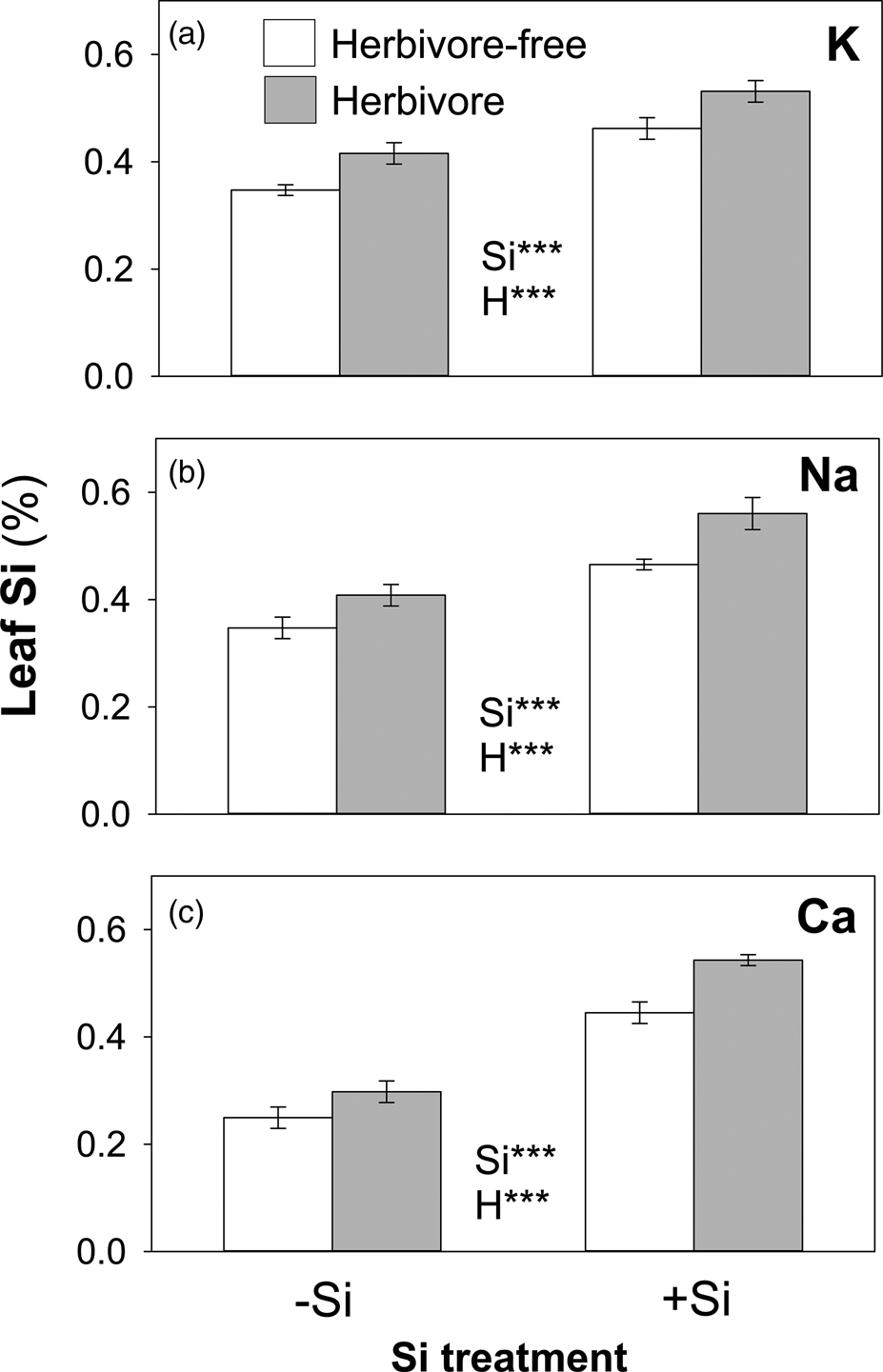
Leaf biomass was significantly reduced by herbivory but unaffected either by Si supplementation or type of Si supplementation (fig. 1, table 1). There was a significant interaction between Si addition and Si type (table 1) which reflected a significant positive effect of potassium silicate on leaf biomass when tests were conducted separately for each Si type (table S2). This was not observed for sodium silicate or calcium silicate (fig. 1b, c, respectively; table S2). Herbivory reduced leaf mass in potassium, sodium and calcium treatments, and there were no interactions between Si supplementation and herbivory (table S2). Leaf Si concentrations were increased by Si supplementation and herbivory for all Si types (fig. 2, table 1). Si concentrations were lowest in Ca-treated –Si plants which led to both Si type and the interaction between Si type and Si supplementation being statistically significant (table 1). Herbivory increased leaf Si concentrations across all treatments to a similar degree (fig. 2, table 1 and table S2).
Impacts of herbivory and Si supplementation on final leaf mass of +Si plants treated with (A) potassium silicate, (B) sodium silicate and (C) calcium silicate and –Si plants. Mean standard ± error shown, N = 10. Significant results of ANOVA tests for each carrier/Si type (see table S2) indicated for (Si) supplementation and (H)erbivory: *P < 0 0.05, **P < 0.01 and ***P < 0.001.

Impacts of herbivory and Si supplementation on leaf Si concentrations of +Si plants treated with (A) potassium silicate, (B) sodium silicate and (C) calcium silicate and –Si plants. Mean standard ± error shown, N = 10. Significant results of ANOVA tests for each carrier/Si type (see table S2) indicated for Si supplementation and (H)erbivory: ***P < 0.001.

Results of three-way ANOVA tests examining the effects of Si supplementation (–Si and +Si), herbivory (+ and –) and carrier/Si type (K, Na and Ca) on leaf biomass and leaf Si concentration

Statistically significant impacts (P < 0.05) indicated in bold.
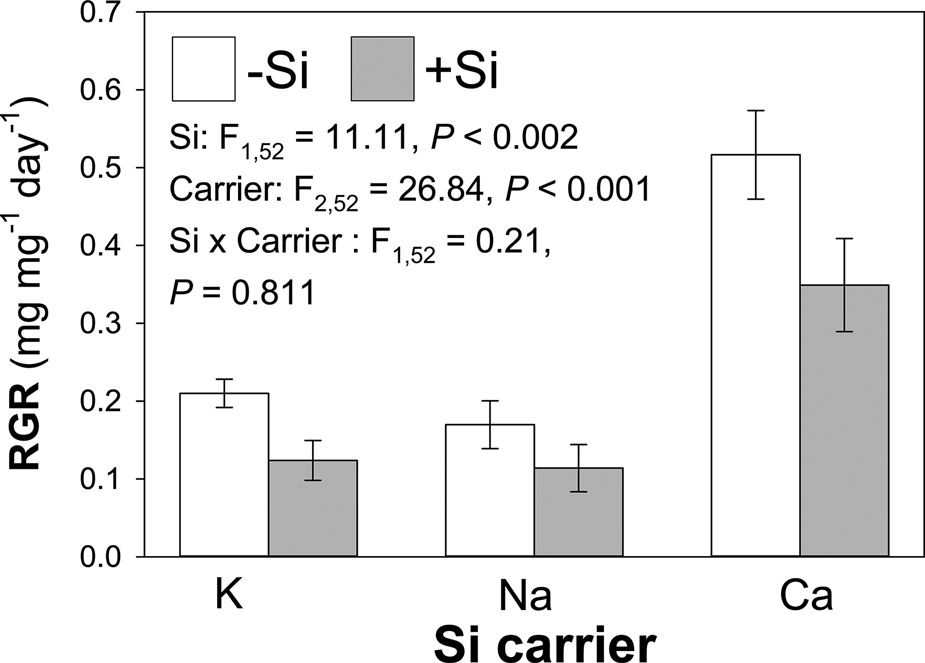
Herbivore RGR was significantly reduced by Si supplementation (fig. 3). Herbivore RGR was higher on Ca-treated –Si and +Si plants, which was reflected in the statistical significance of Si type (fig. 3). There was, however, no statistically significant interaction between Si supplementation and Si type indicating that herbivore growth was detrimentally affected to a similar extent regardless of how Si was being applied to the plants. There was a strong negative correlation between herbivore RGR and the concentration of Si in leaves (fig. 4).
Effects of Si supplementation on relative growth rates (RGR) of Helicoverpa punctigera. Mean standard ± error shown. N = 10 except for Na –Si and Ca +Si plants where N = 9 due to herbivore mortality.

Negative correlation between leaf Si concentrations and Helicoverpa punctigera relative growth rates (RGR) on –Si plants (open symbols) and +Si plants (grey symbols). See fig. 3 legend for details of N.

Discussion
To our knowledge, this is only the second report of Si-based defence against an insect herbivore in soybean. Moreover, we observed that Si is an inducible defence and that Si accumulation in foliage is directly related to reduced growth rates of H. punctigera. While concentrations of Si in foliage were low compared to many grasses, soybean clearly has the capacity to increase Si uptake over a relatively short period of time (<7 days) when under attack by insect herbivores.
Si uptake operates via passive and active mechanisms, the former driven largely by transpiration and hydraulic processes and the latter by active anion transporters (Ma and Yamaji, Reference Ma and Yamaji2015). Plants that acquire Si in excess of 1% of dry mass almost invariably have Si transporter genes that belong to nodulin 26-like intrinsic proteins (NIPs) (Deshmukh and Bélanger, Reference Deshmukh and Bélanger2016) including Lsi1, Lsi2 and Lsi6 genes (Ma and Yamaji, Reference Ma and Yamaji2006; Yamaji et al., Reference Yamaji, Mitatni and Ma2008). Si transporter genes have been identified in soybean, namely GmNIP2-1 and GmNIP2-2 (Deshmukh et al., Reference Deshmukh, Vivancos, Guérin, Sonah, Labbé, Belzile and Bélanger2013), and these are functionally similar to Lsi1 and Lsi2 in rice, respectively (Ma and Yamaji, Reference Ma and Yamaji2006). Moreover, of the 725 plant species listed by Hodson et al. (Reference Hodson, White, Mead and Broadley2005), soybean was ranked within the top 15% in terms of Si accumulation which suggests it has the capacity to take up Si in relatively large quantities. In the current study, Si concentrations were relatively low overall but rose rapidly once plants came under attack, which suggests that there was some degree of active control of Si uptake in soybean.
Ferreira et al. (Reference Ferreira, Moraes and Antunes2011) reported that Si supplementation of soybean did not affect oviposition but did reduce the survival of the Hemipteran B. tabaci, which suggests that Si may be active against a broader range of soybean pests. Interestingly, they also reported that Si reduced concentrations of phenolics which could have had defensive properties (Ferreira et al., Reference Ferreira, Moraes and Antunes2011). While this initially seems paradoxical, Si and phenolic concentrations are often negatively correlated, which is indicative of a defensive trade-off (Cooke and Leishman, Reference Cooke and Leishman2012; Johnson and Hartley, Reference Johnson and Hartley2018). Si might therefore be a particularly effective herbivore defence by itself despite it reducing the levels of other defensive chemicals (Frew et al., Reference Frew, Powell, Sallam, Allsopp and Johnson2016).
It is unclear why we saw generally higher rates of RGR on plants supplemented with calcium. Calcium is an important signalling component within plant defence responses with attacked plants sometimes showing increased concentrations in the foliage (e.g. Sarfraz et al., Reference Sarfraz, Dosdall and Keddie2009; Johnson et al., Reference Johnson, Cloyd, Nechols, Williams, Nelson, Rotenberg and Kennelly2012). One possible explanation is that increased baseline levels of calcium concentrations may have interfered with such processes and allowed faster herbivore development. Alternatively, while not as important as for vertebrate herbivores, calcium can also have nutritional value to insect herbivores (Thangavelu and Bania, Reference Thangavelu and Bania1990; Cohen, Reference Cohen2004). Regardless, the lack of significance (P = 0.81) in the interaction between Si supplementation and Si type clearly shows that the effects of Si supplementation were similar regardless of the carrier element.
While the negative impacts of herbivory on leaf biomass were not lessened with Si supplementation over the 6 days of herbivore exposure in the current study, it remains possible that this would have occurred as more Si was accumulated. Alternatively, Si-supplemented plants may have been able to tolerate the relatively lower levels of herbivory imposed by smaller herbivores on +Si plants (Johnson et al., Reference Johnson, Reynolds, Gurr, Esveld, Moore, Tory and Gherlenda2019). Having established the potential for Si defences in soybean in the current study, longer term experiments involving measurements of flowering, yield and nitrogen fixation would be useful to determine if these defences are truly beneficial for crop protection. Other studies have reported beneficial effects of Si supplementation on legume performance, including increased growth, root nodulation and nitrogen fixation (Nelwamondo and Dakora, Reference Nelwamondo and Dakora1999; Nelwamondo et al., Reference Nelwamondo, Jaffer and Dakora2001; Dakora and Nelwamondo, Reference Dakora and Nelwamondo2003; Johnson et al., Reference Johnson, Hartley, Ryalls, Frew, DeGabriel, Duncan and Gherlenda2017). Increased pest resistance arising from Si defences would be an important addition to the repertoire of benefits arising from Si supplementation of legumes.
Supplementary material
The supplementary material for this article can be found at https://doi.org/10.1017/S0007485319000798.
Acknowledgements
Jenni Kremer is thanked for technical assistance on the project which was funded by the Australian Research Council via grants awarded to SNJ (DP170102278 and FT170100342). CSIRO (Narrabri, Australia) provided insect material and Environmental Analysis Laboratory, Southern Cross University assisted with leaf Na analysis.