



1. Introduction
The theory of uniformly hyperbolic dynamical systems was initiated in the 1960s by Smale [Reference Smale23] and Anosov [Reference Anosov2], providing a detailed description of a large class of systems, often with very complex evolution. Since the 1970s, with the works of Abraham and Smale [Reference Abraham and Smale1], and Newhouse [Reference Newhouse21], it has been known that uniformly hyperbolic systems do not form a dense set of dynamical systems. In response weaker concepts emerged, such as the non-uniformly hyperbolic systems introduced by Pesin [Reference Pesin22] in 1977. These systems are characterized by having hyperbolic ergodic measures, that is, with all Lyapunov exponents non-zero. It took a few decades to demonstrate that non-uniformly hyperbolic systems are also not dense. Namely, Kleptsyn and Nalsky [Reference Kleptsyn and Nalsky18] constructed in 2007 a dynamical system on the torus  $\mathbb{T}^3$ with a robustly zero Lyapunov exponent. Later, in 2016, Bochi, Bonatti, and Díaz [Reference Bochi, Bonatti and Díaz7] presented new open sets of diffeomorphisms in higher-dimensional manifolds with non-hyperbolic ergodic measures, i.e., with zero exponents. The result shown by Kleptsyn and Nalsky is based on a toy model built a few years earlier by Gorodetski, Ilyashenko, Kleptsyn, and Nalsky [Reference Gorodetski, Ilyashenko, Kleptsyn and Nalsky17]. In this paper, we will show that the existence of non-hyperbolic ergodic measures is abundant in the class of transitive skew products associated with iterated function systems (IFS) where the toy models in [Reference Gorodetski, Ilyashenko, Kleptsyn and Nalsky17] were constructed.
An IFS on  $\mathbb{S}^1$ is a family of functions
 $\mathscr{F}=\{f_1,\dots,f_k\}$ from the circle
 $\mathbb{S}^1$ to itself that can be applied (composed) successively in any order. Therefore, such compositions are elements of the semigroup
 $\langle \mathscr{F} \rangle^+$ associated with these transformations. Moreover, the sequence of compositions can be seen as the fibre of the iterations of the locally constant (or one-step) skew product
 \begin{equation}
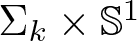
F:\Sigma_k\times \mathbb{S}^1 \to \Sigma_k \times \mathbb{S}^1, \qquad
F^n(\omega,x)=(\sigma^n(\omega),f^n_\omega(x))
\end{equation}
where at the base we have the shift  $\sigma:\Sigma_k\to \Sigma_k$ and
 \begin{equation*}
f^n_\omega\stackrel{\scriptscriptstyle\rm def}{=} f_{\omega_{n-1}}\circ \dots \circ
f_{\omega_0} \quad \text{for} \ \
\omega=(\omega_i)_{i\geq 0} \in \Sigma_k\stackrel{\scriptscriptstyle\rm def}{=}
\{1,\dots,k\}^{\mathbb{N}} \quad \text{and} \quad n\geq 1.
\end{equation*}
To emphasize the role of the fibre maps and the product structure, we will write  $F=\sigma \lt imes \mathscr{F}$.
Given an ergodic  $F$-invariant measure
 $\mu$, Birkhoff’s Ergodic Theorem guarantees the existence of the limit
 \begin{equation*}
\lambda(\omega,x)=\lim_{n\to \infty} \frac{1}{n}\log |(f^n_\omega)'(x)| \quad \text{for }\ \mu-\text{a.e}.~(\omega, x)\in \Sigma_k\times
\mathbb{S}^1.
\end{equation*}
In fact
 \begin{equation}
\lambda(\mu)\stackrel{\scriptscriptstyle\rm def}{=} \int \log |(f_{\omega})'(x)| \, d\mu
=\lambda(\omega,x) \quad \text{for}\ \mu-\text{a.e}\ (\omega,x)\in \Sigma_k\times
\mathbb{S}^1.
\end{equation}
The value  $\lambda(\mu)$ is called the Lyapunov exponent along the fibre of the skew product
 $F$ with respect to the measure
 $\mu$.
For  $r\geq 1$ and
 $k\geq 2$, we denote by
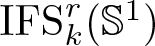 $\operatorname{\mathrm{IFS}}_k^r(\mathbb{S}^1)$ the set of families
 $\mathscr{F}=\{f_1,\dots,f_k\}$ with
 $f_i$ belongs to the space
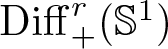 $\mathrm{Diff}^r_+(\mathbb{S}^1)$ of orientation-preserving diffeomorphisms of the circle equipped with the
 $C^r$-topology. Moreover, we say that
 $\mathscr{F}=\{f_1,\dots,f_k\}$ and
 $\mathscr{G}=\{g_1,\dots,g_k\}$ are
 $C^r$-close if, by reordering the elements families if necessary,
 $f_i$ and
 $g_i$ are
 $C^r$-close for every
 $i=1,\dots,k$. We define
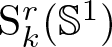 $\mathrm{S}_{k}^{r}(\mathbb{S}^{1})$ as the set of skew products
 $F=\sigma \lt imes \mathscr{F}$, where
 $\mathscr{F}\in \operatorname{\mathrm{IFS}}_k^r(\mathbb{S}^1)$. We endow
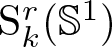 $\mathrm{S}_{k}^{r}(\mathbb{S}^{1})$ with a topology, stating that
 $F=\sigma \lt imes \mathscr{F}$ is close to
 $G=\sigma \lt imes \mathscr{G}$ if
 $\mathscr{F}$ and
 $\mathscr{G}$ are
 $C^r$-close.
Gorodetski et al. [Reference Gorodetski, Ilyashenko, Kleptsyn and Nalsky17] constructed an open set  $\mathcal{U}$ in
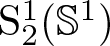 $\mathrm{S}_2^1(\mathbb{S}^1)$ such that each
 ${F}\in \mathcal{U}$ has an ergodic invariant measure
 $\mu$ with
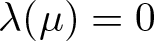 $\lambda(\mu)=0$. Such measures are approximated by periodic measures with a specific tail structure and called
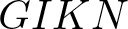 $GIKN$-measures or royal measures, c.f. [Reference Kwietniak and Łaçka19]. Originally in [Reference Gorodetski, Ilyashenko, Kleptsyn and Nalsky17], it is shown that this open set can be constructed as a
 $C^r$-neighbourhood of a skew product
 $G=\sigma \lt imes \mathscr{G}$ with
 $\mathscr{G}=\{g_1,g_2\}$ where
 $g_1$ is an irrational rotation and
 $g_2$ has a pair of hyperbolic periodic points with additional conditions on the eigenvalues. Later, Bochi et al. [Reference Bochi, Bonatti and Díaz6] generalized this result for IFSs on compact manifolds of higher dimension. In fact, they constructed open sets of IFSs in the
 $C^r$ topology for
 $r\geq2$ where the associated skew products have an ergodic invariant measure, limit in the weak
 $^*$ topology of periodic measures, with full support, and where all Lyapunov exponents along the fibres are zero. It is worth noting that the measures obtained by the method of approximation by periodic orbits typically have zero entropy, as proved in [Reference Kwietniak and Łaçka19]. Further developments regarding the construction of non-hyperbolic measures include the
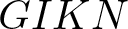 $GIKN$ method based on so-called flip-flop families introduced in [Reference Bochi, Bonatti and Díaz7, Reference Bonatti, Díaz and Bochi8], which provides a set of positive entropy supporting only non-hyperbolic measures. More recently, ‘mixed’ methods combining the
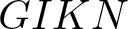 $GIKN$ and flip-flop approaches have established the robust existence of non-hyperbolic ergodic measures with both positive entropy and full support [Reference Bonatti, Díaz and Kwietniak10, Reference Łaçka20]. For a detailed survey of these results, we refer the reader to [Reference Díaz13].
A skew product 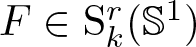 $F\in \mathrm{S}_{k}^{r}(\mathbb{S}^{1})$ is said to be transitive if there has a dense orbit. We denote by
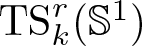
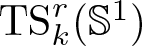
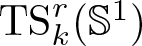 $\mathrm{TS}_k^r(\mathbb{S}^1)$ the subset of
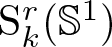 $\mathrm{S}_{k}^{r}(\mathbb{S}^{1})$ formed by transitive skew products. The open set of skew products constructed in [Reference Gorodetski, Ilyashenko, Kleptsyn and Nalsky17] is contained in this set. The following main result shows that any transitive skew product can be approximated by an open (in
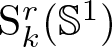 $\mathrm{S}^r_k(\mathbb{S}^1)$) set of transitive skew products having a non-hyperbolic ergodic measure with full support. This concludes affirmatively the conjecture [Reference Bonatti, Díaz and Gorodetski9, Conj. 2] in our setting.
Theorem A.
For  $k\geq 2$ and
 $1\leq r\leq \infty$, there exists an open and dense subset
 $\mathcal{R}$ of
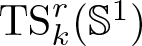 $\mathrm{TS}_{k}^{r}(\mathbb{S}^{1})$ such that for every
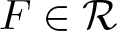 $F\in\mathcal{R}$ there is an ergodic
 $F$-invariant probability measure
 $\mu$ with full support whose Lyapunov exponent
 $\lambda(\mu)$ is equal to zero. The probability measure
 $\mu$ is a
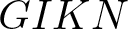 $GIKN$-measure.
The  $C^1$-density of maps with non-hyperbolic ergodic invariant measures, as in the above theorem, was stated in [Reference Díaz, Gelfert and Rams12, Cor. 2 and 8.10] on the set of all locally constant skew products with
 $C^1$-fibre maps that are robustly transitive and have periodic points of different indices. Although the result in [Reference Díaz, Gelfert and Rams12] is stated for Hölder skew products, the approximation by locally constant skew products in cylinders proposed is not clear. This result is a corollary of Proposition 8.9 in [Reference Díaz, Gelfert and Rams12], which is not fully proved. The authors observe that the proof of a similar result in [Reference Bonatti, Díaz and Ures11] for partially hyperbolic diffeomorphisms of compact manifolds can be translated mutatis mutandis to obtain such a proposition in the locally constant skew product setting. The results in [Reference Bonatti, Díaz and Ures11] show the density of the strong unstable (strong stable) foliation, and the authors in [Reference Díaz, Gelfert and Rams12] translate this property to the locally constant skew product setting as the forward (backward) minimality of the underlying IFS. However, this translation is incorrect: while the minimality of the strong unstable foliation implies the forward minimality of the IFS, the converse does not hold. As demonstrated by the counterexamples in [Reference Barrientos and Cisneros3, Cor. 6.10], there exist IFSs that are forward minimal, yet their associated strong unstable foliations are not minimal. Consequently, establishing the density of minimal IFSs is insufficient to deduce the density of minimal strong foliations, leaving the proof in [Reference Díaz, Gelfert and Rams12] incomplete. Nevertheless, according to [Reference Barrientos and Cisneros3, Thm. B], it follows that the set of skew products having both strong stable and strong unstable foliations also contains an open and dense subset of
 $\mathrm{TS}^r_k(\mathbb{S}^1)$. Consequently, the set
 $\mathcal{R}$ in Theorem A not only satisfies the conclusions of the theorem but can also be chosen to include this additional geometric property.
In §2, we revisit the proof of a key result from Gorodetski et al. [Reference Gorodetski, Ilyashenko, Kleptsyn and Nalsky17], which introduced the method of approximation by periodic orbits. This method serves as a fundamental tool for our main theorem. Later works [Reference Bochi, Bonatti and Díaz6, Reference Bonatti, Díaz and Gorodetski9, Reference Díaz and Gorodetski14] refined and extended this approach. By incorporating these refinements, we simplify and improve the original proof given in [Reference Gorodetski, Ilyashenko, Kleptsyn and Nalsky17]. In §3, we use this framework and recent results from [Reference Barrientos and Cisneros3] to prove Theorem A.
2. Ergodic non-hyperbolic measure with full support
To prove Theorem A, we need the following slight generalization of [Reference Gorodetski, Ilyashenko, Kleptsyn and Nalsky17, Thm. 2]. First, we recall some definitions.
A finite family  $\mathscr{F}$ of circle diffeomorphisms is
– minimal if for every
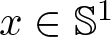
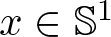
 $x\in \mathbb{S}^1$ the orbit
$\mathcal{O}(x)=\{f(x): f\in \langle \mathscr{F}\rangle^+ \}$ is a dense set in
$\mathbb{S}^1$;
– expanding if for every
$x\in \mathbb{S}^1$, there is
$f$ in
$\langle \mathscr{F}\rangle^+$ such that
$|(f^{-1})'(x)| \gt 1$.





We say that  $\mathscr{F}$ is backward minimal and backward expanding if the family
 $\mathscr{F}^{-1}=\{f^{-1}: f\in \mathscr{F}\}$ is minimal and expanding, respectively.
Theorem 2.1. For any  $k\geq 2$, consider the skew product
 $F=\sigma \lt imes \mathscr{F}$ where
 $\mathscr{F}=\{f_1,\dots,f_k\}$ is a family of circle
 $C^1$-diffeomorphisms such that
(i)
$\mathscr{F}$ is minimal;(ii)
$\mathscr{F}$ is backward expanding;(iii) there exists
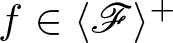
$f\in \langle\mathscr{F}\rangle^+$ with a hyperbolic attracting periodic point.


Then  $F$ has an ergodic invariant measure
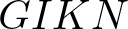
 $\mu$ with full support, which is a
 $GIKN$-measure and satisfies
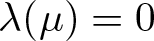 $\lambda(\mu)=0$.
The method of approximation by periodic orbits, introduced in [Reference Gorodetski, Ilyashenko, Kleptsyn and Nalsky17], is a central tool for constructing the non-hyperbolic invariant measures in the above theorem. However, the property of full support of the limit measure was not directly proven in [Reference Gorodetski, Ilyashenko, Kleptsyn and Nalsky17]. This property was obtained later in [Reference Bochi, Bonatti and Díaz6] for skew products with higher-dimensional fibre space by spreading the sequence of periodic points in the ambient space using previous results from [Reference Bonatti, Díaz and Gorodetski9]. In what follows, we replicate these ideas to demonstrate the above theorem.
2.1. Preliminaries
In this section, we collect some results from [Reference Barrientos, Fakhari, Malicet and Sarizadeh4, Reference Bochi, Bonatti and Díaz6, Reference Bonatti, Díaz and Gorodetski9, Reference Díaz and Gorodetski14, Reference Gorodetski, Ilyashenko, Kleptsyn and Nalsky17] that will be used in the proof of Theorem 2.1.
The following proposition, which follows directly from the definition of weak $^*$ topology and (2), is fundamental to the Lyapunov exponent approximation method.
Proposition 2.2. Let 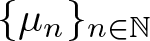 $\{\mu_n\}_{n \in \mathbb{N}}$ and
 $\mu$ be invariant ergodic probability measures for the skew product
 $F = \sigma \lt imes \mathscr{F}$. If
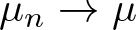 $\mu_n \to \mu$ as
 $n \to \infty$ in the weak
 $^*$ topology, then
 $\lambda(\mu_n) \to \lambda(\mu)$ as
 $n \to \infty$.
Given an  $n$-periodic orbit
 \begin{equation*}
X = \left\{ G(x_0), G^2(x_0), \dots, G^{n-1}(x_0), G^n(x_0) = x_0 \right\}
\end{equation*}
of a continuous map  $G$ on a compact metric space, the atomic measure uniformly distributed on
 $X$ is defined by
 \begin{equation*}
\mu_X = \frac{1}{n} \sum_{i=0}^{n-1} \delta_{G^i(x_0)},
\end{equation*}
where  $\delta_y$ denotes the Dirac measure at the point
 $y$. This measure is
 $G$-invariant and ergodic.
Definition 2.3. Let  $X$ and
 $Y$ be periodic orbits of
 $G$. Given
 $\gamma \gt 0$ and
 $\aleph \gt 0$, we say that
 $Y$ is a
 $(\gamma, \aleph)$-good approximation of
 $X$ if the following conditions hold:
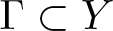
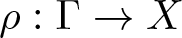
(i) There exists a subset
$\Gamma \subset Y$ and a projection
$\rho : \Gamma \to X$ such that
$d(G^j(y), G^j(\rho(y))) \lt \gamma$ for all
$y \in \Gamma$ and all
$j = 0, 1, \dots, P-1$, where
$P$ is the period of
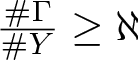
$X$;(ii)
$\frac{\#\Gamma}{\#Y} \geq \aleph$;(iii)
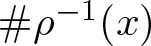
$\#\rho^{-1}(x)$ is the same for all
$x\in X$.





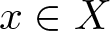
Definition 2.4. We refer to a sequence 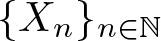 $\{X_n\}_{n \in \mathbb{N}}$ of
 $G$-periodic orbits, where
 $\#X_n\to \infty$ as
 $n\to \infty$, as a
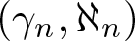
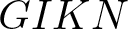 $GIKN$-sequence if there exist sequences of positive real numbers
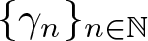 $\{\gamma_n\}_{n\in\mathbb{N}}$ and
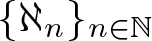 $\{\aleph_n\}_{n\in\mathbb{N}}$ that satisfy:
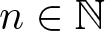
(1) For each
$n \in \mathbb{N}$, the orbit
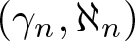
$X_{n+1}$ is a
$(\gamma_n, \aleph_n)$-good approximation of
$X_n$;(2)
$\sum_{n=1}^\infty \gamma_n \lt \infty$;(3)
$\prod_{n=1}^\infty \aleph_n \in (0, 1]$.




By an abuse of terminology, we will also refer to the sequence of atomic measures 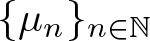 $\{\mu_n\}_{n\in\mathbb{N}}$ uniformly distributed over the orbit
 $X_n$, as to
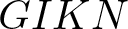 $GIKN$-sequence of measures.
The next result corresponds to [Reference Bonatti, Díaz and Gorodetski9, Lem. 2.5], which refines [Reference Díaz and Gorodetski14, Prop. 2.5]. Compare also with [Reference Gorodetski, Ilyashenko, Kleptsyn and Nalsky17, Lem. 2 and Section 8].
Theorem 2.5. Let 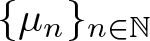 $\{\mu_n\}_{n\in\mathbb{N}}$ be the
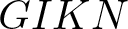 $GIKN$-sequence of ergodic measures associated with a sequence of
 $G$-periodic orbits
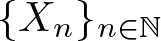 $\{X_n\}_{n \in \mathbb{N}}$. Then
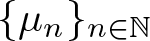 $\{\mu_n\}_{n \in \mathbb{N}}$ weak
 $^*$ converges to an ergodic measure
 $\mu$ supported on the topological limit of
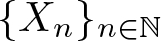 $\{X_n\}_{n \in \mathbb{N}}$, that is,
 \begin{equation*}
\mathrm{supp}~\mu = \bigcap_{k=1}^\infty \overline{\bigcup_{l=k}^\infty X_l}.
\end{equation*}
Definition 2.6. A measure  $\mu$ is
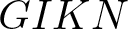 $GIKN$-measure if it is a weak
 $^*$ limit of a
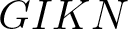 $GIKN$-sequence.
Given a finite word  $\bar{\omega} = \bar{\omega}_0 \bar{\omega}_1 \dots \bar{\omega}_{P-1}$ in the alphabet
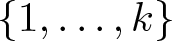 $\{1, \dots, k\}$, i.e., a sequence of length
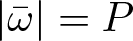 $|\bar{\omega}| = P$ with
 $\bar{\omega}_j \in \{1, \dots, k\}$ for
 $j = 0, 1, \dots, P-1$, we define the cylinder
 \begin{equation*}
[[ \bar{\omega} ]] \stackrel{\scriptscriptstyle\rm def}{=} \{ \omega = (\omega_i)_{i \geq 0} \in \Sigma_k : \omega_i = \bar{\omega}_i \text{ for } i = 0, \dots, |\bar{\omega}|-1 \},
\end{equation*}
the composition
 \begin{equation*}
T_{\bar{\omega}} \stackrel{\scriptscriptstyle\rm def}{=} f_{\bar{\omega}_{P-1}} \circ f_{\bar{\omega}_{P-2}} \circ \dots \circ f_{\bar{\omega}_0},
\end{equation*}
and use 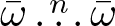 $\bar{\omega}\,\overset{n}{\ldots}\,\bar{\omega}$ to represent the concatenation of
 $n$ copies of
 $\bar{\omega}$. Furthermore, the infinite concatenation of copies of
 $\bar{\omega}$ is denoted by
 $\bar{\omega}^\infty$.
Remark 2.7. Clearly, if 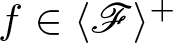 $f\in\langle \mathscr{F} \rangle^+$, then there is an integer
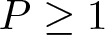 $P\geq 1$ and a finite word
 $\bar{\omega}=\bar{\omega}_0 \bar{\omega}_1 \dots \bar{\omega}_{P-1}$ such that
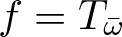 $f=T_{\bar{\omega}}$. Furthermore, if
 $f$ has a fixed point
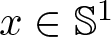 $x\in\mathbb{S}^1$, then
 $z=(\bar{\omega}^\infty,x)\in\Sigma_k\times\mathbb{S}^1$ is a
 $P$-periodic point of the skew product
 $F = \sigma \lt imes \mathscr{F}$. Hence,
 $f$ generates a
 $P$-periodic orbit
 $X=\{z,F(z),\dots,F^{P-1}(z)\}$ of the skew product
 $F$, where
 $P$ is the number of maps in
 $\mathscr{F}$ generating
 $f$.
One advantage of using an atomic periodic measure for the skew product  $F = \sigma \lt imes \mathscr{F}$ is that its Lyapunov exponent can be computed explicitly. This leads to the following proposition:
Proposition 2.8. Consider 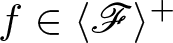 $f \in \langle \mathscr{F} \rangle^+$ with a fixed point
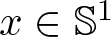 $x \in \mathbb{S}^1$. Let
 $X$ be the
 $P$-periodic orbit of the skew product
 $F = \sigma \lt imes \mathscr{F}$ generated by
 $f$. Then,
 \begin{equation*}
\lambda(\mu_X) = \frac{1}{P} \log |f'(x)|,
\end{equation*}
where  $\mu_X$ denotes the atomic measure uniformly distributed over
 $X$.
The following lemma from [Reference Bochi, Bonatti and Díaz6, Lem. 6.3] provides a key tool for establishing density properties of orbits.
Lemma 2.9. Assume that  $\mathscr{F}$ is minimal. Then, for any
 $\eta \gt 0$ and any non-empty open set
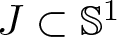 $J \subset \mathbb{S}^1$, there exist constants
 $\delta_0 = \delta_0(\eta, J) \gt 0$ and
 $K = K(\eta, J) \in \mathbb{N}$ such that for every open interval
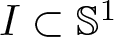 $I \subset \mathbb{S}^1$ with length at most
 $\delta_0$, there exists a finite word
 $\bar{\omega}$ in the alphabet
 $\{1, 2, \dots, k\}$ with
 $|\bar{\omega}| = R \leq K$ satisfying:
(I) For every
$(\omega, x) \in [[ \bar{\omega} ]] \times I$, the segment of the orbit of
$F = \sigma \lt imes \mathscr{F}$,
is
\begin{equation*}
F^{[0,R]}(\omega, x) \stackrel{\scriptscriptstyle\rm def}{=} \{ F^j(\omega, x) : 0 \leq j \leq R \},
\end{equation*}
$\eta$-dense in
$\Sigma_k \times \mathbb{S}^1$;(II)
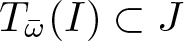
$T_{\bar{\omega}}(I) \subset J$.




The following proposition, which appears in [Reference Gorodetski, Ilyashenko, Kleptsyn and Nalsky17, Prop. 3], provides a complementary result about the control of intervals under compositions of the generators of  $\mathscr{F}$.
Proposition 2.10. If  $\mathscr{F}$ is minimal, then for any interval
 $J$ in
 $\mathbb{S}^1$, there exist constants
 $K_0 = K_0(J) \in \mathbb{N}$ and
 $\delta_0 = \delta_0(J) \gt 0$ such that any interval
 $I$ with length smaller than
 $\delta_0$ can be mapped into
 $J$ by some composition of at least
 $K_0$ generators of
 $\mathscr{F}$.
Proof. Assume Lemma 2.9 holds. Take any  $\eta \gt 0$. Fix
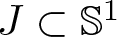 $J\subset\mathbb{S}^1$. Use Lemma 2.9 to find
 $\delta_{0}=\delta_{0}(\eta,J)$ and
 $K=K(\eta,J)$. Cover
 $\mathbb{S}^1$ with finitely many intervals of length
 $\delta_{0}/{2}$. Denote the interval forming that cover by
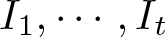 $I_{1},\cdots,I_{t}$. Applying Lemma 2.9 to each
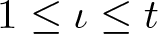 $1\leq \iota\leq t$ we find a word
 $\omega(\iota)$ with
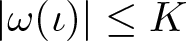 $|\omega(\iota)|\leq K$ such that
 $T_{\omega(\iota)}(I_{\iota})\subset J$. Let
 $K'_{0}=\min\{|\omega(\iota)|: 1\leq\iota\leq t\}$. Let
 $\delta'_{0}$ be the Lebesgue number for our cover. Now consider any interval
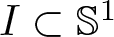 $I\subset\mathbb{S}^1$ with length less that
 $\delta'_{0}$. There is
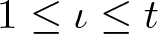 $1\leq\iota\leq t$ such that
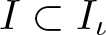 $I\subset I_{\iota}$ and
 $I$ is mapped into
 $J$ by a composition of
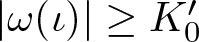 $|\omega(\iota)|\geq K'_{0}$ generators of
 $\mathscr{F}$. Hence,
 $\delta'_{0}$ and
 $K'_{0}$ are constants needed to establish Proposition 2.10.
Finally, the following proposition is an immediate consequence of [Reference Barrientos, Fakhari, Malicet and Sarizadeh4, Lem. 3.1] and provides key properties of backward expanding systems.
Proposition 2.11. Assume that  $\mathscr{F}$ is backward expanding. Then there exist constants
 $\nu \gt 1$, functions
 $h_1, \dots, h_m \in \langle \mathscr{F} \rangle^+$, and open intervals
 $B_1, \dots, B_m$ of
 $\mathbb{S}^1$ such that:
(a)
$\mathbb{S}^1 = B_1 \cup B_2 \cup \dots \cup B_m$;(b)
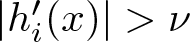
$|h'_i(x)| \gt \nu$ for all
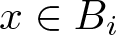
$x \in B_i$ and
$i = 1, 2, \dots, m$.


2.2 Main lemma
This lemma is an improved version of [Reference Gorodetski, Ilyashenko, Kleptsyn and Nalsky17, Lemma 3] where we spread the constructed periodic orbits densely on 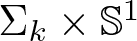 $\Sigma_k\times \mathbb{S}^1$.
Lemma 2.12. Consider  $F=\sigma \lt imes \mathscr{F}$ and assume that
(i)
$\mathscr{F}$ is minimal ;(ii)
$\mathscr{F}$ is backward expanding;(iii) there exists
$f\in \langle\mathscr{F}\rangle^+$ with a hyperbolic attracting periodic point.


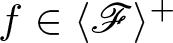
Then, there exist  $0 \lt c \lt 1$ and
 $d \gt 0$ depending only on
 $\mathscr{F}$, such that if
 $X$ is the
 $P$-periodic orbit of
 $F$ generated by
 $f$, then for every
 $\gamma \gt 0$ and
 $\eta \gt 0$, there exists a periodic orbit
 $X'$ of
 $F$ with period
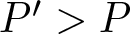 $P' \gt P$ with the following properties:
(1)
$ c \cdot \lambda(\mu_{X}) \lt \lambda(\mu_{X'}) \lt 0$;(2)
$X'$ is
$(\gamma,\aleph)$-good approximation of
$X$ where
$\aleph\stackrel{\scriptscriptstyle\rm def}{=} 1-d\cdot |\lambda(\mu_{X})|$;(3)
$X'$ is
$\eta$-dense in
$\Sigma_k\times\mathbb{S}^1$.






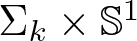
Proof. First, let us prove the existence of the periodic orbit  $X'$ of
 $F$ with a period greater than
 $P$. Since
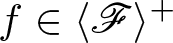 $f \in \langle\mathscr{F} \rangle^{+}$, there exists a finite word
 $\hat{\omega}$ such that
 $f = T_{\hat{\omega}}$ and
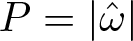 $P=|\hat{\omega}|$. Let
 $x$ be the attracting periodic point for
 $f$, meaning
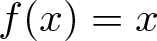 $f(x) = x $ and
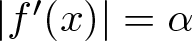 $|f'(x)| = \alpha $ where
 $ 0 \lt \alpha \lt 1 $. Let us take constants
 $\alpha_{-} $ and
 $ \alpha_{+} $ such that
 \begin{equation}
0 \lt \alpha_{-} \lt \alpha \lt \alpha_{+} \lt 1.
\end{equation}
Fix  $\gamma \gt 0$. By the continuity of
 $f'$, there is an interval
 $J $ containing
 $x$ such that
 \begin{equation}
0 \lt \alpha_{-} \leq |f'(y)| \leq \alpha_{+} \lt 1 \quad \text{for all}\ y\in J, \quad\text{and}\quad L^{2P}|J| \lt \gamma,
\end{equation}
where we denote by  $|I|$ the length of an interval
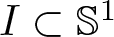 $I\subset \mathbb{S}^{1}$ and
 $L\stackrel{\scriptscriptstyle\rm def}{=}\max\{\|g'\|_\infty: g\in \mathscr{F}\}$.
From (i) and Lemma 2.9, for  $J$ and
 $\eta \gt 0$, there exist
 $\delta_{0} = \delta_{0}(J,\eta) \gt 0$ and
 $K = K(J,\eta) \in \mathbb{N}$ such that (I) and (II) hold. On the other hand, from (ii) and Proposition 2.11, there exist a constant
 $\nu \gt 1$, diffeomorphisms
 $h_{1},\dots,h_{m}\in\langle \mathscr{F}\rangle^+$, and open intervals
 $B_{1},\dots,B_{m}$ of
 $\mathbb{S}^{1}$ such that (a) and (b) hold. Let
 $\lambda \gt 0$ be the Lebesgue number of the cover in (a). Recall that this means any interval of length less than
 $\lambda$ is contained in some
 $B_i$. Let us set
 \begin{equation}
L_{1}=\max\{\|h'_{i}\|_{\infty}: i=1,\dots,m\} \gt 1 \quad \text{and} \quad
\delta=\min\{\delta_{0},|J|L^{-K},\lambda/L_1\} \gt 0.
\end{equation}
For each 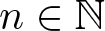 $n \in \mathbb{N}$ sufficiently large, we take
 $r = r(n) \in \mathbb{N}$ to be the unique integer such that
 \begin{equation}
0 \lt \frac{\log \frac{\alpha_+^{-n} \delta}{L_1|J|}}{\log L_1} \leq r \lt \frac{\log \frac{\alpha_+^{-n} \delta}{L_1|J|}}{\log
L_1} + 1 = \frac{\log\frac{\alpha_+^{-n}\delta}{|J|}}{\log L_1}.
\end{equation}
Note that it holds
 \begin{equation}
\frac{\delta}{L_{1}}\leq\alpha_{+}^nL_{1}^{r}|J| \lt \delta.
\end{equation}
Since 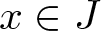 $x \in J$ is an attracting fixed point of
 $f$, using the Intermediate Value Theorem, the condition
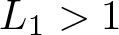 $L_{1} \gt 1$, and (4), (7) and (5), we have
 $ |f^n(J)|\leq \alpha_+^n |J| \leq \alpha^n_+ L_1^{r} |J| \lt \delta \lt \lambda$. Thus, there exists
 $i_1\in\{1,\dots,m\}$ such that
 $f^n(J)\subset B_{i_1} $. Similarly, since
 \begin{equation*}|h_{i_1}f^n(J)|\leq \alpha_+^n
L_1|J|\leq \alpha_+^n L_1^{r}|J| \lt \delta \lt \lambda,
\end{equation*}
we obtain  $i_2\in \{1,\dots,m\}$ such that
 $h_{i_1}f^n(J)\subset B_{i_2}$. Proceeding recursively, we obtain
 $i_1,\dots,i_r\in \{1,\dots,m\}$ such that
 \begin{equation}
f^n(J)\subset B_{i_1} \ \ \text{and} \ \ h_{i_j}\dots h_{i_1}f^n(J)\subset B_{i_{j+1}}
\
\text{for every}\ j=1,\dots,r-1.
\end{equation}
Denote by  $\bar{\kappa}_0=\hat{\omega}\,\overset{n}{\ldots}\,\hat{\omega}$ and consider the finite word
 $\bar{\kappa}_1$ such that
 $ T_{\bar{\kappa}_1}=h_{i_r}\circ \dots \circ h_{i_1}$. Then, using the Intermediate Value Theorem again, observing that
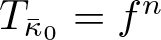 $T_{\bar\kappa_0}=f^n$ and due to (8), (4), and (b), we have
 \begin{equation}
\alpha^n_- \nu^r|J| \leq |T_{\bar\kappa_1}T_{\bar\kappa_0}(J)|\leq L_{1}^{r}\alpha_{+}^{n}|J|.
\end{equation}
Let  $I=T_{\bar\kappa_1}T_{\bar\kappa_0}(J)$. Then, from equations (7), (9), it follows that
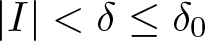 $|I| \lt \delta \leq\delta_0$. Thus, by the definition of
 $\delta_{0}=\delta_{0}(J,\eta)$ and (II), there exists a finite word
 $\bar\kappa_2$, with
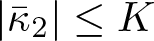 $|\bar\kappa_2|\leq K$, such that
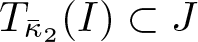 $T_{\bar\kappa_2}(I)\subset J$. Therefore,
 $T_{\bar\kappa_2}T_{\bar\kappa_1}T_{\bar\kappa_0}(J)\subset J$ by the definition of
 $I$. Taking the finite word
 $\bar{\omega}=\bar\kappa_0\bar\kappa_1\bar\kappa_2$, we have
 $T_{\bar{\omega}}=T_{\bar\kappa_2}\circ T_{\bar{\kappa}_1}\circ T_{\bar\kappa_0}$, and thus,
 \begin{equation}
T_{\bar{\omega}}(J)\subset J \quad \text{with} \quad |\bar{\omega}|=nP+|\bar\kappa_1|+|\bar\kappa_2| \gt P.
\end{equation}
From 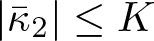 $|\bar\kappa_2|\leq K$, (5), and (7), we have
 \begin{equation}
|T'_{\bar{\omega}}(y)|\leq L^KL_1^r\alpha_+^n \lt L^{K} \frac{\delta}{|J|}\leq L^{K}\frac{|J|L^{-K}}{|J|}=1
\quad \text{for all} \quad y\in J.
\end{equation}
Hence, (10) and (11) imply that  $T_{\bar{\omega}}$ is a contraction on
 $J$. Therefore, by the Banach Fixed-Point Theorem,
 $T_{\bar{\omega}}$ has a unique fixed point
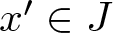 $x'\in J$. Finally, by Remark 2.7, there exists a periodic orbit
 $X'$ generated by
 $T_{\bar{\omega}}$ with period
 $P'=|\bar{\omega}| \gt P$.
It should be noted that the previous argument holds for any sufficiently large integer  $n$ and constants
 $\alpha_+$ and
 $\alpha_-$ satisfying (3). Furthermore, since
 $\bar\kappa_2$ is the finite word given by Lemma 2.9 and the fact that
 $\sigma^{nP+\bar{\kappa}_1}(\bar{\omega}^\infty)\in [[\bar\kappa_2]]$, it follows from (I) that
 \begin{equation*}F^{[0,|\bar\kappa_2|]}\left(\sigma^{nP+\bar{\kappa}_1}(\bar{\omega}^\infty), T_{\bar\kappa_1}T_{\bar\kappa_0}(x')\right),\end{equation*}
is  $\eta$-dense in
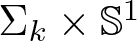 $\Sigma_k\times\mathbb{S}^1$. Since
 $F^{[0,|\bar\kappa_2|]}\left(\sigma^{nP+\bar{\kappa}_1}(\bar{\omega}^\infty), T_{\bar\kappa_1}T_{\bar\kappa_0}(x')\right)\subset X'$, it follows that the orbit
 $X'$ is
 $\eta$-dense in
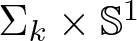 $\Sigma_k\times\mathbb{S}^1$, thus proving Item (3).
Now let us calculate the Lyapunov exponent along the fibre with respect to the measure  $\mu_{X'}$. For this, according to (9), we have
 $
|T'_{\bar{\omega}}(x')|\geq
|T'_{\bar\kappa_2}(T_{\bar{\kappa}_1}T_{\bar\kappa_0}(x'))|\,
\alpha_-^n\nu^r \geq e^{C_1} \alpha_-^n \nu^r
$, where
 \begin{equation}
C_1=\min \{ \log |DT_{\bar\kappa}(y)|: \, y\in \mathbb{S}^1 \ \text{and} \ |\bar\kappa| \lt K \}.
\end{equation}
Thus, we have
 \begin{equation}
\log|T'_{\bar{\omega}}(x')| \gt C_{1}+r\log\nu+n\log\alpha_{-}.
\end{equation}
Substituting (6) into (13), we get
 \begin{equation}
\begin{aligned}
\log|T'_{\bar{\omega}}(x')| & \gt C_{1}+ \frac{\log \nu}{\log L_1}
\log \frac{\alpha_+^{-n}\delta}{L_1 |J|} +n\log\alpha_{-}\\
& = C_{1}+ C_2 + n\, ( \log \alpha_- - \frac{\log \nu}{\log L_1}\log
\alpha_+)
\end{aligned}
\end{equation}
where
 \begin{equation}
C_2=\frac{\log \nu}{\log L_1} \log \frac{\delta}{L_1 |J|}.
\end{equation}
Taking into account that  $0 \lt \alpha \lt 1$ and
 $1 \lt \nu \lt L_1$,
 \begin{equation*}
(1-\frac{2\log\nu}{3\log L_{1}})\log \alpha \lt (1-\frac{\log\nu}{\log L_{1}})\log \alpha \lt 0.
\end{equation*}
Thus, since
 \begin{equation*}
\lim_{(\alpha_-,\alpha_+)\to (\alpha,\alpha)} \log\alpha_{-}-\frac{\log\nu}{\log
L_{1}}\log\alpha_{+} = (1-\frac{\log\nu}{\log L_{1}})\log
\alpha,
\end{equation*}
there exist  $\alpha_{-}$ and
 $\alpha_{+}$ satisfying (3) and (4), such that
 \begin{equation}
(1-\frac{2\log\nu}{3\log L_{1}})\log\alpha \leq \log\alpha_{-}-\frac{\log\nu}{\log
L_{1}}\log\alpha_{+}.
\end{equation}
Writing  $C_{3}=C_{1}+C_{2}$ and substituting (16) into (14), it follows that
 \begin{equation}
\log|T'_{\bar{\omega}}(x')| \gt C_{3}+n(1-\frac{2\log\nu}{3\log L_{1}})\log\alpha.
\end{equation}
From Proposition 2.8, the Lyapunov exponent along the fibre with respect to the measure  $\mu_{X'}$ can be estimated as
 \begin{equation}
\lambda(\mu_{X'})=\frac{1}{P'}\log|T'_{\bar{\omega}}(x')|=\frac{\log|T'_{\bar{\omega}}(x')|}{nP+|\bar\kappa_1|+|\bar\kappa_2|}.
\end{equation}
Noting that,  $\log|T'_{\bar{\omega}}(x')| \lt 0$ since
 $T_{\bar{\omega}}$ is a contraction, and substituting (17) into equation (18), we have
 \begin{equation}
\begin{aligned}
\lambda(\mu_{X'}) \gt \frac{1}{nP} \left(C_{3}+n(1-\frac{2\log\nu}{3\log L_{1}})\log\alpha\right)
=\lambda(\mu_X)(1-\frac{2\log\nu}{3\log L_{1}})+\frac{C_3}{nP}~,
\end{aligned}
\end{equation}
where the last equality follows since  $\lambda(\mu_X)=(\log \alpha)/P$. Since
 $C_3=C_2+C_1$ and the constants
 $C_1$ and
 $C_2$ in (12) and (15) do not depend on
 $n$ (they only depend on
 $\mathscr{F}$ and the interval
 $J$), then
 $C_3/nP \to 0$ as
 $n\to \infty$. Thus, similarly to above, since
 \begin{equation*}
\lambda(\mu_X)(1-\frac{\log\nu}{2\log L_{1}}) \lt \lambda(\mu_X)(1-\frac{2\log\nu}{3\log L_{1}}),
\end{equation*}
we find a sufficiently large  $n$ such that (19) becomes
 \begin{equation*}
\lambda(\mu_{X'}) \gt \lambda(\mu_X)(1-\frac{2\log\nu}{3\log
L_{1}})+\frac{C_3}{nP} \gt \lambda(\mu_X)(1-\frac{\log\nu}{2\log L_{1}}).
\end{equation*}
This proves Item (1) of the lemma with  $c=1-\frac{\log\nu}{2\log L_{1}}\in (0,1)$.
Now we will prove that  $X'$ is a
 $(\aleph,\gamma)$-good approximation of
 $X$. For this,
 $X'$ must satisfy conditions (i)–(iii) in Definition 2.3. Indeed, let
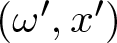 $(\omega',x')$ and
 $(\omega,x)$ be periodic points of
 $F$ that generate
 $X'$ and
 $X$, respectively. Note that
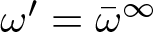 $\omega'=\bar{\omega}^\infty$ and
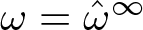 $\omega=\hat{\omega}^\infty$. Since
 $\bar{\omega}=\hat{\omega}\,\overset{n}{\ldots}\, \hat{\omega}\bar\kappa_1\bar\kappa_2$ and
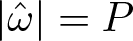 $|\hat{\omega}|=P$, the first
 $Pn$ letters of the sequences
 $\omega'$ and
 $\omega$ coincide. Let
 $M$ be the smallest positive integer such that
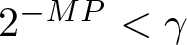 $2^{-MP} \lt \gamma$. Since
 $n$ can be arbitrarily large, we can also demand that
 $2M+1 \lt n$. Then
 $M \lt n-M-1 \lt n$, and therefore
 \begin{equation}
\tilde{X'}=\{F^{j}(\omega',x'): \, MP\leq j \lt (n-M-1)P \},
\end{equation}
is contained in the set of the first  $n$ iterations by
 $F^P$ of the point
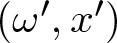 $(\omega',x')$. Now let us define the projection
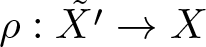 $\rho:\tilde{X'}\to X$ as follows:
 \begin{equation}
\rho(F^{j}(\omega',x'))=F^{j}(\omega,x).
\end{equation}
Then, for  $i=0,\dots,P-1$,
 $j=MP,\dots,(n-M-1)P-1$, we have
 \begin{align*}
d\left(F^i\left(F^j(\omega',x')\right), F^i\left(\rho\circ F^j(\omega',x')\right)\right) &= d\left(F^{i+j}(\omega',x'),F^{i+j}(\omega,x)\right) \\
&= \max\{\bar{d}(\sigma^{i+j}(\omega'),\sigma^{i+j}(\omega)),
|f^{i+j}_{\omega'}(x') \\
& \quad-f^{i+j}_{\omega}(x)| \}.
\end{align*}
Since the first  $nP$ letters of
 $\omega'$ and
 $\omega$ are the same, and since
 $MP\leq i+j \lt nP$, we have
 $\bar{d}(\sigma^{i+j}(\omega'),\sigma^{i+j}(\omega))\leq 2^{-MP} \lt \gamma$. For the same reason, writing
 $j=qP+\tau$, we have
 \begin{equation*}
f^{i+j}_{\omega'}=f^{i+j}_{\omega}=f^i_{\sigma^j(\omega)}\circ
f^j_\omega = f^i_{\sigma^\tau(\omega)}\circ f^\tau_{\omega}\circ
f^q=f^{i+\tau}_\omega \circ f^q.
\end{equation*}
Then, since  $x$ and
 $x'$ are in
 $J$ and
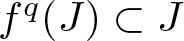 $f^q(J)\subset J$, by virtue of (4), it holds that
 $
|f^{i+j}_{\omega'}(x')-f^{i+j}_{\omega}(x)| \leq
|f^{i+\tau}_\omega(J)|\leq L^{2P}|J| \lt \gamma$. We conclude
 \begin{equation*}
d\left(F^i(y), F^i(\rho(y))\right) \lt \gamma \quad
\text{for all}\ y\in \tilde{X'}\ \text{and}\ i=0,\dots,P-1,
\end{equation*}
proving Item (i) in Definition 2.3.
Now let us show Item (ii) in Definition 2.3. For this, note that
 \begin{equation}
\begin{aligned}
1-\frac{\#\tilde{X'}}{\#X'}&=\frac{|\bar{\kappa}_1|+|\bar\kappa_2|+(2M+1)P}{nP+|\bar{\kappa}_1|+|\bar\kappa_2|}
\leq \frac{|\bar{\kappa}_1|+K+(2M+1)P}{nP}.
\end{aligned}
\end{equation}
On the other hand, denoting by  $H=\max\{|\bar\beta_1|,\dots,|\bar\beta_m|\}$ where
 $\bar\beta_i$ is the finite word that generates
 $h_i$, by (5), (6), and
 $\bar\kappa_1=\bar\beta_{i_r}\dots\bar\beta_{i_1}$, we have
 \begin{align*}
|\bar{\kappa}_1| &\leq r H \leq \frac{-n\log \alpha_+ + \log \delta |J|^{-1}}{\log
L_1} H \\
&\leq \left(-n\log \alpha - K\log L\right) \frac{H}{\log L_1} =
- \left (n {P \, \lambda(\mu_X)} + {K\log L }\right) \frac{H}{\log
L_1}.
\end{align*}
Substituting this expression into (22) we have
 \begin{equation*}
1-\frac{\#\tilde{X'}}{\#X'} \leq |\lambda(\mu_X)| \frac{H}{\log
L_1} + \frac{C_4}{nP}~,
\end{equation*}
where  $C_4= K + (2M+1)P-K H \frac{\log L}{\log L_1}$. Since
 $C_4$ does not depend on
 $n$, by again taking
 $n$ sufficiently large, it follows that
 \begin{equation*}
\frac{C_{4}}{nP}+|\lambda(\mu_{X})|\frac{H}{\log L_1}\leq
|\lambda(\mu_{X})|\frac{2H}{\log L_1}.
\end{equation*}
Therefore, from (22), we have
 \begin{equation*}
\aleph=1-d\cdot |\lambda(\mu_X)|\leq\frac{\#\tilde{X'}}{\#X'} \quad
\text{where}\ d=2H/\log L_1 \gt 0.
\end{equation*}
This shows Item (ii) in Definition 2.3.
Finally, we only need to show Item (iii) in Definition 2.3. For this, given  $\tau=0,1,\dots,P-1$, we have
 \begin{equation*}
\begin{aligned}
\#\rho^{-1}(F^{\tau}(\omega,x))&=\#\{F^{j}(\omega',x')\in\tilde{X}': \, \rho(F^{j}(\omega',x'))=F^{\tau}(\omega,x)\}\\
&=\#\{\, j \in \mathbb{N} : MP \le j \lt (n - M - 1)P \text{ and } \\
j&= qP+\tau\, \text{for some}\, q\in\mathbb{N}\} \\
&= \frac{(n-M-1)P-MP}{P}=n-2M-1.
\end{aligned}
\end{equation*}
This proves the last item and therefore  $X'$ is a
 $(\gamma,\aleph)$-good approximation of
 $X$.
Note that a priori,  $\aleph$ may not be positive (requirement of the definition of good approximation). However, the lemma provides a new periodic orbit with smaller exponent. Thus, recursively applying the lemma, we always find an element
 $f$ satisfying (iii) whose associated periodic orbit has an exponent small enough with
 $\aleph \gt 0$.
2.3. Proof of Theorem 2.1
To prove this result, we use Theorem 2.5. First, we establish that  $F$ admits a sequence of periodic orbits
 $\{X_n\}$ with increasing periods
 $P_n$.
Let 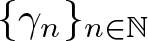 $\{\gamma_n\}_{n \in \mathbb{N}}$ and
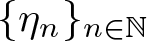 $\{\eta_n\}_{n \in \mathbb{N}}$ be positive sequences satisfying:
 \begin{equation}
\sum_{n=1}^\infty \gamma_n \lt \infty \quad \text{and} \quad \eta_n \to 0 \quad \text{as} \quad n \to \infty.
\end{equation}
Let  $X_1$ be the periodic orbit of
 $F$ generated by
 $f$, with period
 $P_1$. By recursively applying Lemma 2.12, for each
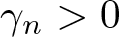 $\gamma_n \gt 0$ and
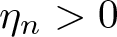 $\eta_n \gt 0$, there exists a periodic orbit
 $X_{n+1}$ of
 $F$ with period
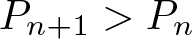 $P_{n+1} \gt P_n$ such that
a)
$c \cdot \lambda(\mu_{X_n}) \lt \lambda(\mu_{X_{n+1}}) \lt 0$;b)
$X_{n+1}$ is a
$(\gamma_n, \aleph_n)$-good approximation of
$X_n$, with
$\aleph_n = 1 - d \cdot |\lambda(\mu_{X_n})|$;c)
$X_{n+1}$ is
$\eta_n$-dense in
$\Sigma_k \times \mathbb{S}^1$.






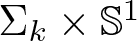
Here,  $0 \lt c \lt 1$ and
 $d \gt 0$ are constants depending only on
 $\mathscr{F}$. In particular,
 \begin{equation*}
c^n \cdot \lambda(\mu_{X_1}) \lt \lambda(\mu_{X_{n+1}}) \lt 0,
\end{equation*}
which implies that  $\lambda(\mu_{X_{n+1}}) \to 0$ as
 $n \to \infty$. Therefore,
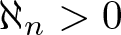 $\aleph_n \gt 0$ for sufficiently large
 $n$. Without loss of generality, we assume this holds for all
 $n \geq 1$.
Furthermore, since
 \begin{equation*}
\sum_{n=1}^\infty |\lambda(\mu_{X_n})| \leq \sum_{n=0}^\infty c^n |\lambda(\mu_{X_1})| \lt \infty,
\end{equation*}
the Comparison Test for Series implies
 \begin{equation*}
-\infty \lt \sum_{n=1}^\infty \log \left(1 - d \cdot |\lambda(\mu_{X_n})|\right) = \sum_{n=1}^\infty \log \aleph_n \lt 0,
\end{equation*}
and consequently,  $\prod_{n=1}^\infty \aleph_n \in (0, 1]$.
By Theorem 2.5, the sequence 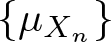 $\{\mu_{X_n}\}$ of atomic measures uniformly distributed over the orbits
 $X_n$ has a limit. The limit measure
 $\mu$ is ergodic, and its topological support is
 $
\mathrm{supp}~\mu = \bigcap_{j=1}^\infty \left(\overline{\bigcup_{l=j}^\infty X_l}\right)$. From c) and the fact that
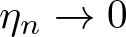 $\eta_n \to 0$ as
 $n \to \infty$, we deduce that
 $
\overline{\bigcup_{l=j}^\infty X_l} = \Sigma_k \times \mathbb{S}^1$, which implies
 $\mathrm{supp}~\mu = \Sigma_k \times \mathbb{S}^1$.
On the other hand, since the sequence of Lyapunov exponents 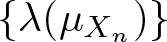 $\{\lambda(\mu_{X_n})\}$ converges to zero, Proposition 2.2 implies that
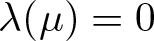 $\lambda(\mu) = 0$. This completes the proof of the theorem.
3. Proof of Theorem A
For completeness, we recall that a family  $\mathscr{F} \in \mathrm{IFS}^r_k(\mathbb{S}^1)$ is said to be transitive if the associated skew product
 $F = \sigma \lt imes \mathscr{F}$ is transitive. Equivalent definitions can be found in [Reference Barrientos and Cisneros3, Def. 4.1, Thm. 4.2, 4.5, and 6.1]. Moreover,
 $\mathscr{F}$ is called robustly minimal (transitive) if any sufficiently small
 $C^1$ perturbation of
 $\mathscr{F}$ remains minimal (transitive).
It is straightforward to verify that properties (ii) and (iii) of Theorem 2.1 are open in the  $C^1$ topology. This implies that any IFS sufficiently close to
 $\mathscr{F}$ in the
 $C^1$ topology also satisfies these properties. However, property (i) is not generally open. Nevertheless, it was established in [Reference Barrientos, Fakhari, Malicet and Sarizadeh4] that if
 $\mathscr{F}$ is both expanding and minimal, then minimality is
 $C^1$-robust. Since minimality of
 $\mathscr{F}$ implies transitivity of the skew product
 $F=\sigma \lt imes \mathscr{F}$ (cf. [Reference Barrientos and Cisneros3, Remark 4.4 and Theorem 6.1]), we obtain the following observation:
Remark 3.1. The set of skew products  $F = \sigma \lt imes \mathscr{F} \in S^r_k(\mathbb{S}^1)$ such that
 $\mathscr{F}$ satisfies properties (i)–(iii) and
(iv)
$\mathscr{F}$ is forward expanding,

is an open subset of 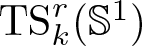 $\mathrm{TS}^r_k(\mathbb{S}^1)$ for every
 $r \geq 1$.
Definition 3.2. An open set  $B$ is called a globalized blending region for
 $\mathscr{F}$ if there exist maps
 $h_1, \dots, h_m, T_1, \dots, T_s, S_1, \dots, S_t \in \langle \mathscr{F}\rangle^+$ and an open set
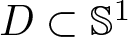 $D \subset \mathbb{S}^1$ such that
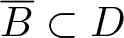 $\overline{B} \subset D$ and
(1)
$\overline{B} \subset h_1(B) \cup \dots \cup h_m(B)$,(2)
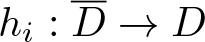
$h_i: \overline{D} \to D$ is a contracting map for
$i=1, \dots, m$,(3)
$\mathbb{S}^1 = T_1(B) \cup \dots \cup T_s(B) = S_1^{-1}(B) \cup \dots \cup S_t^{-1}(B)$.



As shown in [Reference Barrientos, Fakhari, Malicet and Sarizadeh4, Sec. 6], a skew product  $F = \sigma \lt imes \mathscr{F}$ where both
 $\mathscr{F}$ and
 $\mathscr{F}^{-1}$ possess globalized blending regions satisfies conditions (i)–(iv). In particular, Theorem 2.1 applies. This result parallels [Reference Díaz, Gelfert and Rams12, Prop. 8.3], where robust transitivity follows from the existence of blenders (analogous to conditions (1) and (2) of Definition 3.2) combined with the requirement that every point has forward and backward iterates inside the blender’s domain (analogous to condition (3)).
The key idea behind the proof of Theorem A is to demonstrate that, up to conjugation, any transitive locally constant skew product can be approximated by one satisfying conditions (i)–(iv). These properties essentially arise from constructing a pair of globalized blending regions for  $\mathscr{F}$ and
 $\mathscr{F}^{-1}$, which can be found within the proof of the next results borrowed from [Reference Barrientos and Cisneros3].
The following result was proved by Barrientos and Cisneros in [Reference Barrientos and Cisneros3, Cor. 5.5].
Theorem 3.3. Let  $\mathscr{F}$ be a transitive family in
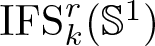 $\operatorname{\mathrm{IFS}}^r_k(\mathbb{S}^1)$, where
 $r \geq 1$ and
 $k \geq 2$. Then, there exists
 $\mathscr{G} \in \operatorname{\mathrm{IFS}}^r_k(\mathbb{S}^1)$,
 $C^r$-close to
 $\mathscr{F}$, such that
 $\mathscr{G}$ is both robustly forward and backward minimal, the elements of
 $\mathscr{G}$ are Morse-Smale diffeomorphisms, and there exists a map
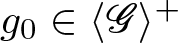 $g_0 \in \langle \mathscr{G}\rangle^+$ that is
 $C^\infty$-conjugate to an irrational rotation.
The next result, stated in [Reference Barrientos and Cisneros3, Thm. 3.25], improves [Reference Barrientos, Fakhari and Sarizadeh5, Thm. B] and generalizes earlier results on robustly minimal IFSs on the circle described in [Reference Gorodetski and Ilyashenko15, Reference Gorodetski and Ilyashenko16].
Theorem 3.4. Let  $f_1, f_2$ be orientation-preserving circle diffeomorphisms. Assume that
 $f_1$ is an irrational rotation and
 $f_2$ is not a rotation. Then,
 $\mathscr{F} = \{f_1, f_2\}$ is both forward and backward expanding and robustly forward and backward minimal.
Now we are ready to give the proof of our main result.
Proof of Theorem A
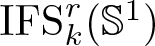
Denote by 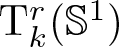 $\mathrm{T}^r_k(\mathbb{S}^1)$ the set of transitive elements of
 $\mathrm{IFS}^r_k(\mathbb{S}^1)$. Since every minimal IFS is also transitive (cf. [Reference Barrientos and Cisneros3, Rem. 4.4]), by Theorem 3.3, there is a dense set
 $\mathcal{D}$ of
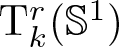 $\mathrm{T}^r_k(\mathbb{S}^1)$ such that every
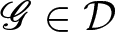 $\mathscr{G}\in \mathcal{D}$ is robustly transitive, its elements are Morse-Smale diffeomorphisms, and there is a map
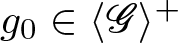 $g_0\in \langle \mathscr{G}\rangle^+$ that is
 $C^\infty$ conjugate to an irrational rotation. Let
 $\phi$ be the
 $C^\infty$ conjugacy map between
 $g_0$ and the rigid irrational rotation. Set
 $\hat{\mathscr{G}}=\phi\circ \mathscr{G}\circ\phi^{-1}$. Note that since the property of being a Morse-Smale diffeomorphism is invariant under smooth conjugation, the elements of
 $\hat{\mathscr{G}}$ are also Morse-Smale diffeomorphisms. Moreover, since
 $\langle\hat{\mathscr{G}}\rangle^+$ also has an irrational rotation, by Theorem 3.4, we conclude that
 $\hat{\mathscr{G}}$ is both backward and forward expanding and robustly forward and backward minimal. Since the expanding property is also a robust property (cf. [Reference Barrientos, Fakhari, Malicet and Sarizadeh4, Cor. 3.1] or [Reference Barrientos and Cisneros3, Rem. 3.10]) and
 $\mathscr{G}$ is robustly transitive, we can consider a neighbourhood
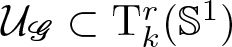 $\mathcal{U}_{\mathscr{G}} \subset \mathrm{T}^r_k(\mathbb{S}^1)$ of
 $\mathscr{G}$ in
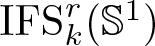 $\operatorname{\mathrm{IFS}}^r_k(\mathbb{S}^1)$ such that for every
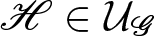 $\mathscr{H}\in \mathcal{U}_{\mathscr{G}}$, the family
 $\hat{\mathscr{H}}=\phi\circ \mathscr{H}\circ\phi^{-1}$ is both backward and forward expanding and robustly forward and backward minimal. Thus, by Theorem 2.1, the skew product
 $\hat{H}=\sigma \lt imes\hat{\mathscr{H}}$ has an
 $\hat H$-invariant ergodic probability measure
 $\hat\mu$ with full support, limit of periodic measures, and with Lyapunov exponent
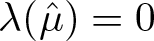 $\lambda(\hat\mu)=0$. Consider the map
 $\Phi=\mathrm{id}_{\Sigma_{k}}\times\phi$ and notice that
 $\hat{H}=\Phi\circ H\circ \Phi^{-1}$, where
 $H=\sigma \lt imes\mathscr{H}$.
Claim 3.5.
The measure 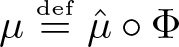 $\mu\stackrel{\scriptscriptstyle\rm def}{=}\hat\mu \circ \Phi$ is an
 $ H$-invariant ergodic probability with full support, limit of periodic measures, and with Lyapunov exponent
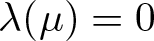 $\lambda(\mu)=0$.
Proof. We first observe that  $\hat{H}^{-1} = \Phi \circ H^{-1} \circ \Phi^{-1}$. Hence, for any measurable set
 $A \subset \Sigma_{k} \times \mathbb{S}^{1}$, since
 $\hat{\mu}$ is a
 $\hat{H}$-invariant measure, i.e.,
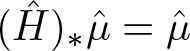 $(\hat{H})_{*}\hat{\mu} = \hat{\mu}$, we have
 \begin{align*}
\mu(A) &= \hat{\mu}(\Phi(A)) = (\hat{H})_{*}\hat{\mu}(\Phi(A)) = \hat{\mu}(\Phi \circ H^{-1} \circ \Phi^{-1} \circ \Phi(A)) = \hat{\mu}(\Phi \circ H^{-1}(A)) \\
&= \mu(H^{-1}(A)).
\end{align*}
Thus,  $\mu$ is
 $H$-invariant. Moreover, if
 $A$ satisfies
 $H^{-1}(A) = A$, then
 \begin{equation*}
\hat{H}^{-1}(\Phi(A)) = \Phi \circ H^{-1} \circ \Phi^{-1}(\Phi(A)) = \Phi \circ H^{-1}(A) = \Phi(A)
\end{equation*}
and thus, since  $\hat{\mu}$ is an ergodic measure for
 $\hat{H}$, we have that
 $\mu(A) = \hat{\mu}(\Phi(A)) \in \{0,1\}$. Hence,
 $\mu$ is also an ergodic measure for
 $H$. Also, since
 $\Phi$ is a homeomorphism and
 $\hat{\mu}$ has full support, then
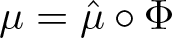 $\mu = \hat{\mu} \circ \Phi$ inherits full support. Furthermore,
 $\mu$ is also a limit of periodic measures, as
 $\hat{\mu}$ is. Finally, we will calculate the Lyapunov exponent
 $\lambda(\mu)$. To do this, observe that
 $\hat{\mathscr{H}}=\phi\circ \mathscr{H} \circ \phi^{-1}$ and thus the fibre maps of
 $\hat{\mathscr{H}}^n$ are given by
 $\hat{h}^n_\omega=\phi \circ h^n_\omega \circ \phi^{-1}$ for any
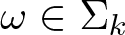 $\omega\in \Sigma_k$, where
 $h^n_\omega$ are the fibre maps of
 $H^n$. Hence,
 \begin{equation*}
\begin{aligned}
\lambda_{\hat{H}}(\omega,x)
& = \lim_{n\to\infty} \frac{1}{n} \log |(\hat h^n_\omega)'(x)| \\
&= \lim_{n\to\infty} \frac{1}{n} \log |\phi'(h^n_\omega\circ \phi^{-1}(x))|+ \lim_{n\to\infty} \frac{1}{n} \log |(h^n_\omega)'(\phi^{-1}(x))| \\
&\quad + \lim_{n\to\infty} \frac{1}{n} \log |(\phi^{-1})'(x)| \\
&= \lim_{n\to\infty} \frac{1}{n} \log |(h^n_\omega)'(\phi^{-1}(x))| = \lambda_{H}(\omega,\phi^{-1}(x))= \lambda_{H}(\Phi^{-1}(\omega,x))
\end{aligned}
\end{equation*}
for every  $(\omega,x)\in \Sigma_k\times\mathbb{S}^1$. Now, since
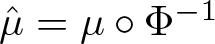 $\hat\mu= \mu \circ \Phi^{-1}$, by the above equality, we have
 \begin{equation*}
\lambda(\hat{\mu})=\int \lambda_{\hat{H}}(\omega,x) \, d\hat\mu = \int \lambda_{\hat{H}}(\Phi^{-1}(\omega,x)) \, d\mu =\int \lambda_{{H}}(\omega,x) \, d\mu = \lambda(\mu).
\end{equation*}
Since 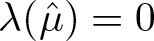 $\lambda(\hat\mu)=0$, we also get that
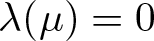 $\lambda(\mu)=0$ as required. This completes the proof
Now, we conclude the proof by taking  $\tilde{\mathcal{R}}$ as the open set formed by the union of the neighbourhoods
 $\mathcal{U}_{\mathscr{G}}$ for
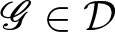 $\mathscr{G}\in \mathcal{D}$. Since
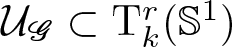 $\mathcal{U}_{\mathscr{G}}\subset \mathrm{T}^r_{k}(\mathbb{S}^1)$ and
 $\mathcal{D}$ is dense in
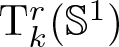 $\mathrm{T}^r_{k}(\mathbb{S}^1)$, we get that
 $\tilde{\mathcal{R}}$ is open and dense in
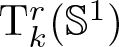 $\mathrm{T}^r_{k}(\mathbb{S}^1)$. Then, by the definition of the topology in
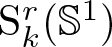 $\mathrm{S}^r_k(\mathbb{S}^1)$ and in view that
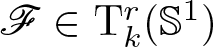 $\mathscr{F}\in \mathrm{T}^r_{k}(\mathbb{S}^1)$ if and only if
 $F=\sigma \lt imes \mathscr{F}\in \mathrm{T}^r_{k}(\mathbb{S}^1)$, we get the set
 $\mathcal{R}=\{F=\sigma \lt imes \mathscr{F}\in \mathrm{S}^r_{k}(\mathbb{S}^1): \mathscr{F} \in \tilde{\mathcal{R}}\}$ is an open and dense subset of
 $\mathrm{TS}^r_k(\mathbb{S}^1)$. Moreover, for every
 $H=\sigma \lt imes \mathscr{H}\in \mathcal{R}$, the family
 $\mathscr{H}$ belongs to
 $\mathcal{U}_{\mathscr{G}}$ for some
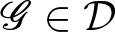 $\mathscr{G}\in \mathcal{D}$ and thus by Claim 3.5, there is an ergodic
 $F$-invariant probability measure
 $\mu$ with full support whose Lyapunov exponent
 $\lambda(\mu)$ equal to zero. Furthermore, the probability measure
 $\mu$ is a limit in the weak
 $^*$ topology of sequences of invariant measures supported on periodic points. This concludes the proof.
Acknowledgements
The first author, P. G. Barrientos, was supported by grant PID2020-113052GB-I00 funded by MCIN, PQ 302738/2025-8(CNPq), and JCNE E-26/201.305/2022 (FAPERJ). The proof of Theorem 2.1 forms part of the results obtained in the master’s thesis of the author, J. A. Cisneros. We express our deepest gratitude to Prof. Lorenzo J. Díaz for his insightful comments on the results obtained. His contributions as a member of the master’s and doctoral committees of the second author have been invaluable and greatly appreciated.



