INTRODUCTION
The two facets of selenium (Se), as a nutrient and also as a potent toxic substance, makes it a trace element of concern to the health of both animals and humans. Se has three levels of biological activity (Hamilton, Reference Hamilton2004): (i) trace concentrations are required for normal growth and development; (ii) moderate concentrations can be stored to maintain homeostatic functions; and (iii) elevated concentrations can result in toxic effects. Se is an important component of enzymes and proteins, such as glutathione peroxidase, selenoprotein P and tetraiodothyronine 50-deiodinase. The maximal daily safe intake of Se recommended by the World Health Organization was 0.4 mg d−1 for adults of 55 kg (7μg kg−1 d−1) (Dalton and Bird, Reference Dalton and Bird2003).
Se has not been classified as beneficial to plants in general, although it has been considered as potentially useful to plants capable of accumulating large amount of the element (Shanker, Reference Shanker2006). In cultivated plants, Se content has been increased using various enrichment techniques. The most frequently used techniques for enrichment are Se fertilization of soil (Shah et al., Reference Shah, Kannamkumarath, Wuilloud, Wuilloud and Caruso2004; Xue et al., Reference Xue, Hartikainen and Piironen2001), foliar treatment of plants with Se solution (Hu et al., Reference Hu, Xu and Pan2001) and hydroponic (Kahakachchi et al., Reference Kahakachchi, Boakye, Uden and Tyson2004; Whanger et al., Reference Whanger, Ip, Polan, Uden and Welbaum2000) or aeroponic (Smrkolj et al., Reference Smrkolj, Germ, Kreft and Stibilj2006) cultivation in a nutrient solution containing Se. Plants that have been examined for Se uptake and fortification include Indian mustard, onion and garlic (Kahakachchi et al., Reference Kahakachchi, Boakye, Uden and Tyson2004; McSheehy et al., Reference McSheehy, Pannier, Szpunar, Potin-Gautier and Lobinski2002; Whanger et al., Reference Whanger, Ip, Polan, Uden and Welbaum2000). Limited studies have also examined the feasibility of Se fortification in cereals and soyabean through soil and foliar application (Gupta and MacLeod, Reference Gupta and MacLeod1994). Se-enriched vegetables may be a better delivery source for organoselenium analogues than the commonly used selenite or selenomethionine. Hyper-accumulators are efficient Se extractors, although their phytoremediation potential is often limited by their slow growth rate and low biomass production (Germ et al., Reference Germ, Stibilj and Kreft2007).
Instrumental neutron activation analysis (INAA) and allied methods have been used to study Se levels in vegetables and food grains in Portugal (McNaughton and Marks, Reference McNaughton and Marks2002; Ventura et al., Reference Ventura, Freitas, Pacheco, Meerten and Wolterbeek2007). A study of Se hyper-accumulation in food crops cultivated in a seleniferous region of India using INAA found the highest Se concentrations ever reported in grain for human consumption (Sharma et al., Reference Sharma, Prakash, Srivastava, Sadana, Acharya, Prakash and Reddy2009).
Vegetables such as garlic and onion accumulate higher concentration of Se due to the presence of the chemically similar sulphur and its derivatives (Klapec et al., Reference Klapec, Mandic, Grgic, Primorac, Perl and Krstanovıc2004). Although Ip and Lisk (Reference Ip and Lisk1995) and other researchers have investigated the possibility of using Se-hyper-accumulating crops like Allium for prevention of cancer, the concept of using metal hyper-accumulating crops for nutraceutical applications is still at a very early stage. Biologically, Se acts as an antioxidant by preventing the reduction of tocopherol concentration, inhibiting lipid peroxidation (Xue et al., Reference Xue, Hartikainen and Piironen2001), and enhancing superoxide dismutase and glutathione peroxidase activity (GSH-Px) activity in ryegrass (Lolium perenne) (Hartikainen et al., Reference Hartikainen, Xue and Piironen2000). Various approaches have been followed to determine the pro- and anti-oxidant activity of foods and supplements (MacDonald-Wicks et al., Reference MacDonald-Wicks, Wood and Garg2006). Products of lipid peroxidation expressed as thiobarbituric acid reactive substances (TBARS) and expression of anti-oxidant properties such as GSH-Px activity (Rosales et al., Reference Rosales, Ruiz, Hernandez, Soriano, Castilla and Romero2006; Xue et al., Reference Xue, Hartikainen and Piironen2001) have been extensively used as indicators to monitor pro- and anti-oxidant activity of Se.
Although, various reports indicate the hyper-accumulating potential of Allium species (Whanger et al., Reference Whanger, Ip, Polan, Uden and Welbaum2000), these crops have never been envisaged as phytoremediating crops. For most of the world's cultures, for centuries, onion has been an important culinary ingredient and garnish.
Keeping in view (i) the need to understand Se uptake and its biological activity in plants, and (ii) the aim to introduce Allium as a Se-hyper-accumulating and fortifying crop, the present study examined the accumulation of Se in A. cepa cultivated in Se-enriched soils and associated changes in levels of TBARS and GSH-Px activity. Total Se was quantified using INAA using reactor neutrons and high resolution gamma ray spectrometry.
MATERIALS AND METHODS
Plant growth conditions
Two-week-old onion plantlets (variety Nasik red) obtained from commercial seed outlets were grown in Se-supplemented plots of 60 cm × 60 cm size during December 2007–April 2008. Each plot was dug 25 cm deep and soil was removed. The plot was layered with polysheet to prevent leaching of Se into lower layers. The soil of individual plots was sun-dried and supplemented with Se in concentrations of 2.5, 5.0 and 7.5 mg kg-soil−1 as selenate (Na2SeO4; CDH) and selenite (Na2SeO3.5H2O; Merck) solution. The soil was then spread back in the plots. The plantlets were sown in a random block design pattern (Zar, Reference Zar2006) with 15 plants in each plot. The plantlets were spray-irrigated on alternate days with tap water in which Se was not detected. Plants were harvested (in triplicate for each concentration) along with rhizospheric soil at intervals of 40, 80 and 120 days after planting. The fresh weight of the plant samples were recorded after cleaning the extraneous soil under running tap water followed by air drying for 30 min to remove surface water.
Sample preparation for irradiation
The plant and soil samples were dried at 40 °C for 2–3 days to reduce moisture content. Dried soil samples were crushed and sieved using a 0.2-mm mesh. Dry weight of plant samples was recorded. Dried plants were macerated and homogenized using a mechanical mixer with thorough cleaning of the grinding apparatus after every grinding session. Samples were oven dried at 40 °C to constant weight before irradiation. An elemental standard of Se was prepared using an ICP liquid standard (Spex) containing known concentrations of Se (5–20 μg) by fusing in pure amorphous silica powder. Control samples of NRCC CRM DOLT-1 and IAEA RM SL-1 were also used to evaluate the accuracy of the method. Samples and reference materials weighing about 100 mg were packed in aluminum foil.
Sample irradiation and Se quantification
The samples, the reference materials, Se standards and silica blank, sealed appropriately, were introduced into Harwell cans and irradiated in the self-server position of the CIRUS reactor (Bhabha Atomic Research Centre [BARC]) for 7 h duration with a neutron flux of ~1013 cm−2s−1. The samples were allowed to cool for about 10 days, and then the radioactive assay of the samples was carried out by high resolution gamma ray spectrometry for 1–10 h depending on Se concentration levels. A Compton suppressed spectrometer consisting of the HPGe-BGO detector systems coupled to a PC based 8k MCA card (PHAST-BARC) was used for gamma ray spectrometric measurements. The peak areas were determined using peak-fit software PHAST. The resolution of the detector was 2.0 keV at 1332 keV of 60Co. The relative method of INAA was used to calculate Se concentrations in the samples and reference materials (Sharma et al., Reference Sharma, Prakash, Srivastava, Sadana, Acharya, Prakash and Reddy2009).
Biochemical analysis
Thiobarbituric acid reactive substances (TBARS method). The determination of TBARS, the assay for content of malondialdehyde, was carried out using the method outlined by Miller and Aust (Reference Miller and Aust1989). Whole plants (including roots) were homogenized in 0.15M potassium chloride (SD Fine), 0.25M tris HCl buffer (Hi-Media), 2 mM ADP (Hi-Media) and 10 μM ferrous sulphate (SD Fine), and incubated at 37 °C for 5 min. One gram of homogenized tissue was suspended in 10 ml buffer in triplicate; 700 μl of the buffer suspensions was further incubated at 37°C for 5 min, then the reaction was initiated by adding 0.1 mM ascorbic acid in a total volume of 1ml. The reaction was terminated after 30 min by adding 2 ml of thiobarbituric acid reagent (0.375% TBA (HiMedia) + 15% trichloroacetic acid (SDFine) + 0.2N HCl (Merck)), and the aldehydes formed were estimated at 535 nm using a UV-Visible spectrophotometer (Hitachi U2800). The molar extinction coefficient was found to be 1.56 × 10⁵ M−1 cm−1. An appropriate blank was taken without tissue homogenate. The result is represented as concentration of malondialdehyde (MDA) in M mg−1.
Glutathione peroxidase assay. Glutathione peroxidase (GSH-Px) (EC 1.11.1.9) activity was measured by a modification of the method of Flohe and Gunzler (Reference Flohe, Gunzler and Packer1984) by using 1.3 mM H2O2 (SD Fine) as substrate. The enzyme was extracted by the method described by Hartikainen et al. (Reference Hartikainen, Xue and Piironen2000) modified by inclusion of 1mM EDTA and 1% polyvinylpyrrolidone as protease inhibitors. The enzyme activity was calculated as a level of GSH measured 412 nm using a UV-visible spectrophotometer (Hitachi U2900) and shown as nmol GSH 100 mg−1 fresh weight.
Statistical analysis
Interactions between the Se uptake and pro/anti oxidant properties in the plantlets were analysed using Graphpad Prism Software (V 4.03). The association between the parameters were examined using simple linear correlation analysis (Zar, Reference Zar2006). The relationship was determined over time (40–120 days) between (i) levels of pro-oxidant (TBARS) indicator between control and experimental plants at each test concentration; (ii) levels of anti-oxidant (GSH-Px) indicator between control and experimental plants at each test concentration; (iii) Se accumulation in Se-exposed plants and TBARS levels; and (iv) Se accumulation and GSH-Px levels. The observations were also subjected to two-tailed t-test (Zar, Reference Zar2006) to compare the levels of (i) TBARS, (ii) GSH-Px and (iii) Se accumulation in plants exposed to either of the Se oxyanions. The test assumed that there would be no significant difference in the influence of Se oxyanions on the mentioned properties in plants, The significance of t-value obtained was checked at p < 0.05.
RESULTS AND DISCUSSION
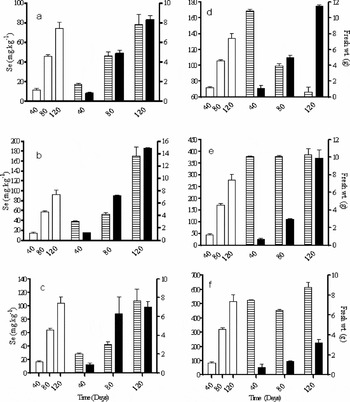
The present study focused on the influence of Se oxyanions on the growth and associated anti- and pro-oxidant activities induced during the growth period up to 120 days. The effect of Se on plant growth was dependent on dosage and the chemical form used as a supplement. The observations on the fresh weight of the plants indicated that exposure to Se oxyanions (selenate or selenite) showed significant differences (p < 0.05) between the weight of plants grown in soils devoid of exogenous Se and the plants grown in soil supplemented with either oxyanion (Figure 1). The range of 2.5 to 7.5 mg kg−1 of Se (IV and VI) was chosen to relate experimental conditions to the total Se concentration in seleniferous soils, which range from 2.7 to 6.8 mg kg−1 (Sharma et al., Reference Sharma, Prakash, Srivastava, Sadana, Acharya, Prakash and Reddy2009). Exposure to selenite at 2.5 mg kg−1 stimulated the growth of the plant across the duration of the growth period. Although, at 5.0 mg kg−1 and 7.5 mg kg−1, the growth was inhibited in the initial phase (40 days), the plants recovered from the inhibitory effect of Se (selenite) gaining greater or equal biomass to that of the plants in control conditions. Exposure to selenate at 2.5 mg kg−1 and 5.0 mg kg−1 inhibited the growth of the plant followed by recovery at later stages. However, at 7.5 mg kg−1, the effect of selenate was significant on plants as indicated by the retarded growth when compared to control.
Variations in Se concentration and fresh weight of plants grown in 2.5, 5.0 and 7.5 mg kg-soil−1 of selenite (a, b and c) and selenate (d, e and f) enriched soils). ◻ – fresh weight of control plants;  – total Se concentration (mg kg−1) in whole plants; ◼ – fresh weight of plants exposed to Se as selenite (a, b and c) and selenate (d, e and f).

The concentration of total Se in plants increased in comparison to the control during the duration of growth. The comparison between the total Se levels on exposure to either oxyanion indicated higher uptake of Se in plants exposed to selenate than selenite. Inhibition of growth in the presence of selenate, correlated with significantly high levels of total Se in the plants reaching >600 mg kg−1 (at 7.5 mg kg−1 exposure) over 120 days. Between the Se oxyanions, the accumulation of selenite was observably gradual and consistent with limited influence on the growth of the plants, whereas the accumulation of selenate was rapid and high across the growth period, inhibiting the growth, especially at higher concentrations of exposure. Comparison between the fresh weights of the plant to the total Se levels in the whole plant indicated positive correlations between both parameters over the duration of growth on exposure to selenite. The increasing uptake by the plants corresponded with the rapid decrease in total Se in the rhizospheric zone of soil to below the detection limits (data not shown).
These observations are in accordance with tissue level Se concentrations observed in Brassica juncea (Hanson et al., Reference Hanson, Pilon-Smits, Garifullina, Lindblom and Lawrence2003) and Stanleya pinnata (Feist and Parker, Reference Feist and Parker2001) on exposure to selenate. However, the inhibition of the plant growth was also observed to be significant in the presence of selenate when compared to selenite, an observation which differed from that of Rios et al. (Reference Rios, Rosales, Blasco, Cervilla, Romero and Ruiz2008) in lettuce plants (Lactua sativa) where selenate was observably less toxic than selenite across various levels of exposure. The incorporation of Se as selenate was more prominent in leaves followed by bulbs of the plantlets (Wrobel et al., Reference Wrobel, Kannamkumarath, Caruso, Wysocka, Bulska, Swiatek and Wierzbicka2004). The accumulation of Se when exposed to selenate was reported to be higher than when grown in presence of selenite in plants such as B. juncea, A. fistulosum and A. schoenoprasum, and L. sativa, (De Souza et al., Reference De Souza, Pilon-Smits, Lytle, Hwang, Tai, Honma, Yeh and Terry1998; Kápolna and Fodor, Reference Kápolna and Fodor2007; Rios et al., Reference Rios, Rosales, Blasco, Cervilla, Romero and Ruiz2008).
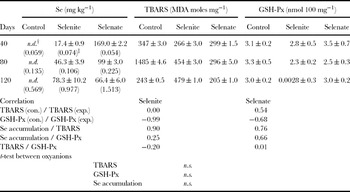
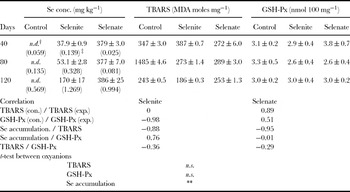
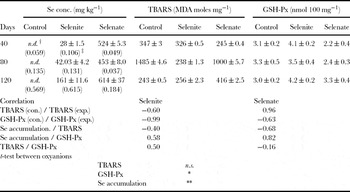
The variations in TBARS and GSH-Px with varying levels of Se in the whole plant were monitored in the present study (Tables 1–3). Without supplementation, the levels of TBARS and GSH-Px indicated a decrease up to 80 days followed by an increase at 120 days, a trend that has also been reported in other plants (Hartikainen et al., Reference Hartikainen, Xue and Piironen2000). Supplementation of 2.5 mg kg−1 of selenite to soil and corresponding increase in Se concentration in plants induced TBARS generation up to 80 days, during which the GSH-Px levels were observed to be lower. However, over further growth to 120 days, the TBARS levels reduced with corresponding increase in GSH-Px levels indicating initiation of anti-oxidant activity with increase in peroxidation. Exposure of plants to 2.5 mg kg−1 of selenite and selenate, resulted in increasing and decreasing trends in TBARS levels. The trends significantly correlated with the levels of Se accumulation during this period. At 5 mg kg−1, there was no definite trend observed in TBARS levels on exposure to selenate whereas a reducing trend in the same was noted with selenite. The changes in GSH-Px levels correlated with Se levels in the whole plants exposed to 5.0 and 7.5 mg kg−1 of selenate with marginal or no correlation at low levels of Se exposure as selenite. In the case of plants grown in soils supplemented with 7.5 mg kg−1, the levels of peroxidation product did not correlate with Se levels recorded in the plants exposed to either of the oxyanions, and GSH-Px activity increased during the 120 days of growth.
Se concentration and pro (TBARS)/anti-oxidant (GSH-Px) properties (±s.d.) in whole plants of A. cepa whole exposed to 2.5 mg Se kg−1.

†n.d.: not detected.
‡Mean dry weight (g) of the plant is shown with Se concentration in parentheses.
Se concentration and pro- (TBARS)/anti-oxidant (GSH-Px) properties (± s.d.) in whole plants of A. cepa exposed to 5 mg Se kg−1.

†Not detected.
‡Mean dry weight (g) of the plant is shown with Se concentration in parentheses.
**Significant at p < 0.005.
Se concentration and pro- (TBARS)/anti-oxidant (GSH-Px) properties (± s.d.) in whole plants of A. cepa exposed to 7.5 mg Se kg−1.

†Not detected.
‡Mean dry weight (g) of the plant is shown with Se concentration in parentheses.
*Significant at p < 0.05; **significant at p < 0.005.
The GSH-Px levels in control plants increased up to 80 days followed by a decrease to 120 days. Amongst the plants exposed to Se oxyanions in soil, analysis of variance between levels of Se, TBARS and GSH-Px indicated variation in mean levels of these parameters at all levels of Se supplementation. The high Se dosage, in general, was observed to boost the GSH-Px activity to neutralize the Se-induced oxidative stress recorded as a distinct increase in TBARS values. Such variations during the growth were also reported by Hartikainen et al. (Reference Hartikainen, Xue and Piironen2000) in ryegrass grown in soils supplemented with 10 mg kg−1 as selenite. An inverse relationship was observed between the TBARS and GSH-Px levels of control and experimental plants indicating the influence of Se exposure on pro- and anti-oxidant activity. The positive correlation between the Se concentrations and antioxidant activities reported here for onion plantlets also agrees with the earlier reports on ryegrass (Cartes et al., Reference Cartes, Shene and dela Luz Mora2006; Hartikainen et al., Reference Hartikainen, Xue and Piironen2000), germinating barley seeds (Huang et al., Reference Huang, Lauridsen and Clausen1994) and broccoli (Pedrero et al., Reference Pedrero, Madrid, Hartikainen and Camara2008).
CONCLUSION
In understanding the role of Se hyper-accumulating crop plants in preparation for their introduction in to biofortification programmes, it is necessary to examine the nature of uptake of the metalloid by the plant under natural cultivation conditions, a factor that was taken into account in the present study. The results indicate that in crop plants like alliums, which can be used as phytoremediating/biofortifying plants, Se application in the form of selenite is more beneficial than selenate. This oxyanion was relatively less phytotoxic, with limited or no influence on the edible biomass of the plant. The accumulated levels of Se at exposure to 2.5 mg kg−1 of soil selenite supplementation were within the stipulated range of Se in foods by regulatory agencies. In addition, TBARS levels and corresponding GSH-Px were observed to be reliable and stable indicators for monitoring the variations of pro- and anti-oxidant activity induced by Se accumulation and assimilation by the plants.