Introduction
To help patients achieve high quality of life toward the end of life, it is important to honor patient's rights of autonomy and improve the extent to which patients receive health care that is consistent with their values and preferences in the event of incapacity (Heyland et al., Reference Heyland, Cook and Rocker2010; Sinuff et al., Reference Sinuff, Dodek and You2015). Advance care planning (ACP) is defined as a process that supports patients in understanding and sharing their values, life goals, and preferences regarding future medical care (Sudore et al., Reference Sudore, Lum and You2017).
ACP has been embedded in healthcare systems in developed countries. However, it is still new to the clinicians and general public in mainland China. Beijing Civil Affairs Bureau approved the foundation of the Beijing Living Will Promotion Association in June 2013. The website of association “Choice and Dignity” (http://www.lwpa.org.cn/) could provide advice on instituting ACP and access to a Chinese-language version of ACP document called Five Wishes. However, the practices in the clinical setting are still rare.
A clinician plays a critical role in ACP communication, as well as ensuring the realization of patients’ goals. A survey among doctors working in the largest teaching hospital at the University of Hong Kong found that 94% of participants indicated a willingness to discuss ACP with patients (Luk et al., Reference Luk, Ngai and Chau2015). Despite the clinicians’ crucial role in the implementation of ACP, their practices and attitudes toward ACP are not well explored in mainland China.
This study aims to explore clinicians’ practices and attitudes regarding ACP in tertiary hospitals in mainland China. Furthermore, to fully understand their attitude toward ACP, we aim to explore clinicians’ attitudes to their own healthcare autonomy and end-of-life care, as well as the willingness of instituting their own ACP.
Methods
This study used a cross-sectional survey design to examine the proposed aims.
Subjects
Chinese hospitals are organized according to a 3-tier system (Primary, Secondary, or Tertiary institutions) that recognizes a hospital's ability to provide medical care, medical education, and conduct medical research. Tertiary hospitals round up the list as comprehensive or general hospitals at the city, provincial or national level, which are responsible for providing specialist health services, perform a bigger role with regard to medical education and scientific research, and serve as medical hubs providing care to multiple regions.
We aim to explore the clinicians’ practices and attitudes regarding ACP in tertiary hospitals. Clinicians from tertiary hospitals in Beijing, Guangxi, and Inner Mongolia were invited to participate in the study through a designing clinical research course. The clinicians voluntarily participated in this course.
Questionnaire
A questionnaire was formulated by members of the research team based on related literature to obtain information including demographic characteristics, practices, and attitudes toward ACP. The questionnaire referred to a survey exploring the general public's attitudes toward ACP in 15 different provinces throughout mainland China, and an ACP guide for adolescents and young adults called Voicing My CHOiCES™ (Zadeh et al., Reference Zadeh, Pao and Wiener2015; Kang et al., Reference Kang, Liu and Zhang2017). Before beginning the survey, participants were provided with a standard definition of ACP and advance directive (AD). The questionnaire was piloted and revised to ensure the validity of the results.
Data collection
Questionnaires were distributed and collected anonymously. A questionnaire survey platform called “Wenjuanxing” (www.wjx.cn) was used for data collection. To ensure that there was no missing value in the questionnaire, the questionnaire could not be submitted if the required contents were not completed. This survey was conducted from October to December 2019. Duplicate questionnaires were deleted based on IP address. Participants who were not clinicians were excluded. This study was approved by the Ethics Committee of Beijing Children's Hospital Affiliated to Capital Medical University.
Statistical analysis
Data were analyzed by using SAS 9.4. Descriptive statistics were used to summarize the data. Chi-square test or the Fisher exact test were used to measure differences, with P-values < 0.05 considered statistically significant.
Results
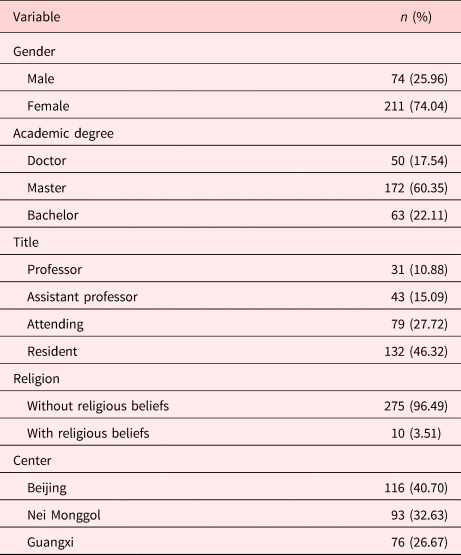
The total number of participants included 285 clinicians. The data response rate was 84.57% (285/337). Clinicians’ socio-demographic characteristics are shown in Table 1. The participants were predominately female (74.04%). The median age of participants was 32 (interquartile range: 29, 37) years. Participants were from Beijing (40.70%), Inner Mongolia (32.63%), and Guangxi (26.67%), respectively.
Socio-demographic characteristics of clinicians

Clinicians’ practices toward ACP
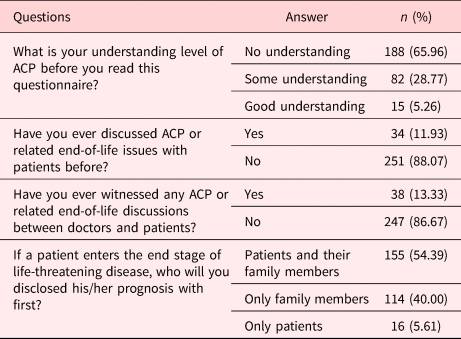
Clinicians’ practices toward ACP are shown in Table 2. The results showed that most of the clinicians had an inadequate understanding of ACP. One hundred and eighty-eight (65.96%) had no understanding of ACP. Only a few clinicians had experience in participating or witnessing an ACP or related end-of-life discussions. Forty percent of clinicians only disclosed prognosis to family members.
Clinicians’ practices toward ACP

Clinicians’ attitudes toward ACP
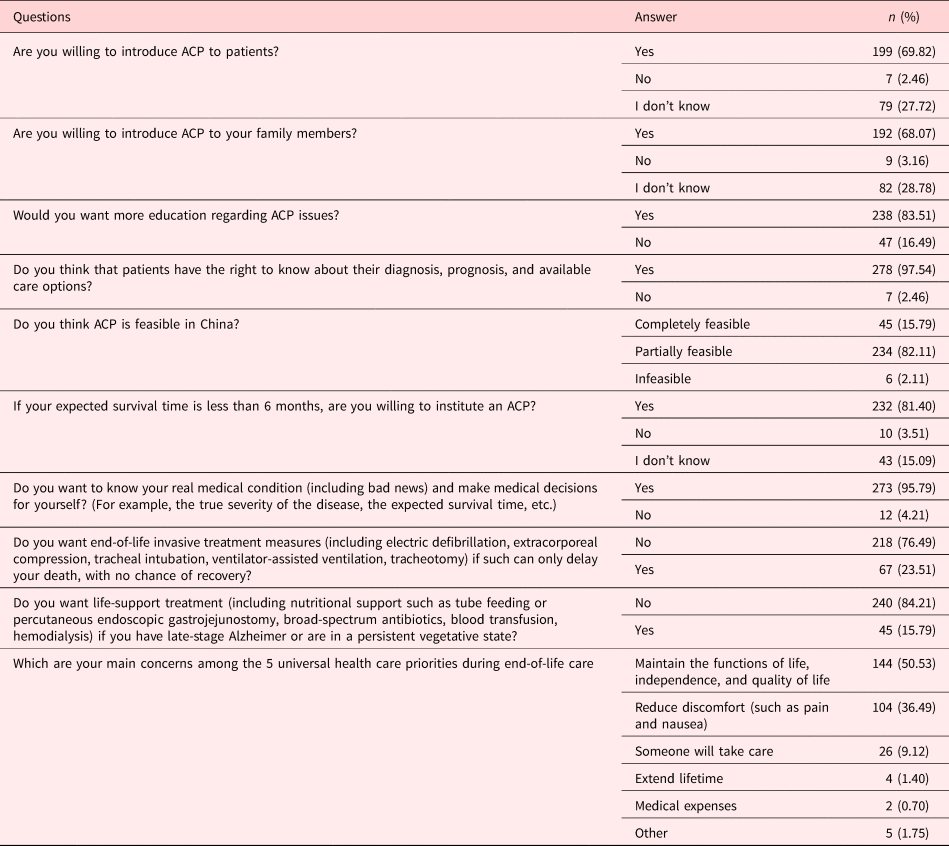
Clinicians’ attitudes toward ACP are shown in Table 3. Among 285 clinicians, 69.82% of clinicians were willing to introduce ACP to patients. Two hundred and thirty-eight (83.51%) clinicians wanted more education on ACP. Almost all clinicians believed that patients had the right to know about their diagnosis, prognosis, and available care options. Most clinicians (82.11%) regarded that ACP was partially feasible in mainland China.
Clinicians’ attitudes toward ACP

Table 3 also shows clinicians’ attitudes to their own health care autonomy and end-of-life care, as well as the willingness of instituting their own ACP. If they had a serious illness, almost everyone was willing to find out their true health status and decide for themselves, and 232 (81.40%) wanted to institute an ACP for themselves. The main concerns during end-of-life care were functional maintenance and quality of life in 144 (50.53%) participants.
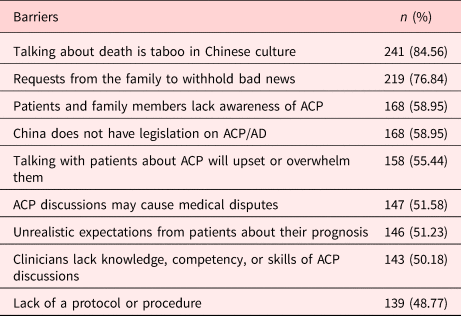
Table 4 shows the perceived barriers to the use of ACP in mainland China. The biggest barriers were cultural factors. Under the background of Chinese culture, talking about death was often taboo, and withholding bad news could protect patients. Other barriers included the lack of knowledge in healthcare providers and the public, the lack of relevant legislation and protocol on ACP, and the possible disadvantages brought by ACP.
Barriers to use of ACP in mainland China

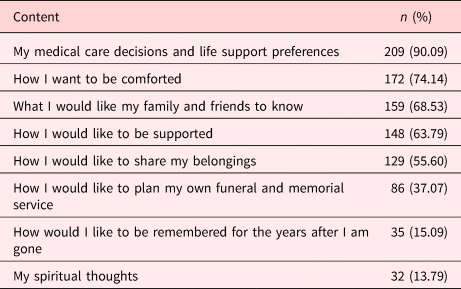
Participants who wanted to institute ACP were required to answer their preferred content in ACP (Table 5). The results showed that participants attached importance to expressing preferences for medical care, comfort, and support. Most participants did not want to make after-death arrangements for themselves and express their spiritual thoughts.
Preferred content in ACP

Two hundred and thirty-two participants who wanted to institute ACP were required to answer their preferred content in ACP.
The questionnaire offered explanations and examples for each content of ACP.
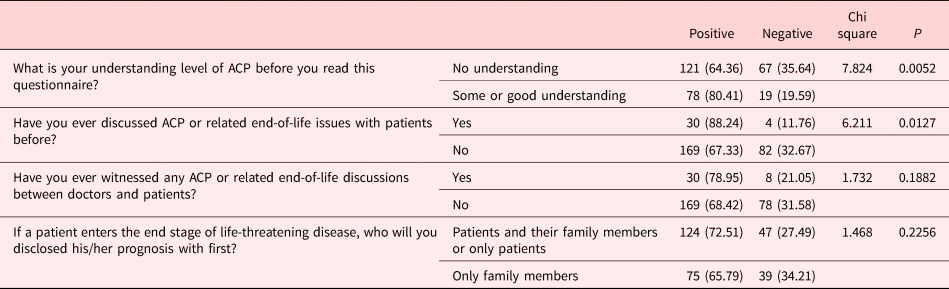
Influencing factors of clinicians’ willingness to introduce ACP to patients
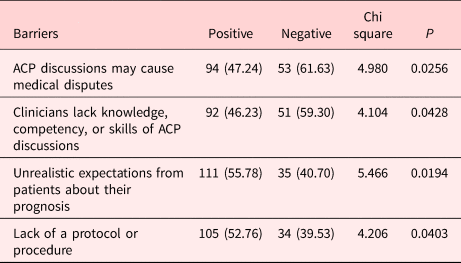
We assessed the associations between clinicians’ practices toward ACP and willingness to introduce ACP to patients. For the purpose of analysis, willingness to introduce ACP to patients was dichotomized as positive (yes) or negative (no or I don't know). Statistical analysis revealed that some or good understanding level (P = 0.0052) and practical experience (P = 0.0127) of ACP were associated with the positive willingness (Table 6). We further analyzed the differences in perceived barriers between the two groups (Table 7). More clinicians with negative willingness regard “ACP discussions may cause medical disputes” and “clinicians lack knowledge, competency, or skills of ACP discussions” as barriers. More clinicians with positive willingness regard “unrealistic expectations from patients about their prognosis” and “lack of a protocol or procedure” as barriers.
Influencing factors of clinicians’ willingness to introduce ACP to patients

Differences in perceived barriers among participants

There was no significant difference among the other barriers.
Discussion
To our knowledge, this study is the first reported multicenter investigation of clinicians’ practices and attitudes toward ACP/AD in mainland China. In addition, this study is the first reported clinicians’ willingness of instituting their own ACP in mainland China.
ACP is an essential component of palliative care. However, the completion rate of ACP is very low in China, and most patients refuse to be involved in ACP (Gu et al., Reference Gu, Chen and Liu2016; Kang et al., Reference Kang, Liu and Zhang2017). Exploring clinicians’ practices and attitudes of ACP will be useful to help us find a way to better promote and implement ACP in mainland China.
This study showed that clinicians had inadequate understanding and minimal exposure to ACP, even if they were from tertiary hospitals. Similar conclusions were drawn in Tang et al.'s study, which reported that nurses in southwest China had limited knowledge and practices on ACP (Tang et al., Reference Tang, Li and Shi2020). Lack of ACP education for healthcare providers is regarded as largely responsible. Conversations concerning ACP are sensitive topics, and therefore a strong body of knowledge is the premise for clinicians to perform ACP practice professionally (Nakazawa et al., Reference Nakazawa, Kizawa and Maeno2014; Lee et al., Reference Lee, Auth and Hinderer2017; Juliá-Sanchis et al., Reference Juliá-Sanchis, García-Sanjuan and Zaragoza-Martí2019; Howard et al., Reference Howard, Bernard and Slaven2020). However, ACP-related theoretical and practical education is very few, even palliative care education is very limited in mainland China (Ye et al., Reference Ye, Mao and Hu2019). ACP should be included in all levels of education for clinicians. Furthermore, it is crucial to provide clinicians with specific training and resources needed to implement ACP.
Clinicians’ attitude toward ACP is a critical factor in their willingness to initiate or participate in ACP discussions. Although the awareness of ACP was fairly low, once learn about the standard definition of ACP, most clinicians had a positive attitude toward ACP. Most clinicians wanted more education on ACP and were willing to introduce ACP to patients and their own family members. This result is similar to that of Luk et al. in Hong Kong, which found that physicians working in Hong Kong were willing to initiate ACP discussions, although many had limited knowledge or experience relating to ACP (Luk et al., Reference Luk, Ngai and Chau2015). A literature review shows that physicians overall have a positive attitude toward ACP/AD, even across cultures. For the 12 quantitative studies, the quantified positive attitudes toward ACP/AD ranged from 93.4% to 44.9% (Coleman, Reference Coleman2013). These results suggest that clinicians are willing to participate in ACP and prior knowledge of ACP will increase the chance of their learning and practices, implying the importance of education and dissemination of ACP among clinicians.
Among 285 clinicians, almost everyone was willing to find out their true health status and decide for themselves, and about 80% wanted to institute an ACP for themselves. This result indicates that the concept of “good death” has gradually been influencing clinicians’ awareness of end-of-life care and patient autonomy. Clinicians recognize the purpose and value of ACP, which is the basis for clinicians to use ACP. It can be inferred that, equipped with enough knowledge and training, clinicians would be even more willing and also more able to promote ACP.
Although clinicians realize the value and significance of ACP, there are still many barriers to ACP practice in mainland China. This study found that, different from western countries, the main barriers of ACP implementation in China were mostly related to cultural factors. In Chinese culture, death is a taboo topic that people feel uncomfortable discussing, which may hinder the chance in ACP discussion (Cheng et al., Reference Cheng, Li and Chan2014, Reference Cheng, Shek and Man2019). In addition, telling patients the truth about their disease is believed to be bad for the patients’ health and recovery, and is considered dehumanizing and immoral by the Chinese. Many families decide not to disclose prognosis to the patients in China, which lead to inconsistencies between opinion and behavior in clinicians (Xu, Reference Xu2007; Chaitin and Rosielle, Reference Chaitin and Rosielle2013). As is shown in this study, although almost all clinicians believed that patients had the right to know about their diagnosis, prognosis, and available care options (Table 3), 40% of them only disclosed prognosis to family members (Table 2). As ACP is a culturally sensitive topic, future research should focus on the influences of cultural factors on ACP discussion, and develop culturally sensitive strategies to facilitate these discussions without disrupting harmony in Chinese families (Teno et al., Reference Teno, Lynn and Wenger1997; Brown, Reference Brown2003; Lee et al., Reference Lee, Auth and Hinderer2017). In addition, legislation on ACP should be developed to decrease the potential risks of medical disputes and protect the patients’ rights.
Exploring the preference of ACP among Chinese is the first step to develop culturally appropriate ACP procedures and documents. This study is the first reported Chinese preferred content in ACP. This research shows that the Chinese may not want to make after-death arrangements for themselves. Most after-death arrangements are made according to local customs. In addition, we found that clinicians considered spiritual thoughts to be an unnecessary part of ACP. The possible reason is that existing spiritual supports are mostly religious supports, and China has low proportions of religious populations. However, Cai et al. found that Chinese nonreligious parents have a strong need for spiritual support when faced with life-threatening conditions of their children (Cai et al., Reference Cai, Guo and Luo2020). Spirituality is a fundamental element of the human experience, and spiritual support should be offered to all patients and their families regardless of their affiliated status with organized religion (Best et al., Reference Best, Butow and Olver2014). Future research needs to explore the unique spiritual needs of the Chinese and develop the corresponding ACP module.
Limitation
The recruitment of subjects was done by convenience sampling and limited to a subset of clinicians working in hospitals in three regions reduces sample representativeness and generalizability of results.
Conclusion
Although ACP has been launched in Asia for several decades, it is still in its infancy in mainland China. This study indicated that clinicians had inadequate understanding and minimal exposure to ACP. Most clinicians recognized the value and significance of ACP and had a positive attitude toward ACP. The main barriers of ACP implementation in China were mostly related to cultural factors. Clinicians need to be provided with education and training in order to promote their ACP practices. Culturally appropriate ACP processes and documents need to be developed based on Chinese culture and Chinese needs.
Conflict of interests
The author(s) declared no potential conflicts of interest with respect to the research, authorship, and/or publication of this article.