Introduction
Lecanora symmicta (Ach.) Ach. is a widespread species that has been recorded from most temperate regions of the world (Brodo et al. Reference Brodo, Sharnoff and Sharnoff2001; Lumbsch & Elix Reference Lumbsch and Elix2004; Galloway Reference Galloway2007; Edwards et al. Reference Edwards, Aptroot, Hawksworth, James, Smith, Aptroot, Coppins, Fletcher, Gilbert, James and Wolseley2009). Although included in the genus Lecanora on account of such key characters as its crustose thallus, Trebouxioid photobiont, eight-spored, Lecanora-type asci and usually simple ascospores, its systematic position is yet to be fully resolved (Printzen & May Reference Printzen and May2002; Pérez-Ortega et al. Reference Pérez-Ortega, Spribille, Palice, Elix and Printzen2010). The species is clearly not closely related to the ‘core’ of Lecanora, the so-called ‘subfusca group’ with L. allophana Nyl. as its type species. Rather, its affinities are closer to L. polytropa (Hoffm.) Rabenh., L. varia (Hoffm.) Ach. and their relatives, which contain usnic acid, commonly associated with zeorin and/or xanthones, and have ± biatorine apothecia that lack oxalate crystals in the excipulum. Indeed Choisy (Reference Choisy1929) coined a generic name, Straminella, for the group, and perhaps the chief impediment to the acceptance of this name is the difficulty in delimiting the genus and the plethora of names that exist within L. symmicta itself (Śliwa & Wetmore Reference Śliwa and Wetmore2000; Printzen & May Reference Printzen and May2002).
In the southern Australasian region, the existence of Lecidea subtecta Stirt. as a name for one of the more clear-cut L. symmicta-type entities led Kantvilas & LaGreca (Reference Kantvilas and LaGreca2008) to examine the group more closely, albeit with little success. They introduced the combination Lecanora subtecta for a very distinctive lichen with yellow to orange, vividly yellow-pruinose, biatorine apothecia, and noted the salient features of several other related lichens studied. More recently, the author re-examined an unusual, unidentified lichen collected some 25 years ago in Tasmania, and concluded that this species shares many characters with L. symmicta. As there appears to be no existing name for this lichen, it is described here as new.
Material and Methods
The study is based on collections held in the Tasmanian Herbarium (HO) and the author's field observations in Tasmania. Observations of apothecial anatomy were undertaken using light microscopy on hand-cut sections mounted in water, 10% KOH (K), Lugol's iodine (IKI), ammoniacal erythrosin and lactophenol Cotton Blue. Initial measurements of thalline and apothecial tissues were made in water, whereas asci, ascospores, paraphyses and hyphae were measured in K. Ascospore and soredial measurements are based on at least 50 observations each, and are presented in the format: smallest measurement–average–largest measurement. Routine chemical analyses using thin-layer chromatography followed standard methods, with solvent A the preferred medium (Orange et al. Reference Orange, James and White2001). To confirm that usnic acid was not present in trace amounts, chemical composition was also checked by Professor J. A. Elix using high performance liquid chromatography (Elix et al. Reference Elix, Giralt and Wardlaw2003).
The Species
Lecanora coppinsiarum Kantvilas sp. nov
Mycobank No.: MB563537
Thallo sorediato, candido, atranorinum continenti, apotheciis biatorinis, immarginatis, aurantiaco-roseis, albida pruina tectis, ascis ad Lecanoram pertinentibus et ascosporis simplicibus hyalinisque distincta.
Typus: Tasmania, Brown Mountain Road near Campania, 42°35′S 147°29′E, occasional on burnt Eucalyptus wood in Acacia mearnsii open woodland, 220 m alt., 16 August 1981, G. Kantvilas 741/81 & P. W. James (HO—holotypus; BM, E—isotypi).
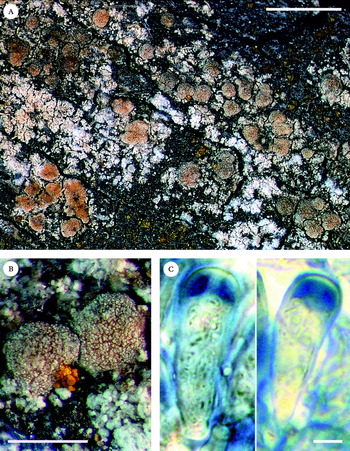
(Fig. 1)
Lecanora coppinsiarum (holotype). A, habit, showing sorediate thallus and pruinose, biatorine apothecia; B, detail of apothecia; C, asci stained with Lugol's iodine after pretreatment with KOH. Scales: A = 2 mm; B = 500 µm; C = 6 µm.

Thallus effuse, ecorticate, not delimited, pale greyish, soon dissolving entirely into granular soredia; soralia vivid white, initially roundish, erumpent to excavate, c. 0·2–0·5 mm wide, soon coalescing into irregular patches to c. 4 cm wide; individual soredia grains 16–30–50 µm, inspersed with granules that fluoresce in polarized light and dissolve in KOH; photobiont Trebouxia-like, with ± globose cells, 10–18 µm diam.
Apothecia biatorine from the earliest stages, 0·2–0·5 mm diam., scattered to crowded, roundish or irregularly rhomboid where squashed together, nestling amongst soredia; disc orange-pink, coarsely whitish pruinose, plane to undulate to convex; proper excipulum not evident, in section cupulate, colourless, composed of radiating, loosely interwoven, branched and anastomosing hyphae 1·5–2·0 µm thick, not inspersed with crystals, lacking photobiont cells, 10–40 µm thick, soon becoming reflexed and excluded. Hypothecium colourless, 20–40 µm thick, composed of loosely interwoven, short-celled hyphae to 5 µm thick. Hymenium 45–55 µm thick, colourless, rather coherent in KOH, not inspersed but overlain by an irregular layer 5–10 µm thick of yellow-brown crystals that fluoresce in polarized light and dissolve in KOH. Asci clavate, 8-spored, 35–45 × 10–15 µm, of the Lecanora-type, with a well-developed amyloid tholus penetrated entirely by a cylindrical, weakly amyloid masse axiale with parallel flanks; ocular chamber short and blunt. Paraphyses 1·5–2·0 µm thick, simple to sparsely branched; apices not markedly expanded. Ascospores hyaline, thin-walled, ellipsoid to oblong, occasionally a little bent, simple but very rarely with a crooked, rather spurious septum, 10·0–11·9–15·0 × 4·0–4·9–6·0 µm, arranged irregularly to obliquely in the ascus.
Pycnidia not found.
Chemistry. Atranorin only; thallus K+ yellow, KC−, C−, P− (or very weakly pale orange), UV−.
Etymology. The new species honours the British lichenologists, Brian and Sandy Coppins, friends and colleagues who have assisted the author in various ways, and in particular in elucidating the relationships of this new species.
Distribution and ecology. Lecanora coppinsiarum was collected in dry (annual rainfall < 600 mm), Eucalyptus-dominated woodland where it grew on charred, rotting eucalypt wood and on the bark of Allocasuarina littoralis, a common understorey tree. Despite repeated and extensive searches, it is known from only three Tasmanian localities, where in both instances it was very uncommon. However, its general habitat (dry sclerophyll woodland) is extremely common in eastern Tasmania and south-eastern mainland Australia, and hence it could be expected to be more widespread. It is part of a rich assemblage of mainly corticolous and lignicolous lichens, including Buellia dissa (Stirt.) Zahlbr., Caloplaca wilsonii S.Y. Kondr. & Kärnefelt, Punctelia subrudecta (Nyl.) Krog, Rinodina asperata (Shirley) Kantvilas, Trapeliopsis flexuosa (Fr.) Coppins & P. James and Usnea inermis Motyka.
Remarks. This is a very distinctive species, readily recognized by its vivid white sorediate thallus containing atranorin only, its thickly grey-pruinose, biatorine, orange-pink apothecia, its Lecanora-type asci and simple, oblong-ellipsoid ascospores. The apothecial margin is very poorly developed from the outset and the apothecia appear superficially to be immarginate. This character alone is highly distinctive, for at first glance this lichen looks more like a Micarea (of which there are several species in similar habitats in Tasmania) than a Lecanora. Initially, several alternative taxonomic placements were considered for this species. It displays some superficial affinity to Scoliciosporum, but that genus differs in having transversely septate ascospores that are coiled in the ascus, and a hymenium that is very lax in KOH. The immarginate, pinkish apothecia are also reminiscent of either Biatora or Micarea, but these genera have markedly different asci.
The study of this lichen included a comprehensive examination of Tasmanian collections of sterile sorediate lichens. Although a chemistry comprising atranorin only may not seem unusual, in the context of the Tasmanian lichen biota it is actually rather striking. There are several superficially similar, often sterile, whitish, sorediate species known, but all have distinctive (and different) chemistries (as well as a different habitat ecology). These include species of Trapeliopsis (gyrophoric acid), Austroblastenia pauciseptata Sipman and Megalospora pulverata Kantvilas (pannarin and zeorin), Megalaria pulverea (Borrer) Hafellner & Schreiner (atranorin, zeorin, fumarprotocetraric acid), Meridianelia maccarthyana Kantvilas & Lumbsch and Coccotrema sp. (fatty acids), Phlyctis sp. (psoromic acid), Ramboldia sorediata Kalb (thamnolic acid) and Pertusaria novaezelandiae Szatala (hypothamnolic acid). Indeed the author has encountered only one sterile sorediate collection containing atranorin only (Kantvilas 2/09, HO) and this cannot be included in L. coppinsiarum as it has a rimose-areolate thallus with discrete, excavate, roundish soralia, 0·5–0·7 mm wide, that discolour greenish.
The relationships of Lecanora coppinsiarum with other species of the genus are not clear. It clearly has no affinities with the ‘core’ of the genus [L. subfusca (L.) Ach.], where the species have prominent apothecial margins containing oxalate crystals and photobiont cells, and ascospores that are generally larger and more ovate (Lumbsch Reference Lumbsch1994; Guderley et al. Reference Guderley, Lumbsch and Elix1998). However, its similarity to L. symmicta and to the Australian L. subtecta (see Kantvilas & LaGreca Reference Kantvilas and LaGreca2008) is striking, in particular with respect to the biatorine apothecia, the reduced to excluded margin, the structure of the excipulum that lacks crystals and photobiont cells, and the generally rather narrow, oblong ascosopores that are occasionally spuriously 1-septate. The granular sorediate thallus also concurs with the L. symmicta group. The main difference between the taxa is chemical, in that L. symmicta and its allies, including members of the L. polytropa-L. varia group, all have yellowish apothecia and invariably contain usnic acid (Śliwa & Wetmore Reference Śliwa and Wetmore2000). The same applies to, for example, the L. saligna (Schrad.) Zahlbr. group (usnic acid ± other compounds) and Lecidea leprarioides Tønsberg (pseudoplacodiolic acid and Bacidia-type asci; Aptroot et al. Reference Aptroot, Gilbert, Hawksworth, Coppins, Smith, Aptroot, Coppins, Fletcher, Gilbert, James and Wolseley2007).
As demonstrated by Printzen & May (Reference Printzen and May2002), the chemistry of the L. symmicta group is potentially rather more complicated, and they discussed L. filamentosa (Stirt.) Elix & Palice [as L. ramulicola (H. Magn.) Printzen & P. May], which contains atranorin together with usnic acid, but appears to be related to L. symmicta. These authors also explored generic affinities of the group. More recently, using DNA sequence data, Pérez-Ortega et al. (Reference Pérez-Ortega, Spribille, Palice, Elix and Printzen2010) found that, despite morphological and anatomical similarities, L. filamentosa and L. symmicta fall into separate groups within Lecanora; it is perhaps with the former that the closest relationships of L. coppinsiarum will prove to be.
Additional specimens examined. Tasmania: 2 km S of Howden near the Powder Jetty, 43°03′S 147°18′E, 20 m alt., 1997, G. Kantvilas s.n. (HO); Three Thumbs, 42°37′S 147°53′E, 400 m alt., 2011, G. Kantvilas 235/11 (HO).
New Record
In their investigation of some L. symmicta-type lichens from Australia, Kantvilas & LaGreca (Reference Kantvilas and LaGreca2008) noted a minute species from Nothofagus twigs. This species is now identified as L. subviridis de la Rosa & Messuti, a species described and hitherto known only from south-western Argentina.
Lecanora subviridis de la Rosa & Messuti
Lichenologist 42: 301 (2010).
This species is characterized by a poorly developed, inconspicuous thallus containing usnic acid as the main secondary compound, waxy, epruinose apothecia, 0·2–0·5 mm diam., with a persistent margin containing photobiont cells, and small broadly ellipsoid to subglobose ascospores, 6–10 × 5–7 µm (see de la Rosa et al. Reference de la Rosa, Messuti and Lumbsch2010 for full description). It was described from the twigs of Nothofagus dombeyi in Argentina. In Tasmania, it is known from a single, tiny collection from the twigs of Nothofagus cunninghamii in cool temperate rainforest.
Specimen examined. Tasmania: Yarlington Tier, 42°32′S 147°18′E, 620 m alt., 1987, G. Kantvilas 144/87 (HO).
I thank Brian Coppins for his very helpful suggestions regarding the affinities of the new species, and Jean Jarman for her painstaking efforts in producing the photographs and preparing them for publication. This work was undertaken in part whilst the author was a guest at the Botany Department, Natural History Museum, whose support and hospitality is gratefully acknowledged.