

Introduction
Islands host particularly vulnerable biodiversity, as insular species often evolve in isolation, developing unique traits but losing the ability to cope with introduced predators and competitors. Several studies have reported the decline and extinction of insular endemic species following the introduction of non-native predators or competitors such as mammals, particularly various species of rats, or snakes. Notable examples include New Zealand’s giant weta Deinacrida mahoenui (Watts & Thornburrow, Reference Watts and Thornburrow2009), the Lord Howe woodhen Hypotaenidia sylvestris (Portelli & Carlile, Reference Portelli and Carlile2019) and the Pinta Island tortoise Chelonoidis abingdonii (Cayot & Hunter, Reference Cayot and Hunter2021).
Within the Mediterranean biodiversity hotspot, this phenomenon is also evident in the decline of the Aeolian wall lizard Podarcis raffonei (Plate1), an endemic reptile of the Aeolian Islands that is categorized as Endangered on the IUCN Red List (Salvi et al., Reference Salvi, Corti, Ficetola and Vignoli2024). Its populations are fragmented into four tiny, isolated nuclei (Ficetola et al., Reference Ficetola, Silva-Rocha, Carretero, Vignoli, Sacchi and Melotto2021). This limited distribution is interpreted as a relic of a wider range across the Aeolian archipelago (Capula, Reference Capula1993, Reference Capula1994; Capula & Lo Cascio, Reference Lo Cascio and Capula2011) that contracted as a result of competition and hybridization with the Italian wall lizard Podarcis siculus, introduced to the archipelago in historical times (Capula et al., Reference Capula, Luiselli, Bologna and Ceccarelli2002; Lo Cascio, Reference Lo Cascio2010; D’Amico et al., Reference D’Amico, Bastianelli and Faraone2018; Ficetola et al., Reference Ficetola, Silva-Rocha, Carretero, Vignoli, Sacchi and Melotto2021, Reference Ficetola, Melotto, Scali, Sacchi and Salvi2024; Berrilli et al., Reference Berrilli, Gambioli, Bombi, Garzia, Muraro and Pardo2024; Sherpa et al., Reference Sherpa, Salvi, Silva-Rocha, Capblancq, Paris and Carretero2024). On Vulcano Island, the decline of P. raffonei as a result of the presence of P. siculus has been documented over the last 40 years (Paris et al., Reference Paris, Ficetola, Obiol, Silva-Rocha, Carretero and Salvi2024). Currently the last stronghold of P. raffonei on Vulcano Island is the promontory of Capo Grosso (Fig. 1), which, although having an area of only c. 0.7 ha, is the largest of the four remaining locations of the species, represents > 50% of the species’ total range and is the only population on a large island. This site is critical for the species’ conservation as it harbours the largest extant population, with higher genetic diversity and lower inbreeding levels compared to the other three microinsular populations (Gabrielli et al., Reference Gabrielli, Benazzo, Biello, Ancona, Fuselli and Iannucci2023; Salvi, Reference Salvi2023; Paris et al., Reference Paris, Ficetola, Obiol, Silva-Rocha, Carretero and Salvi2024; D. Salvi et al., unpubl. data).
The Endangered Aeolian wall lizard Podarcis raffonei on Scoglio Faraglione (photo: L. Vignoli).

The Aeolian archipelago, where we surveyed the Aeolian wall lizard Podarcis raffonei on the islet of Strombolicchio off the coast of Stromboli Island, the islet of Scoglio Faraglione off the coast of Salina Island, and the Capo Grosso promontory on Vulcano Island. At Capo Grosso, P. raffonei coexists with the black rat Rattus rattus.

On Capo Grosso, the presence of P. siculus seems limited (c. 0.3% of total lizard occurrence on the promontory; B. Gambioli & L. Vignoli, pers. obs.), with a low frequency of hybridization between the two species (Paris et al., Reference Paris, Ficetola, Obiol, Silva-Rocha, Carretero and Salvi2024). However, recent observations have identified a new threat to this population: the black rat Rattus rattus. During nocturnal surveys in 2020–2022, we observed a high density of rats (> 30 per ha) at Capo Grosso, significantly higher than observed during 2018–2020. The black rat is one of the most pervasive invasive species globally (Capizzi et al., Reference Capizzi, Bertolino and Mortelliti2014). Its negative impact on biodiversity is well-documented, particularly in island ecosystems (Shiels et al., Reference Shiels, Pitt, Sugihara and Witmer2014; Harper & Bunbury, Reference Harper and Bunbury2015), where it preys directly on native reptiles, ground-nesting birds and invertebrates (Jones et al., Reference Jones, Tershy, Zavaleta, Croll and Keitt2008; St Clair, Reference St Clair2011; Capizzi et al., Reference Capizzi, Sposimo, Sozio, Fratini and Zanet2024). Rats also disrupt native island ecosystems by outcompeting native species for shared resources, leading to changes in community dynamics (Russell et al., Reference Russell, Sataruddin and Heard2014). These combined impacts have resulted in severe population declines and local extinctions of reptiles on many islands (Case & Bolger, Reference Case and Bolger1991; Smith et al., Reference Smith, Cogger, Tiernan, Maple, Boland and Napier2012; López-Darias et al., Reference López-Darias, López-González, Padilla, Martín-Carbajal and Piquet2024), making rats a leading driver of biodiversity loss in insular systems. Within the Mediterranean region, the impact of rats on lizards has been recorded on many islands, including cases of extirpation of endemic Podarcis lizards on Mediterranean islets (Sciberras & Schembri, Reference Sciberras and Schembri2008; Siracusa et al., Reference Siracusa, Larosa and Petralia2012), raising concern that rats could extinguish Vulcano’s last population of P. raffonei.
Given the limited resources in the highly restricted and isolated habitat of the Capo Grosso promontory, an increasing rat population could intensify trophic interference with P. raffonei, potentially driving its population to extinction. However, the identification of shared dietary resources between the two species as well as the detection of lizards in the rat’s diet is a challenging task, especially in faecal samples and through morphological assessments (Bonin et al., Reference Bonin, Dussault, Taillon, Lecomte and Côté2020; Simbula et al., Reference Simbula, Bissattini and Vignoli2022). Molecular techniques such as DNA metabarcoding are being successfully used to address these issues as they allow fast, cost-effective and precise taxonomic identification of food items, and reduce some of the biases associated with traditional microscopy assessments of diet (Kartzinel & Pringle, Reference Kartzinel and Pringle2015). Here, we present a population estimate of P. raffonei on Capo Grosso to verify any decline since 2017, and assess (1) the dietary spectrum of rats and lizards on Capo Grosso and, for comparison, on two other islets, (2) any trophic overlap between rats and lizards, and whether the invasive rats prey on P. raffonei, and (3) the strengths and limitations of the metabarcoding approach for these purposes. This study contributes to the limited knowledge of the diet of P. raffonei. It is the first evaluation of lizards on Vulcano Island and will provide key information on the ecological interactions between the black rat and the Aeolian wall lizard and the processes underlying the decline of the latter at Capo Grosso. This information is crucial for developing targeted conservation measures.
Study area
We studied three of the four extant populations of the Aeolian wall lizard. Capo Grosso is a c. 0.7 ha promontory on the north-west of Vulcano Island, with a maximum altitude of 30 m. It hosts the largest surviving P. raffonei population (800–1,300 individuals; Ficetola et al., Reference Ficetola, Silva-Rocha, Carretero, Vignoli, Sacchi and Melotto2021). The promontory is characterized by thick Mediterranean maquis and hosts a breeding colony of the yellow-legged gull Larus michahellis, Scopoli’s shearwater Calonectris diomedea, green whip snake Hierophis viridiflavus and black rat. Scoglio Faraglione is a rocky islet of c. 0.5 ha, with a maximum altitude of 33 m. It hosts halophilous vegetation (Lo Cascio & Capula, Reference Lo Cascio and Capula2011). Strombolicchio is a c. 0.7 ha rocky islet 1.5 km off the north-east coast of Stromboli Island, with a maximum altitude of 49 m. Its steep cliffs are covered by prostrate Mediterranean maquis (Dianthus rupicola aeolicus and Hyoseris lucida taurina). Both islets are devoid of rats and snakes, but host breeding seabirds. We did not study the fourth extant population, on La Canna, as it is a steep, 71-m high sea stack with difficult access.
Methods
Demographic data collection and analysis
To evaluate potential demographic variation in the population on Capo Grosso exposed to potential interactions with black rats and recent land use modification, we carried out repeated counts of lizards along fixed linear transects. The aim was not to obtain absolute abundance estimates, but to derive a standardized and comparable estimate of population size relative to previous surveys conducted with the same protocol (Ficetola et al., Reference Ficetola, Barzaghi, Melotto, Muraro, Lunghi and Canedoli2018). Linear transects were surveyed by the same two observers (authors GS and BG), for 3 days (following Lo Cascio & Ficetola, Reference Lo Cascio, Ficetola and Stoch2016) in April 2022. Four 50 m long, 40 m wide transects, representative of the available habitat, were surveyed by one or both observers together from 8.00 to 13.00, encompassing the activity peak of the lizards, to estimate their abundance and detectability through N-mixture models (Royle, Reference Royle2004). For each transect, the following habitat covariates were recorded: per cent cover of herbaceous vegetation, shrub vegetation, and exposed soil. Covariates specific to each survey were recorded: cloud cover (ranked from 0 to 3), time when lizards were observed, and number of observers (one or two, as a measure of field effort). Each transect was surveyed eight times, on consecutive days, to ensure the assumption of demographic closure during the survey was met. Repeated count data were modelled in both N-mixture models classical inference and Bayesian framework in R 4.4.2 (R Core Team, 2024) using the unmarked and umbs packages (Fiske & Chandler, Reference Fiske and Chandler2011; Kellner et al., Reference Kellner, Fowler, Petroelje, Kautz, Beyer and Belant2022). Models were built using site and survey covariates (cloud cover, time of day, number of observers) considered alone and additively. Model selection was first explored under the maximum-likelihood framework using the Akaike information criterion (AIC), but final inference relied on Bayesian models compared using leave-one-out cross validation (Vehtari et al., Reference Vehtari, Gelman and Gabry2017); Gelman and Rubin’s diagnostic was used to check for convergence (Plummer et al., Reference Plummer, Best, Cowles and Vines2006). Estimated abundance within each transect (each covering 50 × 4 m = 200 m2; total surveyed area = 800 m2) was used to calculate the population density, which was then extrapolated to the whole area (2,990 m2; Ficetola et al., Reference Ficetola, Silva-Rocha, Carretero, Vignoli, Sacchi and Melotto2021) to estimate the total population size. Although the number of sampling occasions (sites × visits) is comparable to the one used by Ficetola et al. (Reference Ficetola, Barzaghi, Melotto, Muraro, Lunghi and Canedoli2018), the N-mixture models fitted using maximum likelihood failed to stabilize with increasing values of the upper bound of integration, leading to the production of infinite estimates of abundance, as predicted by the negative values of the covariance diagnostic applied to the count data sets (Dennis et al., Reference Dennis, Morgan and Ridout2015). When detection probability is low, such a bias greatly depends on the upper bound of integration (Couturier et al., Reference Couturier, Cheylan, Bertolero, Astruc and Besnard2013). Therefore, final inference was based on Bayesian N-mixture models, which are less sensitive to upper integration bounds and provide more stable estimates under low detectability and small sample sizes (Kellner et al., Reference Kellner, Fowler, Petroelje, Kautz, Beyer and Belant2022).
Diet sample collection
Lizards were collected by noosing, sexed using secondary characters (Arnold & Ovenden, Reference Arnold and Ovenden2002), measured from snout to vent (snout–vent length, SVL), using a caliper (precision 0.01mm) and gently manipulated to stimulate defecation. Faecal samples were collected for a total of 34 adult lizards (SVL ≥ 50 mm) and stored in pure ethanol for genetic analyses: eight (five females, three males) from Strombolicchio in spring, 17 (11 females, six males) from Scoglio Faraglione in spring and autumn, and nine (one female, eight males) from Capo Grosso in spring and autumn. Twelve faecal samples of rats were collected on Capo Grosso during the same period.
DNA extraction, amplification and sequencing
Genomic DNA of each faecal sample was extracted using the E.Z.N.A. Tissue DNA Kit (Omega Bio-tek, Norcross, USA) following the tissue protocol instructions, with overnight lysis at 56° C and final DNA elution in 80 μL of millQ water. For studying a wide spectrum of the diet of both P. raffonei and rats, we amplified (1) c. 185 bp of the mitochondrial cytochrome oxidase subunit I (cox1) to target invertebrate prey, and (2) c. 185 bp of the chloroplast trnL (UAA) intron to target plant matter. Additionally, to assess the possible occurrence of P. raffonei in rat faecal samples, we amplified (3) a short fragment (c. 185 bp) of the mitochondrial small ribosomal subunit gene (12S). Details on primer sequences, PCR conditions, blocking primer design and library preparation are provided in Supplementary Material 1.
Bioinformatic analysis
The analysis of sequencing reads was performed in QIIME 2 2024.2 (Bolyen et al., Reference Bolyen, Rideout, Dillon, Bokulich, Abnet and Al-Ghalith2019). We used cutadapt 4.0 (Martin, Reference Martin2011) to remove primers and isolate the fragment of interest. Using the software DADA2 (Callahan et al., Reference Callahan, McMurdie, Rosen, Han, Johnson and Holmes2016), raw sequences were filtered by removing low-quality reads, chimeric sequences and singletons, and for denoised paired-end read joining and sequences dereplicating. DADA2 was run with the expected error parameter (--p-max-ee-f and --p-max-ee-r) set to 4.0. Amplicon sequence variants were then post-clustered de novo into operational taxonomic units (OTUs) using Vsearch 2.7.0 (Rognes et al., Reference Rognes, Flouri, Nichols, Quince and Mahé2016) at 98% similarity. Taxonomic assignments were performed against reference databases using the QIIME 2 feature-classifier plugin (Bokulich et al., Reference Bokulich, Kaehler, Rideout, Dillon, Bolyen and Knight2018) and classify-consensus-blast function. For cox1 and 12S we used the more updated MIDORI Reference 2 database (Leray et al., Reference Leray, Knowlton and Machida2022) and for trnL we used MetabarcodeDBsV2 (Rahbek et al., Reference Rahbek, Borregaard, Antonelli, Colwell, Holt and Nogues-Bravo2019). For species determination we used > 97% similarity and > 85% coverage of a query to a record in the database. When query sequence matching was < 97%, we assigned it to higher taxonomic levels (i.e. genus, family or order). Operational taxonomic units represented by < 1% of the total number of reads of each sample were not considered, to reduce false positives from possible lab and sequencing cross-contaminations (Deagle et al., Reference Deagle, Thomas, McInnes, Clarke, Vesterinen and Clare2019). All the OTU identifications were cross-referenced with known presence records of invertebrates and plant taxa from the Aeolian Islands based on literature sources, iNaturalist (2025) and GBIF (2025).
Diet analysis
The per cent of occurrence metric was calculated following Deagle et al. (Reference Deagle, Thomas, McInnes, Clarke, Vesterinen and Clare2019) to quantify the proportion of a specific prey item relative to the combined occurrences of all food items, standardized so that the total equals 100%. Variations of dietary descriptors (i.e. diet richness and composition) were analysed at three taxonomic levels (order, family and species/OTU) and compared: (1) among populations of lizards, and (2) between lizards and rats on Capo Grosso. Analyses were based on the number of amplicon reads per sample, and prey items converted into a presence (> 0) and absence (0) matrix. All statistical analyses were conducted in R. Niche breadth was estimated by means of rarefaction curves based on Hill numbers using the R package iNEXT 3.0.0 (Chao et al., Reference Chao, Gotelli, Hsieh, Sander, Ma and Colwell2014; Hsieh et al., Reference Hsieh, Ma and Chao2016). To avoid biases caused by communities with different levels of richness that require different survey effort to be characterized sufficiently, we compared the estimated richness based on completeness (i.e. survey coverage) rather than sample size (i.e. number of surveys; Chao & Jost, Reference Chao and Jost2012). Because the number of surveys per season was limited, surveys were pooled by population and season was not included as a factor in the analyses. Differences in prey diversity among populations were considered significant if the 95% confidence intervals did not overlap. Pianka’s index (Pianka, Reference Pianka1973) was used to asses trophic niche overlap between P. raffonei and R. rattus at Capo Grosso, and to evaluate dietary similarity among P. raffonei populations across sites. To determine whether the observed values exceeded those expected by chance, we compared them to a distribution of null values generated through null model simulations employing the RA3 algorithm (Lawlor, Reference Lawlor1980) implemented in the EcoSimR package (Gotelli et al., Reference Gotelli, Hart and Ellison2015) in R.
Results
Lizard demography on Capo Grosso
In the best model, with mean detection probability of 0.21, no habitat covariate had a significant effect; therefore, the estimated lizard abundance was the same for all transects: 23.49 (95% CI 14.73–31.90) lizards. The total estimated population was 350 (95% CI 212–475) lizards.
Diet analysis
We obtained 732,712 paired raw-end reads for cox1, 464,184 for trnL and 1,527,182 for 12S. After quality control and filtering we retained 406,867 read pairs for cox1, 337,148 for trnL and 1,360,649 for 12S. We removed all OTUs that were: (1) taxonomically unassigned, (2) assigned to fungi, (3) represented co-amplification of the host species, (4) identified in the negative controls, and (5) found under the 1% threshold. In total, we retained 61 OTUs for cox1, 26 OTUs for trnL and one OTU for 12S. Among them, five OTUs of cox1 represent gastrointestinal parasites of P. raffonei and rats; these were not considered in the diet analyses (Supplementary Table 1).
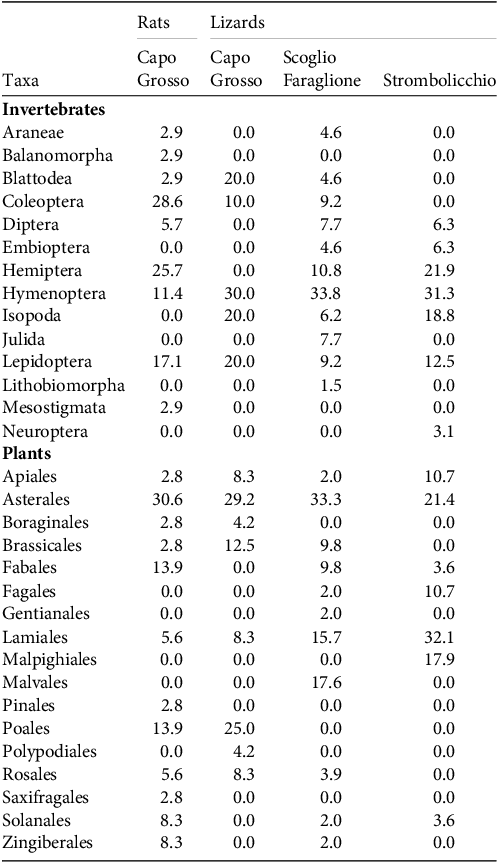
The analysis of cox1 data identified 44 Arthropoda OTUs in the diet of P. raffonei, with 40 identified to species and four to genus. For the plant component of the diet, the analysis of trnL data identified 23 OTUs, three of which were identified to species, six to genus, and 14 at the family or higher level. Occurrence results for both animal and plant components in lizards and rats are reported in Table 1. Overall, Hymenoptera was the most frequent prey group, followed by Hemiptera (except on Capo Grosso), Isopoda and Lepidoptera. Asterales and Lamiales were in general the most frequently consumed plant material. For the 12S analysis, only one sample of P. raffonei, collected from Scoglio Faraglione, successfully amplified, with a single OTU identified as a gull of the genus Larus.
Per cent occurrence of prey, by taxon, in wall lizard Podarcis raffonei and black rat Rattus rattus faecal pellets in the three study areas (Fig. 1). Values were calculated following Deagle et al. (Reference Deagle, Thomas, McInnes, Clarke, Vesterinen and Clare2019) to quantify the proportion of a specific prey item relative to the combined occurrences of all food items, standardized so that the total equals 100% (separately for invertebrates and plants).

Table 1 Long description
Table with two main categories: Invertebrates and Plants. The table lists various taxa under these categories and shows their percentage occurrence in the diet of wall lizards and black rats in three study areas: Capo Grosso, Scoglio Faraglione, and Strombolicchio. Each study area has separate columns for rats and lizards. The table includes percentages for different taxa such as Araneae, Coleoptera, Hymenoptera, Asterales, and Lamiales.
Regarding the diet of R. rattus, the analysis of cox1 data identified 20 Arthropoda OTUs, with 19 identified to species and one to genus. For the plant component, the analysis of trnL data identified 13 OTUs, one to species, two to genus, and 10 to the family level or higher. Coleoptera (28.6%) and Hemiptera (25.7%) were the most frequently consumed prey groups, and Asterales was the most commonly consumed plant material (30.6%; Table 1). For the 12S analysis, we identified one OTU in the rat’s diet, which was taxonomically assigned to the gull genus Larus. DNA of P. raffonei was not detected in rat faeces.
Considering similar survey coverage among the three lizard populations, those from Scoglio Faraglione exhibited the broadest invertebrate dietary niche and those from Capo Grosso the narrowest. This difference was significant at all taxonomic levels (Fig 2a; Supplementary Table 2). On Capo Grosso, rats had a wider niche than the Aeolian lizard at all taxonomic levels, but niche breadth difference was significant only at the OTU level (Fig. 2a). Lizards from Scoglio Faraglione and rats from Capo Grosso exhibited the broadest plant dietary niche at all taxonomic levels (Fig. 2b). However, the observed differences were not statistically significant, as illustrated by the large overlap of confidence intervals among lizard and rat populations (Fig. 2b; Supplementary Table 2).
Rarefaction and extrapolation curves of (a) arthropod and (b) plant prey taxa richness at the order, family and operational taxonomic unit (OTU) levels for lizard and rat populations in the Aeolian archipelago. Taxa richness serves as a proxy for dietary niche breadth; non-overlapping 95% confidence intervals (shaded areas) indicate significant differences among populations. Note the different y-axis scales. (Readers of the printed journal are referred to the online article for a colour version of this figure.)

Fig. 2 Long description
Panel A: Three line graphs depict taxa richness of arthropods at the order, family, and OTU taxonomic levels. The x-axis represents sample coverage, and the y-axis represents taxa richness. Different colored lines represent different islands: Capo Grosso, Rats, Scoglio Faraglione, and Strombolicchio. The shaded areas indicate 95 percent confidence intervals. Panel B: Three line graphs depict taxa richness of plants at the order, family, and OTU taxonomic levels. The x-axis represents sample coverage, and the y-axis represents taxa richness. Different colored lines represent different islands: Capo Grosso, Rats, Scoglio Faraglione, and Strombolicchio. The shaded areas indicate 95 percent confidence intervals. The graphs show that taxa richness increases with sample coverage, with significant differences among populations indicated by non-overlapping confidence intervals.
Niche overlap and diet similarity analyses revealed distinct patterns between invertebrate- and plant-based diets. For the invertebrates, the highest diet similarity was observed at the order level among P. raffonei populations (mean Pianka index 0.792). All the pairwise combinations were statistically significant when compared with a null model generated using the RA3 randomization algorithm (P < 0.02; Supplementary Table 3). In contrast, on Capo Grosso there was a statistically non-significant degree of niche overlap between P. raffonei and rats (Pianka index 0.50, P = 0.239). As expected, as taxonomic resolution increased, overlap values decreased, especially between lizards and rats. At the family level, Scoglio Faraglione and Strombolicchio had the highest similarity (Pianka index 0.658, P = 0.008), whereas the comparison between P. raffonei and rats on Capo Grosso has the lowest value (Pianka index 0.195, P = 0.360). At the OTU level, the overlap was limited across all pairs (Supplementary Table 3). In contrast, the plant-based component of the diet exhibited different patterns. At the order level, P. raffonei and rats on Capo Grosso had the highest overlap (Pianka index 0.815, P = 0.006). The lowest similarity was between Strombolicchio and Capo Grosso (Pianka index 0.444, P = 0.217), at family and OTU levels (Supplementary Table 3).
Discussion
This study provides a high-resolution picture of the dietary spectra of the Endangered Aeolian wall lizard and of the invasive black rat at Capo Grosso, and evaluates potential trophic interactions in the context of a marked demographic decline of P. raffonei. The combination of repeated-count demography and DNA metabarcoding suggests that negative effects of rats on lizards at Capo Grosso are more likely mediated by interference, particularly for plant-derived food, rather than by direct predation.
Decline of the Aeolian wall lizard on Capo Grosso: plausible drivers
The population of P. raffonei on Capo Grosso underwent a demographic decline from 2017 to 2022. The estimated population size in 2022 (212–475 lizards) was markedly lower than that obtained by Ficetola et al. (Reference Ficetola, Silva-Rocha, Carretero, Vignoli, Sacchi and Melotto2021) in 2017 (800–1,300 lizards) in the same study area and using the same methodology. Although it is difficult to identify the causal factor(s) of the observed population decline, we examined potential abiotic and biotic changes that occurred on Capo Grosso during this time.
By analysing satellite images of the promontory from 2014 to 2020, together with our direct observations, we documented a dramatic shift in land use leading to a significant increase in vegetation density. Until 2015, a local shepherd practiced winter goat grazing on the promontory, which effectively controlled the vegetation growth, especially adventitious species dominated by Rubus sp., maintaining the typical Mediterranean scrub. Following the abandonment of goat grazing, adventitious and nitrophilous plants have rapidly expanded, leading to high vegetation density. This increase in vegetation density enhances habitat suitability for rats by providing food, shelter and nesting sites (Harper et al., Reference Harper, Dickinson and Seddon2005), and consequently supports a higher rat density, as observed during 2020–2022. The growth of the rat population on the small and isolated promontory of Capo Grosso could have contributed to the decline of P. raffonei observed over 5 years. Rats are opportunistic feeders, exploiting a wide range of food items, including seeds, fruits, insects, small vertebrates and eggs (Jones et al., Reference Jones, Tershy, Zavaleta, Croll and Keitt2008; St Clair, Reference St Clair2011; Capizzi et al., Reference Capizzi, Sposimo, Sozio, Fratini and Zanet2024). In island environments, where resource availability is inherently limited, the introduction of a generalist predator can have cascading effects, reducing not only prey populations but also the availability of food for other native species (St Clair, Reference St Clair2011; Russell et al., Reference Russell, Sataruddin and Heard2014). By consuming seeds and seedlings, rats may alter plant regeneration and vegetation structure over time (Grant-Hoffman et al., Reference Grant-Hoffman, Mulder and Bellingham2010), and by exploiting invertebrates, they directly reduce resources available to lizards. In microinsular Podarcis populations, rat predation on invertebrates has been linked to negative demographic effects, as documented for P. siculus on Lachea Island, Sicily (Siracusa et al., Reference Siracusa, Larosa and Petralia2012). Similarly, for the Balearic lizard Podarcis lilfordi, the presence of R. rattus is associated with higher levels of fluctuating asymmetry and significantly lower population densities compared to rat-free islets, likely reflecting stress induced by competition or predation pressures (Pérez-Mellado et al., Reference Pérez-Mellado, Hernández-Estévez, García-Díez, Terrassa, Ramón and Castro2008; Garrido & Pérez-Mellado, Reference Garrido and Pérez-Mellado2014). Beyond competition, direct predation by rats is a significant threat to insular populations of lizards (Case & Bolger, Reference Case and Bolger1991). Numerous cases of predation of the Selmunett lizard Podarcis filfolensis kieselbachi by rats were observed on Selmunett Island, Malta, and documented as one of the main causes of population decline (Sciberras & Schembri, Reference Sciberras and Schembri2008). Rat predation has also been documented on larger-sized lizards, such as the Endangered Tenerife speckled lizard Gallotia intermedia (López-Darias et al., Reference López-Darias, López-González, Padilla, Martín-Carbajal and Piquet2024). Considering the ubiquitous presence of rats on many archipelagos, where they occur in sympatry with various lacertid species, and their broad feeding spectrum (Shiels et al., Reference Shiels, Pitt, Sugihara and Witmer2014; Harper & Bunbury, Reference Harper and Bunbury2015; Pomeda-Gutiérrez et al., Reference Pomeda-Gutiérrez, Medina, Nogales and Vargas2021), lizard consumption by rats may be more common than previously thought.
Evidence from rat eradication programmes further underscores the detrimental effects of rat presence. Following R. rattus removal from Berlenga Island, Portugal, the Berlenga wall lizard Podarcis carbonelli berlengensis exhibited trophic niche expansion and increased sexual dimorphism, likely driven by reduced competition pressure and greater resource availability (Nunes et al., Reference Nunes, Mota-Ferreira, Sampaio, Andrade, Oliveira and Rebelo2022). Similarly, rat eradication on several Mediterranean islands and islets, such as Isola delle Femmine, La Scola and Zannone, have consistently resulted in increased lizard densities (Capizzi et al., Reference Capizzi, Baccetti, Sposimo and Francesco2015; Canale et al., Reference Canale, Di Dio, Massa and Mori2019). In line with these findings, and as discussed below, results from our dietary analyses suggest that the negative effects of rats on lizards at Capo Grosso may be mediated by trophic interactions.
Dietary spectra of Aeolian lizards and rats, and potential trophic interactions
Aeolian wall lizards primarily consume arthropods but incorporate a substantial portion of plant material into their diet. DNA metabarcoding allowed us to characterize this dietary breadth with high taxonomic resolution. In terms of dietary habits, our findings on prey diversity and frequency only partially align with morphological observations of the diet of P. raffonei (Luiselli et al., Reference Luiselli, Capula, Corti, Lo Cascio and Pérez-Mellado2004; Lo Cascio & Capula, Reference Lo Cascio and Capula2011). We identified a high diversity of Diptera and Hemiptera, a significant food source only marginally reported previously. Similarly, in our study, Lepidoptera was the third most frequent prey item, whereas earlier studies either omitted them (Lo Cascio & Capula, Reference Lo Cascio and Capula2011) or found them at low frequencies (Luiselli et al., Reference Luiselli, Capula, Corti, Lo Cascio and Pérez-Mellado2004). Using DNA metabarcoding, we identified a high diversity of plant OTUs (34% of the dietary diversity of P. raffonei, with 84% assigned to family), contrasting with previous studies that reported a minimal contribution of plant matter (c. 3% of dietary elements; Luiselli et al., Reference Luiselli, Capula, Corti, Lo Cascio and Pérez-Mellado2004) or assessed plant material based on volume rather than diversity (e.g. 8–12% of the total volume of examined pellets; Lo Cascio & Capula, Reference Lo Cascio and Capula2011). These discrepancies cannot be attributed to sampling differences, as all studies examined populations from Scoglio Faraglione and Strombolicchio in spring. Traditional observation methods based on faecal dissection often suffered from taxonomic resolution and significant bias, as detection probability is strongly influenced by digestion (Cabodevilla et al., Reference Cabodevilla, Mougeot, Bota, Mañosa, Cuscó and Martínez-García2021). For instance, soft foods, such as Lepidoptera and Diptera larvae, are typically more digestible, leading to their frequent underrepresentation in dietary analyses (Sullins et al., Reference Sullins, Haukos, Craine, Lautenbach, Robinson and Lautenbach2018; Alemany et al., Reference Alemany, Pérez-Cembranos, Pérez-Mellado, Castro, Picornell and Ramon2023; Tang et al., Reference Tang, Wang, Wu, Wang, Fu and Zhang2023). The increased taxonomic accuracy provided by DNA metabarcoding provided a more detailed understanding of the diet of P. raffonei and was crucial for assessing niche breadth and niche overlap between lizard and rat populations.
Overall, on Capo Grosso rats exhibited a broader niche width than P. raffonei for both animal and plant diet components, although differences in plant niche width were not significant. The plant component of the diet revealed an unexpectedly high frequency of plant taxa in the diet of both rats and lizards. We expected this for an opportunistic omnivore such as the rat, but not for a typically insectivorous lizard, although insular species are known to shift to omnivory when food resources are limited (Van Damme, Reference Van Damme1999; Cooper Jr & Vitt, Reference Cooper and Vitt2002; Carretero, Reference Carretero2004; Vervust et al., Reference Vervust, Pafilis, Valakos and Van Damme2010; Taverne et al., Reference Taverne, Fabre, King-Gillies, Krajnović, Lisičić and Martin2019; Alemany et al., Reference Alemany, Pérez-Cembranos, Pérez-Mellado, Castro, Picornell and Ramon2023). In our study, DNA metabarcoding detected an overlap in plant OTUs between P. raffonei and the rat, with a high dietary niche overlap even at low taxonomic levels, suggesting potential trophic competition for plant-based resources. Although our analysis is based on a qualitative assessment of trophic spectra, this highlights that low taxonomic resolution can result in the identification of a specific ecological pattern (such as niche overlap in our case) where no such pattern exists (Martinez, Reference Martinez1993). It also emphasizes the importance of high-resolution analyses, such as DNA metabarcoding, in uncovering subtle but ecologically meaningful differences in dietary composition and niche dynamics (Lenat & Resh, Reference Lenat and Resh2001; Grimbacher et al., Reference Grimbacher, Catterall and Kitching2008; de Oliveira Jr et al., Reference de Oliveira, Ortega, dos Santos Ribas, Lopes and Bini2020). However, careful interpretation is needed, especially regarding plant diversity and the degree of dietary overlap. Although DNA metabarcoding is a powerful tool with high sensitivity, plant DNA detected in omnivorous consumers may originate from environmental contamination or secondary consumption rather than active feeding (Ando et al., Reference Ando, Mukai, Komura, Dewi, Ando and Isagi2020; Tercel et al., Reference Tercel, Symondson and Cuff2021; Da Silva et al., Reference Da Silva, Porto, Amorim, Beja and Mata2025). Despite these limitations, the high-resolution methodological approach adopted in our study provides a robust dietary characterization of P. raffonei and invasive black rats on Capo Grosso, identifying previously unreported dietary components and establishing a baseline for future monitoring. Furthermore, our findings suggest that the observed lizard population decline following increased rat density is more strongly mediated by trophic overlap for plant resources than by predation. In a microinsular setting such as Capo Grosso even subtle shifts in resource availability or competitive pressure may have disproportionate demographic consequences. Urgent conservation measures are therefore needed, including rat control and vegetation management to reduce rat habitat suitability. Re-establishing moderate grazing, as practised traditionally before 2016, could help limit rat populations while maintaining open microhabitats beneficial for lizards and arthropods (Godínez-Álvarez, Reference Godínez-Álvarez2004; Romero-Egea et al., Reference Romero-Egea, Robles, Traveset, Del Rio and Hervías-Parejo2023). These actions are already being undertaken within the LIFE EOLIZARD project and should be sustained as part of an integrated long-term conservation strategy.
Author contributions
Study conceptualization: LV, DS; data curation: EB, DSV, BG; design of methodology: LV, EB, BG, GS, DS; data analysis: EB, BG, GS; writing: LV, EB, GS, DS; revision: LV, EB, BG, GS, DJH, DS; supervision: LV, DJH, DS.
Supplementary material
The supplementary material for this article is available at doi.org/10.1017/S0030605326103482
Acknowledgements
This study was funded by the European Commission LIFE Programme (Project 101114121 LIFE22-NAT-IT-LIFE EOLIZARD).
Conflicts of interests
None.
Ethical standards
This research abided by the Oryx guidelines on ethical standards. Lizards were captured and handled under permits from the Italian Ministry of Environment (MiTE-2021-0037921 and MiTE- 2022-0024516/0044985). No animals were sacrificed.
Data availability
Raw sequencing data generated in this study have been deposited in the NCBI Sequence Read Archive under BioProject accession number PRJNA1438719.




 Open access

