Introduction
Chronic kidney disease (CKD) is a condition defined as the structural or functional abnormalities of the kidney, with or without decreased glomerular filtration rate (GFR) for 3 months or longer, manifest either by abnormalities in pathological or markers of kidney damage (Reference Chonchol, Lippi and Salvagno1). It is estimated that globally 843.6 million people were affected by CKD in 2017, which is consistent with the rise in risk factors like diabetes and obesity (Reference Kovesdy2). Diabetes and CKD hold 9th and 18th places, respectively, in terms of overall mortality worldwide (3). In India, the prevalence of diabetes was 7.3 percent in 2017 (Reference Anjana, Deepa and Pradeepa4) and the prevalence of CKD ranged between <1 and 17 percent in 2013 (Reference Ene-Iordache, Perico and Bikbov5). People with diabetes have two times higher odds of developing CKD as compared to nondiabetics (Reference Koye, Magliano, Nelson and Pavkov6). In India, 40 percent of people with type 2 diabetes develop CKD (Reference Prasannakumar, Rajput and Seshadri7), which is the second most common cause of end-stage renal disease (ESRD) (Reference Parameswaran, Geda and Rathi8). About 0.22 million people in India are diagnosed with ESRD each year (9) and about 95 percent of them experience catastrophic health expenditure (Reference Khan, Jan and Rashid10). Further, over 90 percent of ESRD patients who require renal replacement therapy (RRT) die due to the inability to pay for care, and 60 percent of those who begin RRT abandon it for financial reasons (Reference Anjana, Deepa and Pradeepa4). The Government of India has implemented the Pradhan Mantri National Dialysis Program (PMNDP) to provide free dialysis services and reduce the out-of-pocket expenditure (OOPE) of below-poverty-line patients with ESRD. Still, the economic burden borne by CKD patients remains high. (Reference Khan, Jan and Rashid10). Hence, early detection of CKD by population-based screening can reduce the proportion of ESRD and its management associated with financial impoverishment.
CKD is characterized by increased urine albumin excretion or decreased glomerular filtration rate (GFR), or both (Reference Idowu, Ajose, Adedeji, Adegoke and Jimoh11). As per KDIGO guidelines, screening of microalbuminuria among diabetics enables early detection of CKD (Reference Molitch, Adler and Flyvbjerg12). The National Institute for Health and Clinical Excellence (NICE) recommends annual microalbuminuria screening for type 2 diabetes patients and initiates treatment if microalbuminuria is detected. In India, the National Programme for Prevention and Control of Cancer, Diabetes, Cardiovascular Diseases and Stroke (NPCDCS) recommends facility-based annual microalbuminuria screening among type 2 diabetics (13). The Ministry of Health and family welfare implements and publically funds this program.
Microalbuminuria is routinely assessed through albumin–creatinine ratio (ACR) in spot urine samples. ACR is a quantitative laboratory-based test that requires either the patient to visit the facility to provide samples or samples to be transported to the facility for testing. Both options come at a cost and with practical challenges (Reference Hoerger, Hoerger and Wittenborn14). Spot urine dipstick microalbuminuria, on the other hand, is a qualitative point-of-care test. Although the laboratory-based spot-urine ACR is widely recognized for microalbuminuria screening, urine dipstick tests are still recommended owing to test time and the feasibility of performing in the community (Reference Kuritzky, Toto and Van Buren15). However, the diagnostic accuracy of dipstick microalbuminuria is 92 percent of sensitivity and 44 percent of specificity, which is less than the acceptable threshold (80–90 percent) of sensitivity and specificity for use as an ideal screening tool (Reference Nagrebetsky, Jin and Stevens16; Reference Power, Fell and Wright17).
Several economic evaluation studies conducted in various countries identified that population-based screening of CKD using microalbuminuria among the diabetic population is cost-effective (Reference Hoerger, Hoerger and Wittenborn14; Reference Lepore, Maglio, Nosari, Dodesini and Trevisan18; Reference Srisubat, Sriratanaban, Ngamkiatphaisan and Tungsanga19). However, the cost-effectiveness of population-based screening for CKD using microalbuminuria had not yet been assessed from the Indian context. Therefore, we aimed to evaluate the cost-effectiveness of implementing population-based microalbuminuria screening in India among patients with normotensive type 2 diabetes mellitus aged ≥40 years. In order to address the gap in diagnostic accuracy, we considered two screening scenarios: Scenario I with the dipstick point of care test and Scenario II with the gold standard ACR. Further, scenario II was also combined with a serum creatinine test to account for the clinical heterogeneity, that is, albuminuric and nonalbuminuric presentation of CKD. The modeling approach of the present study is consistent with the model reported by Srisubat et al. (Reference Srisubat, Sriratanaban, Ngamkiatphaisan and Tungsanga19). Nevertheless, our study stands out due to two distinct screening interventions modeled in the study to address the feasibility and clinical appropriateness of the screening interventions in the Indian context.
Methods
The target population for the present study is people with type 2 diabetes without hypertension. People with both type 2 diabetes and hypertension were excluded from the screening because the population received ACEI as a front-line hypertension management drug. Ethics clearance was not required for the study as it adopted data from secondary sources.
Model Overview and Cost-Effectiveness Analysis
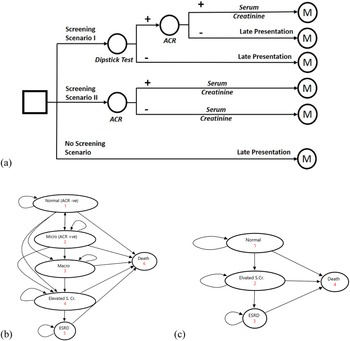
We employed a decision tree followed by the Markov model to estimate the cost-effectiveness of two population-based screening strategies compared with the current no-screening scenario. The decision tree was employed to model the unidirectional flow and segregation of the initial cohort based on the screening strategies. As CKD is a chronic disease with recurrent events, the Markov model was further employed to model the disease progression on the segregated cohort over time.
The case identification and the screening strategies of the two scenarios are depicted in Supplementary Figure S1. The decision tree and Markov model were used to estimate the cost-effectiveness of annual, 5- and 10-yearly screening of microalbuminuria compared with the no-screening scenario. The initial cohort was segregated as per the positive and negative predictive values of the screening/diagnostic tests and clinical presentations. The natural history of CKD demanded two Markov models, which are albuminuric (Figure 1B) and nonalbuminuric CKD (Figure 1C), with six and four mutually exclusive health states, respectively. In addition to normal (normoalbuminuria), elevated serum creatinine (Elevated Sr. Cr.), ESRD and death health states in the nonalbuminuric CKD model, the albuminuric Markov model included two albuminuric health states such as Microalbuminuria and Macroalbuminuria. Segregated cohort from the decision tree entered into the Markov model. Markov model was simulated over a lifetime with an annual interval as per the transition probabilities which were applied based on the natural history of the disease under the screening and nonscreening scenarios. Half-cycle correction made in the model allowed the random transition of cohort throughout each cycle.
Schematic representation of decision tree and Markov models (A); Albuminuric chronic kidney disease (CKD) (B), and nonalbuminuric CKD (C). ACR, albumin–creatinine ratio; ESRD, end-stage renal disease.

The cost incurred by both patients and health system for screening, case identification and management of clinical events in India over the lifetime was simulated along with the health-related quality of life/utilities experienced at each health state. Due to the nonavailability of data, except for patients receiving dialysis, utility values for all other health states were obtained from a Thailand-based study. The cost and health utilities were discounted at the annual rate of 3 percent as per the HTA India reference case (Reference Kaur, Chauhan and Prinja20). The differences in the total cost, total quality-adjusted life years (QALY), and total life years between intervention scenarios (I or II) and comparator were used to estimate incremental cost-effectiveness ratio (ICER). The cost-effectiveness threshold in the present study was assumed to be one time GDP per capita of India. Net monetary benefit (NMB) was also calculated from the model-based estimates by monetizing health benefits with one-time per capita GDP as the threshold.
We adopted a societal perspective for the study, including the direct and indirect medical costs incurred by patients and the resources used by the health system. Since CKD is a chronic and progressive condition, the costs and consequences associated with the interventions and comparator were stimulated for a lifetime horizon until the entire cohort was absorbed in the death state. The model was developed using Microsoft Excel (Microsoft Corporation, 2019).
Model Inputs Parameters
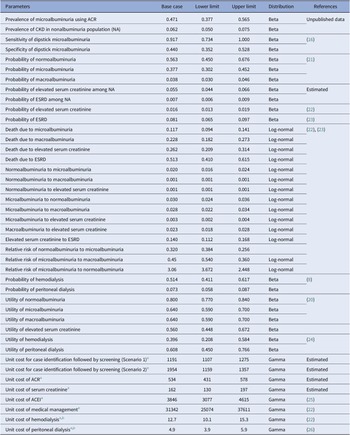
Input parameters used in the model were from secondary sources due to the lack of time and resources available to conduct a primary study (Table 1). The diagnostic accuracy of the dipstick test (Reference Nagrebetsky, Jin and Stevens16) and other clinical data related to the prevalence of CKD stages and transition probabilities were obtained from the targeted literature search (Reference Srisubat, Sriratanaban, Ngamkiatphaisan and Tungsanga19; Reference Adler, Stevens and Manley27). The diabetic-specific mortality and all-cause mortality used in the model were specific to India (Reference Mohan, Shanthirani and Deepa28; 29). Health state utilities for hemodialysis and peritoneal dialysis were obtained from a primary study conducted by the investigators in a tertiary care center in Puducherry, India, using the EQ-5D-5L questionnaire and India-specific health-related quality of life tariff (Reference Jyani, Sharma and Prinja30). The utility associated with the health states of elevated serum creatinine was obtained from a Thailand-based study, which is relatable to India Because of the geographical and cultural similarities (Reference Srisubat, Sriratanaban, Ngamkiatphaisan and Tungsanga19). Utility indices for other health states were obtained from the other sources provided in an HTA study conducted in India (Reference Kaur, Chauhan and Prinja20).
Model input parameters

a In Indian Rupees (₹).
b In Lakh.
Cost Parameters
Direct and indirect costs used in the model were compiled from the National Sample Survey Office (NSSO) 2017–2018, the National Health System Cost Database for India (NHSCDI) (Reference Prinja, Chauhan and Bahuguna25), prior studies, online price quotes by different vendors, and assumptions. The unit cost of dipstick screening included the price of the kit, incentives, allowances, and training given to community healthcare workers. The costs of ACR and serum creatinine were the median online price incorporated with outpatient consultation costs in PHC as per NHSCDI. The Angiotensin Converting Enzyme Inhibitor (ACEI) drug cost was taken from the NHSCDI, and the unit cost was estimated as per the dosage and duration of medication. The cost of hemodialysis, peritoneal dialysis, and other medical management was taken from the literature (Reference Kaur, Prinja and Ramachandran22; Reference Jeloka, Upase and Chitikeshi26; Reference Ahlawat, Tiwari and D’Cruz31). The proportion of people undergoing hemodialysis and peritoneal dialysis was taken from a study conducted in Chandigarh, India (Reference Parameswaran, Geda and Rathi8). The OOPE comprised OPD, IPD and follow-up visits cost along with income loss incurred by the patients as per the NSSO (2017–18) data. OOPE borne by patients due to hemodialysis was obtained from Kaur et al. (Reference Kaur, Prinja and Ramachandran22). All the costs were adjusted for inflation and converted into 2021 prices.
Sensitivity Analysis
Uncertainty in the model parameter values was assessed through one-way sensitivity analysis (OWSA) and probabilistic sensitivity analysis (PSA). OWSA was carried out in MS Excel with a ±20 percent change in the base case values, as shown in Table 1. PSA was done through Monte Carlo simulation over 1,000 times using MS Excel macros function through visual basic coding. The results of OSWA and PSA were presented using a tornado graph and cost-effectiveness plane, respectively.
Threshold Analysis
We also conducted a threshold analysis to determine at what coverage percentage the two screening strategies are cost-effective. Coverage of screening assumed in the threshold analysis considered the following factors, which are participation, retention, and loss to follow-up of the eligible population. ICER was estimated for annual screening with the range of coverage from 1, 5, 20, 40, 80, and 100 percent, and the results were plotted against the willingness to pay threshold of one-time GDP per capita (₹1,45,679).
Results
Base Case Results
Screening Scenario I
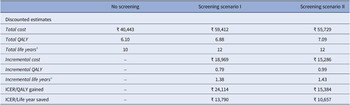
The total discounted cost incurred for population-based microalbuminuria screening using scenario I was ₹ 59,412 (US$ 744), whereas no-screening resulted in ₹ 40,443 (US$ 507) (Table 2). The total discounted QALY for no-screening and screening scenario I was 6.10, 6.88. The life-years saved under screening scenario I was 1.38 compared with the no-screening scenario. At the discounted rate of 3 percent on cost and QALY, the screening scenario I resulted in ₹ 24,114 (US$ 302) ICER/QALY gained and ₹ 13,790 (US$ 173) ICER/life-year saved compared to the no screening scenario. Assuming the threshold value (λ) as the one-time GDP per capita income of India (₹ 1,45,679), the NMB for the scenario I was ₹ 0.96 lakh (Table 3).
Base case results (N = 1)

a Undiscounted.
The net monetary benefit associated with annual microalbuminuria screening (N = 1)

Note: Assuming the per capita GDP of India as threshold (λ) = ₹ 1,45,679 (FY 2020–21, MoSPI, India)
Screening Scenario II
Population-based microalbuminuria screening using scenario II resulted in a total cost of ₹ 55,729 (US$ 698) and a total QALY of 7.09, under the discounted rate of 3 percent (Table 2). The total life-years saved under screening scenario II was 1.43. Compared with no-screening, the discounted ICER per QALY gained for scenario II was ₹ 15,384 (US$ 193), whereas the discounted ICER per life-years saved under scenario II was ₹ 10,657 (US$ 134). The NMB associated with scenario II was estimated as ₹ 1.29 lakh as per the threshold of India’s one-time GDP per capita income (₹ 1,45,679) (Table 3).
One-Way Sensitivity Analysis
Variations in the ICER concerning the higher and lower base case parameter values at 20 percent are presented in Supplementary Figure S2a,b. In scenario I, “Relative risk of Normo to microalbuminuria” and “Transition Probability of Normo to microalbuminuria” had the highest variations in the ICER. Other parameters that influenced the ICER estimate were “Cost of ACEI,” “Utility of Normoalbuminuria,” “Transition Probability of Micro to Normoalbuminuria,” and so forth. However, the changes in “Prevalence of Microalbuminuria” caused lesser variation in the base case ICER of scenario I than the above-mentioned parameters. In scenario II, “Relative risk of Micro to Normoalbuminuria,” “Utility of microalbuminuria,” “Cost of ACEI,” and “Prevalence of microalbuminuria” had the strongest influence on the ICERs.
Probabilistic Sensitivity Analysis
Monte Carlo-probabilistic sensitivity analysis was performed with 1000 simulations. The simulated incremental costs and incremental QALYs (n = 1000) derived for both the two screening scenarios in comparison with no screening were plotted in the cost-effectiveness (CE) plane (Supplementary Figure S3). All the simulated values fell on the northeastern quadrant of the CE plane. According to the willingness to pay threshold, the probability that scenario I/scenario II to be cost-effective was 100 percent (Figure 2).
Cost-effectiveness acceptability curve of population-based microalbuminuria for screening scenarios I and II.

Impact of Microalbuminuria Screening on ESRD Cases
As per the model, the total reduction of ESRD cases over 10 years in screening scenario I and scenario II per 1,00,000 population (hypothetical cohort) were 180 and 193, respectively (Supplementary Table S1). The reduction in ESRD cases resulted in cost savings of ₹ 12.3 crore in screening scenario I and ₹ 13.3 crore in screening scenario II over 10 years.
Frequency of Screening
The cost-effectiveness of both the screening scenarios I and II were assessed at 5 and 10 yearly frequencies (Supplementary Figure S4). The total discounted cost of 5-yearly screening under scenario I and scenario II were ₹ 50,609 and ₹ 51,413, whereas the 10-yearly screening resulted in ₹ 49,729 and ₹ 50,444, respectively. The QALY gain at both 5- and 10-year intervals of screening was 0.54 and 0.52 for scenario I and 0.70 and 0.69 for scenario 2, respectively. The number of ESRD cases averted at a 5-yearly screening frequency under scenario I was 85, and scenario II was 90. The total number of ESRD cases averted under scenario I and scenario II at 10-yearly frequency was 72 and 76, respectively. The ICER/QALY gain at a screening frequency of 5 years under scenario 1 was ₹ 18,013, and scenario II was ₹ 14,862. The 10 yearly screenings resulted in ₹ 16,911 and ₹ 13,874 ICER/QALY gained under scenario I and scenario II, respectively.
Threshold Analysis
Both annual microalbuminuria screening scenarios were cost-effective, even with coverage as low as 5 percent considering one GDP per capita as the threshold (Figure 3). The minimal coverage required for scenarios I and II to be cost-effective was 3.2 1.3 percent, respectively. Coverage reduction elevated the total cost of screening and lowered the total QALY gain in the intervention. Consequently, the intervention had a higher ICER per QALY gained with the decrease in coverage. Reduced screening frequency resulted in an increase in ICER per QALY gained under a similar coverage rate (results not shown).
Threshold analysis with varying screening coverage and its respective incremental cost-effectiveness ratio (ICER) per quality-adjusted life years (QALY) gained (dotted lines: Threshold – India GDP per capita).

Discussion
We found that annual population-based microalbuminuria screening in India among normotensive type 2 diabetes patients aged ≥40 years was cost-effective at the ICERs of ₹ 24,114 (US$ 308) and ₹ 15,384 (US$ 196) per QALY gained and ₹ 13,790 and ₹ 10,657 per life years-saved for the screening scenarios I and II, respectively, compared with the no screening scenario. In both intervention scenarios, the cost of ACEI and the relative risk of micro to macroalbuminuria had the highest influence on the ICER estimates. The probability that both interventions were cost-effective was 100 percent at the per capita GDP of India.
Similar studies from Asia, the US, and European countries have shown that the population-based screening for MA among diabetic populations using dipstick was a cost-effective strategy in preventing ESRD and its progression. As reported by Wu et al., the screening for microalbuminuria in newly diagnosed type 2 diabetes patients was a cost-saving option for the prevention of CKD in the Chinese population (Reference Wang, Yang, Wang and Zhang32; Reference Wu, Zhang, Lin and Mou33). Studies from other Asian countries like Japan (Reference Kondo, Yamagata and Hoshi34), Thailand (Reference Srisubat, Sriratanaban, Ngamkiatphaisan and Tungsanga19), and Korea (Reference Go, Kim and Park35) also found CKD screening using either proteinuria or albuminuria dipstick to be cost-effective in high-risk populations, especially among diabetics. Studies from the US and European countries on CKD screening using microalbuminuria or proteinuria among diabetics and/or hypertension populations have found the intervention to be cost-effective (Reference Komenda, Ferguson and Macdonald36). However, CKD screening among the general population was not cost-effective, as reported by studies across the world.
The estimated ICER per QALY gained for screening CKD in diabetic patients from the present study for scenario I (US$ 308) and II (US$ 196) are higher than the estimate from Thailand ($ 96.8). However, the estimates were lower than those estimated in Korea ($37,812) (Reference Lepore, Maglio, Nosari, Dodesini and Trevisan18), the US and European countries ($5,298- $54,943) (Reference Ferguson, Tangri and Tan37). Studies employing proteinuria screening exhibited a higher ICER than studies involving microalbuminuria screening. The lower diagnostic accuracy of proteinuria compared to microalbuminuria in detecting CKD results in considerable false positive and false negative screening test results, which leads to unwarranted confirmatory tests and/or late treatment among the screened population. Hence, the variance of ICER estimates obtained in our study compared with other studies could be attributed to the variations in the prevalence and clinical presentation of microalbuminuria/proteinuria across diabetic populations. This observation was further supported by OWSA findings, where the prevalence of microalbuminuria and the sensitivity of the dipstick microalbuminuria test show considerable impact on the variations in the ICER estimates. The speculation is supported by Sisrubat et al., where the positive predictive value of dipstick microalbuminuria determined the robustness of the model estimates (Reference Kaur, Prinja and Ramachandran22).
The choice of dipstick or ACR for the microalbuminuria screening in the diabetic population still has a greater influence on the ICER estimates. As reported by Lepore et al. (Reference Lepore, Maglio, Nosari, Dodesini and Trevisan18), using dipstick and ACR to screen microalbuminuria in the diabetic population resulted in ICERs of $2,607 and $8,902, respectively. Contrastingly, in the current study, the ICER of the ACR-based screening, that is, scenario II did not show much variation from the ICER of dipstick-based screening scenario I. This could be the impact of parallel screening as ACR was combined with serum creatinine which diagnosed the nonalbuminuric diabetic population, who would otherwise progress to CKD if screened using scenario I.
In the study, although ICER/QALY gained for 10 yearly screening was more cost-effective when compared to 5 yearly and annual screening for microalbuminuria in the population, the health gain in terms of QALY gain and ESRD cases reduction was lowest for decadal screening when compared to other screening frequencies. Further, with respect to the total cost of screening, a lower frequency of screening incurred lesser costs. Therefore, in a resource-limited setting like India, it might be prudent to consider implementing 5 yearly or decadal screening for CKD than the annual screening. Further, the cost-effectiveness of the two interventions was less sensitive to the coverage with respect to loss of follow-up and nonadherence to the treatment. Even the marginal increase in incremental QALY makes both screening scenarios cost-effective even at the lowest coverage rate. However, we recommend that future studies shall undertake budget impact analysis for the interventions to throw light on their affordability of implementation in India.
The major strength of the study was the assessment of two types of screening interventions, one was based on feasibility (scenario I), and the other was based on clinical validity (scenario II), which enabled us to gauge the extent of benefit derived from scenario I. Compared to other cost-effectiveness studies, our model is more realistic and novel in its structure as it addresses clinical heterogeneity and incorporates nonalbuminuric CKD. Further, we used local evidence on the prevalence of microalbuminuria among diabetic patients estimated from a WHO STEPS survey conducted in Puducherry during 2019–2020 by the investigators (yet to be published). However, the prevalence was based on a single-time estimation of microalbuminuria which might have led to an overestimation of the prevalence due to the high false positivity rate. Still, the estimate of microalbuminuria prevalence was congruent with the national-level prevalence data (Reference Parameswaran, Geda and Rathi8).
The shortcomings of the study were data limitations which were majorly from secondary sources, especially from non-Indian sources. Although the uncertainty on the data was addressed through sensitivity analysis to some extent, described below are the potential impact of such data. The natural progression and transition probabilities for different stages of CKD were derived from the UK, which may represent disease progression among the Indian population to a lesser extent. Hence, the results of the present study may not be generalizable and transferable, especially in the circumstance where the scenarios are beyond the variation covered in the sensitivity analysis. As the population undergoing renal transplantation is negligible in India, we did not incorporate parameters relevant to renal transplantation in the model (as per expert opinion). The cardiovascular complications associated with CKD were also not incorporated, and such incorporation would make the intervention more cost-effective. Other limitation includes the cost estimates used in the study, which were mainly based on secondary data sources. Side effects of ACEI were not incorporated into the model. The cohort of nonalbuminuric CKD was not assigned with the benefit of early detection due to the complex nature of the etiologies and treatment effectiveness. The coverage of screening was assumed to be 100 percent in the model, and therefore, lower coverage may negatively impact the ICER estimation. Future studies shall address the aforementioned limitations.
Conclusion
Both scenarios of annual population-based screening for microalbuminuria were cost-effective with ICER of ₹ 24,1146/US$ 308 (scenario I) and ₹ 15,384/US$ 196 (scenario II) per QALY gained, which were below the threshold value of per capita GDP of India. Early CKD detection through population-based screening has the potential to reduce ESRD cases as well as ESRD-related expenditures borne by both the health system and patients. In India, conducting microalbuminuria screening at a lesser interval would result in a reduction of the total cost with marginal health gain.
Supplementary material
The supplementary material for this article can be found at https://doi.org/10.1017/S0266462323002623.
Data availability statement
The datasets generated and analyzed during the current study are available from the corresponding author on request. The code that supports the findings of this study is available from the corresponding author on request.
Acknowledgments
We acknowledge the contribution of Dr. Gaurav Gyani, PGIMER, Chandigarh, for his critical comments in improving the model and the manuscript.
Author contribution
Data analysis and interpretation: S.M.K., S.E., S.S.K., S.R.R., A.S.; Manuscript drafting: S.M.K., S.E., S.R.R., P.S., J.A.; Research idea, study design, analysis, and interpretation: S.S.K., S.M.K., S.E., S.R.R., P.S.; Supervision and mentorship: S.S.K., S.P., B.S., K.R. All authors have read and approved the manuscript.
Funding statement
The study was funded by the Department of Health Research (DHR), Government of India, New Delhi, India.
Competing interest
The authors declared no potential conflicts of interest concerning the research, authorship, and/or publication of this article.