Introduction
Dementia is an umbrella term for several organic disorders that mainly affect older adults and lead to cognitive and functional decline, and its most common type is Alzheimer’s disease (AD). According to the World Alzheimer’s Report 2019, over 50 million people are living with dementia worldwide, and it is estimated that this number will triple to 152 million in 2050 (Alzheimer’s Disease International, 2019). In 2012, the World Health Organization (WHO) and Alzheimer’s Disease International (ADI) declared dementia as a public health priority (World Health Organization, 2012). In 2017, the WHO developed a global action plan on the public health response to dementia, of which raising awareness of and improving knowledge of dementia was recommended as a key domain (Alzheimer’s Disease International, 2018; World Health Organization, 2017). Dementia knowledge refers to the knowledge and beliefs about recognition, management, and prevention of dementia (Jorm et al., Reference Jorm, Korten, Jacomb, Christensen, Rodgers and Pollitt1997; Low and Anstey, Reference Low and Anstey2009). There is clear evidence that dementia knowledge has a role in an individual’s health behavior. Furthermore, when people are more knowledgeable about dementia, they are more capable of identifying early dementia symptoms, more likely to seek timely professional help, and more willing to adopt healthier lifestyles (Kim et al., Reference Kim, Sargent-Cox and Anstey2015; Lee et al., Reference Lee2011; Mukadam et al., Reference Mukadam, Cooper and Livingston2013; Werner, Reference Werner2003).
To date, considerable research has explored dementia knowledge and its associated factors. Two recent systematic reviews have found that there are many misconceptions about dementia in the general population. For example, dementia is often considered a normal part of aging (Cahill et al., Reference Cahill, Pierce, Werner, Darley and Bobersky2015). Cations and colleagues found that 48% of respondents thought that dementia is not preventable, and 42% believed that there is a cure for dementia (Cations et al., Reference Cations, Radisic, Crotty and Laver2018). Regarding the factors associated with dementia knowledge, sociodemographic factors (e.g. age, gender, education, and ethnicity), exposure to dementia (e.g. positive family history of dementia), and mental health status (e.g. depression symptom) were all investigated in previous studies (Cahill et al., Reference Cahill, Pierce, Werner, Darley and Bobersky2015; Cutler and Hodgson, Reference Cutler and Hodgson2001; Lee, Reference Lee2015; Lee and Casado, Reference Lee and Casado2019; Zhang et al., Reference Zhang2017). However, there is inconsistent evidence on the association between these factors and dementia knowledge, except for evidence indicating that better education levels are consistently associated with higher levels of dementia knowledge. Therefore, based on these previous findings, we assume that three dimensions would associate with one’s dementia knowledge: (1) self-related factors, including demographic characteristics and mental health status, (2) dementia-related factors, including emotional reaction to dementia and dementia experience, and (3) social–cultural context, including migration experience and social relationship
Specifically, our study compared dementia knowledge and its associated factors between older Chinese adults living in Australia and those living in China to explore how similarly or differently these various factors, especially the social–cultural context, might affect older people’s dementia knowledge. Previous studies indicate that immigrants might be vulnerable to cognitive impairment, disadvantaged in local health services, and underrepresented in dementia research. For example, immigrants present poorer cognitive function and greater vulnerability in certain types of dementia, such as early onset dementia (Alzheimer’s Society, 2007; Xu et al., Reference Xu, Zhang and Wu2017). Additionally, they are less likely to access dementia services, such as diagnostic services and caregiver support (Cooper et al., Reference Cooper, Tandy, Balamurali and Livingston2010; Shanley et al., Reference Shanley2012). Therefore, it is worthwhile to consider how immigrant status may affect dementia knowledge, which will be valuable when developing culturally and socially appropriate dementia awareness programs for older Chinese immigrants and nonimmigrants.
Although Chinese migrants have represented the second largest migrant group in Australia since 2017, to our knowledge, only one study has been conducted in Australia that reported dementia knowledge among Chinese immigrants (Australian Bureau of Statistics, 2019; Low et al., Reference Low2010). This study included 437 Chinese Australians aged 18–89 and found that approximately 72% of the participants could correctly recognize dementia when presented with a case vignette. However, this study focused on different ethnic groups only within Australia and did not report findings by age group (i.e. young adults vs. older adults).
Recent studies involving older Chinese adults have mainly been conducted in mainland China and the United States of America. To our knowledge, no studies have examined older Chinese adults living in China compared with their counterparts living overseas. In studies conducted in mainland China, Zhang et al. and Gao et al. reported the correct response rates of two standardized dementia knowledge scales as 55.5% and 61.3%, respectively, in urban-dwelling older adults (Gao et al., Reference Gao, Gao, Guo, Sun and Zhang2020; Zhang et al., Reference Zhang2017). In contrast, Zheng et al. reported that only 28.8% of older Chinese Americans recognized dementia as a chronic mental illness (Zheng and Woo, Reference Zheng and Woo2016). In Sun et al. ’s study, the accuracy rate of a 24-item Alzheimer’s Disease Knowledge Scale (ADKS) was 73%, and older Chinese Americans were most knowledgeable about the course and life impact of dementia (Sun et al., Reference Sun, Gao, Shen and Burnette2014). A number of variables, such as age, gender, marital status, education, income, living environment, suspected depression, and family history of dementia, have been examined as factors associated with dementia knowledge among older populations (Huang et al., Reference Huang2014; Liang et al., Reference Liang2012; Shi et al., Reference Shi2018; Sun et al., Reference Sun, Gao and Coon2015; Sun et al., Reference Sun, Gao, Shen and Burnette2014; Xu et al., Reference Xu2013; Yu et al., Reference Yu, Chen, Sun and Yuan2016; Zhang et al., Reference Zhang2017). Similar to research in the general population, the findings were inconsistent across studies. Previous studies have also examined immigration-related factors, such as the duration of residence in the host country, English proficiency, and acculturation levels. However, none of these factors was found to be associated with dementia knowledge in older Chinese immigrants (Diamond and Woo, Reference Diamond and Woo2014; Low et al., Reference Low2010; Sun et al., Reference Sun, Gao, Shen and Burnette2014).
To improve our understanding of dementia knowledge among older Chinese people, we aimed to compare dementia knowledge levels between older Chinese adults who were first-generation migrants in Melbourne, Australia, and older Chinese adults in Beijing, China. We also explored the similarities and differences in the factors associated with dementia knowledge. Based on earlier studies, we hypothesized that the level of dementia knowledge would be higher among older Chinese adults in Melbourne than among those in Beijing and that the factors associated with dementia knowledge would be different between these two groups.
Methods
Design and participants
This study employed a cross-sectional research design. Two convenience samples were recruited from the metropolitan areas of Melbourne, Australia, and Beijing, China, from March to May 2019. A total of 453 participants were recruited, including 204 from Melbourne and 249 from Beijing. The inclusion criteria were as follows: (1) aged 50 or older, (2) born in Mainland China and self-identified as Chinese, (3) living in the community, and (4) not diagnosed with dementia, mild cognitive impairment, or other neurocognitive disorders. Participants in Melbourne were first-generation Chinese immigrants.
During the recruitment process, in Melbourne, 1 trained investigator visited 5 different Chinese community senior groups and introduced this study to the groups; in Beijing, 10 trained investigators each visited 1 community health center and introduced this study individually or to up to 3 older adults at one time. Older adults who were interested in this study were then asked to complete the questionnaire on-site individually. All surveys were self-administered.
The study was approved by the Medicine and Dentistry Human Ethics Sub-Committee of the University of Melbourne and the Ethics Review Board of Peking University Institute of Mental Health (Sixth Hospital). All participants provided written consent.
Measures
The Chinese version of the ADKS was used to assess AD knowledge levels among the Chinese population (Carpenter et al., Reference Carpenter, Balsis, Otilingam, Hanson and Gatz2009; Wang et al., Reference Wang, Xiao and He2015). It comprises 30 true/false questions and covers 7 subdomains, including (1) risk factors, (2) assessment and diagnosis, (3) symptoms, (4) disease course, (5) impact, (6) caregiving, and (7) treatment and management. The ADKS score ranges from 1 to 30, with a higher score indicating a better knowledge of dementia.
Participants’ demographic information was collected, including age, gender, present marital status, education, current employment status, number of chronic diseases, and smoking history. Participants were also asked to indicate their experience related to dementia, including the family history of dementia, previous contact with people living with dementia (PLWD), previous experience of caring for PLWD, perception of the impact of dementia, and worries about dementia.
Anxiety, loneliness, and depression were assessed with the Chinese version of the following established scales, which were all translated and validated among the Chinese population: the Geriatric Anxiety Inventory (GAI) for anxiety (Dow et al., Reference Dow2018; Pachana et al., Reference Pachana, Byrne, Siddle, Koloski, Harley and Arnold2007), the De Jong Gierveld Loneliness Scale for loneliness (De Jong Gierveld and Van Tilburg, Reference De Jong Gierveld and Van Tilburg2006; Leung et al., Reference Leung, de Jong Gierveld and Lam2008; Lin et al., Reference Lin, Bryant, Boldero and Dow2016a), and the Geriatric Depression Scale-15 (GDS-15) for depression (Dow et al., Reference Dow2018; Lin et al., Reference Lin2016b).
Migration information of Melbourne participants was examined with three questions: age at migration, duration of residency in Australia, and self-reported English proficiency.
Data analysis
Based on previous studies, a two-sample –-test was used to estimate the sample size required for this study, with a power of 0.95 and a significance level of 0.05. To achieve a significant ADKS total score difference of 2.0, a standard deviation (SD) of 4.0, and factoring in a nonresponse rate of 25%, 141 participants were required in each group.
Descriptive analyses were conducted for the Melbourne sample and the Beijing sample. Means and SD are presented for normally distributed continuous variables, median and quartile are presented for other continuous variables with skewed distribution, and numbers and percentages are presented for categorical variables. Based on the type and distribution of each variable, the t-test, Mann–Whitney U test, and χ2 test were selected to compare the ADKS score, dementia-related experience, demographic characteristics, and mental health status between the Melbourne group and the Beijing group.
Bivariate analysis was deployed to explore potential significant factors associated with the ADKS total score (using p-value < 0.1). A stepwise linear regression model was used to explore whether these potential significant factors in the bivariate analysis remained significantly associated with the ADKS total score after controlling for other demographic and dementia-related factors. Before entering this model, the variable of self-reported English proficiency was transformed into two categories as follows: 1 = “ very poor or poor” and 2 = “ average or good”. All assumptions of the multiple linear regression model were satisfied. Statistical significance was evaluated at the 0.05 level using two-sided tests. All data analyses were conducted with SPSS Statistics 20.0 (IBM Corp. Released 2011. IBM SPSS Statistics for Windows, Version 20.0. Armonk, NY: IBM Corp.).
Results
Demographic characteristics of the study participants
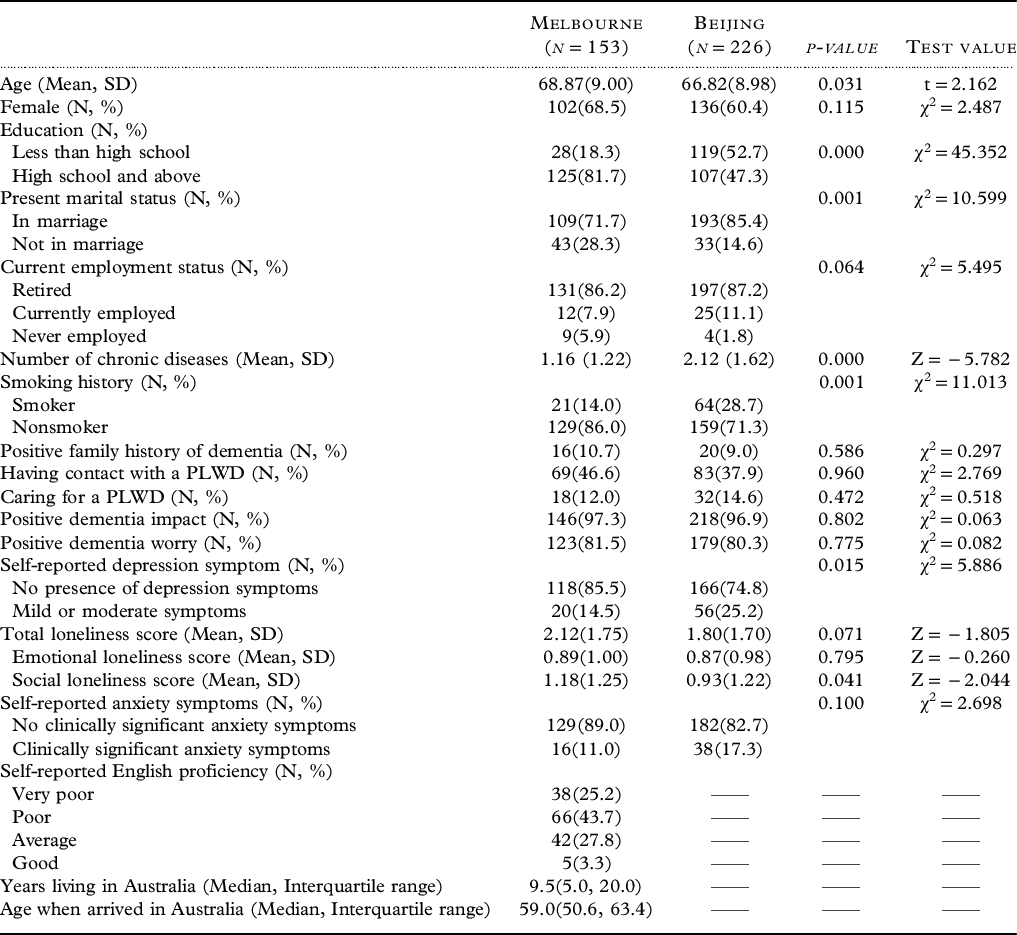
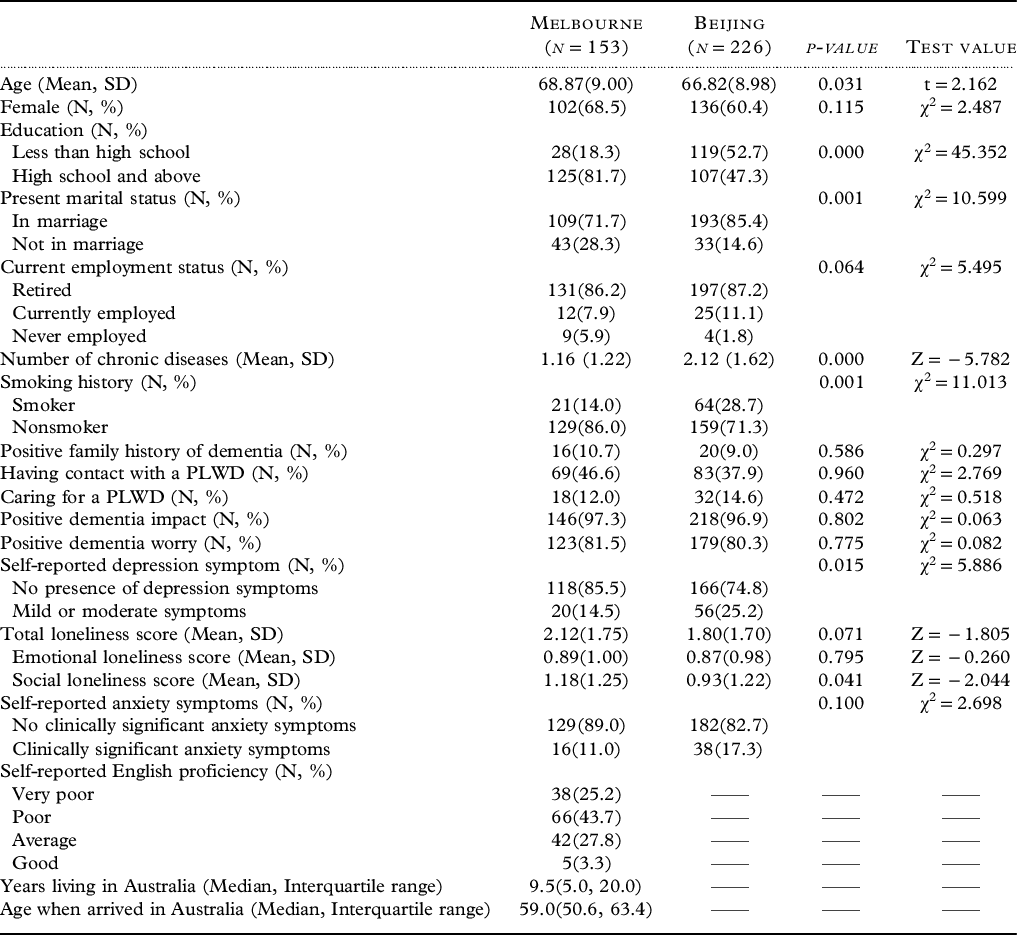
In total, 453 participants were approached, and 379 (response rate: 83.7%) completed the questionnaire, including 153 (response rate: 75.0%) from Melbourne and 226 (response rate: 87.3%) from Beijing. As shown in Table 1, people in Melbourne were older and less likely to be married. They also had higher education levels, lower smoking rates, and fewer chronic diseases. There was no significant difference in gender distribution or employment status between the two groups.
Demographic characteristics, dementia-related experiences, and mental health status of study participants
PLWD = people living with dementia.
Participants in Melbourne migrated to Australia at a median age of 59.0 years (Quartile = 50.6) and had lived in Australia for a median of 9.5 years (Quartile = 5.0). A total of 68.9% of the participants rated their English proficiency as “poor or very poor.”
Mental health status and experiences related to dementia of study participants
Social loneliness scores were significantly higher in the Melbourne group (p = 0.041), whereas self-reported depression symptoms were significantly lower (p = 0.015). No significant difference was observed in the overall loneliness scores, emotional loneliness scores, or self-reported anxiety symptoms between the two groups (Table 1).
There were no differences between the Melbourne and Beijing groups in the positive family history of dementia, contact, and caring experience for PLWD. Additionally, no significant differences were found between the two groups regarding self-reported dementia impact and dementia worry (Table 1).
Comparison of the level of dementia knowledge between the two groups
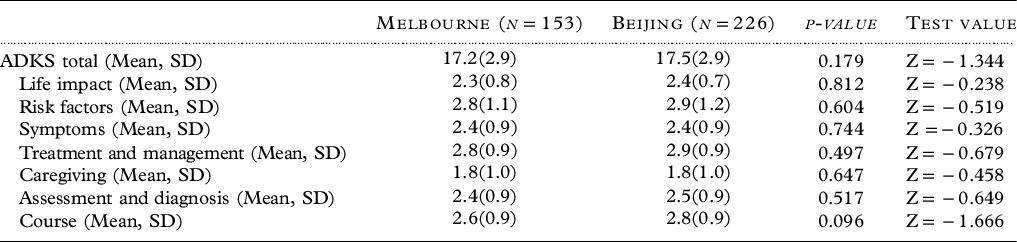
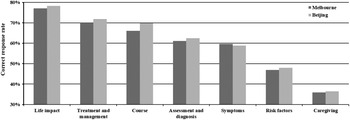
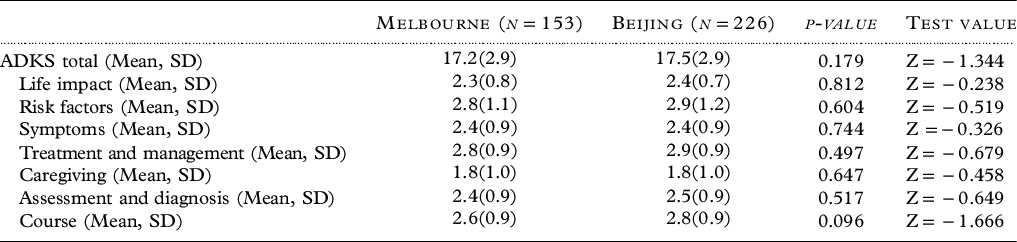
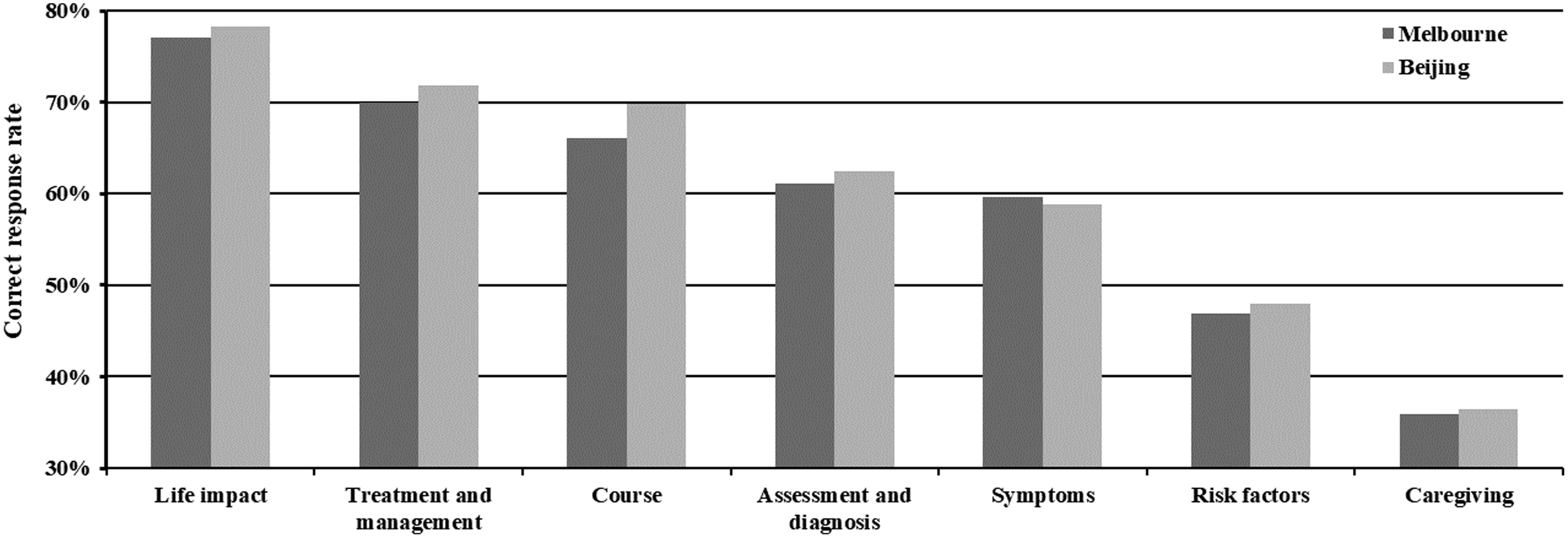
The average ADKS score was 17.2 ± 2.9 in the Melbourne group and 17.5 ± 2.9 in the Beijing group. There was no significant difference in the overall ADKS scores between these two groups (Table 2). There were also no significant differences in the subdomain scores. The highest correct response rates were found in the life impact subdomain, followed by treatment and management, course, assessment and diagnosis, and symptoms subdomains. The lowest correct response rates were found in the caregiving information subdomain, followed by the risk factors subdomain (Figure 1).
Comparison of the ADKS total score and subdomain scores between the Melbourne and Beijing groups
Dementia knowledge subdomains between the Melbourne and Beijing groups.
Factors associated with the level of dementia knowledge
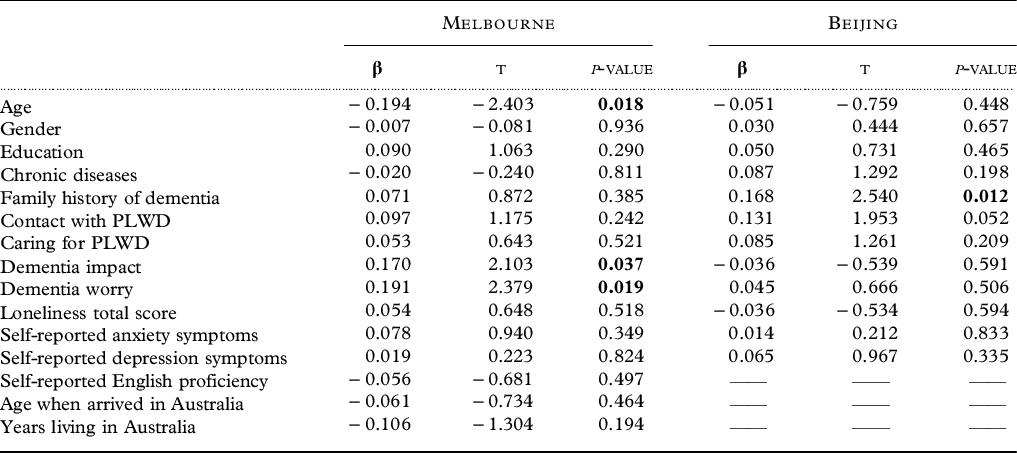
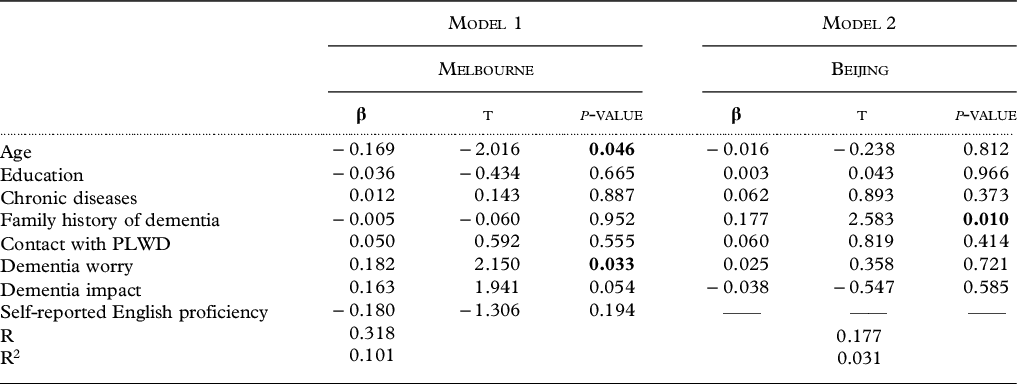
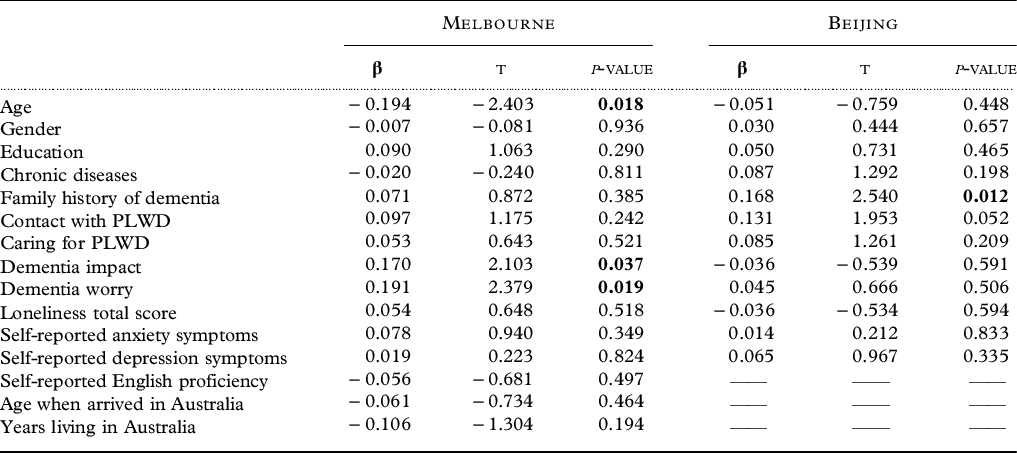
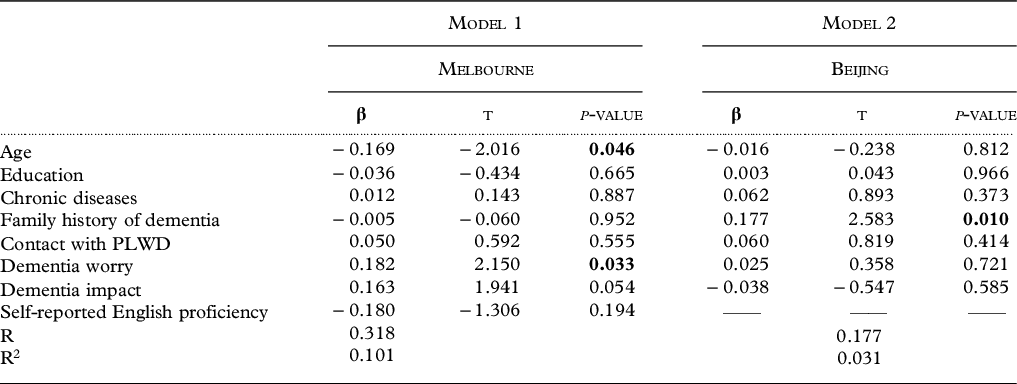
In the Melbourne group, age, dementia impact, and dementia worry were significantly correlated with the ADKS total score in the bivariate analysis (Table 3), with being younger and worried about getting dementia being positively associated with dementia knowledge. Both age and dementia worry remained significantly associated with the ADKS total score in the multivariate analysis (Table 4).
Factors associated with the ADKS total score: results from the bivariate analysis
PLWD = people living with dementia.
Factors associated with the ADKS total score: results from the multiple analysis
PLWD = people living with dementia.
In the Beijing group, a positive family history of dementia was the only variable significantly associated with the ADKS total score in both the bivariate and multivariate analyses (Tables 3 and 4). Having a positive family history of dementia was associated with a higher level of dementia knowledge.
Discussion
To the best of our knowledge, this study was the first to specifically compare dementia knowledge between older Chinese adults living in Melbourne, Australia, and Beijing, China, and to explore the similarities and differences of the factors associated with dementia knowledge between these two groups. In this study, we found no significant difference in the overall level of dementia knowledge or in its subdomains between the Melbourne and Beijing groups. Older Chinese adults were more familiar with the life impact, treatment and management, and the course of dementia, and they knew less about the risk factors and caregiving information. In the Melbourne group, younger age and self-reported dementia worry were positively associated with dementia knowledge, whereas a positive family history of dementia was positively associated with dementia knowledge in Beijing.
Overall dementia knowledge among older Chinese adults in two cities
The study found similar levels of dementia knowledge among older Chinese people in Melbourne and Beijing. This was in contrast to our hypothesis that, compared to older people living in China, older Chinese immigrants living in Australia had better dementia knowledge. We proposed this hypothesis because older immigrants are more likely to be higher educated, have fewer health conditions, and have more healthy behaviors than their counterparts in the countries of origin, a phenomenon known as the selectivity of the migrant process (Kennedy et al., Reference Kennedy, Kidd, McDonald and Biddle2015). Whereas our study did find these features among older Chinese immigrants in Australia, our study did not find a difference in the levels of dementia knowledge between the two groups or associations between education, health conditions, health behaviors, and dementia knowledge. One possible reason for this unexpected finding might be the recruitment sources of participants in this study. Participants were recruited from the metropolitan areas of Melbourne and Beijing. These two cities represented the highest urban development levels in Australia and China, respectively. Their economic, social, cultural environments, and healthcare systems may have a similar comprehensive impact on people’s dementia knowledge. In addition, our participants were approached via community centers or clubs, which are the primary information sources for older Chinese people, and they were likely socially more active than the general older population. This means that they might have had equal opportunity to gain dementia knowledge in their native language and disseminate it within their cultural network groups, which suggests that potential language barriers and social and cultural differences might not have a significant impact on their knowledge level.
We found that older Chinese Australians in this study had a lower level of dementia knowledge than older Chinese Americans in Sun et al. ’s study (57.3% vs. 73%), which used a comparable tool (Sun et al., Reference Sun, Gao, Shen and Burnette2014). One possible explanation is the different content structure of the dementia knowledge scales used in the two studies. According to our findings, if there are more questions about life impact, treatment, and management, older Chinese Australians are more likely to obtain a relatively high total score. Another possible explanation may be that our study only included people born in mainland China. In Sun et al. ’s study, nearly one-third of participants were born in America or outside of mainland China, such as Hong Kong and Taiwan. The different social demographic and financial factors in their places of birth might influence people’s attitudes towards dementia and the accessibility to dementia resources, which might impact their dementia knowledge.
With older people in China, the level of dementia knowledge reported in this study (58.3%) is similar to those reported by Zhang et al. and Gao et al. (55.5% and 61.3%, respectively), but higher than that reported in Huang’s study (45.1%) (Gao et al., Reference Gao, Gao, Guo, Sun and Zhang2020; Huang et al., Reference Huang2014; Zhang et al., Reference Zhang2017). In these studies, participants were all recruited from urban areas, and the dementia knowledge scales were standardized. One interesting finding is that when these studies are combined, there is an increasing trend of dementia knowledge levels among older adults living in mainland China, with the knowledge levels increasing from 45.1% in 2011 to 55.5% in 2014 and 58.3% in 2019. This may be explained by more information in media and more public awareness campaigns in recent years, for example, the Memory Health in the Community and the Yellow Bracelet Project (Alzheimer’s Disease International, 2017).
The structure of dementia knowledge in various subdomains among older Chinese adults in the two cities
Our study reported similar dementia knowledge structures in the seven subdomains between older Chinese people in Melbourne and Beijing. The pattern of dementia knowledge in these subdomains was consistent with that reported in Sun et al. ’s study with older Chinese Americans (Sun et al., Reference Sun, Gao, Shen and Burnette2014), which found that older Chinese Americans were most knowledgeable about the course and life impact subdomains, followed by the treatment subdomain; they were least knowledgeable about the risk factors for dementia. The only difference was the order of the caregiving information subdomain, which had the lowest correct response rate in older Chinese Australians and the third highest correct response rate in older Chinese Americans. These findings suggest that older Chinese people, regardless of where they live, have similar levels of dementia knowledge in the subdomains. In other words, older Chinese people as a whole tend to know more about some aspects of dementia than others. These findings on the subdomains of dementia knowledge have potential implications when designing culturally appropriate education programs for the different older Chinese populations living in Australia, America, and mainland China. The programs should focus more on caregiving information and risk factors for dementia. Future studies should focus on factors related to the dementia knowledge subdomains by exploring people’s intention and motivation for seeking information represented in the different dementia knowledge subdomains.
Factors associated with dementia knowledge between the two groups
In the Melbourne group, younger age was significantly associated with a higher level of dementia knowledge. Younger people might have more opportunities to access dementia-related information, especially online, and they might also face fewer English language barriers, which allow them to gain bilingual information. This finding was consistent with previous studies among older Chinese Americans (Liu and Woo, Reference Liu and Woo2013; Sun et al., Reference Sun, Gao, Shen and Burnette2014), but different from other studies among older Chinese in urban China that did not find significant relationships between age and dementia knowledge (Huang et al., Reference Huang2014; Zhang et al., Reference Zhang2017). Interestingly, in Liu’s study, a positive relationship was observed between age and dementia knowledge among people aged 18–60. However, for those aged over 60, this was not the case, and dementia knowledge was lower in general. Therefore, our findings cannot be generalized to other age or ethnic groups.
Self-rated dementia worry was also found significantly associated with dementia knowledge in the Melbourne group. Dementia worry was defined as “an emotional response to the perceived threat of developing dementia, indenpendent of chronological age and cognitive status” (Kessler et al., Reference Kessler, Bowen, Baer, Froelich and Wahl2012). The previous finding among older Chinese Americans also showed a significant relationship between the level of dementia knowledge and the perceived threat of developing dementia (Sun et al., Reference Sun, Gao and Coon2015). This relationship could be bidirectional. Having a high level of worry about getting dementia may motivate people to actively seek dementia information. On the other hand, with a higher level of dementia knowledge, especially about life impact, caregiving burden, and prognosis, people are likely to have more concerns about developing dementia. However, the relationship between dementia worry and dementia knowledge was not found in the Beijing group. In a previous study, compared to people with a college education and above, less educated people presented a higher level of worries with increased knowledge of dementia (Sun et al., Reference Sun, Gao and Coon2015). Therefore, more factors might need to be considered when discussing the association between dementia knowledge and dementia worry, for example, people’s education level and socioeconomic conditions. Thus, future longitudinal studies should be conducted to explore in more detail the actual relation between dementia knowledge and worry.
Our finding in the Beijing group that a positive family history of dementia was associated with a higher level of dementia knowledge is consistent with Lee’s study involving older Korean adults (Lee et al., Reference Lee2016). One possible explanation for this finding is that people with a positive family history of dementia are more likely to be caregivers for or have interactions with a PLWD, which could contribute to their awareness of and knowledge about dementia. They also would often be more likely to actively look for dementia-related information (e.g. early symptoms and risk factors) to reduce their own risk of dementia. On the other hand, the finding that the family history of dementia is not associated with dementia knowledge among older Chinese Australians is consistent with the finding in Lee’s study with Chinese Americans (Lee, Reference Lee2015). One possible reason for this might be that although the older Chinese Australians have a positive family history of dementia, they still had limited contact with the PLWD in their family. For them, the scenario might be that they only heard about this disease from other relatives by phone or only meet the PLWD when they travel back to China.
Limitations
Several limitations need to be highlighted for the present study. The current study explores dementia knowledge mainly from the medical science perspective; however, other dimensions, for instance, dementia beliefs and cultural values, also need to be considered in future studies. Our participants were recruited from the metropolitan areas of Melbourne and Beijing, therefore, future studies are needed to represent the older adults from rural areas. Given the cross-sectional approach of our study, we can only report on associations between dementia knowledge and other variables. More studies, including longitudinal studies and experimental studies, are needed to examine their causal relationships further.
Conclusion
This cross-national study examined dementia knowledge and its associated factors among older Chinese adults in Melbourne, Australia, and Beijing, China. Our findings indicate that older Chinese adults living in Melbourne and Beijing had similar levels of dementia knowledge and similar knowledge structures. They were most knowledgeable about the life impact of dementia, followed by its treatment and management, course, assessment and diagnosis, and symptoms. They were less familiar with the risk factors for dementia and caregiving information. Furthermore, we found that dementia knowledge was associated with age and dementia worry in the Melbourne group and associated with a family history of dementia in the Beijing group.
These findings have important implications for the development of tailored dementia education programs for these two groups and might be informative for other older Chinese populations worldwide.
Conflict of interest
None.
Description of authors’ roles
M. Zhao, N. Lautenschlager, H. Wang, and X. Lin formulated the research questions. M. Zhao, N. Lautenschlager, H. Wang, X. Lin, E. You, K. Ellis, X. Lv, and X. Yu designed the study. M. Zhao, N. Lautenschlager, H. Wang, H. Zhang, and X. Lv supervised the data collection. M. Zhao, E. You, and X. Lv carried out the statistical analysis. All authors contributed substantially to the study conduct and interpretation of the data. M. Zhao wrote the manuscript. N. Lautenschlager, H. Wang, X. Lin, E. You, K. Ellis, X. Lv, H. Zhang, and X. Yu provided critical review and comments on the manuscript.
Acknowledgments
This study was conducted as part of Mei Zhao’s Ph.D. project supported by the Melbourne Research Scholarship from the University of Melbourne and the Academic Unit of Psychiatry for Old Age, Department of Psychiatry, the University of Melbourne, and research funding to Professor Huali Wang in Beijing. The sample size calculation was supported by the Melbourne Statistical Consulting Platform, the University of Melbourne. The authors thank Mengmeng Xia, Yunjing Chen, Shuli Tao, Ruifang She, and staff in Beijing Xueyuan Road community health centers, staff and members in Melbourne Bentleigh Chinese Community Association, North Melbourne Chinese Association, Monash Chinese Senior Friendship Association, Whitehorse Chinese Senior Friendship Association, and Chinese Seniors Cultural Association Inc., and all participants in this study.