Since its first introduction in the early 1990s automatic milking (AM) systems have become relatively commonplace, and there are now estimated to be some 8000 AM units functioning around the world (Svennersten-Sjaunja & Pettersson, Reference Svennersten-Sjaunja and Pettersson2008). AM represents a considerable investment on the part of the farmer, and it is important that economic return is maximized. Inevitably, amount of milk sold per AM unit per year is a dominant factor in economic models, and this in turn is a function of the number of milkings and the amount of milk obtained at each milking. In order to maximize the number of milkings, a farmer may choose either to increase cow numbers or to adopt management practices that will increase the number of visits that each cow makes to the AM unit (or both). Milk yield and lactation persistency are increased by milking more frequently (Österman & Bertilsson, Reference Österman and Bertilsson2003; Sorensen et al. Reference Sorensen, Muir and Knight2008) but estimates suggest that milk yield increases achieved in practice using AM can be as little as 2% (Wade et al. Reference Wade, van Asseldonk, Berentsen, Ouweltjes, Hogeveen, Meijering, Hogeveen and de Koning2004) or as much as 7 or 8% (Svennersten-Sjaunja et al. Reference Svennersten-Sjaunja, Berglund and Pettersson2000; Speroni et al. Reference Speroni, Pirlo and Lolli2006). AM units generate a great deal of milking-related data. However, despite the considerable research effort into AM systems, there are surprisingly few data available relating milking frequency to whole-lactation characteristics in AM; none of the more than 130 publications resulting from the definitive 2004 automatic milking symposium (Meijering et al. Reference Meijering, Hogeveen and de Koning2004) report a lactation curve, for instance. Without such data, the choice between increasing cow numbers or increasing attendance cannot be made in an informed way, and economic optimization of AM systems is not possible. A preliminary analysis from our group indicated that higher milking frequency in AM could increase whole-lactation yield by around 13% (cows) and 17% (heifers) provided that the increased frequency was maintained throughout the lactation (Svennersten-Sjaunja & Pettersson, Reference Svennersten-Sjaunja and Pettersson2008). The specific objectives of this more detailed analysis involving additional data were to substantiate these findings, to explain them in terms of changes to the lactation curve and to establish how whole-lactation milk yield was affected by attendance (and hence milking frequency) and changes in attendance during the course of the lactation. The aim was to provide data that would enable informed choices to be made for managing cow numbers and cow attendance at AM in an economically optimized way.
Methods
Analysis was performed on lactation data collected by a voluntary AM system (VMS™: De Laval, Tumba, Sweden) operating at the Kunsängens Research Centre of the Swedish University of Agricultural Sciences between 1 January 1999 and 31 December 2006. Management of the research herd included considerable movement of cows between the AM barn and a conventional milking unit, so only a proportion of the total of 127 245 daily milk yield records contributed complete lactation data. Milk yield and date data were used in combination with calving dates to construct lactation curves, which were then included for further analysis only if the following criteria were met: first recorded milk yield before 31 d post calving; last recorded milk yield after 200 d post calving; records available for more than 50% of the lactation period. There were 683 recorded calvings from a total of 318 cows during the qualifying period, which spanned from 30 d before the start of the yield recording period to 200 d before the end. Of these 683 potential lactation records, 240 (35%) were included in the analysis. There were 142 different cows represented within this analysis dataset, of which 58 were included more than once (up to 5 times). There were 68 heifer lactations and 172 cow lactations. Standard management for the herd was all-year round calving, grazing from around May to around September and grass-silage based mixed ration fed during winter months. Concentrate feed, given according to milk yield, was offered in the AM unit as well as in automatic concentrate feeding stations. Cows had voluntary access to the AM unit with the exception that access was denied within 6 h of the last attendance. Attendance during the preceding period was checked between 8·00 and 9·00 and again between 16·00 and 17·00 each day, and any animal that had not visited in the preceding 12 h (heifers) or 14 h (cows) was brought to the AM unit. In practice very few animals had to be fetched in this way. For the purposes of deriving daily milk yield and milking frequency the day was defined as 00·00–23·59 and milking start time was used, so milkings that spanned midnight were ascribed to the earlier day. Further details of the management system can be found in Melin et al. (Reference Melin, Wiktorsson and Norell2005).
Analysis of data was performed using Minitab release 11 (Minitab Inc, PA 16801, USA). Milk yield curves were constructed from daily milk yield data averaged over 5-d periods, to avoid day to day fluctuations caused by variations in milking frequency (for example, a cow might visit 6 times in 2 d, but if the third visit occurred shortly after midnight approximately 33% of the total production would be ascribed to day 1, and 66% to day 2). Peak milk yield was defined as the numerically greatest 5-d averaged yield irrespective of when it occurred, and the time of peak was defined as the third day of that period. Total lactation yield was the sum of all 5-d periods irrespective of lactation length. Lactation persistency was defined as the rate of decline in milk yield with time, calculated from linear regression analysis of the 5-d means between days 100 and 300 post calving. Mean values for milking frequency were calculated for three periods, namely 35–65 d post calving (early milking frequency), 165–235 d post calving (late milking frequency) and the whole of the lactation (average milking frequency). Analysis was performed separately for heifer lactations and for cow lactations and analysis of variance was used to compare heifers and cows. Within each group, further analysis of variance was performed to compare the quartiles of animals with the highest and lowest average milking frequencies. Differences of P<0·05 or better were considered significant.
Results
Lactation data
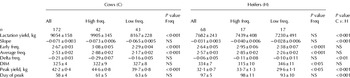
Lactation data are in Table 1. The average lactation yield for all cows was 9054 kg and for all heifers 7682 kg. Milking frequency (times milked per day) was similar in early lactation for cows (2·67) and heifers (2·64). Milking frequency decreased across the course of lactation. Although the changes were small they were significant; overall means (cows and heifers together) of 2·66±0·03 and 2·49±0·02 for early and late lactation, respectively, P<0·001, t test. Furthermore, the decrease in milking frequency was significantly greater in cows than in heifers (Table 1). Lactation persistency was significantly poorer in cows than in heifers (slopes of yield decline of −0·071 and −0·031 respectively, (Table 1) but lactation length (days in milk, DIM) did not differ. Peak yield was higher and occurred earlier in cows, both differences being highly significant, (P<0·001, Table 1).
Lactation characteristics for cows and heifers, and for subsets of cows and heifers comprising the highest and lowest quartiles of milking frequency averaged across the lactation†

† Table abbreviations: DIM: lactation length (days in milk). Early freq: milking frequency between days 35 and 65 of lactation. Ave. freq: milking frequency across the whole of the lactation. Delta freq: change in milking frequency between early and late (165–235 d) lactation. Peak yield is the numerically greatest yield recorded during the lactation, and day of peak is when it occurred. P value Freq: comparison of High frequency and Low frequency quartiles, analysis of variance. P value C v. H: comparison of cows and heifers, analysis of variance
Effects of milking frequency
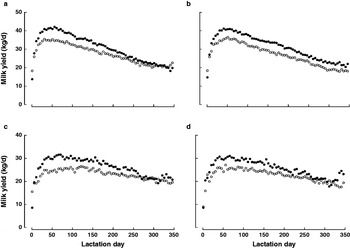
Milking frequency affected milk yield (Fig. 1). This is shown in Table 1 by comparison of mean milk yield values for the highest and lowest quartiles of average milking frequency. The significant differences in average milking frequency between these groups are, therefore, a direct consequence of the analysis approach. However, frequency measured in early lactation did also differ significantly. Furthermore, although there was a tendency for the decline in milking frequency to be greater in animals milked more frequently, this difference was not significant (delta frequency Table 1). In cows, lactation yield was 21% higher in the high-frequency group than in the low-frequency group (P<0·001, Table 1), whereas the equivalent difference in heifers was small and non-significant. The reason for this difference between cows and heifers is apparent in Fig. 1. This shows lactation curves for cows (top panels, a and b) and heifers (bottom panels, c and d). Within each panel the two curves are for high-frequency and low-frequency quartiles. The left-hand panels (a,c) show the effect of different frequencies determined in early lactation, and it can be seen that peak yield is higher in both high frequency groups, whereas lactation persistency is poorer. The right-hand panels (b,d) are for average frequency, i.e. show the effect of frequency determined throughout lactation. The effects on peak yield are still apparent, but now there are other effects as well. In cows, lactation persistency is improved compared with those milked frequently only in early lactation (compare a and b), whereas this effect is not seen in heifers.
Lactation curves for cows (a and b) and heifers (c and d) grouped according to highest (filled symbols) and lowest (open symbols) quartiles for milking frequency measured either in early lactation (a and c) or across the whole of lactation (b and d).

Correlations amongst lactation parameters
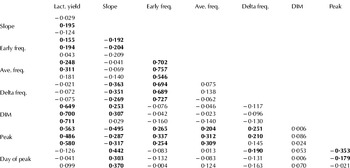
Correlations amongst the various lactation parameters are given in Table 2. Lactation persistency (slope) was negatively correlated with peak yield in both cows and heifers, but correlations between persistency slopes and lactation yield were small and only significant in cows. Positive correlations between measures of milking frequency and lactation yield were also only apparent in cows, whereas peak yield was positively correlated with milking frequency in both cows and heifers. Those animals (cows and heifers) that showed the least decrease in milking frequency (delta frequency) had the best lactation persistency (Table 2). Finally, later peak yields were of smaller magnitude and were associated with more persistent lactations, in both cows and heifers.

Discussion
These AM data show clear effects of milking frequency on lactation characteristics, which can result in very considerable differences in total lactation output, especially in cows. They also confirm that voluntary attendance at the AM unit decreases across the course of lactation, but show that good management will keep this decrease to a minimum. Finally, the data demonstrate that both of these findings differ between cows and heifers, with milk yield of cows being more affected by milking frequency than that of heifers.
The concept that milk output is related to milking frequency has been a familiar one for many years (Pearson et al. Reference Pearson, Fulton, Thompson and Smith1979) and ever since the first introduction of AM systems there has been a recognition that the rate of attendance for milking will be a primary determinant of production. The more recent observation that frequent milking improves lactation persistency as well as immediate yield (Österman & Bertilsson, Reference Österman and Bertilsson2003; Sorensen et al. Reference Sorensen, Muir and Knight2008) reinforces this notion. Our preliminary data from the same AM as used here suggested that cows milked more frequently in early lactation would have improved yield for the duration of the lactation (Svennersten-Sjaunja & Pettersson, Reference Svennersten-Sjaunja and Pettersson2008). A carry-over effect of very frequent milking in early lactation has been seen before (Bar-Peled et al. Reference Bar-Peled, Maltz, Bruckental, Folman, Kali, Gacitua, Lehrer, Knight, Robinzon, Voet and Tagari1995) and may be attributable to increased mammary development. Recent interest in milking frequency has concentrated on the early lactation period (Wall & McFadden, Reference Wall and McFadden2008) presumably in recognition of the economic advantages of incurring extra labour (milking) costs for only a limited period. The same arguments do not apply to AM; there is no additional labour cost, and the objective is to have as many productive milkings per day per AM unit as possible. The present data confirm the stimulatory effect of early-lactation milking frequency on peak milk yield, but also show that milking frequency remains influential throughout lactation. The fact that better yields were obtained from the high average frequency quartile than from the high early frequency quartile does not argue against a carry-over effect, but shows that any carry-over is of smaller magnitude than the increase due to continued high frequency. Visual comparison of the lactation curves (Fig. 1) would certainly suggest that one effect of continued high frequency was to improve lactation persistency, at least in cows. This conclusion is supported by the observed correlation between decline in milking frequency and lactation persistency. However, it is not statistically supported by direct analysis of the persistency slopes. We have previously commented on the difficulties inherent in measuring lactation persistency (Sorensen et al. Reference Sorensen, Muir and Knight2008) and this observation reinforces those comments. In cows, the effects of early lactation frequency were to increase total lactation yield by 12% (9657 l v. 8590 l, data not shown) whereas maintained high frequency increased it by 21% (Table 1). This difference is entirely attributable to persistency; peak yield was not different (Fig. 1). So, on the one hand, lactation persistency slopes are not statistically different, but on the other hand, improved persistency constitutes a major part of the increased milk yield.
The present observations of relationships between milking frequency, milk yield and lactation persistency do not establish cause and effect. It is known that effects of milking frequency are mediated locally within the udder (Hillerton et al. Reference Hillerton, Knight, Turvey, Wheatley and Wilde1990) but despite considerable research, the exact nature of the autocrine or paracrine factors that are responsible remains elusive (Wilde et al. Reference Wilde, Addey, Bryson, Finch, Knight and Peaker1997a; Silanikove et al. Reference Silanikove, Shamay, Shinder and Moran2000). The same factor(s) that have an immediate effect on secretion rate may also have a long-term effect on mammary development, by reducing the apoptosis that normally accompanies declining lactation (Wilde et al. Reference Wilde, Quarrie, Tonner, Flint and Peaker1997b). Udder-halves milked thrice daily throughout a planned 18-month extended lactation not only had significantly better lactation persistency than contralateral udder-halves milked twice daily, they also had improved milk quality attributable to improved maintenance of the integrity of the secretory epithelium (Sorensen et al. Reference Sorensen, Muir and Knight2001).
The differences in milking frequency that we observed are relatively modest. In a recent analysis of nutritional strategies in AM, milking frequencies of 3·16±0·00 in early lactation and 2·60±0·01 in late lactation were observed (Halachmi et al. Reference Halachmi, Shoshani, Solomon, Maltz and Miron2009) using what is described as a ‘semiforced cow-traffic’ system (the only access to concentrate feed was through the AM). The initial frequency was considerably greater than we obtained, but the decrease across the course of lactation was also much higher (an overall decline of −0·56 compared with the figures we obtained of –0·21 for cows and −0·06 for heifers). This would suggest that we are unlikely to be overestimating the potential effects of maintained milking frequency, and may be underestimating it. We observed differences between heifers and cows in the extent to which milking frequency was maintained, heifers being better in this respect. Heifers also had better persistency, but this is a commonly observed phenomenon that is more likely to be related to continuing growth than to milking frequency.
The accepted principle underlying AM is that cows choose when to be milked. In free cow traffic systems this principle is fully adopted, but there is considerable debate concerning the extent to which cows are motivated to be milked, and most farmers use feed as an inducement. Semiforced cow traffic offers concentrate feed after passage through the AM unit or through control gates, whereas in forced cow traffic cows must transit the AM in order to obtain either concentrate or forage. Free choice typically results in fewer visits than either forced or semiforced traffic, and there is a growing concensus that semiforced systems offer the best option (Hermans et al. Reference Hermans, Ipema, Stefanowska and Metz2003). However, generalization is difficult, since the optimum system for any one farmer will depend on a variety of factors such as building layout, time of year, extent and location of grazing, calving pattern and so on. During the period of data collection two different semiforced systems were in operation in our barn provided with AM. Initially cows could return to the pre-selection area immediately after being milked, subsequently access was prevented until 6 h had elapsed. This modification reduced the overall variation in milking interval, but had no significant effect on milking frequency (G Pettersson, unpublished observation). There is evidence to suggest that milking frequency in AM system is a heritable trait (Nixon et al. Reference Nixon, Bohmanova, Jamrozik, Schaeffer, Hand and Miglior2009). The data used to reach this conclusion came entirely from heifer lactations. Our data indicate that milking frequency is less variable and less influential in the heifer, and within-cow comparison of milking frequencies in different lactations demonstrated only average repeatability from one lactation to the next (data not shown). Further investigation of the potential of selective breeding for increased milking frequency is warranted.
Another management consideration that is receiving renewed attention is calving interval. The long-accepted view that 12 months represents the optimum is being challenged in favour of longer intervals, both in terms of economics (De Vries, Reference De Vries2006) and welfare (Allore & Erb, Reference Allore and Erb2000). Extended lactation cycles of longer than 12 months will only be commercially viable in situations where lactation persistency can be maximized, and in an AM context this means when attendance is high and remains high throughout the lactation. Recurring pregnancy has a negative impact on persistency from the start of the third trimester onwards (Sorensen et al. Reference Sorensen, Muir and Knight2008). In the present study cows were rebred for 12-month lactation cycles, and none of the analyses took recurring pregnancy into account. However, reanalysis of the persistency slopes with data restricted to the first 250 d post calving (which would have avoided the third trimester of recurring pregnancy in most cases) did not improve the relationship between persistency and either milking frequency or milk yield. The increased milking frequency (thrice daily or greater) needed for successful extended lactation is theoretically achievable in AM system, but was not achieved here, and so we can neither support nor refute the adoption of longer lactations in AM system.
In conclusion, the data reported here highlight the importance of milking frequency throughout lactation in AM, especially in mature cows. Based on these findings, farmers using AM should consider the adoption of management practices that maximize attendance throughout the lactation.