Introduction
Housing displacement and eviction have become major policy issues in many developed welfare states since the onset of the COVID-19 pandemic. The increasing cost of housing, the financialisation of housing, and post-pandemic rent arrears have generated significant debate on the ability of procedural tenant protections to impact structural inequality (Çelik, Reference Çelik2024). In response to these debates, policymakers across jurisdictions have enacted legal protections that include enhanced notice requirements, access to counsel, and court-based protections. However, there is an ongoing debate regarding whether these protections alter the underlying distribution of housing risk structure or merely redistribute the legal processes (Humphries et al., Reference Humphries, Nelson, Nguyen, van Dijk and Waldinger2024).
Evictions are common across Maryland and many regions of the United States. Housing loss is often understood as the normal operation of housing markets, not as an outcome of systemic inequity (Desmond, Reference Desmond2016). After the pandemic, Maryland had 48.1 eviction filings per 100 renter households, which was among the highest per capita in the nation (Maryland Department of Housing and Community Development, 2024). However, behind the mask of written contracts, legal rules and court processes is a larger reality: eviction is a reflection of the compounded impact of economic exclusion, racially discriminatory housing policies and decades of legal precedents that contribute to the structural disadvantages of low-income tenants and racially marginalised tenants (Gershenson & Desmond, Reference Gershenson and Desmond2024). In fact, eviction is not solely a result of nonpayment but is shaped by constrained choices within broader structural conditions. Health research supports this assertion, indicating how this process affects the health of tenants, especially Black women, who experience catastrophic wellness and health repercussions due to housing instability (Rao et al., Reference Rao, Essien, Powell-Wiley, Maddineni, Das, Halm, Pandey and Sumarsono2023). These women are disproportionately evicted, with as much as 30 per cent of filings in various jurisdictions evicting Black women, even though they inhabit a small share of the population (Hepburn et al., Reference Hepburn, Louis and Desmond2020). Similarly, Black men are nearly 40 per cent of all unhoused individuals and are confronted with a multitude of intersecting barriers to housing and supportive services (Kleinman & Morris, Reference Kleinman and Morris2023; Markowitz & Syverson, Reference Markowitz and Syverson2021; Rhee & Rosenheck, Reference Rhee and Rosenheck2021; Richard, Reference Richard2023).
Alarmingly, the legal arena has historically favoured landlords and created structurally limited protections for low-income tenants, women, Black, or disabled (Graetz et al., Reference Graetz, Gershenson, Hepburn, Porter, Sandler and Desmond2023). Taken together, it is not by chance that tenants who experience the highest level of eviction court representations are there through structural arrangements that lead to displacement. The impacts also go beyond being unhoused, disruption of education, lack of creditworthiness, declining health, and limited access to other housing options (Acharya et al., Reference Acharya, Bhatta and Dhakal2022; Biederman et al., Reference Biederman, Callejo-Black, Douglas, O’Donohue, Daeges, Sofela and Brown2021; Warren & Hanratty, Reference Warren and Hanratty2022). These effects add to racial inequity and intergenerational poverty, especially evident in national crises like the COVID-19 pandemic.
The pandemic has illustrated the successes and shortcomings of emergency housing policy. Maryland has proposed state policies, including the Access to Counsel in Evictions Act (SB 154) and the Renters’ Rights and Stabilization Act (HB 693), with new policy choices for tenant protections and procedural due process (Keene et al., Reference Keene, Denary, Harper, Kapolka, Benfer and Hepburn2023). These policies reflect progress toward expanding and solidifying procedural protections for tenants, although central questions remain about whether these represent or simply imply a structural change, or whether they disrupt or simply standardise access for tenants in an inequity context. This article assesses Maryland’s eviction-related legislation enacted between 2020 and 2024 to determine whether more recent policy initiatives are indicative of structural change or are purely a temporary response. We evaluate whether these policies offer significant and sustained relief for people facing the highest risk of eviction and housing instability. We engage with legislation at the statutory-language level and the implementation of tenant-protection legislation to note advances and persisting obstacles in the fight for housing justice.
This research assesses whether post-pandemic eviction legislation in Maryland constitutes a shift toward structural change or primarily procedural adjustments, with an emphasis on how statutory design influences the distribution of risk regarding housing.
Historical roots of housing inequality
The United States has experienced a long-term evolution of racially segregated housing through a series of legally sanctioned policies and practices. Housing policies, specifically those that were implemented through redlining during the early twentieth century and urban renewal efforts during the middle of the twentieth century, both directly and indirectly led to the displacement of large numbers of Black residents from their homes and prevented them from participating in wealth-building activities related to homeownership (Benfer et al., Reference Benfer, Vlahov, Long, Walker-Wells, Pottenger, Gonsalves and Keene2021; Steil et al., Reference Steil, Albright, Rugh and Massey2018). Historically constructed racialised housing markets have contributed to current levels of housing instability. Eviction risk continues to be high in historically disinvested areas due to continued concentration of race-based disparities in eviction rates (Fowle, Reference Fowle2022; Willison et al., Reference Willison, Unwala, Singer, Creedon, Mullin and Cook2024). A consistent body of research finds that racial disparities in eviction are not an incident of historical or contemporary policies, but rather are shaped by persistent institutional arrangements connecting housing markets, housing policy, and structural inequality. As a result, understanding how contemporary eviction policies will develop over time requires an understanding of how recent legal developments connect to the longer-term development of racialised housing governance.
Research aims and guiding questions
In this paper, we sought to explore the extent to which Maryland’s recent eviction-related laws reflect a shift from procedural justice to structural reform. Specifically, the following questions guided our analysis:
-
(1) To what extent do Maryland’s post-2020 eviction laws address the root causes of housing instability, including racial and economic inequality?
-
(2) To what extent do reforms such as the Access to Counsel in Evictions Act and the Renters’ Rights and Stabilization Act represent a shift toward structural change, rather than merely providing procedural safeguards in an inherently inequitable housing system?
-
(3) How are historically marginalised populations, including Black women, low-income renters and tenants with disabilities, impacted by these legislative reforms?
By critically assessing the language, implementation, and equity implications of these laws, we evaluated how far Maryland has come in advancing housing justice and how far it still needs to go. In this analysis, we do not assume that Maryland’s policymakers were attempting to advocate for a housing justice model as part of their policy-making efforts. Instead, the focus is on whether or not the legislative architecture of the new laws will have a material impact on how the risks associated with housing are distributed structurally within Maryland’s society. Therefore, the distinction between structural changes and procedural reforms in this analysis is made analytically, not morally.
Theoretical framework
This study is situated in a critical theoretical framework that draws on the concepts of racial capitalism (Housing Justice in Unequal Cities Network, 2020; Robinson, Reference Robinson1983) and slow violence (Nixon, Reference Nixon2011; Pain, Reference Pain2019) to interrogate how recent eviction-related legislation in Maryland interacts with deeper processes of dispossession and inequality. Together, these frameworks support a multidimensional analysis of how legal reforms mediate systemic harm, particularly in the lives of historically marginalised communities. By situating housing instability not as a series of isolated legal events but as part of a broader continuum of racialised and gendered structural violence, we treat eviction law as both a product and a mechanism of inequality, shaped by and contributing to the ongoing reproduction of dispossession.
The framework of racial capitalism offers a critical political-economic lens through which to understand the persistence of housing instability. Coined by Robinson (Reference Robinson1983), the term racial capitalism refers to the mutually constitutive relationship between racial domination and capitalist accumulation in which racial hierarchies organise and justify economic exploitation. This approach positions racialisation not as a distortion of capitalism but as foundational to its operations. In the housing domain, racial capitalism is evident in policies and practices that normalise segregation, displacement and banishment, often under the guise of legal neutrality, private property rights or market rationality. Through this lens, eviction-related reforms are not merely neutral legal instruments, but technologies of governance that may either reproduce or reconfigure systems of racialised control, accumulation and disposability.
In tandem, the concept of slow violence, introduced by Nixon (Reference Nixon2011) and extended by Pain (Reference Pain2019), foregrounds the temporal, affective and often invisible harms produced by protracted processes of displacement. Pain conceptualises slow violence as a form of harm that unfolds gradually, accumulates over time, and is difficult to recognise in dominant frameworks of policy and law. Applied to urban-housing contexts, this concept captures the lived realities of tenants subjected to prolonged housing precarity – what Pain termed chronic urban trauma – where the persistent threat of eviction destabilises work, education, caregiving and community ties. Pain’s feminist and postcolonial reframing highlights the embodied and emotional geographies of eviction, emphasising how slow violence permeates the everyday experiences of marginalised tenants (Lacerda et al., Reference Lacerda, Santoro, Alho, Brito and Harkot2022; Pain, Reference Pain2019). This framing illuminates the ways legal protections, even when expanded, may still operate in a system that produces harm incrementally and systemically (Lacerda et al., Reference Lacerda, Santoro, Alho, Brito and Harkot2022).
These frameworks are particularly salient in Maryland, where entrenched racial and economic inequalities have long shaped housing instability. Although recent legislative reforms, such as the Access to Counsel in Evictions Act and the Renters’ Rights and Stabilization Act, appear to advance tenant protections, a deeper theoretical interrogation reveals the limits of proceduralism that lacks material redistribution or structural change. By engaging the concepts of racial capitalism and slow violence, we examined whether these reforms signal a meaningful shift toward housing justice or primarily serve to manage and contain the symptoms of a broader system of racialised dispossession.
The analytical frameworks of racial capitalism and slow violence were used as a lens to provide mechanisms to operationalise those frameworks analytically; thus, not simply as a descriptive or normative descriptor. Statutory design elements (i.e., enforcement strength, sunset provisions, eligibility thresholds, and administrative discretion) were evaluated for their role in structuring the distribution of housing risk over time. The framework of racial capitalism was useful in identifying how neutral-appearing legal rules can be designed to produce unequal exposure to harm and extraction by organising the flow of resources and benefits. The framework of slow violence provided an analytic focus on cumulative harm that arises from delayed implementation, weak enforcement, and differential access to services and benefits. Thus, this method allowed the research to move past descriptive policy analysis and identify how legal structure mediates access to housing instability.
Methodology
We undertook this qualitative legislative analysis of 42 housing bills at the state level in Maryland between 2020 and 2024. We selected the bills through purposive sampling based on their connection to eviction prevention, tenant protections and housing stability. The purposive-sampling approach reflected other housing-policy research that reported an analysis of legislative documents (Patton, Reference Patton2015). The research team sourced the legislative documents that included the bills’ text, the fiscal notes for bills, the amended bills and the enrolled versions from the Maryland General Assembly’s official database. In establishing the overarching framework of the study, the research team used critical theoretical frameworks, including racial capitalism and slow violence, to critically examine how specific racialised laws/parts of laws may reproduce systemic inequities while appearing ostensibly race-neutral (Nixon, Reference Nixon2011; Pain, Reference Pain2019; Robinson, Reference Robinson1983). To analyse the legislative text, the research team identified five domains for coding in NVivo, which included legal-rights expansion, barriers to process, enforcement, equity-based language, and protections for specific populations, informed by qualitative content-analysis techniques (Hsieh & Shannon, Reference Hsieh and Shannon2005). For analytic transparency and rigor, the methods employed for the study of legislative documents allow for replicability in participant selection, operationalisation, legal documents, procedures, and publication-reporting requirements (Campbell et al., Reference Campbell, Quincy, Osserman and Pedersen2013; Charmaz, Reference Charmaz2014).
Scope of analysis
The analysis centred on Maryland state laws enacted between 2020 and 2024 specifically related to eviction prevention, tenant safeguards, rental aid and legal aid for tenants. In total, the analysis included 42 pieces of legislation comprising approximately 725 pages of legislative text, fiscal and policy notes, bill summaries, and enrolled bills. Notable legislation included the following:
-
• Renters’ Rights and Stabilization Act of 2024 (HB 693)
-
• Access to Counsel in Evictions Act of 2021 (SB 154)
-
• Eviction Moratorium Extension Act (HB 18, 2020)
-
• Statutes related to mechanisms around court processes, filing fees, eviction notices and landlord–tenant issues.
We accessed the documents directly from the Maryland General Assembly’s database using keyword searches (i.e., ‘eviction’, ‘tenant rights’, ‘housing stability’) and analysed terms using a coding rubric. We sourced the legislative documents on April 7, 2025, from the official Maryland General Assembly database, thereby ensuring comprehensiveness and authenticity (Maryland General Assembly, 2024).
Data collection and sources
We identified primary legislative texts through subject indexing on the Maryland General Assembly’s website, using keywords such as ‘eviction’, ‘tenant protections’ and ‘housing stability’. We reviewed each legislative document comprehensively, including bill summaries, fiscal and policy notes, amendments, and the final enrolled versions. Supplementary sources encompassed committee testimony, reports from the Attorney General, and implementation documents from the Maryland Department of Housing and Community Development.
Analytical strategy
We applied a three-step legislative-content-analysis framework:
-
(1) Content Coding: We systematically coded each legislative document to identify key themes, including the expansion of legal rights, procedural barriers, funding mechanisms, enforcement provisions and the intended target populations. We developed the codes through inductive and deductive approaches, adhering to the qualitative content-analysis procedures outlined by Hsieh and Shannon (Reference Hsieh and Shannon2005).
-
(2) Comparative Legal Review: We analysed statutes over multiple years to monitor legislative developments, identifying whether protections were enhanced, diminished, or retained. A historical comparison with pre-2020 legislation provided a baseline for assessing changes.
-
(3) Equity and Impact Assessment: Using an equity framework (Woolf et al., Reference Woolf, Aron, Dubay, Simon, Zimmerman and Luk2015), we examined the differential impact of legislative provisions on specific subpopulations, including low-income tenants, renters of colour and individuals with disabilities. We corroborated legislative intent with data derived from eviction and homelessness statistics provided by the Maryland Judiciary and the Department of Housing and Community Development.
Rigor and credibility
To ensure our analysis was strong and consistent, several researchers independently reviewed a sample of the legislative texts to check we were interpreting the material in similar ways. This process helped confirm that our coding was reliable and not overly shaped by any one person’s perspective (Campbell et al., Reference Campbell, Quincy, Osserman and Pedersen2013). When team members did not agree, we talked through differences and reached a shared understanding of what the text was saying (Barbour, Reference Barbour2001). We used peer debriefing and memorandum writing to reflect on researcher positionality throughout the process, reflecting on how our own backgrounds and assumptions might impact our work (Lincoln & Guba, Reference Lincoln and Guba1985). These tools helped us stay thoughtful and intentional, especially given the complex racial and policy issues we were analysing (Charmaz, Reference Charmaz2014).
Findings
The key thematic results were analysed using the methods described in the theoretical framework to illustrate how statutory design can produce varying levels of protection for individuals, varying degrees of delay and different levels of exposure (to various consequences). Rather than analysing each legislative event in isolation from other legislative actions, our analysis considers how the language of enforcement, structure of rollout and rules of eligibility create a cumulative trajectory of risk for all affected by the statute. Additionally, this methodology allows us to read provisions which may appear to be procedural in nature but may provide for different outcomes at different times.
We identified a discernible shift toward expanded procedural tenant protections rather than structural reform, particularly in response to the COVID-19 pandemic and its aftermath.
Enhanced procedural protections for tenants
This theme represents the state’s movement to provide stronger formal legal protections for tenants through the formalised eviction process. All of the reform efforts reviewed across the bills included an emphasis on standardising notices to tenants, filing requirements for evictions (thresholds), and increasing procedural fairness in the courts. These efforts increase formal legal protections afforded to tenants; however, they do not impact the fundamental economics of the rental housing market nor transfer any amount of the inherent risks associated with rental housing from landlords to tenants.
The Renters’ Rights and Stabilization Act of 2024 (HB 693) represent a notable departure from pre-pandemic statutory design by placing procedural protections squarely in Maryland’s landlord–tenant legal regime. For instance, the Act limits application fees to $25, addressing a longstanding situation in which landlords charged exorbitant amounts that created significant financial challenges for low-income tenants (Maryland General Assembly, 2024). This provision limits the potential of landlords to generate income from application fees, which are most often borne by lower-income applicants. The ostensibly race-neutral procedural rules, from a racial capitalist viewpoint, organise the distribution of housing risk in ways that continue to allow for the extraction of value via fees, notice and eviction processes, but do not affect the underlying ownership or pricing structure.
In addition, the Act establishes a requirement for standardised eviction notices that must now include an explicit description of tenants’ rights and information about available legal resources, codified in Section 8-401.1(d). This requirement was developed not only to reference the continually high-demand rental market conditions that common tenants and housing-consumer advocates found so confusing, but many rental tenants were also unknowledgeable about court procedure, timelines or legal implications that led to default judgements (Stout, 2024).
Perhaps in the most significant change, Section 8-402(c) expands protections for tenants from ‘just cause’ eviction; that is, an eviction cannot proceed unless landlords can show a legally sufficient reason, such as nonpayment of rent, breach of lease or property damage. This is a major shift from prior law, when a landlord could terminate a lease without reason at the end of a lease term and tended to complement any eviction in a gentrifying neighbourhood. Moreover, the cap for landlords to initiate failure-to-pay-rent actions was raised from $250 to $600, and landlords must give tenants a minimum of 15 days (formerly 5 days) notice before an eviction proceeding could be initiated. These periods provide time for tenants to consider locating legal help or applying for emergency rental assistance.
Still, significant gaps persist. The Act provides limited protections for tenants in informal rental relationships, such as those with no written leases or unlicensed basement units. These tenants are still vulnerable to evictions through summary proceedings, providing only limited legal protections. Section 8-406(b) imposes a mild $100 fine on landlords who do not follow required notice procedures, but housing advocates have pointed out that the limited enforcement capacity of the statute renders it ineffective. For example, most landlords who continue to violate the law rarely, if ever, see any enforcement or accountability for their violations, due to generally poor regulatory monitoring and enforcement with the potential regulatory authority (Business Insider, 2024).
These reforms illustrate our concept of procedural substitution, which is the expansion of formal rights with no redistributive structural changes. While the increased use of standardised notice procedures and ‘just cause’ provisions increases procedural certainty for tenants, neither will change the rent-setting power of landlords nor their ability to exploit tenant demand in high-demand rental markets.
Institutionalisation of the right to counsel in eviction proceedings
The theme analyses the institutionalised legal representation as a method to address informational and procedural inequalities that occur in eviction proceedings. The statutory framework defines a formal right to counsel; however, variation in implementation across jurisdictions impacts how much protection tenants are able to receive from this right in practice.
The Maryland Attorney General’s Office released two annual implementation reports, in 2023 and 2025, which report on how the programmes are being rolled out at the jurisdictional level, and the patterns of case-level data in relation to representation. The implementation reports indicate that jurisdictions with legal representation for tenants have better outcomes for their tenants compared to jurisdictions where tenants do not have legal representation. Secondary evaluation findings suggest an association between legal representation and a higher likelihood of resolving cases without displacement. Since the data provided by the programme evaluations were not derived from the present study’s own estimation methodology, they should be interpreted as descriptive implementation patterns rather than as causal effects attributable to this analysis. Additionally, the reports showed lower rates of default judgements and higher rates of settlement negotiations among represented tenants (Stout, 2024).
By the summer of 2024, 15,131 tenants were receiving support statewide, highlighting the structural impacts described in the 2024 Annual Access to Counsel Report from MLSC, which further identified that 11,708 tenants served were women (72 per cent of those served), and 12,968 tenants served were people of colour (86 per cent of those served), suggesting potential for reducing racialised disparities in eviction exposure; however, the long-term equity effects of this intervention have yet to be evaluated. Nevertheless, accessibility issues remain. In particular, tenants in Western Maryland and regions of the Eastern Shore (where provider networks are limited and legal aid offices are few) are still reporting missing initial legal support or delayed communication prior to hearings. Additionally, language access continues to be an issue. Although the Act emphasises multilingual outreach and keeping tenants aware, advocacy organisations like the Public Justice Center emphasised, in their annual report, that tenants who are limited-English proficient or those without digital access – especially recent immigrants and elderly renters – remain unaware of their eligibility and entitlement to legal representation until it is too late (Public Justice Center, 2024). This is particularly problematic in light of the accessibility and scalability of the statewide intent of the programme. These patterns represent administrative filtration, as access to formally guaranteed rights is determined by institutional capacity and local implementation conditions.
Equity considerations and remaining limitations
This theme emphasises how the statutory design that is race neutral and the enforcement capacity are unequal for the purpose of producing equitable housing results. The distribution of eviction risk continues to be concentrated on marginalised groups even with additional procedural protections, as well as the lack of structure and accountability in implementation.
Although the legislative trend in Maryland has pointed to greater emphasis on tenant protections, equality in their implementation and impact, spatially and temporally, is uneven. A comparison of eviction filings through the Maryland Judiciary Case Search (2023) against demographic data for the State from the Maryland Department of Housing and Community Development, indicated that Black women are overrepresented at nearly 31 per cent of all eviction filings in the State and comprise less than 14 per cent of the adult population in Maryland. In jurisdictions like Baltimore City and Prince George’s County, this disproportionately rises, confirming the established research on the gendered and racialised nature of evictions (Hepburn et al., Reference Hepburn, Louis and Desmond2020; Rao et al., Reference Rao, Essien, Powell-Wiley, Maddineni, Das, Halm, Pandey and Sumarsono2023).
The continuing inequity exists, in part, because Maryland’s eviction reforms have not done away with the race-neutral language of law, with its legally defined protection of evictions. Although the reforms are presented as progressive, their use of race-neutral legal language undercuts their effectiveness for equitable housing. For instance, the Renters’ Rights and Stabilization Act (HB 693) does not treat source-of-income discrimination as specifically disallowed, so landlords can deny anyone with a Housing Choice Voucher. Therefore, Black and brown renters will be disproportionately impacted, though no language is explicitly identified as racial in this instance. Rather, we see that race-neutral statutes often (re)produce structural inequities in practice under the umbrella of fairness. Enforcement mechanisms, like a $100 penalty for not giving notice, are vague and mild enough not to serve as a deterrent. The law did not include a specified system of accountability for landlords violating tenant protections, thereby undermining the law’s original intent.
Furthermore, the same legislation does not indicate how it would assess the role of racial-equity-impact assessments in programme evaluation to show the extent to which the systemic reforms of laws reach and benefit tenants who remain most vulnerable to housing instability. Tenant advocates, including the Public Justice Center and Baltimore Renters United have emphasised the need for required disaggregated data reporting and racial-equity audits to determine who directly benefits from the reforms and who tends to remain on the fringes of evictions.
In addition to implementation logistics, the path and content of housing legislation in Maryland have been and will continue to be shaped by political and budgetary restrictions. For instance, although the Access to Counsel in Evictions Act (SB 154) appropriated first-year funding for access to counsel, the ongoing funding for tenant representation will depend on an annual process of negotiating the budget, such that these resources may have to compete with other political priorities. Landlord lobbyists have previously opposed stronger rent regulations and social inequities at the legislative level, shaping the boundaries of what is politically acceptable. These political pressures coalesce to demonstrate the lack of rent control, no mandate on racial-equity outcomes and limited tenant protections in the recently passed HB 693. Thus, what may be provided in the legislation reflects not only the technical or moral concerns of the political actors but also the limits of political compromise in the ongoing landscape of high-stakes conflicts over housing policy. Political mobilisation and building broader coalitions will be necessary to target the structural barriers we face and demand changes that are transformative, not incremental.
These reforms provide additional protection for tenants through the expansion of procedural safeguards. However, based on the statutory design and implementation structures for these reforms, it is likely that the structural factors which create the potential for evictions will remain unchanged. They do not directly address the inequitable discrimination among landlords, inequitable access to housing subsidies, and the lack of access to equitable social services. They may only reinforce the inequities they claim to dismantle. The weak penalties associated with violation of the just cause provision as well as the absence of racial equity audits demonstrate an example of enforcement attenuation, where formalised accountability mechanisms fail to have enough institutional force to be effective in changing landlord behaviour. These disparities are examples of slow violence. The disparity in enforcement and access contributes to long-term cumulative harms to tenants who endure prolonged exposure to housing instability without a corresponding institutional response.
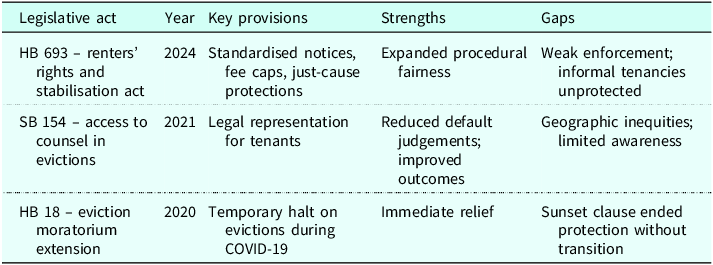
Table 1 presents three ‘anchor’ legislative cases selected to illustrate distinct policy instruments identified across the broader dataset of forty-two laws. These cases were selected as examples of procedural reform, legal representation and emergency intervention, thus allowing for a comparative analysis of legislative intent and the potential for implementation effects.
Legislative acts and their provisions

Table 1. Long description
A table with four rows and four columns. The columns are labeled Legislative act, Year, Key provisions, Strengths, and Gaps. The rows are labeled with specific legislative acts and their details. Row 1: HB 693 – renters’ rights and stabilisation act, 2024, Standardised notices, fee caps, just-cause protections, Expanded procedural fairness, Weak enforcement; informal tenancies unprotected. Row 2: SB 154 – access to counsel in evictions, 2021, Legal representation for tenants, Reduced default judgements; improved outcomes, Geographic inequities; limited awareness. Row 3: HB 18 – eviction moratorium extension, 2020, Temporary halt on evictions during COVID-19, Immediate relief, Sunset clause ended protection without transition.
Summary of legislative findings
As previously outlined, Maryland’s policy reforms and laws provide a significant shift toward procedural protections, especially with HB 693 and SB 154, which would advance standardised notices, just-cause eviction standards, and the right to counsel; all significant tenant protections. Still, the incomplete nature of the reforms does not effectively translate to protections to practice, reinforce existing privilege, create uneven enforcement based on location, create or expand equitable implementation or spark any structural change. The earlier analysis showed that in multiple situations, the vagueness of penalties to restrict eviction, the lack of outreach and inconsistent access across the region undermined the reforms created. Overall, while largely procedural, race-neutral policy changes do not substantially shift power, destabilise racialised-housing precarity or simply reproduce it.
Comparative policy reflections: Maryland in the national context
We approach comparison as a means of designing contrasts in the ways that the jurisdictions vary with respect to two dimensions: (1) the type of policy being compared (price regulation vs. procedural safeguards for records, record relief); and (2) the dose of the policy (universal/statewide vs. pilot/municipal), and we use this typology to provide clearer illustrations of stronger structural designs rather than to assert comparative causality between the jurisdictions.
Although Maryland’s newest legislative proposals mark a significant movement toward tenant protections, placing them in a broader national landscape emphasises the opportunities and the limitations. For example, California’s Tenant Protection Act of 2019 (AB 1482) establishes statewide rent caps (5 per cent plus inflation) and prohibits evictions without just cause across most residential properties statewide. The statewide breadth differs qualitatively from Maryland’s Renters’ Rights and Stabilization Act of 2024 (HB 693), which, although bold in mandating notice for a standardised eviction notice and creating additional procedural fairness, lacks substantive interventions such as rent stabilisation or rent/circumstance-based protection from displacement, and thus lacks the capacity to disrupt long-term displacements in the same way that California can.
New York City’s Right to Counsel (Local Law 136, 2017) is often cited as a national model for equitable access to legal representation in eviction proceedings, and the full citywide implementation of this model has produced documented reductions in eviction outcomes. Meanwhile, the Access to Counsel in Evictions Act (SB 154, 2021) lags in full implementation in Maryland, has notable legal aid gaps in rural counties and has lower awareness for non-English-speaking tenants. Although Maryland certainly deserves praise for being one of the few states with statewide legislation, these implementation challenges indicate a potential lack of critical infrastructure, outreach and long-term funding.
Even Minnesota’s 2021 housing omnibus bill substantiated the inclusion of automatic expungement of certain eviction records, but it also expanded access to rental assistance, which shows another frontier that Maryland has yet to address: evicted tenant recovery and reintegration into stable housing. Ultimately, these comparisons demonstrate that despite significant strides in procedural rights and access to legal representation for tenants, Maryland’s housing legislation has not yet produced substantive protections or structural reinvestments that would sustain and disrupt patterns of racialised displacement and homelessness. Therefore, the best practices from these states could inform and direct the next wave of reforms and expand Maryland’s progress from procedural justice to structural transformation. Long-standing findings in social policy indicate that a statutory right to benefit is by no means a guarantee of outcome; instead, it depends on administrative capacity, local discretion and the level of funding for those responsible to ensure that formal rights are translated into substantive protection (Moynihan et al., Reference Moynihan, Herd and Harvey2015; Lipsky, Reference Lipsky1980).
These comparative points suggest that although Maryland’s legislative direction, albeit one that is not ultimately redistributive, offers an implementable procedural framework for mid-sized states with limited housing budgets, the limitations in Maryland indicate that all states must enact structural components of racial-equity audits, enforceable protections and wraparound-service funding into their eviction legislation. Although this analysis is state-specific, it contributes a conceptual lens for assessing housing policy reforms in other municipalities by emphasising the difference between formal proceduralism and transformative justice.
Study limitations and future directions
Although this legislative analysis provides great insight into statutory intent and policy framing, it does not reflect how tenants will experience these laws in practice, and this gap reflects the need for future qualitative research (Mosley & Gibson, Reference Mosley and Gibson2017; Sandfort & Moulton, Reference Sandfort and Moulton2015). In addition, due to the contemporary nature of many laws in this study (between 2020 and 2024), it could be argued that stakeholders have had insufficient time to assess their impact over time. Although the limits of our analysis may have indicated legislative intent and temporary practice, we could not ascertain the long-term impacts of these practices or their lasting effects on housing stability, the number of evictions and systemic inequality. It is a reasonable limitation to have when we consider making determinations regarding structural change. Ultimately, the permanence of the change can only be inferred through future longitudinal, or follow-up studies and the meaning of structural change will only be captured in practices over time.
Furthermore, this analysis only looks at the language of the legislation and it does not capture how tenants experience these laws in practice, nor does it show the challenges of implementation, such as the delays inherent in the administration of the law, varying levels of discretion at the court level, or individual tenants’ different levels of knowledge and access to these protections (Brodkin, Reference Brodkin2011). Even though legislative analysis gives insightful commentary about the law, it fails to capture the fidelity of implementation, the relationship between tenants and landlords and the sociocultural contexts in which they operate. Future studies may use qualitative approaches through in-depth or semi-structured interviews with tenants, legal advocates, judges from the housing court and policymakers. Using qualitative and mixed-method approaches like this will ultimately provide richer descriptions of the possible impacts of these reforms in the real world and will help elucidate barriers or facilitators to achieving equitable housing outcomes, which could not otherwise be defined by just reading legislation (Henwood et al., Reference Henwood, Wenzel, Mangano, Hombs, Padgett, Byrne, Rice, Butts and Uretsky2015; Weaver, Reference Weaver, Peters and Fontaine2019).
Discussion and policy implications
The study’s findings show that while the post-pandemic eviction reforms in Maryland are increasing procedural protections for tenants, they are not changing the structure or who bears the risk of housing loss. Although measures like standardising notice periods and providing counsel for tenants will make it easier for them to navigate the court system, neither measure addresses the fundamental reasons that people are being displaced, which include high rent burdens, unbalanced market power among landlords and tenants and unequal access to rental subsidies. From a social policy standpoint, the results of this study mirror other research that has found that expanding formal rights does not automatically lead to fairer or more equitable outcomes. Rather than simply having formal rights, administrative capacity, enforcement mechanisms and the overall infrastructure used to implement those rights determine whether formal rights actually create positive change. The continued existence of geographic disparities in tenant access to legal representation and weak enforcement mechanisms demonstrates how administrative constraints can filter procedural reforms. These findings add to comparative discussions of welfare state governance by showing that the expansion of procedural policies can occur concurrently with persistent structural inequalities. Therefore, the distinction between procedural and structural reform could serve as an appropriate lens for examining the effectiveness of housing policies across different nations and institutions.
Conclusion
Maryland’s recent legislation represents an important procedural shift in housing reform, but not structural reform. Although HB 693 and SB 154 purport to enhance legal protections, they neither transfer power, create racial equity nor reverse permanent housing inequities. Examples from California, New York and Minnesota demonstrate that procedural protections alone will not resolve systemic inequities. These findings suggest that achieving equity in housing policy requires approaches that extend beyond procedural expansion to include enforcement, redistribution and structural intervention. Until state legislation weaves in racial equity as part of the repeal dimension, together with implementation, these reforms will remain symbolically expansive but institutionally constrained reforms, rather than powerful paths to transformative housing justice.
Appendix A: legislative coding protocol and sample codebook
Overview
This appendix adds to the methodology by offering a rich description of the legislative coding process used to analyse Maryland’s eviction-related laws enacted between 2020 and 2024. It includes the coding strategy, code definitions and examples from legislation to create transparency and support study replicability. The study used a hybrid qualitative content analysis technique to create a coding scheme that contained preexisting (deductive) taxonomies from literature on eviction and housing instability and emergent (inductive) themes uncovered during the document review. The legal documents reviewed were coded using NVivo 15.
The following table provides a sample of the codebook used for this study.
Codebook table

Long description
A table categorizing and defining legal provisions related to tenant rights, procedural barriers, enforcement mechanisms, target populations, and equity-oriented language. The table has five rows and three columns. The columns are labeled Code category, Definition, and Example from legislation. Row 1: Code category, Expansion of tenant legal rights; Definition, Provisions that increase tenants legal protections or access to services; Example from legislation, Tenants earning up to 50 percent of the median income are entitled to legal counsel in eviction hearings. (SB 154). Row 2: Code category, Procedural barriers; Definition, Legal or administrative obstacles that may prevent tenants from defending themselves effectively; Example from legislation, Tenants must file a written response within 5 business days of receiving an eviction notice. Row 3: Code category, Enforcement mechanisms; Definition, Specific mandates or penalties for landlords or public officials failing to comply with regulations; Example from legislation, Landlords who fail to provide required notice are subject to a $100 fine. (HB 693). Row 4: Code category, Target population identified; Definition, References to specific vulnerable groups targeted for protection; Example from legislation, Special legal aid allocation for tenants with disabilities or seniors living alone. Row 5: Code category, Equity-oriented language; Definition, Explicit mention of racial equity, structural inequality or justice-based frameworks; Example from legislation, The law shall aim to address racial disparities in eviction outcomes through targeted outreach.
Coding process
Data Collection: We obtained legislative documents from the Maryland General Assembly’s digital repository using these keywords: eviction, tenant rights, rental assistance, legal aid, housing stability. We read each law in its entirety, including fiscal notes and any amendments.
Unit of Analysis: We coded each bill at the section level (e.g. Section 8-401.1), which helped us note microlevel policy changes and structural changes to the law.
Double Coding & Reliability: Twenty per cent of the dataset was double-coded by two researchers. Discrepancies were settled through discussion, arriving at a Cohen’s Kappa coefficient of 0.82.
Code Refinement: Throughout the analytic process, we refined our codes through iterative discussion and memorandum writing, allowing for the emergence of subcodes and new themes, as necessary.