Introduction
Fresh salad greens are a popular item at farm stands, markets, and larger grocers. In temperate climates, the growing season can be extended by using inexpensive, plastic-covered greenhouses or high tunnels with little or no supplemental heating. Greens produced in greenhouses are typically high-yielding, capturing premium prices in shoulder seasons (Carey et al. Reference Carey, Jett, Lamont, Nennich, Orzolek and Williams2009). Demand for locally grown produce is largely responsible for recent increases in greenhouse use by smaller farmers (Carey et al. Reference Carey, Jett, Lamont, Nennich, Orzolek and Williams2009; Lamont Reference Lamont2009).
Production of greens in greenhouses is often hampered by slugs (Gastropoda: Pulmonata). They consume foliage, kill young plants, and reduce marketability of older plants by chewing holes and depositing mucus and faeces on leaves (Glen et al. Reference Glen, Wiltshire, Bohan, Storer, Clarkson and Weinart2003; Port et al. Reference Port, Shirley, Collier, Bohan, Symondson and Glen2003). Slugs thrive in cool, humid, low-light conditions, and adults can survive winters in areas protected from freezing (Anonymous 2003; Dill and Kirby Reference Dill and Kirby2010), making them particularly problematic in spring and autumn in soil-floored greenhouses. Both slug species used in the following experiments, Deroceras reticulatum (Müller) and Arion subfuscus (Draparnaud), are known crop pests, with the former probably being the most common and destructive species in northern temperate cropping systems (Glen Reference Glen1989; Grimm et al. Reference Grimm, Forsyth, Schueler and Karstad2009).
Chemical molluscicides formulated with baits are available to control slugs. However, they are relatively inefficient (Henderson and Triebskorn Reference Henderson and Triebskorn2002), can have negative nontarget effects (Kelly and Martin Reference Kelly and Martin1989; Martin Reference Martin1991; Bailey Reference Bailey2002), and are not allowed in organic agriculture. Nonchemical slug controls include iron phosphate baits (Sluggo®), diatomaceous earth, beer cup or board traps, crushed eggshells, lime, copper, or good sanitation (Flint and Wilen Reference Flint and Wilen2009; Dill and Kirby Reference Dill and Kirby2010), but these options are labour intensive and effects are inconsistent (D.B., personal observation). Caffeine may be a useful slug repellent and toxicant (Hollingsworth et al. Reference Hollingsworth, Armstrong and Campbell2002, Reference Hollingsworth, Armstrong and Campbell2003) but can be phytotoxic. The parasitic nematode Phasmarhabditis hermaphrodita (Schneider) (Nematoda: Rhabditidae) can be effective (Hass et al. Reference Hass, Hughes and Glen1999; Glen et al. Reference Glen, Wilson, Brain and Stroud2000; Grewal et al. Reference Grewal, Grewal, Taylor and Hammond2001) but is not available in North America (Rae et al. Reference Rae, Verdun, Grewal, Robertson and Wilson2007). Other approaches to slug management for greenhouse greens production are needed.
Many ground beetles (Coleoptera: Carabidae) are generalist predators and some are important natural enemies of crop pests. Pterostichus melanarius (Illiger) is a relatively large carabid that consumes small slugs and slug eggs (Ayre Reference Ayre2001; McKemey et al. Reference McKemey, Symondson, Glen and Brain2001, Reference McKemey, Symondson and Glen2003) and is associated with areas of high slug density in cereal crops (Symondson et al. Reference Symondson, Glen, Ives, Langdon and Wiltshire2002). Adults are summer active, and larvae develop in the soil in autumn, typically overwintering as third-instars (Basedow Reference Basedow1994). Pterostichus melanarius larvae are also effective predators of juvenile slugs (Thomas et al. Reference Thomas, Glen and Symondson2008, Reference Thomas, Harwood, Glen and Symondson2009). Carabus nemoralis Müller, a large carabid that has mouthparts adapted to feeding on molluscs, can attack slugs weighing up to 1.3 g, and may not be satiated as quickly as smaller carabids (Hatteland et al. Reference Hatteland, Grutle, Mong, Skartveit, Symondson and Solhøy2010, Reference Hatteland, Symondson, King, Skage, Schander and Solhøy2011; Pianezzola et al. Reference Pianezzola, Roth and Hatteland2013). Carabus nemoralis adults are active in early spring when slugs can be most damaging (Barlow Reference Barlow1973). Both species are relatively abundant in synanthropic habitats in North America (Bousquet Reference Bousquet2010).
In agricultural fields, habitat management practices can benefit ground beetle populations (Thomas et al. Reference Thomas, Mitchell and Wratten1992; McLeod et al. Reference McLeod, Wratten, Sotherton and Thomas2004). To build up ground beetle populations in greenhouses, large, easily recognisable species, such as P. melanarius and C. nemoralis, could be trapped live as adults in fields and released into greenhouses, as has been demonstrated with the carabid Abax parallelepipedus Piller and Mitterpacher (Symondson Reference Symondson1993). Alternatively, P. melanarius larvae could be reared and released in autumn when they are needed against slugs, although high levels of cannibalism may limit the commercial viability of rearing larvae. Here we present results from laboratory and greenhouse experiments that examined the potential of adult and larval P. melanarius and adult C. nemoralis for slug control in salad greens.
Materials and methods
Carabus nemoralis predation on Arion subfuscus in the laboratory
Carabus nemoralis beetles and slugs were collected near a woodpile at the Agricultural Campus of Dalhousie University, Truro, Nova Scotia, Canada in mid May 2012. Beetles were trapped with covered dry pitfall traps (473 mL plastic cups) and slugs were hand picked from plant foliage during rain. Slugs were identified as A. subfuscus; the two species in the A. subfuscus group are only morphologically distinguishable by the position of the internal genitalia in relation to the digestive gland, but Arion fuscus has not been identified in North America (Grimm et al. Reference Grimm, Forsyth, Schueler and Karstad2009; McDonnell et al. Reference McDonnell, Rugman-Jones, Backeljau, Breugelmans, Jordaens and Stouthamer2011). Beetles were sexed, held individually in the laboratory in small plastic bins (base=50×100 mm; height=75 mm) with moist peat and fed cat food (Whiskas®; Mars Canada, Bolton, Ontario, Canada) every three to four days. Beetles were not fed for five days before the start of the experiment. Ten to 12 slugs per plastic container (base=28×16 cm; height=11 cm) placed in a refrigerator were fed lettuce and carrot pieces every second day.
We used plastic pails (height=30 cm, bottom diameter=21 cm) filled 12 cm deep with potting soil (Pro Mix BX, PremierTech Horticulture, Rivière-du-Loup, Quebéc, Canada) as arenas in which to test beetle predation on slugs. Ten seeds of an Asian green (Brassica rapa Linnaeus (Brassicaceae) var. “Tokyo Bekana”, Johnny’s Selected Seeds, Waterville, Maine, United States of America) were seeded in the arenas 15 days before the start of the experiment, and seedlings were thinned to four plants per arena after nine days. Arenas were kept in a greenhouse and watered daily. There were three treatments: (1) no slugs and no beetles; (2) four slugs and no beetles; and (3) four slugs and one male and one female C. nemoralis. Each treatment was replicated five times.
At the start of the experiment on 4 June when plants where at the 8–10 leaf stage, one slug was randomly chosen and placed on a plant stem. Beetles were individually weighed and a male and female placed on the potting mix surface. Plastic lids that had centres removed were used to close the pails, with pieces of floating row cover (Agribon+AG-19, Johnny’s Selected Seeds) secured between the pail and the lid. Arenas were held in a growth chamber at 12 °C, 65% relative humidity, 14:10 light:dark photoperiod in a completely randomised design. One additional slug was added onto a plant stem in each arena one, two, and four days after the start of the experiment. Average slug weight was 242±131 mg(±SD). Slugs were introduced gradually rather than all on the first day to reduce the likelihood that slugs would damage plants before beetles were able to control them. After 11 days, the number and total fresh weight of leaves of harvestable quality (did not contain large holes to preclude sale in a salad mix) per arena were recorded. Live slugs and beetles were recovered and counted. Beetles were individually weighed, frozen in liquid nitrogen and stored at −20 °C until their foreguts were extracted and weighed.
Pterostichus melanarius predation on Deroceras reticulatum in a greenhouse
Adult P. melanarius were captured in dry pitfall traps (473 mL plastic cups) placed in agricultural research plots in Bible Hill, Nova Scotia, Canada in late July 2011. Beetles were removed daily from traps for a week, sexed, and placed individually in glass jars (height=9 cm, diameter=4 cm) with 2 cm of dry sand. Jars were stored in the dark at 4–5 °C for three months. Two days before the start of the experiment, beetles that survived were moved to the laboratory and placed individually in Petri dishes (diameter=9 cm) with a thin layer of moist peat and a piece of ground beef (~2 g). Beetles that consumed the beef within 24 hours were weighed and returned to Petri dishes. The heaviest, most active beetles were selected for the experiment.
To obtain larval P. melanarius, 50 adult females were collected as described above and held in the laboratory individually in plastic jars (120 mL) with 3 cm of moist peat. Eggs were sorted from peat in each jar and placed together in a single Petri dish onto a thin layer of moist peat twice weekly for three weeks. Beetles were put in new jars with fresh peat after each sort. Petri dishes were held at 25 °C and checked daily for newly hatched larvae. Larvae were placed individually in plastic jars (120 mL) with 3–4 cm of a 3:1 mixture of moist peat and soil from the area where adult beetles were collected. Every four to five days, larvae were fed small pieces of either crushed cat food (Whiskas®), live mealworms (Coleoptera: Tenebrionidae), live blowfly larvae (Diptera: Calliphoridae), or ground beef placed into the peat and soil mixture. Jars were held in a growth chamber where temperature and photoperiod were reduced by a decrement each week from 25 °C to 15 °C and 15 to 10 hours of light. One day before the start of the experiment, larvae were sorted from jars and the 50 largest second-instars were used in experiments.
To obtain D. reticulatum, slugs were picked from crop foliage at an organic farm (Pleasant River, Nova Scotia, Canada) in late September and early October 2011. This medium-sized slug (maximum length, 35–50 mm) is recognisable by the position of the concentric mantle ridges and from congeners by colour and ability to produce sticky, milky coloured mucus when disturbed (South Reference South1992; Grimm et al. Reference Grimm, Forsyth, Schueler and Karstad2009). Slugs were maintained in groups of 20 in covered plastic pails (10 L) containing 10 cm of field soil. Every second day fresh lettuce leaves were provided, old leaves were removed, and the soil surface was lightly misted with water to maintain humidity. Pails were kept in an unheated building where the temperature was 2–3 °C above the outdoor temperature.
The experiment was conducted in a plastic-covered greenhouse with a soil floor at Pleasant Hill Farm, Queens County, Nova Scotia, Canada (44°26'5''N, 64°54'22''W). The soil was roto-tilled to prepare it for planting of winter salad greens. Experimental mesocosms were circular (diameter=75 cm; height=30 cm) galvanised steel rings pushed 5–10 cm into the tilled soil and arranged in a single 17 m row (the length of the greenhouse). Clear plastic (polyethylene sheeting, 6 mm) was taped with sheathing tape (Canadian Technical Tape Co., Montréal, Québec, Canada) to the inside of the mesocosm and painted with Insect-a-Slip (Bioquip, Rancho Dominguez, California, United States of America) to prevent slugs and beetles from escaping. Organic potting soil (Jolly Farmer Products, Northampton, New Brunswick, Canada) was put in each mesocosm and leveled to a depth of 10 cm.
On 30 October 2011, six varieties of Asian greens were transplanted in an identical spatial arrangement into each mesocosm. Each received six “Tokyo Bekana”, four “Black Summer”, one “Yokatta-na”, two “Yukina Savoy”, five “Pink Lettucy”, and two “Maruba Santoh” (Johnny’s Selected Seeds). Varieties and proportions reflect those used in Pleasant Hill Farm’s commercial plantings. Each mesocosm received ~7 L of water after transplanting and was watered as needed during the experiment.
One day after transplanting, beetles and slugs were introduced to mesocosms. Treatments were randomly assigned to mesocosms within four blocks. Each block was four consecutive mesocosms. The treatments were: (1) 0 beetles and 0 slugs; (2) 0 beetles and 12 slugs; (3) five P. melanarius adults (three females and two males) and 12 slugs; and (4) 10 P. melanarius larvae and 12 slugs. The combined weight of the 12 slugs in each mesocosm was recorded, for an average individual slug weight of 293±33 mg (±SD). Adult and larval beetles were dispersed over the soil surface in each mesocosm. Slugs were initially placed on a Petri dish lid at the center of each mesocosm and thereafter dispersed within the mesocosm.
All salad green leaves of a harvestable size were hand picked from mesocosms on 18 November and 2 and 14 December 2011. As in the laboratory experiment, the number and total fresh weight of leaves of harvestable quality per mesocosm was recorded. At each harvest, the soil surface and harvested leaves were thoroughly searched, and the number of live slugs observed was recorded. Any slugs on leaves harvested 18 November or 2 December were returned to the centre of the mesocosm.
On 14 December the potting soil from mesocosms was sifted through a hardware cloth screen (4 mm mesh) attached to a 45×60 cm wood frame. Beetles, slugs, and other organisms, mainly cutworms (Lepidoptera: Noctuidae), earthworms (Oligochaeta), and wireworms (Coleoptera: Elateridae), remaining on the screen were counted. The sifted soil was also checked for small organisms. Cutworms were identified as either Xestia adela Franclemont or Xestia dolosa Franclemont (Capinera Reference Capinera2001) and have been common pests at Pleasant Hill Farm in recent years (D.B., personal observation).
Soil temperature was recorded hourly during the experiment with HOBO U12 data loggers (TMC50-HD sensors, Decagon Devices Inc., Pullman, Washington, United States of America) and volumetric moisture (m3/m3) levels with ECH20 Dielectric Aquameter probes (S-SMC-M005 sensors, Decagon Devices Inc., Pullman, Washington, United States of America; calibrated to −0.1 m3/m3 in air) attached to a HOBO Weather Station (Onset Computer Corp., Pocasset, Massachusetts, United States of America). A temperature sensor and a moisture sensor were placed 5 cm below the soil surface in each mesocosm of two blocks (eight sensors total). Soil temperatures and moisture levels were averaged over all sensors for the growing periods between planting and harvest or each successive harvest.
Data analyses
In both experiments residuals of leaf count data followed normal or nearly normal distributions so analysis of variance (ANOVA) was used to determine treatment effects on the total number of leaves (harvestable+unharvestable), number of harvestable leaves, and fresh weight of harvestable leaves. A Student’s t-test was used to compare average weight per slug introduced to arenas and number of live slugs at the end of the laboratory experiment. Percent change in beetle weight ([weightfinal–weightinitial]/weightinitial) and foregut weight were compared between males and females using a Student’s t-test. In the greenhouse experiment, separate ANOVAs were conducted for leaf counts and weight at each harvest. Numbers of live slugs observed were compared between treatments and across harvest dates. Block was included as a random effect, and Tukey’s honest significant difference (HSD) test (P<0.05) was used to separate significantly different means.
Because cutworms were relatively numerous in the mesocosms at the end of the experiment, were likely feeding on leaves (Capinera Reference Capinera2001), and may be preyed on by beetles, ANOVA (as described above) was used to determine an effect of treatment on the number of cutworms. Correlations were calculated between number of cutworms per mesocosm and number and weight of harvestable leaves at the last harvest. In mesocosms with adult beetles, correlations were calculated between the number of live beetles recovered and the number of cutworms and number and weight of harvestable leaves at the last harvest. All analyses were done using JMP software (SAS 2012) at α=0.05.
Results
Carabus nemoralis predation on Arion subfuscus in the laboratory
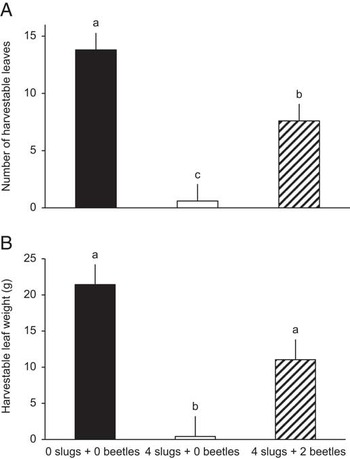
There was no significant difference between total numbers of leaves (harvestable+unharvestable) growing in arenas (F 2,12=0.09, P=0.92), but the presence of slugs and beetles had a significant effect on numbers (F 2,12=19.95, P<0.001) and weight (F 2,12=14.08, P<0.001) of harvestable leaves. When beetles were added to arenas, number and weight of harvestable leaves were significantly greater than in arenas with slugs and without beetles (Fig. 1). Leaf weight was highest in arenas without slugs, but the number of leaves in arenas with slugs and beetles was not significantly less than in arenas without slugs (Fig. 1).
Mean (+SE) number (A) and weight (B) of harvestable salad green leaves from plants grown with or without Arion subfuscus slugs and Carabus nemoralis beetles in a growth chamber. Means with the same letters in each panel are not significantly different (Tukey’s honest significant difference, P>0.05).

Significantly fewer live slugs were recovered from arenas with beetles than those without (0.4±0.2 versus 3.4±0.5 (±SE); t=8.66, n=8, P<0.001). All beetles were recovered live at the end of the experiment. Percent body weight increase was identical for female and male beetles (10.3±13.8% versus 10.3±4.9% (±SE); t=0.00, n=8, P=0.99). Female foregut weight was not significantly greater than that of males (28.4±6.5 mg versus 18.0±2.7 mg (±SE); t=1.47, n=8, P=0.18).
Pterostichus melanarius predation on Deroceras reticulatum in a greenhouse
Total number of leaves per mesocosm (harvestable+unharvestable) was not significantly affected by treatment at any of the harvests (18 November: F 3,9=0.87, P=0.49; 2 December: F 3,9=0.09, P=0.96; 14 December: F 3,9=0.46, P=0.72).
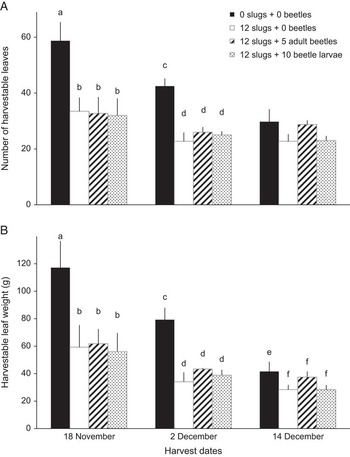
The number of harvestable leaves per mesocosm was significantly affected by treatment at the first two harvests but not at the last (18 November: F 3,9=10.35, P=0.003; 2 December: F 3,9=14.10, P=0.001; 14 December: F 3,9=1.94, P=0.19). There were more harvestable leaves in mesocosms without slugs and beetles than in the other three treatments at the first two harvests (Fig. 2A).
Mean (+SE) number (A) and weight (B) of harvestable salad green leaves harvested from mesocosms with or without Deroceras reticulatum slugs and adult or larval Pterostichus melanarius beetles in a greenhouse. For each harvest date in each panel, means with the same letter of the same case are not significantly different (Tukey’s honest significant difference, P>0.05).

The fresh weight of harvestable leaves per mesocosm was significantly affected by treatment at all harvests (18 November: F 3,9=9.53, P=0.004; 2 December: F 3,9=21.56, P<0.001; 14 December: F 3,9=4.23, P=0.04). Harvestable leaf weight in mesocosms without slugs and beetles was greater than in mesocosms of the other three treatments at the first two harvests, but not greater than in mesocosms with adult beetles and slugs at the last harvest (Fig. 2A). The presence of beetles did not prevent significant reductions in numbers or weight of harvestable leaves due to slugs.
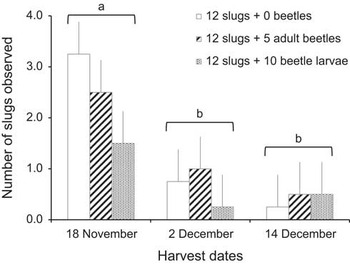
The number of slugs observed was significantly affected by harvest date (F 2,24=10.13, P<0.001), but not treatment (F 2,24=1.12, P=0.34) or the interaction of harvest date and treatment (F 4,24=0.77, P=0.56). Greater numbers of slugs were observed on the first harvest date compared to the last two harvest dates (Fig. 3).
Mean (+SE) number of slugs observed on each harvest date in mesocosms with or without Deroceras reticulatum slugs and adult or larval Pterostichus melanarius beetles in a greenhouse. Means (over all treatments) at each harvest date with the same letter are not significantly different (Tukey’s honest significant difference, P>0.05).

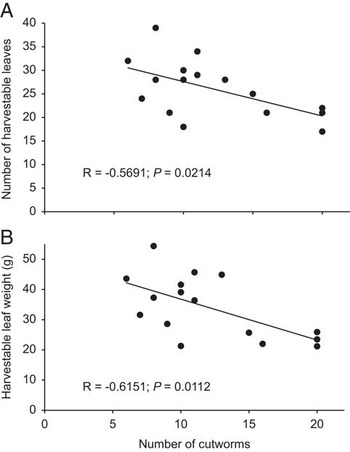
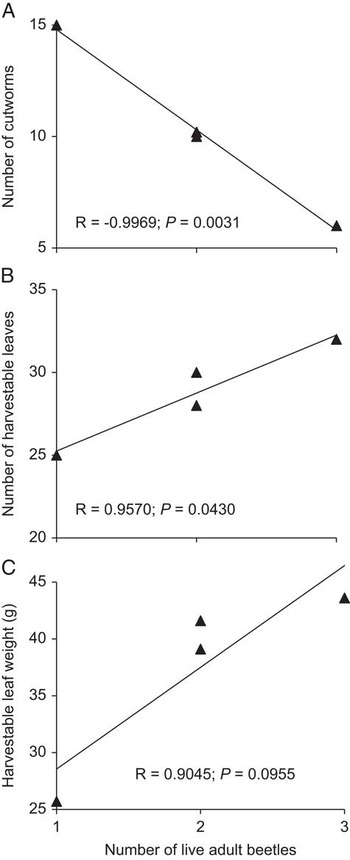
There were significant negative correlations between the number and weight of harvestable leaves and the number of cutworms recovered at the final harvest (Figs. 4A–B), suggesting that cutworms were responsible for plant damage towards the end of the experiment. In mesocosms that received adult beetles, an average of 2.0±0.8 (±SD) live adult beetles per mesocosm were recovered at the final harvest. The number of live beetles in these mesocosms was significantly negatively correlated with the number of cutworms and positively correlated with the number and weight of harvestable leaves (Figs. 5A–C). However, adult beetle presence did not significantly affect cutworm recovery rates, as the number of cutworms did not vary between treatments (F 3,9=0.77, P=0.54). There were 12.1±4.7 (±SD) cutworms recovered per mesocosm. Only two beetle larvae, both third-instars, were recovered from mesocosms in which they were added.
Relationships between number (A) and weight (B) of harvestable salad green leaves during the final growing period (2–14 December) and numbers of spotted cutworms (Xestia species) recovered from mesocosms on 14 December. Deroceras reticulatum slugs and adult or larval Pterostichus melanarius beetles were added to mesocosms at the beginning of the greenhouse experiment on 31 October.

Relationships between number of spotted cutworms (Xestia species) (A), number (B), and weight (C) of harvestable salad green leaves with the number of live Pterostichus melanarius beetles recovered on the final harvest (14 December) in mesocosms in a greenhouse.

The mean soil temperatures were 10.4 °C, 8.5 °C, and 7.4 °C and soil moisture levels were 0.198, 0.195, and 0.211 m3/m3 for the periods preceding harvests on 18 November, 2 and 14 December 2011, respectively.
Discussion
Our results showed that slugs and/or cutworms can inflict significant damage to salad greens but achieving control with ground beetles appears to depend on factors such as beetle density, beetle life stage, slug size, or soil temperature. In small arenas in the laboratory, C. nemoralis consumed most A. subfuscus slugs that were initially placed on plant stems, greatly increasing the number and weight of harvestable leaves compared to arenas with slugs and no beetles. Carabus nemoralis preys on the Iberian slug, Arion vulgaris Moquin-Tandon, and D. reticulatum (Hatteland et al. Reference Hatteland, Grutle, Mong, Skartveit, Symondson and Solhøy2010, Reference Hatteland, Symondson, King, Skage, Schander and Solhøy2011; Pianezzola et al. Reference Pianezzola, Roth and Hatteland2013), but this is the first demonstration of predation on A. subfuscus by C. nemoralis to reduce yield loss of a crop. Both males and females appear to be contributing to slug predation as both increased in percent body weight at the same rate. Larger females with larger foreguts (~10 mg heavier) probably consume more than males, as is the case with A. parallelepipedus (Symondson Reference Symondson1993). Beetles did not kill every slug during our experiment, but the retention of harvestable leaves achieved with C. nemoralis was significant given that in the absence of beetles slugs completely decimated the salad greens. The small search area (346 cm2) of experimental arenas may have inflated predation rates, but the results are encouraging and serve as an impetus for greenhouse experiments testing C. nemoralis for slug management.
In larger arenas in the greenhouse neither adult nor larval P. melanarius reduced salad green damage due to slugs even though these beetles are well-known D. reticulatum predators (Symondson et al. Reference Symondson, Glen, Wiltshire, Langdon and Liddell1996, Reference Symondson, Cesarini, Dodd, Harper, Burford and Glen2006; Oberholzer and Frank Reference Oberholzer and Frank2003; Foltan Reference Foltan2004). Introduced P. melanarius may not be as effective slug predators compared with beetles that are acclimatised to greenhouse conditions, as was suggested with A. parallelepipedus (Symondson Reference Symondson1993), and the prolonged holding time (three months) of adults at low temperature before our experiments may have compromised their predation efficiency. Slug size (average=293 mg) used in our experiment may also have limited predation. In previous studies, there was a low probability of P. melanarius predation on slugs over 100 mg, and attacks on slugs 100–200 mg only occurred after prolonged periods of exposure in the laboratory (McKemey et al. Reference McKemey, Symondson, Glen and Brain2001). However, in other outdoor and field experiments there was no indication of a relationship between beetle consumption rates and slug size (Bohan et al. Reference Bohan, Bohan, Glen, Symondson, Wiltshire and Hughes2000; McKemey et al. Reference McKemey, Symondson and Glen2003).
At each harvest we recorded a low percentage of the live slugs we introduced to mesocosms (including the control mesocosm without beetles) and found a few dead slugs. Maintenance of D. reticulatum at high density (in the pails we used) may cause elevated risk of disease (Henderson Reference Henderson1968), causing mortality after placement in mesocosms. Because adult P. melanarius are facultative scavengers (Foltan et al. Reference Foltan, Sheppard, Konvicka and Symondson2005), availability of slug carrion may have reduced predation on live slugs. Only two out of five beetles on average were recovered from mesocosms, and one pair of elytra was found, suggesting low beetle survival. This could be due to cannibalism or starvation, with surviving beetles scavenging on beetle carcasses. Overall, capturing adult P. melanarius in summer and saving them individually for three months in cool conditions was relatively easy, and could be a way for growers to use beetles in the autumn. However, predatory ability and survival of these beetles after release will need further study to ensure adequate fitness, and so that they can be used at optimum densities and released at a time in the season when younger, smaller slugs may dominate populations (Hunter Reference Hunter1968).
The feeding ecology of carabid larvae is poorly understood, although it is known that third-instar P. melanarius orient to subterranean live or dead slugs and can reduce numbers of Arion intermedius Normand and D. reticulatum in small plots (Thomas et al. Reference Thomas, Glen and Symondson2008, Reference Thomas, Harwood, Glen and Symondson2009). We were unable to rear enough P. melanarius larvae to the third-instar stage by the beginning of the experiment, so we introduced second-instars. The second-instars introduced to our mesocosms were probably unable to prey on the large slugs we used. Pterostichus melanarius larvae may be more effective against slug eggs and small slugs that often remain underground (Glen and Wiltshire Reference Glen and Wiltshire1986). Thomas et al. (Reference Thomas, Harwood, Glen and Symondson2009) reported density-dependent intra-specific competition between larvae that reduced slug predation rates. However, the density of larvae in our experiment was about five times less, thus reducing the likelihood that larval cannibalism contributed to low predation rates. Carabid larvae can be more numerous than adults, and P. melanarius larvae are normally active during autumn when control of slugs in greenhouses is needed (Thomas et al. Reference Thomas, Harwood, Glen and Symondson2009). Since carabid larvae are difficult to weight rear due to cannibalism and high mortality (Tomlin Reference Tomlin1975, but see Symondson Reference Symondson1994), adults could be introduced to greenhouses followed by conservation efforts that would allow larvae to develop successfully in order to consume young slugs before larger slugs become a significant problem.
Soil temperature in the greenhouse may also have affected beetle activity, hunger, or mobility, thereby lowering slug predation rates. The mean soil temperature was just over 10 °C in November and decreased through to mid-December. Carabid beetles tend to consume fewer slugs at lower temperatures, with Pterostichus madidus (Fabricius) consuming less than half as many slugs at 12 °C than at 20 °C (Ayre Reference Ayre2001). Predation rates by C. nemoralis in a growth chamber at 12 °C did not seem to be negatively affected, although arenas were small. Fall planting of salad greens typically occurs about a month earlier than in our experiment, and higher temperatures at that time may cause greater beetle hunger and activity resulting in increased slug predation rates.
Spotted cutworms were found in relatively high numbers (6–20 per mesocosm) at the end of the experiment. These may have been present in the soil below mesocosms or migrated into the mesocosms. Our results suggest cutworm damage increased as the experiment progressed as the numbers of harvestable leaves in mesocosms with zero slugs or beetles declined considerably with each harvest. Some of this decline may be due to cooler temperatures and shorter daylight, but there were strong negative correlations between number and weight of harvestable leaves and numbers of cutworms recovered at the final harvest, suggesting cutworms were an important factor.
Even though we did not plan to evaluate beetle predation on cutworms, our results indicate that adult beetles may be consuming some cutworms. In the four mesocosms with adult beetles, there was a significant negative relationship between number of cutworms and number of live beetles recovered and significant positive relationships between number and weight of harvestable leaves and number of live beetles recovered at the last harvest. In addition, harvestable leaf weight at the last harvest was slightly, but not significantly, higher in mesocosms with adult beetles than those with larvae or without beetles and not significantly less than in mesocosms without slugs or beetles. Pterostichus melanarius can consume cutworms (Epstein et al. Reference Epstein, Zack, Brunner, Gut and Brown2001), and other large carabids are good predators of various cutworm and armyworm pests (Lepidoptera: Noctuidae) (Best and Beegle Reference Best and Beegle1977a, Reference Best and Beegle1977b; Clark et al. Reference Clark, Luna, Stone and Youngman1994; Frank and Shrewsbury Reference Frank and Shrewsbury2004). Spotted cutworm larvae spend time beneath plant debris and on the soil surface where they are susceptible to predation, but climb plants to feed at night where they may avoid nocturnal predators (Capinera Reference Capinera2001). It appears P. melanarius has a capacity to limit cutworm populations and reduce damage to greens, but this should be tested with direct manipulation of cutworm and beetle densities.
Even though there has been considerable effort in the laboratory, small plots, and fields, ground beetle predation on slugs in greenhouses is largely unexplored. To our knowledge, this is the first assessment of P. melanarius released into greenhouses during autumn. Based on our results C. nemoralis should be tested in greenhouses during spring, and further testing of P. melanarius adults against small slugs and other soft-bodied pests, like cutworms, is warranted. An approach encouraging reproduction and larval development in greenhouses may be better than rearing and releasing larvae. Beetle conservation in greenhouses could be modelled on field efforts where grasses that provide favourable habitat could be planted in small areas, or alternative prey provided when pest densities are low (Thomas et al. Reference Thomas, Noordhuis, Holland and Goulson2002; Bell et al. Reference Bell, Traugott, Sunderland, Skirvin, Mead and Kravar-Garde2008). However, alternative prey could reduce slug predation if both are present together (Symondson et al. Reference Symondson, Cesarini, Dodd, Harper, Burford and Glen2006), and in this mesocosm experiment presence of cutworms may have partially caused lower predation on slugs. Beetle populations could also be augmented each year by releasing newly captured adults, which is relatively easy to do with pitfall traps. Finally, tests of beetle predation may be integrated with other strategies, such as Bacillus thuringiensis (Bt) commonly used for cutworms (Pottorff and Panter Reference Pottorff and Panter2009). As demand for local, fresh, healthy food increases, growers will need new and competitive pest control options of which biological solutions should be a prominent component.
Acknowledgement
The authors thank the Organic Crop Improvement Association for funding and Paul Manning, Pramod Rathor, Krilen Ramanaidu, and Ruan Daros for technical assistance.