1. Introduction
Environmentally friendly products, also referred to as ‘green’ products, are goods and services considered to inflict minimal or no harm on the environment, such as non-toxic detergents, mercury-free batteries, hybrid cars and clean energy. This paper analyzes settings where firms produce homogeneous goods whose environmental properties differ. Specifically, we study the case in which the production of a homogeneous product by a ‘green’ industry is less harmful to the environment than that from a ‘brown’ industry. Some firms usually generate low emissions during their production process.Footnote 1 Organic food, for instance, is produced using agricultural techniques that do not require synthetic inputs such as pesticides and chemical fertilizers. A study developed by Cook et al. (Reference Cook, Morgan, Radenovic, Renzi and Born2007) analyzes the greenhouse gas impacts of specific farming techniques. They find that the cultivation process of organic food, such as potatoes, apples and asparagus, generates considerably less CO2 emissions than conventional farming methods.Footnote 2
A green product is an impure public good in our setting, through which public goods can be provided privately (Cornes and Sandler, Reference Cornes and Sandler1996; Kotchen, Reference Kotchen2006). We consider that consumers who favor green products experience an additional benefit from their purchase decision. In particular, they are concerned about how the production process potentially affects the environment and benefit not only from using the good but also from its environmental characteristics.Footnote 3 Our paper hence studies how a tax/subsidy policy can promote the consumption of green products in a context of horizontal product differentiation. In addition, we investigate the welfare consequences of this policy.
The paper develops a two-stage complete information game. In the first stage, the government decides on an optimal policy (tax or subsidy) that maximizes social welfare. The second stage represents the horizontal product differentiation where firms compete in prices. A firm's location in our model measures the degree of emissions produced by these firms. We consider the case where two firms produce either brown or green goods. These two products provide the same base utility when they are consumed. The production process of a brown good harms the environment, whereas green products do not damage the environment, i.e., they are pollution-free goods. Moreover, we assume that consumers are not homogeneous; that is, they have different preferences for green and brown products and their ultimate purchasing decision is affected by price and traveling costs. The government in our model maximizes the social welfare which explicitly considers the environmental damage generated by the firm producing a brown good. The two different policies analyzed in this paper influence prices by modifying firms' marginal cost and thus influence consumers' behavior. In our study we aim to answer the following questions: (1) what is the optimal environmental policy when consumers are heterogeneous in their preferences for green products? and (2) how is such policy affected by a change in the proportion of green consumers?
We show that, when products are differentiated in their environmental properties, a tax/subsidy policy increases social welfare. Specifically, our efficiency comparisons suggest that, under a setting of horizontal product differentiation, a tax/subsidy (either on consumers or polluting firms) produces a larger social welfare than no policy. Moreover, the proportion of consumers who prefer green products also affects the welfare gains from imposing a tax or subsidy policy. Hence, our setting suggests that the promotion of environmental awareness among consumers can reduce the need for regulation, avoiding the costs associated with its implementation. Some studies have previously analyzed government's influence on market behavior. Bansal and Gangopadhyay (Reference Bansal and Gangopadhyay2003) study the effects of both uniform policies on firms, and regulations that discriminate between firms based on their environmental quality in the presence of environmentally aware consumers. They find that uniform and discriminatory subsidies reduce total pollution and enhance aggregate welfare, while taxes have the opposite properties. Cremer and Thisse (Reference Cremer and Thisse1999) analyze a vertical differentiation model considering firms' entry behavior. They show that a commodity tax may have a significant impact on the market structure and it may be welfare improving. Unlike this literature which considers vertical product differentiation, our paper examines a setting of horizontal product differentiation where goods are homogeneous. As a consequence, this study provides a simplified way to analyze the impact of a policy on social welfare when consumers are asymmetric in their concerns about the pollution a good emits. In addition, our model does not need to consider that quality and environmental properties are related, unlike the previous literature. The final products generated by two firms are homogeneous in all dimensions, except for the externality (emissions) generated during their production process.
In addition to tax/subsidy policies, other policy instruments have also been discussed in the literature, such as emission standards or emission permits. For instance, similar to Cremer and Thisse (Reference Cremer and Thisse1999), Moraga-Gonzalez and Padro-Fumero (Reference Moraga-Gonzalez and Padro-Fumero2002) consider a model where firms' demand is exogenous. They show that, despite the existence of an emission standard, industrial aggregate emissions can still be increased and social welfare reduced as a consequence of the standard. Similarly, Parry et al. (Reference Parry, Williams and Goulder1999) assessed the welfare effects of a revenue-neutral carbon tax and carbon emission permits, taking into account pre-existing tax distortions in factor markets. They found that a carbon tax performs better than emissions permits and that it is welfare improving under a larger set of parameter values. These studies, however, have analyzed environmental regulation under a setting of vertical product differentiation.
The structure of the paper is as follows. Section 2 describes the model, section 3 analyzes an unregulated market, section 4 analyzes the implementation of tax and subsidy policies, describing their welfare consequences, and section 5 contains some concluding remarks.
2. Model
Assume two types of consumers, green (G) and neutral (N). Green consumers account for λ proportion of the population while the proportion of neutral buyers is 1 − λ, where λ ∈ (0,1). Similar to the linear city model of horizontal product differentiation, we represent the length of the city from zero to one. Consumers are uniformly located along this segment and their location is denoted by x ∈ (0, 1), which represents the distance from the left end of the city. Assume that the total amount of consumers is M > 0. In addition, there are two firms located at each end of the city, firm 1 and firm 2, producing a green product and a brown product, respectively. Firm 1 is at the left end and firm 2 at the right. Consider that green and brown products are similar except for their environmental impact. For instance, if both firms produce detergent, all consumers obtain the same utility from using this product. However, the production of detergent by firm 1 does not contaminate the environment while the production process of firm 2 is not environmentally friendly and generates an environmental damage. We also assume that each consumer buys one unit of the good. Consumers' utility from buying the product of the pollution-free firm (firm 1) is

while their utility from purchasing firm 2's product is

Hence, when consumer i is green (i = G), she obtains a utility v from consuming a green or brown product and an additional utilityFootnote 4g if this good is produced by firm 1. In addition, p 1 and p 2 denote the price of a green and a brown product, respectively, where both prices are strictly positive. The cost or disutility per x units of distance traveled by the consumer when buying either product is r ∈ ℝ+. Intuitively, r captures the disutility that consumers experience when buying a green (x = 0) or a brown (x = 1) good that differs from their ideal preference for environmental features in the product. The neutral buyer (i = N) only obtains a utility v from both types of goods. In particular, this type of buyer does not experience an additional utility from a good produced using clean technology. Firms 1 and 2 have the following profit functions,

where Q ji represents firm j's demand function from buyer i and c j represents firm j's marginal cost, where j = {1, 2} and i = {G, N}. Assume linear cost functions and marginal costs satisfy c 1 > c 2, intuitively firm 1 incurs a higher cost from the reduction of emissions while firm 2's abatement efforts are zero.Footnote 5 In our model fixed costs are equal to zero.
In addition, the government seeks to implement an environmental policy, either a tax t, or subsidy s, which induces the consumption of an environmentally friendly product. The optimal policy maximizes the following social welfare function,

where CS is the consumer surplus including green and neutral buyers, PS represents the producer surplus considering profits from firms 1 and 2, Env is the environmental damage produced by firm 2 and Gov denotes the government revenue (expenditure) from the tax (subsidy, respectively). We consider that the production of one unit of the brown good generates one unit of emission, hence, Env = d × (Q 2G(p 1, p 2) + Q 2N(p 1, p 2)) where d represents the marginal environmental damage. The time structure of the game is as follows: first, the government implements an environmental policy (either a tax or subsidy) that maximizes social welfare; and then firms simultaneously and independently set profit-maximizing prices.
3. Unregulated market
In the case where the government does not implement an environmental policy, our model is reduced to a one-stage game in which firms compete in prices. First, let us analyze the demand function that firms 1 and 2 face. Note that a green consumer is indifferent between buying a green or a brown product when

Therefore, the distance x that makes green buyers indifferent between consuming a green or brown product is 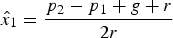 . Similarly, the indifference point for neutral buyers solves v − p 1 − rx = v − p 2 − r(1 − x), i.e.,
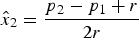 . Lemma 1 describes the demand from both types of consumers.
Lemma 1
For a given pair of prices (p1, p2), firm 1's demand is
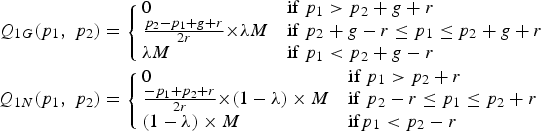
for green and neutral consumers, respectively. Similarly, firm 2's demand is

The above lemma describes buyers' behavior for different ranges of prices. Notice that a green buyer does not consume firm 1's product if the difference in prices does not compensate the additional utility she obtains from consuming an environmentally friendly good (net of the travel cost, r). Similarly, the neutral consumer buys a green product (from firm 1) if the price of the brown good exceeds the price of the green product, after considering the travel cost.
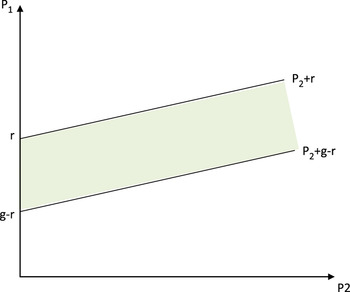
Firms identify their best response given the price charged by the other firm. That is, firm 1 has to decide its optimal price given its rival's strategy. Let us restrict our analysis to interior solutions,Footnote 6 where p 1 ∈ [p 2 + g − r, p 2 + r] and p 2 ∈ [p 1 − r, p 1 + r − g]. In order to guarantee that p 2 + g − r < p 2 + r and p 1 − r < p 1 + r − g, then g ∈ (r, 2r). The shaded areas in figure 1 describe the regions for the interior solution for green and neutral buyers. Therefore, firms j's maximization problem is

where j ≠ k. Therefore, optimal prices and firms' equilibrium profits are


Interior solutions

Prices and profits of both types of firms are affected by the proportion of consumers λ who value the environmental benefits from green products. Notice that firms 1's profits (firm 2's) increase (decrease) with the proportion of consumers who value environmental products (larger λ) and with the additional benefits associated with green products, i.e., yield a larger g. Additionally, as expected, we also find that the travel cost positively affects firms' profits. Finally, using (2) and (3) we obtain equilibrium output levels
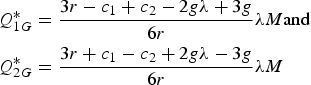
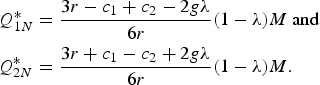
The demand for green products is positively related to the utility that the consumer derives from protecting the environment, g. This result suggests that, for a given population, an increase in consumers' awareness of conservation of the environment positively affects the demand for goods produced by environmentally friendly firms. We next discuss our results when the government imposes a tax or a subsidy policy.
4. Tax and subsidy policy
4.1. Tax on the production of polluting goods
We now analyze the case where the government decides to promote the consumption of green products by setting an emission fee t on firm 2's production. Let us use lemma 1. However, the firm's maximization problem is different, since firm 2 not only incurs a cost c 2 from producing the brown good but also an additional cost from its emissions. Firm 2's maximization problem becomes

The optimal prices when a given tax t is set by the government are identified in lemma 2.
Lemma 2
The optimal prices of firm 1 and 2 in the second stage of the game where the government sets a tax t are, respectively,


Higher taxes increase the price charged by both firms. Note that when the proportion of consumers who prefer green products is close to zero (λ = 0), then the tax can potentially induce the consumption of environmentally friendly products. In fact, if the tax offsets the difference in marginal costs, c 1 − c 2, the good produced by firm 1 becomes cheaper than the brown product. In addition, firm 2's profits are affected by t. In particular, the policy favors firm 1's profits, increasing them by an amount equal to the tax. The following proposition describes the regulator's choice of optimal taxes in the first stage of the game, and below we elaborate on its intuition and comparative statics.
Proposition 1
In the two-stage complete information game, the optimal tax on firm 2 is

In particular, the optimal tax increases in the environmental damage d, and in consumers' benefit from the green product g. In order to revert the environmental damage, the government sets a higher tax which induces the consumption of environmentally friendly products. In addition, the tax is decreasing in firm 1's cost disadvantage, c 1 − c 2. Intuitively, when both firms are equally efficient in the production of green and brown products, the tax only internalizes the negative effect of pollution and the utility benefits from the green product. In contrast, when the production of the green firm is more costly, c 1 > c 2, the tax becomes less stringent.
4.2. Tax on the consumption of polluting goods
We next investigate the case where the tax is imposed on consumers of brown products. Since the tax is now paid by consumers, their utility functions are as follows:

when they consume a green product and their utility from purchasing firm 2's product is

Note that both types of consumers pay a tax  when buying a good produced by firm 2. Therefore, the demand for both firms is substantially different from those presented in lemma 1. In the presence of a tax
 on brown purchases, the distance x that makes green buyers indifferent between consuming a green or brown product is that from solving
 , i.e.,
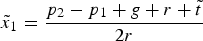 . Similarly, the indifference point for neutral buyers is
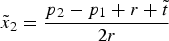 .
Lemma 3
For a given pair of prices (p1, p2), firm 1's demand is

for green and neutral buyers, respectively. Similarly, firm 2's demand is

When the regulator sets a tax on consumers buying brown goods, relative prices are affected, ultimately promoting the consumption of green products. More neutral buyers are induced to consume green products as their relative price, after considering taxes and traveling costs, decreases. In addition, more green buyers choose green products since brown goods become more expensive with the tax. The following proposition specifies the optimal tax set on consumers.
Proposition 2
In the two-stage complete information game, the optimal tax on the consumers of the brown product is  .
Note that the optimal tax described in proposition 2 coincides with that identified in proposition 1. This tax ensures that those consumers who are indifferent between buying green and brown goods decide to purchase the environmental product given the extra cost imposed by a tax  . Note that when the proportion of consumers preferring green goods increases, the tax increases and consumers become more heavily penalized when buying a brown product. Intuitively, the negative externality produced by firm 2 is mainly internalized by the neutral buyers who decide to consume a polluting good (brown product).
4.3. Subsidy on the consumption of green goods
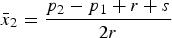
We next analyze the implementation of a subsidy s. In this setting, both types of consumers receive the subsidy s when buying a good produced by firm 1. Therefore, in the presence of a subsidy, the distance x that makes green buyers indifferent between consuming a green or brown product is now represented by  . Similarly, the indifference point for neutral buyers is
 . Let us now examine the optimal subsidy resulting from the maximization of social welfare.
Proposition 3
In the two-stage complete information game, the optimal subsidy to consumers for their purchases of green products is s* = t*.
Hence, a subsidy policy that makes the green product relatively cheaper is equivalent to a tax that makes the brown product more expensive. Most importantly, the environmental policies examined in the paper yield the same social welfare. In a context of complete information, Weitzman (Reference Weitzman1974) discusses that price and quantity controls produce the same outcomes. Our paper hence shows that different environmental regulations achieve similar results also in contexts of horizontal differentiation, and demonstrates that environmental policy is welfare improving even in the presence of consumers with heterogeneous concerns about the environment. We next analyze the welfare comparison between the different environmental policies.
Corollary 1
The social welfare when an optimal emission fee t* is imposed on the polluting company (or a tax  is set on the consumer buying polluting goods), or an optimal subsidy s* is provided to the firm producing the environmentally friendly good (or the consumer buying its product), is strictly larger than that arising when the regulator is absent, i.e., t = 0 and s = 0.
Hence, Corollary 1 implies that if two products are only differentiated in their environmental properties (i.e., in terms of emissions levels), the tax/subsidy policy increases the social welfare since it induces a higher proportion of neutral consumers to buy from firm 1, ultimately reducing the environmental damage. This result highlights the welfare-maximizing advantages of a tax/subsidy policy when consumers are asymmetric in their environmental preferences, and suggests that the implementation of environmental policies is indeed relevant when consumers are not homogeneous. The mere existence of a group of green buyers does not adequately address the negative externality produced by firm 2, while the implementation of environmental policies achieves higher social welfare. In addition, our model specifies that the increase in social welfare resulting from the environmental policy decreases with the proportion of green consumers, making environmental regulation less necessary. Finally, note that different weights on consumer and producer surplus can potentially affect the stringency of the environmental policy. For instance, if the regulator assigns more weight to consumer than producer surplus, the tax (subsidy) would become less stringent (more generous, respectively), leading to an increase in the quantity produced. However, the equilibrium social welfare induced by both policy instruments would coincide, given that the regulator is perfectly informed about the industry characteristics.
5. Conclusions
This paper studies a Hotelling's linear city model in order to analyze how different policies affect consumers' behavior when choosing between green (pollution-free goods) and conventional brown products. Specifically, we study the effects of a pollution tax and a subsidy on welfare. Firms' demand is endogenous in our linear product differentiation model. Consumers are divided into two different groups: those who favor an environmentally friendly production process and those who do not care about the protection of the environment. We show that, when products are differentiated in their environmental properties, the introduction of a tax/subsidy policy increases social welfare. In addition, the proportion of green buyers and the environmental damage induce more stringent policies. However, despite the consumers' preferences, when a green good is too costly to produce, it may be unprofitable to promote its consumption, and as a consequence the tax/subsidy is relatively small or non-existent.
From a policy perspective, when consumers value the environmental properties of a product differently and, in addition, goods are identical except for their negative effects on the environment, a tax/subsidy policy increases welfare. However, this policy is specifically targeting the group of consumers (or firms) who do not assign any value to the environmental protection. Hence, the promotion of environmental awareness among consumers can potentially eliminate the role of the tax/subsidy policy and the costs borne of its implementation. In other words, the higher the proportion of consumers who obtain an additional benefit from green products, the lower the need for this type of environmental policy. Sartzetakis et al. (Reference Sartzetakis, Xepapadeas and Petrakis2009) show that changing consumers' preferences over time through education can improve social welfare. Further research is nonetheless necessary to analyze the complementarities between policies that increase consumers' awareness of the environment and tax/subsidy policies.
Appendix
1. General case
Let us identify the social welfare when no environmental policy (either tax or subsidy) is implemented by the government. The social welfare is defined as follows:

where the consumer surplus is composed of green (G) and neutral (N) buyers, CS = CS G + CS N. In addition, green buyers choose between goods produced by firms 1 and 2. Hence, CS G + CS 1G + CS 2G and CS N + CS 1N + CS 2N. Finally, consumer surplus can be written as

and

Producer surplus is composed of both firms' profits,  , and the environmental damage is denoted by Env = d × (Q 2G (p 1, p 2) + Q 2N (p 1, p 2)), where d represents the magnitude of environmental damage and

Hence the total social welfare in the general case, SW GC, can be denoted as

2. Proposition 1
First, note that the tax is imposed on firm 2. Hence, firm 1's and 2's demands are identical to those in lemma 1. In the second stage of the game firms compete à la Bertrand. Therefore, firm 1 solves the following maximization problem

and firm 2 solves

Hence, optimal prices and firms' profits are

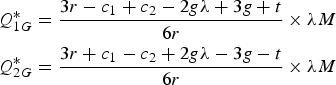
The demand of green consumers is
and the neutral buyers' demand is
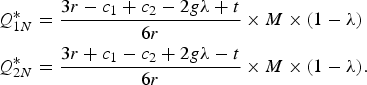
Substituting optimal prices and demand for green and brown products, we obtain firms' profits

Finally, in the first stage of the game the government sets the optimal tax,

and therefore the social welfare is

and solving the first-order conditions (FOC) with respect to t we obtain the optimal tax,

Finally, substituting t* into the SW(t), we obtain

3. Proposition 2
First, in lemma 3 we identify the demand functions. Note that the tax  is imposed on consumers of the good produced by firm 2. In the second stage of the game firms compete à la Bertrand. Hence, firm 1 solves the same maximization problem as in proposition 1 and firm 2 solves

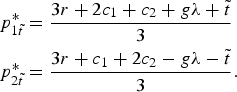
Therefore, optimal prices and firms' profits are
Hence, the demand of green consumers is
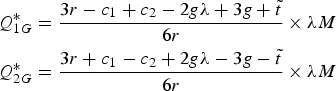
and the neutral buyers' demand is

Substituting optimal prices and demand for green and brown products, we obtain firms' profits
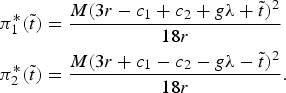
Finally, in the first stage of the game the government sets the optimal tax,

and therefore the social welfare is

and solving the FOC with respect to  we obtain the optimal tax,

Finally, substituting  into the
 , we obtain

4. Proposition 3
In the presence of a subsidy to consumers buying green goods, the distance x that makes green buyers indifferent between consuming a green or brown product is now represented by  . Similarly, the indifferent point for neutral buyers is
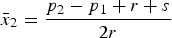 . In the second stage of the game firms compete in Bertrand. Hence, each firm solves the same maximization problem as in proposition 2, but now considering the subsidy on consumers. Therefore, optimal prices and firms' profits are

Hence, the demand of green consumers is

and the neutral buyers' demand is

Substituting optimal prices and demand for green and brown products, we obtain firms' profits
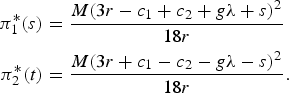
Finally, in the first stage of the game the government sets the optimal subsidy,

and therefore the social welfare is

and solving the FOC with respect to s we obtain the optimal subsidy,

Finally, substituting s* into the SW(s), we obtain

We next compare social welfare when no policy is in place vs. the case where the consumer of a green product receives a subsidy,

since

and

5. Corollary 1
Welfare comparison
Note that the social welfare obtained in the general case, SW GC, is always a component of the social welfare when a policy is implemented by the government. We obtain from our previous results that