





Introduction
In 2016, the Grand Bargain proposed a sweeping vision of an international humanitarian system (IHS) that unites local and global actors (United Nations Interagency Standing Committee, 2016). Its goal was twofold: to embrace digital innovation while also ceding some humanitarian action to local non-governmental organizations (NGOs). Digital technologies (DTs) certainly promise to facilitate the global communication necessary for localization (Belliveau, Reference Belliveau2016; Meier, Reference Meier2011), but they also risk excluding digitally disadvantaged groups (Heeks, Reference Heeks2022; Madianou, Reference Madianou2019; Sandvik et al., Reference Sandvik, Jumbert, Karlsrud and Kaufman2014). Digital humanitarianism therefore raises questions about which NGOs benefit and which are left behind.
NGOs exchange resources and information with a web of IHS actors, including the UN, donors, international NGOs, and beneficiaries (Oloruntoba & Gray, Reference Oloruntoba and Gray2006). Communication platforms, social media, and management software have increasingly facilitated these interactions since the early 2000s (Beyes et al., Reference Beyes, Chun, Clarke, Flyverbom and Holt2022), and accountability mechanisms have followed suit. NGOs frequently use DTs to track data, issue reports, and ensure staff safety (Ebrahim, Reference Ebrahim2003). Digital integration is consequently, in many cases, essential for IHS interactions and accountability.
Yet, not all NGOs reach the same level of digital integration. Some only employ DTs for communication, while others leverage DTs to transformatively redesign and strategize processes and opportunities (Mergel et al., Reference Mergel, Edelmann and Haug2019; Murphy et al., Reference Murphy, Carmody and Surborg2014). Non-profit scholarship primarily emphasizes that digital literacy (DL) is the key to such transformative integration (Chetty et al., Reference Chetty, Qigui, Gcora, Josie, Wenwei and Fang2018). However, in addition to the internal DL explanation for NGOs’ digital integration, external characteristics like conflict or rurality can also shape a “digital divide,” where regions possess unequal assets or a disparate ability to extract value from the same assets (Heeks, Reference Heeks2022; Hutchins, Reference Hutchins2020; van Dijk & Hacker, Reference van Dijk and Hacker2003).
While past embeddedness theory suggests that environmental factors shape digital possibilities (Hess, Reference Hess2004), the interaction between environment and digital literacy is underexplored in NGO contexts. As the IHS facilitates localization through DTs, it is essential to consider how some NGOs are disadvantaged by a digital divide. This study addresses this gap by exploring the processes through which rurality and conflict contexts mediate the translation of DL into transformative integration and, consequently, impact NGOs’ abilities to maintain accountability.
The study conducted 16 semi-structured interviews with NGOs in two Nigerian states, Borno and Ogun, with disparate levels of infrastructure (Adeleke, Reference Adeleke2021) and conflict (Awojobi, Reference Awojobi2014). The results support past research that higher DL facilitates greater digital integration. However, NGOs in rural and conflict-affected Borno faced a skill-implementation gap where organizations possessed digital skills but could not leverage them due to three barriers: infrastructure gaps, bandwidth ceilings, and beneficiary connectivity limitations. These environmental factors ultimately constrained even highly skilled NGOs’ abilities to fulfill their accountabilities. The study indicates that technological assets, digital opportunities within the IHS, and digital literacy alone are insufficient to overcome an NGO digital divide.
The article proceeds in seven sections. The second section reviews existing literature on NGO digital integration, distinguishes communicative from transformative digital integration, and discusses the role of DL. The third section introduces an embeddedness framework focused on contexts of rural and conflict-affected areas. The fourth section details the methodology. The fifth section presents the findings. The sixth section discusses the policy implications and theoretical contributions. The final section concludes with future research directions.
Conceptualizing transformative digital integration in NGOs
The digitalization of the humanitarian system has shifted NGOs’ modes of interactions with donors, other NGOs, beneficiaries, and their own teams. Before digitalization, NGOs typically engaged through project reports, monitoring and evaluation (M&E) forms, and beneficiary surveys (Ebrahim, Reference Ebrahim2002, Reference Ebrahim2003). The digital age, however, has expanded not only the number of NGOs visible to international humanitarian agents but also the methods for maintaining interactions (Cavicchi & Vagnoni, Reference Cavicchi and Vagnoni2023).
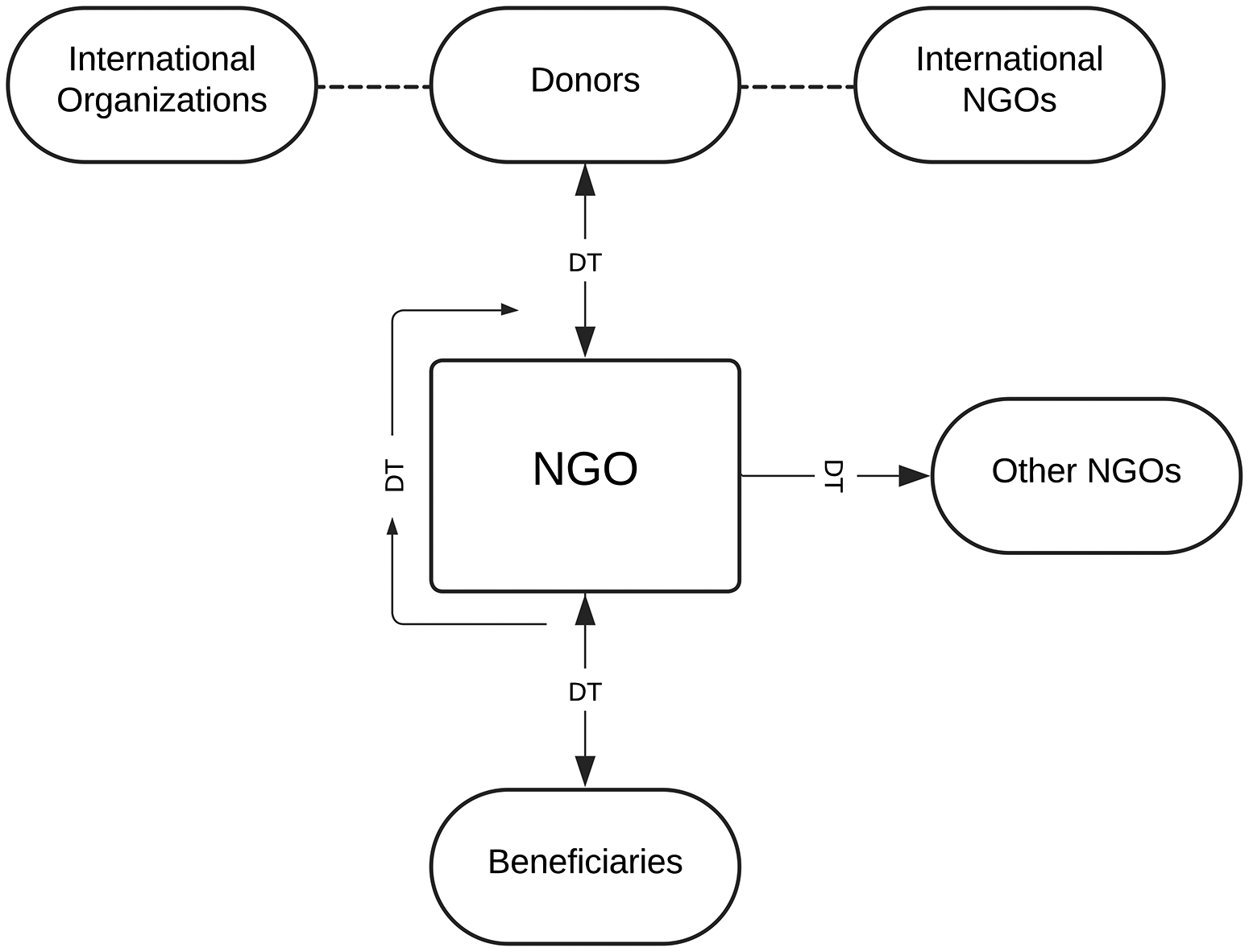
As Figure 1 illustrates, NGOs employ DTs in four directions: upwards to donors, horizontally to other NGOs, downwards to beneficiaries, and internally with their staffs. Across these interactions, NGOs use DTs to communicate with partners, fundraise digitally, fill out digital M&E templates, host or attend virtual meetings, participate in social media, access and contribute to international databases, manage volunteers and projects, monitor crises on open source maps, and provide digital services to beneficiaries (Godefroid et al., Reference Godefroid, Plattfaut and Niehaves2024; Hall et al., Reference Hall, Schmitz and Dedmon2020; Lynn et al., Reference Lynn, Rosati, Conway, Curran, Fox, O’Gorman and Lynn2022).
Four Directions NGOs Employ Digital Technologies (“DTs”) Along Upward, Downward, Horizontal, and Internal Lines of Interaction.

It is important to understand NGO digital integration since technological applications increasingly serve as the infrastructure for interorganizational humanitarian accountability. In the early 2000s, a surge of financial and management scandals damaged trust in NGO credibility (Gibelman & Gelman, Reference Gibelman and Gelman2001) and inspired calls for greater NGO accountability to IHS stakeholders (Ebrahim, Reference Ebrahim2003). Najam (Reference Najam1996) argues that NGOs are accountable upwards to patrons, downwards to clients, and internally to themselves. Ebrahim’s (Reference Ebrahim2003) framework identifies five mechanisms that enable NGOs to demonstrate these directional accountabilities: reporting, performance assessments, participation, self-regulation, and social auditing. These traditional mechanisms are now often mediated by the upward, downward, horizontal, and internal applications of DTs, including digital M&E frameworks, virtual communication platforms, project management software, and social media information sharing.
While DTs can facilitate direct and transparent relationships between NGOs and the public (Vaccaro & Madsen, Reference Vaccaro and Madsen2009) and improve resource management (Berrett, Reference Berrett2022), they also create new dependencies that may inadvertently exclude NGOs with limited technological capacity. Ebrahim (Reference Ebrahim2003) emphasizes that effective accountability requires NGOs to balance competing demands as they are held responsible by donors and hold themselves responsible to their missions. When accountability mechanisms are digitally mediated, NGOs’ abilities to fulfill demands may be partially determined by their digital capabilities. An NGO unable to maintain real-time beneficiary databases or conduct virtual stakeholder meetings, for example, may find itself systematically disadvantaged. Digital integration is consequently a vehicle for maintaining accountability to and participating in the international system.
Integration complexity, however, varies across organizations. Mergel et al. (Reference Mergel, Edelmann and Haug2019) distinguish “digitization” (analog to digital) from “digitalization” (marginal extension) and “digital transformation” (full cultural and organizational change). Similarly, Murphy et al. (Reference Murphy, Carmody and Surborg2014) describe “thin” integration as only incorporating DTs as “communication devices” (266) and “thick” integration as applying internet, software, and data tools as “strategic resource[s]” (270) for discovering new capital and processes. Transformative NGO digital integration synthesizes DTs to not only increase communication efficiency but also innovatively advance organizational processes and impact. Mature digital interoperability, in turn, enables greater information sharing and transparency, therefore facilitating accountability (Gottschalk, Reference Gottschalk2009; Kouroubali & Katehakis, Reference Kouroubali and Katehakis2019).
These scales of integration introduce questions about why some organizations achieve greater digital transformation than others. Potential factors can be conceptualized as internal—organizations’ decision-making or skills—or external—conditions in organizations’ surrounding environments. Information and Communication Technologies for Development (ICT4D) and non-profit literature frequently cite digital literacy (DL), an internal condition, as the key factor enabling or preventing transformative digital integration. Chetty et al. (Reference Chetty, Qigui, Gcora, Josie, Wenwei and Fang2018) argue that DL encompasses a broad set of information, computer, media, communication, and technological skills that combine creativity and analytical prowess with basic hardware skills. Greater DL has been shown to enable NGOs to make data-driven, real-time decisions (Bălăcescu, Reference Bălăcescu2021), innovate technological solutions (Chetty et al., Reference Chetty, Qigui, Gcora, Josie, Wenwei and Fang2018), and simultaneously synthesize multiple digital platforms (Ha & Kim, Reference Ha and Kim2024), all skills that contribute to transformative digital integration. This internal organizational answer alone, however, neglects external explanations.
Embeddedness theory and the digital divide
NGOs’ external cultures of adoption and resource availability impact their digital capabilities, openness, and decision-making (Godefroid et al., Reference Godefroid, Plattfaut and Niehaves2024). This article, therefore, draws from organizational embeddedness theory as developed in organizational sociology literature. Organizational embeddedness differs from earlier institutional and network embeddedness theory (Granovetter, Reference Granovetter1985; Polanyi, Reference Polanyi1944) by focusing on how environmental characteristics like politics, economics, and technological conditions constrain and enable organizational capacity. This lens especially draws from Hess’s (Reference Hess2004) “territorial embeddedness.” Hess argues that the geographic and infrastructural contexts in which organizations are anchored shape their possibilities. This lens allows this article to examine how external conditions like rurality and conflict shape NGO digital capabilities.
Like other organizations, NGOs are embedded in infrastructural contexts that vary in digital resources and information (Gilbert et al., Reference Gilbert, Masucci, Homko and Bove2008). Early ICT4D studies built on organizational theory and conceptualized the “digital divide” by binarily distinguishing between groups with access to physical technologies, data, internet, and electricity and groups without access (Heeks, Reference Heeks2022). More recent studies, however, acknowledge that even as most of the world now possesses DTs, divisions still exist in the degree to which users extract value from them (van Dijk & Hacker, Reference van Dijk and Hacker2003) or are adversely incorporated by them (Heeks, Reference Heeks2022). These disparities have been linked to various embedded factors including regional variations, broadband connection, education levels, internet skills, and employment (Lera-López et al., Reference Lera-López, Billon and Gil2011). Ongoing conflict, for instance, can exacerbate already existing disparities in technological access due to infrastructure destruction or intentional governmental network suspensions (Hutchins, Reference Hutchins2020).
ICT4D research consequently indicates that external conditions impact digital integration, but prior NGO research has focused primarily on digital literacy, not environmental characteristics like rurality or conflict. As a result, little is known about how external barriers influence even highly skilled NGOs’ abilities to integrate DTs transformatively. This study, therefore, asks how do environmental constraints of rurality and conflict mediate the relationship between digital literacy and transformative digital integration, and what are the implications for humanitarian accountability?
Methodology
This study seeks to understand not whether environment matters, as territorial embeddedness theory indicates, but how structural conditions of conflict and rurality shape digital transformation. It aims to specify theory by applying an interpretive case study approach via semi-structured interviews across differing contexts. The approach allows this study to synthesize information across spaces and geographies (Bartlett & Vavrus, Reference Bartlett and Vavrus2016) and investigate the impact of varying contexts on real experiences (Fox-Wolfgramm, Reference Fox-Wolfgramm1997). The context variations isolate environmental factors while avoiding positivist assumptions by centering participants’ choices and experiences.
As an outside researcher based at a UK institution, the author addressed limited first-hand contextual knowledge by prioritizing participants’ own experiences and interpretations. The interview process addressed the potential distancing of the virtual format through preliminary rapport-building conversations and flexible interview scheduling that accommodated participants’ preferences. Interviewees also regularly confirmed the researcher’s interpretations, understood that participation was voluntary, and drove the direction of conversation through a semi-structured model.
Case study: Borno State and Ogun State in Nigeria
Nigeria was selected due to its strong NGO presence with over 190,000 registered local and national NGOs (Ojo, Reference Ojo2024) and internet usage disparities between the North and South (Adeleke, Reference Adeleke2021). This study analyzes two Nigerian states, Borno in the Northeast and Ogun in the Southwest, that differ in internet and data usage (see Figure 2). Borno has a 36% higher population than Ogun (Nigeria Governors’ Forum, 2023) but 56% fewer internet subscribers and 57% fewer active mobile voice subscribers (National Bureau of Statistics, 2024). Additionally, Borno is among Nigeria’s least developed, most rural states (Adeleke, Reference Adeleke2021; Monguno & Umara, Reference Monguno, Umara, Mustapha and Meagher2020), and Ogun is among Nigeria’s most developed and industrial centers but is surrounded by rural regions with lower connectivity (Adeleke, Reference Adeleke2021).
Number of Internet and Active Mobile Voice Subscribers in 36 Nigerian States in Quarter 3 of 2023. Created by author. Statistics: Nigerian National Bureau of Statistics, 2024.

Fig. 2 Long description
At the top left, two color scales define the data. The first scale for Number of Internet Subscribers ranges from light green (1,195,580) to dark blue (19,188,745). The second scale for Number of Active Voice Subscribers ranges from light green (1,558,509) to dark blue (27,043,333).
The map of Nigeria shows the highest concentration of subscribers in the Southwest and North-Central regions.
* In the North, Kano is a prominent outlier with a darker teal shade indicating high subscriber numbers, while surrounding states like Sokoto, Katsina, Jigawa, and Yobe are in light green. Borno shows a medium green shade.
* In the Central region, Kaduna and Niger show moderate teal shades, while Plateau, Bauchi, and Gombe are lighter.
* In the Southwest, Lagos is the darkest blue on the map, representing the highest tier of subscribers. Neighboring Ogun and Oyo are also shaded in darker teal.
* In the South and Southeast, states like Delta, Edo, and Akwa Ibom show light to medium green shades, while inland states like Enugu, Imo, and Cross River are among the lightest shades.
Additionally, Borno and Ogun NGOs are embedded in different conflict environments. Boko Haram primarily operates in Northeast Nigeria (Awojobi, Reference Awojobi2014), and its threats displaced 2.1 million Nigerians in Borno between 2009 and 2021 (Bell & Card, Reference Bell and Card2021). The differences between Borno and Ogun consequently enable this study to examine the degree of NGO digital integration across geographic and conflict variations.
Data collection and analysis
This study selected interviews as the data collection method to grant interpretive information from participants who have experienced the phenomenon studied (Rosenthal, Reference Rosenthal2016). An ethics review from the London School of Economics and Political Science first approved this research in order to reduce the risks of unanticipated harm (DiCicco-Bloom & Crabtree, Reference DiCicco-Bloom and Crabtree2006). Sixteen local and national NGOs managed by Nigerian nationals, six in Ogun and ten in Borno, working in a range of sectors, including health, youth, gender, poverty, and governance, were identified through the Nigerian Network of NGOs and internet search. Recruitment occurred through publicly available information (15 NGOs) and snowballing (1 NGO). In the following analysis, Ogun NGOs are designated “O-NGOs,” and Borno NGOs are designated “B-NGOs.”
Data collection occurred in two phases. Initial interviews (B-NGO = 4, O-NGO = 4) in mid-2024 achieved preliminary thematic saturation when no new theoretical insights emerged regarding environmental constraints and digital capacity, aligning with Guest et al.’s (Reference Guest, Namey and Chen2020) finding that basic themes often emerge within seven interviews. Eight follow-up interviews (B-NGO = 6, O-NGO = 2) in late 2025 sought to understand the three environmental barriers that emerged during the first sample. The iterative approach revealed deeper theoretical insights (Glaser & Strauss, Reference Glaser and Strauss1967). The second phase prioritized Borno NGOs since initial interviews found that Borno primarily experienced environmental constraints.
Importantly, interviewees were information-rich cases. Twelve interviewees were NGO directors, and four were program managers or directors assigned to the interview by executive directors for their expertise in the NGOs’ DTs. The research verified organizational roles through NGO websites and social media and confirmed credibility by conducting interviews during working hours, requesting participants to describe specific organizational decision-making processes, and asking about interviewees’ roles and responsibilities. All participants received information about the research procedure, purpose, and publication before interviews.
Semi-structured interviews based on an interview guide gathered targeted data along main themes while allowing flexibility to follow-up (Adams, Reference Adams, Newcomer, Hatry and Wholey2015). First phase interview questions centered around uses and challenges of DTs; digital literacy; and digital integration on upward, downward, horizontal, and internal interactions. Second phase interview questions focused on infrastructure gaps, bandwidth ceilings, beneficiary connectivity limitations, and implications for accountability. Interviews occurred virtually via Zoom and lasted approximately 45 minutes.
First phase interview analysis followed thematic processes outlined by Belotto (Reference Belotto2018) and Naeem et al. (Reference Naeem, Ozuem, Howell and Ranfagni2023). The analysis first grouped keywords and phrases in interview data into “codes” that identified participants’ core messages. The patterns in codes were interpreted into themes which were then conceptualized into two broad categories (see Table 1). In addition to the initial codes, second phase analysis coded to the three environmental barriers identified by the first phase (illustrated by italics in Table 1). After coding, analysis, and drafting were complete, Claude (Anthropic AI) was used for proofreading to check for typographic errors in the final manuscript in early 2026. No artificial intelligence was otherwise used.
Thematic analysis

Table 1 Long description
The table consists of three columns: Categories, Themes, and Codes.
* Row 1 (Header): Categories, Themes, Codes.
* Row 2: Category is NGO DT integration processes. Theme is DT applications (Fig. 1). Codes include Upward DTs, Horizontal DTs, Internal DTs, and Downward DTs.
* Row 3: Category continues as NGO DT integration processes. Theme is Thick and thin integration. Codes include Communication value, and Data collection and analysis.
* Row 4: Category continues as NGO DT integration processes. Theme is Digital literacy. Codes include Perceptions of DTs, Technology adoption, Existing digital literacy, Digital literacy impact on integration, Building digital literacy, and IT problems.
* Row 5: Category is Role of environment. Theme is Embedded characteristics. Codes include Infrastructure, Investment, Insurgency, and Network connection.
* Row 6: Category continues as Role of environment. Theme is Impact on accountability. Codes include Accountability to donors, Accountability to NGOs, Accountability to organization, and Accountability to beneficiaries.
* Row 7: Category continues as Role of environment. Theme is Environmental barriers (second interview phase). Codes include Infrastructure gaps, Bandwidth ceilings, and Beneficiary connectivity limitations.
There are nevertheless important limitations to acknowledge. First, the single case study approach limits generalizability to other contexts that differ in governance, geography, history, or socioeconomics. The findings, however, suggest embeddedness theory can explain digital divides in other contexts. Second, interviews were conducted virtually, which necessitates that NGOs possess some level of digital integration. However, this limitation helpfully enabled the study to analyze differential value extraction from DTs, a key dimension of the digital divide (Heeks, Reference Heeks2022). This methodological choice aligned with the study’s theoretical focus on embedded environment. The paper’s contribution lies not in comparing DT usage to a lack of DT usage but in examining the impact of environment on NGOs’ capacities to extract value from existing DT usage and digital literacy.
Analysis
Borno NGOs’ DL skills influenced their integration complexities and ambitions, but infrastructure gaps and bandwidth ceilings ultimately limited their abilities to apply their skills in practice. While Ogun NGOs did not experience the same bandwidth and investment gaps, they noted that their rural beneficiaries often did, leading to a gap in beneficiary connectivity in both Ogun and Borno. As a result, environmental factors constrained even highly skilled Borno and Ogun NGOs’ abilities to use DTs to fulfill accountabilities.
Communicative and transformative NGO digital integration
Upwards, NGOs used DTs to promote activities to partners via social media, meet with donors virtually, publish reports, fill out legal forms and donor-provided M&E templates, and access Fintech. B-NGO2, for instance, noted that “we have this portal designed to help us…interact with donors and the international organization systems and even sometimes the government.” B-NGO2 also uses a grants management software that requires it “to be a partner with the donor to be able to access the system.” Horizontally, NGOs used DTs to send newsletters, join workshops, meet with other NGOs, and read peer newsletters. O-NGO4, for instance, said DTs brought more than 300 NGO staff together annually: “It is at the Charity Lecture that everybody comes together. And they tell you, ‘My friend shared it with me,’ or ‘I saw it on Facebook, I saw it on Instagram, and it’s a program I want to attend.’”
Internally, NGOs used DTs to communicate with their teams, manage finances through automated accounting or Excel Spreadsheets, store files in the cloud, collect data through platforms including KoboCollect, assign tasks, and manage projects through software including NuLab. Downwards, NGOs used DTs to share event details with beneficiaries through WhatsApp and social media, profile and track beneficiary data, and offer digital services. B-NGO1 said, “We actually don’t go [to beneficiaries’ locations] physically because of technology. We just give them a call and make them aware of events that will take place on particular dates.” In each direction, DTs serve as communication, reporting, participation, and performance assessment devices.
Most of these technological functions, however, were thin uses for communication value. When asked about the value of technology, every NGO indicated that they valued technology for its ease of communication with partners, other NGOs, their teams, and beneficiaries. According to O-NGO1, DTs “allow us to connect with more people” since, as B-NGO1 emphasized, “we are online; we are visible.” Certainly, these communicative roles impact NGO engagement. DTs enabled O-NGO4, for instance, to expand its reach by “mak[ing] people know what we are doing…Some even invite us to come to their locations to help children in that area.” These NGOs generally reported that the value of DTs lay in digitally translating existing activities.
Other NGOs, however, integrated DTs in transformative ways that sought and tested new platforms and applied real-time data to reevaluate programs. B-NGO2, for instance, described using a wide range of digital platforms and software to manage staff, collect program data, make international connections with donors and universities, and discover new project techniques. In one case, it used data analysis via KoboCollect to redirect an ongoing education project that missed its targets: “If we didn’t have that real-time tracking, we might not get to discover the problem [until] the end of the project when we will not be able to make any decision anymore because the project has ended.” B-NGO3 similarly said it regularly sought new DTs since many of its employees were young and digitally open. For example, B-NGO3 used management software to conduct community surveys before introducing a reintegration program for former Boko Haram insurgents. It aimed to determine “if that’s going to impact the community” and adjusted the planning according to feedback. B-NGO8 uses data protection systems to “strengthen confidentiality because we do not want children’s names and pictures being displayed.” Three NGOs even implemented digital literacy programs for beneficiaries. B-NGO5, for instance, trained over 1,400 individuals. Each of these NGOs exhibited a high level of DL that enabled them to collect information, adjust programs in real time, and shape programs around specific needs.
Digital literacy as a facilitator of transformative digital integration
B-NGO2 and B-NGO3 said that they place a strong organizational focus on building digital skills. B-NGO3 acknowledged, “It’s required having people with the required skill set because most of the time that thing was [where] the innovation comes into play.” It hosts bi-monthly or quarterly digital skills trainings and encourages staff to learn skills independently through YouTube and online courses. B-NGO2 drafted a Digital Strategy because “we want to go as digital as possible…[since] it makes our work very effective.” It also regularly conducts staff trainings and hires external experts to host workshops. B-NGO2 reported success: “I have someone who came and didn’t even know how to use a mouse on a computer, but this guy today can design an interactive dashboard using Power BI.” B-NGO2 and B-NGO3 credited their digital complexity to their staff’s digital skills and openness to new digital platforms.
In contrast, NGOs with less complex levels of integration indicated their staffs were less technologically open and knowledgeable. O-NGO3 said some employees have a “bit of a grasp of the digital technology, [and others] are just coming up and trying to find their ways around it.” O-NGO3 and B-NGO4 agreed that younger employees are more “digitally inclined” but that the rest are lagging. Several NGOs did attend external workshops, but topics focused on shifting existing processes from analog to digital. O-NGO1, for instance, attended a workshop to learn how to upload to Google Drive, and B-NGO4 paid for a 3-week training in Excel. B-NGO1 and O-NGO3 said that they fill skill gaps by hiring external IT experts from Lagos. Several NGOs attributed their low DL to digital hesitancy. O-NGO3 said the “level of skill is way below average” because “a particular portion of the population is always skeptical toward the adoption of technology.” O-NGO1, O-NGO3, and B-NGO4 agreed that they hesitate to adopt new technologies until DTs “prove themselves first” or are recommended by other NGOs. The lack of technological openness and knowledge therefore resulted in lower levels of technology adoption and innovative integration complexity.
Embedded characteristics: Three barriers to transformative digital integration in Borno
However, high digital literacy did not guarantee that NGOs were able to integrate DTs to the degree that their skills would allow. Rather, all ten Borno NGOs pointed to constraints in their data, internet, and power as barriers to digital integration. NGOs reported three particular barriers: infrastructure gaps, bandwidth ceilings, and beneficiary connectivity limitations.
Infrastructure gaps
As B-NGO6 highlighted, Borno is “one of the most conflict-affected states in Nigeria by the operation of Boko Haram.” Borno NGOs consistently identified three challenges Boko Haram posed to digital integration. First, Boko Haram insurgents destroyed infrastructure. “When this whole crisis came,” B-NGO8 said, “the armed group started burning communication infrastructures and masts.” B-NGO3 agreed that “the terrorists still have been destroying electricity here,” and B-NGO4 noted that “for three to six months [at the beginning of the insurgency], there was no network at all.” These accounts align with the 2023 Global Terrorism Index identification of Nigeria as the eighth most terrorism-impacted country due to Boko Haram (Institute for Economics and Peace, 2023). Onuoha (Reference Onuoha and Mantzikos2013) documents Boko Haram’s systematic destruction of telecommunication masts in five Northern states, including Borno. In 2012 alone, Boko Haram destroyed 150 masts in an attempt to disrupt the Nigerian government from tracking Boko Haram members, resulting in service disruptions across the region (Onuoha, Reference Onuoha and Mantzikos2013).
Second, military operations temporarily and unexpectedly suspend internet connection. B-NGO6 reported, “When the military wants to go into the bush or they have a certain operation, they’ll ask the operators to shut down the network, so it affects everybody.” B-NGO9 agreed that “because of security, [internet] is switched off for…sometimes half a day…so that means the whole day you can’t literally do anything.” In May 2013, for instance, Nigeria’s security forces imposed a network blackout for 21 days in Adamawa, Borno, and Yobe states as a counterinsurgency measure (Jacob & Akpan, Reference Jacob and Akpan2015). When asked how often connection is shut off, B-NGO6 replied, “Nobody can predict when it will happen.”
Third, outside investors hesitate to rebuild infrastructure. NGOs acknowledged that “there is a lot of damage in terms of infrastructure” (B-NGO9) which has “cost billions of naira [so] the [government] was unable to rebuild it to the previous standards” (B-NGO8). Outside estimates report that infrastructure damaged by Boko Haram and floods cost 15.9 billion naira to repair in 2012 alone (Onuoha, Reference Onuoha and Mantzikos2013). Corporations or outside investors hesitate to build infrastructure since, as B-NGO2 explained, “nobody wants to bring in a multi-million-dollar project and then it [is] vandalized in the next year.” The key to rebuilding infrastructure, B-NGO8 offered, was the government’s gradual policy to “oversee and safeguard and secure facilities, especially ones that have been constructed by the government and then handed over to network service providers. But there could be more.”
Most Borno NGOs responded to these infrastructural challenges by relying on radio or analog systems. However, they still sometimes lost contact with their colleagues, sometimes for weeks. Some even traveled to other cities or states for connection. But traveling came with risks: “Sometimes in the process of trying to go [to the city] to make calls, people get attacked, and they are even killed” (B-NGO4). Borno NGOs consequently faced disproportionate infrastructure gaps to Ogun NGOs. As O-NGO6 acknowledged, “Especially with the insecurity [in the Northeast] and terrorist attacks, [Borno NGOs] will definitely face more challenges with connectivity using digital tools compared to the Southwest where we currently are.”
Bandwidth ceilings
Even if Borno NGOs maintained infrastructure, however, internet speed and capacity was more limited. B-NGO2 stated that higher levels of network connection were necessary for more complex technological integrations since it “consumes a lot of bandwidth.” All four Borno NGOs in the first sample mentioned poor network connection in rural areas as the primary challenge to using DTs and applying DL to communicate with stakeholders and report their work. B-NGO1 said, “You might not be able to reach those you want to reach in good time, or sometimes it’s even impossible to reach them [at all].” B-NGO7 echoed, “Internet speeds delayed a lot of information…You drop the message in the morning [and it is] four hours before you get them…We struggle a lot to receive information quickly.” On a scale of one to ten with ten being strongest bandwidth, B-NGO9 assigned Borno connection a two “because it’s really, really challenging…It disrupts your work and slows you down.”
Borno NGOs also reported struggling with the bandwidth to run Zoom or Microsoft Teams meetings with international partners or to upload data. Importantly, B-NGO2 said that connectivity challenges prevented it from adopting the DTs that it would use if it had better connection. For example, B-NGO2 was unable to use QuickBooks since it consumed too much data and noted, “We do not have access to internet facilities to even report our idea.” B-NGO4 concluded, “It gets so frustrating,” and B-NGO9 agreed, “You feel like you want to just explode with anger.”
In contrast, when asked if it experienced bandwidth challenges managing multiple platforms, O-NGO5 responded, “It’s been easy.” The Nigerian National Bureau of Statistics (2024) reports that Ogun is one of the four most well-connected states in Nigeria (see Figure 2). Only one Ogun NGO acknowledged connectivity as the primary challenge with digital integration. Although connectivity limitations “do disrupt meeting workflow,” O-NGO5 noted that “generally speaking, [the solution] may just be a matter of finding a part in the house or the building that is better for this particular network…You don’t really need to go far.”
Borno NGOs, on the other hand, were required to adapt institutionally. B-NGO2 identified a software toolbox that enabled employees to collect data offline in rural areas and later upload it to the central database in an area of strong connectivity. The tool, however, still required staff to “come back into the main cities to even have access to the internet.” B-NGO9 prepared to spontaneously adjust programmatic operations or data collection if bandwidth dropped: “We always have a plan B…in case the network doesn’t work.” While two other Borno NGOs used the UN Humanitarian Hub as a reliable network provider, B-NGO8 also noted that “it’s not enough because it’s limited and you can only access it when you come to the Hub.” While these solutions offered flexibility, they nevertheless did not overcome daily frustrations with bandwidth.
Beneficiary connectivity limitations
Although most Ogun NGOs said they faced no major network disturbances of their own, they acknowledged that their beneficiaries often lived in rural areas that did face challenges. O-NGO2 said, “A lot of our beneficiaries…do not have access to technology beyond their phone at times…Some of them don’t have electricity.” O-NGO5 agreed, “In remote villages, they don’t have access to quality internet, so that’s why we have to send a representative or even go there.” The Nigerian National Bureau of Statistics (2024) documents that states to Ogun’s east, including Osun and Ondo, maintain digital connectivity levels similar to Borno (see Figure 2). Rural beneficiaries also often lack prerequisite skills like literacy to build DL. O-NGO3 noted, “We have [rural] artisans. We have people [who] are not all that educated, really didn’t go beyond secondary education, and some did not really have an education at all…The level of skill [is] way below average.” All six Ogun NGOs agreed that they were only sometimes able to engage beneficiaries on communication platforms like WhatsApp due to disparities in network and power access.
This lack of network access limited O-NGOs’ abilities to maintain long-term relationships and reporting mechanisms with rural beneficiaries. O-NGO2 explained, “It’s very hard to do follow-ups since you might have to go to their place of trading, and sometimes that changes. But, if we were able to send an email, they could be on an email newsletter group.” O-NGO4 acknowledged the potential for accountability with reliable connection: “At times, we have to be physically present…if [the rural village] doesn’t have connectivity…But if it has connectivity, all you do is just get [the beneficiary’s] number or get his ID and send those [services] to him.” DTs, therefore, could facilitate accountability to beneficiaries through regular feedback on programmatic decisions, but NGOs found that the lack of network, power, and DL in rural areas inhibited such transformative downward digital integration.
Implications for accountability
The three barriers challenged Borno NGOs’ abilities to engage with stakeholders and maintain accountability in a digitally mediated environment. Upwards, NGOs said that discovering new partners, filling out M&E templates, meeting virtually with donors, advertising via social media, accessing banking, and filling out forms for the Nigerian government all required reliable connection. While both Ogun and Borno NGOs reported that donors and UN agencies required them to use specific software like Notion, Salesforce, and UN platforms (O-NGO5, B-NGO8), Borno NGOs disproportionately experienced infrastructural constraints. B-NGO6 remembered when donors shifted to these digital platforms: “The communication differs. Before, you used to give them a report, write and submit…Now the digital world has taken over…The [donors] will have to train you how to use the tools, the digital communication.” Yet, even after these digital literacy trainings, NGOs found that poor connection or infrastructure damage frustrated upward accountability.
For instance, one of B-NGO9’s partners provided a router that was unable to reliably connect to the network, and, as a result, their software “won’t even open at all.” B-NGO10 similarly noted that it prioritizes creating and sharing media since “without seeing what we have done, it is impossible to get [donors] on the phone because you cannot be entrusted with a whole lot of money.” But B-NGO10 added that it regularly struggled to upload video content about its projects due to slow bandwidth, sometimes even “roaming around to get network…literally battling for network.” O-NGO2 summarized, “Not having connection can impact the ability of technology to be used for monitoring and evaluation and program direction.”
Horizontally, NGOs said that poor connection prevented them from fully collaborating. B-NGO4, B-NGO8, O-NGO6, and B-NGO9 emphasized that “the internet has helped us in the industry sector to be coordinated” (B-NGO9), prevent duplication, and host coordination meetings online. Yet, B-NGO9 also acknowledged that there are often glitches during meetings. B-NGO8 further pointed out: “It mostly becomes challenging because sometimes the network itself is not stable…[or] if I’m in the field and I’m not able to make it back home on time, I have to miss the meeting.” Digital platforms like Zoom and Teams consequently provided opportunities for horizontal accountability, but their accessibility was partly shaped by network connectivity.
Internally, NGOs highlighted two challenges to accountability. First, network limitations constrained Borno NGOs’ applications of DTs as decision-making tools. As B-NGO2 notes, DTs “make work very, very easy, and then we become efficient” as the director assigns staff tasks and can “concentrate on other activities or important things.” B-NGO7 agreed but also observed, “The service provider has really delayed a lot of decision-making and responses during most emergencies.” One time, its staff was unable to rapidly communicate during a flooding emergency, ultimately impairing its operational flexibility and efficiency. One of B-NGO6’s local NGO partners was similarly unable to collect survey data to improve operations since “it was very difficult because of the connectivity.”
Second, Borno NGOs faced challenges ensuring the security of staff. O-NGO5, B-NGO6, and B-NGO7 reported that poor connectivity limited communication between staff during emergencies and field operations. B-NGO6 remembered a time when Boko Haram struck the same location where its staff was conducting an emergency food security program. Their car had already left to the next location, and “there was no means of calling the driver to come pick [them] up.” They walked on foot to the next city. “If there was communication,” B-NGO6 concluded, “something like this wouldn’t happen.” Infrastructural barriers consequently not only limited decision-making capacity during operations but also risked safety of humanitarian staff.
Downwards, in addition to beneficiary connectivity gaps impairing information sharing with rural beneficiaries, NGOs experienced limitations using DTs for beneficiary services. Four NGOs acknowledged the value of digital services. B-NGO5, for instance, reported that after teaching one woman to use DTs, she “started using her social media handles to market herself as a makeup artist…because of the training she got from us.” However, connectivity limitations inhibited the full value of digital services. B-NGO6 and B-NGO9 observed challenges with government and donor pressures to move cash to digital transfers since “one cannot make a transfer of funds to another because of internet” (B-NGO9). B-NGO6 noted that in cases where digital transfers are employed in rural communities, a “distribution period that is planned for five days may take longer, up to ten days, because of network connectivity issues.” NGOs were optimistic about the value of DTs in beneficiary services but nevertheless cautioned that disparate infrastructure places constraints on the realities of digital services.
Discussion
The study’s primary contribution is specifying how environmental embeddedness moderates the relationship between digital literacy and transformative integration. By exploring how environment interacts with DL to shape NGOs’ DT usage, this study suggests that bandwidth ceilings, infrastructure gaps, and beneficiary connectivity limitations in Borno perpetuate an NGO digital divide in the humanitarian system. Table 2 synthesizes patterns and variations across Borno and Ogun. In Borno, bandwidth ceilings and unprofitable investment undermined DL so that even high-DL organizations could not fully leverage their internal capacity to achieve “thick” or “transformative” digital integration (Mergel et al., Reference Mergel, Edelmann and Haug2019; Murphy et al., Reference Murphy, Carmody and Surborg2014). In Ogun, DL was the primary limiting factor for digital integration except in rural areas where beneficiaries faced bandwidth ceilings and damaged infrastructure.
Comparative analysis of digital integration and accountability implications across contexts

Table 2 Long description
The table consists of five columns: Direction of engagement, Digital tools used, Environmental impact in Borno, Environmental impact in Ogun, and Accountability implications.
* Upward engagement to donors: Uses social media, virtual meetings, M&E templates, grant portals, and Fintech. Borno faces bandwidth ceilings and infrastructure gaps, while Ogun has functional access. Accountability implication: Borno NGOs risk funding disadvantages due to perceived lower responsiveness.
* Horizontal engagement to other NGOs: Uses newsletters, workshops, coordination platforms, and information sharing. Borno faces bandwidth and infrastructure gaps, while Ogun can host and participate in large-scale virtual events. Accountability implication: Borno NGOs risk marginalization from participatory environments.
* Internal engagement within NGO: Uses cloud storage, data collection, project management, and accounting. Borno faces bandwidth and infrastructure gaps, while Ogun runs platforms reliably. Accountability implication: Borno NGOs cannot maximize software or ensure staff safety; Ogun is limited by DL.
* Downward engagement to beneficiaries: Uses WhatsApp, social media, tracking databases, and digital services. Both Borno and Ogun face beneficiary connectivity limitations. Accountability implication: Both regions struggle to maintain contact with or provide digital services to rural communities.
The study challenges the dominant focus on digital literacy as the primary determinant in NGO digital transformation (Bălăcescu, Reference Bălăcescu2021; Ha & Kim, Reference Ha and Kim2024). Borno NGOs’ infrastructure-poor contexts constrained their capabilities to complexly integrate and innovate multiple platforms, even when their ambition, creativity, and skill would have allowed. As Heeks (Reference Heeks2022) argues, these disparities in the ability to extract value from DTs is a digital divide that persists even amid equal physical assets. Due to infrastructure gaps, bandwidth ceilings, and beneficiary connectivity limitations, Borno NGOs faced a skill-implementation gap where even highly skilled NGOs encountered structural barriers to implementing their preferred technological solutions. DL is a necessary but insufficient condition for NGO transformative digital integration.
Ebrahim’s (Reference Ebrahim2003) accountability model relies on NGOs possessing the ability to choose how to demonstrate performance to stakeholders. This study indicates that, in a digitally mediated IHS, environmental constraints beyond NGOs’ DL impair their capacities to digitally maintain accountability. These constraints create credibility penalties against less digitally accessible NGOs that face challenges meeting donor expectations, coordinating with other NGOs, ensuring staff security, and serving beneficiaries. Consequently, the digitalization of coordination and reporting mechanisms, while offering communication efficiency and global connections, may inadvertently also systematize disadvantages for NGOs operating in infrastructure-poor environments. The mere existence of digital platforms to connect IHS members and projects without attention to environmental disparities leaves behind less digitally accessible groups.
The NGO digital divide poses several implications for practitioners. First, regular digital skills trainings that introduce data analysis, new DTs, and multi-platform synthesis would allow NGOs to advance their DL and develop the technological creativity necessary for digital transformation. Second, NGOs could implement approaches that both build internal capacity and engage in infrastructure advocacy, recognizing that neither alone is sufficient. They may leverage strategic partnerships with technology firms, universities, and donors to access low-bandwidth DTs. Third, local governments could ensure greater protections against infrastructure damage. Fourth, innovators could expand offline data collection systems that reduce dependency on connectivity. Fifth, donors and international partners in the IHS should recognize the limitations of purely digital accountability frameworks and adjust reporting expectations to accommodate NGOs in low-connectivity environments. DL investments are valuable, but to be truly effective, they must go hand-in-hand with external investments and a holistic perspective to alleviate the ceiling created by the digital divide.
Conclusion
By exploring how NGOs’ local environments shape their digital integration, this study indicates that digital literacy, while necessary, is insufficient for NGO digital transformation when infrastructure gaps, bandwidth ceilings, and beneficiary connectivity limitations create barriers to implementation. While DL enabled Borno NGOs to thickly integrate technologies, environmental limitations restricted even highly skilled NGOs’ abilities to use DTs to communicate, track data, provide digital services, and ensure staff security. Ogun NGOs similarly faced challenges in their attempts to maintain contact with rural beneficiaries who did not have reliable digital access. The resulting digital divide challenges humanitarian accountability since infrastructural constraints systematically disadvantage some NGOs in their ability to meet increasingly digitalized coordination and reporting expectations. The Grand Bargain’s goals to localize and integrate DTs in development are consequently constrained by NGOs’ disparate abilities to extract value from technologies.
These findings provide initial evidence that territorial embeddedness can constrain digital transformation outcomes, suggesting a pathway for future research. This study identifies infrastructural constraints as a key moderating factor, but the full ecology of digital transformation involves additional variables that warrant further investigation, including organizational culture, donor requirements, and technological change. Additionally, while this study merely identified the implications for humanitarian accountability, future research could extend theory about accountability in the digital divide or digital adverse incorporation in the IHS. In short, additional research about the modes of NGO incorporation in multi-stakeholder digital spaces is warranted to better understand the constraints on NGOs’ positions among international humanitarian actors. By critically examining the intersection of localization and DTs, this study contributes to the broader discourse on humanitarian digitalization. It ultimately reveals a need for a more nuanced understanding of the structural challenges that must be addressed to ensure equitable opportunity in an increasingly digital humanitarian space.
Data availability statement
Per the ethics approval, data from interviews are not available to be shared.
Funding statement
No funding was received to conduct this study.
Competing interests
The author has no financial or non-financial interests to disclose.
Ethical standards
An ethics review was approved by the London School of Economics and Political Science, reference number: 342865.
Consent to participate
Interview participants were informed of procedure and content before interviews and confirmed their consent.


 Open access

