Introduction
Children are one of the most vulnerable populations in disasters.Reference Gausche-Hill 1 Focusing on earthquakes, it is established that the rates of death and injuries are different in age subgroups. Child injuries are more severe, therefore causing higher mortality. It is well-established that the optimal treatment of fractures in children sometimes differs from the adult standard of care.Reference Rodríguez-Merchán 2 , Reference de Billy, Gindraux and Langlais 3 Nevertheless, very few articles have been published about orthopedic injuries and their treatment in children during earthquakes. In a typical disaster context, the imbalance between hospital overcrowding and inadequate resources may lead to lower standards of care. Compared to an ordinary emergency unit setting, the access to diagnostic tests or operating rooms (ORs) is often delayed for non-life-threatening conditions, even if severe. Moreover, easier and faster surgical techniques may be preferred to traditional ones. In spite of these differences, guidelines about pediatric traumatology during earthquake disasters are still missing.
Report
Materials and Methods
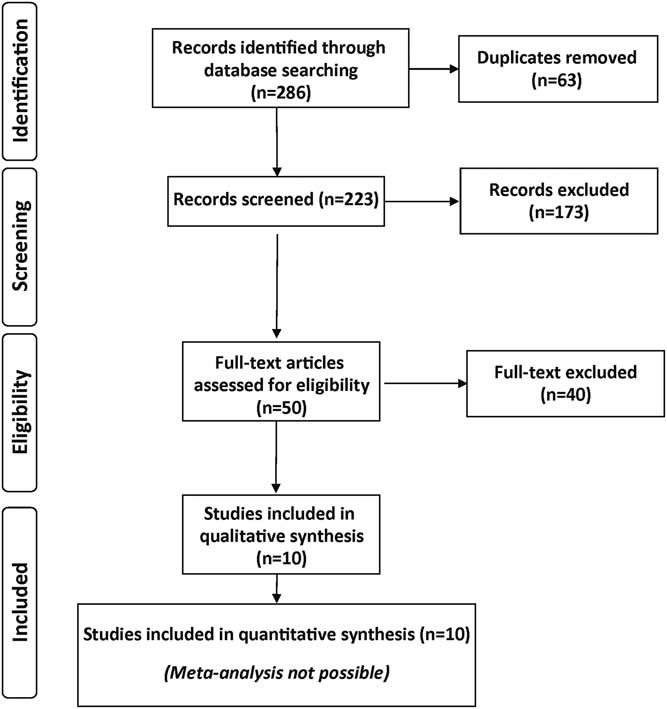
In agreement with the Preferred Reporting Items for Systematic Reviews and Meta-Analyses (PRISMA) Statement (Figure 1),Reference Moher, Liberati, Tetzlaff and Altman 4 a systematic review of the medical literature was carried out. PubMed database (National Center for Biotechnology Information; Bethesda, Maryland USA) was researched from 1999 until the end of 2014 using the key words “earthquake orthopedic,” “earthquake limb,” “earthquake hand,” “earthquake foot,” “earthquake spine,” and “earthquake pelvic.” After excluding the duplicates, two independent reviewers screened the identified articles for inclusions following the review of the abstracts. In case of disagreement, uncertain articles had been read in full to assess their relevance to the study. Eventually selected papers underwent a full-text reading in order for them to be included in the qualitative and quantitative synthesis. Data were collected into an Excel database (Microsoft Office for Mac 2011, Microsoft Corporation; Redmond, Washington USA). Original articles written in English, Italian, Spanish, or French reporting data about orthopedic injuries and their treatment in children (≤18 years old) during earthquakes were selected. Studies reporting injuries in both children and adults were included, as long as pediatric data could be easily identified. Single case reports, reviews, editorials, commentaries, and letters were not included. Articles written in other languages or dealing with a single type of injury or surgical procedure were also excluded. The study aimed to evaluate the incidence of orthopedic earthquake-related injuries in children: clinical features (fractures, dislocations, and/or soft-tissue damages) and body distribution of traumatic injuries, treatment performed (conservative or surgical and type of surgical procedures), length of stay, and possible complications. Another objective was the identification of starting points to define the standard of care for this population during earthquakes.
PRISMA Flow Chart. Abbreviation: PRISMA, Preferred Reporting Items for Systematic Reviews and Meta-Analyses.

Incidence and treatment of traumatic injuries occurring in districts having no orthopedic relevance (ie, head, thorax or abdominal traumas, and spinal cord lesions) lie outside of the study aim and were not considered.
Ethical Approval/Informed Consent
This report does not contain any studies with human participants performed by any of the authors. For this type of study, informed consent was not required.
Results
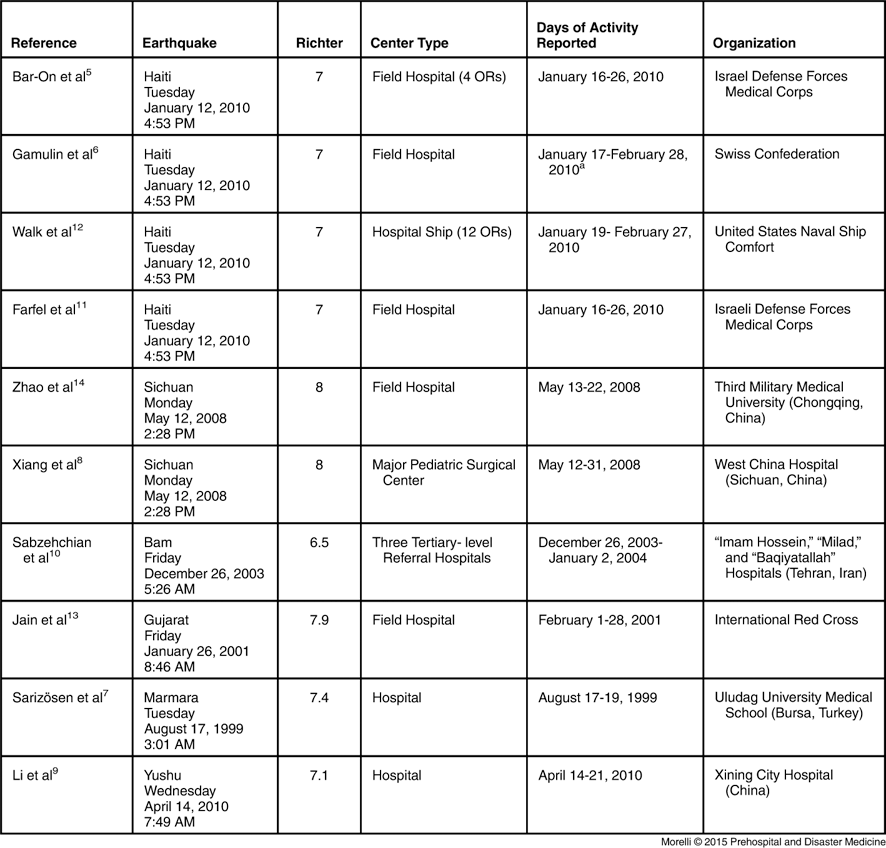
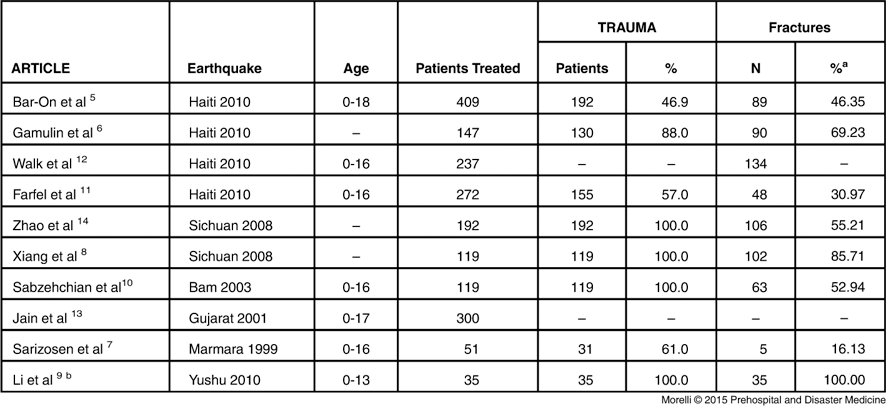
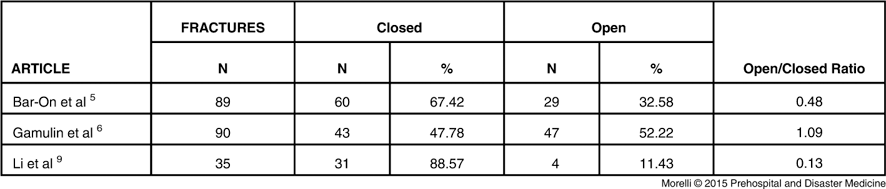
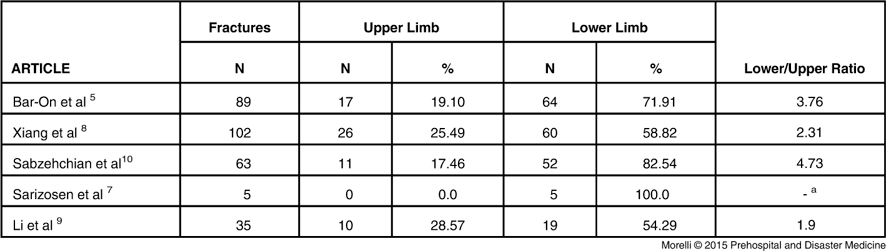
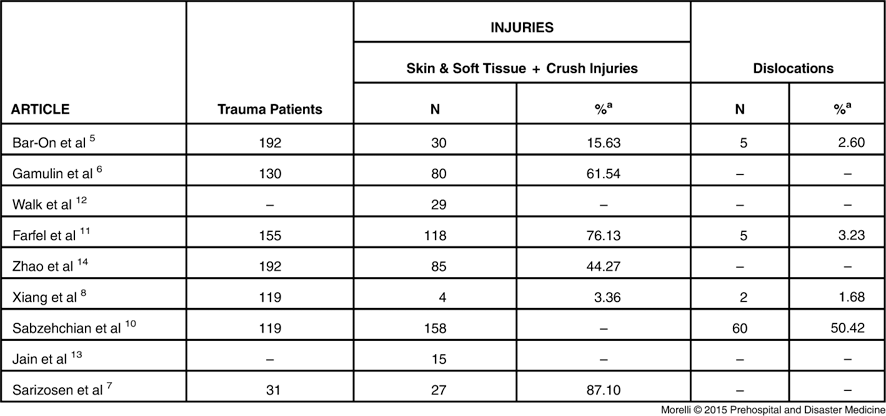
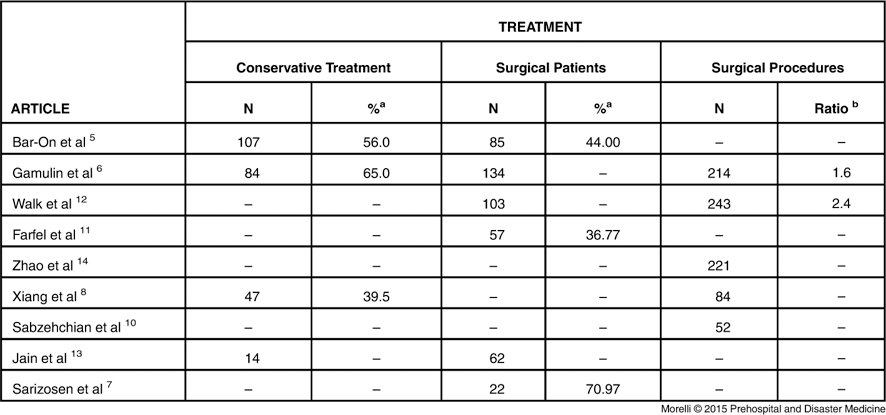
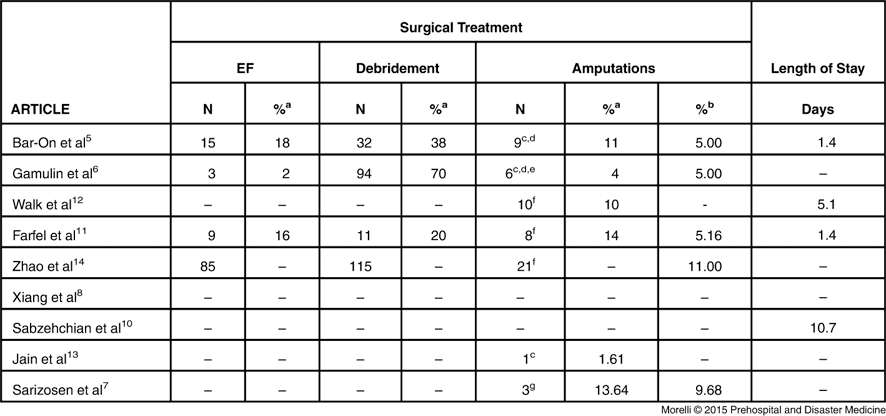
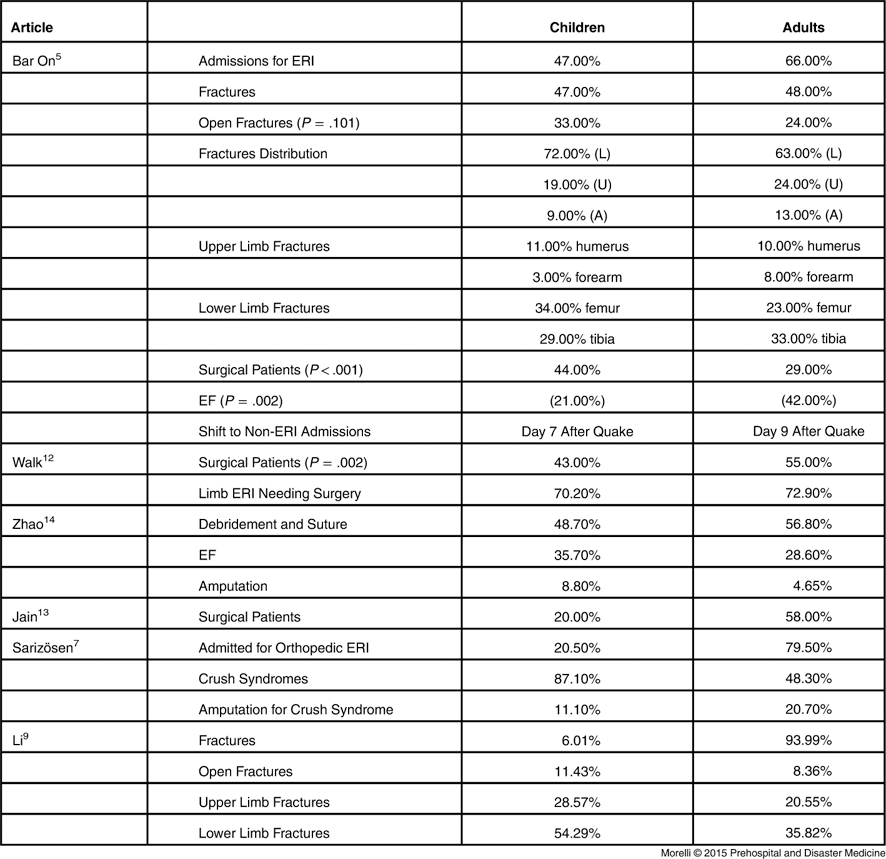
Two hundred and eighty-six papers were identified and screened. Ten were included in the quantitative analysis (Table 1). The percentage of children reaching field hospitals for a traumatic injury varied from 46.9% to 100.0% of the total pediatric admissions (Table 2).Reference Bar-On, Lebel, Blumberg, Sagi and Kreiss 5 , Reference Sarizösen and Durak 7 , Reference Sabzehchian, Abolghasemi, Radfar, Jonaidi-Jafari, Ghasemzadeh and Burkle 10 , Reference Farfel, Assa and Amir 11 The percentage of trauma-admitted patients suffering from fractures varied from 16% to 86% (Table 2).Reference Sarizösen and Durak 7 , Reference Xiang, Cheng, Liu, Huang, Li and Liu 8 Only three papers reported open fracture rate, counting up to 11%, 33%, and 52% of total fractures (Table 3).Reference Bar-On, Lebel, Blumberg, Sagi and Kreiss 5 , Reference Gamulin, Armenter-Duran, Assal, Hagon and Dayer 6 , Reference Li, Jiang, Chen, Yang, Wang and Wang 9 The open/closed fracture ratio differed in the reports, from 0.13 up to 1.09 (Table 3).Reference Bar-On, Lebel, Blumberg, Sagi and Kreiss 5 , Reference Gamulin, Armenter-Duran, Assal, Hagon and Dayer 6 , Reference Li, Jiang, Chen, Yang, Wang and Wang 9 Fractures involved lower extremities much more frequently than upper ones (from 54% to 83%, with a lower/upper limb ratio up to 4.73; Table 4).Reference Li, Jiang, Chen, Yang, Wang and Wang 9 , Reference Sabzehchian, Abolghasemi, Radfar, Jonaidi-Jafari, Ghasemzadeh and Burkle 10 In one study, all fractures were in lower limbs.Reference Sarizösen and Durak 7 Severe skin and soft-tissue injuries included crush injuries, burns, deep wounds, limb peripheral nerve or vascular lesions, muscular ruptures, and intramuscular hematomas. Children receiving these injuries ranged from 3% to 87% of the pediatric population admitted for trauma (Table 5).Reference Sarizösen and Durak 7 , Reference Xiang, Cheng, Liu, Huang, Li and Liu 8 Only four studies dealt with dislocations.Reference Bar-On, Lebel, Blumberg, Sagi and Kreiss 5 , Reference Xiang, Cheng, Liu, Huang, Li and Liu 8 , Reference Sabzehchian, Abolghasemi, Radfar, Jonaidi-Jafari, Ghasemzadeh and Burkle 10 , Reference Farfel, Assa and Amir 11 These injuries affected 2% to 50% of trauma-admitted patients (Table 5).Reference Xiang, Cheng, Liu, Huang, Li and Liu 8 , Reference Sabzehchian, Abolghasemi, Radfar, Jonaidi-Jafari, Ghasemzadeh and Burkle 10 However, neither their distribution nor their features were often specified. For instance, it was not detailed as to whether dislocations involved major or minor joints, as shoulder or interphalangeal joints, respectively. The exact ratios between surgical and conservative treatments were impossible to calculate. In fact, some studies reported the amount of surgical procedures performed, others recounted the number of surgical patients, possibly undergoing different procedures. This consideration barely has been confirmed by the “surgery-per-patient” ratio, equal to 1.6 and 2.4 in the only two studies from which this element was estimable (Table 6).Reference Gamulin, Armenter-Duran, Assal, Hagon and Dayer 6 , Reference Walk, Donahue, Sharpe and Safford 12 Notwithstanding, these data are poorly comparable and few studies expanded upon them: the number of surgical patients appeared to be superior to the amount of conservative treatments performed in two reports out of three (Table 6).Reference Bar-On, Lebel, Blumberg, Sagi and Kreiss 5 , Reference Gamulin, Armenter-Duran, Assal, Hagon and Dayer 6 , Reference Jain, Noponen and Smith 13 Beyond debridement, the most common surgical procedures were external fixations (EFs) and amputations (Table 7).Reference Bar-On, Lebel, Blumberg, Sagi and Kreiss 5 , Reference Gamulin, Armenter-Duran, Assal, Hagon and Dayer 6 , Reference Farfel, Assa and Amir 11 , Reference Zhao, Shi, Hu and Li 14 The amputation rate varied from 5% to 11% of children treated for a traumatic injury and from 4% to 14% of surgical patients (Table 7).Reference Bar-On, Lebel, Blumberg, Sagi and Kreiss 5 , Reference Gamulin, Armenter-Duran, Assal, Hagon and Dayer 6 , Reference Farfel, Assa and Amir 11 , Reference Zhao, Shi, Hu and Li 14 Indications for amputation included: non-viable limb or gangrene; severe infection or uncontrollable sepsis; extended bony and soft-tissue loss (ie, after crush injuries); and crush syndromes after a failed fasciotomy.Reference Bar-On, Lebel, Blumberg, Sagi and Kreiss 5 , Reference Gamulin, Armenter-Duran, Assal, Hagon and Dayer 6 , Reference Sarizösen and Durak 7 , Reference Jain, Noponen and Smith 13 The average length of stay in hospitals varied from 1.4 days to 10.7 days (Table 7).Reference Bar-On, Lebel, Blumberg, Sagi and Kreiss 5 , Reference Sabzehchian, Abolghasemi, Radfar, Jonaidi-Jafari, Ghasemzadeh and Burkle 10 , Reference Farfel, Assa and Amir 11 Table 8 reports the differences between children and adults concerning miscellaneous variables analyzed by each study.
Summary of the Studies Included in the Systematic Review

Abbreviation: OR, operating room.
a The data analyzed in this review refer only to the early period (January 17-26). The paper reports scarce data concerning the late period.
Patients, Trauma Patients, and Fractures

a Percent of trauma patients.
b This article exclusively reported data about trauma-admitted patients with fractures.
Open vs Closed Fractures

Fracture Distribution: Upper vs Lower Limb

a This article specifies data about lower limbs fracture only, and it is not relevant for upper vs lower limb fracture distribution computation.
Skin, Soft Tissue, Crush Injuries, and Dislocations

a Percent of trauma patients.
Conservative vs Surgical Treatment

a Percentage of trauma patients.
b Surgeries per patient.
Surgeries Performed and Length of Stay

Abbreviation: EF, external fixation.
a Percentage of surgical patients.
b Percentage of trauma patients.
c Indications for amputations: non-viable limb.
d Indications for amputations: uncontrollable sepsis/severe infection.
e Indications for amputations: crush injury with extended bone and soft-tissue loss.
f Indications for amputations: unknown.
g Indications for amputations: crush syndrome (after fasciotomy).
Children vs Adults (Comparisons)

Abbreviations: A, axial skeleton; EF, external fixation; ERI, earthquake-related injuries; L, lower limb; U, upper limb.
Discussion
These results suggest that children, as expected, often report fractures or other injuries of orthopedic relevance after an earthquake. Even so, today there are still no clear guidelines regarding treatments for children with orthopedic issues during earthquakes. If confirmed, the greater prevalence of lower extremity fractures found in this study is likely to influence the triage. During a disaster triage, in fact, a patient’s inability to walk conditions the emergency category to be selected.Reference Rigal and Pons 15 The great majority of lower limb injuries reduces the number of walking wounded and increases the number of children to be seen in urgency. This earthquake-related injury pattern differs significantly from everyday practice. Fractures in the upper limbs (especially radial, humeral, and clavicular fractures) are usually the most common in children.Reference Wilkins and Aroojis 16 The predominance of lower limb fractures during earthquakes likely are due to different injury mechanisms as opposed to everyday life (ie, impact against collapsing walls versus fall onto an outstretched hand). Unfortunately, the data about the number of exposed fractures have only been found in three articles.Reference Bar-On, Lebel, Blumberg, Sagi and Kreiss 5 , Reference Gamulin, Armenter-Duran, Assal, Hagon and Dayer 6 , Reference Li, Jiang, Chen, Yang, Wang and Wang 9 Open fractures are reported as more common than closed ones in only one of these papers.Reference Gamulin, Armenter-Duran, Assal, Hagon and Dayer 6 Nevertheless, the open fracture rate is higher than the 2.9% in the common practice.Reference Wilkins and Aroojis 16 This may be due to the different mechanisms of injury (ie, violent impact against falling debris). Moreover, the Gustilo and Anderson classification is never referred to.Reference Kim and Leopold 17 The use of this classification is encouraged in order to show the reader a more precise portrait of fracture gravity and infectious risk. Further studies are needed to verify these important elements. If confirmed, field hospitals should be enriched with a larger amount of external fixators. To this end, it is important to underline that EF is the most common surgery performed in these reports. Contrary to open reduction internal fixation, EF has evident advantages in an earthquake disaster scenario. Firstly, EF is the recommended treatment for Gustilo IIIB and IIIC fractures.Reference Cross and Swiontkowski 18 In a recent Médecins Sans Frontières (Geneva, Switzerland) report, use of EF lowered the amputation rate among open fractures, increasing the limb salvage rate.Reference Bertol, Van den Bergh and Trelles Centurion 19 Moreover, the typical hospital overcrowding caused by a disaster may benefit from shorter surgical times, leading to a more efficient “surgical treatment capacity.”Reference Taeger, Ruchholtz, Waydhas, Lewan, Schmidt and Nast-Kolb 20 A Damage Control Orthopedics strategy (similar to the one used for multiple trauma patients) may be safer than Early Total Care for these potentially complicated patients.Reference Taeger, Ruchholtz, Waydhas, Lewan, Schmidt and Nast-Kolb 20 Sepsis, hemorrhage (due to traumatic major amputations or vessel injuries), gangrene, compartmental syndrome, crush syndrome, and nerve injuries are described as possible complications.
Such a diverse amputation rate stresses how referring to guidelines is important to establish when this surgery should be recommended.Reference Knowlton, Gosney and Chackungal 21 Considering the majority of disasters affect low- and middle-income countries, after-amputation care is often missing in these settings.Reference Nickerson, Chackungal, Knowlton, McQueen and Burkle 22 , Reference Chu, Ford and Trelles 23 If there are no resources to face its physical and social complications (phantom limb pain, inability to work, and marginalization), an amputation may be a condemnation. Amputation should be the last resort, particularly when an adequate after-amputation care may not be guaranteed.
Few papers reported dislocations incidence; these appear less frequent than fractures. Scattered idle information has been found about pelvic and spinal fractures.
Miscellaneous comparisons (trauma admissions, injury patterns, surgeries, and others) were made between children and adults groups by six studies, with contrasting results (Table 8).Reference Bar-On, Lebel, Blumberg, Sagi and Kreiss 5 , Reference Sarizösen and Durak 7 , Reference Li, Jiang, Chen, Yang, Wang and Wang 9 , Reference Walk, Donahue, Sharpe and Safford 12 – Reference Zhao, Shi, Hu and Li 14 Nevertheless, open fractures seem to be more frequent in children than adults.Reference Bar-On, Lebel, Blumberg, Sagi and Kreiss 5 , Reference Li, Jiang, Chen, Yang, Wang and Wang 9 A possible reason is that children have less soft tissues than adults surrounding bones (and therefore less to protect them against strong impacts). Seemingly, children are slightly more prone to lower limb fractures compared to adults.Reference Bar-On, Lebel, Blumberg, Sagi and Kreiss 5 , Reference Li, Jiang, Chen, Yang, Wang and Wang 9 In one study, the femur was the most commonly fractured bone in children (P=.054).Reference Bar-On, Lebel, Blumberg, Sagi and Kreiss 5 Because all the earthquakes analyzed happened on weekdays, a possible reason may be found in the different daily activities for children and adults. For example, children are likely to sit at school during daily earthquakes, exposing their femoral diaphysis to falling debris. During the same earthquake, however, adults may sit or stand, depending on their job. Further studies are needed to confirm and explain these different results.
Limitations
Several limitations emerged from the analysis, affecting this review and making a meta-analysis impossible. First of all, when writing a review about a disaster, coping with non-standardized reports is a must. Several authors may report the information they subjectively consider useful. As a consequence, the level of evidence within these kinds of reviews may serve as inadequate. The definition of the pediatric age (for some authors extended from birth to 16 years of age, for others up to 18 years) varied within the reports. It was difficult to find an accurate percentage of pediatric patients out of all the earthquake victims. There was not a clearly defined timing of the health care activities described, without distinction between the early and late periods of the disaster. One study made this distinction, but reported epidemiological details concerning the early period only.Reference Gamulin, Armenter-Duran, Assal, Hagon and Dayer 6 Reports often neglected to declare the type of center (secondary/tertiary referral center) in which procedures took place. Therefore, correlations between injury type or treatment and disaster period or hospital type were impossible to estimate. It is important to emphasize the lack of data regarding antibiotic therapy and prophylaxis, post-surgical rehabilitation, complications, and after-amputation care. Indications for amputations are often not reported. Patients’ length of stay has never been correlated to their injuries or treatment. Few data were found about open fractures, dislocations, or pelvic and spinal fractures. The Gustilo and Anderson classification was never referred to. Moreover, papers did not report the number of either pelvic fractures causing hemodynamic instability or spine fractures provoking spinal cord involvement. Additionally, data were not homogeneous: some authors referred to the number of injured and treated patients, others to the number of injuries and treatments performed.
Conclusion
Papers often show few and dissimilar evidence, but at the same time, they reveal some interesting findings. Children cannot be studied in concert with adults as their condition for growth merits different medical and surgical needs. They differ greatly with regard to fractures epidemiology, injury mechanisms, fixation methods and techniques, healing time, and acceptable degrees of alignment after a reduction. Subjecting them to the same “orthopedic rules” used for adults would result in devastating consequences (malalignment, aberrant growth of long bones, angular deformities, and more). Considering the high rate of orthopedic patients among children with earthquake-related traumas, the presence of an orthopedic surgeon familiar with children traumatology strongly is suggested. Field hospitals and teams should be prepared and get resources to treat mainly lower extremities fractures in children. It is reasonable to conclude that EF should be encouraged, thus, a consistent amount of external fixators is required. However, more studies are needed to define a precise role for this technique. Moreover, further studies should evaluate if less-severe injuries, usually surgically treated, could be subjected to conservative treatments with fairly beneficial outcomes in order to limit ORs from overcrowding.
Acknowledgements
The authors are very grateful to Dr. Philip Oechsli for the English language editing of this manuscript.