

Introduction
What makes a theory critical? This question has been asked many times and yet, despite almost 25 years of research into the possibility of a critical security studies, it remains as relevant as ever. The debate around securitization theory’s critical status illustrates the importance of this question. Despite its inclusion into the canon of critical security studies,Footnote 1 securitization theory has been described as ‘elite-centric, discourse-dominated, conservative, politically passive, and neither progressive nor radical’,Footnote 2 leading to a tension between readings of securitization theory as a critical approachFootnote 3 and competing interpretations denying its critical status.Footnote 4 At the heart of these critiques lies what has been called the ‘security as silence’ problem,Footnote 5 that is, the realisation that a conception of security that relies on speech might exclude those actors who are not able to speak and voice their concerns.
Postcolonial theory has given IR scholars new perspective on the blind spots of putatively critical scholarship.Footnote 6 Re-examining the ‘silence-problem’ from this angle, this article shows how securitization theory sets up a definably colonial relationship whereby certain voices cannot be heard, while other voices try to speak for those who are silenced.
I show this ‘colonial moment’ in securitization studiesFootnote 7 in two steps. First, I examine the existing claim that securitization theory marginalises the subaltern,Footnote 8 a claim that is rooted in the idea of silence as speech act failure. I show that the current literature does not capture the full range of mechanisms through which this happens. I suggest there are in fact three: when the subaltern cannot speak, when the subaltern are not being listened to, and when the subaltern cannot be heard or understood. I call these mechanisms locutionary silencing, illocutionary frustration, and illocutionary disablement. I put forward in particular the third form of silence that occurs when the subaltern cannot be heard or understood due various types of disabling frames. Second, I demonstrate how, if the subaltern are marginalised, others have to step in: they have to speak and securitize ‘for’ them. This describes a second form of silencing that derives not from speech act failure, but from the imposition of securitizations ‘for’ onto the subaltern, from speaking security for them. Drawing on Gayatri Chakravorty Spivak, I highlight the colonial dimension of this move. In particular, I show how critical scholars intent on denouncing securitization theory’s marginalising effects are forced into a trap set up by securitization theory’s epistemological framework: in order to critique they have to do the very thing they are denouncing. Having shown that the ‘colonial moment’ in securitization studies is based on two main forms of silencing, each operating through a range of different mechanisms, I illustrate some of these points through a reading of the 2015/16 Cologne New Year’s Eve events. The relative ease with which white women were securitized and spoken ‘for’ in the aftermath of these events shows that the marginalising effects of securitization theory are just as relevant within a white ‘Western’ liberal space, thereby countering the current literature’s bias in locating the problems of silence and marginalisation solely with ‘brown’ people or in the ‘non-West’. Securitization theory’s ‘silence-problem’ derives from the structure of the theory itself, not from skin colour or from a specific geographical location.
Rereading securitization theory through a postcolonial lens shows that its ‘silence-problem’ is in fact more extensive and politically debilitating than previously assumed: it effectively reduces securitization theory to a form of ‘white man’s burden’. It also offers new insights about easily made connections in security studies and International Relations between criticality and philosophy of science. The analysis developed in this article shows that the recourse to a radical speech act epistemology does not automatically and unequivocally make a theory ‘critical’.
Revisiting the ‘silence-problem’: the three mechanisms of marginalisation in securitization theory
The critique of securitization theory’s so-called ‘silence-problem’ sits at the core of debates around its status as a critical approach to security. Securitization theory grounds our knowledge of the category ‘security’ in speech and discourse, which means that whomever cannot complete the required securitizing speech act is excluded from the concept of security and thus marginalised. In this section, I revisit the conceptual framing of existing critiques of silence, silencing, and marginalisationFootnote 9 and argue that, while important and insightful, they remain limited because they do not capture the full range of mechanisms through which securitization theory marginalises the subaltern. I argue that there are three different ways in which securitization theory does so: locutionary silencing, illocutionary frustration, and illocutionary disablement. Previous critiques of securitization theory have focused mostly on the first, and to a lesser degree the second, and fail to appreciate how all three work together to silence certain voices and in particular those of the ‘subaltern’.
Three types of marginalisation
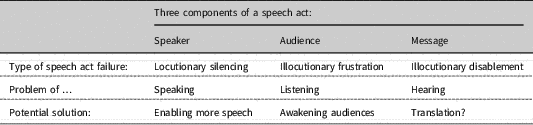
From a linguistic perspective, speech acts can fail in three different ways. Jennifer Hornsby and Rae Langton have explored and systematised speech act failure with regards to sexual assaults in their feminist critique of linguistics.Footnote 10 A gagged sexual assault victim who cannot speak is in a different situation from a victim who can voice his or her objections to a tormentor who chooses not to hear. A third circumstance arises when the assaulter hears the refusal but interprets it as consent.Footnote 11 Following Hornsby and Langton,Footnote 12 I suggest that there are three different ways in which securitization theory marginalises the subaltern: through locutionary silencing, through illocutionary frustration and through illocutionary disablement.Footnote 13 These three categories describe whether you can speak, whether they choose to listen to what you are saying, and whether anyone can actually hear and understand you (Table 1).
The three mechanisms of silence.

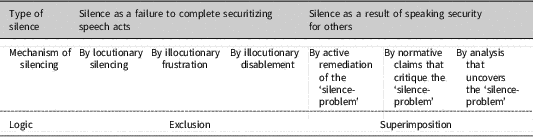
The colonial structure of securitization theory.

Locutionary silencing Footnote 14 happens when no speech is uttered at all, either because the speaker is physically impeded from talking, for instance by being gagged, or threatened with violence if they speak. For securitization theory, those who, like Hans Christian Andersen’s Little Mermaid, are threatened with death but cannot speak of it become excluded from the concept of security. This is the example given by Lene Hansen who looks at honour killings of women in Pakistan in her analysis of the ‘silence-problem’ within securitization studies.Footnote 15 Many Pakistani women cannot speak publically of the problems they are facing (for example, rape), because if they did so, they would be harmed or killed. The women in Hansen’s example cannot claim the concept of ‘(in)security’ to describe their experience, because they cannot speak. The category of locutionary silencing shows that securitization theory has marginalising effects: within its framework all those who cannot voice their concerns are excluded from determining what counts as security and what does not. They simply fall outside of security studies as securitization theory understands it.
Illocutionary frustration involves the unwillingness of the audience to take up the message. It happens when speech is uttered and understood, but ignored. For example, the UN Security Council’s refusal in 1994 to treat the events in Rwanda as ‘genocide’ could be read in this way. In that case speech had been uttered, pleading for an understanding of the events as genocide. The UN Security Council heard and understood the locutions. The point is that it refused the uptake and chose not to complete the speech act. This is the example given by Ken Booth who highlights that those who face a threat to their existence and speak, but do not have the power to make the audience listen, are equally excluded from the concept of security: ‘Those without discourse-making power are disenfranchised, unable to join the securitization game.’Footnote 16 While seemingly only rephrasing Hansen’s point,Footnote 17 Booth’s critique in fact reorients the analytical focus from the speaker’s muteness to the audience’s power to silence and exclude. The category of illocutionary frustration, thus, shows that securitization theory has marginalising effects: within its framework all those who cannot address a sufficiently powerful audience willing to listen to their concerns are excluded from determining what counts as security and what doesn’t.
Illocutionary disablement describes a situation where speech is uttered, but the audience fails to hear or understand the intended meaning because of specific ‘disabling frames’Footnote 18 distorting the message. The classical example within linguistics is that of the actor trying to warn about a fire, but tragically failing to do so because the audience takes it to be part of the play. These ‘disabling frames’ are epistemological structures that filter and shape our view of reality. They are ‘operations of power’Footnote 19 in that they foreground specific readings of reality and disappear others, thereby leading us to see – or in this case, hear – the world according to specific pre-scripted notions. In the case of Hornsby and Langton, pornography acts as such a disabling frame, but racism, misogyny, and various other forms of prejudice work in similar ways. Certain forms of repetition could also be imagined as ‘disabling frames’: if someone is known for regularly screaming ‘help’ for the fun of it, then their words are likely to be understood differently over time and not to trigger a response anymore – even in the event of real danger. Illocutionary disablement has not yet been explored by the existing securitization literature but is in fact crucial for understanding silence. In a world that is marked by a ‘[e]urocentric, patriarchal, neoliberal and secular international political culture’,Footnote 20 as well as by ascendant notions of white supremacy, the voices of all those who cannot or refuse to articulate their experience through that prism, risk being lost. The following three examples may serve as an illustration of the way in which securitizing attempts can be silenced through illocutionary disablement: ideology, conceptual vocabulary, and language difference.
Ideology or other powerful narratives can act as disabling frames. Sherene Razack’s account of the power that ‘narratives of innocence’ have in constituting white nation-states’ ‘official mythologies’ can be interpreted in that light.Footnote 21 Using the example of the Canadian peacekeeping mission in Somalia, she shows how, even with numerous media images, videos, and stories of the Canadian peacekeepers’ engagement in torture, violence, and cruelty during their mission abroad, the Canadian public reframed the message into a noble story of innocent Canadians bestowing civilisation upon the ‘savage’. In this case, a securitization of the events would be difficult within the Canadian context. Even when reaching the ears of the relevant public, securitizing moves would not be audible, because they would be distorted and disabled by the power of narratives of ‘goodness’ and ‘innocence’ of a specifically colonial sort.
The requirement for a specific conceptual vocabulary may act in similarly disabling ways. Postcolonial theory points to the dominance of liberal ideology and its corresponding vocabulary that articulates communicative encounters within the international sphere, and highlights its exclusiveness and its inextricability from power relations.Footnote 22 In order to be heard one must adopt ‘Western thought, reasoning and language’,Footnote 23 express one’s concerns with the given grammar and vocabulary, and have the capacity to do so in the first place.Footnote 24 With reference to transitional justice, Paul Gready highlights, for instance, how the original experiences of victims trying to make their claims heard typically get lost.Footnote 25 In order to be heard, they need to rework their stories in order to neatly fit into the categories and expectations established by transitional justice regimes. Following the same logic, attempted securitizations may simply not be heard or recognised for not using the right vocabulary.
Language difference, finally, may serve as third example of illocutionary disablement. Indeed, securitization theory has no resources to deal with language difference, because it is, like most of the discipline of linguistics, underpinned by the fiction of monolingualityFootnote 26 and assumptions of universality.Footnote 27 International relations, however, are carried out under a condition of hierarchical multilinguality, a fact that has received remarkably little attention within the discipline of IR and its linguistic turn.Footnote 28 Similarly, at a domestic level, most postcolonial states in the world are multilingual, as Sinfree Makoni notes for the African context.Footnote 29 Because language is politicalFootnote 30 and because different languages structure our thinking differently,Footnote 31 the language in which securitizations can be successful matters; one may try to securitize but fail to be heard for not using or not knowing how to use a hegemonic language.
The category of illocutionary disablement shows that securitization theory has marginalising effects: all those whose concerns cannot be heard or understood are excluded from determining what counts as security and what doesn’t.
Implications
Revisiting securitization theory’s ‘silence-problem’ has allowed me to systematise its marginalising effects according to three specific mechanisms of silence. Establishing such a typology not only highlights the complexity and the diversity of securitization theory’s marginalising effects, but also helps to map the existing critiques of securitization theory onto this grid. What this shows, is that most of the literature treats the ‘silence-problem’ as a problem of ‘speaking’, that is, through the lens of what I have dubbed ‘locutionary silencing’.Footnote 32
This is problematic: conceiving of silence only as a problem of speech implies that marginalisation results from ‘non-participation’. It suggests that silence results from the speaker’s disengagement in the process. Analysing silence only through the prism of speech means erasing the active role played by the speakers in many cases, disavowing their participation in the process or even denying their existence. One can be ‘silent’, however, while uttering words, loudly screaming and engaging in the speech act in a very real way, as the two cases of illocutionary disablement and illocutionary frustration show. These are cases where the subaltern makes securitizing or desecuritizing moves, but is just as incapable of completing the speech act of security as those who do not physically speak; the subaltern are silenced if not silent. Hence the necessity to move away from a sole focus on locutionary silencing and instead appreciate how all three mechanisms of silence work together in different ways to marginalise subaltern voices.
The ‘colonial moment’ in securitization studies
Having shown that the current literature deals with securitization theory’s problem of silence from a limited perspective, I now proceed to examine a key problem that both securitization theory and its critics are steeped in: the problem of securitizing ‘for’, of speaking security for others. This is the ‘colonial moment’ in securitization studies: if the subaltern are silenced in one of the three ways described above, then others must speak for their security problems. Putting words into the subaltern mouth is problematic as it buries those words under layers of representation and thus silences them further. In that sense, this section excavates a second form of silence in securitization studies: silence through speaking security for others.
Three types of securitizations ‘for’
Securitization theory structurally excludes the subaltern from claiming the label of (in)security for the issues they face through the three mechanisms of locutionary silencing, illocutionary frustration, and illocutionary disablement. By excluding them from accessing and completing securitizing speech acts, securitization theory simultaneously also opens up a space for others to securitize for the subaltern: if the subaltern cannot securitize, then others can or even ‘must’ do it for them. This move, which we may call a securitization ‘for’, can occur in three different ways: by political action designed to remediate or take advantage of the ‘silence-problem’, by normative claims intending to critique the ‘silence-problem’, as well as by mere analysis aimed at locating and uncovering the ‘silence-problem’.
The first form of securitization ‘for’, that is, political action designed to remediate or take advantage of the ‘silence-problem’, works in a straightforward way: if for example the Pakistani women of Hansen’s example cannot securitize the issues they face, then NGOs, networks of transnational activists or other powerful human rights advocacy groups can take political action and do it for them. The second and third forms of securitizations ‘for’, however, are less straightforward to understand. Why does a critique of securitization theory’s marginalising effects or even a simple diagnosis of the ‘silence-problem’ necessarily involve an act of securitization ‘for’?
Pointing to securitization theory’s silencing and marginalising effects involves showing that some part of the securitizing speech-act is disabled. Such an analysis, however, presupposes that the subaltern actually has a ‘security’ problem, that they cannot securitize it but that they should be able to. In short, even the well-meaning critic must stipulate ‘security’ before the successful completion of the speech-act. Within the speech act epistemology established by securitization theory, however, this is impossible, since security can only come into being and be known through the successful completion of a speech act.
This paradoxical situation can make better sense by going back to the ontological and epistemological basics of securitization theory. Three different levels need to be distinguished for this purpose: that of the securitization analyst, that of the securitizing actors, and that of the theory itself. Each of these levels operates with a different logic and is placed at a different position on the divide between objective and discursive epistemology. The securitization analysts use securitization theory in order to find out what counts as security. They identify, within discourse, which claims have been successful and can thus be counted as security. At this level, both the security ontology and epistemology are discursive. The securitizing actor and the securitizing audience, however, both operate with an objective conception of what security is. They read the world and make claims about what really constitutes a security issue, thereby competing with other actors’ interpretations of the world.Footnote 33 At the level of the theory, finally, the construction is a hybrid one: securitization theory is a half discursive, half objective construction. Indeed, it makes an objective claim as to what security is by fixing its form as exception and extraordinary measures. An issue becomes securitized when a securitizing actor declares that a referent object is threatened in an existential way and therefore extraordinary measures are necessary to ward it off. However, at the same time, securitization theory also operates with a discursive notion of security by leaving its specific content open for definition by the securitizing actors and audiences.Footnote 34
As the distinction between these levels makes clear, the securitization analyst cannot make any normative claims about what security should be, outside of what can be found in discourse.Footnote 35 When the securitization analysts do offer a normative critique and make claims about what security should be, they are forced to move from a discursive towards an objective conception of security and must thereby also shift from the role of a securitization analyst to the role of a securitizing actor. This means that no critique of securitization theory can be made on its own epistemological grounds. In order to critique, but even in order to point to a lack of securitization, one is forced to step out of the parameters offered by securitization theory: one must embrace an objective ontology and become a securitizing actor, that is, change levels in the model of securitization theory’s ontological and epistemological positioning. However, by engaging in the securitization process, one is thereby effectively securitizing ‘for’ the marginalised.
The silencing effects of securitizing ‘for’
Why is securitizing and thereby speaking ‘for’ the subaltern problematic? The problem associated with speaking ‘for’ the subaltern is that such a move easily ends up silencing the very people one tries to give a voice to – as laid out by Spivak.Footnote 36 Drawing on Marx’s distinction between ‘vertreten’ and ‘darstellen’, the crux of Spivak’s argument lies in a critique of an often-made conflation between the two meanings of representation as ‘speaking for’ (‘vertreten’) as in politics, and representation as ‘re-presentation’ (‘darstellen’) as in philosophy or art.Footnote 37 Spivak illustrates this by using the example of ‘sati’, an Indian practice of widow sacrifice abolished by the British during their occupation of India. Denouncing the practice as barbaric, the British declared the widows to be burned against their will and hence in need of saving, a position that Spivak presents as a case of ‘[w]hite men saving brown women from brown men.’ On the Indian side, however, as a move to resist the British colonial meddling, the opposite argument was being made in order to defend the practice of sati by contending that the sacrifice was made out of free will and that ‘the women actually wanted to die’.Footnote 38 Both the British and the Indian men were ‘speaking for’ and hence representing (‘vertreten’) the widows politically, but at the same time they were implicitly ‘re-presenting’ them (‘darstellen’), claiming to truthfully reproduce the women’s motivations, wishes and desires.
By conflating the two meanings of representation, the subaltern are further marginalised in two ways. The subaltern are silenced by the epistemic violence of essentialisation involved in the act of re-presentation. Indeed, the act of ‘re-presentation’ (darstellen) requires a definition of the re-presented group as homogenous, thereby negating its heterogeneity and erasing the complexity and diversity of the position and agency of its group members.Footnote 39 This is what Spivak criticises with regards to ‘sati’: if the women in question had been able to speak, we would probably have ended up with a multiplicity of different opinions and voices. Both the British and the Indian positions, however, reduce that complexity into one voice, casting the women in question as a homogenous group and committing thereby an act of epistemic violence.Footnote 40
The subaltern are further silenced by the complicity of the re-presenter in the re-presentation process. By ‘speaking for’ while at the same claiming to truthfully portray, the re-presenters cast themselves as transparent and thereby erase their own complicity in the process of re-presentation.Footnote 41 There is a gap between the re-presentation and the re-presented and in this inevitable gap lies what Roland Bleiker calls ‘the very location of politics’.Footnote 42 This is the space where the re-presenter’s own intentions, goals, and motivations slide in, almost unnoticed, but end up thickening the layer of re-presentation behind which the subject in question disappears even more effectively. In Spivak’s case of sati, the women’s voices get lost between the Indian anti-colonial agenda, served by a re-presentation of the women’s free will, and the British colonial agenda, served by a re-presentation of sati as oppressive and backward: ‘[b]etween patriarchy and imperialism, subject-constitution and object-formation, the figure of the woman disappears.’Footnote 43
Drawing on Spivak clarifies how securitizing ‘for’ the marginalised has silencing effects. This happens, because in order to speak ‘for’ them, the securitizer needs to homogenise and essentialise the securitized and ultimately runs the risk of superimposing his or her own voice and agenda onto them. Securitizations ‘for’ therefore represent a second form of silencing that stands next to the one explored in the previous section. Both work through different mechanisms: the form of silencing explored in the previous section results from a failure to complete securitizing speech acts and works through the mechanisms of locutionary silencing, illocutionary frustration, and illocutionary disablement; the form of silencing explored in this section results from the imposition of securitizing speech acts ‘for’ and works through the mechanisms of active remediation, normative critique, and mere analysis of the ‘silence-problem’. The first type of silence works through a logic of exclusion, whereby the subaltern are denied the possibility to claim the label of security to describe their issues; the second type of silence works through a logic of superimposition, whereby the subaltern are silenced because someone else’s voice speaks for them (Table 2).
Both forms of silencing derive directly from securitization theory’s epistemological set-up, that is, from locking security into discourse. Like two sides of the same coin, the form of silence resulting from the failure to complete a securitizing speech act and the form of silence resulting from the imposition of securitizing speech acts ‘for’ are intimately connected and reinforce each other: because the subaltern are silenced, others can speak for them; and because they are already spoken ‘for’, it becomes more difficult for the subaltern to securitize in the first place.
The colonial dimension of securitizations ‘for’
Securitizing ‘for’ the subaltern does not only have silencing effects, it also bears a colonial dimension. This derives from the epistemological set-up of the theory itself. Moving security to discourse creates a structure where the subaltern are first silenced and then can only be spoken for. Securitization theory’s ‘silence-problem’ thus reduces the theory to a form of ‘white man’s burden’.
Extant critiques of the ‘silence-problem’ occlude this structure of relations. To illustrate their point, they select examples of ‘brown’ subjects or case studies located outside the ‘West’: the silenced ones in Booth’s example are Rwandan,Footnote 44 those in Nicole Jackson’s analysis come from Central Asia,Footnote 45 in Monika Barthwal-Datta’s work they are Bangladeshi,Footnote 46 and the little mermaid in Hansen’s critique is brown. In doing so, they inadvertently make it appear as if the ‘silence-problem’ was an issue of skin colour or geographical location, instead of a structural feature of the theory itself. Locating silence, powerlessness and oppression abroad is a common colonial move, also in academia.Footnote 47 As Miriam Ticktin puts it, it is usually ‘they’, and not ‘we’, who are the subjects of violence.Footnote 48 In practice, Hansen’s gendered critique of securitization theory does not talk about the difficulties faced by little mermaids in general, but about the difficulties to securitize faced by brown little mermaids. In her analysis, the problem of silence is located abroad, as it is supposedly ‘less outspoken in the West’.Footnote 49 Arguing that women are silenced and oppressed abroad has also implications for domestic politics in the sense that it suggests that women at home need not be liberated because they already are free, thus potentially covering up domestic oppression and silencing their concerns.Footnote 50 In that sense, the existant analyses suggest that securitization theory’s silencing effects are limited to the ‘non-West’ and that ‘white women’ or for that matter anyone else in ‘the West’ faces no obstacles to translate their concerns into security. It further suggests that it is only outside ‘the West’ that the civil society is not fully democratic or the media not entirely free. Securitization theory’s silencing effects, however, are not confined spatially, but relevant globally, as shown all too easily by the struggles of Muslim communities in ‘the West’ to fight their securitization,Footnote 51 or the way in which ‘East Germans’ were silenced during the time of German reunification in the middle of a supposedly egalitarian public space and ‘captured in degrading, essentialising stereotypes not unlike those critiqued in the post-colonial literature’.Footnote 52
Securitizing ‘for’ someone across the international power divide is additionally problematic, as the act of re-presentation is inevitably loaded by the legacy of imperialism.Footnote 53 Transnational or postcolonial feminists like Valerie Amos and Pratibha Parmar, Marnia Lazreg and Chandra Mohanty expose the gendered aspects of these interactions.Footnote 54 In what they term to be ‘imperial feminism’, they critique white Western feminists’ claims to solidarity with women of colour, where ‘white women save brown women from brown men’. It is important to highlight the problematic nature of such securitizations ‘for’ that are colonial or imperial in the sense that they reproduce historical dynamics of domination and exploitation. However, this is a different argument than the one foregrounded in this article. I argue here primarily that we can talk of a colonial structure in securitization theory because of its double move of silencing the subaltern and forcing others to securitize ‘for’ them. This is a structural, not a historical point.
White women under attack!
In what follows I illustrate some of the silencing and marginalising effects of using securitization theory by drawing on the case of the 2015/16 Cologne New Year’s Eve events.Footnote 55
Commonly referred to as the ‘sex attacks’ of Cologne, the events of that night present themselves as follows: during the night of New Year’s Eve 2015/16, a high number of sexual offences and theft offences were committed in Cologne. The victims of these offences were almost exclusively women. According to the police, congregations of up to 1,000 people at a time were witnessed in areas around the central station. Most of these individuals were male, aged 15–35 and – based on their physical appearance – were deemed to be of Arab or North African origin. These young men were witnessed surrounding women, sexually harassing them, and in many cases also robbing them.Footnote 56 As to the extent of the events, the public prosecution authorities of Cologne disclosed that 1,054 complaints had been registered by 10 February 2016, almost half of which (454) concerned sexual assaults.Footnote 57 One striking characteristic of the New Year’s Eve events is the intensity reached by the public debate following it.Footnote 58 The wave of online outrage has been called ‘hysteria’,Footnote 59 or characterised as an ‘online mob’.Footnote 60 While the topics of this intensive public debate have revolved around the scale of the events, the question of whether or not the assaults were planned, the actions and previous knowledge of the police as well as the origin of the perpetrators,Footnote 61 a recurrent and dominant theme across social media, many politicians, conservative publicists, and normal users has been a strongly voiced concern about immigrants and the safety of German women. The ‘sex attacks’ in Cologne, they say, show that there is a problem with foreigners/Muslims/refugees and that one ought to be allowed to refuse them entry to one’s country.Footnote 62
When approached through the lens of securitization theory, the New Year’s Eve events could therefore be read as follows: in the aftermath of the New Year’s Eve celebrations, ‘male Muslim migrants’ were successfully securitized as a danger to ‘white German women’ and thereby to Germany.Footnote 63 As The Economist writes, ‘[a]fter Cologne, when Europeans think of refugees, many no longer picture persecuted families or toddlers. Instead they see menacing young men imbued with the sexism that is all too common across the Middle East and North Africa.’Footnote 64
Analysing the Cologne New Year’s Eve events through a securitization lens illustrates a case of marginalisation through illocutionary disablement. Two elements play a role here: the (in)ability of many ‘white German women’ and ‘male Muslim migrants’ to determine the outcome of the securitization process, and the role of sexism and racism as disabling/enabling frames in the process. The events in Cologne had such an impact, it has been suggested, because they sit at the intersection between sexism and racism.Footnote 65 The intersection of these frames played out in two contradictory ways, in a first stage disabling the securitization of the Cologne 2015/16 New Year’s Eve events, while in a second stage enabling the securitization of these same events. Indeed, in a first stage ‘sexism’ prevented the women who reported the events straightaway from being taken seriously,Footnote 66 while the fear of being considered ‘racist’ induced major nationwide newspapers and news outlets to remain silent about the events.Footnote 67 In a second stage, however, the events very soon became a massive social media phenomenon, and the role of racism and sexism changed. Sexism was reappropriated and reshaped in a very specific way by the frame of racism: ‘white German women’ were now the victims of sexual assaults after all – but only of assaults carried out by non-white ‘male Muslim migrants’, a reading that left ‘white male German’ perpetrators of sexual violence entirely out of the picture.Footnote 68 Here, ‘racism’ enabled their securitization, leaving aside the voices of those ‘male Muslim migrants’ who argued for a successful integration – including adaptation to German ‘sexual habits’.Footnote 69 Similarly, at this stage of the process, ‘sexism’ discredited the voices of those women trying to push against their securitization as helpless victims of lustful migrants.Footnote 70 The important point here is that the positions and experiences of many ‘white German women’ and ‘male Muslim migrants’ were not excluded from the dominant constructions because they were silent; they were excluded while loudly making their claims. As such they were silenced, not silent – a case of illocutionary disablement.
Analysing the Cologne New Year’s Eve events through a securitization lens also illustrates the problems attached to a securitization ‘for’: the silencing effects, the superimposition of a political agenda and the erasure of domestic problems.Footnote 71 The securitization of ‘male Muslim migrants’ is based on a radical generalisation from the perpetrators of Cologne to all other men looking similar,Footnote 72 thus essentialising them into a diffuse mass of sexually aroused foreigners, mainly described with animalistic vocabulary – ‘primates’, ‘apes’, ‘wild packs’.Footnote 73 In the case of the ‘white German women’, their securitization as referent object of security is tied to the narrative ‘black man rapes white woman’,Footnote 74 and is based on a generalisation of German women as being the helpless victims of foreign attacks – as epitomised by the title images chosen by SZ and Focus, two news outlets that both published pictures of naked white female bodies with black hands groping their bodies.Footnote 75 This homogenisation and essentialisation of ‘white German women’ and ‘male Muslim migrants’ is not only silencing, but also has two more specific implications. First, this diverts attention from domestic problems. In an interview, journalist Kübra Gümüsay comments that the concerns about women and migrants draw an idealised picture of German society and project their own sexism to the newly arrived.Footnote 76 This not only ‘outsources’ the problem, but also prevents a real debate about sexualised violence.Footnote 77 While the ‘white German woman’ is thus successfully defended against black threats, she remains available for abuse by the white man.Footnote 78 Second, the process of homogenisation and essentialisation opens up a space for the political interests of those engaged in it. Many highlight the hypocritical feminism of – mainly conservative – commentators who start caring about dangers to the equal status of women only when migrants are involved, especially if they are Muslim.Footnote 79 Such a co-optation of feminism for racist positions has been dubbed ‘Femonationalism’ and describes the use of feminist positions to justify an incompatibility between Islam and the Western values, or a reenactment of border for nationalist positions.Footnote 80
Analysing the Cologne New Year’s Eve events through a securitization lens also illustrates the way in which an application of securitization theory effectively disables the possibility for critique. Indeed, applying securitization theory to the case of the New Year’s Eve sexual assaults means that it becomes impossible for an analyst or third party observer to point to objective criteria in order to contest the securitization of ‘male Muslim migrants’ or ‘white German women’. They would not be able to use statistics showing the high numbers of sexual molestations against women both in Germany and in Europe,Footnote 81 or to highlight the fact that refugees are more often victims than perpetrators of sexual abuse and that they ‘were responsible for only 3.6% of the sexual offences in Germany in 2015’.Footnote 82 They would not be able to point to the fact that sexual violence and rape are more often a problem in private surroundings,Footnote 83 but that when they do happen in the public space such as during big public events like the Oktoberfest or carnival, they are to a large extent carried out by white German men.Footnote 84 Within the securitization framework, pointing to these events would turn the observer into a securitizing actor whose reference to objective ‘facts’ then constitutes an attempted securitization ‘for’ a marginalised group. As such they would have to make claims, for instance, about ‘white German women’ as not endangered, and ‘male Muslim migrants’ as not threatening – or, conversely, about ‘female Muslim migrants’ as endangered and ‘white male Germans’ as threatening – thereby leading to silencing effects similar to those described above. Because the sympathetic critics who become securitizing actors probably only do so in the first place in order to remedy the silencing effects of a securitization. They would run into the same type of problem they are trying to solve in the first place. The possibility to exercise critique is thereby effectively disabled. The result of this is that an application of securitization theory to the case of the 2015/16 Cologne New Year’s Eve events would congeal the construction of ‘male Muslim migrants’ as a security threat to ‘white German women’ into its current use, thereby reproducing the power dynamics leading to its construction in the first place.
Finally, an analysis of the Cologne New Year’s Eve events through the securitization lens also illustrates some of the colonial dynamics involved in deploying the theory. There are two different moments here. The first moment derives from the double dynamic of silencing and then speaking ‘for’ that makes up securitization theory’s colonial structure. As shown earlier, the mechanism of illocutionary disablement effectively silenced ‘German women’ by drawing on the disabling frames of racism and sexism. They were then spoken for, in particular by conservative positions keen on advancing their own politics. It is in that sense that the situation of the ‘German women’ is comparable to that of Spivak’s sati widows: the multiplicity of their voices and the complexity of their positions is lost between competing re-presentations mobilised for their own political purposes. The second colonial moment involved in deploying securitization theory derives from the way in which it taps into historically loaded legacies of colonialism. Historically, ‘white women’ have played an important role in justifying colonial practices. They were necessary in order to cast ‘black men’ as sexual predators and hence, as uncivilised.Footnote 85 In the case of the Cologne New Year’s Eve events, the securitizations ‘for’ German women reproduce these dynamics and thus also acquire a colonial dimension in this second, historical sense.
Conclusion: Can the subaltern securitize?
Can the subaltern securitize? The postcolonial rereading of securitization theory offered in this article foregrounds three different angles to answer this rhetorical question. First, and most obviously, the subaltern cannot securitize because they are structurally excluded from the concept of security – by locutionary silencing, illocutionary disablement, and illocutionary frustration. Second, the subaltern cannot securitize because they are always already being securitized and spoken for – as in this case by the ‘well-intentioned intellectual[s]’Footnote 86 trying to highlight and remediate the subaltern predicament. Finally, I would like to suggest in this conclusion, the subaltern cannot securitize because the popular rendering of securitization theory as critical obfuscates and rationalises their marginalisation. Ultimately, it perhaps does not matter that much whether securitization theory truly is critical or not. What matters, however, is its official labelling as such and its inclusion into the critical security studies canon. This inclusion is not innocent: by presenting the subaltern marginalisation as part of a ‘critical’ project, they are truly silenced and critical security studies becomes complicit in this move.
One insight gained from re-examining the existing critiques of securitization theory’s ‘silence-problem’ concerns the question of whether securitization theory is salvageable or not. The existing critiques have assumed that a solution to the ‘silence-problem’ is feasible and a critique of it indeed possible. Where silence and marginalisation are conceived as a problem of listening, they have encouraged listening more, for example, by creating or ‘awakening audiences’.Footnote 87 Where silence and marginalisation are conceived as a problem of speech, they have suggested enabling more speech, for example, by bringing in the body and images as forms of non-verbal communication.Footnote 88 Such efforts, however, are limited because they have not taken into account the full range of mechanisms through which the subaltern are prevented from completing securitizing speech acts. Bringing in visuality, for example, as a way to increase the range of expression available to the subaltern, at best only remediates forms of locutionary silencing, but does not help in situations of illocutionary frustration or illocutionary disablement where the problem lies either with the audience or with a distortion of the securitizing message. This is where an understanding of the full range of securitization theory’s marginalising effects might be of help: when all three mechanisms of silence are considered at the same time and understood as working together in marginalising the subaltern, then perhaps the problem of silence resulting from speech act failure can be addressed. Despite this carefully optimistic note, the potential solutions for each type of silence remain limited in their own way. In cases of locutionary silencing, a focus on the body and on images is of no help when speech is not possible either verbally or non-verbally.Footnote 89 In cases of illocutionary frustration, creating and awakening new audiences might remain ineffective in those cases where only a particular audience could complete the securitizing speech act.Footnote 90 In cases of illocutionary disablement where silence is the result of a problem of hearing, one might consider translation as a possible solution.Footnote 91 As the abundant postcolonial literature on translation suggests, however, acts of translations remain necessarily limited and are interwoven with difficult power dynamics.Footnote 92 A translation can only ever be an imperfect account of the original. This is particularly problematic when the translation is from a subaltern to a hegemonic position: here the translation can only be understood by the hegemon if it is framed and phrased in the logic of its own language, thereby violently transforming and adapting the subaltern position. Conversely, if the translation remains too close to the original, it runs the risk of failing to make it intelligible at all. In addition to those limitations, trying to salvage securitization theory in this way is also problematic: not only does it fail to address forms of silence resulting from superimposing security speech onto others, but it runs the risk of reinforcing these dynamics. Any attempt at recuperating securitization theory must acknowledge this problem and find a way to deal with it.
Finally, the re-examination of securitization theory’s ‘silence-problem’ in this article also complicates superficial assumptions about the relations between philosophy of science and criticality that still pervade the disciplines of security studies and International Relations more generally. These likely derive from International Relations’ specific disciplinary history. Indeed, in the context of a discipline deeply concerned with its scientific status,Footnote 93 turning to the philosophy of science and interrogating the foundations and origins of the discipline’s knowledge has been an effective tool of critique in the past. By asking the ‘how do you know what you know’ question, critical approaches to International Relations have used epistemology as a powerful angle of attack against the mainstream. Much of the critical work in IR has therefore been articulated in opposition to and rejection of the discipline’s mainstream objectivism, tightly building critical IR around epistemological self-reflection,Footnote 94 thereby leading to a common equation of radical epistemology with criticality.Footnote 95
The rereading of securitization theory offered in this article complicates this assumption by showing that the relation between a radical epistemology and criticality is an ambivalent one, where no clear connection can be drawn between the two. On the one hand, the analysis in this article has shown that the main reason behind securitization theory’s ‘silence-problem’ lies in its specific epistemological choice to locate security within speech act theory. Regarding this move, it is important to note that speech act theory per se is not the culprit here. The idea of speech acts or subaltern speech can be used to critical effect.Footnote 96 When a female resistance agent commits suicide while menstruating,Footnote 97 or when peasants use strategies such as ‘foot dragging, dissimulation, desertion, false compliance, pilfering, feigned ignorance, slander, arson, sabotage, and so on’Footnote 98 as forms of everyday resistance, then these acts carry a political significance. They can be read as the subaltern ‘voice’ and doing so can serve a critical purpose. These forms of ‘speech’, however, are very different from the securitizing speech acts examined in this article. By locking the very existence of security into a specific type of speech acts, ‘security speech’ becomes unattainable for the subaltern. At the same time it makes their own forms of speech and resistance available to academics, activists, and politicians alike to re-present it for their own purposes by securitizing ‘for’ them. While the problems of silence I highlight in this article therefore derive from speech act theory, they do so because securitization theory mobilises it in a very particular way by casting the epistemology of security into that specific mould, not because speech act theory is in and of itself problematic.
On the other hand, however, these same ontological and epistemological choices to locate security within speech act theory have also led to its inclusion in the canon of critical security studies. Indeed, it is securitization theory’s move to discourse that has led to its inclusion into that canon because it helps reveal ‘the politics of security’ and thus enables potential desecuritizations.Footnote 99 While the application of securitization theory onto the example of the 2015/16 Cologne New Year’s Eve events illustrated some of its politically debilitating effects, such an application could also be used to show some of its ‘critical’ aspects. Applying securitization theory to the case of the 2015/16 Cologne New Year’s Eve events could help denaturalise the obviousness of ‘male Muslim migrants’ as threats and ‘white German women’ as endangered objects. It would highlight the socially constructed nature of these categories, focus on the historically contingent political process underwriting their construction and explore some political consequences of that move, thus potentially enabling their desecuritization.
Securitization theory’s choice for a radical security epistemology therefore provides the grounds for its inclusion into the critical security canon while also causing the problematic dynamics of marginalisation and silencing highlighted in this article. Paradoxically enough, securitization theory’s philosophy of science position thus gives the theory its ‘critical’ edge, while simultaneously also undermining this same ‘critical’ potential. This paradox derives to a certain extent from competing understandings of the meaning of ‘criticality’, with proponents of securitization theory’s critical nature implicitly adopting a wide interpretation of the termFootnote 100 while contestations of its ‘critical’ dimension rely on a much narrower tradition of understanding.Footnote 101 However, this does not diminish the paradox’s power to draw attention to the ambivalent relation between radical epistemology and criticality, showing that no clear connection can be drawn between the two. Just as forms of objectivism can be mobilised for critical purposes,Footnote 102 more radical epistemologies can work against it: a particular epistemological stance or philosophy of science position therefore does not in and of itself make a theory critical.Footnote 103
Acknowledgements
For their helpful comments on earlier drafts of this article, I thank the editors and anonymous reviewers of the European Journal of International Security, as well as Tarak Barkawi, George Lawson, Christopher Murray, Joanne Yao, and Dirk Janssen. Different versions of this article were presented at the LSE IR Theory workshop in 2016, at BISA in 2016, and at the HTIR workshop in Groningen in 2018. I wish to thank all the participants for their helpful questions, comments, and suggestions.
Sarah Bertrand is a PhD Candidate and Graduate Teaching Assistant in the International Relations department at the London School of Economics and Political Science (LSE). She is also an editor of Millennium: Journal of International Studies, vol. 46.