Introduction
Today's organizations face a rapid change in workplace dynamics. Work relationships are more socially and politically driven and it is of paramount importance that in addition to their abilities and performance, organizational members possess a keen understanding of these aspects of organizational life (Meurs, Gallagher, & Perrewé, Reference Meurs, Gallagher and Perrewé2010). Political skill (PS) is one such construct which has caught the attention of researchers as an effective tool and an utmost important competency to survive effectively in the social and political landscapes of organizations (Ferris et al., Reference Ferris, Berkson, Kaplan, Gilmore, Buckley, Hochwarter and Witt1999; Mintzberg, Reference Mintzberg1985). The predominant view of PS characterizes it as an interpersonal effectiveness construct that subsumes a keen situational analysis with the ability to calibrate behavior in an apparently forthright manner, according to the situational demands (Ferris, Treadway, Perrewé, Brouer, Douglas, & Lux, Reference Ferris, Treadway, Perrewé, Brouer, Douglas and Lux2007; Kimura, Reference Kimura2015; Zellars, Perrewé, Rossi, Tepper, & Ferris, Reference Zellars, Perrewé, Rossi, Tepper and Ferris2008). Politically skilled people are equipped to make adept use of these capabilities to exert effective influence over their counterparts to achieve their personal and/or organizational goals.
The extant literature on PS reveals that there is a conceptual divide in the way it has been characterized by two competing perspectives. The first perspective is inspired by Mintzberg (Reference Mintzberg1983, Reference Mintzberg1985) and Pfeffer's (Reference Pfeffer1981) independent and parallel studies, rooted in the domains of power and politics. Mintzberg (Reference Mintzberg1983, Reference Mintzberg1985), stressing on the political nature of organizations, stated that organizational members need to have some special skills to execute political behaviors effectively. Bolstering the same view, Pfeffer (Reference Pfeffer1981) also stressed upon the paramount importance of PS in effective portrayal of one's behavior in workplace. Keeping in view the importance of PS to progress in the political milieu of organizations, it is important to note that the scholarly work on organizational politics is inspired by two divergent views. While one view of organizational politics, as articulated by Fedor, Maslyn, Farmer, and Bettenhausen (Reference Fedor, Maslyn, Farmer and Bettenhausen2008), acknowledges its functional role in the career path of an individual, the other predominant view of organizational politics characterizes political behaviors as self-furthering, dishonest, and manipulative acts that circumvent the formal systems of an organization and aim to strengthen the power bases to get hold of workplace resources (Harris, Andrews, and Kacmar, Reference Harris, Andrews and Kacmar2007; Vigoda, Reference Vigoda2002; Vigoda-Gadot and Talmud, Reference Vigoda-Gadot and Talmud2010). Hence, it could be reasonably conjectured that PS (as a skillset to execute political behaviors) and political behavior (as its execution) are intertwined and interlinked concepts and share the dual nature of organizational politics in the form of good and bad politics.
Subsequent to the abovementioned pioneering studies of Mintzberg (Reference Mintzberg1983, Reference Mintzberg1985) and Pfeffer (Reference Pfeffer1981), the impetus for further research on PS was provided by Ferris et al. (Reference Ferris, Treadway, Kolodinsky, Hochwarter, Kacmar, Douglas and Frink2005, Reference Ferris, Treadway, Perrewé, Brouer, Douglas and Lux2007), who presented a more neutral approach when compared with its earlier conceptualization by Pfeffer (Reference Pfeffer1981) and Mintzberg (Reference Mintzberg1983). Ferris et al. (Reference Ferris, Treadway, Kolodinsky, Hochwarter, Kacmar, Douglas and Frink2005) framed it in a more positive light and defined it as a resource that helps achieve personal and organizational objectives in ways that are functional to both the individuals and their organizations. Hence, implicit in their view of PS is the aspect that refers to a more legitimate and socially acceptable means of achieving one's objectives. In line with this view of PS, a large stream of research on this construct owes its development to this in-depth theoretical foundation laid by Ferris et al. (Reference Ferris, Treadway, Kolodinsky, Hochwarter, Kacmar, Douglas and Frink2005, Reference Ferris, Treadway, Perrewé, Brouer, Douglas and Lux2007) [for latest reviews, see Munyon, Summers, Thompson, and Ferris (Reference Munyon, Summers, Thompson and Ferris2015); Kimura (Reference Kimura2015)]. Moreover, since the time PS was operationalized as political skill inventory (PSI) by Ferris et al. (Reference Ferris, Treadway, Kolodinsky, Hochwarter, Kacmar, Douglas and Frink2005), there has been a surge of scholarly work focusing primarily on its functional nature with serious neglect toward its equally important dark side as implied by its earliest conceptualization.
In view of the above discussion, we assert that the prevalent, limited view of PS leaves us ill-informed about its equally important second nature and hence we lack a deeper understanding of its effects on a broader gamut of associated organizational outcomes. Moreover, in addition to highlighting the importance of PS as a critical social skill, researchers lay strong emphasis on honing employees' PSs through various training and mentoring programs in organizations (Ferris, Perrewe, & Douglas, Reference Ferris, Perrewe and Douglas2002). Therefore, we argue that given the dual nature of PS, researchers and practitioners cannot appreciate its full scope unless they are fully cognizant of its equally potent negative aspect and its possible nefarious effects.
This study aims to fill this gap by conceptualizing and testing a framework that empirically validates the untested notion of the dark side of PS. Considering both competing views of PS as two sides of the same coin, we demonstrate that besides having a functional aspect, this competency has an equal potential to goad a person toward achieving selfish objectives in the form of self-serving counterproductive work behaviors (SSCWB). This argumentation involves answering two major questions as ‘how’ and ‘when’ PS can elicit dysfunctional behaviors. The primary focus of this study is to investigate the ‘when’ aspect by delving into the contextual factors that provide a conducive environment for the execution of its negative side. For this, we borrowed insights from the trait activation theory (Tett & Burnett, Reference Tett and Burnett2003) to demonstrate that the dark side of PS comes into play through its interaction with certain trait relevant contextual conditions. Explaining it the other way, as politically skilled people are situationally astute and flexible enough to mold their behavior in the most situation specific way (Ferris et al., Reference Ferris, Treadway, Perrewé, Brouer, Douglas and Lux2007), they will exercise the negative side of PS only in contexts which they assess to be the most relevant and rewarding situations for the demonstration of the negative side of PS in the form of self-serving counterproductive behaviors.
This study offers several significant contributions to help extend the body of knowledge in the domains of PS and counterproductive work behaviors (CWB). The most significant contribution this study claims in the domain of PS, in specific, and organizational politics, in general, is to empirically test the previously untested notion of the dark side of PS. In this regard, it is the first study, to date, which conceptualizes and tests a model of the dark side of PS. Moreover, researchers lay heavy emphasis on the need to explore the relationship between PS and negative discretionary behaviors with the boundary conditions that discourage or facilitate its use (Munyon et al., Reference Munyon, Summers, Thompson and Ferris2015). Our study heeds these calls by investigating the relationship between PS and self-serving counterproductive behaviors, with perceptions of organizational politics (POP) as an important boundary condition.
Second, another important theoretical contribution this study makes is providing the basis for examining contextual variables as an integral part of the investigation of PS as a self-serving device. It is important to mention that the theoretically assumed positive effects of PS have been mainly investigated as direct relations (Kimura, Reference Kimura2015), with little attention to the context (Blickle, Wendel, & Ferris, Reference Blickle, Wendel and Ferris2010). Moreover, given that PS reflects both the good and bad sides of organizational politics, it is all the more important to explore which contextual conditions are particularly relevant in bringing out the functional or dysfunctional traits of PS. Hence, by highlighting organizational politics as a trait relevant situation for demonstration of the dark PS, this study extends the trait activation theory (Tett & Burnett, Reference Tett and Burnett2003) in the domain of PS to have a more nuanced understanding of its link with negative organizational outcomes.
Third, the current study also makes a significant addition in the domain of CWB by conceptualizing and operationalizing a scale for self-serving counterproductive behaviors. It is important to note that the available CWB scales have been criticized for not covering a broader domain of negative behaviors (Bowling & Gruys, Reference Bowling and Gruys2010). Moreover, researchers claim the ‘one fit to all’ measures for CWBs might fall short of capturing behaviors which are different in their nature and manifestation from the CWBs measured by commonly available scales. It is exactly this gap which the present research addresses by developing and validating a scale for self-serving CWB as a distinct category of negative behaviors, in terms of their manifestation and scope.
Finally, the existing body of knowledge on CWB asserts that the prime antecedents of these behaviors are mainly in the forms of adverse events or negative emotions, elicited at the personal or organizational level (Fida, Paciello, Tramontano, Fontaine, Barbaranelli, & Farnese, Reference Fida, Paciello, Tramontano, Fontaine, Barbaranelli and Farnese2015). By drawing the researchers' attention to the fact that PS (besides being primarily an interpersonal skill) may act as a prime antecedent to perpetrate counterproductive acts, this study opens up further avenues in the investigation of personal and contextual factors that might act as forerunners of CWB but are not negative in nature.
Theoretical Background and Hypothesis Development
Political skill and its self-serving side
Shi, Johnson, Liu, and Wang (Reference Shi, Johnson, Liu and Wang2013) noted that the rapidly changing dynamics of today's workplace emphasize the fact that conventional notions of a person's ability in the form of technical superiority and knowledge are not sufficient to achieve success in organizations. In addition to this, as Ferris et al. (Reference Ferris, Treadway, Perrewé, Brouer, Douglas and Lux2007) suggested, a large part of organizational success is determined by how individuals position themselves socially and politically in their workplaces. Given this political nature of organizational life, Mintzberg (Reference Mintzberg1985), in his seminal work on power and politics, stressed on the fact that to navigate effectively through the ‘political arenas’ of organizations, people need to have some special skills. These notions were also discussed and elaborated upon in a parallel and independent stream of work by Pfeffer (Reference Pfeffer1981), who was the first person to coin the term ‘political skill’ for these special skills that Mintzberg (Reference Mintzberg1983) later mentioned in his work. It is, thereby, important to note that both these seminal studies converged on a common theme in the conceptualization of PS and characterized it as an effective tool for the execution of political behaviors that are viewed by a dominant stream of organizational politics literature as self-serving, manipulative, and divisive acts that are not sanctioned by formal systems of an organization (Ferris, Russ, and Fandt, Reference Ferris, Russ, Fandt, Giacalone and Rosenfeld1989; Harris, Andrews, and Kacmar, Reference Harris, Andrews and Kacmar2007; Mayes and Allen, Reference Mayes and Allen1977; Vigoda-Gadot and Talmud, Reference Vigoda-Gadot and Talmud2010). Based on this key aspect of political behavior, it seems logical to assume that a construct, representing the ability to engage in political behavior should also reflect a dishonest and deceptive nature of organizational politics.
After the aforementioned conceptualization by Mintzberg (Reference Mintzberg1983, Reference Mintzberg1985) and Pfeffer (Reference Pfeffer1981), Ferris et al. (Reference Ferris, Treadway, Kolodinsky, Hochwarter, Kacmar, Douglas and Frink2005) reconceptualized and operationalized the construct of PS after two decades. It is interesting to note that contrary to its earlier conceptualization as a skill, imperative to the execution of manipulative and self-furthering political behaviors, its theoretical and empirical development by Ferris et al. (Reference Ferris, Treadway, Kolodinsky, Hochwarter, Kacmar, Douglas and Frink2005, Reference Ferris, Treadway, Perrewé, Brouer, Douglas and Lux2007) framed it by taking a more neutral view. According to them, it is an interpersonal skill, which is marked by a good diagnosis of a situation and is followed by a person's ability to calibrate their behavior accordingly to achieve their personal and organizational objectives. Therefore, their characterization of PS primarily reflects the functional side of organizational politics which associates PS with the achievement of objectives in a socially desirable manner that are functional for the individuals possessing them and their organizations.
Ferris et al.’s (Reference Ferris, Treadway, Kolodinsky, Hochwarter, Kacmar, Douglas and Frink2005) groundbreaking work led to the accumulation of a decent volume of work that was built upon the functional view of PS and highlighted its effects in the form of greater job satisfaction, good performance ratings by supervisors, better task and contextual performance, greater career success, and improved personal reputation (Munyon et al., Reference Munyon, Summers, Thompson and Ferris2015). Hence, based on the extant literature on PS, it is evident that PS has been predominantly framed as a positive attribute. There is also an extensive discussion in Ferris et al. (Reference Ferris, Treadway, Perrewé, Brouer, Douglas and Lux2007) study about how employees may be trained to possess higher PS as well as a suggestion toward hiring politically skilled candidates in jobs.
The above discussion leads us to believe that in terms of influence tactics to obtain the personal objectives and resources, the characterization of PS is inspired by two competing, yet parallel, streams of research. While one stream of research highlights its legitimate and socially acceptable side to achieve objectives, the other stream focuses on its subversive and socially unacceptable side. Given the dichotomy in the nature of political activity, it is evident that the prevailing view of PS falls short of reflecting its dysfunctional and self-furthering side. The only exception to this claim is a handful of studies in the current stream of literature that caution against its generally accepted positive view. For example, in his comprehensive review on PS, Kimura (Reference Kimura2015) inferred that very high levels of PS may lead to detrimental effects, thereby making a proposition quite contrary to the fundamental assumptions of its functional role. He also stated that in the absence of necessary organizational controls, politically skilled managers might use this skill to further their self-serving goals at the cost of organizational good. Furthermore, certain aspects of PS have been found to be overlapping with construct Machiavelli in a study undertaken by Brouer, Duke, Treadway, and Ferris (Reference Brouer, Duke, Treadway and Ferris2009). Additionally, its negative use to promote personal gains has also been hinted at in the work of Brouer, Harris, and Kacmar (Reference Brouer, Harris and Kacmar2011). However, it is noteworthy that none of these studies have provided any empirical or conclusive evidence to supplement these assertions and the notion of the dark side of PS continues to remain underdeveloped. Hence, we assert that being a competence with a dual nature, whether or not PS produces a functional outcome will depend on the person's motivation and the latitude provided by the context (Kapoutsis, Papalexandris, Treadway, & Bentley, Reference Kapoutsis, Papalexandris, Treadway and Bentley2017). The current study leaves the motivational aspect open for debate and focuses primarily on the contextual aspect.
Given the situational understanding and the flexible nature of politically skilled persons, it is logical to postulate that context plays an extremely important role in the predictive ability of PS. Drory and Vigoda-Gadot (Reference Drory and Vigoda-Gadot2010, p. 198) reinstated this view by arguing that, ‘While the level of political skill is primarily an individual quality, the inclination to use its selfish vs functional side may depend on social and cultural factors.’ Borrowing insights from trait activation theory (Tett and Burnett, Reference Tett and Burnett2003), the current study investigates POP as an important trait relevant factor that serves as an impetus to activate the negative side of PS in the form of SSCWB.
Self-serving counterproductive work behaviors
Penney and Spector (Reference Penney and Spector2005) explained that CWB are commonly known phenomena in organizational life. Due to their deleterious effects in the form of potential harm to organizational reputation, increased turnover, ramification costs, and property loss (Bowling and Gruys, Reference Bowling and Gruys2010; Robinson and Bennett, Reference Robinson and Bennett1995; Spector and Fox, Reference Spector, Fox, Fox and Spector2005; Vigoda, Reference Vigoda2002), they pose a serious threat to the well-being of organizations and their members (Fox, Spector, & Miles, Reference Fox, Spector and Miles2001; Penney & Spector, Reference Penney and Spector2005; Vardi & Wiener, Reference Vardi and Wiener1996).
Besides the two overarching categories of CWB toward organization and CWB toward individuals as outlined by Gruys and Sackett (Reference Gruys and Sackett2003), research documents a number of subcategories of these behaviors according to their nature and severity (Robinson and Bennett, Reference Robinson and Bennett1995; Sackett, Reference Sackett2002). Most of the commonly available scales of CWB measure these subcategories under the domains of theft, aggression, violence, sabotage, substance abuse, and absenteeism (Griffin & Lopez, Reference Griffin and Lopez2005; Gruys & Sackett, Reference Gruys and Sackett2003; Martinko, Gundlach, & Douglas, Reference Martinko, Gundlach and Douglas2002; Robinson & Bennett, Reference Robinson and Bennett1995). However, Bowling and Gruys (Reference Bowling and Gruys2010) observed that the available scales do not capture a complete domain of such behaviors. They further stated that the research on CWB is heavily dependent on ‘one-size-fits-all’ scales that do not reflect a broad range of contextual variations in organizational behaviors. In an attempt to address these concerns, the current study aims to conceptualize and operationalize a distinct category of negative behaviors and labels them as SSCWB.
Taking insights from the organizational politics literature, it is a well-supported fact that political behaviors are marked by self-furthering and manipulative acts (Ferris et al., Reference Ferris, Treadway, Brouer, Munyon, Ferris and Treadway2012) that are contrary and detrimental to organizational norms (De Clercq & Belausteguigoitia, Reference De Clercq and Belausteguigoitia2017; Ferris, Perrewe, & Douglas, Reference Ferris, Perrewe and Douglas2002; Vigoda-Gadot & Talmud, Reference Vigoda-Gadot and Talmud2010) but the current stream of research continues to exclude them from the domain of CWB (Bowling & Gruys, Reference Bowling and Gruys2010). So far, the only exception to this assertion is found in the work of Robinson and Bennett (Reference Robinson and Bennett1995) in which they classified such manipulative acts as ‘political deviance.’ After their work, none of the subsequent scales for CWB have dealt with this distinct category of negative behaviors, which are characterized by a covert and manipulative nature and focus on the pursuit of self-furthering agendas. Hence, most self-serving behaviors are also counterproductive but are different in their nature and manifestation from the more common and overt categories of CWB (physical or verbal abuse, anger, aggression, coming to work late, absenteeism, harassment, material theft, or withdrawal). In line with these arguments, it is intuitively appealing to assume that politically skilled individuals, by virtue of their sharp assessment of people and situations and an apparently sincere demeanor, are more likely to perpetrate SSCWB than any other category of CWB.
Building on this view, our study links the negative manifestations of PS with SSCWB that we define as ‘Acts of deviance, which are demonstrated in an attempt to further one's own self-interest at the cost of counterparts or organization. They are well planned and executed in a covert and subtle manner in an attempt to hide one's ulterior motives.’
Moderating role of perceptions of politics: a trait activation perspective
Organizational politics has undergone a lot of inquiry and debate in management studies due to its immense importance and relevance in organizational life (Ferris, Perrewé, Daniels, Lawong, & Holmes, Reference Ferris, Perrewé, Daniels, Lawong and Holmes2017). The extant literature on organizational politics reflects that there is no single overarching perspective that informs its understanding. However, the predominant view characterizes organizational politics as a negative phenomenon (Drory & Vigoda-Gadot, Reference Drory and Vigoda-Gadot2010; Ferris, Perrewe, & Douglas, Reference Ferris, Perrewe and Douglas2002; Mintzberg, Reference Mintzberg1985; Vigoda-Gadot & Talmud, Reference Vigoda-Gadot and Talmud2010), which is marked by, ‘self-serving behaviors by employees to gain self-interests, advantages and benefits at the expense of others and sometimes contrary to the interests of the entire organization’ (Vigoda & Cohen, Reference Vigoda and Cohen2002, p. 312). Hence, because of its detrimental nature, a large stream of research has associated organizational politics with outcomes that are counterproductive to both organizational members as well as the organizations themselves (Chang, Rosen, & Levy, Reference Chang, Rosen and Levy2009; Ferris, Russ, & Fandt, Reference Ferris, Russ, Fandt, Giacalone and Rosenfeld1989; Vigoda, Reference Vigoda2002; Vigoda-Gadot & Kapun, Reference Vigoda-Gadot and Kapun2005).
In addition to the above, a large stream of research in organizational politics indicates that the organizational context, charged with high POP, is characterized by uncertainty and ambiguity about procedures, expectations, and roles (Miller, Rutherford, & Kolodinsky, Reference Miller, Rutherford and Kolodinsky2008), with a prevailing sense of injustice, inequity, and unfairness in the organizational atmosphere (Bozeman, Perrewe, Kacmar, Hochwarter, & Brymer, Reference Bozeman, Perrewe, Kacmar, Hochwarter and Brymer1996; Cropanzano, Howes, Grandey, & Toth, Reference Cropanzano, Howes, Grandey and Toth1997). The existence of these mechanisms fosters a climate that is ridden by a struggle to promote self-interest (Zettler & Hilbig, Reference Zettler and Hilbig2010) and the achievement of personal goals in improper ways (Drory & Vigoda-Gadot, Reference Drory and Vigoda-Gadot2010) by organizational members.
As a result of this nefarious nature and its dysfunctional effects, POP have been used as an important contextual variable in organizational behavior research (Hochwarter, Witt, & Kacmar, Reference Hochwarter, Witt and Kacmar2000; Naseer, Raja, Syed, Donia, & Darr, Reference Naseer, Raja, Syed, Donia and Darr2016). To demonstrate its effects on the relationship of PS and self-serving CWBs, our study builds its main premise on the trait activation theory of Tett and Burnett (Reference Tett and Burnett2003). According to them, ‘Trait activation is the process by which individuals express their traits when presented with trait relevant situational cues’ (p. 502). Moreover, the theory posits that the extent to which a dispositional trait is expressed in certain work behavior depends on two characteristics of the situation; one being the relevance of situation for the exhibition of that trait and second one is the strength of situation (Tett & Guterman, Reference Tett and Guterman2000), which indicates the extent to which certain traits or abilities are enhanced by the situation (compellingness) (Judge & Zapata, Reference Judge and Zapata2015) to perform a certain behavior. Hence, the theory provides a more nuanced approach in person-situation interaction paradigm (Funder, Reference Funder2006, Reference Funder2009; Mischel, Reference Mischel1968, Reference Mischel1977, Reference Mischel2009; Mussel & Spengler, Reference Mussel and Spengler2015) to understand the interplay of dispositions and situations in shaping human behavior.
It has been argued earlier that PS, being a bipolar dispositional trait, has a potential for both functional and dysfunctional behaviors. Hence, keeping in line with the main tenets of trait activation theory, we argue that the dark, dysfunctional side of PS will be activated in a context where the situation provides very clear cues for the execution of such behaviors (a strong situation). Hence, a highly political context (a trait relevant situation), rooted in the self-furthering tendencies of organizational members and marked with an overall unfairness in organizational systems (Cropanzano et al., Reference Cropanzano, Howes, Grandey and Toth1997) acts as a strong situation (Judge & Zapata, Reference Judge and Zapata2015; Meyer, Dalal, & Hermida, Reference Meyer, Dalal and Hermida2010) by providing clear guidance to these situationally discreet people about the most rewarding and normative self-serving behaviors to sail through effectively in such environments. This forms the basis for the following hypothesis:
Hypothesis 1
Perceptions of organizational politics will moderate the relationship between political skill and self-serving counterproductive work behaviors. For individuals with high perceptions of organizational politics, increased levels of political skill will be associated with increased levels of self-serving counterproductive work behaviors. For individuals with low perceptions of organizational politics, an increase in political skill will be unrelated to variations in self-serving counterproductive work behaviors.
Method
Sample and procedure
We administered 400 questionnaires to the employees and 800 questionnaires to their peers in English language, for which we chose employees from nine large private sector organizations (both service and manufacturing) in Pakistan. These employees belonged to the middle and upper levels of management in their organizations. All these employees were well versed in English as it is the official language in Pakistan.
We used two different sources for our data collection to account for the common method bias. The first questionnaire, measuring PS and POP, was filled by the focal employees and the second questionnaire, measuring self SSCWB, was filled by their peers. This procedure was adopted in line with the work of Fox, Spector, Goh, and Bruursema (Reference Fox, Spector, Goh and Bruursema2007) who supported the view that research on counterproductive behaviors needs to employ ‘non-incumbent’ oriented and more ‘objective’ measures for such behaviors. Considering the fact that the peers share many common aspects of their work together and have frequent interactions with each other at work (Harris and Schaubroeck, Reference Harris and Schaubroeck1988), it was reasonably assumed that their report on the SSCWB of their colleagues would form a more objective measure of assessment, free of social desirability bias.
In the first step, we identified the key top management persons in target organizations through the authors' personal contacts, who we requested for access to their organizations for this study. Upon their acquiescence, we requested them to give us access to their human resource department heads who provided us with the lists of employees in various departments along with their respective heads. In the second step, we contacted the heads of these departments and requested them to provide us their employees' lists after which we selected focal employees randomly from each list by identifying two peers of each focal person with the help of their respective supervisors. Both the questionnaires (focal and peers) were then coded with the same numbers. We then administered the first questionnaire (Q-1) among the focal employees who reported measures of PS and POP along with their basic demographics. In the next step, we administered the second questionnaire (Q-2) to their peers by contacting them personally and assuring them that the information provided by them will remain confidential.
Of the 400 questionnaires (Q-1) administered, we received 284 responses (response rate 71%) and out of the 800 questionnaires administered to peers (Q-2), we received 583 responses (response rate 72%). For the analysis, we retained 250 complete responses from the focal persons (Q-1), which were matched by both their peers' responses (Q-2).
Measures
All items measured in the survey were anchored to a 5-point Likert-type scale, ranging from 1 (strongly disagree) to 5 (strongly agree), except for SSCWB, which had different anchors ranging from 1 (never) to 5 (very frequently).
Political skill
We used the 18-item PSI developed and tested by Ferris et al. (Reference Ferris, Treadway, Kolodinsky, Hochwarter, Kacmar, Douglas and Frink2005). Some of the sample items included: ‘I always seem to instinctively know the right thing to say or do to influence others’ and ‘I understand people very well.’ The α reliability of this scale was .75.
Perceptions of organizational politics
A 15-item scale developed by Kacmar and Carlson (Reference Kacmar and Carlson1997) was used to measure POP. Some of the sample items included were: ‘Agreeing with powerful others is the best alternative in this organization’ and ‘Promotions in my workplace are not valued much because how they are determined is so political.’ The α reliability of this scale was .73.
Self-serving counterproductive work behaviors
We found no validated measures of SSCWB for our study. Hence, we developed a new measure by following the recommended practices for scale development by Hinkin (Reference Hinkin1998).
Rooted in the available literature, the definition of SSCWB has been presented in the earlier section. The next step in this process was item generation, for which we employed a deductive approach (Hinkin, Reference Hinkin1998). We contended that our theoretical foundation provides enough information to generate the initial set of items. We selected our items from a study conducted by Marcus and Schuler (Reference Marcus and Schuler2004) to develop a CWB scale to cover a larger domain of such behaviors. We selected 20 items from their study, which fell outside the common categories of theft, aggression, sabotage, and abuse and were conceptually close to the definition of SSCWB. Additionally, 20 more items were also chosen randomly from these four categories and included in the earlier list.
For content adequacy assessment, a questionnaire that contained the definition of SSCWB along with all 40 items was presented to 20 PhD scholars and instructors in the organizational behavior domain of a private university. They were asked to match the items they thought were most relevant to the given definition. Among them, 90% of the respondents grouped the same 14 items into the SSCWB category which were chosen for the final scale and all the answers were then ranked using a 5-point Likert scale (never, rarely, occasionally, frequently, and very frequently) in response to the question, ‘How often might you have engaged into the given behaviors at your current job?’
Next, the factor structure and internal reliability of the SSCWB scale were assessed. The relationship of SSCWB with other constructs, which should be a part of its nomological network, was also assessed for convergent and discriminant validities. For convergent validity, following a practice similar to the one employed in Khan, Moss, Quratulain, and Hameed (Reference Khan, Moss, Quratulain and Hameed2016), we argue that SSCWB has a conceptual overlap with Machiavelli, for which we identified the ‘amoral manipulation’ dimension from Dahling, Whitaker, and Levy (Reference Dahling, Whitaker and Levy2009) scale for Machiavellianism. For discriminant validity, SSCWB, due to its nefarious nature, was considered as a conceptually distinct construct from OCB, for which the ‘interpersonal helping’ and ‘personal industry’ dimensions of OCB as found in Moorman and Blakely (Reference Moorman and Blakely1995) were included in our analysis.
The finalized questionnaire was administered among 206 students of the Executive MBA program of a private university. They were all professionals, employed in a diverse range of private sector organizations. The average age of the respondents was 31 years, the average experience was 6 years, and 85% of the respondents were male.
For the above set of respondents, data were split in half and the factor analysis was conducted to keep a more parsimonious set of items. By following the exploratory factor analysis guidelines by Hinkin (Reference Hinkin1998), we retained items with loadings >.5 and deleted those that had cross-loadings on more than one factor. The cumulative percentage of total variance explained by chosen items was found to be 62%, which met the acceptable criteria as laid down by Hinkin (Reference Hinkin1998). The interitem correlations were also strong and significant (Cronbach's α for the eight retained items was .85), which showed a good internal consistency of the developed scale (Nunnally, Reference Nunnally1976).
For confirmatory factor analysis, we used the other half of the data (n = 103). The results produced by content validity and exploratory factor analysis were supported by confirmatory factor analysis which was performed by testing two models; the first model with all the items on their respective factors and the second one as a single-factor model with all the items loaded on one factor. In the first model, all the items revealed good loadings on their respective constructs along with reasonably good model fit indices, χ2(131, n = 103) = 170, comparative fit index (CFI) = .902 (Hu & Bentler, Reference Hu and Bentler1999), Tucker–Lewis index (TLI) = .885 (Tucker & Lewis, Reference Tucker and Lewis1973), and root mean square error of approximation (RMSEA) = .05 (Kline, Reference Kline2005). We then tested for a one-factor solution in which all the items were loaded on a single factor. The one-factor model showed poor fit to data, χ2(135, n = 103) = 320, CFI = .54, TLI = .48, RMSEA = .116. The results showed that the three-factor model had a superior fit when compared with the single-factor model with Δ χ2(4) = 150, p < .01. The final scale showed an α reliability of .85 and is presented in Appendix B.
In the next step, we used this scale to measure the SSCWB behaviors of the employees from their peers. The response ratings from each pair of peers were then averaged to get a single score. Few sample items from the scale include: ‘Presented ideas of colleagues in a way that portrayed them as mine, to get credit for them,’ ‘Extending favors to colleagues or higher-ups to receive payment or favor in return,’ and ‘Read confidential information or mail addressed to coworkers to see if it could be manipulated for personal benefit.’
Control variables
We controlled for those demographic variables for focal persons and their peers, which could influence the hypothesized relationship in our study. Studies such as Jung and Yoon (Reference Jung and Yoon2012) and Wei and Si (Reference Wei and Si2013) suggested that age, education level, gender, and tenure are associated with CWB. Moreover, we also controlled for the number of years for which the peers of the focal persons had worked together with them as it could affect the peers' response relating to the focal persons' SSCWB (peers having worked for more than a year with the focal person were chosen). Following these studies, we controlled for our respondents' age (continuous variable), gender (0 = male, 1 = female), education (1 = bachelors, 2 = masters, 3 = MPhil, 4 = professional degree), and tenure (no. of years).
Data analysis and results
Table A1 presents the means, standard deviations, correlations, and internal consistency reliability estimates for the study variables. The interaction terms (POP and political skill) were mean centered before running the analysis.
Since the data were collected by nine different organizations, we ran a check on the possibility of any significant patterns of response on SSCWB that might be associated with a particular organization. We ran an analysis of variance (ANOVA) test to find out whether there was a significant difference between at least one pair of SSCWB means over the selected organizations. The results of the ANOVA test indicated an insignificant difference in SSCWB over the sample of nine organizations with F (8, 241) = .879, p = .45.
For the assessment of the data fit of our model, a confirmatory factor analysis was performed. Though an independent source was used to measure the SSCWB, we examined the discriminant validity of the constructs measured through focal persons (PS and POP) by conducting confirmatory factor analysis. For this, we compared a two-factor measurement model comprising of two latent variables, namely, PS and POP, with a single-factor model with all the items of both scales loaded on one factor (Anderson and Gerbing, Reference Anderson and Gerbing1988).
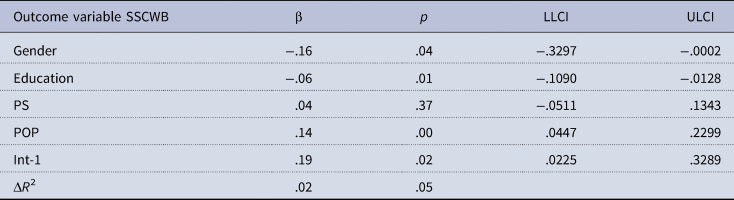
The results of a two-factor model produced significantly improved results with χ2(186, n = 250) = 381.068, GFI = .87, CFI = .85 (Hu & Bentler, Reference Hu and Bentler1998), and RMSEA = .06 (Hoyle, Reference Hoyle1995) compared with a single-factor model with χ2(350, n = 250) = 1176.801, GFI = .71, CFI = .52, and RMSEA = .097 with Δχ2(164) = 795.733, p < .01). Moreover, we used PROCESS MACRO version 3 (Hayes, Reference Hayes2016) to run the analysis for the moderation results. Table A2 provides the results for our hypotheses related to the moderating effects of POP on the relationship between PS and SSCWB.
The results indicated a significant interaction between PS and POP, β = .20, p < .05. Moreover, the bootstrap intervals for both lower and upper limits (LLCI = .0301, ULCI = .3801) also showed a non-zero interval (Hayes, Reference Hayes2016) which acted as a double check for significance with ΔR 2 = .02 at p < .05, after introducing the interaction term. The overall model shows R 2 = .10 with p < .01. Table A1 shows that in control variables, only gender and education were found to be significantly related to SSCWB. Thus, we used these two controls in our analysis. We hypothesized that this interaction will be significant and positive for high values of POP which was supported by the results in Table A3. The table shows the conditional effects of PS on SSCWB at three different values of POP (mean, mean − 1SD, and mean + 1SD) with an effect size of .15, significant at p < .05 only for high values of POP (mean + 1SD). The conditional effects of PS on SSCWB for values of POP at mean − 1SD (low values of POP) were not significant.
We also probed these results through a simple slope analysis of a significant interaction by using the (mean ± 1SD) criterion as recommended by Aiken, West, and Reno (Reference Aiken and West1991). Figure 1 shows the results.
Moderating effect of POP on relationship of PS and SSCWB

Figure 1 revealed that for high values of POP, as PS increases, its relationship with SSCWB shows an upward slope. On the contrary, on low values of POP, as PS increases, its relationship with SSCWB shows a downward slope. This relationship can be explained in the same vein by arguing that in contexts, low in POP, the low political perceptions of the politically smart people will provide a situational assessment of ‘clear and uncompromising standards’ (Drory and Vigoda-Gadot, Reference Drory and Vigoda-Gadot2010) with high fairness and justice perceptions (Vigoda, Reference Vigoda2001) by mitigating the ambiguity around goal achievement (a weak situation for the execution of its negative side). Therefore, in such contexts, politically skilled people will focus more on performance and positive influence behaviors.
Discussion
This study was conducted with the aim of highlighting the less researched, negative side of PS. A synthesis of the literature reveals that its conceptualization is ruled by two competing schools of thought. The earliest conceptualization by first school of thought [Pfeffer (Reference Pfeffer1981) and Mintzberg (Reference Mintzberg1983)] was rooted in the domains of power and politics and characterized PS as a critical competency to execute political behaviors effectively. Hence, these earliest proponents see PS as a concept that is intertwined with the negative, self-serving side of organizational politics, albeit the available literature does not provide any evidence of conceptual or empirical development of this notion in the domain of PS. On the other hand, inspired by second school of thought, the contemporary literature on this social competency owes its in-depth theoretical and empirical development by Ferris et al. (Meta-Theoretical Framework, Reference Ferris, Treadway, Perrewé, Brouer, Douglas and Lux2007; PSI, Reference Ferris, Treadway, Kolodinsky, Hochwarter, Kacmar, Douglas and Frink2005) who took a more neutral view and operationalized it as a construct reflecting the functional side of organizational politics. Since then, all the available scholarship on PS has been inspired by this view and considers it as an interpersonal style construct (Zellars et al., Reference Zellars, Perrewé, Rossi, Tepper and Ferris2008) and a competency that is associated with career success, good performance ratings, good reputation, a stress buffer, and an antidote to negative effects of organizational contexts (Munyon et al., Reference Munyon, Summers, Thompson and Ferris2015). However, there are hardly any efforts toward developing an understanding of its dysfunctional side, which was very evident in its pioneering studies. With an ever-increasing emphasis for scholars to develop this skill through coaching and training, it is very important to have a more in-depth knowledge of its broader effects beyond its functional utility in organizations. Therefore, through this investigation, the study highlights its possible pitfalls whose investigation is extremely crucial for a deeper understanding of the way the dual nature of PS works.
We drew on the trait activation theory (Tett & Burnett, Reference Tett and Burnett2003) to argue that organizational politics acts as a trait relevant situation (Tett & Guterman, Reference Tett and Guterman2000) which activates the dark side of PS. Moreover, on the other hand, politically skilled people, being situationally smart and flexible, thrive on showing the most appropriate behaviors as per situational demands. Hence, having an assessment of a political context promoting such behaviors, the dark side of PS will find it rewarding to respond to this situation by pursuing the selfish agendas of politically smart people in the form of self-serving CWBs. Hence, a highly political context marks a strong situation (Judge & Zapata, Reference Judge and Zapata2015), which gives clear and powerful signals of thriving on self-serving behaviors being the most rewarding and apt behavior to pursue personal agendas in workplaces. On the other hand, the results also revealed that in an organizational context, perceived to be low in political dynamics, PS was not found to be related to self-serving behaviors. Explaining it from the trait activation perspective, we argue that a context, low in political perception, constitutes a weak situation for bringing out the dark side of politically savvy people. A context, low in political perceptions indicates greater formalization of rules, policies, and procedures (Ferris, Harrell-Cook, & Dulebohn, Reference Ferris, Harrell-Cook, Dulebohn, Bacharach and Lawler2000) and hence gives cues that circumventing the rules will not constitute normative behavior. Hence, politically skilled people would not find it worthwhile to indulge in negative behaviors as they can achieve their goals by engaging in socially acceptable behaviors (the use of its functional side), necessary for personal advancement. Therefore, in the light of trait activation theory, this study cautions against making generic conclusions about the beneficial effects of PS as such effects might be heavily dependent on trait relevant situations (in case of the execution of its dark side, the trait relevant situations are likely to be different than the ones relevant to its functional use).
Theoretical implications
This study provides significant theoretical implications to extend the scholarship in the domains of PS and CWB. Hence, by conceptualizing and empirically validating the negative outcomes of PS in the form of SSCWB, this study stimulates thinking about overemphasizing its positive effects. Moreover, this study also helps researchers in making a more informed and fine grain analysis of PS and its effects on variables of interest by delineating situations which activate its dysfunctional mechanism.
Another important theoretical contribution this study claims is providing the basis for examining contextual variables as an integral part of the investigation of the self-serving side of PS. Moreover, as discussed earlier, the theoretically assumed positive effects of PS have been investigated mainly as direct relations (Kimura, Reference Kimura2015), with little attention to the context (Blickle, Wendel, & Ferris, Reference Blickle, Wendel and Ferris2010). However, the results, showing a significant relationship between PS and SSCWB in the presence of trait relevant context (POP), lead to an important finding that compared with its functional side, the dysfunctional side of PS is more heavily dependent on trait relevant situations and unless they are present, the dark facet of PS is likely to stay dormant. Hence, the current study extends the theoretical domain of trait activation theory in the realm of organizational politics and provides an impetus for the development of a comprehensive taxonomy of trait relevant situations which have a potential to put into play the negative side of PS. Moreover, the explanatory value of trait activation perspective can inform many other areas of organizational behavior domain which can potentially play an important role in the activation of the dark PS.
Additionally, we also argue that due to their situation-based smart nature, politically skilled persons are less likely to engage in commonly investigated categories of CWB (in the form of theft, abuse, aggression, and withdrawal), which are more overt in nature. Thus, by linking PS with self-serving counterproductive behaviors, this study opens up future avenues for research into other forms of negative behaviors that might be investigated as an outcome of the execution of its dark side.
This study also has significant theoretical implications for scholarship on job design. Research indicates that there is a wider scope for the demonstration of PS in jobs that are enterprising in nature and provide greater freedom for behavioral flexibility in social interactions (Blickle, Wendel, & Ferris, Reference Blickle, Wendel and Ferris2010). Yet another important implication of this study would be to investigate what type of work characteristics provides motivation and facilitation to the politically discreet people for its dysfunctional use.
In addition to the above, this study also provides significant insights to broaden the domain of antecedents related to the CWB. By presenting PS as a potential precursor to the self-serving CWB, we demonstrated that it is not always the negative factors that elicit dysfunctional behaviors, the motivation to perpetrate them (under some contextual temptations) could also come from persons who are socially and politically skilled. Hence, it bridges the gap between CWB research and other cross disciplinary areas to have a broader understanding of personal and organizational dynamics that propel organizational members to perpetrate different forms of CWB.
Finally, the newly developed scale for SSCWB holds promise for future research work in CWB domain as a distinct category of negative behaviors. Hence, it has the potential to help researchers make a more informed inquiry into the antecedents and outcomes of these behaviors besides providing a valid tool for their measurement.
Future directions
By establishing the link between PS and self-serving CWB, we aim to bring the attention of researchers toward its darker side, which is an equally important aspect in understanding a broader domain of associated behaviors. The study establishes that the negative execution of PS is heavily dependent on trait relevant situations. Though we tested this model with only one such situation (POP), it would be fruitful to explore more contextual factors which act as trait relevant situations for the execution of its self-serving side. For example, it would be insightful to investigate the interplay of PS with negative contextual conditions such as role conflict and ambiguity, in-group–out-group differentiation, weak job design model, bullying, and abusive leadership to explore the type of personal and organizational outcomes which are produced by politically shrewd people in their attempt to navigate through these demanding conditions.
Second, along with the facilitating boundary conditions, this study also provides an impetus for focusing on the mediating mechanisms that can explain how PS is transmitted into certain negative outcomes. For example, Pfeffer (Reference Pfeffer2010) suggested that PS is an important vehicle of achieving power in an organization. Taking a parallel view of research in the power domain, we find compelling evidence of the fact that the sense of power corrupts and makes self-furthering goals more salient to its incumbents (Keltner, Gruenfeld, and Anderson, Reference Keltner, Gruenfeld and Anderson2003). Drawing upon insights from these perspectives, our study suggests that the investigation into the role of perceived personal power can be a fruitful area to provide a logical explanation of any negative outcomes associated with PS.
Additionally, in its investigation, the current study treats all its four dimensions, namely social astuteness, interpersonal influence, networking skills, and apparent sincerity as a single cumulative factor. It will be fruitful to undertake investigations into a dimensional analysis of PS in the future to see whether a particular dimension is more closely associated with negative behaviors.
Last, another area of research that could be informed by the insights of this study is the leadership domain. A recent review by Munyon et al. (Reference Munyon, Summers, Thompson and Ferris2015) implied that leaders may also use this skill to manipulate their followers to achieve their personal motives, albeit no scholarly efforts have been directed toward this notion in the literature on leadership thus far. Therefore, an investigation into the dark side of leaders' PSs and their effects on their followers has the potential to add significantly to the scholarship on dark leadership.
Strengths and limitations
A large volume of research on PS has been conducted in Western culture which involves work contexts that are quite different from that of Eastern culture. This study was conducted in Pakistan which ranks high in power distance and uncertainty avoidance (Naseer et al., Reference Naseer, Raja, Syed, Donia and Darr2016). Pakistan has a high index in corruption on account of political and economic reasons, which creates a conducive environment for self-serving behaviors and politicking in organizations as they are a part of its larger social context. Thus, it holds currency to investigate the role of PS in Eastern contexts which present altogether different dynamics than Western contexts where a majority of the research on this construct has been conducted.
Second, we used independent sources for the measurement of the predictor (self-report) and outcome variables (peer report) to account for the common method variance which is a potential threat to the effect sizes when the data have been collected by a single source (Podsakoff, MacKenzie, Lee, & Podsakoff, Reference Podsakoff, MacKenzie, Lee and Podsakoff2003).
Our study has a few limitations which we acknowledge. First, PS was measured using focal persons. Hence, the data collected did not provide an additional check and more information on alternative source assessment. While some studies such as Blickle and Schnitzler (Reference Blickle and Schnitzler2010) and Westbrook, Veale, and Karnes (Reference Westbrook, Veale and Karnes2013) have revealed no distortion in self-rated PS, Blickle et al. (Reference Blickle, Kramer, Schneider, Meurs, Ferris, Mierke and Momm2011) also documented that self-rated PS might include intentional faking. It is also quite possible that in highly political environments, people with high PS might under-report their social competencies to look ‘apparently sincere’ and keep a low profile. The intentional faking of PS is also possible in such environments. Since this possibility could not be ruled out in self-report measures, we could provide reasonable assurance that the results thus obtained were not distorted by this potential weakness. As discussed earlier, we have strong evidence that the prevalent practice in PS research has adopted self-report measures (Shi et al., Reference Shi, Johnson, Liu and Wang2013; Todd, Harris, Harris, and Wheeler, Reference Todd, Harris, Harris and Wheeler2009; Westbrook, Veale, and Karnes, Reference Westbrook, Veale and Karnes2013). However, future studies on PS can consider using peer-related measures to overcome this bias.
Next, since there was no existing measure of SSCWB, we conducted a separate study for the development of a SSCWB scale by following all the necessary conventions governing scale construction as articulated in Hinkin (Reference Hinkin1998). However, our study used a limited nomological network for SSCWB and there is a need for more elaborate efforts to build upon this initial work.
Another limitation we would like to highlight is the values of our fit indices of measurement model in the study. The CFI and GFI values hover around .85 and .87, which are very close to the generally accepted ideal criteria (Hu and Bentler, Reference Hu and Bentler1998) of >.9. We, however, find compelling references from the management research raising concerns over generalizability of fit indices in different samples and situations (Marsh, Hau, & Wen, Reference Marsh, Hau and Wen2004). Hu and Bentler (Reference Hu and Bentler1998, p. 449) emphasized that ‘It is difficult to designate a specific cutoff value for each fit index because it does not work equally well with various types of fit indices, sample sizes, estimators, or distributions.’ In the presence of this evidence for the subjectivity and specificity of the nature of fit indices, we are confident that the reported fit indices in our study do not raise a doubt on the validity of our measurement model.
Practical implications
This study offers some important considerations for practitioners. Ferris et al. (Reference Ferris, Blickle, Schneider, Kramer, Zettler, Solga and Meurs2008) indicated that PS, besides being a personal variable, can also be honed through training, mentoring, and socialization. In all these processes, managers must consider and appreciate the dark side of PS with its potential consequences while dealing with such programs involving coaching employees on such skills.
Kimura (Reference Kimura2015) asserted that due to their superior impression management skills, irrespective of their true competence, politically skilled people usually had better performance ratings. On the other hand, Todd et al. (Reference Todd, Harris, Harris and Wheeler2009) suggested that they had more successful career paths when compared with their counterparts. Hence, in important career decisions concerning the hiring and promotion of politically skilled people, it is imperative for managers to be cognizant of the fact that a high level of PS in employees can both benefit and threaten organizations.
Finally, we demonstrated that it is of paramount importance for the top management to cultivate an organizational environment that discourages politicization by ensuring adherence to rules, regulations, and fair practices. A highly political environment is not only unhealthy in itself, but will also encourage socially astute people to avail political opportunities and be counterproductive as well.
Acknowledgements
This manuscript is an original work that has not been submitted to nor published anywhere else. All authors have read and approved the paper and have met the criteria for authorship.
Appendix A
Means, standard deviations, and correlations among variables

Moderating effects of POP on the relationship between PS and SSCWB

Conditional effects of PS on SSCWB at values of POP

Appendix B
Scale for the Self-Serving Counterproductive Work Behaviors
Instructions: Please cross the box against the choice that indicates how often your peer might have engaged in the given behaviors in the past one year.


Fariha Zahid is currently a PhD Management candidate in Suleman Dawood School of Business, Lahore University of Management Sciences (LUMS). Her research areas include political skill, power and politics, and counterproductive work behaviors.
Arif Nazir Butt is a professor of Organizational Behavior at the Suleman Dawood School of Business, Lahore University of Management Sciences (LUMS). He earned his PhD degree in Management from McGill University, Montreal, Canada. His research areas include negotiation, emotions, creativity, diversity, managerial ethics, and values.
Abdul Karim Khan is an Associate Professor at the Department of Business Administration, United Arab Emirates University. He earned his PhD in Organizational Behavior from IAE Aix en Provence, Graduate School of Management, France. His key research areas include compensation management, organizational justice, counterproductive work behaviors, team dynamics, discrete emotions, abusive supervision, and social exchange relations.