Introduction
Archaeocetes are Eocene stem cetaceans that document early stages in the evolutionary transition of whales from land to sea. They are typically divided into five families that include about 40 genera (Uhen, Reference Uhen2010). The three most basal families (Pakicetidae, Ambulocetidae, and Remingtonocetidae) have been known exclusively from early to middle Eocene strata in Indo-Pakistan on the southern margin of the ancient Tethys Sea (Fig. 1), and many authors have suggested that this region was the center of origin for cetaceans (e.g., West, Reference West1980; Gingerich et al., Reference Bajpai and Gingerich1998). The more derived Protocetidae and Basilosauridae are known from Indo-Pakistan, but they were more cosmopolitan and have been recovered from middle to late Eocene deposits on several continents around the world (e.g., Gingerich, Reference Gingerich2010; Uhen et al., Reference Uhen, Pyenson, Devries, Urbina and Renne2011; Uhen, Reference Uhen2013).
Geographic distribution of Remingtonocetidae. Rayanistes afer, n. gen. n. sp., is the first remingtonocetid known outside Indo-Pakistan. All of these localities are Lutetian (early middle Eocene) in age, and all were on the southern margin of the eastern Tethys Sea during the Eocene.

The archaeocete family Remingtonocetidae is generally regarded as a sister group of the clade that includes Protocetidae, Basilosauridae, and later Neoceti (crown group Cetacea). Remingtonocetids can be recognized by their unusual cranial and mandibular morphology (Kumar and Sahni, Reference Kumar and Sahni1986; Gingerich, Arif, and Clyde, Reference Gingerich, Arif and Clyde1995a; Thewissen et al., Reference Bajpai, Thewissen and Conley2011). The best known remingtonocetid is Remingtonocetus, which is known from crania, teeth, much of the vertebral column, ribs, and hind limb elements (Fig. 2). Remingtonocetid crania are generally about six times longer than they are wide across the frontals, their rostra comprise more than 60% of condylobasal skull length, and their mandibular symphyses extend back at least to P3 (Gingerich et al., Reference Gingerich, Arif, Bhatti and Clyde1998). However, remingtonocetids also have very distinctive postcranial morphology, which allows them to be identified with confidence even in the absence of cranial material. Remingtonocetids have long cervical vertebrae that are unusual for cetaceans; sacra with as many as four fused vertebral centra; robust pelves with bladelike ilia and ischia rising sharply from the body of the innominate anterior and posterior to the acetabulum; acetabular notches that are narrow to closed; and robust hind limbs with evidence of some capacity for weight-bearing (Gingerich et al., Reference Gingerich, Arif and Clyde1995a; Gingerich et al., Reference Gingerich, Haq, Khan and Zalmout2001a; Madar, Reference Madar1998; Thewissen and Bajpai, Reference Thewissen and Bajpai2009; Bebej et al., Reference Bebej, Haq, Zalmout and Gingerich2012).
Skeletal reconstruction of the best known remingtonocetid, middle Eocene Remingtonocetus domandaensis, showing the large skull with a long rostrum, long cervical vertebrae, large sacrum, pelvis, and femur characteristic of Remingtonocetidae. Elements of the new genus and species Rayanistes afer are shaded and circled. Skeleton of Remingtonocetus is redrawn from Bebej et al. (Reference Bebej, Haq, Zalmout and Gingerich2012).
Here we describe a new specimen from the middle to late Lutetian part of the Midawara Formation of Egypt. The specimen includes partial lumbar and caudal vertebrae; a sacrum with four vertebral centra; a left innominate with a complete ilium, ischium, and acetabulum; and a nearly complete left femur. The morphology of the recovered elements indicates that the specimen is a remingtonocetid, making it the first record of Remingtonocetidae in Africa and the most basal archaeocete to be found outside Indo-Pakistan.
Systematic paleontology
Institutional abbreviations
CGM, Egyptian Geological Museum, Cairo, Egypt; GSM, Georgia Southern Museum, Statesboro, Georgia, USA; GSP-UM, Geological Survey of Pakistan-University of Michigan collection, Quetta, Pakistan; H-GSP, Howard University, Geological Survey of Pakistan collection, Quetta, Pakistan; IITR-SB, Indian Institute of Technology Roorkee, Sunil Bajpai collection, Roorkee, India; UMMZ, University of Michigan Museum of Zoology, Ann Arbor, Michigan, USA.
Anatomical abbreviations
Ca, caudal vertebra; L, lumbar vertebra; S, sacral vertebra.
Order Cetacea Brisson, Reference Brisson1762
Family Remingtonocetidae Kumar and Sahni, Reference Kumar and Sahni1986
Type genus
Remingtonocetus Kumar and Sahni, Reference Kumar and Sahni1986
Included genera
Andrewsiphius Sahni and Mishra, Reference Sahni and Mishra1975; Remingtonocetus Kumar and Sahni, Reference Kumar and Sahni1986; Dalanistes Gingerich et al., Reference Gingerich, Arif and Clyde1995a; Attockicetus Thewissen and Hussain, Reference Thewissen and Hussain2000; Kutchicetus Bajpai and Thewissen, Reference Bajpai and Thewissen2000; and Rayanistes n. gen.
Diagnosis
Remingtonocetidae differ from all other archaeocetes in having extremely long, narrow skulls; relatively narrow supraorbital shields; small orbits; convex palates; palatine-pterygoid surfaces with prominent midline keels; laterally-positioned auditory bullae; and long mandibular symphyses extending to or beyond the position of P3 (Kumar and Sahni, Reference Kumar and Sahni1986; Gingerich et al., Reference Gingerich, Arif and Clyde1995a, Reference Gingerich, Arif, Bhatti and Clyde1998; Williams, Reference Williams1998). In the postcranial skeleton, remingtonocetids are distinguished from contemporary protocetids in having relatively long cervical vertebrae, a narrower sacrum, distinctive innominates, and a femur lacking a distinct fovea capitis femoris (Gingerich et al., Reference Gingerich, Arif and Clyde1995a, Reference Gingerich, Arif, Bhatti and Clyde1998; Madar et al., Reference Madar, Thewissen and Hussain2002). Remingtonocetid sacra are relatively narrow and long, with a minimal biauricular breadth to sacral length ratio in the range of 0.38 to 0.49. The pakicetid Pakicetus is at the small end of this range (Madar, Reference Madar2007), and the ambulocetid Ambulocetus is at the large end of this range (Madar et al., Reference Madar, Thewissen and Hussain2002). Protocetids, in contrast, have broader sacra, with a minimal biauricular breadth to sacral length ratio in the range of 0.47 to 0.76.
Remingtonocetid innominates have bladelike ilia and ischia rising sharply from the body anterior and posterior to the acetabulum. The acetabulum appears relatively large and deep due to its sharp rim, although measurements of relative size and depth do not show a clear difference from protocetids. The acetabular notch separating ends of the lunate surface within the acetabulum is narrow or closed entirely. Remingtonocetids have an acetabular notch to acetabulum diameter ratio ranging from 0.00 (closed) to 0.12, in contrast to protocetids, for which this ratio ranges from 0.28 to 0.38. Remingtonocetid femora differ from those of most other middle Eocene archaeocetes in lacking a distinct fovea capitis femoris. In addition, remingtonocetid femora have denser cortical bone than those of contemporary protocetids and consequently show less damage due to compression during burial.
Discussion
Two species of non-basilosaurid archaeocetes (Protocetus atavus and Pappocetus lugardi) were known when the first remingtonocetid specimens were described. Sahni and Mishra (Reference Sahni and Mishra1972) described the first remingtonocetids from the middle Eocene of India, and named the new species Protocetus sloani from a fragmentary cranium and edentulous jaw pieces. Sahni and Mishra (Reference Sahni and Mishra1975) described four additional cetaceans from the Eocene of Kutch: Indocetus ramani and Protocetus harudiensis, which they considered to be protocetid archaeocetes, and Andrewsiphius kutchensis and Andrewsiphius minor, which they placed in the odontocete family Agorophiidae. Better comparative material allowed Kumar and Sahni (Reference Kumar and Sahni1986) to recognize the distinctness of these taxa, leading them to combine P. sloani and P. harudiensis in the new genus Remingtonocetus, and to group Remingtonocetus and Andrewsiphius together in the new family Remingtonocetidae.
Dalanistes ahmedi (Gingerich et al., Reference Gingerich, Arif and Clyde1995a), Attockicetus praecursor (Thewissen and Hussain, Reference Thewissen and Hussain2000), Kutchicetus minimus (Bajpai and Thewissen, Reference Bajpai and Thewissen2000), and Remingtonocetus domandaensis (Gingerich et al., Reference Gingerich, Haq, Khan and Zalmout2001a) were placed in Remingtonocetidae mainly on the basis of cranial material with the diagnostically long narrow skulls and rostra of remingtonocetids. The first specimens of Remingtonocetus with postcranial remains were initially misidentified as the protocetid Indocetus ramani (Gingerich et al., Reference Gingerich, Raza, Arif, Anwar and Zhou1993). Discovery of Dalanistes ahmedi with associated skeletal elements enabled the error to be corrected (Gingerich et al., Reference Gingerich, Arif and Clyde1995a). Protocetids and remingtonocetids are much better known now than they were in the 1990s, and most of the known remingtonocetid postcranial elements are as distinctive as remingtonocetid cranial elements. Loss of the acetabular notch separating ends of the lunate surface within the acetabulum of the innominate in remingtonocetids means that the acetabular fossa is also greatly reduced or lost, a condition consistent with reduction and loss of the fovea capitis femoris. Both features indicate reduction or loss of the round (or teres) ligament connecting the femoral head to the acetabulum, suggesting a hip joint with less weight-bearing capability in remingtonocetids compared to other early archaeocetes (see below). Gingerich et al. (Reference Gingerich, Arif and Clyde1995a, Reference Gingerich, Arif, Bhatti and Clyde1998) reported that protocetids lack a distinct acetabular notch, but this was an error due to misidentification of a broken remingtonocetid innominate (GSP-UM 3015) as that of a protocetid.
Genus Rayanistes new genus
Type species
Rayanistes afer, by monotypy.
Diagnosis
As for type species by monotypy.
Etymology
A combination of ‘Rayan,’ from Wadi El Rayan, provenance of the holotype, and ‘istes’ (Gr., masc., ‘agent’). This construction parallels Platanista (the modern Indus and Ganges river dolphin) and Dalanistes (the large-bodied remingtonocetid known from Indo-Pakistan).
Occurrence
Rayanistes is known only from the type locality (see below).
Remarks
The species described here is placed in a new genus because its distinctive morphology indicates locomotor adaptations different from those of other remingtonocetids.
Rayanistes afer new species
Figures 3.1–3.2, 3.5–3.6, 3.9–3.11, 4.1, 5.1, 6.1–6.2
Vertebrae of middle Eocene Rayanistes afer n. gen. n. sp. and Remingtonocetus domandaensis. (1, 2) lumbar vertebra L6 of R. afer n. gen. n. sp. (CGM 42190), in anterior and left lateral view; (3, 4) lumbar vertebra L6 of R. domandaensis (GSP-UM 3552), in anterior and left lateral view; (5, 6) caudal vertebra Ca1 of R. afer n. gen. n. sp. (CGM 42190), in anterior and left lateral view; (7, 8) caudal vertebra Ca1 of R. domandaensis (GSP-UM 3408), in anterior and left lateral view; (9–11) sacral vertebrae S1–S4 of R. afer n. gen. n. sp. (CGM 42190), in anterior, left lateral, and dorsal view. Note the posteriorly angled base of the neural spine on L6 in Rayanistes (2) compared to the anteriorly angled neural spine of Remingtonocetus (4); the high vertical neural spine on Ca1 in Rayanistes (6); the short auricular process on S1 of the sacrum in Rayanistes (9, 11); fusion of centra on sacral vertebrae S2–S3 but not S1 or S4 (10, 11); fusion of neural spines on sacral vertebrae S2–S3 but not S1 or S4; and pleurapophyseal contacts connecting transverse processes of all four sacral vertebrae, enclosing sacral foramina between successive vertebrae (arrows; 11). Ventral surfaces of sacral vertebrae S1–S3 are eroded and missing; ventral surface of S4 is intact.
Left innominates of middle Eocene archaeocetes and the modern hippopotamus, in lateral view (anterior at left). (1) Rayanistes afer n. gen. n. sp. (CGM 42190); (2) Remingtonocetus domandaensis (GSP-UM 3408); (3) Remingtonocetus domandaensis (GSP-UM 3552); (4) Ambulocetus natans (H-GSP 18507); (5) Hippopotamus amphibius (UMMZ 84041); (6) Qaisracetus arifi (GSP-UM 3410); (7) Georgiacetus vogtlensis (GSM 350); (8) Rodhocetus kasranii (GSP-UM 3012); (9) Maiacetus inuus (GSP-UM 3551); (10) Pakicetus attocki (H-GSP 30395 and 30427). The dorsal margins of Rayanistes afer (1) and Remingtonocetus domandaensis (3) are virtually complete. Note the dorsal expansion of the ischium posterior to the acetabulum in R. afer (1), similar to that of A. natans (4), and the contrasting dorsal expansion of the ilium anterior to the acetabulum in R. domandaensis (3). The innominate of A. natans (4) is a composite constructed from left and right innominates (Madar et al., Reference Madar, Thewissen and Hussain2002). The innominate of P. attocki (10) is a composite constructed from partial innominates of P. attocki and Nalacetus ratimitus (Madar, Reference Madar2007). Specimens are compared at the same total length. Principal features are labeled for H. amphibius (5). Scale bar represents 10 cm in each illustration.
Left acetabula on innominates of middle Eocene archaeocetes, in lateral view (anterior at left). (1) Rayanistes afer n. gen. n. sp. (CGM 42190); (2) Remingtonocetus domandaensis (GSP-UM 3552); (3) R. domandaensis (GSP-UM 3408); (4) Dalanistes ahmedi (GSP-UM 3106); (5) Ambulocetus natans (H-GSP 18507); (6) Rodhocetus kasranii (GSP-UM 3012). The margin of the lunate surface is outlined on each specimen to demonstrate closure of the acetabular notch separating ends of the lunate surface. The acetabular notch is narrow in Rayanistes afer (1), narrow to closed in other Remingtonocetidae (2–4), and more open in A. natans (5) and protocetids like R. kasranii (6).
Left femora of middle Eocene archaeocetes. (1–2) Rayanistes afer n. gen. n. sp. (CGM 42190), posterior and anterior views; (3) Remingtonocetus domandaensis (GSP-UM 3054), anterior view; (4) Ambulocetus natans (H-GSP 18507), anterior view; (5) Maiacetus inuus (GSP-UM 3551), anterior view; (6) Rodhocetus kasranii (GSP-UM 3012), anterior view. Note the more robust femora of Rayanistes (1–2) and Remingtonocetus (3) compared to those of other archaeocetes, and the more vertically oriented head and shorter neck on the femur of Rayanistes (1–2). Specimens are compared at the same total length (estimated in Rayanistes and Remingtonocetus, which are missing distal condyles). Scale bar represents 5 cm in each illustration.
Holotype
CGM 42190, associated elements of one postcranial skeleton, including a well preserved lumbar vertebra; partially preserved sacrum; well preserved caudal vertebra; left innominate preserving the ilium, ischium, and acetabulum; and a nearly complete left femur. The holotype is the only known specimen.
CGM 42190 was collected in the Western Desert of Egypt near the southern bench of Qaret Qusur El-Arab, 8 km southwest of Minqar El-Rayan and 32 km south-southeast of Wadi Al-Hitan. It was recovered from one of the higher terraces in the upper middle part of the Midawara Formation, which is the second formation in the Wadi El-Rayan series of Beadnell (Reference Beadnell1905). The Midawara Formation rests on the nummulitic limestone platform of the Muweilih Formation and is overlain by hard resistant limestones of the Sath El-Hadid Formation.
The Midawara Formation is a multistory sedimentary package in Wadi El-Rayan. A single sedimentary cycle consists of thick shales and dark green sandy glauconites topped by benches of thin coquinal limestone. The middle part of the Midawara Formation here is 30–40 meters thick and bears a rich middle Eocene assemblage of neoselachians (Underwood et al., Reference Underwood, Ward, King, Antar, Zalmout and Gingerich2011) and marine mammals (Gingerich et al., Reference Gingerich, Antar and Zalmout2013). Based on regional lithological and paleontological correlation between Cairo et al., (Reference Strougo2008) found that the Midawara Formation spans the fourth and fifth Mokattamian stages, making it middle to late Lutetian in age.
Diagnosis
Rayanistes afer shares remingtonocetid features including a sacrum that is narrow and long (minimal biauricular breadth to sacral length ratio of 0.42); an innominate with a bladelike ilium and bladelike ischium rising sharply from the body anterior and posterior to the acetabulum; a large, deep acetabulum with a sharp rim and a narrow acetabular notch (ratio of notch width to acetabulum diameter of 0.09); and a femur with dense cortical bone and lacking a distinct fovea capitis femoris. Rayanistes afer is distinctive among remingtonocetids in having the neural spine on L6 angled posteriorly; an innominate with an ilium that is lower dorsally and an ischium that extends much higher dorsally; and in having a femur with a shorter neck, more vertically oriented head, and more circular diaphyseal cross-section with no distinct lateral flange.
Rayanistes afer is closest to Remingtonocetus domandaensis and Remingtonocetus harudiensis in size but differs (to the extent they can be compared) from Remingtonocetus and Dalanistes in orientation of the neural spine on the last lumbar vertebra (Fig. 3); relative development of the ilium and ischium on the innominate (Fig. 4); and orientation of the head, length of the neck, and robustness of the greater trochanter on the femur (Fig. 6). Rayanistes afer differs from Andrewsiphius sloani in being larger, and in the orientation and relative size of the femoral head. Rayanistes afer is closest in innominate morphology to Ambulocetus natans, but differs in having a larger acetabulum (Fig. 4), a narrower acetabular notch (Fig. 5), and a much shorter femur with a larger femoral head (Fig. 6).
Occurrence
Rayanistes afer is known only from the type locality of middle to late Lutetian age (early middle Eocene) in Fayum Province, Egypt.
Description
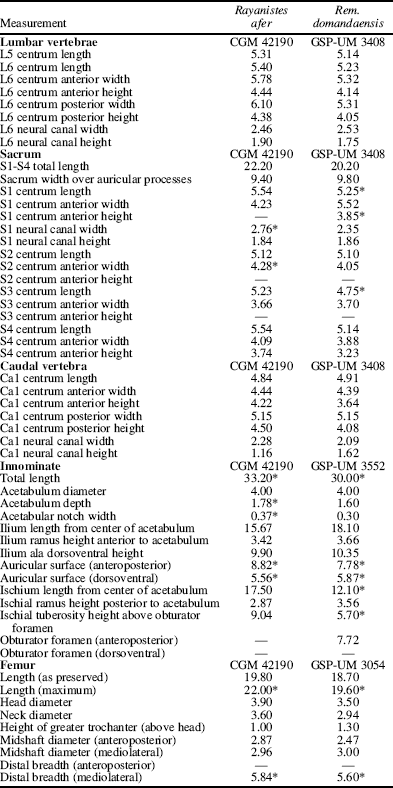
The preserved lumbar vertebra, sacrum, caudal vertebra, innominate, and femur of Rayanistes afer are described separately in detail below. Measurements are given in Table 1.
Measurements of vertebrae and hind limb elements of Rayanistes afer n. gen. n. sp. compared to those of Remingtonocetus domandaensis
Measurements are in centimeters.
* Estimates.
Etymology
Species name ‘afer’ (L., ‘Africa’) refers to the provenance of the holotype and its significance as the first remingtonocetid known from the African continent.
Lumbar vertebrae
CGM 42190 includes one well-preserved lumbar vertebra (Fig. 3.1–3.2), with fragments of others. This is identified as L6 because it has a transverse process with an anteroposteriorly shorter and more angled base, like that of L6 in Remingtonocetus (Bebej et al., Reference Bebej, Haq, Zalmout and Gingerich2012). Anterior and posterior epiphyses are reniform and come to slight corners laterally at the level of the transverse processes. A thin, short transverse process is preserved on the right side. It projects anteroventrally from the centrum, but extends very little laterally. The pedicles supporting the neural arch are thick (approximately 1.5 cm mediolaterally) and outline a neural canal that is semicircular to triangular in shape. Slight depressions for attachment of ligamenta flava are present on the anterior laminae dorsal to the neural canal, but they are not nearly as prominent as the deep ligamentous pits present on lumbar vertebrae of R. domandaensis (GSP-UM 3552). Prezygapophyses are gently curved and face dorsomedially. Metapophyses are present, but not as robust as those of R. domandaensis (GSP-UM 3552). Postzygapophyses are not preserved. The base is all that remains of the neural spine, and its angulation indicates that the neural spine was inclined posteriorly rather than anteriorly or vertically as in all other remingtonocetids.
An additional partial lumbar centrum is tentatively identified as L5. Only the right dorsal-most portion of the centrum is preserved. It appears similar in length to L6, although its other proportions cannot be accurately estimated. A partial neural spine with a right postzygapophysis (possibly of L5) was also recovered. The postzygapophysis faces ventrolaterally with a strong lateral component, indicating that it must belong to a post-diaphragmatic thoracic or lumbar vertebra. The neural spine on this fragment appears to be inclined posteriorly, corroborating interpretation of the neural spine angle of L6.
Sacrum
The sacrum of Rayanistes afer includes four vertebrae, S1–S4 (Fig. 3.9–3.11). The ventral surface of the sacrum is heavily weathered, and much of it is not preserved. The auricular process is absent on the left side and poorly preserved on the right side. Dorsal sacral foramina are large (ranging from 1.9 cm to 2.6 cm in diameter). The anterior and posterior epiphyses of S4 are circular in cross-section. As a whole, the sacrum of CGM 42190 appears less robust than sacra known in specimens of Remingtonocetus domandaensis (Bebej et al., Reference Bebej, Haq, Zalmout and Gingerich2012), but this is partly because so much of the ventral surface has been eroded away. The overall length of S1–S4 and the size and thickness of the fused neural spines between S2 and S3 demonstrate that the sacrum of R. afer was a robust element.
Like most other remingtonocetids, S1–S3 were fused together whereas S4 remained free (Bebej et al., Reference Bebej, Haq, Zalmout and Gingerich2012); however, the pattern of fusion among S1–S3 in R. afer is unique. In R. domandaensis (GSP-UM 3408 and 3552), S1–S3 are solidly fused across centra, neural spines, zygapophyses, and pleurapophyses. In CGM 42190, the centrum of S1 is not fused to that of S2, although the centra of S2 and S3 are solidly fused together. The pleurapophyseal shelf appears continuous across S1–S4. There are pleurapophyseal articulations, but there is no pleurapophyseal fusion apparent between any of the sacral vertebrae. The neural spines of S2–S3 are fused together; however, the base of the incomplete neural spine of S1 is free from that of S2, suggesting a lack of fusion between these neural spines (at least near their bases). Zygapophyses between S1–S2 and S2–S3 are fused together, and those between S3–S4 may have been fused as well.
Caudal vertebra
An additional almost complete vertebra is identified as Ca1 (Fig. 3.5–3.6). Anterior and posterior epiphyses are missing, but these were circular in cross-section. Robust transverse processes project laterally from the centrum, with a slight ventral curvature. Both left and right transverse processes are broken distally, but they appear to have been knob-like as in Ca1 of Remingtonocetus domandaensis (GSP-UM 3408; Fig. 3.7–3.8). The neural arch rises from the anterior part of the centrum and defines a semicircular neural canal. Pre- and postzygapophyses are not preserved. The neural spine is incomplete but appears to be mostly vertical in orientation. An additional fragmentary centrum might be that of Ca2, but it preserves little additional anatomical detail.
Innominate
The left innominate of CGM 42190 preserves a virtually complete ilium, ischium, and acetabulum (Fig. 4.1). The acetabulum is large (4.0 cm in diameter) and roughly circular. It is similar in size and shape to the acetabulum in Remingtonocetus domandaensis (GSP-UM 3408: 4.0 cm on the right and 3.9 cm on the left; GSP-UM 3552: 4.0 cm), and it is notably smaller than acetabular diameters typical for Dalanistes ahmedi (e.g., GSP-UM 3089: 4.6 cm; GSP-UM 3106: 4.5 cm; GSP-UM 3296: 4.4 cm). The lunate surface of CGM 42190 encompasses almost the entire circumference of the acetabulum, resulting in an acetabular notch that is very narrow (Fig. 5.1) like those seen in other remingtonocetids (Fig. 5.2–5.4), and unlike the broader acetabular notch seen in protocetids and other archaeocetes (Fig. 5.5–5.6).
The ilium is similar in size and overall shape to that of R. domandaensis (GSP-UM 3552; Fig. 5.3). It is long, bears a broad auricular surface on the medial aspect of the ala for articulation with the sacrum, and exhibits a lateral flare away from the midline. The iliac body possesses a roughened area just anterior to the acetabulum that is approximately triangular in shape. This corresponds to the distinct triangular rugose depression for origin of the m. rectus femoris present in R. domandaensis (GSP-UM 3408 and 3552) and D. ahmedi (GSP-UM 3106 and 3296). The ilium of Rayanistes afer also has some notable differences compared to that of R. domandaensis. The ala of the ilium is slightly narrower dorsoventrally compared to that in R. domandaensis (GSP-UM 3552), yet the body and ala are both thicker mediolaterally, making the ilium of R. afer more robust. In addition, the distal-most tip of the ala in CGM 42190 comes to a prominent tuberosity that is not apparent in R. domandaensis (GSP-UM 3552).
The ischium of R. afer is longer anteroposteriorly than the ilium. The body of the ischium nearest to the acetabulum is narrower dorsoventrally, thicker mediolaterally, and rounder in cross-section than that of R. domandaensis (GSP-UM 3552). The dorsal margin of the ischium curves dorsally and medially, forming a complex, three-cornered ischial tuberosity that outlines a very broad and flat ischiatic table for attachment of muscles that served to retract the hind limb and flex the knee joint. The ischiatic table in CGM 42190 is more than twice as large as the comparable surface area preserved in R. domandaensis (GSP-UM 3552). The fragmentary innominate described for Kutchicetus minimus (IITR-SB 2647.32; Thewissen and Bajpai, Reference Thewissen and Bajpai2009) suggests that it too may have had a similarly expanded ischiatic table.
A piece of what appears to be the pubis was recovered with CGM 42190. It is not attached to the rest of the innominate, but is similar in size and shape to the pubis of R. domandaensis (GSP-UM 3552).
Femur
The femur of Rayanistes afer preserves the head, neck, greater trochanter, intertrochanteric fossa, base of the lesser trochanter, and shaft down to the distal epiphyseal plate (Fig. 6.1–6.2). This was found in two pieces, broken just distal to the lesser trochanter, but very little bone is missing. The cross-section visible at this point indicates that cortical bone is thick, and even the cancellous bone appears very dense. The proximal portion of the patellar groove is apparent, but the distal epiphysis and condyles are not preserved. The femur of R. afer is similar in size to the femur of Remingtonocetus domandaensis (GSP-UM 3054), which is also incomplete distally, but the femur of R. afer is more robust.
The femoral head of R. afer is spherical and smooth, lacking a distinct fovea capitis femoris. It is larger in diameter than that of R. domandaensis and is oriented more vertically on a much thicker neck. The greater trochanter in both species extends above the head to about the same degree, although both the greater and lesser trochanters of R. afer appear more substantial than those of R. domandaensis. Together the trochanters help define a large intertrochanteric fossa. The femoral shaft R. afer is more circular in cross-section and lacks the distinct lateral flange present on the femoral shaft of R. domandaensis (GSP-UM 3054).
Remarks
Rayanistes afer is important in extending the geographic range of Remingtonocetidae to the African continent, and it is also important in adding to what we know of remingtonocetid pelvic and hind limb morphology. Complete sacra were known previously for Remingtonocetus, Dalanistes, and Kutchicetus, and reasonably complete femora were known for Remingtonocetus, Kutchicetus, and Andrewsiphius. However, Remingtonocetus was the only remingtonocetid represented by innominates with a well preserved ilium and ischium. Rayanistes is the first to yield all three elements (sacrum, innominate, and femur) well-preserved in association in one individual specimen.
Biogeographical implications
The broadening geographic range of archaeocetes seems to correlate closely with their relative degree of adaptation to an aquatic lifestyle. Fully aquatic Basilosauridae achieved a worldwide distribution (Uhen, Reference Uhen2010). Semiaquatic Protocetidae are not known from as many localities, but they too are known from several continents. The oldest and phylogenetically most basal protocetids, such as Artiocetus (Gingerich et al., Reference Gingerich, Haq, Zalmout, Khan and Malkani2001b), Maiacetus (Gingerich et al., Reference Gingerich, Haq, Koenigswald, Sanders, Smith and Zalmout2009), and Rodhocetus (Gingerich et al., Reference Gingerich, Raza, Arif, Anwar and Zhou1994; Gingerich et al., Reference Gingerich, Haq, Zalmout, Khan and Malkani2001b), are all restricted to Pakistan. Younger and more derived protocetids, such as Qaisracetus (Gingerich et al., Reference Gingerich, Haq, Khan and Zalmout2001a) and Babiacetus (Trivedy and Satsangi, Reference Trivedy and Satsangi1984; Gingerich, Arif, Bhatti, Raza, and Raza, Reference Gingerich, Arif, Bhatti, Raza and Raza1995b; Bajpai and Thewissen, Reference Bajpai and Thewissen1998) from Indo-Pakistan, Protocetus and Eocetus (Fraas, Reference Fraas1904) from Egypt, and Georgiacetus (Hulbert, Petkewich, Bishop, Bukry, and Aleshire, Reference Hulbert, Petkewich, Bishop, Bukry and Aleshire1998), Carolinacetus (Geisler et al., Reference Geisler, Sanders and Luo2005), and Crenatocetus (McLeod and Barnes, Reference McLeod and Barnes2008) from the eastern United States, achieved a much broader geographic distribution.
Prior to the recovery of Rayanistes afer, the three geologically-oldest and phylogenetically most basal families of archaeocetes (Pakicetidae, Ambulocetidae, and Remingtonocetidae) were known exclusively from Indo-Pakistan, the putative site of origin for Cetacea. Rayanistes afer extends the range of Remingtonocetidae to North Africa (Fig. 1), adding an additional family of archaeocetes to those known from outside of Indo-Pakistan.
Remingtonocetidae and Protocetidae were broadly contemporaneous in the middle to upper Lutetian strata of Indo-Pakistan, but they have been found to predominate in different environments. In the Domanda Formation of Pakistan, remingtonocetids tend to be more common in shallow marine environments, while protocetids tend to be more common in deeper marine environments (Gingerich et al., Reference Gingerich, Arif, Bhatti and Clyde1998). This environmental distribution, along with differences in cranial and postcranial anatomy, contributed to widespread interpretation of remingtonocetids as shallow water ambush predators and protocetids as pursuit-oriented predators able to swim with greater efficiency offshore (Gingerich et al., Reference Gingerich, Arif and Clyde1995a, Reference Gingerich, Arif, Bhatti and Clyde1998; Gingerich, Reference Gingerich1998; Bajpai et al., Reference Bajpai, Thewissen and Conley2011). Given their presumably greater swimming capabilities, protocetids were thought to be the most basal archaeocetes to disperse away from Indo-Pakistan (Geisler, Sanders, and Luo, Reference Geisler, Sanders and Luo2005).
Recovery of R. afer in Egypt demonstrates that remingtonocetids had the locomotor capability to disperse across the southern Tethys Sea between Indo-Pakistan and northern Africa. This does not negate any ecological differences in where remingtonocetids and protocetids may have lived or how they hunted, but it does suggest that the distinctively specialized remingtonocetids were more skilled as swimmers than is commonly acknowledged.
Discovery of a more basal clade of archaeocetes outside Indo-Pakistan also raises the question of whether Indo-Pakistan was the geographic center of cetacean origins. Given the current state of the evidence, this is still the most likely scenario because the oldest and most primitive archaeocetes are concentrated in that region. However, it should be noted that Ypresian and early Lutetian localities elsewhere have yet to be explored so intensely. Fieldwork in Wadi Al-Hitan and the surrounding areas in northern Egypt has yielded an excellent record of archaeocetes, but most have come from upper Lutetian, Bartonian, and Priabonian strata (Gingerich, Reference Gingerich2008, Reference Gingerich2010; Gingerich et al., Reference Gingerich, Antar and Zalmout2013). The oldest known Egyptian archaeocete is the middle Lutetian Protocetus atavus (Fraas, Reference Fraas1904) from the Lower Building Stone Member of the Gebel Mokattam Formation (Strougo et al., Reference Strougo, Abul-Nasr and Haggag1982; Gingerich, Reference Gingerich1992; Zalmout and Gingerich, Reference Zalmout and Gingerich2012). Recovery of the remingtonocetid R. afer described here and recovery of additional undescribed protocetid taxa from Lutetian strata in Egypt (Gingerich, Reference Gingerich2010; Gingerich et al., Reference Gingerich, Antar and Zalmout2013) raises the possibility that further exploration of Lutetian formations in Egypt may uncover more primitive taxa like Pakicetidae and Ambulocetidae. If pakicetids and ambulocetids are discovered in northern Africa, then our understanding of where cetaceans originated and how and when they dispersed to other regions will need to be reevaluated.
Functional implications
Relatively little of the postcranial skeleton was recovered for Rayanistes afer; however, important functional insights can be gained from the features preserved. Bebej and colleagues (Reference Bebej, Haq, Zalmout and Gingerich2012) interpreted Remingtonocetus domandaensis as a highly specialized foot-powered swimmer, and this interpretation appears apt for R. afer as well. In both taxa, concave surfaces on the dorsal aspects of the sacra, broad ilia of the innominates, and high greater trochanters on the femora supported well-developed gluteal musculature (e.g., m. gluteus superficialis and m. gluteus medius) for powerful retraction of the hind limb (Getty, Reference Getty1975; Schilling et al., Reference Schilling, Fischbein, Yang and Carrier2009; Fisher et al., Reference Fisher, Scott and Adrain2010; Bebej et al., Reference Bebej, Haq, Zalmout and Gingerich2012). However, anatomical differences in the hind limb and vertebrae indicate that Remingtonocetus and Rayanistes did not swim in an identical fashion. These similarities and differences are discussed in turn.
Vertebral column
The lumbar vertebra known for Rayanistes afer is similar to those of Remingtonocetus domandaensis in many ways. The centrum is of similar proportions, the transverse processes are roughly the same size and angled to the same degree, the neural canal is about the same size and shape, and the zygapophyses are gently curved and face mediolaterally. But there are some notable differences. The less prominent attachment sites for ligamenta flava in the anterior laminae of L6 in R. afer indicate reduction of these ligaments, while the less robust metapophyses suggest reduction of the m. multifidus lumborum. The ligamenta flava are anteroposteriorly oriented ligaments that connect the neural arches of adjacent vertebrae and have been shown to be highly resistant to ventral flexion (Dumas et al., Reference Dumas, Beaudoin and Drouin1987; Gál, Reference Gál1993; Ponseti, Reference Ponseti1995). Branches of the m. multifidus lumborum run between the metapophyses and zygapophyses of one vertebra and the neural spines of a more anterior vertebra. These muscles, like ligamenta flava, serve with other muscles of the transversospinalis system primarily to stabilize the lumbar region (English, Reference English1980; Evans, Reference Evans1993; Pabst, Reference Pabst1993; Schilling and Carrier, Reference Schilling and Carrier2010). Taken together, the inferred reductions of the ligamenta flava and m. multifidus lumborum in R. afer relative to those of R. domandaensis suggest that the lumbar region of R. afer was comparatively less resistant to ventral bending (i.e., more passively flexible).
Another key difference is the orientation of the neural spines in the lumbar region. In R. afer, the base of the neural spine of L6 and a neural arch disarticulated from an unidentified posterior thoracic or lumbar vertebra demonstrate that the neural spines in this region were oriented posteriorly. Slijper (Reference Slijper1946) described how the orientation of the neural spines in a vertebral region is indicative of the relative dominance of various groups of epaxial muscles. Lumbar neural spines with a posterior inclination signal a reduction in the importance of the m. longissimus lumborum. This muscle is the primary lumbar extensor in mammals (Carlson, 1978; Alexander et al., Reference Alexander, Dimery and Ker1985; Pabst, Reference Pabst2000), although it may also serve more of a rheostatic function in some cases (Zhou et al., Reference Zhou, Sanders and Gingerich1992). In R. domandaensis, the lumbar vertebrae lack anapophyses and possess transverse processes that are short and exhibit relatively little anterior or ventral inclination, indicating diminished leverage for the m. longissimus to extend the spine and suggesting that this muscle served more of a stabilizing role (Bebej et al., Reference Bebej, Haq, Zalmout and Gingerich2012). Although we are unable to assess the presence or absence of anapophyses or the angulation of the transverse processes in the anterior lumbar region of R. afer, L6 is like the lumbar vertebrae of R. domandaensis with regard to these traits, so it is reasonable to hypothesize that the m. longissimus did not serve to actively extend the lumbar region of R. afer. Therefore, if the m. longissimus played more of a stabilizing role in R. afer and the posteriorly inclined neural spines of the lumbar vertebrae signal a decrease in the relative development of this muscle, then these traits also suggest that the lumbar spine of R. afer was more passively flexible than that that of R. domandaensis.
The unique features of the sacrum in R. afer (such as the large sacral foramina and the lack of fusion between various sacral elements) may have little functional significance. Fusion patterns within the sacrum are highly variable within mammals, with complete fusion sometimes not occurring until well into adulthood (e.g., Passalacqua, Reference Passalacqua2009; Robertson and Shadle, Reference Robertson and Shadle1954; Sánchez-Villagra, Reference Sánchez-Villagra2002), so these features may not have persisted throughout the animal’s life. But regardless, the partial to complete fusion exhibited by S1–S3 would have precluded any intervertebral movement, and the overall length of the sacrum would have disrupted any functional continuity between the lumbus and the anterior part of the tail. Thus, while the lumbar region appears to have been more passively flexible, the morphology of the sacrum is consistent with the interpretation that R. afer did not utilize dorsoventral undulation of its vertebral column to generate propulsion during swimming.
Innominate
Rayanistes afer exhibits a very broad ischiatic table. The archaeocetes Pakicetus attocki (Fig. 4.10) and Ambulocetus natans (Fig. 4.4) had ischia that were expanded to various degrees, but no archaeocetes had an ischium as broad as that of R. afer. Among modern mammals, ruminant artiodactyls have complex, multifaceted ischia with multiple tuberosities (Getty, Reference Getty1975), while the modern hippo Hippopotamus amphibius (Fig. 4.5) also has an expanded ischium (Pickford, Reference Pickford2008). This part of the innominate serves as the origination surface for muscles like the m. gluteobiceps (or m. biceps femoris), m. semitendinosus, and m. semimembranosus, which collectively serve to retract the femur and flex the knee (or stifle) joint (Getty, Reference Getty1975; Evans, Reference Evans1993; Schilling et al., Reference Schilling, Fischbein, Yang and Carrier2009; Fisher et al., Reference Fisher, Scott and Adrain2010; Deban et al., Reference Deban, Schilling and Carrier2012). Fisher and colleagues (Reference Fisher, Scott and Adrain2010) noted that these muscles in hippos are robust, possess extensive fusions, and exhibit more distal insertions, characteristics that signal a significant increase in power to aid in propelling the hippo’s large body through the water. Given the expansive ischiatic table of R. afer, its femoral retractor muscles must have been similarly robust and able to provide an effective power stroke during pelvic paddling.
Femur
The narrow acetabular notch and lack of a distinct fovea capitis femoris on the femur indicate reduction of the round (or teres) ligament anchoring the femoral head in the acetabulum. This ligament is one of the primary stabilizers of the hip joint, and its reduction compromises the ability of a mammal to support its weight on land. Rayanistes afer is similar to Remingtonocetus domandaensis in possessing this characteristic (Gingerich et al., Reference Gingerich, Haq, Khan and Zalmout2001a; Bebej et al., Reference Bebej, Haq, Zalmout and Gingerich2012). The lateral keel on the femur of R. domandaensis indicates a well-developed m. adductor magnus, which extends and adducts the femur (Gingerich et al., Reference Gingerich, Arif and Clyde1995a; Bebej et al., Reference Bebej, Haq, Zalmout and Gingerich2012). Absence of a lateral keel on the femur of R. afer indicates that the m. adductor magnus was less substantial, suggesting that the femur of R. afer may have been more habitually abducted relative to the femur of R. domandaensis. The more vertical orientation of the femoral head and neck in R. afer is consistent with this inference. Modern bovids that live in closed, forested habitats that require higher degrees of hind limb maneuverability tend to exhibit more vertically oriented femoral heads compared to bovids that live in more open environments (Kappelmann, Reference Kappelman1988). This connection between the orientation of the femoral head and maneuverability of the hip joint is also evident in other mammals (e.g., Fleagle and Meldrum, Reference Fleagle and Meldrum1988; White, Reference White1993), suggesting an increase in multi-directional maneuverability of the femur in R. afer relative to the condition in R. domandaensis.
Summary
Features of the vertebral column and hind limb in Rayanistes afer suggest that it swam in a way both similar to and different from its relative Remingtonocetus domandaensis. The robust hind limb and expansive innominate of R. afer demonstrate that the muscles necessary for performing a power stroke during pelvic paddling were extensive. The more abducted orientation of its femur suggests increased maneuverability of the hip joint and likely gave it different hydrodynamics than R. domandaensis. Features of the vertebral column demonstrate that R. afer was not suited to utilize dorsoventral undulation of lumbar, sacral, and anterior caudal vertebrae for propulsion, yet the increased degree of passive flexibility in the lumbar region would have facilitated an increase in the length of its power stroke during pelvic paddling due to increased sagittal bending. This would have increased the thrust generated during each stroke cycle. In sum, these characteristics indicate that R. afer was a more efficient and maneuverable foot-powered swimmer than R. domandaensis.
Acknowledgments
We are grateful to W. J. Sanders for preparation of CGM 42190 and the other remingtonocetid specimens discussed here. We thank M. D. Uhen, A. Berta, and two anonymous reviewers for helpful comments and suggestions on earlier versions of this manuscript. C.W. Thompson and J. G. M. Thewissen provided access to comparative specimens. This research was supported by the Calvin College Biology Department, the Egyptian Environmental Affairs Agency, and grant EAR-0920972 from the U.S. National Science Foundation.