Alternate care sites (ACS) use nontraditional locations to deliver medical care to support overwhelmed hospital systems during disasters and public health emergencies. 1 During the coronavirus infectious disease 2019 (COVID-19) pandemic, the United States experienced many challenges with hospital capacity and medical staffing to care for patients presenting with acute hypoxemic respiratory failure.
The state of California, through the Emergency Medical Services Authority (EMSA), deployed California Medical Assistance Teams (CAL-MAT) to establish alternate care sites in overburdened regions. Reference Christensen, Metzner and Lovett-Floom2 The team initially established an acute care ACS in the gymnasium of Imperial Valley College in Imperial County, California, in June 2020 during the first surge of COVID-19 cases. Reference Breyre, Sloane and Herring3
Imperial County is a resource-limited area in southern California, bordering Mexico, with a population of approximately 180,000 people. Over 25% of persons live below the poverty line in Imperial County, 4 and the county leads the state of California in rates of asthma-related hospitalizations, diabetes-related deaths, and tuberculosis. 5
In September 2020, the ACS in Imperial County was shuttered and placed in “warm status,” where it remained operational but unused, following a decrease in patient volume. In November of 2020, the ACS was re-established as a 76-bed hybrid-care alternate care site 1 designated as Alternate Care Site - Imperial Valley College 2 (ACS-IVC2) when a second surge of COVID-19 cases again overwhelmed the capacities of the 2 local hospitals in Imperial County: El Centro Regional Medical Center and Pioneers Memorial Healthcare District. A hybrid care ACS model, as defined by the Federal Healthcare Resilience Task Force, 1 provides mid-level care corresponding to Level 3 (medical-surgical care) patients. This level of care for COVID-19 patients includes moderately symptomatic patients that may require oxygen (more than 2 LPM), nursing care, or assistance with activities of daily living. As a hybrid-care level ACS, ACS-IVC2 was capable of providing medical-surgical care 24 hours a day to offload COVID-19 patients from both the inpatient wards and emergency departments of the 2 hospitals.
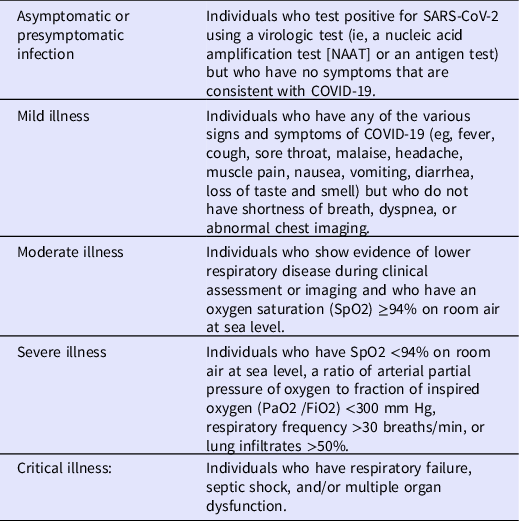
Adults with moderate to severe COVID-19 disease (Table 1) requiring supplemental oxygen by non-high flow nasal cannula and who were unable to be discharged home were considered for admission. Reference Breyre, Sloane and Herring3,Reference Gandhi, Lynch and Del Rio6,7 Clinical care was provided in line with published standards of clinical practice for the care of COVID-19 patients, including the use of remdesivir and dexamethasone. 7 ACS-IVC2 received its first patient on November 19, 2020. In the first month of operation, the facility was focused on coordinating with local and state-level agencies, enhancing the logistical supply network, and refining the staffing and administrative support needed.
Clinical spectrum of SARS-CoV2 infection

Note: Reproduced from reference 7.
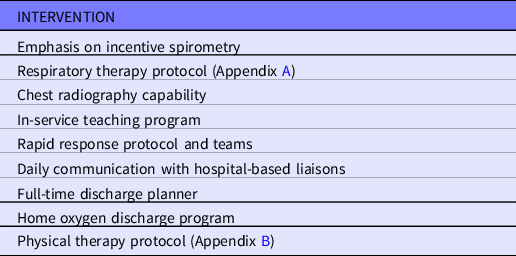
Multiple interventions to improve clinical care were initiated in the transition period between December 15 and December 31, 2020. The clinical care interventions were a combination of clinical guidance, improved clinical capability, and formalized treatment protocols (Table 2).
Instituted changes in the provision of clinical care at the ACS-IVC2 in the transition period from December 15, 2020, to January 1, 2021

The impact of these clinical care interventions on the care and disposition of patients were evaluated by comparing 2 groups: those admitted before implementation of the clinical care interventions and those admitted following the interventions. The transfer rate back to hospital was evaluated as a surrogate measure of the efficacy of patient selection for admission to the ACS and competency of care provided to these moderately to severely symptomatic patients.
Methods
Data on the demographics, clinical course, and disposition were collected from patients admitted to the hybrid-care level ACS-IVC2 site from its opening on November 19, 2020, until discharge of the last patient on February 28, 2021. Data were abstracted from paper charts and from the Web-based program Listrunner (https://www.listrunnerapp.com). The de-identified data were then imported into a spreadsheet on Google Sheets. These data were submitted to the Institutional Review Board (IRB) review board of Committee for the Protection of Human Subjects at the California Health and Human Services Agency and were determined to be IRB exempt.
The 2 cohorts, those admitted between November 19, 2020, and December 14, 2020 (Period 1), and those admitted from January 1, 2021, to February 28, 2021 (Period 2), were compared to evaluate the impact of clinical care interventions instituted during the Transition Period (15 to 31 December 2020) on a range of demographic and outcome measures, with an emphasis on hospital transfer rates. The Transition Period data were excluded from statistical analysis to reduce confounding from partially implemented protocols. It had the added benefit of excluding the holiday period, where staffing, transfer decisions, and discharge decisions may have been affected. Statistical analysis was performed using Stata/BE 17.0 (StataCorp LP, College Station, Texas). Measured values were reported as percentages or mean ± standard deviation. Mean values of continuous variables were compared using the Welch’s t-test with unequal variances. Categorical variables were compared using the χ2 tests. A P value of < 0.05 was considered statistically significant.
Results
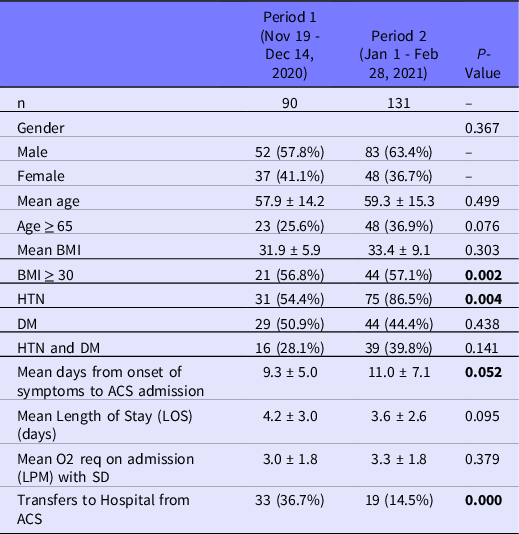
The ACS-IVC2 was in operation from November 19, 2020, to February 28, 2021. A total of 326 patients were admitted over a 3-mo time period, with 90 admitted in Period 1 (November 19 - December 14, 2020) and 131 admitted in Period 2 (January 1, - February 28, 2021) (Table 3). All patients admitted to the ACS were confirmed COVID-19 positive before acceptance, and all met criteria for hospital-level care with moderate to severe COVID-19 symptoms.
Demographics of patients admitted to the ACS-IVC2

*P value compares Period 1 with Period 2 patients.
Of these 326 patients, 247 (73.3%) patients were discharged home, 79 (24.2%) were transferred back to a hospital, 3 (0.9%) were discharged to a skilled nursing facility, and 5 (1.5%) left against medical advice (AMA). The median length of stay (LOS) was 3 d.
The patients were admitted to the ACS from the local hospitals at an average of 10.3 (± 0.47) days from the onset of symptoms, with more time between symptom onset and ACS admission in Period 2 as compared to Period 1 (9.3 ± 5.0 vs 11.0 ± 7.1; P = 0.052). Among the 273 patients for which the originating location (emergency department vs medical floor) was recorded, 68% of patients arrived to the ACS as a direct admission from the emergency department. The average age was 58.7 (± 0.99) y old. Male and female patients presented equally. Most patients (60.8%) were obese (body mass index [BMI] ± 30) across both periods; however, a significantly higher number of obese patients presented to the ACS in Period 2 as compared to Period 1 (67.7% vs 32.3%; P < 0.00). The most common comorbidities were hypertension (HTN) and diabetes mellitus (DM), with more than half the patients (57%) admitted having 1 or both diseases. Significantly more patients presenting to the ACS in Period 2 had comorbid hypertension than in Period 1 (86.5% vs 54.4%; P < 0.001). A total of 90% of the patients required supplemental oxygen at rest on admission. Median supplemental oxygen requirements on admission to the ACS was 3 LPM (0-8 LPM) while the mode was 4 LPM. The 2 cohorts of patients, Period 1 and Period 2, were similar in age, gender distribution, and median admission oxygen requirement.
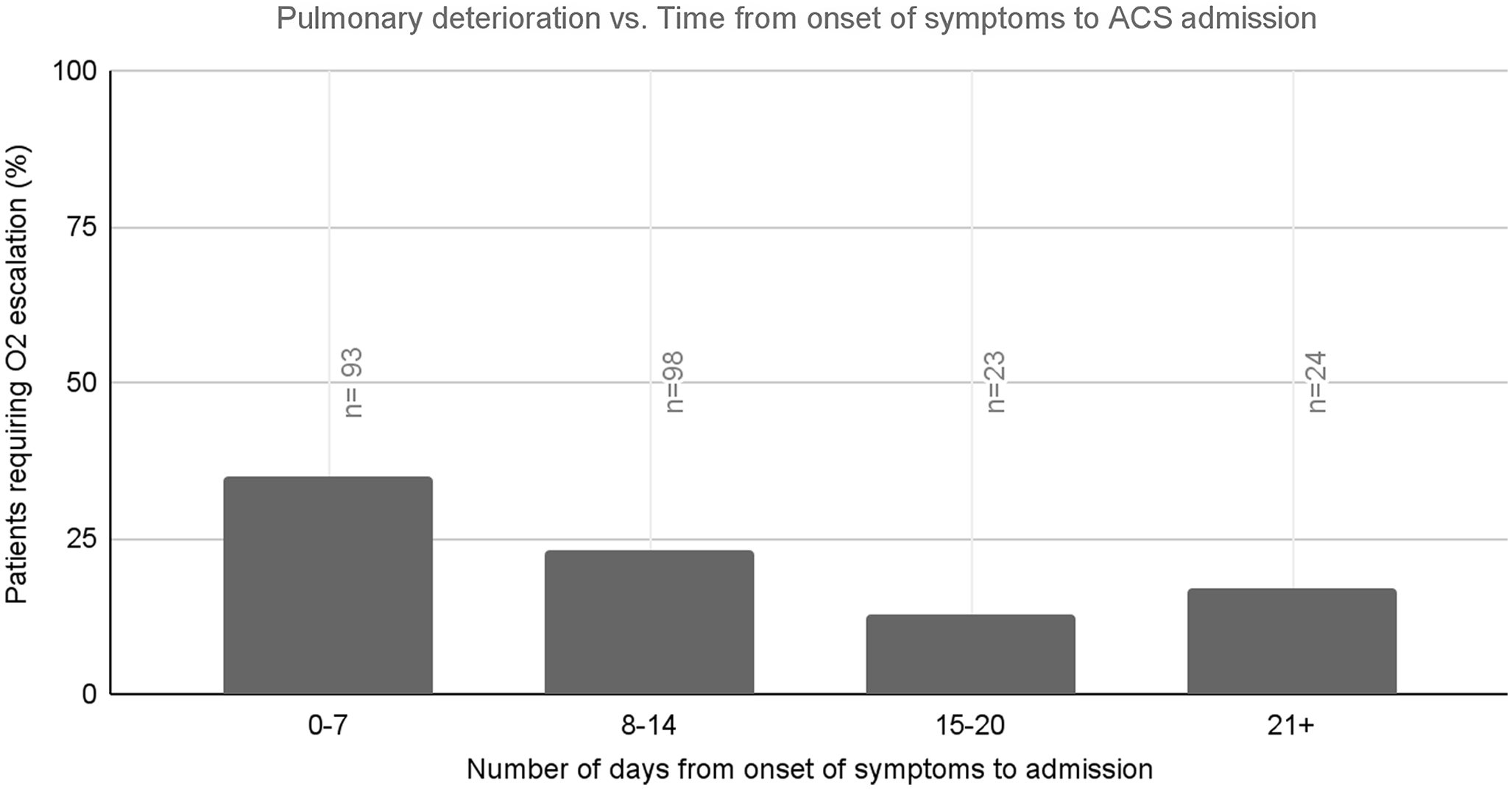
We classified patients as experiencing pulmonary deterioration if they required an increase in supplemental oxygen needs of 4 LPM or more at any time during their stay at the ACS. Overall, 24.4% of patients (n = 221) required an increase in supplemental oxygen requirements of 4 LPM or more in Period 1 and 2, with 40.7% of these patients requiring transfer back to the hospital. Periods 1 and 2 each had 27 patients requiring an increase of supplemental oxygen needs of 4 LPM or more, and each period had 11 of those patients experiencing pulmonary deterioration transferred. Patients who were admitted to the ACS within the first 7 d of their onset of symptoms, had the highest likelihood of escalation in their oxygen requirement by more than 4 LPM (47.7% vs 31.4 % after the first 7 d; P < 0.053) (Figure 1).
Patients requiring oxygen escalation of 4 LPM or more plotted against the number of days between onset of symptoms and admission.

During the whole operation of ACS-IVC2, there were a total of 79 transfers back to the hospital, with Periods 1 and 2 accounting for 52 of them. Transfers were mainly due to pulmonary and cardiac issues. Forty-six patients (58%) were transferred for hypoxia or respiratory distress, with 27 patients requiring more than 4 LPM increase in supplemental O2. Thirteen patients (16%) were transferred for cardiac problems including chest pain and EKG (electrocardiogram) changes. Other reasons for transfers included rectal bleeding and abnormal labs. There were no deaths and no intubations before or during ambulance transport back to the hospital during any of the transfers. Twelve of 79 patients ultimately returned to the ACS, following in-hospital evaluation and treatment. Median days spent in hospital before readmission to ACS was 4 days. Outcomes for the other 67 patients transferred to the hospital are not known.
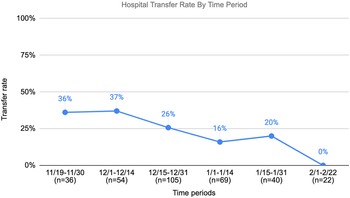
The transfer rate back to the hospital for patients initially admitted to the ACS decreased from 33 transfers of 90 admissions (36.7%) in Period 1 to 19/131 (14.5%) in Period 2 (P = 0.002).
Discussion
The main objective of an ACS is to offload overburdened hospitals. This is especially important for small community hospitals in remote areas such as those in Imperial County, where each of the hospitals are licensed for less than 200 beds and there are no tertiary care centers in the county. Reference Breyre, Sloane and Herring3 Kadri et al. found that hospitals experiencing surges were associated with higher mortality rates. Reference Kadri, Sun and Lawandi8
COVID-19 pneumonia is characterized by a variable clinical course with few reliable predictors of subsequent deterioration. With the paucity of effective treatments other than oxygen and respiratory support available during the time period that this ACS operated, clinical deterioration requiring a higher level of medical treatment is expected for some patients. Because ACS usually cannot match the full capability of a general acute care hospital, judicious patient selection and optimization of care provided within the ACS is important to provide safe and quality care to limit transport of patients back to overwhelmed hospitals.
For the ACS to provide expanded support to the local hospitals, admission criteria were broadened when the Imperial ACS was reopened during the second COVID-19 wave. The oxygen limitation was increased from 2 LPM to 8 LPM. Oxygen concentrators with a maximum flow rate of 10 LPM were used as the primary source of supplemental oxygen, delivered by means of simple nasal cannula, nasal cannula oxymizer, or face mask. Reference Devereaux, Backer and Salami9 All patients had continuous pulse oximetry monitoring. With this oxygen strategy, patients were accepted with up to an 8 LPM initial oxygen requirement, allowing some reserve for escalation of oxygen therapy in case of respiratory deterioration.
Admission criteria were also expanded to include more complex comorbidities. Sanyaolu et al. noted that COVID-19 patients with a history of hypertension, obesity, chronic lung disease, diabetes, and cardiovascular disease are at greatest risk for severe disease and have worse prognosis. Reference Sanyaolu, Okorie and Marinkovic10 Well-controlled chronic diseases were successfully managed, such as those requiring hemodialysis, with active malignancies, and liver cirrhosis. Patients with obstructive sleep apnea could bring their continuous positive airway pressure device from home to be used with entrained supplemental oxygen at nighttime. Obesity was a limitation only if patients could not fit in the bariatric wheelchairs or could not self-prone.
The major care improvements implemented at the ACS-IVC2 to optimize patient treatment and reduce the need to transfer patients back to the hospital included both patient care and staff team support. Patient care optimization included emphasis on incentive spirometry to decrease atelectasis from low lung volume breathing, pulmonary rehabilitation, and gradually progressive physical therapy. Reference Seyller, Gottlieb and Colla11,Reference Zhu, Wang and Zhou12 Continuous pulse oximetry and trending of a patient’s incentive spirometry volume trend also served as a clinical sign for disease progression or improvement. During both time periods, standard treatment for ACS patients included Remdesivir (if not provided during care before transfer), dexamethasone, and anti-thrombotic therapy, encouragement for self-proning, and weaning of supplemental oxygen as tolerated, which were standard of care recommendations at that time. Data on the extent and degree of individual adherence to self-proning recommendations are not available.
Because staff consisted of rotating disaster medical (paid) volunteers with many new program graduates, tools to optimize team function and support decision-making were instituted. These included pre-printed admission orders, protocols for clinical care, regular in-service education, integration of pharmacists into the clinical teams, and establishment of a rapid response team that could evaluate and stabilize a patient with clinical deterioration or signs of distress (Table 2). Active team integration has been demonstrated in other settings to improve care and reduce medical errors. Reference Morey, Simon and Jay13,Reference Risser, Rice and Salisbury14 ACS admission criteria were widely circulated within the hospitals, and clinical liaisons at each hospital had daily calls with ACS staff to determine which patients were suitable for care at the ACS.
Not all patients who required an increase in O2 flow rates were transported back to the hospital. The use of portable chest x-ray permitted ACS clinicians to monitor progression of disease and supported clinical decision making for patients with pulmonary deterioration. Patients who required increased supplemental O2 at the ACS, without significant radiographic change, and remained hemodynamically stable were kept at the ACS and closely monitored. Reference Kohli, Hande and Chugh15
Efforts also focused on preventing patients from returning to the emergency department after discharge from the ACS. Respiratory therapy and physical therapy aimed to optimize patient functionality and pulmonary rehabilitation. With the establishment of a home oxygen program, patients who were stable on supplemental oxygen less than 5 LPM were discharged home with close monitoring through home health and paramedic visits.
While patients in the 2 time periods were similar in demographics and comorbidities, the transfer rate for new admissions decreased by nearly 60% with no deaths or emergent intubations before or during transport. There are many factors that may affect the transfer rate, but we observed that implementation of process improvement clinical care interventions significantly contributed to this reduction in transfer rate.
Symptomatic patients with COVID-19 tend to have potentially significant underlying comorbidities, which complicate the provision of care in a non-traditional environment. At a similar hospital-level ACS in New York caring for less-severely symptomatic COVID-19 patients with a maximum supplemental oxygen requirement of 4 LPM on admission, Mathews et al. had a transfer rate of 12%. Reference Mathews, Podlog and Greenstein16 At the Imperial County ACS, the transfer rate was 14.5% of admissions for a higher acuity patient population with greater initial oxygen requirements.
Patients within the first week of symptom onset are in the acute infection phase and have a higher probability of deterioration. Reference Datta, Talwar and Lee17 Admitting patients who are more than 1 wk from the onset of symptoms may assure that supplemental O2 requirements can be met and transfer rates further decreased; however, we accepted patients directly from the 2 hospital emergency departments when both the ED and the in-patient services were experiencing major surge.
The relative value of individual clinical care interventions on reduced transfer rates or improved aggregate care cannot be determined from our data. The effects of such clinical changes are likely synergistic and are reflected in overall improvements in care delivery. After a period of 2 wk (Transition period), a 60% reduction in transfer rate was achieved despite a higher acuity patient population and shorter length of stay (Figure 2). There were no dramatic changes in COVID-19 treatments or the virus itself during that time, and staff expertise with a rotating core of volunteer nurses and doctors did not account for the difference.
Percent of patients transferred back to hospital in each time period. n = number of patients admitted in that time period.

The transfer rate provides a useful measure of patient appropriateness and the ability of a hybrid care ACS to provide a safe and effective means to decompress overburdened hospitals. While transfers for patients who deteriorate are expected, a high return rate may reflect an increased health risk to patients, greater costs to the health-care system, increased logistical burden of patient transport, and a lower perceived value of the ACS to the local medical community. The relative impact on health-care surge and cost-effectiveness of ACS versus expanding resources within hospitals is not resolved and likely depends on many factors, including the health resources within a community and region, the nature of the health-care surge, and the capabilities of the ACS. The experience in Imperial County demonstrates the potential value of ACS as well as factors to optimize this value to both patients and health systems.
This observational study has multiple limitations. While the Imperial County ACS was 1 of the highest used ACS locations in the state of California, the overall patient admissions totaled 326, limiting ability to generalize these results. Additionally, this patient population is from a resource-limited and health-care–limited area of the United States, which also limits application to areas with greater resources and enhanced preventative health care. In analyzing the change following this study’s intervention, the local inpatient capacity increased from Period 1 to Period 2. During this time, tents and additional staffing increased the local hospitals’ ability to admit more patients, and this may have altered the patients who presented as candidates for the ACS. Long-term patient follow-up would be useful because 67 of the 79 patients transferred were lost to follow-up. Outcomes for patients discharged on the home oxygen program were not available for this analysis, but maybe evaluated in a subsequent publication. Future studies at other ACS should also look at the application of similar clinical care interventions and validate the use of transfer rate as a metric for ACS.
Given that hospitals experiencing surges are associated with higher mortality, Kadri et al. also suggested ACS should be opened earlier to prevent hospitals from reaching capacity. This topic is especially important as regions across the country experience rising COVID-19 cases and consider instituting crisis standards of care (CSC). California has so far been able to avoid CSC by using multiple other measures, including ACS, to manage the surge.
Conclusions
ACS are a viable option for managing COVID-19 patients and provide relief to overburdened hospitals. Continuous quality improvement of clinical care protocols and enhancing team performance with education and counseling are recommended to optimize care at an ACS and should be part of every ACS plans. Transfers back to a surging hospital system for patient decompensation is occasionally necessary, but efforts to limit these occurrences are warranted. Using the transfer rate for patients from an ACS back to a general acute care hospital is proposed as a metric of appropriateness of patient selection and the ability of the ACS to treat patients. The data support the implementation of clinical care interventions to help reduce the transfer rate back to hospitals.
Acknowledgments
The authors thank Molly Pringle and Gloria Cheng. The authors recognize the tremendous work, organization, and leadership by individuals at EMSA, CAL-MAT, and Imperial County. The authors also recognize the numerous volunteer responders who worked throughout the state of California during the COVID-19 pandemic. Special thanks to David Duncan, MD, EMSA Director during COVID-19 response, and Craig Johnson, Chief, Disaster Medical Services Division, EMSA.
Author contributions
All authors contributed to the development of the manuscript and provided content for this article.
Conflicts of interest
The authors have no conflicts of interest to disclose.
Appendix A Respiratory Therapy Guidelines for the Imperial Alternate Care Site
The Imperial ACS has been established due to the COVID needs in Imperial County. The ACS is neither a regular hospital nor a skilled nursing facility, so guidelines differ in this setting. Due to the disaster, the number of respiratory therapists (RTs) are limited, and it is important to use their skills in their area of expertise and train the nurses, LVNs, paramedics, EMTs, and CRNs to help with the less specialized respiratory needs of the patient.
The following treatments/procedures will be done by the non-Respiratory Therapy staff on a regular basis. If you have any questions about how to do them correctly, please ask 1 of the RTs or physicians.
-
Incentive Spirometry Instruction (please show the patient how to use it).
-
Incentive Spirometry Documentation (please document the patient’s IS level)
-
Metered Dose Inhaler (MDI) (please give the patient their treatment and document)
Oxygen therapy can be managed by the non-Respiratory Therapy staff IF:
-
The oxygen level is 4 LPM or less
-
Non-Respiratory Staff can do oxy-walks
-
Non-Respiratory Staff can wean patients down from 4 LPM
-
The oxygen level needs to be raised to maintain a saturation of 92% or higher
-
Non-Respiratory Staff can always turn up the Oxygen flow rate. They can only turn down the oxygen rate if it starts at 4 LPM.
-
The Respiratory Therapist needs to be notified if an interface is changed (ie, going from nasal cannula at 4 LPM to a mask at 8 LPM to maintain the saturation of 92%)
Please watch the video from the Fairview ACS on Oxygen and devices https://youtu.be/bef05o19Iz0
Please watch the video from the Fairview ACS on Oxygen weaning https://youtu.be/a8DfSKaUrmE
The following should always be done by Respiratory Therapy
-
Initial Respiratory Assessment
-
Daily Respiratory Assessment
-
Management of Oxygen of 5 LPM or higher
-
Respiratory Decompensation Management
For Respiratory Decompensation:
Anyone noting respiratory decompensation should call the Respiratory Therapist. The Respiratory Therapist then decides on the patient’s status. If further care is needed, the Respiratory Therapist calls the Provider. The Provider will then assess the patient and provide treatment. If a decision is made to transfer the patient, the Provider making that decision will authorize an ambulance be called (unless a Code Blue is called and then the transport is called immediately).
Cheat Sheet for Respiratory Treatment
This is just a guide and not an order sheet. Not all of these medications may be ordered by the provider. It is for information only. Please follow the dosing that is on the order sheet.
Incentive Spirometry
-
Patient to do it every 20 min, 5 times, while awake.
-
Maximal effort goal is predicted for male and female based on age and height- see chart
-
Try to get them to at least 1500
-
Document in the chart once a shift
Metered Dose Inhaler
-
Remember to always shake the inhalers before using (except Qvar does not need to be shaken).
-
For new, 1st time to be used MDI’s - Prime 4 times before 1st time use only
-
Albuterol (beta agonist) fast acting bronchodilator
-
Always give this inhaler first if more than 1 inhaler is ordered.
-
Always use a spacer (if available) if no spacer available, use 2 finger technique for proper spacing of MDI
-
-
Combivent inhalers may not be available. If it is not, then we make our own version using an Albuterol inhaler and an Atrovent inhaler. The equivalent to Combivent is Albuterol (2 puffs) and Atrovent (2 puffs) (total of 4 puffs)
-
Qvar (steroid inhaler)
-
Patient breath activated - opening readies for delivery, then close to prepare for next inhalation delivery. Open and close for each breath to be delivered.
-
Do NOT use a spacer
-
No need to shake
-
40 µg – give 4 puffs to equal 160 µg
-
80 µg – give 2 puffs to equal 160 µg
-
Given BID for a total of 320 mcg per day
-
Patient needs to swish water in mouth (and spit out) after use (do not swallow)
-
-
Symbicort 80 & 160 doses (steroid and long-acting bronchodilator)
-
Maintenance medication for Asthma/COPD
-
2 puffs q 12 h
-
Has been added on as a prn per GINA guidelines
-
Oxy-walk (only if at 4 LPM or less)-desaturation for home oxygen qualification is <89%
-
30-sec sit to stand test
-
At least 2 times in 30 sec unassisted
-
-
6-min oxy walk test (only if Home O2 is being considered)
-
Vitals need to be stable
-
If desaturating, add O2 1 L at a time to maintain saturation >90%
-
Weaning off O2 (4 LPM or less)
-
Goal is 92% on Room Air
-
Decrease by 1 liter and monitor for 1-2 h
-
Can continue to go lower if the O2 sat is still 92% or greater
-
If they fail weaning on 1 d, wait and try again the next day
-
Patients should remain on Room Air successfully for a period of at least 24 h before discharge.
Caution: New admit patients may be on the worsening side of the disease so do not wean until monitored for 24 to 48 h.
Appendix B Physical Therapy Guidelines for the Alternate Care Site (ACS)
The Imperial ACS has been established due to the COVID needs in Imperial County. The ACS is neither a regular hospital nor a skilled nursing facility, so guidelines differ in this setting. Due to the disaster, the number of physical therapists (PTs) are limited, and it is important to use their skills in their area of expertise and train the nurses, LVNs, paramedics, EMTs, and CRNs to help with the less specialized physical needs of the patient.
The following patient and non-patient related basics may be administered under the supervision of licensed PTs by the non-PT staff on a regular basis. If you have any questions about how to do them correctly, please ask 1 of the PTs or physicians.
This is the profile of a patient suitable for this:
-
The patient is not using an assisted device such as a cane, wheelchair, or walker
-
The patent is on 4 LPM of oxygen or less
-
The home the patient is going to has no obstacles (no stairs, no stories)
If your patient fits this profile, please refer to the below established protocol
(You can always walk these kinds of patients with devices but discharge planning should be done by PT)
Ambulate them to tolerance following the protocol of maintaining their sats at 92%
IF the patient is on Room Air for 8 h and sats at 92% or better, please notify the PT or Physician and do the following:
-
Ambulate the patient 300 feet on Room Air
-
If the pulse ox is 89% or greater, no home O2 is required and he/she is recommended for discharge
-
If the pulse ox drops below 89%, allow the patient to rest for 5 min
-
If the pulse ox drops below 85%, stop the oxy walk
-
If the heart rate goes above 90% of 220-age (144 for example for a 60-y-old) or the patient is in distress, stop the oxy walk.
-
If the pulse ox returns to 89% or greater at 5 min, no home O2 is required and he/she is recommended for discharge
-
If the pulse ox is less than 89% after 5 min, home O2 is recommended and consider repeat testing the next day.
There is a video at https://youtu.be/wzLij516BEc from the Fairview ACS on patient movement and more advanced techniques such as the Hoyer lift. It is worth reviewing.
Discharge Worksheet
Patient name: _______________________
Date: _____________ Time:_________________
DISCHARGE Planning by EMT:
-
Patient on Room Air at rest for 24 h and Sats at 92% or higher
-
Provider approves discharge planning
-
PT approves discharge planning
-
Proceed with Oxy Walk
-
Oxy Walk Results:
-
Date___________________________________
-
Distance walked: _________________________
-
Lowest O2 Sat____________________________
-
Recovery time to O2 Sat >88%_______________
-
Maximum Heart Rate______________________
-
DISCHARGE Planning by PT:
-
Community Ambulation Clearance:_________
-
# of Stairs: _____________
-
10M Walk
-
Time: _____________
-
AD: ______________
-
-
TUG Test:
-
Time: ____________
-
AD: ______________
-
-
30” Sit to Stand Test:
-
# of Reps: _________
-