Implications
Embryonic mortality is a major source of economic loss in the cattle industry, and may occur because of intrinsic embryonic, maternal and management factors. These factors may interact, which makes difficult to study their mechanisms of action and the design of appropriate therapeutic approaches. Herein, we used an in vivo model, considering a compromised embryo and a high-fertility recipient, to evaluate therapeutic strategies designed to enhance embryonic survival. Preliminary results showed that treatment with hCG at embryo transfer may be of interest to decrease embryonic mortality, whereas carprofen had no apparent effect on embryo survival.
Introduction
Pregnancy loss is a major cause of reproductive failure and of economic waste in dairy herds. Pregnancy losses are more prevalent (up to 40%) until maternal recognition of pregnancy (Humblot, Reference Humblot2001). Early and late embryonic losses are significantly greater in lactating cows than in heifers (Chagas e Silva et al., Reference Chagas e Silva, Lopes-da-Costa and Robalo Silva2002; Sartori et al., Reference Sartori, Sartor-Bergfelt, Mertens, Guenther, Parrish and Wiltbank2002). This is related to the higher prevalence of sub-optimal post-ovulatory plasma progesterone (P4) concentrations (CRRP NE-161, 1996; Chagas e Silva et al., Reference Chagas e Silva, Lopes-da-Costa and Robalo Silva2002) and to the lesser steroidogenic capacity of luteal cells (Shelton et al., Reference Shelton, Gayerie De Abreu, Hunter, Parkinson and Lamming1990; Pretheeban et al., Reference Pretheeban, Balendran, Gordon and Rajamahendran2010) of cows, compared with heifers. Embryonic survival is dependent on the timely elongation and secretion of interferon tau by the blastocyst, in order to inhibit the luteolytic signal, features that are regulated by maternal concentrations of P4 (Garrett et al., Reference Garrett, Geisert, Zavy and Morgan1988; Kerbler et al., Reference Kerbler, Buhr, Jordan, Leslie and Walton1997; Mann and Lamming, Reference Mann and Lamming2001). This regulation by P4 is apparently indirect (Clemente et al., Reference Clemente, de La Fuente, Fair, Al Naib, Gutierrez-Adan, Roche, Rizos and Lonergan2009) through the modulation of the luteolytic signal (Mann et al., Reference Mann, Lamming and Payne1998) and the composition of the histotroph (Lonergan, Reference Lonergan2011) and, probably by other embryo-maternal signaling pathways yet poorly understood or unknown (Bazer et al., Reference Bazer, Wu, Spencer, Johnson, Burghardt and Bayless2010).
Because of its role in pregnancy establishment and maintenance, P4 supplementation of early pregnancy has received the focus of attention of practitioners and researchers, as a strategy to control embryonic mortality in cattle. Early luteal (Days 5 to 7) treatment with human chorionic gonadotropin (hCG) induces ovulation of the dominant follicle, formation of secondary corpora lutea (CL) and increases plasma P4 concentrations. These effects on embryo survival, however, have been controversial (recently reviewed by De Rensis et al., Reference De Rensis, López-Gatius, García-Ispierto and Techakumpu2010; Lonergan, Reference Lonergan2011; Wiltbank et al., Reference Wiltbank, Souza, Carvalho, Bender and Nascimento2011). Target treatment of risk populations seems to be of merit, whereas general use of the drug seems to be redundant. This probably also applies to embryos. Survival of cryopreserved embryos was increased through hCG therapy at embryo transfer (ET) but that of embryos originated through artificial insemination (AI) was not improved (Chagas e Silva and Lopes-da-Costa, Reference Chagas e Silva and Lopes-da-Costa2005).
Another strategy to control embryo mortality is to inhibit the endometrial release of luteolytic and other pro-inflammatory prostanoids and cytokines, either at AI/ET or at the onset of maternal recognition of pregnancy, through the administration of non-steroidal anti-inflammatory drugs (NSAIDs). Results also have been controversial. Administration of flunixin meglumine at onset of maternal recognition of pregnancy (Days 13 to 16 post-AI) increased pregnancy rate in some (Guzeloglu et al., Reference Guzeloglu, Erdem, Saribay, Thatcher and Tekeli2007; Merril et al., Reference Merril, Ansotegui, Burns, MacNeil and Geary2007), but not all experiments (Geary et al., Reference Geary, Ansotegui, MacNeil, Roberts and Waterman2010; Rabaglino et al., Reference Rabaglino, Risco, Thatcher, Lima, Santos and Thatcher2010; von Krueger and Heuwieser, Reference von Krueger and Heuwieser2010). Flunixin meglumine administered at ET significantly increased pregnancy rate of recipients, although depending on location (Purcell et al., Reference Purcell, Beal and Gray2005) and on embryo quality (Scenna et al., Reference Scenna, Hockett, Towns, Saxton, Rohrbach, Wehrman and Schrick2005). Ibuprofen lysinate administered to recipient heifers 1 h before ET significantly increased survival of frozen-thawed embryos (82% v. 56%, respectively), compared with controls (Elli et al., Reference Elli, Gaffuri, Frigerio, Zanardelli, Covini, Candiani and Vignali2001).
Carprofen is a long-acting NSAID that allows treatment with a single administration and with a low milk excretion rate (Ludwig et al., Reference Ludwig, Jordan, Rehm and Thun1989), which is approved for use in lactating dairy cattle without a withdrawal period. In the bovine, a recent study showed that carprofen preferentially inhibits cyclooxygenase (COX) isoform 2 activity (Brentnall et al., Reference Brentnall, Cheng, McKellar and Lees2012). Treatment with carprofen had no positive effect on pregnancy rate, either given at AI in dairy cows (Heuwieser et al., Reference Heuwieser, Iwersen and Goetze2011) or at Days 14 to 16 post-AI in dairy heifers (von Krueger and Heuwieser, Reference von Krueger and Heuwieser2010). The effect of carprofen administered at ET on embryo survival has not been reported.
In this study, a novel in vivo model was used to evaluate therapeutic strategies designed to enhance embryonic survival. This embryo-recipient model (demi-embryo and virgin dairy heifer) allowed the evaluation of drug effects on the survival of low developmental competence embryos, ruling out main maternal factors (uterine health, sub-luteal P4 concentrations) associated with embryo mortality. The objective of this study was to evaluate the effects of treatment with hCG, carprofen and hCG plus carprofen at ET on plasma P4 concentrations of recipient virgin dairy heifers and on embryonic growth and survival. The main experimental hypothesis behind the study is that luteotrophic (hCG) and NSAID (carprofen) drugs, inducing changes in uterine environment and function, may rescue development and survival of low developmental competence embryos (demi-embryos). These effects on embryonic development and survival may occur in an additive or even synergic way following the simultaneous administration of hCG and carprofen.
Material and methods
Recipients and treatments
The entire set of recipients was managed as a single group. Virgin Holstein heifers (n = 163) from a single dairy were enrolled in the experiment. These heifers were 15 months old, had a mean body condition score of 3 (scale 1 to 5), were healthy, normally cyclic and gynaecologically sound as evaluated by a routine veterinary examination. At this examination, heifers with a palpable mature CL were treated with a prostaglandin F2α analogue (Veteglan, Laboratories Calier, Barcelona, Spain) and the tail head was painted to improve subsequent detection of estrus. All recipients were observed in standing estrus with a clear mucous vulvar discharge, and immediately before transfer, all had a single mature CL. At ET, recipients were randomly allocated to one of four treatments: (i) hCG (Chorulon, Intervet, Boxmeer, The Netherlands; 2500 IU im); (ii) carprofen (Rimadyl, Laboratories Pfizer, Portugal; 500 mg iv); (iii) hCG plus carprofen; and (iv) untreated controls.
Embryo production, bisection and transfer
Embryos were recovered from superovulated Holstein donors from the same herd according to methods previously described (Chagas e Silva and Lopes-da-Costa, Reference Chagas e Silva and Lopes-da-Costa2005). Quality grade 1 embryos (Stringfellow and Seidel, Reference Stringfellow and Seidel1998) were selected for bisection as reported elsewhere (Lopes-da-Costa et al., Reference Lopes-da-Costa, Chagas e Silva, Deloche, Jeanguyot, Humblot and Horta2011). Briefly, one embryo at a time was washed in splitting medium (Vigro Splitting Medium, AB Technology, Pullman, WA, USA), moved into a 50 μl microdrop of the same medium and bisected through one microblade. Bisection was accomplished so that the two halves were of similar size and, for blastocysts so that the inner cell mass and the trophoectoderm cells were equally distributed in the two demi-embryos. Upon bisection, the two halves were transferred to culture medium (Vigro Holding Plus, AB Technology, Pullman, WA, USA) for 5 min, washed, evaluated, loaded in French mini-straws, and immediately transferred to the uterine horn ipsilateral to the CL bearing ovary of recipients on Day 7 of the estrous cycle (Day 0 = estrus). Demi-embryos were randomly allocated to the four treatments so that each donor produced one or more sets of demi-embryos for all treatments.
Secondary CL and pregnancy evaluation
Presence of secondary CL was evaluated on Day 14 and pregnancy was evaluated on Days 28, 42 and 63 by ultrasonography, using a 7.5 MHz rectal linear probe. A positive pregnancy diagnosis relied on imaging of an embryonic vesicle with embryo proper and of embryonic/fetal heartbeat and movements. On Day 42 embryonic measures were taken, including the crown−rump length (CRL) and the longest embryonic width (made at mid body, at the stomach level; herein referred as width). These measurements were assessed twice, the resulting mean being recorded as the eligible measurement. Pregnancy was presumed in recipients with luteal plasma P4 concentrations until Day 21. Four windows of embryonic/fetal mortality were defined: (i) early embryonic mortality (EEM), occurring from Days 7 to 15; estimated to have occurred in heifers returning to estrus 18 to 24 days following the reference estrus (Day 0) and with low plasma P4 concentrations (<2.0 ng/ml) on Day 21; (ii) late embryonic mortality 1 (LEM1), occurring from Days 16 to 28; estimated to have occurred in heifers not returning to estrus on Days 18 to 24, with luteal plasma P4 concentrations (>3.0 ng/ml) on Day 21 and found non-pregnant on pregnancy diagnosis on Day 28; (iii) LEM2, occurring from Days 28 to 42 in heifers found pregnant on pregnancy diagnosis on Day 28 and subsequently found non-pregnant on Day 42; and (iv) early fetal mortality (EFM), occurring from Days 42 to 63 in heifers found pregnant on pregnancy diagnosis on Day 42 and later found non-pregnant on Day 63.
Blood collection and storage and plasma P4 measurement
Blood samples from the caudal vessel were collected in all recipients on Days 0 (estrus), 7 (ET and treatment if any), 14 and 21. Pregnant heifers on Day 28 were further submitted to blood collection on Days 28, 42 and 63 of pregnancy. All blood collections were performed at 0900 h before feeding (except on Day 0). Blood was collected into 10 ml heparin-containing syringes (NH4-heparin, Monovette, Sarstedt) through an 18 G needle, immediately centrifuged at 400 × g for 20 min, and the supernatant plasma aliquoted into 1.5 ml cryotubes. These tubes were transported on ice to the lab and stored at −25°C until assayed. Plasma P4 concentrations were measured by a solid phase without extraction chemiluminescent immunoassay in an IMMULITE 1000 analyzer (Siemens Healthcare Diagnostics, GmbH, Eschborn, Germany), using commercial kits (IMMULITE 1000 Progesterone Kit, Siemens Healthcare Diagnostics, Amadora, Portugal). The analytical sensitivity of the assay was 0.2 ng/ml. The inter-assay and intra-assay coefficients of variation were 12.5% and 7.1%, respectively.
Statistical analysis
Data were analyzed using statistical software (Statistica for Windows, version 7.0, 2004, Statsoft, Tulsa, OK, USA). Categorical data were analyzed by the Fisher's exact test. Data from embryonic measurements were evaluated by ANOVA. Data from plasma P4 concentrations were also analyzed by ANOVA with repeated measures (7 days for pregnant and 4 days for non-pregnant recipients), considering the fixed effects of treatment, pregnancy (presence on Day 42), day (within-effect) and their interactions. Post hoc LSD (least significant difference) evaluations were computerized for all significant effects. Significance was tested at the 5% level (P < 0.05). Values are mean ± s.e.m., unless otherwise specified.
Results
Fourteen heifers were retrospectively removed from analysis because of the presence of luteal plasma P4 concentrations on Day 0 (n = 8; 5%) and to noncompliance to the experimental protocol (n = 6). Treatments with hCG and hCG plus carprofen induced secondary CL in 36 of 37 (97%) and 34 of 38 (90%) heifers, respectively, whereas treatment with carprofen did not induce the formation of secondary CL. Overall, secondary CL developed ipsilateral and contralateral to the primary CL on 46% and 54% of occasions, respectively. This distribution was similar in heifers treated with hCG alone or with hCG plus carprofen.
Plasma P4 concentrations
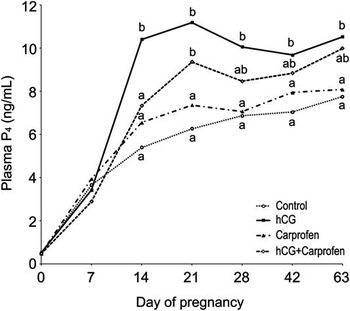
Group, pregnancy, Day and the interactions group × Day and pregnancy × Day affected (P < 0.01) plasma P4 concentrations of recipients. Mean plasma P4 concentrations on Day 7 were not affected by treatment and pregnancy (overall: 3.7 ± 0.1 ng/ml). Mean plasma P4 concentrations on Day 14 were affected by treatment (P < 0.01), but not by pregnancy. Overall (pregnant and non-pregnant heifers), concentrations on Day 14 were similar in control and carprofen treatments (6.1 ± 0.4 and 6.6 ± 0.4 ng/ml, respectively), being lower than in hCG plus carprofen treatment (8.7 ± 0.4 ng/ml) and hCG treatment (10.4 ± 0.4 ng/ml). Concentrations of these latter two treatments differed.
Figure 1 illustrates mean plasma P4 concentrations of recipients maintaining a pregnancy until Day 63. As shown, treatment with hCG increased mean plasma P4 concentrations on Days 14 (compared with all other treatments) to 63 (compared with control and carprofen). Treatment with carprofen had no effect on mean plasma P4 concentrations, whereas treatment with hCG plus carprofen only increased concentrations on Day 21 (compared with control and carprofen; but similar to hCG). Recipients presumed pregnant on Day 21 and later found non-pregnant on Day 28 (experiencing LEM1) had plasma P4 concentrations until Day 21 similar to those of recipients pregnant on Day 28. In LEM1 heifers, the range of plasma P4 concentrations on Day 21 was 4.1 to 16.6 ng/ml. Recipients pregnant on Day 28 and later found open on Day 42 (experiencing LEM2) had plasma P4 concentrations until Day 28 similar to those of heifers maintaining pregnancy until Day 42.
Mean plasma P4 concentrations of dairy heifers maintaining pregnancy until Day 63 following transfer of one demi-embryo and treatment with hCG or/and carprofen. Dots represent the LSD means; error bars are omitted to improve clarity. Dots with different superscripts differ significantly: abP < 0.05. Treatment groups: control (n = 16); hCG (n = 19); carprofen (n = 18); hCG + carprofen (n = 17). Overall (Days 0 to 63) mean s.e. (range) of P4 values: 0.14 (0.02 – 0.45). hCG = human chorionic gonadotropin.

Embryonic size and survival
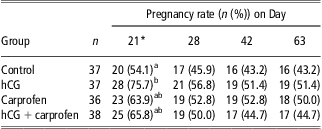
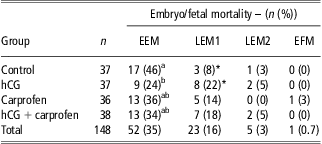
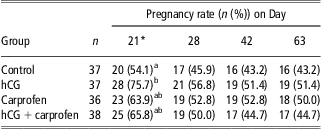
Embryonic size on Day 42 was not affected by treatments (P = 0.41; overall mean ± s.d.: CRL – 21.3 ± 2.0; width – 11.1 ± 1.2). Table 1 shows pregnancy rates on Days 21, 28, 42 and 63. Table 2 presents the rates of EEM, LEM1, LEM2 and EFM. The location of the secondary CL relative to the primary CL had no effect on pregnancy rate: overall, pregnancy developed on 56% of ipsilateral locations and on 51% of contralateral occasions.
Pregnancy rates of dairy heifers following transfer of one demi-embryo and treatment with hCG or/and carprofen
hCG = human chorionic gonadotropin.
*Presumed pregnant on Day 21 = luteal plasma P4 concentrations until Day 21 (range of values on Day 21: 4.1 to 16.6 ng/ml).
abP < 0.05 (within columns).
Embryo/fetal losses of dairy heifers following transfer of one demi-embryo and treatment with hCG or/and carprofen
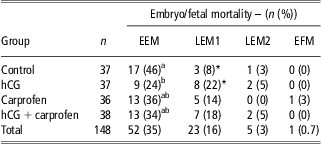
hCG = human chorionic gonadotropin.
EEM = early embryonic mortality occurring from Days 7 to 15; estimated to have occurred in heifers returning to estrus 18 to 24 days following the reference estrus (Day 0) and with low plasma P4 concentrations (<2.0 ng/ml) on Day 21; LEM1 = late embryonic mortality 1, occurring from Days 16 to 28; estimated to have occurred in heifers not returning to estrus on Days 18 to 24, with luteal plasma P4 concentrations (>3.0 ng/ml) on Day 21 and found non-pregnant on pregnancy diagnosis on Day 28; LEM2 = late-embryonic mortality 2, occurring from Days 28 to 42 in heifers found pregnant on pregnancy diagnosis on Day 28 and subsequently found non-pregnant on Day 42; EFM = early fetal mortality, occurring from Days 42 to 63 in heifers found pregnant on pregnancy diagnosis on Day 42 and later found non-pregnant on Day 63.
*P < 0.1 (tendency; within columns).
abP < 0.05.
Discussion
Plasma P4 concentrations
Treatment with hCG on Day 7 of the estrous cycle significantly increased plasma P4 concentrations of non-pregnant heifers on Day 14 and, of pregnant heifers on Days 14 to 63. Interestingly, in pregnant heifers of group hCG plus carprofen, plasma P4 concentrations on Day 14 were lower than in group hCG, only reaching a similar mean to that of group hCG on Day 21. These results indicate that carprofen slowed and/or decreased the luteotrophic stimulus of hCG. This was not mediated through the efficiency of induction of secondary CL because in both treatments, all but one pregnant recipient developed secondary CL. As carprofen alone had no effect on plasma P4 concentrations, simultaneous treatment with carprofen and hCG may impair post-ovulatory remodeling of the secondary CL, as observed in the rat with other NSAIDs (Gaytán et al., Reference Gaytán, Morales, Bellido, Sánchez-Criado and Gaytán2006). This may compromise the subsequent luteal function of secondary CL, precluding or delaying full luteal expression of P4 synthesis. Additionally, carprofen might have inhibited the release of PGE2 in luteal and uterine cells, thus reducing the luteotrophic stimuli to the CLs. In fact, flunixin meglumin reduced the release of PGE2 in an isolated bovine uterus model (Braun and Kietzmann, Reference Braun and Kietzmann2004). Altogether, this may reduce or even remove the potential beneficial effect of hCG on embryo survival.
Recipients experiencing LEM1 (mortality between Days 16 and 28) maintained luteal plasma P4 concentrations (>4 ng/ml) until Day 21, similar to those of heifers maintaining pregnancy until Day 28. Therefore, plasma P4 concentrations until Day 21 did not allow the differentiation between LEM1 recipients and those maintaining pregnancy until Day 28. Also, recipients experiencing LEM2 (mortality between Days 28 and 42) had plasma P4 concentrations until Day 28 similar to those of heifers maintaining pregnancy until Day 42. Again, this indicates that plasma P4 concentrations until Day 28 were unable to distinguish between LEM2 recipients and those maintaining pregnancy until Day 42. Altogether, this indicates that in a high-fertility recipient (virgin dairy heifer), embryonic mortality after maternal recognition of pregnancy cannot be attributed to a peripheral deficiency in P4 concentrations until Day 28. In contrast, in a sub-fertility female model such as the lactating dairy cow, plasma P4 concentrations following maternal recognition of pregnancy are related to the occurrence of LEM. (Stevenson et al., Reference Stevenson, Tiffany and Inskeep2008). This pinpoints a clear difference between heifers and lactating cows regarding the relevance of P4 concentrations as a cause of LEM.
Embryonic survival
Pregnancy rate on Day 21 may be overestimated. Embryos dying after Day 16 trigger the maternal recognition of pregnancy mechanism and induce an extension of the estrous cycle with luteal plasma P4 concentrations on Day 21 (Humblot, Reference Humblot2001). In addition, treatment with hCG per se, may induce an extension of the estrous cycle (Sianangama and Rajamahendran, Reference Sianangama and Rajamahendran1992; Chagas e Silva and Lopes-da-Costa, Reference Chagas e Silva and Lopes-da-Costa2005). Nevertheless, treatment with hCG decreased EEM, thus increasing pregnancy rate on Day 21. This indicates that hCG treatment at ET rescued embryos through the maternal recognition of pregnancy window. In contrast, in hCG-treated heifers subsequent embryonic losses, mainly from Days 21 to 28, originated a Day 63 pregnancy rate that was no longer significantly different from that of controls. Nevertheless, compared with control, the numerical increase (8%) in pregnancy rate on Day 63 of hCG treatment can be of economic interest. At experiment design, we estimated an increase in pregnancy rate in the range of 5% to 20% based on previous (Chagas e Silva and Lopes-da-Costa, Reference Chagas e Silva and Lopes-da-Costa2005) and published (Nishigai et al., Reference Nishigai, Kamomae, Tanaka and Kaneda2002; Wallace et al., Reference Wallace, Breiner, Breiner, Spell, Carter, Lamb and Stevenson2011) results. Treatment with hCG induced the formation of secondary CL and a significant increase in plasma P4 concentrations. Because almost all recipients developed secondary CL, the relative effects of presence of secondary CL and of increased plasma P4 concentrations on embryo survival could not be dissociated.
NSAIDs inhibit the release of prostaglandins and other pro-inflammatory mediators through the inhibition of the COX-1 and COX-2 pathways. Uterine manipulation at ET induces the release of PGF2α (Scenna et al., Reference Scenna, Hockett, Towns, Saxton, Rohrbach, Wehrman and Schrick2005) and transfers requiring more manipulation of the uterus, putatively more traumatic, significantly decrease pregnancy rate (Chagas e Silva et al., Reference Chagas e Silva, Cidadão, Robalo Silva and Lopes-da-Costa1999). This is probably due to a transient inflammatory state of the uterus, resulting in PGF2α release, which is toxic for the embryo (Schrick et al., Reference Schrick, Inskeep and Butcher1993), and/or to an early demise of CL function. The reported beneficial effects on pregnancy rate following treatment with NSAIDs at ET (Elli et al., Reference Elli, Gaffuri, Frigerio, Zanardelli, Covini, Candiani and Vignali2001; Purcell et al., Reference Purcell, Beal and Gray2005; Scenna et al., Reference Scenna, Hockett, Towns, Saxton, Rohrbach, Wehrman and Schrick2005) were attributed to inhibition of prostaglandin release by the uterus in response to manipulation at transfer. Alternatively, NSAIDs could have induced an anti-inflammatory state on the uterus thus improving uterine receptivity. Carprofen, a long-acting NSAID, could potentially enhance the above effects and improve embryo survival. Treatment with carprofen at ET, although numerically increasing pregnancy rate on Day 63 by 7%, had no significant effect on pregnancy rate, compared with untreated controls. This is the first report on the use of carprofen at ET. In the present compromised embryo model, putative inhibition of manipulation-induced prostaglandin release by the uterus might have modestly enhanced embryo survival. This effect is unlikely to have been the result of a uterine health promoting effect of the drug, considering the virgin state of the genital tract model used in the experiment.
Treatment with hCG plus carprofen was based on the rationale that induction of secondary CL and increase in plasma P4 concentrations together with an inhibitory effect on manipulation-induced prostaglandin release at ET, could potentially originate an additive or even synergic effect on embryo survival. Carprofen apparently decreased the beneficial effect of treatment with hCG alone on embryo survival. This could be mediated through disruption of secondary CL function as discussed above.
The greatest prevalence of embryo losses occurred until Day 21 (overall 35%) and then from Days 21 to 28 (overall 16%), whereas losses in the late embryonic and early fetal periods were residual (3% and 0.7%, respectively). In the present in vivo model considering a high-fertility recipient, this indicates that low developmental competence embryos have an intrinsic deficiency to overcome the maternal recognition of pregnancy window and continue development until Day 28. In accordance with these results, therapeutic strategies designed to enhance embryo survival should be attempted during early embryonic development. Treatment with hCG rescued embryo survival through the maternal recognition of pregnancy window but failed to support development thereafter. This might indicate that a second drug-induced embryonic stimulus placed during or shortly after maternal recognition of pregnancy could potentially enhance further embryonic survival. Further studies involving a larger population size are needed to evaluate the above issues and to confirm the effects of drugs (hCG and carprofen) on embryo survival.
Embryonic size at implantation is similar to that previously reported for demi-embryos (Lopes-da-Costa et al., Reference Lopes-da-Costa, Chagas e Silva, Deloche, Jeanguyot, Humblot and Horta2011) and was not affected by treatments. This indicates that the putative effects of treatments on early embryonic elongation and growth were no longer observed at Day 42. Early luteal treatment with P4 or hCG induced longer conceptuses on Days 14 to 16 (Garrett et al., Reference Garrett, Geisert, Zavy and Morgan1988; Mann and Lamming, Reference Mann and Lamming2001), which probably also occurred in the present experiment. The fact that embryonic size at Day 42 of hCG-treated heifers was similar to that of untreated controls, reflects the plasticity of growth regulation mechanisms as previously reported (Lopes-da-Costa et al., Reference Lopes-da-Costa, Chagas e Silva, Deloche, Jeanguyot, Humblot and Horta2011).
In conclusion, herein is reported a novel in vivo model to evaluate therapeutic strategies designed to enhance survival of low developmental competence embryos. Treatment with hCG at ET induced formation of secondary CL and a significant increase in plasma P4 concentrations, which was associated to a significant decrease in EEM. However, subsequent embryonic losses resulted in a non-significant numerical increase by 8% of pregnancies established on Day 63. Therefore, treatment with hCG significantly rescued embryos through the maternal recognition of pregnancy window but was not able to support development thereafter. Alternatively, hCG could have simply delayed embryonic death and return to estrus, through its P4 effect on maternal recognition of pregnancy. Treatment with carprofen at ET had no significant effect on plasma P4 concentrations and rate of embryonic mortality. Treatment with hCG plus carprofen at ET induced formation of secondary CL but decreased the luteotrophic effect of hCG, resulting in no significant effects on rates of embryonic mortality. Poor developmental competence embryos had an intrinsic deficiency in overcoming the maternal recognition of pregnancy challenge and in proceeding to further development until Day 28 of pregnancy, whereas mortality beyond this point was only minimal. Therefore, therapeutic strategies designed to enhance survival of poor developmental competence embryos should be attempted before maternal recognition of pregnancy. Results on pregnancy rates should be confirmed in experiments involving a larger population size.
Acknowledgments
This study was funded by the grant PTDC/CVT/65690/2006 from Foundation for Science and Technology (FCT). Ana Torres was a PhD fellow from FCT (SFRH/BD/37666/2007).