Surgery for neonates with severe hypoplasia of either ventricle includes the bidirectional Glenn procedure, typically performed at 4–6 months of age, followed by the Fontan operation at 3–4 years of age.Reference Iyengar, Winlaw and Galati 1 , Reference Kogon, Plattner, Leong, Simsic, Kirshbom and Kanter 2 Compared with the bidirectional Glenn, the Fontan operation is associated with a longer length of stay, but historically reported costs are similar between these two surgical procedures.Reference Iyengar, Winlaw and Galati 1 – Reference Dean, Hillman, McHugh and Gutgesell 4 Postoperative complications rate and increased length of stay have been shown to substantially increase costs for those undergoing congenital heart surgery.Reference Pasquali, He and Jacobs 5 , Reference Benavidez, Connor, Gauvreau and Jenkins 6 Impaired ventricular function, elevated pulmonary artery pressures, and type of systemic ventricular morphology are reported to be predictors of poor Fontan outcomes.Reference Iyengar, Winlaw and Galati 1 , Reference Hosein, Clarke and McGuirk 7 – Reference Hirsch, Goldberg and Bove 10 The individual factors that directly influence cost and length of stay for the Fontan operation have not been fully explored in the modern era. The objective of this study was to evaluate resource utilisation and factors associated with resource use after the Fontan operation in a contemporary, large, multi-institutional cohort.
Materials and methods
This multi-institutional, retrospective cohort study of children who underwent the Fontan operation between January, 2004 and June 2013 utilised data from the Pediatric Health Information Systems Database. The Pediatric Health Information Systems database is a large inpatient administrative repository of 44 free-standing, not-for-profit children’s hospitals in the United States of America developed by the Child Health Corporation of America – a business alliance of children’s hospitals. Detailed information on demographics, diagnoses, procedures, medications, outcomes, and charges is available on every inpatient admitted to member hospitals since 1997. All patient-level data are de-identified. Evaluation of data quality and reliability is performed through systematic monitoring, including bimonthly coding consensus meetings, coding consistency reviews, and quarterly data quality reports. The study cohort was identified using International Classification of Diseases codes (ICD-9) for both bidirectional Glenn (ICD-9 Px 39.21) and Fontan (ICD-9 Px 35.94) procedures. We included Fontan patients who had their bidirectional Glenn at a Pediatric Health Information Systems participating hospital. This study was exempted from review by the University of Utah Institutional Review Board as all data received were de-identified at the time of retrieval.
In order to reflect contemporary practices, all patients undergoing a Fontan operation between ages 2–⩽6 years were included, whereas patients outside this age range were excluded. Individual patients with multiple medical record numbers or more than one Fontan Current Procedural Terminology codes were excluded.
Demographics and baseline characteristics
Demographic data including age, gender, race, payer, region, driving distance, and time to the closest tertiary-care children’s hospital as well as rural–urban commuting area codes were obtained from the database. Geographic region was defined as west, south, north-central, and north-east on the basis of US Census Bureau information. 11 Driving distance and time were obtained using zip codes and distance to the closest tertiary-care children’s hospital. ICD-9 codes and Current Procedural Terminology codes were used to identify diagnoses and procedures. Each factor evaluated consisted of a list of ICD-9 and Current Procedural Terminology codes that would indicate that particular diagnosis – for example, prematurity included ICD-9 codes 76,506 (extreme immaturity 1.5–1.75 g), 76,526 (31–32 completed weeks of gestation), 76,528 (35–36 completed weeks of gestation), as well as 11 other ICD-9 codes. The following baseline characteristics were analysed irrespective of hospitalisation with multiple codes pulled for each factor: pulmonary venous abnormalities, congenital diaphragmatic hernia, prematurity, gastrostomy tube, intracranial haemorrhage, dysphagia, sepsis, operative valvuloplasty, cardiac arrhythmia, seizures, vocal cord palsy, congenital anomalies including renal anomalies, and syndromes.
Patient identification and variables
Bidirectional Glenn and Fontan hospitalisations were identified by their respective Current Procedural Terminology codes. Information collected for both these hospitalisations included total length of stay, duration of mechanical ventilation, extracorporeal membrane oxygenation, cardiac arrest, atrioventricular valvuloplasty, seizures, intracranial haemorrhage, sepsis, thrombosis, acute renal dysfunction, heart block, and medication use such as vasoactive, heart failure, pulmonary vasodilator, diuretic, or anti-arrhythmic medications. Surgical volume per year at the hospital performing the bidirectional Glenn or Fontan and the total number of hospital admissions between the bidirectional Glenn and the Fontan operation were also obtained. Low-volume (<16 cases/year), moderate-volume (⩾16–<30 cases/year), and high-volume centres (>30 cases/year) were arbitrarily defined on the basis of a telephone survey of number of surgeries performed by high-, medium-, and low-volume centres.
Resource utilisation
Resource utilisation following the Fontan was defined as total hospital length of stay and total hospitalisation costs derived from charges. The estimated length of stay in days was calculated by subtraction of the date of admission from the date of discharge, not accounting for fractional days.
Charges
Charges included hospital-to-patient billing for both type and number of imaging studies, laboratory expenses, clinical billing encounters, medications, and general inpatient stay.
Cost
Hospital charges were converted to actual costs using hospital-specific costs-to-charges ratios. The costs of individual items were standardised to remove the high inter-hospital variation in item costs using the previously defined Costs Master Index developed for resource utilisation in Pediatric Health Information Systems hospitals.Reference Keren, Luan and Localio 12 As charges are an inflated estimate of actual cost, we used cost as the outcome for Classification and Regression Tree analysis.
All costs and charges were inflation-adjusted to 2012 dollars using the All Urban Consumers Price Index found on the Bureau of Labor Statistics website. 13
Statistics
Patient demographics and characteristics are summarised using descriptive statistics. Continuous variables are presented as medians (IQR) and categorical variables as n (%). A stepwise selection procedure was used to find significant predictors of Fontan resource utilisation – adjusted to 2012 dollars – for the Fontan hospitalisation charges and length of stay. The selected variables were then used in a generalised linear model with the Gamma distribution and a log link function with length of stay and charges as dependent variables adjusting for central clustering. Outcomes were expressed as a fold change for each level of a categorical variable compared with a reference level or as charges increase per unit increase of a continuous variable. A Classification and Regression Tree analyses and trees were created for costs and length of stay. A split at each node into child nodes was made for the most strongly associated univariate predictor of each individual outcome. Analyses were performed in SAS (version 9.4, Cary, North Carolina, United States of America) and by using the R package rpart (Cran R Project).
Results
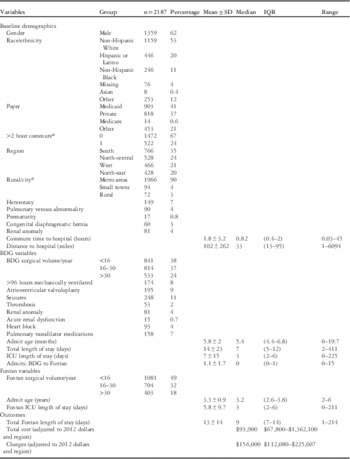
The final study cohort included 2187 children with 314 excluded for a Fontan <2 years or >6 years of age. The cohort was predominantly male, non-Hispanic White, and commuted <2 hours to the closest tertiary-care centre (Table 1). The largest groups were from the south (35%) and lived in a metropolitan area (90%). Medicaid was the predominant payer (41%). The median age of the cohort at the bidirectional Glenn surgical admission was 5.4 months (IQR: 4.4–6.8), with a median length of stay at 7.0 days (IQR: 5–12). The median age for Fontan surgery admission was 3.2 years (IQR: 2.6–3.8).
Baseline demographics with pre-bidirectional Glenn, bidirectional Glenn (BDG), and Fontan surgical variables.

* Data missing (9% for >2 hour commute and 3% for rural/city)
Fontan variables
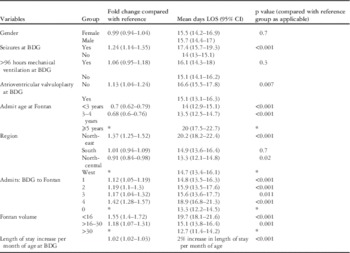
The median Fontan length of stay was 9.0 days (IQR: 7–14) and was not affected by gender. Institutional Fontan volume was strongly associated with hospital length of stay (Table 2). At a fold change of 1.55, patients undergoing the Fontan operation at centres with <16 Fontan operations/year had a mean 7.0-day longer length of stay compared with the reference centres with >30 Fontan operations/year. Centres that performed 16–30 Fontan operations/year had a mean 2.4-day longer stay. An atrioventricular valvuloplasty at the bidirectional Glenn surgery was associated with a mean 1.5-day shorter Fontan length of stay. Patients having a Fontan in the north-east region had a mean increase in their length of stay by 5.5 days compared with the reference west region. Compared with the reference group of no admissions between bidirectional Glenn and Fontan, the mean length of stay increased by 5.6 days in those with more than four hospital admissions between the bidirectional Glenn and the Fontan.
Fontan factors associated with length of stay (LOS) in multivariate modelling.

BDG=bidirectional Glenn
* Reference group
Fontan charges
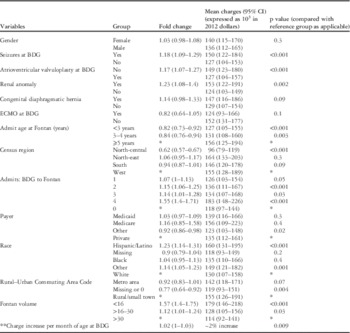
The median charges in 2012 dollars for the Fontan operation totalled $156,000 (IQR: $112,080–$225,607) (Table 1). Centre volume accounted for most of the higher Fontan charges (Table 3). Centres with <16 Fontan operations/year charged an average of 57% more compared with those centres with >30 operations/year. Seizures, no atrioventricular valvuloplasty at bidirectional Glenn, renal anomaly, race, and older age at the Fontan operation were also associated with higher charges at the Fontan hospitalisation. The north-central region of the United States of America had the lowest charges with a mean of $96,000 (95% CI: $79,000–$119,000). Similar to length of stay, when the number of admissions between the bidirectional Glenn and Fontan surgeries was more than four, charges increased by a mean of 55%. Insurance types and rural versus metropolitan location of residence were not associated with increased charges.
Fontan factors associated with charges on multivariate modelling.

BDG=bidirectional Glenn; ECMO=extra corporeal membrane oxygenation
* Reference group
** Charges were used as cost is a calculated variable
Fontan costs and length of stay–Classification and Regression Tree analysis
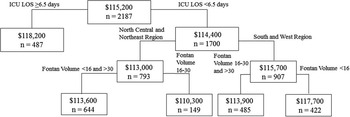
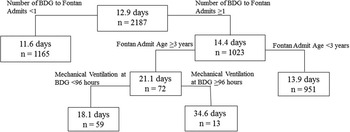
Costs were used for the Classification and Regression Tree analysis. Factors most strongly associated with Fontan costs and length of stay were included in the Classification and Regression Tree analysis (Figs 1 and 2). The mean cost of the Fontan surgery was $115,200 in 2012 dollars (Fig 1), and was most strongly accounted for by the duration of ICU length of stay. The length of stay duration most strongly differentiating total cost occurred at 6.5 days. Geographic region and surgical volume where the Fontan was performed were also important in accounting for costs and length of stay after the Fontan procedure. The average length of stay was 13 days (Fig 2). As noted in the multivariate analysis, total number of admissions between the bidirectional Glenn and Fontan surgeries were a strong predictor of increased length of stay followed by Fontan admit age and mechanical ventilation longer than 96 hours.
Classification and Regression Tree Analysis for Cost at the Fontan Operation. LOS=length of stay.

Classification and Regression Tree Analysis for length of stay at the Fontan Operation. BDG=bidirectional Glenn.

Discussion
We determined current costs and contemporary factors associated with increased resource utilisation for the Fontan operation by using a large multi-institutional database representative of the entire United States of America; one of the strongest predictors of increased resource utilisation was frequent admissions between the bidirectional Glenn and Fontan surgeries. In contrast to the well-studied interstage period between the Norwood and the bidirectional Glenn surgeries, a few studies have focussed on risk factors and outcomes in the interval between the bidirectional Glenn and the Fontan surgeries. Recurrent admissions during this time may identify a patient who is likely to have a suboptimal outcome with a longer length of stay following the Fontan operation. Adverse outcomes during the bidirectional Glenn operation including seizures, longer duration of mechanical ventilation, and extracorporeal membrane oxygenation were associated with increased resource utilisation following the Fontan. These findings suggest that a bad bidirectional Glenn outcome portends adverse Fontan outcomes with increased length of stay and cost. This information is useful for several reasons. First, it may be used to counsel parents to plan for longer hospitalisations after the Fontan surgery. Second, these patients may be targeted for closer follow-up and initiation of more aggressive therapies to improve their overall haemodynamics before their Fontan operation. The mean cost of the Fontan surgery in this study was most strongly accounted for by the duration of ICU length of stay. In a recent study, using the Pediatric Health Information Systems database, postoperative complications and prolonged length of stay following congenital heart surgery were associated with significant costs.Reference Pasquali, He and Jacobs 5 In this study, an increase in the length of stay by 1 day following Fontan increased the adjusted cost/case by $11,096.Reference Pasquali, He and Jacobs 5 Any postoperative complication following Fontan increased the adjusted excess cost/care by $33,065, and with a major complication the adjusted cost/care escalated to $104,485.Reference Pasquali, He and Jacobs 5
Similar to previous reports, low surgical volume remained a strong predictor of longer length of stay.Reference Pasquali, Jacobs and He 3 Higher Fontan surgical volume/year may allow the surgeon and the entire postoperative healthcare delivery team to develop optimal care plans and maintain the high-level skills and experience needed to achieve an earlier discharge from the ICU and hospital in this complex patient population. An approach to address the issue of the effects of centre volume on Fontan resource utilisation might be to limit Fontan surgery to only those centres with larger volumes; however, a different but complimentary approach would be collaborative learning projects that include low-, moderate-, and high-volume centres. This would allow sharing of inter-institutional postoperative practices, likely creating improvement in performance across all centres. A collaborative learning initiative that included site visits was used by Pediatric Heart Network to derive standardised clinical practice guidelines that have the potential to significantly increase the rate of early extubation and reduce the length of stay following cardiac surgeries.14
Regional variation was significant for both charges and length of stay. The most significant increase in length of stay occurred in the north-east region. Wide variations between hospitals in adjusted cost/case have been reported for nearly every CHD surgery.Reference Pasquali, Jacobs and He 3 Adjusted Fontan costs range from a minimum of $26,504 to a maximum of $105,844.Reference Pasquali, Jacobs and He 3 We speculate that part of the increased length of stay in the north-east region may be driven by long-distance or potentially international referrals of more complex or high-risk patients to experienced, high-volume hospitals in this region. The threshold for discharge would be higher for this complex patient population. Regional and other healthcare delivery factors associated with increased resource utilisation at the Fontan operation may be modifiable with changes in healthcare policy.
It is difficult to interpret costs and charges data among eras. Gajarski et al reported mean charges (adjusting to 1992–1993 dollars) for Fontan hospitalisation of $20,615±$1782;15 however, cost data were not obtained, preventing a direct comparison with our cohort. A more contemporary report of costs and charges for the Fontan operation, with dollar values adjusted for inflation and converted to a 2007 equivalent, reported median costs of $36,928 (IQR: $2712–$1,143,363) with the increasing dollar values approaching our results in the current era.Reference Dean, Hillman, McHugh and Gutgesell 4 Although this study was limited to patients undergoing the Fontan for hypoplastic left heart syndrome, and therefore not directly comparable with our population, the similar figures suggest that this resource-intensive patient population is not consuming substantially larger portions compared with preceding single-ventricle groups. Finally, a paper published in 2014 by Pasquali et alReference Pasquali, Jacobs and He 3 evaluating costs for a large number of congenital heart surgeries found costs similar to this study for those receiving a Fontan at a median cost/case of $81,312. As we continue to operate on children with increasing single-ventricle complexity, resource utilisation should be closely scrutinised to ensure maximum value from the stressed healthcare delivery system.
The limitations of this study include known limitations and discrepancies associated with all administrative database studies, including incorrect data entry for ICD-9 and Current Procedural Terminology codes. On the other hand, as discussed above, the quality control measures adopted by Pediatric Health Information Systems administrators to ensure data accuracy and integrity help mitigate this issue to a great extent. We further improved the data integrity by using multiple Current Procedural Terminology and ICD-9 codes to confirm the diagnosis – for example, a patient with hypoplastic left heart syndrome had to have both an ICD-9 code for diagnosis and a Current Procedural Terminology code for the Norwood procedure. Admissions between the bidirectional Glenn and Fontan surgeries were missed if they occurred at any non-Pediatric Health Information Systems centre; however, the majority of admissions for serious medical or surgical issues were likely to occur at the same tertiary-care centre given the medically complex needs of this high-risk, single-ventricle cohort.
Through a large multi-institutional cohort, we identified significant regional differences in resource utilisation following the Fontan operation. Standardisation of perioperative care and sharing of best practices to reduce length of stay and complication rates following surgery may be one way to reduce centre variability, leading to a decrease in both charges and length of stay. Sharing of healthcare cost and outcomes data between hospitals may improve outcomes and reduce costs. Future studies should focus on changes in healthcare delivery and target the identified risk factors to reduce the overall resource consumption of this medically complex group of children.
Acknowledgements
None.
Financial Support
This investigation was supported by the University of Utah Study Design and Biostatistics Center, with funding in part from the National Center for Research Resources and the National Center for Advancing Translational Sciences, National Institutes of Health, through Grant 8UL1TR000105 (formerly UL1RR025764).
Conflicts of Interest
None.
Ethical Standards
The authors assert that all procedures contributing to this work comply with the ethical standards of the relevant national guidelines on human experimentation and with the Helsinki Declaration of 1975, as revised in 2008. Since this study used de-identified data, the study was exempt from institution Review Board review.