Introduction
According to data from the United States (US) Current Population Survey, during the 12 months following September 2007, 26.4 per cent of the US population, or 61.8 million people, volunteered their time through or for organisations and causes (Bureau of Labor Statistics 2009). The rate of formal volunteering had an inverted-U relationship with age, the highest participation (31.3%) being among those aged 35–44 years, and the lowest among the youngest and oldest adults (22.8% of those aged 25–34 years, and 23.5% of those aged 65+ years). Although the rate of volunteering among older adults (aged 55+ years) was lower than among the middle-aged (35–54 years), older volunteers appeared to commit more hours. Those aged 65 or more years had the highest median (96) number of formal volunteering hours, followed by 58 hours among those aged 55–64 years and 52 hours for those aged 45–54 years (Bureau of Labor Statistics 2009).
In 2004, 70.2 per cent of American households donated an average of $2,047 (median $775) to religious and secular organisations/causes (Giving USA Foundation 2008). A nationally-representative survey in 2007 of about 1,300 households found that 68 per cent of respondents aged 35–54 years and 72 per cent of those aged 55+ years made charitable donations, as compared to 45 per cent of those aged 18–34 years (Center on Philanthropy 2007). The average recent donation amounts by those aged 35–54 years were $205 for offline and $190 for online gifts, and the corresponding amounts for those aged 55 or more years were $229 and $135. A recent study also found that, compared to their younger counterparts, older donors tended to be persistent or repeat rather than occasional donors (Rooney, Brown and Wu Reference Rooney, Brown and Wu2008).
The extent (usually in terms of hours) and correlates of time volunteering among older adults have been extensively examined and compared with those of younger volunteers. Comparisons using cross-sectional data have not been able to differentiate between cohort and age effects, however, and reveal little about the determinants of change and stability in people's volunteering behaviour. Previous studies have suggested that many older volunteers were volunteers when young, and that their current and past volunteering hours are significantly correlated (Chambre Reference Chambre1993; Wilson and Musick Reference Wilson and Musick1999). The implication is that the act of generosity may be rooted in individual motivations and other characteristics and resources that are relatively stable over time. Nonetheless, the changes that occur from middle age to late life – a declining rate of volunteering but increased hours – call for more empirical research. We need to examine the factors associated over time with individuals' continuation versus discontinuation of and new engagement in volunteering. Even though many previous studies have examined the factors associated with individuals' money volunteering (whether or not they donate and how much), few have focused on older adults or examined change and stability over time.
The purposes of this study were twofold: to examine the relationship between the prior and current extent of time and money formal volunteering among people aged 55 or more years; and to identify the correlates of change and stability. ‘Formal volunteering’ was defined as the reported hours of time volunteering through or for organisations or causes, and by the amount of charitable donations (including contributions to religious groups and political associations).
Conceptual framework and hypotheses
Many volunteers are motivated by self-interest and derive personal benefits from volunteering, such as tax deductions in the case of money volunteering, self-development through learning about social problems and issues and the people affected by them, increases in self-esteem, and, especially for older adults: finding a sense of purpose through continued social engagement, by leaving a positive legacy, and through getting to know other volunteers; and especially for younger persons: advancing career goals by making business contacts or learning skills that may be useful for conducting their paid jobs (Brooks Reference Brooks2007; Chappell and Prince Reference Chappell and Prince1997; Fraser et al. Reference Fraser, Clayton, Sickler and Taylor2009; Okun, Barr and Herzog Reference Okun, Barr and Herzog1998; Omoto and Snyder Reference Omoto and Snyder2002; Omoto, Snyder and Martino Reference Omoto, Snyder and Martino2000; Pitts and Skelly Reference Pitts and Skelly1984; Simpson, Irwin and Lawrence Reference Simpson, Irwin and Lawrence2006; Wilson and Musick Reference Wilson and Musick1997a).
In addition to self-interest, according to an integrated theory of volunteering, willingness to volunteer is a function of three forms of capital or usable resources: human, social and cultural (Wilson Reference Wilson2000; Wilson and Musick Reference Wilson and Musick1997b). Human capital consists of ‘resources attached to individuals that make productive activities possible: education, income and wealth, and health status’ (Wilson and Musick Reference Wilson and Musick1997b: 698–9). Highly-educated people are more likely to have the skills needed in various social situations, including volunteering. Levels of income and wealth (and attendant tax deductions), needless to say, are likely to be significant determinants of money volunteering. In the case of time volunteering, the available time, often measured by the inverse of a person's paid-work hours, is a necessary resource (Mutchler, Burr and Caro Reference Mutchler, Burr and Caro2003). Social capital refers to social connections and social embeddedness that provide information, pooled labour, bases for reciprocity, and the trust in others and in the community that makes time and money volunteering more likely (Apinunmahakul and Devlin Reference Apinunmahakul and Devlin2008; Brown and Ferris Reference Brown and Ferris2007). Human capital and social capital are often intertwined, as individuals with more education and income and who are in good health are likely to have wider social networks and connections (e.g. co-workers and other work-related contacts and voluntary club and/or professional association memberships), through which they have more opportunities to volunteer.
Cultural capital is the sense of social responsibility or moral obligation towards those who are less fortunate and the motivation to contribute to the greater good. Like human and social capital, cultural capital is acquired, influenced and shaped directly or unwittingly by socialisation, by the generosity of parents and other close associates, by religious beliefs and associations, by the frequency of attendance at religious services, by life experiences that accumulate over time, and by generative concerns, altruism, empathy, and political and economic forces (Adloff Reference Adloff2009; Amato Reference Amato1990; Bryant et al. Reference Bryant, Jeon-Slaughter, Kang and Tax2003; Heiser Reference Heiser2006; Regnerus, Smith and Sikkink Reference Regnerus, Smith and Sikkink1998; Rossi Reference Rossi2001, Reference Rossi, Brim, Ryff and Kessler2004; Steinberg and Wilhelm Reference Steinberg and Wilhelm2003; Wilhelm et al. Reference Wilhelm, Brown, Rooney and Steinberg2004; Wilson and Janoski Reference Wilson and Janoski1995).
In conjunction with the three forms of capital, the extent of a person's volunteering is likely to be a significant predictor of his or her continued volunteering. Having already been connected with organisations, causes and other volunteers, a volunteer is not only more likely to be aware of volunteering opportunities but also more likely to be asked to continue in the role. For example, previous studies found a positive correlation between religious attendance and religious and secular giving (Regnerus, Smith and Sikkink Reference Regnerus, Smith and Sikkink1998; Wilhelm, Rooney and Tempel Reference Wilhelm, Rooney and Tempel2007). Other studies also found that those who were asked to volunteer their time and/or money were significantly more likely to do so than those who were not asked (Bryant et al. Reference Bryant, Jeon-Slaughter, Kang and Tax2003; Freeman Reference Freeman1997). Current volunteers are likely to be asked to continue to volunteer. Penner and Finkelstein (Reference Penner and Finkelstein1998) found among AIDS service organisation volunteers that the initial levels of volunteer activity were strongly correlated with the levels 8–10 months later. Wilson and Musick (Reference Wilson and Musick1999) found a similar significant association over three years. Through his or her act of volunteering, the volunteer is also likely to increase their own cultural capital of altruism and empathy toward the less fortunate, and a stronger commitment to social, political and religious causes. On the other hand, volunteers may also experience burnout from negative interactions with others involved in volunteering and disillusionment with the scale and intractability of the addressed problems (Warburton and McDonald Reference Warburton and McDonald2009).
The psychological and physical benefits from time volunteering may be greater for older than younger adults (Greenfield and Marks Reference Greenfield and Marks2004; Harris and Thoreson Reference Harris and Thoreson2005; Li Reference Li2007; Li and Ferraro Reference Li and Ferraro2005; Narushima Reference Narushima2005; Van Willigen Reference Van Willigen2000), although reaching later life can generate conflicting demands on the time and resources of a volunteer. Some studies have found that older adults who have retired or reduced their work hours, and therefore have more free time, are more likely to take up volunteering and to spend many more hours volunteering in formal settings (Moen et al. Reference Moen, Erickson, Agarwal, Fields and Todd2000; Mutchler, Burr and Caro Reference Mutchler, Burr and Caro2003). A person is more likely to become a dedicated volunteer when the roles of paid worker, family breadwinner, spouse or child-carer have reduced (Adelman Reference Adelman1994; Herzog and Morgan Reference Herzog, Morgan, Bass, Caro and Chen1993; Markham and Bonjean Reference Markham and Bonjean1996). At this lifecourse stage, people can devote more time to helping others beyond their immediate family, whether kin or friends (Chappell and Prince Reference Chappell and Prince1997; Gallagher Reference Gallagher1994; Herzog et al. Reference Herzog, Kahn, Morgan, Jackson and Antonucci1989; Omoto, Snyder and Martino Reference Omoto, Snyder and Martino2000). As a result of decreased financial obligations for child rearing and growing assets, many older adults have more assets and disposable income for money volunteering than younger adults (seeJames and Sharpe Reference James and Sharpe2007). On the other hand, many older people face increasing barriers to volunteering through their own or their spouse's health problems and functional limitations (Burr, Mutchler and Caro Reference Burr, Mutchler and Caro2007; Choi et al. Reference Choi, Burr, Mutchler and Caro2007). The lower rate of volunteering but the greater hours among older adults compared to middle-aged adults may reflect these conflicts in late life. Given the reviewed theoretical understanding and empirical evidence, we formulated six hypotheses:
H1: The hours of time volunteering at a later time (T2) are positively associated with the hours of time volunteering earlier (T1), controlling for human, social and cultural capital.
H2: The amount of money volunteering at T2 is positively associated with the amount of money volunteering at T1, controlling for human, social and cultural capital.
H3: Not being a time volunteer at T1 but being so at T2, as opposed to not being a volunteer at both times, is predicted by more favourable human capital and by positive changes in social and cultural capital.
H4: Time volunteering at both times, as opposed to time volunteering at T1 but not at T2, is predicted by more favourable human capital and by increases in social and cultural capital.
H5: Not being a money volunteer at T1 but being so at T2, as opposed to no volunteering at both times, is predicted by more favourable human capital and by positive changes in social and cultural capital.
H6: Money volunteering at both times, as opposed to money volunteering at T1 but not at T2, is predicted by more favourable human capital and by increases in social and cultural capital.
Because evidence on the age and cohort effects that influence money volunteering is scarce, the same hypotheses were posited for time and money volunteering. The human capital correlates of volunteering included level of education, household income, self-rated health, and work status. Social capital was measured by the number of attendances at various meetings: union/professional group, sports/social group, and any other group. The number of meetings attended, an indicator of social network size, was taken to represent social connections and embeddedness. Cultural capital included religious identification, generative qualities (self-perception of generative contributions), percepting one's parent as a model of generosity (a measure of the effect of parental role modelling in childhood), and intention to volunteer in the future (as a measure of the level of motivation). We chose religious identification, rather than attendance at religious services or meetings, as an indicator of cultural capital because some older adults are unable to attend religious services as frequently as they wish because of chronic illness or functional impairments.
Methods
Data, sample and measures
The data for this study came from the first and second waves of the Survey of Midlife Development in the United States – MIDUS1 1995–96 and MIDUS2 2004–06. MIDUS1 assessed several social and psychological constructs among a national probability sample of 7,189 non-institutionalised, English-speaking adults aged 20–74 years who lived in the 48 contiguous states and had at least one telephone in the household. In addition to the general population sample, siblings of the main sample respondents and a sample of twins were added, and there was over-sampling in selected metropolitan areas. The sampling design and methods and the interview formats (a computer-assisted telephone interview followed by a mailed, self-completion survey) are described in detail by the MIDUS investigators (seeBrim, Ryff and Kessler Reference Brim, Ryff, Kessler, Brim, Ryff and Kessler2004). At the time of MIDUS1 (T1), of the general population sample, 453 respondents completed only telephone interviews and 3,032 respondents completed both a telephone and a self-administered questionnaire. In the MIDUS2 (T2), of the MIDUS1's general population sample, 1,805 respondents aged 30–84 years completed a telephone interview and a self-administered questionnaire. The sample for the current study was 917 respondents in the general population sample who were aged 55–84 years at T2 and completed a telephone interview and a self-administered questionnaire at both T1 and T2.
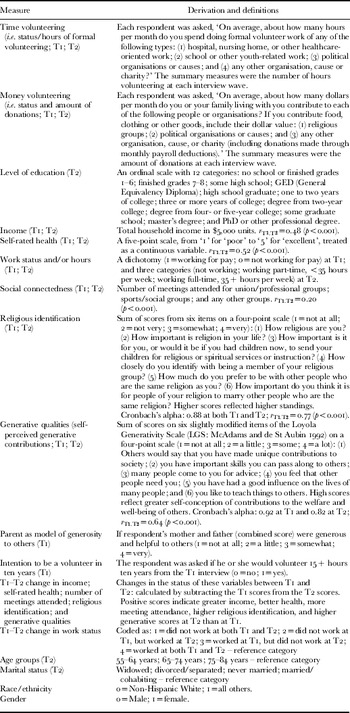
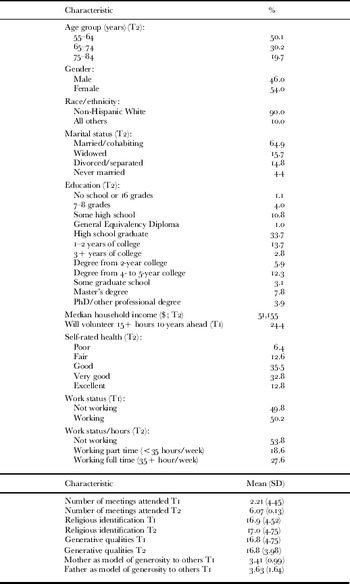
The study variables are described and defined in Table 1, and the socio-demographic characteristics of the sample are presented in Table 2. At T2, about one-half of the sample were aged between 55 and 65 years, little less than one-half were working part-time or full-time, and close to 80 per cent reported their health to be ‘good, very good or excellent’. A large majority (90%) of the sample was non-Hispanic White. The median household incomes ($51,155 for all subjects; $63,533 for those aged 55–64 years; and $39,411 for those aged 65+ years) were a little higher than the US national figures in 2006, namely $54,972 for those aged 55–64 years, and $27,798 for those aged 65+ years (United States Bureau of the Census 2007).
The measures of volunteering and selected controls

Notes: T1: at time 1; T2: at time 2. r T1.T2: Pearson correlation coefficient between the measure at time 1 and time 2.
Socio-demographic characteristics of the analysis sample

Notes: T1: at time 1. T2: at time 2. SD: standard deviation. Sample size: 917.
Data source: Survey of Midlife Development in the United States (MIDUS) 1995–1996 and 2004–2006. For details see text. Author's analysis.
Analysis methods
The relationships between time volunteering at T1 and T2 and for money volunteering over the same interval were first examined. The focus was on the changes in volunteering status from not being a volunteer at T1 to volunteering at T2, as opposed to not being a volunteer at both times, and on remaining a volunteer (i.e. volunteering at both T1 and T2, as opposed to no longer volunteering at T2). Then, the bivariate correlation coefficients among selected socio-demographic characteristics, human, social and cultural capital resources measures, and T1 and T2 hours of time volunteering and amounts of money volunteering were examined. To test hypotheses 1 and 2, negative binomial regression analysis was used. Number of hours of T2 time volunteering and the amount of T2 money volunteering were regressed with the independent variables and the hours of T1 volunteering. Negative binomial regression models were chosen because of the skewed distributions of both hours of volunteering and amounts of donation. Ten outlier cases at T2 of donations of more than $5,000 monthly ($5,500–$24,000) were excluded from the money volunteering regression. To test hypotheses 3–6, four binary logistic regression models (Models I–IV) were used. For each type of volunteering, we first examined the human, social and cultural capital correlates of new engagement in volunteering at T2, as opposed to continuation of no volunteering, among those who did not volunteer at T1. Then, we examined the human, social and cultural capital correlates of repeat volunteering at T2, as opposed to no longer volunteering/quitting, among those who volunteered at T1.
In the bivariate and multivariate analyses, missing values for hours and amount of T1 volunteering (3.5 and 3.9%, respectively) were set to ‘0’ (no volunteering), on the grounds that multiple bivariate analyses had shown no significant difference in human, social and cultural capital characteristics between those with missing data and those who reported no volunteering. The attrition rate at T2 among those who would have been aged 55–84 years was high, at about 45 per cent, but comparisons of T2 respondents and non-respondents with respect to their T1 number of volunteering hours, donation amounts, human capital, cultural capital, social capital and socio-demographic characteristics found not one significant difference. All statistics were weighted by the MIDUS2 post-stratification weight, correcting for region, age and education strata.
Results
Extent of and relationship between T1 and T2 volunteering
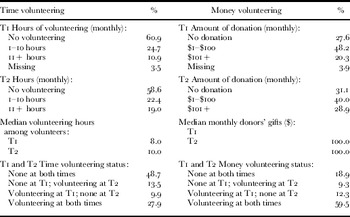
As shown in Table 3, with respect to time volunteering, 35.6 per cent of the sample at T1 reported volunteering, the hours ranging from one to 120 per month (median eight), and 41.4 per cent at T2 reported volunteering, the hours ranging from one to 205 per month (median 10). With respect to money volunteering, 68.5 per cent of the sample at T1 reported having made donations, the amounts ranging from $1 to $3,200 per month (median $100). Of all T1 donors, about 74 per cent gave to religious groups (median $100); about 23 per cent gave to political organisations or causes (median $10); and about 71 per cent gave to other organisations, causes and charities (median $40). At T2, 68.9 per cent reported having made donations, ranging from $1 to $24,000 per month (median $100). Of all T2 donors, about 72 per cent gave to religious groups (median $200); about 20 per cent gave to political organisations/causes (median $20); and 71 per cent gave to other organisations, causes and charities (median $50).
Time and money volunteering at T1 and T2

Notes: T1: at time 1. T2: at time 2. Sample size: 917.
Data source: Survey of Midlife Development in the United States (MIDUS) 1995–1996 and 2004–2006. For details see text. Author's analysis.
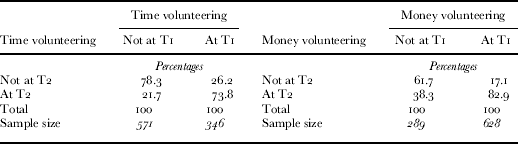
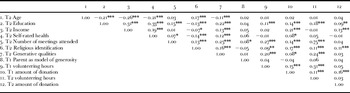
Table 4 shows that both time and money volunteering tended to be stable across the two survey years. A majority of non-volunteers at T1 (78.3% for time and 61.7% for money) remained non-volunteers at T2, while a majority of volunteers at T1 (73.8% for time and 82.9% for money) were volunteers at T2. Further analysis showed that the repeat volunteers volunteered significantly more hours or money amounts at T2 than new volunteers.Footnote 1 On the other hand, there was no significant difference in T1 volunteering hours and money amounts between the repeat volunteers and those who no longer volunteered at T2 (i.e. the quitters). These findings suggest that repeat volunteers were more dedicated volunteers than new volunteers (and the quitters). Also, there was no significant age group difference in the relationship between T1 and T2 money volunteering, but a higher proportion (16.1%) of those aged 55–64 years than aged 75–84 years (9.9%) were new time volunteers at T2 (p=0.07). Table 5 shows that the Pearson's bivariate correlation coefficient between T1 and T2 volunteering hours was 0.31 (p<0.001) and that between T1 and T2 donation amounts was 0.16 (p<0.001). The correlation coefficients also show that the extent of T1 time volunteering was positively and significantly (if weakly) associated with the extent of T1 money volunteering (r=0.15, p<0.001); however, the two types of volunteering at T2 were not significantly related.
The relationship between volunteering at baseline and after nine years
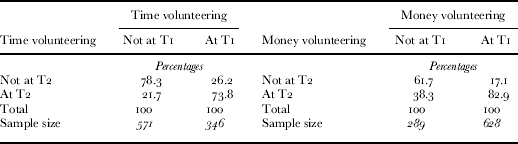
Data source: Survey of Midlife Development in the United States (MIDUS) 1995–1996 and 2004–2006. For details see text. Author's analysis.
Bivariate correlation coefficients among the demographic and human, social and cultural capital variables

Significance levels: * p<0.05, ** p<0.01, *** p<0.001.
Correlates of T2 volunteering
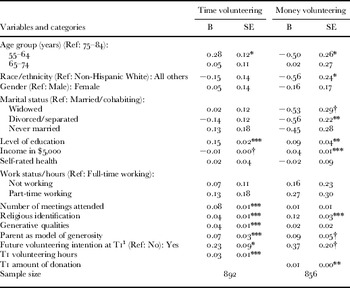
Table 6 shows that the number of hours of T2 time volunteering was significantly and positively associated with younger age (55–64 as opposed to 75–84 years), level of education, number of meetings attended, religious identification, generative qualities, perceived parental generosity, future volunteering intention expressed at T1, and T1 volunteering hours. On the other hand, the number of hours of T2 time volunteering was only marginally negatively associated with household income. Wald chi-squared tests showed that the number of meetings attended had the most impact on the extent of time volunteering, followed by the level of education and the number of T1 volunteering hours. The amount of T2 money volunteering was significantly and positively associated with the level of household income, religious identification, and T1 amount of donation, while it was significantly negatively associated with younger age, being a member of a racial/ethnic minority, and being divorced/separated (as opposed to married). The amount of the donation was also marginally significantly positively associated with volunteering intention at T1 and perceived parental generosity, while it was negatively associated with widowed state. Wald chi-squared tests showed that the level of household income had the most impact on the extent of money volunteering, followed by religious identification, T1 amount of donation, and level of education.
Correlates of T2 time and money volunteering: regression results

Notes: 1. Would volunteer 15+ hours ten years ahead (expressed at T1 interview). B: unstandardised regression coefficient. Ref: Reference category. SE: standard error. Likelihood ratio chi-squared=1337.87 (degrees of freedom (df) 18) p<0.000 for time volunteering, and 1313.18 (df=18) p<0.000 for money volunteering.
Significance levels: † p<0.07, * p<0.05, ** p<0.01, *** p<0.001.
The results provide support for hypotheses 1 and 2 because the extent of T1 volunteering was a significant predictor of the extent of T2 volunteering, controlling for demographic characteristics and human, social and cultural capital. In addition to the extent of T1 volunteering, level of education, religious identification, perceived parental generosity, and earlier expressed volunteering intentions were common predictors of both types of volunteering. The number of meetings attended as a measure of social capital, on the one hand, and generative qualities as a measure of cultural capital, on the other, were significant predictors only of T2 time volunteering. The level of household income was significantly positively associated with T2 money volunteering, while it was marginally significantly negatively associated with time volunteering. This finding suggests that those with higher income were likely to engage in time volunteering but more likely to donate money, a possible ‘money for time substitution’ effect.
Correlates of change and stability in volunteering between T1 and T2
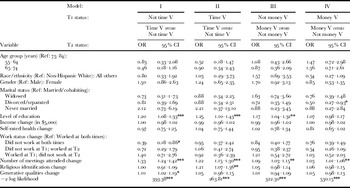
According to Model I in Table 7, new engagement in time volunteering at T2, as opposed to continued non-volunteering, was associated with higher education, not being in paid work at both times, an increased number of meetings attended, and an increase in generative qualities. One unit increase in educational level, meeting attendance and generative qualities associated with, respectively, 1.2, 1.3 and 1.1 greater odds of having become a time volunteer at T2. On the other hand, the odds that those who did not work at either time engaged in time volunteering were significantly lower (0.39) than for those who worked at both times. Given that most of those aged 55–74 years at T2 were of ‘working’ age at T1, those who did not work at both times probably included people with serious impediments to working and volunteering. The continuity or stability in time volunteering behaviour between T1 and T2 (Model II), as opposed to having done no volunteering at T2 (i.e. quitting since T1), was associated with a higher level of education, an increased number of meetings attended, and high religious identification. One unit increase in educational level, meeting attendance and religious identification was associated with, respectively, 1.3, 1.2 and 1.2 greater odds of having been a time volunteer at both T1 and T2.
Odds ratios for changes in time and money volunteering between T1 and T2

Notes: V: volunteer. Ref: Reference category. OR: odds ratio. CI: confidence interval. Sample sizes: 541 for Model I, 345 for Model II, 260 for Model III and 618 for Model IV. There were 16 degrees of freedom in all four models.
Significance levels: * p<0.05, ** p<0.01, *** p<0.001.
New engagement in money volunteering at T2 (Model III), as opposed to continued non-money volunteering, associated with more education and an increased number of meetings attended. One unit increase in educational level and meeting attendance was associated with, respectively, 1.2 and 1.1 greater odds of having become a money volunteer at T2. The continuity/stability in money volunteering behaviour between T1 and T2 (Model IV), as opposed to having done no money volunteering at T2 (i.e. quitting), was associated with an increased number of meetings attended. One unit increase in the number of meetings attended was associated with 1.03 greater odds of having been a money volunteer at both T1 and T2, as opposed to having discontinued money volunteering at T2. In addition, being divorced and separated (as opposed to married) significantly reduced the odds of continued money volunteering by 0.50.
An increase in the number of meetings attended between T1 and T2 was a common predictor of having become a volunteer or continued volunteering at T2 for both types. Level of education was a predictor of having become a time volunteer or a continuing time volunteer at T2 and having become a money volunteer at T2. Increased religious identification or generative qualities were associated with time volunteering but not with money volunteering. Thus, hypotheses 3–6 were only partially supported because an increase in social capital was associated with both types of volunteering, but an increase in cultural capital associated only with time volunteering. As stated, level of education, one indicator of human capital, was also a significant predictor of new engagement in and/or continuing time and money volunteering. Interestingly, however, increased income was not associated with becoming or continuing as a money volunteer, but being divorced/separated reduced the odds of continuing to be a money volunteer.
Discussion
This study has investigated the patterns and correlates of stability and change in two kinds of volunteering over nine years in the USA. In line with previous studies (Penner and Finkelstein Reference Penner and Finkelstein1998; Wilson and Musick Reference Wilson and Musick1999), it has found that volunteering is stable over time, as the majority of volunteers at T1 were also volunteers at T2, and that the extent of T1 volunteering was one of the most significant predictors of the extent of T2 volunteering. As for other correlates of volunteering at the later date, level of education, religious identification, perceived parental generosity, and future volunteering intention/motivation associated with both time and money volunteering. It appears that religious identification was a significant correlate of money volunteering, since a large proportion of donors gave money to religious groups. The other cultural capital variable, generative qualities, and the number of meetings attended, were not significant correlates of money volunteering, while the level of income was a significant correlate, the implication being that money volunteering was influenced more by income availability (and possibly tax deductions) than charitable disposition or intrinsic motives with the exception of religious affiliation.
Even controlling for the level of household income, racial/ethnic minorities and widowed and divorced/separated people were less likely to make charitable contributions. This finding may be because charitable giving is determined by both income and wealth and that minorities and widowed or divorced persons have significantly lower wealth than non-Hispanic Whites and married people (Conley Reference Conley2000; Hurd Reference Hurd2009; James and Sharpe Reference James and Sharpe2007; Rooney, Brown and Wu Reference Rooney, Brown and Wu2008). The results also show that the younger group (aged 55–64 years) was more likely than the older (aged 75–84) to volunteer their time, while the younger was less likely than the older to give money. Although the cross-sectional data did not allow further testing, these findings do not appear to indicate a cohort difference in volunteering propensity. They may reflect the fact that advanced age, accompanied by the onset and/or deterioration of physical and functional health problems, is more of a barrier to time volunteering than money volunteering. The younger group was also more likely than the older to have financial obligations for child rearing and other family-related expenditure.
Although it cannot be claimed that volunteers at both T1 and T2 had volunteered throughout the intervening years, we can state that those aged 55 or more years who volunteered at T2 were highly likely to have been volunteers nine years earlier. In other words, a majority of volunteers in the study were repeat volunteers. The findings also show that a higher proportion of money volunteers than time volunteers were repeat (and possibly persistent) volunteers. As discussed, the continuation of money volunteering may be easier than continuation of giving time, because making donations is less likely to be affected by health problems or other changes such as relocation and spousal care-giving. Overall, it has been shown that both shared and specific factors influence the different longitudinal patterns of time and money volunteering.
Some interesting results were found with respect to the correlates of new engagement and stability in volunteering. Although the level of education was a significant predictor in three of the four equations, changes in income and self-rated health were not significant at all. Using data from respondents of all ages in 5,728 households in the 2001, 2003 and 2005 waves of the Center on Philanthropy Panel Study (part of the Panel Studies of Income Dynamics), Rooney, Brown and Wu (Reference Rooney, Brown and Wu2008) found that education beyond high school increased the chance of a person becoming a repeat donor, while health changes, disability status changes and employment changes made little difference after controlling for income. They also found that changes in income mattered but that the effect was small over four years. The present study found that changes in income and self-rated health did not affect either money or time volunteering.
While the number of meetings attended did not significantly associate with the amount of T2 money volunteering, it was a significant predictor of new engagement and stability in both time and money volunteering, regardless of the number of volunteering hours or the amount of money gifts. It appears that social networks had a positive impact on older adults' charitable giving behaviour, but did not determine the amount of their gifts. These findings are in line with previous studies of all-age adult samples. Apinunmahakul and Devlin found that membership in clubs had a significant impact on number of hours of volunteering, but no impact on gifts of money, possibly because ‘money gifts are frequently solicited anonymously’ (2008: 320). Brown and Ferris (Reference Brown and Ferris2007) found that social networks promote individual charitable giving, to the extent that the inclusion of the variable reduced the direct effect of education and religiosity.
Although new engagement and stability in time volunteering was associated with increased generative qualities and religious identification, we were not able to differentiate the impact of these cultural capital resources on volunteering from the impact of volunteering on them. We can only speculate that the relationships among time volunteering, generative qualities and religious identification are likely to be two-way. As for the socio-demographic characteristics, age and race/ethnicity were not correlated with change and stability in volunteering status, but being divorced/separated had a significant negative effect on the stability of money volunteering. Rooney, Brown and Wu (Reference Rooney, Brown and Wu2008) also found that becoming divorced was one of the most consistent predictors of ceasing to be a donor, but that the effect disappeared after four years. The finding that age was not a significant predictor of change and stability provides further support for the proposition that the propensity to volunteer is independent of birth cohort.
To summarise, this study has eight principal findings. First, a majority of older volunteers of time and/or money were repeat volunteers, which suggests that those who volunteer in mid-life are likely to remain volunteers in late life. Second, over nine years, baseline volunteering hours and money amounts were significant predictors of subsequent hours and amounts, respectively, which suggests that the extent of volunteering tends to be stable over time. Third, compared to new volunteers at T2, repeat volunteers devoted significantly more hours or gave significantly higher gifts. Fourth, level of education matters in volunteering among older adults, for it consistently predicted the extent of both time and money volunteering, and also new engagement and stability in volunteering. Fifth, social network size, as represented by the number of meetings attended, was a significant predictor not only of the hours spent volunteering, but also of new engagement and stability in both time and money volunteering. Sixth, high levels of generative qualities and religious identification appeared to provide significant motives for time volunteering and to affect the hours spent. Seventh, a high degree of religious identification appeared to provide motivation for money volunteering and to affect its amount. Eighth, the relationship between volunteering behaviours and generative qualities (and possibly religious identification) may be reciprocal.
The limitations of the study stem from the limitations of the MIDUS data set. First, since the two interview waves were nine years apart, it is possible that some respondents who were classified as quitters at T2 in fact continued volunteering for several years but quit before the second interview. Likewise, those respondents who were classified as new volunteers at T2 may have begun volunteering soon after the T1 interviews, and so were actually repeat volunteers. As a result, the proportion of repeat volunteers is likely to have been underestimated. Future surveys that monitor volunteering more frequently will be more informative. Second, because those who were not non-Hispanic White comprised only 10 per cent of the sample, all racial/ethnic minorities had to be combined into one group. As a result, any finding pertaining to race/ethnicity must be interpreted with caution. Over-sampling of racial/ethnic minorities is recommended in future research. Third, economic and socio-political conditions differed in the two survey years, 1995–96 and 2004–06, which may have affected individual volunteering decisions. Such period or contextual effects were not considered in this study.
Despite these limitations, the findings have four implications for volunteer recruitment and retention. First, given the stability of volunteering among older adults, organisations and causes should actively recruit younger and middle-aged persons as volunteers and help them continue into late life. Engagement in volunteering may strengthen a volunteer's social and cultural capital, and increased social and cultural capital resources are likely to enable the continuation of volunteering. Second, since repeat volunteers are more dedicated, special attention needs to be paid to volunteer retention. Further research is also needed to examine reasons for discontinuing volunteering and to identify strategies to reduce dropout. Third, the influence of social connectedness as a predictor of new engagement and stability in both time and money volunteering suggests the importance of promoting continued social contact and activities among older adults. Chronic illness and functional impairment in late life cause social isolation among many older adults. It appears that helping older adults maintain their social embeddedness will result in not only personal but also social benefits of volunteering. Fourth, and by way of conclusion, among the human, social and cultural capital resources that support volunteering, the human capital resources (i.e. levels of education and income) in late life are most difficult to change. By contrast, social and cultural capital resources for volunteering in late life can be enhanced with systematic and targeted interventions in volunteer recruitment and retention.