Highlights
∙ We assessed the preferences of Dutch patients for reducing their time spent receiving non-palliative radiotherapy.
∙ We distinguished between five categories of patients’ time.
∙ About half of the patients wanted to reduce their time spent undergoing medical care.
∙ Of those who wanted to reduce their time, about 20% were willing to pay for this to happen.
∙ The amounts patients were willing to pay ranged from £0·32 to £18·1 per hour’s reduction of their time.
∙ The above amounts could be considered as the monetary values they applied to their time.
Introduction
Patients spend a considerable amount of time receiving medical care. They spend for instance time travelling to and from healthcare facilities, waiting for treatment, receiving medical care and then in recovery. Yabroff et al.Reference Yabroff, Davis and Lamont1 provided an overview of the time involved in receiving cancer care for patients aged 65 and above in the United States. The average amount of time patients spent on travelling to, waiting for and receiving care ranged from 17·8 hours per patient per treatment for melanoma to 368·1 hours per patient per treatment for ovarian cancer. Yabroff and KimReference Yabroff and Kim2 found that, in the United States, the time investments associated with informal care giving were also substantial for most types of cancer (on average 8·3 hours a day for 13·7 months). Yabroff et al.Reference Yabroff, Guy and Ekwueme3 also found that cancer survivors had greater patients’ time (costs) compared with similar people without a history of cancer.
The time spent on receiving care (i.e., patients’ time) prevents patients from spending this time in other ways. Patients’ time costs could, therefore, represent an important component of the burden of illness from the perspective of patients, employers and society. Moreover, the satisfaction that patients feel is often negatively associated with the amount of time involved in their medical care.Reference De Serpa4–Reference Pini, Sarafis and Malliarou6 However, only few studies provide information on patients’ preferences regarding reduction of patients’ time in cancer care. To the best of our knowledge, none of them have been carried out in the Netherlands. It is, therefore, worth investigating patients’ preferences with respect to reducing their time spent on receiving cancer care in the Netherlands. If patients would prefer to reduce such time, healthcare managers and hospitals could use this information to improve the quality of cancer care.
If patients want to reduce the time spent on medical care, it is also interesting to know whether and how much they would be willing to pay for this to happen: in other words, to know whether they are willing to give up something else in order to reduce their time spent receiving medical care. Previous attempts to value patients’ time in cancer care have used wages.Reference Yabroff, Davis and Lamont1, Reference Yabroff and Kim2, Reference Jonas, Russel, Sandler, Chou and Pignone7, Footnote i However, valuing patients’ time using wages seems to be an imperfect solution, especially for people who are not workingFootnote ii, Reference Russell9 or when patients are able to multitask.
A natural way to assess (the strength of) patients’ preferences is by using the contingent valuation method.Reference Russell9–Reference Van den Berg, Gafni and Portrait13 This method uses surveys to assess respondents’ preferences for situations (called scenarios), describing a potential gain for them. Respondents are first asked whether they would adopt the proposed scenario followed by being asked what is the maximum amount of money they are willing to pay to receive that gain (called willingness to pay, WTP).Reference O’Brien and Gafni14
Since the introduction of the Health Insurance Act in 2006, Dutch citizens are legally required to purchase health insurance in a competitive market. They are allowed to change insurers every year. Health insurers, therefore, design, price and market their products to attract or repel enrolees.Reference Schut and Van de Ven15 Dutch citizens are now used to buying health insurance and to considering their WTP for health insurance when buying health insurance. The contingent valuation method is, therefore, a natural way to identify and assess people’s values regarding potential healthcare options in the Netherlands.Reference Van den Berg, Gafni and Portrait13
This study describes the development of a contingent valuation survey and presents the empirical results of using it with a sample of patients undergoing non-palliative radiotherapy in a Dutch hospital. It complements previous literature in four main ways. First, an overview of the amount of patients’ time devoted to non-palliative radiotherapy care in the Netherlands is given. Second, we assigned a monetary value to this time and measured the patients’ preferences regarding reducing the time allocated to non-palliative radiotherapy care using the contingent valuation method. Third, we distinguished between five categories of patients’ time, as patients’ preferences might conceivably differ according to the nature of different categories of patients’ time. We distinguished between (1) time waiting for admission, (2) travel time, (3) waiting time, (4) treatment time and (5) total treatment duration. Time waiting for admission refers to the amount of time between medical readiness for radiotherapy and the start of radiotherapy. Travel time is the time that a patient needed to travel between the place where the patient was living and the hospital. Waiting time is the time the patient had to wait at the Department of Radiation Oncology during the days he or she was receiving radiotherapy. Treatment time is the time a patient spent receiving each radiotherapy session. Total treatment duration is the amount of time that elapsed between the first and the last actual radiotherapy (including time to travel to the first treatment and time to travel from the last treatment).Footnote iii Fourth, research also indicates that preferences can be affected by individual characteristicsReference Mitchell and Carson16; therefore, we also investigated how preferences for reducing patients’ time vary with patients’ age, gender, socio-economic and health characteristics.
Material and Methods
Data, study sample and ethics approval
The patients included in our study were being treated at the Department of Radiation Oncology of a Dutch academic hospital. They were eligible for inclusion in the study if their radiation oncologist assessed that they were physically and mentally capable of completing our survey form and were able to understand the Dutch language. An additional inclusion criterion was that the patients were not undergoing palliative radiotherapy. Therefore, patients with terminal cancer (as a consequence of which they cannot be treated anymore) are excluded from our study. We, therefore, only applied for ethical approval for non-palliative patients. The study was approved by the Medical Ethics committee of the VU University Medical Center Amsterdam.
We recruited patients to the study between November 2011 and January 2013. A total of 231 patients were approached at the start of their radiotherapy. After providing a short introduction to the study, the radiation oncologist first asked the patients to give their informed consent and then to complete a written survey. The patients could either complete the survey the same day and hand it back to their radiation oncologist or complete it at home and return it to their radiation oncologist before the end of their treatment. Among all, 142 patients signed the informed consent form and completed the survey (response rate of 62%).
Development of the contingent valuation surveyFootnote iv
Self-reported information on patients’ time
We began by asking the patients to report the amounts of time they spent on their own radiotherapy and other contextual information.
Development of scenarios
Variation in patients’ time related to cancer care can be negatively or positively associated with health outcomes.Reference Luce, Manning, Siegel and Lipscomb17–Reference Visser, van Lanschot, van der Velden, Kloek, Gouma and Sprangers19 We wanted to avoid patients taking this into consideration and repeatedly emphasised in the survey that the suggested potential reductions of the patients’ time did not affect either the effectiveness of the radiotherapy or the chance of experiencing side-effects. The five scenarios are listed in Figure 1.
Scenarios to measure patients’ preferences to reduce the time they spend receiving non-palliative radiotherapy treatment.

Please note that our study did not attempt to measure preferences for recently developed technologies. Even more important, the options described in the scenarios may not be technically feasible or safe and/or do not even exist. In other words, these are hypothetical scenarios, as commonly applied within the contingent valuation literature.Reference O’Brien and Gafni14 However, scenarios that are to some extent realistic from the patients’ perspective help the researcher to assess patients’ preferences.Reference O’Brien and Gafni14 Therefore, all scenarios included in the survey have been developed in close collaboration with radiation oncologists of the Dutch hospital.Footnote v
Preferences regarding reductions in patients’ time
For each category of time, we asked first whether the patients would adopt the proposed scenario (i.e., the suggested change). They could answer either yes or no. If they chose the option described in the scenario, we asked patients whether or not they would be willing to pay for the reduction of their time, given that their health insurer would not reimburse the additional costs. They could again answer either yes or no. Subsequently, we asked the patients whether they were willing to pay a given amount or more out of her/his own pocket. This benchmarked amount of money was calculated as the product of the mean net hourly wage in the Netherlands and the mean time reduction in hours of the patients’ time category discussed. If the patient was willing to pay more than this monetary benchmarked amount, he or she was asked the maximum amount they were willing to pay. If the patient was not willing to pay this monetary benchmarked amount, he or she was also asked the maximum amount of money they would be willing to pay. Finally, we asked how certain the respondents were of their stated WTP answer.Reference Johannesson, Johansson, Kristriim and Gerdtham20 The patients could choose between the following options: ‘Not sure at all’, ‘Quite sure’ and ‘Very sure’. This approach gives valid estimates of the WTP.Reference Blumenschein, Blomquist, Johannesson, Horn and Freeman21 In all cases, before asking questions relating to their WTP, we reminded them to think about their other monthly expenses to have a better idea of what the amounts that they were willing to pay meant to them.
Additional demographic, socio-economic and health information
We collected data on patients’ gender, age, residence, marital status, their highest level of education, net monthly household income, employment status, health status and experienced pain.Reference Crossley and Kennedy22–Reference Dolan23 Finally, the radiation oncologists provided clinical information on each patient—namely, the Eastern Cooperative Oncology Group performance scoreReference Oken, Creech and Tormey24 and presence of co-morbidities (yes/no).
Statistical analyses
To assess the representativeness of our study sample, we compared the mean age and proportion of males and females in the sample with the mean age and proportion of males and females in the full population of patients undergoing non-palliative radiotherapy at the department.
We calculated, for each category of time, the percentage of patients who preferred to reduce their mean patients’ time, and, from those preferring to reduce their time, whether they were willing to pay for it. We computed the percentage of patients who were very sure of their stated WTP. Subsequently, we calculated the mean WTP of those who wished to reduce their patients’ time and were willing to pay for it, and who were very sure of their stated WTP. Next, we tested whether these mean WTPs differed statistically significantly across the categories of patients’ time by means of two-sample t-tests (paired).
Finally, we used two-groups t-tests for every time category in order to explore whether the patients’ preferences regarding reducing their time and their mean WTP differed across genders, education and income levels, working status, health and levels of pain. In all the analyses, a statistical significance level of 5% was used.
Stata/SE 12·0 was used for the statistical analyses.
Results
Study sample characteristics
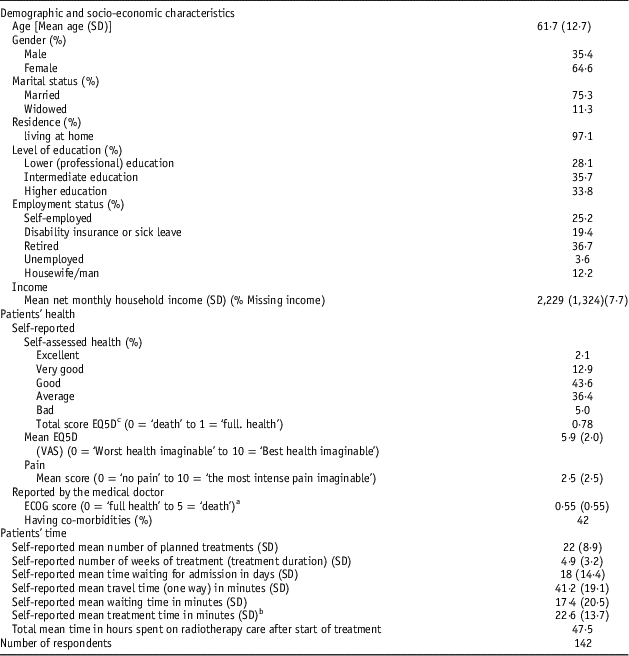
Table 1 reports the individual characteristics of the 142 patients.
Characteristics of the study sample: 142 patients not undergoing palliative radiotherapy
a Oken et al.Reference Oken, Creech and Tormey24
b Calculated as the total average time spent at the hospital for each radiotherapy treatment, minus the waiting time.
c Dolan et al.Reference Dolan23
Abbreviation: ECOG, Eastern Cooperative Oncology Group.
Most importantly, our sample was significantly slightly younger than the overall patient population undergoing non-palliative radiotherapy at the department. The percentages of females and males in our study sample did not differ significantly from the patient population as a whole.
Self-reported information on patients’ time
Patients had on average 22 radiotherapy sessions during 4·9 weeks. The average time waiting for admission was 18 days. The mean one-way travel time to the Department of Radiation Oncology was about 40 minutes. The mean waiting time, including the waiting time for transportation, was 17 minutes, and the mean treatment time was about 23 minutes.
Preferences regarding reductions in patients’ time
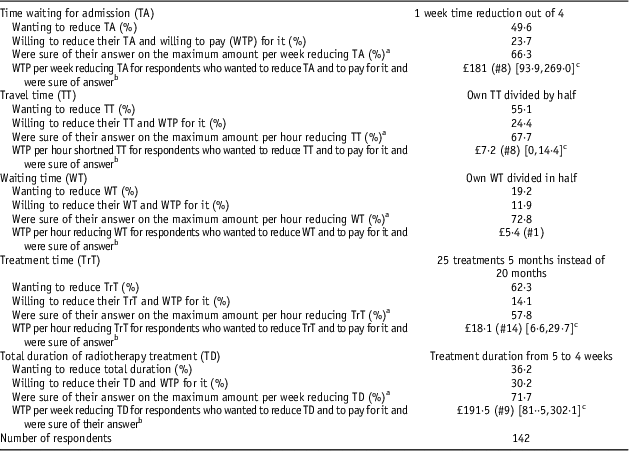
Table 2 provides information on the patients’ preferences for reducing the different categories of time.
Patient time valuation in the study sample: respondents undergoing non-palliative radiotherapy
a Including respondents who were WTP a maximum amount of money equal to 0 euro for a reduction of their patients’ time.
b Excluding respondents who were WTP a maximum amount of money equal to 0 euro for a reduction of their patients’ time.
c Confidence intervals.
Time waiting for admission
About half of the patients stated that they would prefer to have their time waiting for admission reduced by 1 week. About 24% of them were willing to pay for this to happen. The mean WTP of those who were certain of their answer and who wanted to reduce their time waiting for admission and pay for it was £181 per week. The main reasons for preferring reducing time waiting for admission were ‘less emotional distress’, ‘the sooner, the better’ and ‘may positively affect health outcomes’. The main reason for NOT preferring reducing time waiting for admission was ‘Time needed for acceptance’.
Travel time
About half of the patients stated that they would prefer to have their travel time reduced by half, and about 25% of them were willing to pay for this to happen. The mean WTP of those who were certain of their answer and who wanted to reduce their travel time and pay for it was £7·20 per hour. The main reasons for preferring reducing travel time were ‘Travel time too long’, ‘Could come by bicycle’, ‘Bad weather’ and ‘High costs for petrol’.
Waiting time
Among all, 20% of the patients preferred to have their waiting time reduced by half and 12% of them were willing to pay for this to happen. The mean WTP of those who were certain of their answer and who wanted to reduce their waiting time and pay for it was £5·40 per hour. The main reasons for preferring reducing waiting time were ‘Waiting time is a waste of time, annoying or tiring’ and ‘High car park costs’.
Treatment time
Among all, 60% of the patients wanted to reduce the treatment time from 20 to 5 minutes and 14·1% of them were willing to pay for this to happen. The main reasons for preferring reducing treatment time were ‘Gain of time’, ‘No effect on success of treatment’, ‘Treatment is unpleasant, tiring and/or painful’ and ‘More time for other patients’. The mean WTP of those who were certain of their answer and who wanted to reduce treatment time and pay for it was £18·10 per hour.
Total treatment duration
Among all, 36% of the patients preferred to be treated 7 days a week (i.e., also during the weekend) instead of 5 days a week in order to reduce their total treatment duration. 30% of them were willing to pay for this to happen, and the mean WTP of those who were certain of their answer and who wanted to reduce their total treatment duration and pay for it was £191·50 per week. The main reasons for reducing the total treatment duration were ‘The sooner, the better’, ‘Travelling is easier’ and ‘More efficient use of radiotherapy equipment’. The main reasons for not having treatments at the weekend were ‘Time needed to recover and for family’ and ‘Treatment is already tough’.
Overall, patients valued travel and waiting time equally (p-value=0·72), but valued treatment time significantly higher (p-value<0·008) than the other time categories. They marked the lowest value for time waiting for admission (£181 per week reduction or £1·06 per hour reduction).
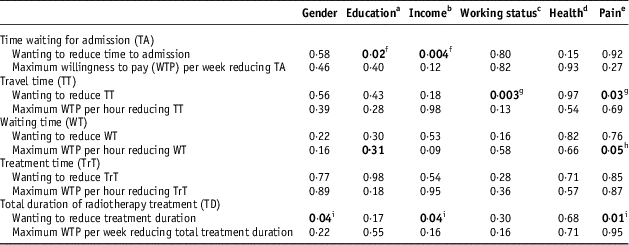
Finally, Table 3 reports the results by patients’ characteristics. More highly educated patients and patients with higher incomes preferred to reduce their time waiting for admission significantly more often than others. Patients with a paid job and patients with higher levels of pain preferred to reduce travel time significantly more often than others. Male patients, patients with higher incomes and patients with lower levels of pain preferred to be treated during weekends significantly more often than others. Patients with higher levels of pain have significantly higher WTP regarding reducing waiting time than others. No significant differences across patient groups were found for the WTP regarding the other four categories of patients’ time.
Mean time valuation by patient characteristics: p-values of two-groups mean comparison t-tests
Bold values significant at a statistical level equal to 5%.
aLower educated (Only elementary education completed or less, or only professional education) versus highly educated.
b Lower income (Lower than €1700) versus high income.
c Having a paid job versus not having a paid job.
d Poor health (Bad) versus average or good health.
e Lower levels of pain (Lower than the mean score pain) versus higher levels of pain.
f Higher educated and higher income people preferred more often to reduce time to admission than others.
g People with a paid job and people with more pain wanted more often to reduce TT than others.
h People with more pain were willing to pay significantly more for reducing WT than others.
i Male individuals, individuals with higher incomes and individuals with less pain wanted more often to reduce their total treatment duration than others.
Discussion and Conclusion
Non-palliative radiotherapy patients reported spending on average 18 days waiting for admission and a total of 44·7 hours (made up of 30 hours of travelling, 6·4 hours waiting at the department and 8·3 hours receiving the actual radiotherapy) during the entire period of their radiotherapy treatment. About half of the patients did not want to reduce the amount of time they spent receiving radiotherapy care, which could indicate that they assessed it as reasonable. In contrast, the other half preferred to reduce their time. However, only about 20% of them were willing to pay for this to happen and their mean WTP was relatively low. It should be noted that our study sample is to a large extent representative of the patient population of the Department of Radiation Oncology of the Dutch hospital, in terms of age and gender.
Other (Dutch) studies have investigated patients’ time associated with cancer care. These studies demonstrated a longer time to admission compared with our study: ~6 weeks before surgery for various tumour sites,Reference Visser, van Lanschot, van der Velden, Kloek, Gouma and Sprangers19 43 days before the start of radiotherapy for glottis laryngeal carcinomaReference Brouha, Op De Coul, Terhaard and Hordijk25 and 56 days before the start of radiotherapy for oropharyngeal carcinoma.Reference Waaijer, Terhaard and Dehnad26 However, these studies used a different definition of time to admission—namely, ‘the time between diagnosis and the start of the treatment’—which is often longer than ‘the time between medical readiness and radiotherapy commencing’ used in our study. As we had no individual information on tumour types available in the dataset, our results are difficult to compare with the results per tumour site of Yabroff et al.Reference Yabroff, Davis and Lamont1 for patients aged 65 and older in the United States.Footnote vi According to the radiation oncologists in the study, there is no reason to believe that one tumour type would be particularly represented in our dataset.
As mentioned above, only a few studies provided information about the preferences of patients regarding reduction of time spent receiving cancer care and most of them used wages to value patients’ time.Reference Yabroff, Davis and Lamont1–Reference Yabroff, Guy and Ekwueme3 Our results show WTPs that are much lower than the mean net hourly wage in The Netherland and which vary significantly across categories of patients’ time.Footnote vii This is in accordance with Jonas et al.Reference Jonas, Russell, Chou and Pignone8, and may indicate that using wages to value the time of patients undergoing non-palliative radiotherapy is likely to give an incorrect estimation of its value as seen by the patients.
Our study clearly has both strengths and weaknesses. An important strength is that, in contrast with most studies, we distinguished five different categories of patients’ time. Second, patients were offered different versions of the survey in which the contingent valuation questions on the various patients’ times were asked in changing order. This was to correct for response bias. Third, the survey questions were phrased in a way that assumes no impact of a change in patients’ time on health outcomes. Fourth, using contingent valuation questions is particularly suitable given the Dutch health insurance context, but our survey methodology can in principle be applied to other healthcare systems.
Our measures of patients’ time were self-reported. This is a potential weakness, although self-reported measures indicate how people perceive the value of their time. These data were also easier to gather than alternative ways of measuring time inputs, such as using time diaries. Second, the low percentage of individuals who preferred to reduce their waiting time might be explained by the relatively short waiting time experienced at the department (namely 17 minutes including time waiting for transportation). Accessibility and waiting times clearly differ between hospitals. Our approach could be used for other departments of radiation oncology, as well as for other cancer treatments to obtain more generalisable results. Third, the accuracy of the computed WTPs was not very precise because of the relatively small sample and because of the low percentages of patients who preferred to reduce their patients’ time and who were willing to pay for this to happen. Note, especially, that a large number of patients (about 80%) who preferred to reduce their patients’ time were not willing to pay for this to happen. These patients possibly believe that either the government, their insurer or health provider should pay for it, or they are willing to pay for these reductions themselves but are constrained by their incomes. This does not necessarily imply that they consider their time as unimportant. Finally, the survey questions were phrased in a way that assumes no impact of a change in patients’ time on health outcomes. The qualitative answers showed that we were able to convince the vast majority of the respondents, as only about 5% of the respondents mentioned that they preferred to reduce, for example, their time waiting for admission because of possible positive health effects. It should be noted that there were a few other inconsistencies in answers: a small number of respondents said that they were not willing to pay but gave positive WTP responses.
In conclusion, our study describes the development of a contingent valuation survey to investigate patients’ preferences regarding reduction in their time spent as patients as well as to assign a monetary value to their time. The results show relatively large amounts of patients’ time involved in non-palliative radiotherapy and varying patients’ preferences according to different categories of patients’ time and individual characteristics. Patients’ time has been acknowledged as potentially important and has been associated with patient satisfaction,Reference Pini, Sarafis and Malliarou6–Reference Russell9 but has been most often ignored because of measurement and valuation problems. Our approach could in principle be used worldwide to measure and value patients’ time. We would, therefore, encourage future empirical research to apply and refine our survey methodology to other and larger groups of cancer patients to obtain more accurate information on the preferences and valuation of cancer patients with respect to reducing their time spent as patients.
Acknowledgements
None.
Financial support
This study has been financed by The Netherlands Organization for Health Research and Development (ZonMw): Project name: ‘Valuation of patient time’, project number: 152002032).
Conflicts of Interest
None.