1. Introduction
People with aphasia (PWA) are commonly reported to have difficulties with inflection (e.g., Edwards, Reference Edwards and Fava2002). These difficulties have particularly been associated with non-fluent variants of the disorder, in which such impairments are often characterised in terms of inflections being lacking: definitions state that in Broca’s aphasia, for example, “the dominant feature is agrammatism (impaired syntax)” (American Speech-Language-Hearing Association (ASHA), 2018) and “[t]he defining feature of agrammatism is the omission of grammatical morphemes” (Berndt, Reference Berndt and Rapp2015, p. 383). This view of inflections being reduced in Broca’s aphasia links with the generative, rule-based approach to morphosyntax (Chomsky, Reference Chomsky1957 onwards) that has underpinned much linguistic research into this disorder to date (e.g., Bastiaanse, Rispens, & van Zonneveld, Reference Bastiaanse, Rispens, van Zonneveld, Bastiaanse and Grodzinsky2000; Friedmann, Reference Friedmann2002; Friedmann & Grodzinsky, Reference Friedmann and Grodzinsky1997; Grodzinsky, Reference Grodzinsky2000). From this theoretical perspective, the stem form of a regularly inflected word (e.g., cat) is typically assumed to be easier to produce than an inflected counterpart (e.g., cats), with the former simply requiring stem retrieval, but the latter requiring both stem retrieval and the rule-governed addition of the inflectional morpheme.
There are three main approaches to plural inflection in the psycholinguistic literature on typical speakers. One is the decompositional, rule-based approach, which, as mentioned, has been strongly influential in linguistic characterisations of aphasia. This proposes that while singulars (coat) and irregular plurals (mice) are stored as wholes, regular plurals (coats) are represented decompositionally, being assembled through the application of a rule to combine the noun stem (coat) plus plural morpheme (-s) (e.g., Marcus, Reference Marcus1995). This rule applies as a default when memory of stored whole-form plurals is not accessed, thus only applying to regular, not irregular, plurals. A contrasting view is the full listing approach (e.g., Butterworth, Reference Butterworth and Butterworth1983), in which all words (including morphologically complex forms) are listed in the lexicon, and therefore all singulars and plurals, both regular and irregular, are stored and processed as wholes. Last, another approach, sometimes described as a parallel dual route model (e.g., Baayen, Dijkstra, & Schreuder, Reference Baayen, Dijkstra and Schreuder1997), combines elements of the other two, proposing that while singulars and irregular plurals are stored and processed as wholes, regular plurals can be processed either as morphologically decomposed representations (cat + -s) or as wholes (cats).
Research on inflection in aphasia has largely focused on verbs and has mainly addressed this issue in speakers with Broca’s aphasia / agrammatism (e.g., Bastiaanse et al., Reference Bastiaanse, Rispens, van Zonneveld, Bastiaanse and Grodzinsky2000; Braber, Patterson, Ellis, & Lambon Ralph, Reference Braber, Patterson, Ellis and Lambon Ralph2005; Faroqi-Shah & Thompson, Reference Faroqi-Shah and Thompson2004, Reference Faroqi-Shah and Thompson2007), who, as explained, are typically characterised as showing a lack or reduction of inflection (see again ASHA, 2018; also Saffran, Berndt, & Schwartz, Reference Saffran, Berndt and Schwartz1989). Analyses of noun inflection often form part of wider studies that also investigate verbs, assessing differences in inflection accuracy between, or overall across, the two classes and reporting effects of grammatical class. For example, Shapiro and Caramazza, (2003) present the case of a patient who was more impaired on words and pseudo-words when these were used as verbs (e.g., he judges) than on the same words used as nouns (e.g., the judges). Such findings have been used to argue for differences in the processing and/or representation of the two classes (e.g., Shapiro & Caramazza, Reference Shapiro and Caramazza2003; see also Laiacona & Caramazza, Reference Laiacona and Caramazza2004), which fits with a wider body of literature reporting a noun–verb dissociation in aphasia (e.g., Crepaldi et al., Reference Crepaldi, Aggujaro, Arduino, Zonca, Ghirardi, Inzaghi, Colombo, Chierchia and Luzzatti2006; Rapp & Caramazza, Reference Rapp and Caramazza2002).
More recent studies, however, have specifically addressed noun inflection for grammatical number, focusing increasingly on the effects of noun ‘dominance’, that is, the relative frequencies of a noun’s singular and plural forms: nouns that are more frequent in the singular (e.g., nose) are termed singular-dominant, whilst those that are more frequent in the plural (e.g., eyes) are plural-dominant. One of the first of only a few models to consider such effects in typical language processing was that of Levelt, Roelofs, and Meyer (Reference Levelt, Roelofs and Meyer1999), in which lexical retrieval involves three levels: a lexical concept and/or semantic level, a lexical-syntactic (lemma) level, and a phonological word-form level. Here, most nouns only have a singular representation at the conceptual and lemma levels; their plurals are formed through activation of an additional MULTIPLE concept (Levelt et al., Reference Levelt, Roelofs and Meyer1999, p. 13), which activates a plural diacritic at the lemma level, before the stem and plural affix are then activated at the word-form level. However, for plural-dominant nouns (e.g., eyes), separate concepts and lemmas are proposed for both singulars and plurals. A reason for this proposal, Levelt et al. explain, is that plural nouns have a difference in meaning to simply the singular meaning in multiple form; for example, eyes has the additional connotation of ‘gaze’ that is not associated with the singular, eye. However, taking into account language in typical speakers and those with aphasia, Nickels, Biedermann, Fieder, and Schiller (Reference Nickels, Biedermann, Fieder and Schiller2015) make substantial changes to this model, suggesting that all nouns have only one conceptual representation, but that this is explicitly coded for SINGULAR or PLURAL at the conceptual level, before activating a singular or plural lemma, respectively (here, our discussion relates to plurals of count nouns, but see also Nickels et al.’s (Reference Nickels, Biedermann, Fieder and Schiller2015) proposals regarding other types such as mass nouns and pluralia tantum). They suggest that the singular form is the default, due to “… a stronger connection between the noun concept (CAT) and the singular noun lemma (cat) than between the concept and plural lemma (cats)” (2015, p. 291). This should result in greater activation, and therefore quicker selection, of the singular lemma than the plural. However, they argue that in plural-dominant nouns, the connection between concept and lemma is stronger for the plural, resulting in a processing advantage for this over the singular, and they suggest that these nouns might have both decomposed and whole-form representations at the word-form level.
The nature of this proposed connection between the concept and lemma is not elaborated but this view appears to be compatible with the constructivist, usage-based approach to language (see, e.g., Ambridge & Lieven, Reference Ambridge and Lieven2011; Bybee & Beckner, Reference Bybee, Beckner, Heine and Narrog2010; Hatchard, Reference Hatchard, Damico and Ball2019), which has been applied with apparent success in other areas of language research (such as child language; e.g., Ambridge & Lieven, Reference Ambridge and Lieven2011; Tomasello, Reference Tomasello2003, Reference Tomasello and Bavin2015), but is only just beginning to gain momentum in aphasiology (e.g., Boye, Bastiaanse, & Harder, Reference Boye, Bastiaanse and Harder2017; Hatchard, Reference Hatchard2015; Hatchard, Wilkinson, & Herbert, Reference Hatchard, Wilkinson and Herbert2013; Ishkhanyan, Sahraoui, Harder, Mogensen, & Boye, Reference Ishkhanyan, Sahraoui, Harder, Mogensen and Boye2017; Menn & Duffield, Reference Menn and Duffield2013). In this approach, all language is learned from the input as constructions (form–meaning pairings) of various sizes and degrees of schematicity, from morphemes and words to multiword ‘chunks’, partially filled schemas, and fully abstract grammatical patterns. Therefore, frequency effects are expected at all utterance sizes and degrees of schematicity and within various paradigms (e.g., affecting which name to use for a given referent or which noun form to use within an inflectional paradigm for grammatical number; see Menn & Duffield, Reference Menn and Duffield2013), and there is indeed mounting evidence of such effects from various linguistic areas (e.g., typical language processing: e.g., Ambridge, Kidd, Rowland, & Theakston, Reference Ambridge, Kidd, Rowland and Theakston2015; Arnon & Clark, Reference Arnon and Clark2011; Bannard & Matthews, Reference Bannard and Matthews2008; Bybee & Scheibmann, Reference Bybee and Scheibmann1999; and aphasia: e.g., Gahl, Reference Gahl2002; Gahl et al., Reference Gahl, Menn, Ramsberger, Jurafsky, Elder, Rewega and Holland2003; Hatchard, Reference Hatchard2015; Zimmerer, Newman, Thomson, Coleman, & Varley, Reference Zimmerer, Newman, Thomson, Coleman and Varley2018).
Support for these proposed differences in the processing of plural-dominant nouns in fluent and non-fluent aphasia comes from reported effects of plural dominance in spoken production tasks, in which singular-dominant plurals were more error-prone than singular-dominant singulars, whereas no difference was observed between plural-dominant singulars and plurals (e.g., Biedermann et al., Reference Biedermann, Beyersmann, Mason, Machleb, Moormann and Lorenz2018; Biedermann, Beyersmann, Mason, & Nickels, Reference Biedermann, Beyersmann, Mason and Nickels2013; Biedermann, Lorenz, Beyersmann, & Nickels, Reference Biedermann, Lorenz, Beyersmann and Nickels2012).
Such research into grammatical number in nouns in aphasia has, however, focused on this issue in isolated single words using experimental paradigms; it has not been examined in spontaneous speech. While experimental work can allow a more targeted investigation of specific linguistic features and enable a faster means of collecting a larger sample of relevant tokens, spontaneous speech arguably provides more naturalistic data and can also highlight language differences across speakers that may be masked in tests such as naming (Dell, Schwartz, Martin, Saffran, & Gagnon, Reference Dell, Schwartz, Martin, Saffran and Gagnon1997). Furthermore, using narratives of well-known stories provides a more restricted context for interpreting the speech than, for example, free conversation (cf. Dell et al., Reference Dell, Schwartz, Martin, Saffran and Gagnon1997), potentially aiding researchers’ predictions about target utterances during data analysis. In addition to this, there is limited qualitative analysis of such errors. Some existing papers have summarised the error types involved: Biedermann et al.’s (Reference Biedermann, Beyersmann, Mason, Machleb, Moormann and Lorenz2018) study of German speakers with aphasia reported singularisation errors (use of the singular instead of the required plural) and pluralisation errors (use of the plural in place of the required singular) (these two types were also reported in participant descriptions by Biedermann et al., Reference Biedermann, Lorenz, Beyersmann and Nickels2012, Reference Biedermann, Beyersmann, Mason and Nickels2013). However, no existing research has provided a systematic qualitative analysis of these errors, described the nouns involved, or reported individual speakers’ levels of consistency in producing errors. Moreover, some papers (e.g., Biedermann et al., Reference Biedermann, Beyersmann, Mason, Machleb, Moormann and Lorenz2018; Lorenz & Biedermann, Reference Lorenz and Biedermann2015) have excluded errors in which the stem as well as the grammatical number was produced incorrectly (e.g., target = cat; production = bats). Whilst there is an argument for doing this to purely study number, it is also interesting to examine all number errors (including those which accompany stem errors), to investigate why a given form of the noun used may have been produced over another form of that noun (within the inflectional paradigm for grammatical number), regardless of whether the lemma is appropriate for the respective utterance.
The current study addresses these gaps by providing a quantitative and qualitative examination of all number errors in nouns produced in spoken narratives by 12 people with a range of aphasia types/severities. These samples were collected for a wider constructivist, usage-based investigation of spoken language in aphasia (Hatchard, Reference Hatchard2015), and the current study was conceived after number errors were noticed in the narratives. Corresponding data from 12 unimpaired speakers narrating the same story are also included for certain points of comparison. The study specifically investigates the following research questions:
1. What is the error rate for the PWA and how does this compare with that for the unimpaired speakers?
2. What type of errors are made with grammatical number and which nouns are involved?
3. Do the errors suggest any relationship with frequency (noun dominance), that is, are the forms produced in the errors more or less frequent than those expected?
4. How consistently do speakers make errors and do these speakers show any ability to vary the form of the nouns concerned?
While this was a somewhat exploratory study, some basic hypotheses could be formulated for these questions. For question 1, no prediction was made regarding the actual rate of errors by the PWA, but, overall, this was expected to be higher than that of the unimpaired speaker group: existing literature proposes that errors in aphasia do not necessarily differ qualitatively from those by unimpaired speakers, but tend to occur at a higher rate (e.g., Dell et al., Reference Dell, Schwartz, Martin, Saffran and Gagnon1997). With regard to question 2, given the aforementioned finding of both singularisation and pluralisation errors in previous aphasia studies, it was expected that both these types would be observed here. We kept an open mind regarding which exact nouns would be affected, however. For question 3, we hypothesised that the form produced in the errors would be more frequent in spoken English than the form required (that is, there would be a dominance effect on error production). As explained, this would fit with the evidence from existing literature that frequency effects are at play in various paradigms (see again Menn & Duffield, Reference Menn and Duffield2013), including that of noun inflection for number. It would also be in keeping with the studies that have specifically reported effects of noun dominance in aphasia (see again above). Last, concerning question 4, the issue of consistency in spoken language capabilities has been raised by Hatchard (Reference Hatchard2015), who points out that while some rule-based, generative research describes impairments in aphasia as if these affect particular structures ‘across the board’ (e.g., Friedmann, Reference Friedmann2002; Friedmann & Grodzinsky, Reference Friedmann and Grodzinsky1997), this is not typically the case when individual speakers’ data is examined (Hatchard, Reference Hatchard2015, p. 21). Instead, there is within-speaker ‘unevenness’ in such capabilities, whereby speakers can often produce a particular feature at some times but not at others. This unevenness could be predicted from a constructivist, usage-based view: since, in this approach, all language is acquired from the input, and the input is uneven (e.g., some items being more frequent than others), language should be entrenched in speakers’ minds in an uneven way. Some forms of nouns should therefore be easier to access than others, and consequently errors should be less likely for some such forms, and in some utterances, than others. We therefore predicted unevenness in error production, rather than speakers demonstrating a consistent difficulty ‘across the board’ (e.g., not being able to produce any regular plurals). The latter part of question 4, regarding speakers’ flexibility with the nouns involved in the errors, was more exploratory; however, it could be that errors are more likely in speakers with a greater level of spoken language impairment. Hatchard’s (2015, pp. 203–316) wider analysis of some of the participants from the current study revealed that those with the lowest spontaneous speech rating not only appeared to have access to fewer constructions overall, but also seemed to rely more on whole-form retrieval of ‘fixed’, lexicalised items (i.e., ‘fixed’ words or multiword ‘chunks’), rather than also being able to assemble items by combining constructions. This should mean that they have access to fewer whole-form nouns that they can retrieve, and also that they are less able to assemble other noun forms by combining constructions (e.g., the noun stem plus plural morpheme). This should mean that errors are more likely in these speakers. In turn, we expected error-producing participants to show limited variation in the forms of the nouns involved in the errors that they produced.
2. Method
2.1. participants
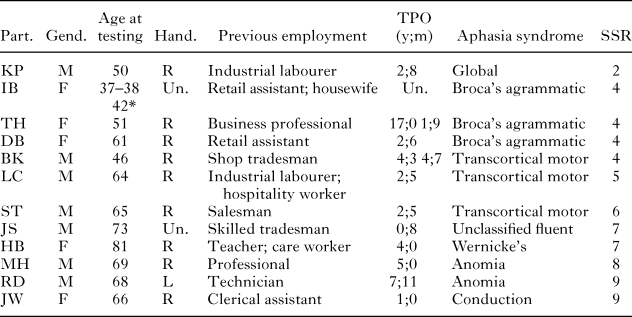
This study examined Cinderella narratives from 12 PWA (see Table 1 for summary of participant details). Corresponding data from 12 unimpaired speakers were also examined for certain points of comparison. The PWA included five participants from the PATSy Database (BK, DB, IB, JS, and JW; Lum, Cox, & Kilgour, Reference Lum, Cox and Kilgour2012; see also Lum, Cox, Kilgour, Morris & Tobin, Reference Lum, Cox, Kilgour, Morris and Tobin1999, for more details of this database) and seven people recruited for the current study (KP, TH, LC, ST, HB, MH, and RD; hereafter referred to as the ‘recruited participants’). All twelve were adults with aphasia resulting from cerebro-vascular accident (stroke) and were selected to include a range of aphasia ‘types’ and severities. They comprised seven males and five females, with an age range of 37–81 years (mean = 60.9, SD = 12.54). All were native English speakers, at least six months post-stroke, with no significant hearing or visual impairment, no significant unintelligibility of speech, no previous history of speech and language impairment prior to stroke, and no other neurological or psychiatric conditions. The PATSy Database participants were also selected based on the availability of narrative recordings in which the majority of speech was intelligible. The ‘recruited participants’ were recruited from local aphasia support groups, with initial interest in participation being gauged by a third person not connected with the research (the support group facilitator). Information about the study, both in ‘aphasia-friendly’ (e.g., Herbert, Haw, Brown, Gregory, & Brumfitt, Reference Herbert, Haw, Brown, Gregory and Brumfitt2012) and more detailed form, was then provided to anyone potentially interested in participating. These participants were selected on the basis that they had sufficient attention ability, comprehension, and expressive language to understand the study, give informed consent to participate, and produce a spoken narrative. Consent was gained in the first data collection session (see below), with additional support from participants’ friends and relatives as necessary. Data collection was approved by the Research Ethics Committee of the University of Sheffield’s Department of Human Communication Sciences.
Participant details (individuals listed in increasing order of spontaneous speech rating)

notes: Part. = participant; Gend. = gender; Hand. = handedness; TPO = time post aphasia onset (where two time periods are listed, the participant has sustained two strokes); SSR = spontaneous speech rating; F = female; M = male; R = right, L = left, Un. = unknown. * The PATSy database states that data for participant IB was collected during two test periods.
The aphasia classifications of the PATSy Database participants given in Table 1 are those listed on that database; those of the recruited participants were established after administering standardised language tests (see below for procedure and ‘Appendix 1’ in the supplementary materials for test results (available at <http://doi.org/10.1017/langcog.2019.21>)). Since this study was specifically interested in spontaneous speech production, and to gain greater insight into the differences in spoken language capabilities between participants, each person was also given a rating for their overall spontaneous speech capabilities, using the scale for “Fluency, grammatical competence, and paraphasias” from the Western Aphasia Battery (WAB; Kertesz, Reference Kertesz1982, p. 3). This assesses the fluency, length, and complexity of utterances on a scale of 1 to 10, with 1 indicating the most limited spontaneous speech capabilities and 10 the most advanced. Again, the spontaneous speech ratings for the PATSy Database participants (Table 1) are those listed on the database, whilst those for the recruited participants were assigned by both the researcher and a qualified speech and language therapist.
The unimpaired speakers’ narratives were collected by Webster, Franklin, and Howard (Reference Webster, Franklin and Howard2001, Reference Webster, Franklin and Howard2007), and included four males and eight females, with an age range of 22–80 years (mean age = 52.3, SD = 19.09). All had “… no history of language or cognitive difficulties and came from a wide range of social/educational backgrounds” (Webster et al., Reference Webster, Franklin and Howard2007, p. 369).
2.2. data collection from recruited participants
Each of the recruited participants attended two data collection sessions of up to one hour. In the first session and the first part of the second session, selected tests from the Comprehensive Aphasia Test (CAT; Swinburn, Porter, & Howard, Reference Swinburn, Porter and Howard2004) were administered to establish the participants’ aphasia profiles (see below for language assessment details). In the latter half of the second session, participants narrated the Cinderella story (details of narrative elicitation procedures are also given below). All tasks involving spoken output from participants were audio-recorded. The narratives were also video-recorded.
For the language assessments, the CAT subtests were administered and scored using the procedures in the CAT manual (Swinburn et al., Reference Swinburn, Porter and Howard2004), with the exception that, rather than tests being discontinued after a certain number of incorrect responses, all were completed in their entirety to maximise the amount of profiling data collected (see again ‘Appendix 1’ for test results). As mentioned, each participant was also rated for their spontaneous speech using the WAB scale for “Fluency, grammatical competence, and paraphasias” (Kertesz, Reference Kertesz1982, p. 3) (see again Table 1).
The narrative was elicited following Saffran et al.’s (Reference Saffran, Berndt and Schwartz1989) procedure, in which participants view pictures of the story before producing the narrative with minimal spoken input from the researcher, with the following exceptions: first, while the recruited participants did first view a picture-book, the researcher did not speak during this time, in order to minimise any priming of participants’ output. Second, although participants were asked to produce the narrative without this resource, they were allowed to view it again during the story-telling if necessary to complete the task, and three participants (KP, LC, and RD) did so. Last, no minimum or maximum duration was specified for the narratives; rather, participants were asked to narrate as much of the story as possible.
2.3. narrative elicitation from PATSy Database participants and unimpaired speakers
The narratives from the PATSy Database participants and unimpaired speakers were also elicited using Saffron et al.’s (Reference Saffran, Berndt and Schwartz1989) method, with the following exceptions: most of the PATSy Database participants’ narratives included considerable spoken input from the interviewer; it is also unknown for most of these participants whether they viewed pictures before and/or during narrative production or were given any verbal summary of the story beforehand (it is known that DB and JS viewed pictures during the story-telling, and that BK was given a verbal summary beforehand). The unimpaired speakers did not view any pictures before or during the task, since all were able to attempt the narrative without doing so.
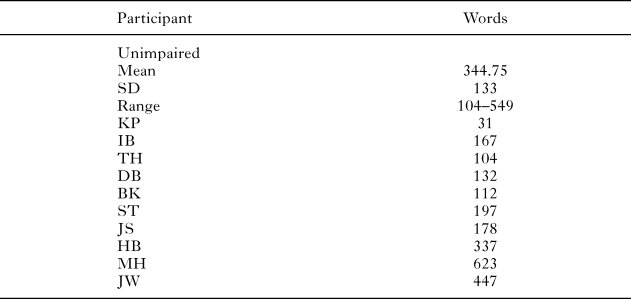
The number of words produced by each person with aphasia in their narrative, counted using the protocol developed by Hatchard (2015, pp. 440–447), is shown in Table 2 (these numbers include only productions by participants, rather than any by interviewers, and also exclude neologisms (productions with fewer than 50% phonemes the same as a recognisable word; cf. Boyle, Reference Boyle2014), audible hesitation tokens (e.g., er, erm), unintelligible speech, and identical repetitions made during attempts at an item).
Number of narrative words per participant

2.4. transcription
The PWA’s narratives were transcribed in their entirety, with transcriptions aiming to capture as much of the participants’ output as possible. Therefore, all productions were retained, including words, phonemic paraphasias (productions with at least 50% of phonemes the same as a recognisable word; Boyle, Reference Boyle2014), neologisms, partial productions (single phonemes; other unfinished productions), audible hesitation tokens, and non-linguistic output (coughing, laughter). In brief, words were transcribed orthographically; broad phonetic transcription was used for non-words, single phonemes, and items with homophones for which it was unknown which homophonous form had been produced. Pauses were noted to 0.1 milliseconds, measured from the acoustic waveform in version 2.0.5 of Audacity(R) recording and editing software (Audacity Team, 2013–2014). The transcription method was tested on the PATSy Database narratives for intra- and inter-rater reliability of transcription of speaker turns, verbal content, and pause placement and length, and found to be reliable in all cases. To measure intra-rater reliability, 10% of each PATSy Database narrative (measured by time duration) was transcribed by the researcher on a second occasion. Agreement levels (total tokens compared shown in parentheses after agreement level) were: speaker turns (Cohen’s Kappa; rater choice between ‘participant turn’, ‘interviewer turn’, or ‘no turn’) = 0.91 (80), p ≤ .001; verbal content (measured by proportion of tokens in agreement) = 0.98 (317); pause position (proportion) = 0.92 (52); and pause length (proportion) = 0.92 (48). Here, minimum levels for reliability were taken as 0.7 for Cohen’s kappa (e.g., Wood, Reference Wood2007, p. 6), and 0.80 for proportional agreement (e.g., Ferguson & Armstrong, Reference Ferguson and Armstrong2009, p. 47). For inter-rater reliability, 10% of each PATSy Database narrative was transcribed by a second person (an aphasia researcher). Agreement levels (total tokens compared shown in parentheses after agreement level) were: speaker turns (Cohen’s kappa) = 0.84 (81), p ≤ .001; verbal content (proportion) = 0.85 (340); pause position (proportion) = 0.87 (70); and pause length (proportion) = 0.84 (61).
The transcriptions of the unimpaired speaker narratives were those by Webster et al. (Reference Webster, Franklin and Howard2001, Reference Webster, Franklin and Howard2007), following Saffran et al.’s (Reference Saffran, Berndt and Schwartz1989) procedure. In sum, again, orthographic transcription was used, with any phonemic paraphasias or neologisms transcribed phonetically. Pauses of one second or above were noted impressionistically by the transcriber.
2.5. noun extraction and coding
All noun tokens were identified in the narratives and coded for grammatical number following the procedures in ‘Appendix 2’ in the supplementary materials. The following were then excluded from the data:
i. neologisms (see definition in transcription section above); these were excluded because, as non-words, they do not have recognisable singular and plural forms, and therefore could not be coded for grammatical number.
ii. tokens whose grammatical number could not be determined (e.g., because the noun was unfinished) and therefore could not be coded for ‘correctness’ of grammatical number.
iii. tokens where the same form had been produced by the interviewer in the turn immediately preceding that containing the participant’s token (these exclusions aimed to limit potential priming effects on participants’ productions by those of the interviewer);
iv. tokens prompted by the interviewer writing down a word for the participant (this only applied to certain tokens of Cinderella in IB’s narrative; again, these exclusions aimed to limit any influence of the interviewer’s productions on the participant’s language).
In total, 1152 noun tokens were included: 402 from the PWA and 750 from the unimpaired speakers. (See ‘Appendix 3’ in the supplementary materials for all tokens produced by the PWA.)
The tokens were then coded for ‘correctness’ of grammatical number, again using the procedure in ‘Appendix 2’. In brief, the grammatical number of each token was classified as correct or incorrect based on its appropriateness for the narrative/linguistic context. A further ‘unclassified’ category was used for tokens whose correctness of grammatical number could not be ascertained and were therefore potential errors. For example, there were several instances where a participant had produced slippers with little accompanying context, and it was unclear whether they were referring to the point where Cinderella was given the glass slippers by the fairy godmother, which would require the plural, or to the one slipper that Cinderella lost on leaving the ball, which would require the singular.
All the above procedures (noun token extraction, coding for grammatical number, and coding for correctness of grammatical number), and the process of identifying target words of phonemic paraphasias, were tested and found to be reliable within and between raters. To measure intra-rater reliability, 15–20% of all PWA’s narratives (measured by time duration) was coded by the researcher on a second occasion following the same procedure (‘Appendix 2’, excluding points C (iv–v) and D (v), which were additions following the reliability tests) on both occasions. Agreement levels (all measured by proportion of tokens in agreement; total tokens shown in parentheses after proportion) were: noun token identification/inclusion = 0.99 (103); target noun identification for phonemic paraphasias = 1.00 (15); coding for grammatical number = 1.00 (102); and coding of correctness of grammatical number = 1.00 (102). For the inter-rater tests, 15–20% of all twelve participant narratives was coded by a second person (a postgraduate linguistics student familiar with language in aphasia), following the same protocol used by the researcher (again, excluding points C (iv–v) and D (v)). Agreement levels (all measured by proportion of tokens in agreement; total tokens shown in parentheses after proportion) were: noun token identification/inclusion = 0.89 (92); target noun identification for phonemic paraphasias = 0.92 (12); coding for grammatical number = 0.99 (82); and coding of correctness of grammatical number = 0.95 (81). Again, in both tests, 0.80 was taken as a minimum proportional agreement level for reliability to be confirmed (cf. Ferguson & Armstrong, Reference Ferguson and Armstrong2009, p. 47).
2.6. analysis
In accordance with the research questions, the data were analysed for:
i. number of errors per participant;
ii. type of errors made and nouns involved;
iii. any relationship with frequency (dominance), that is, whether the form produced was more frequent than, less frequent than, or of equal frequency to the form expected (i.e., dominant, non-dominant, or equi-dominant, respectively; see below for procedure of retrieving frequency values);
iv. speakers’ consistency in producing errors, and any demonstrated ability to vary the form of the nouns involved in the errors.
2.7. retrieval of frequency values
Frequency values for the singular and plural forms of each noun produced in the narratives were retrieved from the spoken British National Corpus (Davies, 2004–). However, in case any words that shared phonological forms with the singular or plural could also influence which phonological form of the noun was more frequent overall, three frequency comparisons were made in total:
1. The singular (e.g., girl) versus the plural (girls).
2. The singular (girl) versus all forms of the noun that share the same phonological form with the plural, that is, the plural (e.g., girls), the singular possessive (girl’s), the singular plus contracted copula is (girl’s), the singular plus contracted auxiliary has (girl’s), and the plural possessive (girls’). (This calculation was only conducted for regular nouns, as irregular plurals do not share the same phonological form as the possessive or contracted forms mentioned.)
3. The frequencies in (2) plus those of all homophones of the singular form (e.g., farther as a homophone of father); or plural form (feat for feet), that is, the total frequencies of items with the same phonological form as the singular versus the total frequencies of items with the same phonological form as the plural.
In all cases, the frequencies of phonemic paraphasias were taken to be those of the target word. For other paraphasias in which a different word was produced, the frequency used was that of the produced word. For each comparison, it was determined which form was more frequent. Finally, it was noted whether the more frequent form was the one produced by the participant in each token. In nearly all cases, the different frequency comparisons did not change which form of the noun was more frequent. Only three nouns (LEG, FOOT, and TAILOR) proved exceptions here, accounting for five of the 402 tokens, across four participants. None of these three nouns were involved in the errors (or ‘potential errors’) observed. Therefore, when referring to noun dominance from here onwards, we report only the frequency values from the first comparison. For added information, the ratio of the dominant over the non-dominant form (dominance ratio) is also given (see ‘Appendix 3’).
3. Results
3.1. overview of tokens
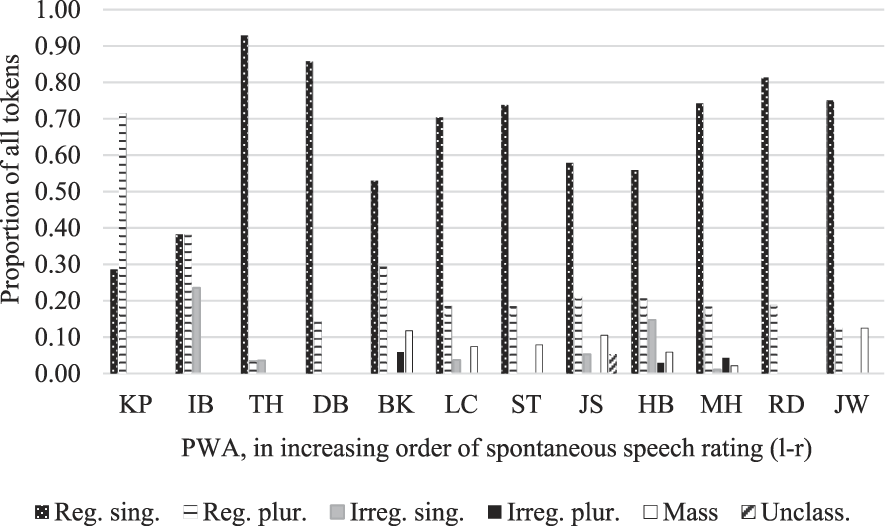
To give an overview of the data prior to addressing the research questions, Figures 1 and 2 summarise the noun tokens produced by each of the PWA (the full list of tokens, along with frequency levels, dominance ratios, and linguistic context of production is provided in ‘Appendix 3’). Figure 1 shows the number of tokens of each noun subcategory as a proportion of all noun tokens, with the participants displayed in increasing order of spontaneous speech rating from left to right. In all twelve participants, the majority of tokens were count nouns. Of this noun type, all participants produced regular singulars and plurals, and all participants except KP, TH, and IB produced both forms of at least one regular noun. Seven participants additionally produced irregular nouns and mass nouns, but tokens of these types were generally low. There was only one unclassified token, a production of doings (as in the doings) by JW, which seemed to be used as a general label for a referent for which JW was struggling to find the conventional term. However, it was unclear if this should be regarded as a singular or plural and the token was therefore left unclassified.
Proportions of token types produced per participant.
notes: Reg. = regular; Irreg. = irregular; sing. = singular; plur. = plural; Unclass. = unclassified.

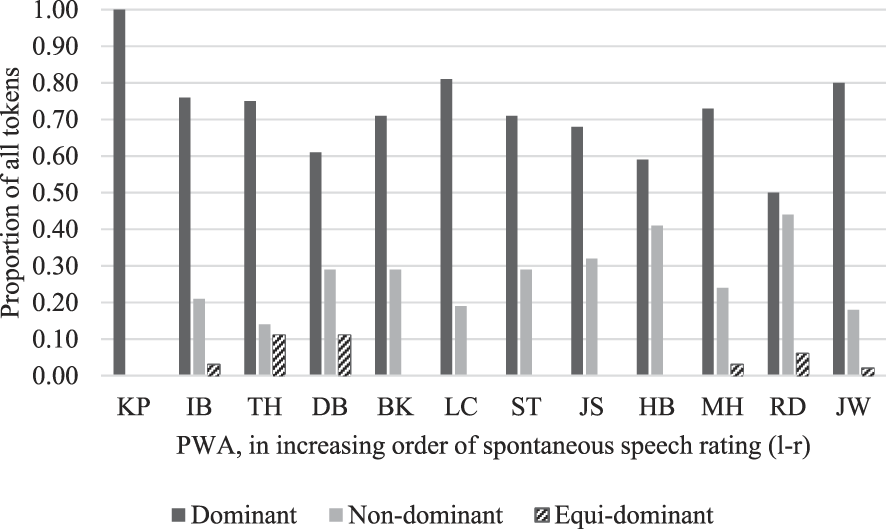
Proportions of dominant, non-dominant, and equi-dominant forms produced per participant.

Figure 2 shows the proportions of tokens in which the dominant, non-dominant, and equi-dominant noun form was used. Here, it can be seen that participants used both dominant and non-dominant forms, that is, using both the more frequent and less frequent noun forms. The exception here was that KP, the speaker with the lowest spontaneous speech rating, only ever produced the dominant form of the nouns that he used.
3.2. error rate
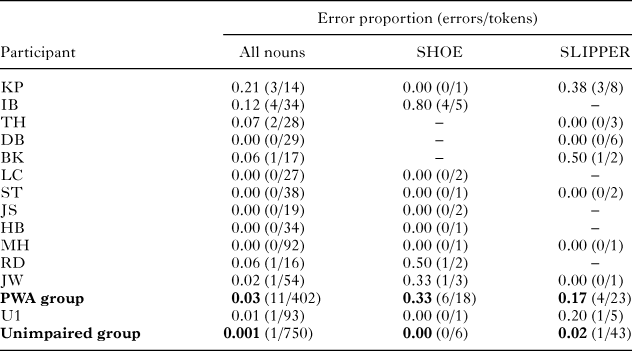
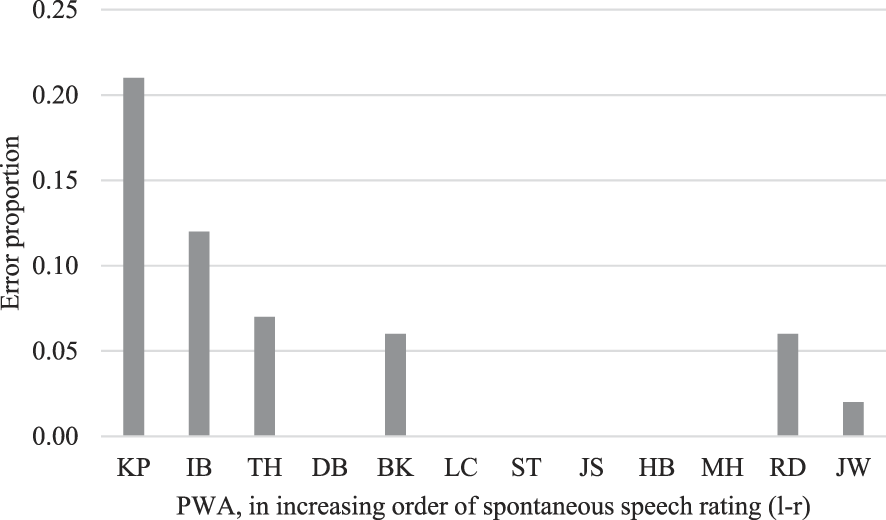
Overall, the error rate was low, both in the unimpaired speakers and in the PWA. In all 750 tokens from the unimpaired speakers, there was just a single error, giving a grouped error rate of 0.001 for these participants. The grouped rate for the PWA was higher (0.03; range = 0.00–0.17); however, there was considerable variation across individuals, with errors only being produced by half of the twelve PWA (see Table 3). The errors were not limited to participants with non-fluent aphasia: the two speakers with the highest spontaneous speech ratings, RD and JW, diagnosed with fluent subtypes (anomia and conduction aphasia, respectively), also made errors. However, in diagrammatic form (Figure 3), the data suggest that errors might be more likely for speakers with lower spontaneous speech ratings and decrease as this rating increases. Consequently, the relationship between this rating and the number of errors was examined using the non-parametric Kendall’s tau correlation. Results indicate a moderate but non-significant correlation between spontaneous speech rating and error proportion (τ = –0.353, p (one-tailed) = .075).
Number of errors per participant (PWA listed in increasing order of spontaneous speech rating)

Error proportion per participant.

On closer analysis, however, it was found that 85% of errors were produced on the same two nouns: SLIPPER and SHOE (see discussion of second research question below). Therefore, it is useful to also report the error rates on these specific nouns (see again Table 3). This analysis reveals a considerably higher error rate for the PWA on both nouns, widening the gap with the corresponding unimpaired group rates.
Although the overall error rate for the PWA is low, it is worth noting that there were further tokens that were judged to be potential errors but which could not be confirmed as errors (see again the ‘Method’ section for an example of this). In total, potential errors accounted for 24 tokens (0.06 of all tokens by the PWA; see again ‘Appendix 3’ for ‘potential error’ tokens), and all were produced by the same participants who made the confirmed errors, with the exception that some potential errors were also noted for LC and JS. The analysis henceforth, however, only addresses the confirmed errors.
3.3. nature of errors
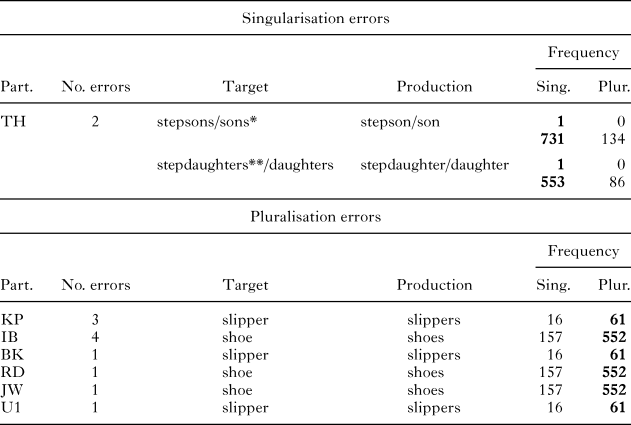
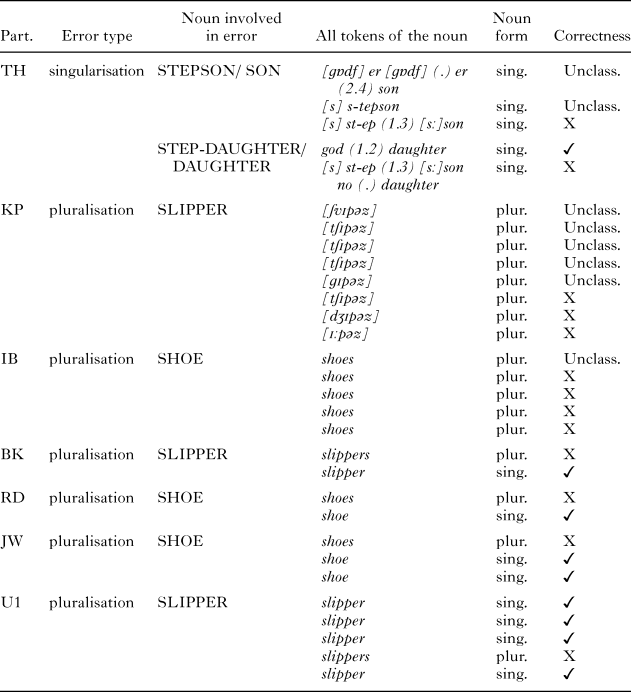
Details of the errors produced by the PWA and the one unimpaired speaker (U1) are shown in Table 4. These included both singularisation errors (production of the singular instead of the expected plural) and pluralisation errors (production of the plural in place of the expected singular). The two singularisation errors were produced by one of the PWA, whilst the 11 pluralisation errors were produced by five PWA and one unimpaired speaker. No participant made both error types. All errors involved production of regular nouns. Both singularisation errors involved kinship terms (stepson; stepdaughter/daughter), which seemed to refer to the ugly sisters. For example (error in bold):
TH. herm (.) came and erm (.) erm /sː/ /sː/ erm (.) /s/ st-ep (1.3) /sː/son no (.) daughter (.) /hɜːn/ (.) erm slipper (1.0) but not /sɜː/ thingy because (.) not there…
Errors produced per participant, with frequency values for each possible noun form (within error type, PWA listed in increasing order of spontaneous speech rating)

notes: Part. = participant; sing. = singular; plur. = plural. Frequencies shown are for the singular and plural only (see again frequency comparison 1 in the ‘Method’ section); bold denotes frequency of produced form. See Table 6 and Appendix 3 for exact productions of tokens. * The exact production here was /s/ st-ep (1.3) /sː/son no (.) daughter. Since son was produced quite separately from step, the frequencies of both stepson and son were considered. ** This token was produced in the utterance /s/ st-ep (1.3) /sː/son no (.) daughter., in which daughter was relatively isolated from step. Therefore, the frequencies of both daughter and stepdaughter were considered.
All 11 pluralisation errors involved references to the glass slipper that Cinderella lost at the ball (slipper, shoe). For instance:
IB. and (7.5) twelve (3.6) and stairs (1.4) and (1.3) /sk/ /skuldᵊ mɪl/ (.)
shoes (1.4) fall (.) and one (.) one (2.5) one (.) shoes …
3.4. relationship with frequency (dominance)
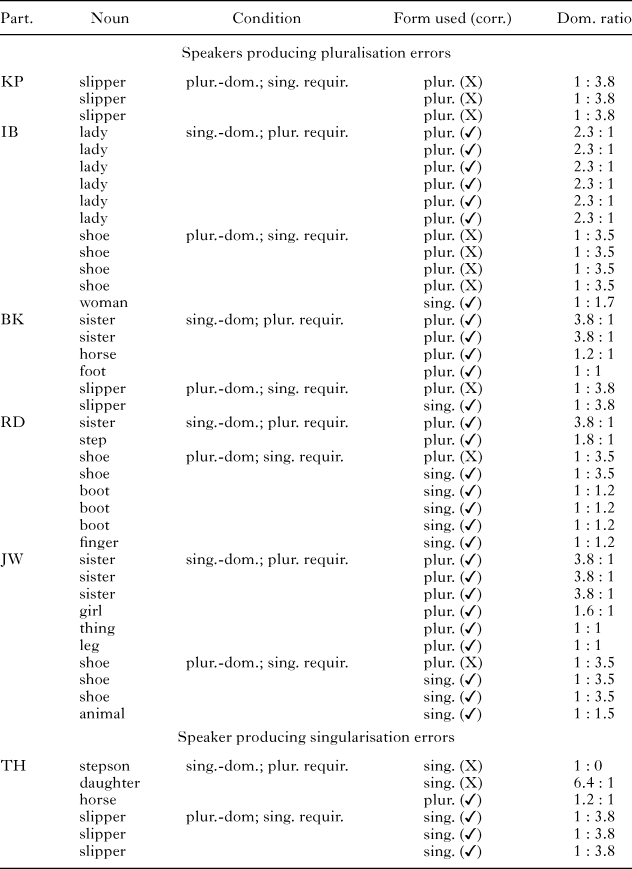
All errors, regardless of type, involved production of the more frequent (dominant) form when the non-dominant form was required (see again Table 4). Furthermore, as can be seen in Table 5, the errors all occurred when the dominance ratio was comparatively high amongst all tokens in this condition (non-dominant form required): the pluralisation errors occurred on nouns with a plural:singular ratio of 3.5:1 and 3.8:1; the singularisation errors occurred on one noun with a singular:plural ratio of 6.6:1, and another with an essentially unknown ratio, 1:0. This relationship with dominance does not appear to be straightforward, however, as, contrary to the observation of pluralisation errors at the ratio of 3.8:1, singularisation errors did not occur on the noun SISTER, which had this same dominance ratio but in the converse direction (singular over plural) (see again Table 5).
All tokens where the non-dominant form was required

notes: Part. = participant; Corr. = ‘correctness’ of grammatical number in the narrative/linguistic context; ✓= used with ‘correct’ grammatical number; X = used with ‘incorrect’ grammatical number; sing. = singular; plur. = plural; sing.-dom = singular-dominant; plur.-dom. = plural-dominant; requir. = required; Dom. = dominance.
3.5. speakers’ consistency with error production
With regard to individuals’ levels of consistency in producing errors, all showed within-speaker unevenness in this respect. First, they did not demonstrate any consistent impairment with a particular type of morphology: the participant who produced singularisation errors did not do so every time they attempted a regular plural (they did produce some regular plurals, and appropriately for the narrative/linguistic context), and those who produced pluralisation errors did not do so on all attempts at a regular singular (producing these singulars at other times, and appropriately for the context). Indeed, all speakers produced some regular singulars and regular plurals. In terms of consistency of error production with the specific nouns involved (Table 5), this was difficult to determine for the one speaker who produced singularisation errors (TH). The nouns concerned were stepson and stepdaughter, and of these, only stepson was produced more than once. However, because of the relative separation of son and daughter from step in these productions, other tokens involving son and daughter were considered here (see Table 6). In the case of stepson, the other productions were unclassified in terms of correctness of grammatical number. For stepdaughter, there was one other production involving daughter, where this too was produced relatively separately to god in the noun goddaughter, and this token was produced with the correct grammatical number. TH produced only the singular forms of these nouns rather than demonstrating any ability to use them flexibly. Of the five participants who made pluralisation errors, in two (those with the lowest spontaneous speech ratings: KP and IB), the only other productions of the nouns concerned were unclassified for correctness of grammatical number. Therefore, no correct uses could be confirmed. Both speakers produced the respective nouns only in the plural form, rather than demonstrating any flexibility with this. However, the remaining speakers (BK, RD, and JW) each produced the nouns concerned in both the singular and plural, demonstrating more flexibility of form than the other two speakers. In doing so, they each used the noun at least once with the correct grammatical number, and in all three cases the erroneous usage was the first production of the noun, with the correct productions following later in the narrative. The unimpaired speaker showed greater flexibility in his tokens of the noun involved in his error (SLIPPER), producing this in both the singular and plural across five tokens (all requiring the singular), with the number error occurring on the fourth of these.
Participants’ tokens of nouns involved in errors (within error type, PWA listed in increasing order of spontaneous speech rating)

notes: Part .= participant; X = incorrect; ✓ = correct; Unclass.= unclassified.
4. Discussion
This section first discusses the results in relation to the research questions, before explaining the implications of these findings for psycholinguistic theory and for aphasiology and clinical practice.
4.1. discussion of research questions
Beginning with error rate, for nouns overall, this was low, for both the PWA and the unimpaired speakers (although difficulties with error identification in the PWA’s narratives, as reflected in the 24 tokens classified as ‘potential errors’, may mean that the rate for this group was in fact higher than reported). In any case, the group rate for the PWA was higher than that for the unimpaired group, and considerably so when calculated for each of the two nouns involved in the majority of errors (SLIPPER and SHOE). The higher group rate for the PWA was predicted: inflection difficulties are commonly recognised in PWA (see again, e.g., Edwards, Reference Edwards and Fava2002) and, more generally, errors in aphasia are thought to resemble those of unimpaired speakers but occur at a higher rate (e.g., Dell et al., Reference Dell, Schwartz, Martin, Saffran and Gagnon1997). However, it is important to acknowledge the individual variation among the PWA: errors were produced by only half of these twelve speakers, with the rate ranging considerably across participants. The rates for the other six PWA (who produced no errors) either did not differ from the unimpaired mean or were in fact below this (in the case of SLIPPER). There was some suggestion that errors may be more likely in speakers with more limited spoken language. This matches the observation in a study of verbs and their ‘host’ utterances produced by several of these same participants (Hatchard, Reference Hatchard2015), that the range of constructions (form–meaning pairings) available to the speakers, and the degree of schematicity in these, seemed to be reduced with greater spoken language impairment. Put differently, speakers appear to rely more on retrieval of ‘fixed’ whole forms and demonstrate a lower degree of morphosyntactic flexibility as spoken language capability decreases. Those with a lower spontaneous speech rating should therefore have fewer whole-form noun forms at their disposal, but should also be less able to assemble forms productively, which should make number errors more likely (see below for further discussion of how such restrictions on linguistic resources could lead to each error type).
Arguably more important than the findings for error rate were those regarding the nature of errors. As predicted based on errors described in the existing literature (e.g., Biedermann et al., Reference Biedermann, Beyersmann, Mason, Machleb, Moormann and Lorenz2018), both singularisation and pluralisation errors were observed. All involved regular nouns, and some semantic commonalities were noted here: the singularisation errors involved kinship terms (stepson/daughter); however, since only two errors of this type were confirmed, both by the same speaker, the data is too restricted to speak of any pattern here. Contrastingly, the pluralisation errors – produced by five PWA and one unimpaired speaker – all occurred on references to the single glass slipper lost by Cinderella, suggesting that references to this item, or perhaps any single item of footwear, may be particularly prone to pluralisation errors. Although the number of error tokens for analysis in both groups is low, the finding that the one error by the unimpaired group was also of this same kind (pluralisation error on the noun SLIPPER) is in keeping with the aforementioned proposal that errors by PWA are not qualitatively different from those of unimpaired speakers but generally occur at a higher rate (see again Dell et al., Reference Dell, Schwartz, Martin, Saffran and Gagnon1997).
In all errors, the form produced was more frequent than that expected, suggesting some effect of relative frequency (dominance) on error production. This, too, was predicted, based on the idea that more frequent forms within a given paradigm are typically easier to retrieve/produce, including in aphasia (see again Menn & Duffield, Reference Menn and Duffield2013). (Note that ‘dominance’ does not necessarily imply high frequency per se; rather, that the form is more frequent than the other form of the noun.) That many errors particularly involved production of plural-dominant nouns in place of their singular counterparts is in line with existing research that reports an effect of plural-dominance on production of grammatical number (e.g., Biedermann et al., Reference Biedermann, Lorenz, Beyersmann and Nickels2012, Reference Biedermann, Beyersmann, Mason and Nickels2013, Reference Biedermann, Beyersmann, Mason, Machleb, Moormann and Lorenz2018). The current study adds to these existing experimental reports of dominance effects in aphasia for single words in isolation, though, by extending such findings to spontaneous (connected) speech.
However, the relationship between dominance and error production is not straightforward: while all errors involved production of the dominant form when the non-dominant form was required, errors did not occur for all tokens in this condition. That is, all but one speaker indeed produced a non-dominant form in at least one token. The exception to this was that one error-producing participant, KP, produced his nouns only in their dominant form, and since this speaker had the lowest spontaneous speech rating, this could further point to some relationship between impairment level and reliance on more frequent forms (see also Hatchard, Reference Hatchard2015, pp. 203–316). Consideration of the dominance ratios for all tokens where the non-dominant form was required revealed that the errors were produced when these ratios were relatively high, suggesting a possible minimum dominance threshold for errors to occur. Evidence has been offered both for (e.g., Alegre & Gordon, Reference Alegre and Gordon1999, for inflected) and against (e.g., Arnon & Snider, Reference Arnon and Snider2010, for multiword sequences) frequency thresholds in retrieval by unimpaired speakers. However, any such threshold in the current data is not clear: for example, while pluralisation errors often occurred when the plural:singular dominance ratio was 3.8:1 (noun = SLIPPER), errors did not occur at the same ratio in the converse condition, where the plural was required of a singular-dominant noun (SISTER). For the pluralisation errors, however, it should be considered that, in addition to the plural of the nouns being more frequent linguistically, the concepts signified by these forms (slippers and shoes) are typically encountered as plural entities in the physical world (and likely on a daily basis); this may further entrench them as plural items in the speakers’ minds, perhaps increasing the likelihood of pluralisation errors on these nouns. It should also be noted that when the nouns involved in the errors were produced more than once by a participant, errors did not occur on all such tokens; however, the erroneous production always occurred on the first token of the noun and this production may then have aided retrieval of the required form (see also discussion of participants’ consistency with error production below). This potential factor, and the possibility of dominance thresholds, would provide an interesting focus for future research (see also below for consideration of other potential factors influencing error production).
Concerning the individuals’ levels of consistency in producing errors, there was no categorical impairment of a particular morphological feature ‘across the board’, that is, a consistent inability to form regular singulars or regular plurals. Rather, all participants produced both these types and most speakers produced both forms of at least one noun. This was predicted based on the observation of within-speaker unevenness in the spoken language capabilities of PWA in other research (Hatchard, Reference Hatchard2015), which could be explained from a constructivist, usage-based view by the unevenness in properties of the input; for example, some items are more frequent than others, which should make them more entrenched, easier to retrieve, and perhaps more likely to be preserved, than less frequent items (Hatchard, Reference Hatchard2015). As regards the error-producing PWA’s flexibility with the nouns involved in the errors, three of those with the lowest spontaneous speech ratings (KP, TH, and IB) produced these nouns in only one form (singular or plural), whilst the other three (BK, RD, and JW) produced them in both forms. This too fits with the aforementioned indications in Hatchard’s study of verbs that, as spoken language capability decreases, speakers’ language is more restricted to ‘fixed’ forms, showing less productivity of constructions. In those who produced both forms, and in so doing produced number correctly and erroneously, the erroneous form was always the first token of the noun, before the correct form was used in later productions. It is plausible that, when first accessing the noun, the more frequent and entrenched form is retrieved over its less frequent counterpart. This may then facilitate retrieval of the less frequent form, since the two forms share various linguistic properties, and activation of one should therefore spread to the other. However, in two of the three participants who used both forms, JW and RD, other factors are also likely to have influenced the shift to the correct production. JW only began referring to the slipper (correctly) in the singular after the PATSy Database interviewer had referred to it using the singular. RD produced the (correct) singular form, shoe, as a self-correction immediately after using boot for the same referent. The singular-to-plural ratio for BOOT (regardless of frequency comparison) is approximately equal (1:1.2), and therefore retrieval of this noun’s singular over the plural may have occurred relatively easily (this should be less likely for the singular of SHOE, for which the singular-to-plural ratio is 1:3.5). It is possible that RD’s production of BOOT as a singular then primed the grammatical number of shoe, either by activating other singular forms or perhaps increasing RD’s awareness of the singular being required. In any case, that errors may be more likely on the first production of an item is an area for further investigation.
4.2. implications for psycholinguistic theory
The above findings have theoretical implications for psycholinguistic models of inflection. In particular, the results arguably pose potential difficulties for the rule-based approach that has underpinned much aphasia research and clinical practice to date. First, the finding of pluralisation errors involving regular plurals is problematic for this approach. In purely rule-based models, regular plurals are assembled compositionally through the retrieval of the stem (singular) and the rule-governed addition of the plural inflection. That is, production of the plural involves retrieval of the singular, and the latter should be the easier of the two forms to produce. Therefore, if a speaker can produce the plural, they should, in theory, be able to produce the singular, and more easily. However, the opposite is observed in the pluralisation errors. Admittedly, it could be proposed that a rule-based system is in place, but that brain damage has resulted in the rule mechanism for pluralisation becoming ‘stuck’, that is, uninhibited in the speakers who produced pluralisation errors and inhibited in those producing singularisation errors. Indeed, the fact that participants only produced errors of one type might appear to support this. However, this is countered by the finding that the speakers showed no consistent deficit with number (all error-producing participants produced both regular singulars and plurals, with three doing so for the nouns involved in the errors). These findings are more compatible with models that propose whole-form storage of at least some regular plurals (e.g., Nickels et al., Reference Nickels, Biedermann, Fieder and Schiller2015). Second, also somewhat problematic, is the suggestion of a frequency effect on the errors, since in a purely rule-based approach, regular plurals have no whole-form representation and should therefore not be subject to frequency effects. Again, it could be considered whether a rule-based system is indeed in place and rule application has simply become more automatic in certain plural dominant nouns. However, the development of such automaticity would presumably still require some record (trace) of exposure to the form to be left in the speaker’s cognitive system, and this is not proposed for regular plurals in the rule-based approach. Instead, this finding is again more compatible with models in which at least some regular plurals are stored as wholes. Last, a further challenge comes from the finding of within-speaker unevenness in error production. The default rule posited for regular noun inflection in decompositional approaches should apply ‘across the board’. Therefore, an impairment with this mechanism should affect all nouns supposedly subject to that process. However, this too was not borne out in the current data: there was no consistent deficit of a morphological feature ‘across the board’, but rather within-speaker unevenness in this respect.
All three of these findings that challenge the rule-based approach – whole-form storage of morphologically complex words; frequency effects on such items; and within-speaker unevenness in the use of grammatical morphemes – could be accounted for, and indeed predicted by, the contrasting constructivist, usage-based approach to language (see again, e.g., Ambridge & Lieven, Reference Ambridge and Lieven2011; Bybee & Beckner, Reference Bybee, Beckner, Heine and Narrog2010; Hatchard, Reference Hatchard, Damico and Ball2019). In this theoretical perspective, all language is learned from the input as constructions: form–meaning pairings of all sizes and degrees of schematicity, from words and phrases to partially and fully abstract (grammatical) patterns (e.g., Goldberg, Reference Goldberg1995, Reference Goldberg2006). Thus, items of all degrees of morphological complexity can be stored as wholes and are therefore subject to frequency effects. Furthermore, since all language is learned from the input, the processes of acquisition and entrenchment of language are driven by input frequency levels. As the input is uneven (some items being more frequent than others), language is acquired and entrenched in an uneven way. This could explain the observed unevenness in the language preserved or impaired in aphasia.
In terms of explaining the two errors types from a constructivist, usage-based approach, speakers with more impaired spoken language would be expected to have access to fewer constructions, and these are likely to be limited to those that are more frequent and lexically ‘fixed’ (i.e., such speakers should show less flexibility in the forms they can produce; see again Hatchard, Reference Hatchard2015; also Zimmerer et al., Reference Zimmerer, Newman, Thomson, Coleman and Varley2018). If a speaker has restricted spoken language, and in particular if the noun concerned is infrequent in the plural, that individual may have access only to the noun’s singular, rather than a stored whole-form plural or a productive plural construction that could be unified with the singular to assemble the plural; alternatively, they may have both forms as wholes but the singular is more frequent and thus more easily retrieved. In both these circumstances, an attempt at the plural could result in a singularisation error (either produced unintentionally, or intentionally as a ‘next-best’ alternative if the speaker is aware that they cannot access the required plural). Contrastingly, if the noun’s plural is frequent enough, a speaker may only have access to this as a ‘fixed’ whole without access to the singular independently, or could have both the singular and plural forms as stored wholes but with the plural being more likely to be retrieved as this is more frequent. Both of these situations could result in a pluralisation error on attempting the singular. As mentioned, that pluralisation errors might be particularly likely on references to a single item of footwear would also be in line with constructivist, usage-based theory, and the wider Cognitive Linguistics approach in which this is situated, which places emphasis on the emergence of language through interaction with the world. We talk about footwear items most frequently in the plural because we usually encounter these in pairs in the physical world, which may also increase their conceptual entrenchment as plural items.
4.3. implications for aphasiology and clinical practice
The current findings also have specific implications for aphasiology and clinical practice. First, the finding of pluralisation errors calls into question the tendency to focus on inflections as lacking in non-fluent aphasia. In particular, the observation of this error type in a speaker diagnosed with Broca’s agrammatic aphasia (IB) challenges definitions that describe this aphasia type as being characterised by a lack of grammatical morphemes (see again ASHA, 2018, and Berndt, Reference Berndt and Rapp2015). Instead, such inflection difficulties can also involve the production of extra morphemes (as well as morpheme substitution; see Whitworth, Webster, & Howard, Reference Whitworth, Webster and Howard2014). Furthermore, as reported for verbs (e.g., Auclair-Ouellet, Pythoud, Koenig-Bruhin, & Fossard, Reference Auclair-Ouellet, Pythoud, Koenig-Bruhin and Fossard2019), inflection difficulties with nouns are not restricted to Broca’s agrammatic aphasia or indeed non-fluent aphasia (two participants with fluent aphasia and one unimpaired speaker also made errors in the current study). Second, pluralisation errors suggest that ‘morphologically complex’ forms, such as regular plurals, can be stored as wholes and are therefore not necessarily more difficult to retrieve than their (superficially) ‘less complex’ counterparts. In addition, these results suggest that such complex forms can be subject to whole-form frequency effects, indicating a need to consider such effects in clinical practice (for example, controlling these when assessing inflection deficits and potentially exploiting them in aphasia therapies). Last, the finding of unevenness raises problems for ‘all-or-nothing’ characterisations of participants’ deficits with specific linguistic features provided in rule-based, generative models of aphasia (e.g., Friedmann, Reference Friedmann2002; Friedmann & Grodzinsky, Reference Friedmann and Grodzinsky1997; see also Hatchard, Reference Hatchard2015, pp. 18–21, for discussion of this point). The current paper instead draws attention to within-speaker unevenness in impairments, and highlights the constructivist, usage-based approach as a promising theoretical perspective to account for this.
4.4. other factors affecting error production
As mentioned, while relative frequency appears to influence error production, various other factors could be at play, and it is important to acknowledge some of these. First, frequency effects beyond the word level were not examined here, but have been demonstrated in unimpaired language (e.g., Ambridge et al., Reference Ambridge, Kidd, Rowland and Theakston2015; Arnon & Clark, Reference Arnon and Clark2011; Bannard & Matthews, Reference Bannard and Matthews2008; Bybee & Scheibmann, Reference Bybee and Scheibmann1999) and aphasia (e.g., Gahl, Reference Gahl2002; Gahl et al., Reference Gahl, Menn, Ramsberger, Jurafsky, Elder, Rewega and Holland2003; see also Hatchard, Reference Hatchard2015, pp. 203–316), and are indeed a central prediction of constructivist, usage-based theory. Such effects could compete with those of dominance, influencing whether a noun is retrieved in singular or plural form. Another consideration is that, if all language is learned from the input, from the particular contexts in which it is used, as proposed in constructivist, usage-based theory, then context-specific frequency effects, that is, from the frequencies of noun forms in the context of the Cinderella story, may also influence production, competing with general frequency (see again Hatchard, Reference Hatchard2015, pp. 125–169; Menn & Duffield, Reference Menn and Duffield2013). The current results indicate that participants mainly produced each noun with the grammatical number frequent for that noun in the context of this story, but when they did not, there appeared to be an influence of the relative frequencies of the nouns’ singular versus plural forms in general language usage (as measured from the Spoken BNC).
Also to be acknowledged are possible priming effects, first, from the interviewer’s language (this was a particular consideration with the PATSy Database participants). Efforts were made to reduce this possibility by excluding noun tokens if the noun had also been produced by the interviewer in the turn immediately preceding that containing the participant’s token. However, it is uncertain whether the interviewer’s earlier productions could still have had an effect. Second, self-priming could occur by the participant. This might include priming of number from nouns that are produced and then self-corrected (see again RD’s production of boot), or from a preceding token of the same noun or indeed any noun.
4.5. limitations and methodological considerations
It is important to acknowledge several limitations with the current study and raise methodological issues for future research in this area. First, there are considerations relating to frequency calculations. The study included three frequency comparisons to assess any impact of these on noun dominance. Some of these counted the singular possessive and contracted singular forms in the plural frequency, as they shared a common phonological form with the plural. However, the noun form in these items is the singular (combined with the possessive -’s or contracted is or has), and it could thus be argued that their frequencies should be added to the singular, not plural, frequency count. This would be more in line with the construction-based approach mentioned, in which meaning, and not just form, should be considered. The construction frequency of the singular could include any corpus entry where the form is used with the singular meaning, and only forms that are paired with the plural meaning should be counted in the plural frequency.
More generally, the current research could be extended to longer speech samples and higher participant numbers, again including a range of aphasia types/severities. Amongst other issues, this would allow further investigation of any link between error production and impairment level, or between aphasia severity and reliance on more frequent noun forms.
4.6. conclusion
This study has provided a quantitative and qualitative examination of grammatical number errors in nouns produced by PWA in spontaneous speech, comparing these, for certain points of analysis, with corresponding data from twelve unimpaired speakers. In sum, the grouped error rate for the PWA was relatively low but still higher than that of the unimpaired group. However, there was considerable individual variation in this rate across the PWA, with errors only being produced by half of these speakers. Arguably more important was the nature of errors. Two error types were observed: singularisation and pluralisation. All occurred on production of regular nouns, and the majority type, pluralisation errors (made by five PWA and one unimpaired speaker), all involved references to Cinderella’s single glass slipper. In all errors, the form produced was more frequent than that expected in the narrative/linguistic context, suggesting an effect of relative frequency (noun dominance) on error production. This adds to existing evidence of dominance effects on nouns in aphasia, which has been reported in experimental studies focusing on nouns as isolated single words; the current results suggest such effects in spontaneous speech. No speaker showed a consistent deficit in producing the singular or plural of regular nouns ‘across the board’; rather there was within-speaker unevenness in these morphological difficulties.
It is argued that these findings pose a challenge for the rule-based approach to morphosyntax which has underpinned much aphasia research to date, and may be better accounted for within a constructivist, usage-based approach to language. The findings also have implications for clinical practice. First, since pluralisation errors were produced by a speaker diagnosed with Broca’s agrammatic aphasia, the results call into question definitions that describe this aphasia type as being characterised by a lack of grammatical morphemes. Second, the suggestion of whole-form storage and consequent frequency effects on at least some regular plurals indicates that such forms are not necessarily more difficult to produce that their singular counterparts and signals a need to consider such frequency effects in aphasia assessment and therapy. Last, the observed inconsistencies in speakers’ impairments emphasise that ‘all or nothing’ characterisations of deficits in aphasia should be avoided, and instead highlight within-speaker unevenness in this respect.
Supplementary materials
For supplementary materials for this paper, please visit <http://doi.org/10.1017/langcog.2019.21>.