Since the 1980s, the eastern part of the nineteenth-century Habsburg province of Galicia has served as a testing ground for constructivist theories of nationalism and national identity. Historians who used these theories developed a variety of tools to analyze the practices and discourses that had allegedly created national communities. Galicia presented these historians many opportunities to weigh the value of “constructivist” theories by offering a rich supply of local empirical material. The Greek-Catholic or “Ruthenian” part of the Galician population has proved to be an especially gratifying object of investigation for these scholars.
Several factors contributed to the attractiveness of the Ruthenians for measuring the effectiveness of these theories. Ruthenians appeared to constitute a classic example of a “nonhistorical” or “small” nation with an allegedly “deficient” social structure that lacked either nobility or bourgeoisie. There was little continuity between Galician Ruthenians and an early modern state-like polity that they could call their own. This made them a perfect object of study for historians influenced by Miroslav Hroch's seminal comparative study of the typology of national movements in Europe.Footnote 1 In addition, the population of East Galicia included two other numerically significant ethnic groups—Poles and Jews, each group with its own particular social profile. For this reason, almost any aspect of social and political life in East Galicia has to be seen within a larger framework of complex interethnic relationships.Footnote 2
The factor that contributed most to scholars' unrelenting interest throughout the 1990s and 2000s in the Galician Ruthenians of the Habsburg Empire, however, was the profound uncertainty they themselves articulated about the national community to which they belonged and the coexistence among them of contradictory and competing national projects. According to John-Paul Himka:
perhaps of greatest interest … is that in the nineteenth century the Galician Ruthenians elaborated two very distinct and mutually exclusive constructions of their nationality (Ukrainian and Russian), could well have been drawn into a third (Polish), exhibited tendencies toward a fourth (Rusyn), and had at least the theoretical possibility of formulating a fifth (a hypothetical nationality, with serious historical underpinnings, that would have included the peoples now called Ukrainians and Belarussians).Footnote 3
Figuring out the national “orientations” and identifications of Ruthenian patriots became itself a major academic exercise.Footnote 4 The issue was further complicated by the fact that the collectivities imagined by these patriots did not necessarily resemble modern nations. The vaguer “Rus'” orientation, for example, was often conceived of in terms of religious and civilizational differences; it did not envisage a national organism or demand exclusive loyalty from its members. Even when these collectivities were imagined as national communities, there were striking differences in the styles in which they were imagined.Footnote 5 On the one hand, a Russian identity in most cases entailed not simply imagery of the Russian nation, but also specific references to the Russian Empire, monarchy, and to Orthodoxy; whereas, on the other hand, a Ukrainian identity held strongly populist connotations.Footnote 6 This can be partly explained by the structural differences between these two national projects. The Russian identity option in Galicia had developed looking at the existing Russian state as potential protector and savior, whereas the Ukrainian option always had implied a belief in the existence of unrecognized cultural communities that had yet to be marked on Europe's mental maps. These differences partly originate in the movements' uneven and divergent historical trajectories, with chronologically different peaks and nadirs occurring in different intellectual and cultural contexts under altered political circumstances.
Although historians agree that the end of the nineteenth century witnessed fierce competition between the Ukrainian and the Russian identity-orientations (as all other identity options faded), most believe that by the outbreak of World War I the Ukrainian orientation had won the adherence of the majority of Galician Ruthenians.Footnote 7 Their explanations for the victory of a Ukrainian national orientation, however, remain problematic on two accounts. First, in a theoretical sense, these historians assume that once “fully formed” or “crystallized,” the nation actually is realized and can hardly be undone.Footnote 8 Second, in a more specific sense, these historians ignore testimonies of contemporaries pointing to the precariousness of the Ukrainian success. During World War I, many Russian administrators and intellectuals believed, in fact, that Russia could win the loyalty of the “peasant mass.”Footnote 9 Even for the leaders of the Ukrainophiles, the final proof of the peasants' unwavering allegiance came only with their support for the Western Ukrainian People's Republic, proclaimed in November 1918, and their sacrifice during the ensuing Ukrainian-Polish War.Footnote 10
This article is not the first to claim that Ruthenian nation building remained fundamentally indeterminate throughout the Habsburg period. Other scholars have pointed to its particular contingencies and to the particular factors that influenced its trajectory.Footnote 11 Nonetheless, by concentrating on permutations of various identity options over time, historians have failed to produce comparative profiles of the competing national orientations at any given moment. Claims made by both the Ukrainophiles and Russophiles about the respective levels of support they enjoyed among the people cannot be taken at face value. At best, they convey to us the number of people who were exposed to the cultural production and activities of one or the other national movement.Footnote 12 Even the most detailed social study of the Russophiles, for example, remains limited to an examination of their middle-class core and has nothing to say about its lower-class base.Footnote 13
This unwillingness of the historiography to weigh the relative power of these identity-orientations might itself be a consequence of the constructivist approach to identity. The more sophisticated the theoretical debates around the issue of identity become, the less historians dare to assess the effectiveness of a particular identity in its historical context. If identity is not fixed, if we no longer conceive of it as a stable dimension of an individual human being, how can we possibly talk about its “spread” and “strength”? Precisely because of these difficulties, Brubaker and Cooper reject the concept as useless for analytical purposes—in its “hard” version, it is no longer intellectually defensible; and in its “soft” version, it is usually so overstretched that it can easily be replaced with the categories of “identification,” “loyalty,” and “network.”Footnote 14
In the Galician case, the “-phile” form used to define groups of activists, according to the identity they professed, indicates that the identities in question should be seen as complex and inherently unstable networks of people and institutions, changing over time and differing from person to person. They indeed were “constructed, contingent, and fluctuating”; they happened rather than developed.Footnote 15 At the same time, they were intentionally conceived projects, with people striving to mobilize other people, and succeeding in doing so. Formal and informal networks of people investing energy, resources, and emotions into a given identity project have formed part of social landscapes real enough to be discerned and charted. Even accepting Brubaker's “operational” conceptualization of identity, with its emphasis on the absence of a permanent fit between identity as representation and identity as a subject's experience, we can still speak of the moments when representation succeeds in “interpellating” (to use the Althusserian term) subjects and generates a response that approximates the expected one. Such moments—when a populace is successfully rallied under the colors of an identity—are also the benchmarks of the identity projects' performance.
This article analyzes one such benchmark performance by the Russophiles: the mass campaign of 1892–1893 organized to protest the introduction of phonetic orthography for the Ruthenian language in Galician schools. This was the first Russophile mass campaign organized explicitly against the Ukrainophiles. The timing of this campaign is also extremely important. The campaign took place at a time when Ruthenian peasants were entering mass politics, but before the Ukrainophile orientation among peasants could benefit from the government's concessions, the phonetic orthography being, perhaps, the most important of them, and before the Ukrainophile network of political, cultural, and economic associations had taken root in the majority of Ruthenian villages.
This article analyzes petitions generated by the Russophile campaign of 1892–1893. In particular, the analysis concentrates on the mechanisms of popular mobilization at the disposal of Russophiles and on their effectiveness. It seeks to evaluate the mobilization potential and strength of the Russophile orientation in the Galician villages.
For a number of reasons, petitions represent a unique source for the history of popular politics. They are a relatively safe, legitimate, and deeply traditional way of appealing to authority for the redress of grievances; yet, they can nevertheless be transformed into a new type of political communication in the context of the modern public sphere.Footnote 16 Petitions have been used as an instrument to measure political influence of petitionersFootnote 17 and are often seen as tangible material that offers clues to the spread, intensity, and nature of social phenomena whose popularity is otherwise difficult to assess.Footnote 18
In the Galician case, there was a long tradition of peasant petitioning dating back to the end of the eighteenth century when the imperial government entered the local scene as an arbiter in disputes between landlords and peasants and as the authority to which the latter could appeal.Footnote 19 By the end of the nineteenth century, three decades of constitutional rule had accustomed peasants even more to all kinds of legal and political procedures, which they learned to value and follow. At the same time, ongoing struggles between competing political forces encouraged peasants to make a personal choice in these matters.
Orthography
Codification of the native language in the case of Galician Ruthenians was a prolonged process intertwined with the formation of their identities. The delimitation of the boundaries between Galician Ruthenians and other neighboring national communities in-the-making overflowed into debates about alphabet, grammar, and spelling.Footnote 20 These debates neither started nor ended in the 1890s. The issues that were disputed, as well as their particular political implications, changed throughout the period. In the mid nineteenth century, the crucial issue seemed to be the choice between the Cyrillic and Latin alphabets, implying lesser or greater similarity with Polish; whereas in the early twentieth century, the issue involved lexical choices between words used by Ukrainian authors in Galicia and in the Russian Empire. In the 1890s, however, the fiercest debate evolved around the choice between phonetic and etymological orthography.
The administrative decision of 1892 to introduce phonetic orthography for the Ruthenian language and literature taught in Galician schools was an outcome of the New Era, a compromise between the Ukrainian national-populist (narodovtsi) politicians in Galicia, on the one hand, and the Austrian government, personified by the viceroy or Staathalter, Kazimierz Badeni, and the Polish majority in the Galician Diet, on the other hand.Footnote 21 The government and the Polish majority had agreed to some concessions to the cultural demands of the Ukrainians, whereas the latter had agreed to support the government and pro-governmental motions in the Austrian parliament and the Galician Diet. The rapprochement was short-lived and the majority of Ukrainian politicians officially denounced it in 1894. Nonetheless, the concessions the Ukrainians obtained during the compromise, one of them being the decision to introduce the phonetic orthography, had a lasting legacy.
The “phonetic” orthography (hereafter fonetyka), unlike the “etymological” one, made the details of contemporary pronunciation visible in writing. This in turn, distanced contemporary Ukrainian from the languages with which it was connected genealogically, first of all from Russian. The phonetic orthography introduced as obligatory in 1892 was codified by Ievheny Zhelekhovsky in his Ukrainian (Little Russian)-German dictionary published in 1882–1886.Footnote 22 For a language greatly expanding its vocabulary to be able to service the needs of a complex modern society, and in an empire with German as the preeminent language, such a dictionary was an indispensable reference work.
Already in 1887, an attempt had been made to introduce fonetyka as standard Ruthenian orthography in Bukovina; and in 1888, Stepan Smal-Stotsky, professor of Ruthenian language at Chernivtsi University, submitted a memorandum to the Ministry of Education and Religion arguing that phonetic orthography should be the school standard for Ruthenian throughout the Habsburg Empire.Footnote 23 Practical moves in this direction followed only in the wake of the Ukrainian-Polish compromise of 1890. At the beginning of 1891, the Presidium of the Galician Diet accepted phonetic orthography for its resolutions and correspondence in Ruthenian. In the fall of 1891, the Ukrainophile Shevchenko Scientific Society based in Lviv approached the Ministry of Education and Religion with a request to introduce fonetyka for the Ruthenian taught in the province's schools. At the beginning of 1892, the Ministry sent the matter for more detailed investigation to the provincial School Council, which, in turn, created an orthographic commission and organized a survey of opinion among teachers of Ruthenian language. The absolute majority of teachers was in favor of fonetyka. The commission, School Council, and Presidium of the Diet decided in favor of fonetyka, and the Ministry of Religion and Education endorsed their decision on 25 November 1892 by its order (Reskript) authorizing the Province's School Council to switch to fonetyka in school instruction of the Ruthenian language. A textbook employing the phonetic orthography written by Stepan Smal-Stotsky (Stocki in the German version of his name) and his collaborator, Theodor Gartner, was published in 1893. Running through four editions in Austria-Hungary and one in North America, Smal-Stotsky's textbook served as a standard for Ruthenian schools until the collapse of Austria-Hungary.Footnote 24
Proponents of the New Era represented these cultural concessions as gains for all Galician Ruthenians. However, the way these concessions were implemented favored the Ukrainophile option of future Ruthenian identity. In many cases, the Ukrainophiles benefited from the decisions regarding appointments to important positions in the cultural sphere. For example, this was the case with the chair of the history of Eastern Europe at Lviv University, the position to which Mykhailo Hrushevsky was appointed. Similarly, standardization of the Ruthenian used in Galician schools was indeed needed, but standardization on the basis of the phonetic orthography favored the Ukrainian identity option.
Even before any official decision was actually made, the Russophiles recognized the threat the Ministry's administrative decision posed to the Russian identity option.Footnote 25 They believed that the introduction of fonetyka was one of the main objectives of the policy of the New Era—if not the main objective—and that true reasons behind this move were political.Footnote 26 As late as 1910, a Russophile Diet deputy claimed that the only important legacy of the New Era had been the change in Ruthenian orthography and that a major Polish intrigue lay behind this:
All you know very well how this fonetyka was introduced. I also acknowledge that this was cunning and very clever, because it appeared as if it was conducted not by the Poles but by the Ruthenians themselves. But what could be easier than forming a commission comprised of people the majority of whom was in favor of fonetyka. And it was truly so. No one could be forced to write in fonetyka therefore it was introduced first in schools. And those who did this knew very well that an old tree cannot be bent over, but a young plant you can bend whichever way you wish.Footnote 27
The Russophiles started a campaign to counteract the survey of schoolteachers by the Province's School Council, which, they claimed, the Poles controlled and manipulated. The goal of their campaign was to show what they considered to be the true opinion of the Ruthenian public.
At first, the major political and cultural organizations controlled by the Russophiles submitted the protests: the political organization, “Ruthenian Council,” the scholarly society Halytsko-Russka Matytsa, the Mikhail Kachkovsky Society for popular enlightenment, the Stauropegion Institute, and the National Home (Narodnyi Dim). Then, on 24 February 1892, the Russophiles organized a rally (viche) in Lviv, which they claimed represented all the Ruthenians (zahal'ne rus'ke). The viche voted in favor of a resolution to petition against fonetyka. The executive committee of the Ruthenian Council drafted the text of the petition, and forms were distributed throughout the province. Signed petitions were sent back to the Ruthenian Council's executive and forwarded from there to the Ministry of Education and Religion in Vienna.
The petition campaign was accompanied by attempts to enlighten people on the issues of orthography. In April 1892, as part of a series of popular Russophile publications, Dmytrii Vintskovsky published a brochure titled A Matter of Orthography.Footnote 28 Vintskovsky explained the word “etymology” as “writing in such a way that once we see some written word, we shall be able to recognize instantly its origin and to distinguish it from any other word that could sound the same way but could mean something different.”Footnote 29 The Russophiles drew on a number of discursive oppositions, linking etymological orthography with tradition and the essence of the distinctive Ruthenian culture, while presenting fonetyka as an innovation introduced by “young teachers” and a step toward assimilation into the Polish culture. After an excursus on the differences between the two orthographies and a rehearsal of arguments about the usefulness of etymological orthography and the problems caused by fonetyka, the brochure anticipated that ordinary people would intervene into these debates:
Naturally we are not happy to hand over to the people the phonetic question, which, in a way, we have been hiding till now. But in the final instance this is as much a question for the people as the question of ritual, and of our calendar; nowadays we are forced to appeal to ordinary people, although we hear their approving voice beforehand: The community does not accept this!Footnote 30
Halytsko-Russka Matytsa provided a more scholarly response to the question of orthography in a book published in 1892.Footnote 31
In the end, the Russophiles claimed to have received 666 petitions with more than 30,000, or, sometimes, a total of 40,000 signatures.Footnote 32 But this mass campaign was to no avail, and the Ministry officially introduced fonetyka at the end of 1892. In response to this decision, the second phase of the campaign was launched. A group of “trustworthy men of the Ruthenian nation” gathered on 23 December 1892 in Lviv and decided to appeal to the emperor, requesting that he lift the ministry's Reskript. The executive of the Ruthenian Council drafted another petition and started distributing it together with preaddressed envelopes.Footnote 33 The signed petitions were to be returned to the executive, who would forward them to the emperor. As of 1 March 1893, by the end of the campaign, the Ruthenian Council claimed to have received 646 petitions with a total of 29,055 signatures.Footnote 34
Although the Russophiles were perfectly aware that there was no unanimity regarding this issue even in the Ukrainian camp itself when they launched the campaign, they were sure that it would gain genuine mass support. Not only those identifying with Russia and Russian culture, but also all those who believed in the value of the local Ruthenian cultural tradition, who were against the intrusion of state administration in the cultural life of a nation, or who were wary of “Polish intrigues” that aimed to weaken and split the Ruthenians, could be rallied against the new orthography.
We should note that, prior to the 1890s, the majority of the Ukrainian national-populists had favored the etymological orthography. Their series of popular publications used etymological orthography even after 1893 and switched to fonetyka only in 1898. The Russophile newspaper pointed out that one of the leading Ukrainian national-populists, Oleksandr Barvinsky, on one occasion had acknowledged to be himself no adherent of fonetyka and that the leading national-populist newspaper was published in the etymological orthography.Footnote 35 Moreover, the conditions of an important endowment used to fund the Ukrainophile series of popular publications stipulated that “every book published in whole or in part from the above-mentioned income should be published in etymological orthography… adapted to the spirit of the Little Russian language”Footnote 36 Facts like these strengthened the Russophiles' conviction that Polish politicians, not so much Ukrainophiles, forced the introduction of fonetyka.
Arguing against fonetyka, the Russophiles appealed to historical tradition. They represented etymological orthography as intimately linked with Eastern Christianity and referred to the etymological orthography as “our … historical sanctity.”Footnote 37 They presented the etymological orthography as an important component of a separate Rus' identity, which the reform would weaken. Fonetyka was presented as yet another step toward religious Latinization and cultural Polonization. It was argued that hrazhdanka (the “civic” script used instead of the Old Cyrillic and introduced in Russia by Peter I) had already westernized the Ruthenian language and that fonetyka was yet another step in this direction.
The Russophile arguments expounded above avoided references to Russia and to the Great Russian language. In some official documents, the Russophiles emphasized that their arguments applied to the Little Russian language as a whole, not just to the particular Galician Ruthenian case. But in general the discussion was framed as a Galician one. Some of the correspondents to the Russophile daily Galichanin protesting against fonetyka were, in fact, champions of a distinct Galician Ruthenian identity. One of them claimed that the difference between Little Russian and Galician Ruthenian was as large as that between Great Russian and Little Russian. He saw the script as a necessary element of historical continuity and one of the pillars of ethnic distinctiveness along with the rite and calendar: “As the Julian calendar is necessary for us, Ruthenian Galicians, no matter whether it is good or bad, so is the Ruthenian language with the complete set of its letters. I would say even more: we should use [Old] Cyrillic more often since it is our original Slavic-Ruthenian script.”Footnote 38 Hence, protests against fonetyka reflected “Russophilism” in its broadest sense—in this context, not so much simply an identification with Russia, but rather as a form of conservatism that indicated discomfort with Ukrainian politics and cultural policies. Such vagueness and heterogeneity had been particular marks of Galician Russophilism entangled between ambivalent loyalties.
Ironically, this rallying around the “holy symbols” of Ruthenianness took place less than a year after Mykhailo Drahomanov, the most remarkable Ukrainian thinker of the time, dedicated the last chapter of his witty, ingenious, and substantive Eccentric Thoughts on the Ukrainian National Movement to the issue of “national sanctities.”Footnote 39 In this book, Drahomanov argued that “The importance of language cannot be extended so far as to force an educated person to consider it a sanctity superior to a human being. Language is, after all, the servant and not a master of the human being.”Footnote 40 Although Drahomanov was critical of both Russophiles and Ukrainian national-populists, his argument worked in favor of fonetyka: “The literary language should be as close as possible to the vernacular.”Footnote 41
For Drahomanov's Galician followers, the Radicals, fonetyka was a progressive option. Despite the situational rapprochement between the Radicals and Russophiles who together opposed the politics of the New Era, the Radicals could not help but support fonetyka as a matter of principle. Mykhailo Pavlyk, one of the leading Radicals, criticized national-populists for accepting fonetyka only after securing the government's backing and contrasted this opportunism with the Radicals' consistency. Otherwise eager to appeal to the opinion of common people, on the issue of orthography, the Radicals asserted that “peasants, sometimes illiterate, should not decide the matter.”Footnote 42
In the long run, the Russophiles proved to be wrong about the Polonizing effects of the introduction of fonetyka. Nonetheless, their fears that fonetyka might undermine the value of tradition for the new generation of Galician Ruthenians were justified. And “true” Russophiles were correct in the assumptions they did not voice publicly at the time of the debate—that the phonetic orthography would undermine their own influence among the Ruthenians and increase the cultural distance between Galician Ruthenians and Russians. Once the new audience accustomed to the phonetic orthography had finished its schooling, the Ukrainophiles permanently switched all their publishing to fonetyka.
The Campaign
The whole campaign against fonetyka was organized from a single center. The Ruthenian Council, the only Russophile political organization, had sent forms with the printed text of the petition to its members, known activists, and organizations throughout the province. The petition drafted in the name of the Ruthenian Council in 1892 included the following arguments. The etymological orthography was codified under the strong “Little Russian” (e.g., Ukrainian) influence; this process involved Ruthenian intellectuals from the Habsburg monarchy and hence it should not be perceived as the orthography borrowed from “Great Russians.” The fonetyka is a provisional and recent invention, which, if accepted, would damage the ability of students to master the Ruthenian language and would isolate them from their cultural tradition.
The largest Russophile organization, the Kachkovsky Society, whose main task was the enlightenment of the people, facilitated the spread of the petition campaign through the extensive network of its village members. Village priests—Russophile activists—also turned out to be very useful. The Kachkovsky society provided regional forums for explaining and discussing the issue. It had also mobilized its peasant membership to show that the phonetic orthography encountered a genuine popular resistance among the Ruthenians.
During the meeting of the Kachkovsky Society's Turka branch, peasant Pavel Kelemanov spoke on the issue of orthography and proposed a motion that the society send a deputation to the emperor in order to plead with the monarch “to be so kind as to re-establish for us our 1000-year old old-Russian etymological orthography and forbid our enemies to intrude into the issues of our forefathers' ancestry.” The chair of the branch, sharing the peasant's concern, pointed to the likelihood of widespread protests and to the havoc the introduction of fonetyka might wreak, but the chair also suggested holding back with the deputation and resorting to it only if the petitions and protests proved to be of no avail.Footnote 43
Petitions with the standard text distributed by the Ruthenian Council were the most popular, but they were not the only ones used. Other organizations put forward their own petitions; these became especially popular during the second stage of the campaign. The Central Executive of the Kachkovsky Society itself had composed a separate petition and sent it to the emperor on 28 January 1893. Claiming to be the largest Ruthenian society with a membership of more than 6,000, it drew the emperor's attention to some formal problems with the procedure for introducing fonetyka. It claimed that the Shevchenko Society, which had proposed the original motion to change the orthography, was not qualified to do so, and that the survey among the schoolteachers had been set up so cleverly that fonetyka seemed to be an obvious choice. In terms of merit, the phonetic orthography was decried as an obstacle to the creation of a single literary language; it was a principle unknown among “cultured” nations like the English, Germans, or French; it retarded Ruthenian pupils' ability to learn foreign languages, the absolute majority of which was based on etymological principles; it was against the whole literary and church tradition of the Ruthenian people; finally, the administrative decision in these matters opposed the constitutional principles of the monarchy—it contradicted the statement issued by the Ministry of Religion and Education back in 1861, confirming that “a direct influence on the formation and development of a language is not within its competence.”Footnote 44
Occasionally, the letters accompanying these petitions were published in the press. Because they could be represented as genuine examples of vox populi lending legitimacy to the whole campaign, letters from ordinary villagers were especially welcome. A letter from the “cantor of the old date” belongs to this category. The cantor saw signing the petition as “fulfilling his patriotic duty.” His motivation was “a feeling of love for the national heritage,” which he and his colleagues had acquired as “pupils of the famous old cantors' schools.”Footnote 45 In this letter, as well as in other Russophile publications, not only fonetyka, but the whole Ukrainophile orientation was also represented as a dubious, recent innovation.
The Russophiles emphasized that state officials who supported fonetyka resisted their campaign. The Ternopil' district captain (Bezirkshauptmann) allegedly warned the villagers:
You have probably received or will receive a paper from the Ruthenian Council containing a protest against orthography. You should not care whether it's with or without a tail [(Ukr. khvostyk, referring both to animal tail and to the diacritics used in the etymological orthography)]. You are not specialists on this and you should not get involved. If anyone among you receives a letter like this it should be immediately sent to the captaincy.Footnote 46
Similarly, it was reported that in the Peremyshliany the district captain spoke against the petitions during the rural mayors' meeting, saying that fonetyka had already been introduced and no one would be able to change that.Footnote 47
In some cases, the impact of the campaign can be traced down to the level of the local community or Gemeinde: the self-governing municipality that normally coincided with individual village, town, and city. In the village of Kutkivtsi near Ternopil', for example, the newly elected community council and the mayor, who was characterized as “a Ruthenian patriot well known in the whole area,” having decided that from now on its whole correspondence with the authorities, as well as with private people, would be in Ruthenian, specified that the “Ruthenian” (Cyrillic) alphabet and the “scholarly” (etymological) orthography should be used. The district captaincy could not do anything about this decision, and its reluctance was reflected only in oral reprimands that the mayor and the council received.Footnote 48
The most alarming confrontation between the officials and campaign activists took place in the district of Kaminka Strumylova. A former community scribe denounced parish priest Iosyf Krasytsky and several of his parishioners and accused them of violating public order by forcing other citizens from Derniv to sign the petition. For this purpose an illegal gathering (one about which the authorities were not notified) had been organized. The first charge was dropped, but the second one was proven; and after the trial, Krasytsky was sentenced to a 30 gulden fine or six days of arrest. Five peasants received three days of arrest each. After the sentence was read out in court, one of the peasants said, “Christ suffered and we too should suffer.”Footnote 49
At the beginning of April 1893, the Ruthenian Council sent a separate petition to the emperor complaining about the Ternopil' and Kaminka Strumylova district captains.Footnote 50 The Russophiles used these two examples of harassment to prove that they were the genuine defenders of the interests of the people, whereas the Ukrainophiles were serving the government and Polish landlords. In fact, these incidents seem to show something different, namely, that the campaign caused no major confrontation between administration and petitioners. Even where some priests may have taken advantage of their influential position to sway parishioners, the charges were not proven. Those signing the petition had no reason to feel threatened by possible consequences for their actions.
The Russophiles claimed that the majority of Ruthenian villagers opposed fonetyka. They pointed to the Ukrainophile popular newspaper Bat'kivshchyna (Fatherland), which was published in fonetyka during 1892 but had returned to the etymological orthography in 1893. This “unsuccessful experiment,” the Russophiles claimed, showed that the “readers of the newspaper did not approve of the orthographic innovation.” The Russophiles also linked the decline in the frequency of Bat'kivshchyna's appearance from weekly to fortnightly with the change of orthography: “By this our people proved that they would not allow the imposition of fonetyka upon them, and also proved that they had signed the numerous petitions against this innovation responsibly.”Footnote 51
Bat'kivshchyna, the major Ukrainophile newspaper that targeted the peasant audience, had been seriously concerned with the campaign from its very beginning. Already in January 1893, the editors worried about the possible impact of the campaign on peasants.Footnote 52 They did their best to represent the whole affair as being of little importance: “there will be nothing evil in this signing, those who want to, may sign, but we are concerned that people are being put in a state of confusion for no good reason.”Footnote 53 They pointed to the fact that their own newspaper had started using fonetyka in the previous year and “it did not harm anyone.” The whole issue was merely technical. The newspaper explained that the “wise heads” had made the decision to switch to fonetyka, whereas the petition would make Ruthenians a laughing-stock in Vienna. It advised writing petitions about a fairer taxation system, universal suffrage, a higher number of Ruthenian schools, and not about “the empty formality of orthography.”Footnote 54
In response to the Russophile campaign, the national-populists launched their own campaign around an issue that they claimed was of greater relevance to the people—universal suffrage in parliamentary elections.Footnote 55 After one month of campaigning, the national-populists had 226 petitions in hand, which, they complained, was a minuscule number for 3,500 communities in Eastern Galicia. The districts that had returned the largest number of these were Stryi (14), Stanislaviv (13), and Kalush (12); whereas Chortkiv, Zalishchyky, Kosiv, Tovmach, Mostyska, Turka and Dobromyl did not submit a single one.Footnote 56 We do not know anything about the number of signatures, but the number of petitions was only one-third of the number of petitions collected by the Russophiles, and the geography of these petitions indicated significant territorial disparities between the influence of the national-populists and that of the Russophiles. We shall return to this issue when analyzing the geography of Russophile petitions.
The Petitions
The 1892–1893 campaign against fonetyka was the second largest petition campaign in the history of Galician Ruthenians. In terms of the numbers of signatures generated, the campaign conducted in 1848 to request the division of Galicia into two provinces (one Ruthenian and one Polish) had superseded the one against fonetyka. In 1848, it was claimed that 133,000 signatures were gathered but, because the original sheets with signatures are not available, the claim cannot be verified. Fragmentary reports on how this campaign actually looked in the villages cast heavy doubts on the numbers reported.Footnote 57 It seems that the majority of “signatures” were automatically generated at the hands of village priests on the basis of the numbers of adult male members in their parishes.
In contrast to the 1848 campaign, the actual signed petitions from the 1892–1893 campaign have been preserved among the materials of the Province's School Council. Once we deduct petitions from prominent individuals, Ruthenian associations, students, and groups of intelligentsia, we are left with slightly more than 500 petitions from 492 communities representing 21,627 signatories. More than 90 percent of the petitions actually use the standard text sent out by the Ruthenian Council and already discussed earlier in this paper. But sometimes people had to draw up a petition of their own because they had not received a printed one from the Ruthenian Council.Footnote 58
In a few cases, handwritten notes appeared below or in addition to the standard printed text. The petition from the village of Slyvnytsia, Przemyśl district, had the following note handwritten at the end of the petition by the local priest: “By the way, the citizens are not yet enlightened enough to have an independent judgment on the philological question; but despite all the obstacles they stand firm with the Church and will not abandon the rampart defending this pillar and affirmation of truth—thus God help us.”Footnote 59 This was a rare acknowledgment of the fact that citizens signing the petition might have had no idea about the issue for which the signatures were rallied.
In most cases, however, the handwritten additions were used to accentuate the outrage or explicate the motivations of the signatories. In the village of Iaseniv, Brody district, the teacher Petr Ivanovich Svidnitsky (he used the Russian form of his name) stressed that this petition was directed against “the tendentious intriguers against our script and alphabet, which, being our thousand year-old possession, is now under assault.”Footnote 60 This note was in standard Russian and full of Biblical references, whereas the petition itself came from the district bordering the Russian Empire. In his handwritten note, a peasant from Horozhana Velyka, Rudky district, emphasized the connection between the orthography and faith, acknowledged his fear of Polonization, colorfully compared the “unheard of, short-tailed” fonetyka to the “lizard losing its tail,” and claimed that he was not able to understand a single book written in fonetyka. He was putting all his faith and hopes in the “Most Enlightened Lord Habsburg” and suggested that the adherents of fonetyka might better convert to Judaism.Footnote 61 The letter was written in the local vernacular. The obsessive writer Isydor Pasichynsky, author of innumerable never-published verses commenting on every political and cultural event of his lifetime, accompanied the petition from his village with the rhymed lines “fonetyka is a thing for nothing // No good will come of it for Rus' but a lot of evil // We have an aversion to the fruits of the New Era // And protest against its introduction.”Footnote 62 In two petitions from the Gorlice district, the following request was added: “not to allow for the replacement of the Ruthenian orthography which had been ours from time immemorial through the introduction of the foreign (zahranychnoi) fonetyka.”Footnote 63
In all cases, the orthography was seen as part of the national tradition to be defended against those aiming to dismantle the distinctive Ruthenian culture brick by brick. And although the number of handwritten notes on the petitions is small, it seems that they fairly represent the campaign activists' sentiments. They also give us some idea about the most active campaigners behind the gathering of signatures in the villages—rural priests, literate peasants, and sometimes teachers.
The arrangement and additional attributes of signatures give us some idea about the signing process. Because most of the Galician population in 1892 remained illiterate,Footnote 64 in addition to real signatures under the petitions, we also find many “crosses” drawn by those whose surnames were listed by someone else. In the majority of cases, the village priests put the illiterate persons on the list. The most frequent pattern in the arrangement of signatures starts with the priest's signature. But there are some exceptions. In the Iablonka Nyzhnia petition, for example, the priest's name appears at the end and the list starts with the mayor (in this case, the priest wrote all the names).Footnote 65 In many cases, in addition to the priest's signature, we also find signatures of the priest's household: his wife, children, and relatives.
In one case, the local priest signed the petition alone.Footnote 66 But normally the priest's signature was followed by at least several others names. Quite often the priest alone, or the priest and his family members, or several priests, or the priest and a cantor were able to sign themselves; whereas the rest of names were added to the list by the same hand. Real peasant signatures are quite distinct and visibly differ from the smooth handwriting of the educated person used to writing. Ironically, some of the original peasant signatures are in Latin script.Footnote 67
The most common pattern for the petition is to include both self-signed names and names signed by someone else. An example of this is the petition from the village of Surokhiv, Jarosław district, where the petition includes 44 crosses and 22 signatures. The explanatory note in this case states that both “those knowing and not knowing how to write were signed according to their wish by Ioann Kondro,” the local cantor. A similar note added by the community scribe is on the petition from the village of Sadkovychi, in the Sambir district.Footnote 68 Cantors, community scribes and, occasionally, teachers signed for others in the cases where the local priest did not sign. Sometimes, several other people have signed for illiterate peasants —this was the case with petitions from the areas most active in the campaign.
The occupation of the signatories is often indicated beside the signature. This is certainly the case with all the clergy, whose clerical status was always denoted in writing. Teachers, mayors, cantors, and members of the village council, as a rule, are singled out in these petitions as well. Their signatures are at the top of the list, demonstrating that the most influential members of the community supported the protest and also reflecting the community's status hierarchy. Sometimes definitions of status accompany rank-and-file signatories as well. In these cases, the categories normally used were “farmer” (hospodar) or “peasant” (selianyn).
All these data—names, signatures, and affiliations—tied to the concrete communities are the most detailed and comprehensive source available on the popular appeal of the Russophile ideological messages and on the mobilizational ability of Russophile institutions and networks. The source is quantifiable and invites some statistical analysis. At the same time, these petitions, from roughly five hundred villages and thousands of villagers, are not a straightforward index to the Russophile movement in Galicia. We do not know how many of the signatories were aware of the differences between the Russophiles and Ukrainophiles, how many of them sincerely felt that the orthographic reform was a threat to their ethnic community, how many merely succumbed to the priests' demands or to peer pressure, and how many were put on the list without being asked for their consent. Interrogating this source, I have tried to keep in mind these problems and not to overstretch my deductions.
The linchpin of my computations was each petition's precisely specified location. The geography of the petitions became the basis for the analytic procedures described below. My basic assumption was that the Russophile and Ukrainophile influences and sympathies were not distributed evenly throughout the province. Galicia's microregions differed from each other by ethnic composition, natural environment, economy, and the social composition of their population. I assumed that these differences must have influenced the workings of the national projects. Moreover, I hoped that geographical unevenness in popular support for the cause of the etymological orthography could shed light on the nature of Russophilism as a political project and as a popular movement.
Geographies of Russophilism
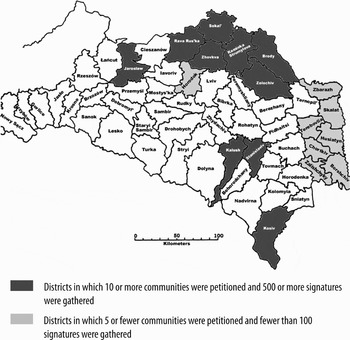
In conducting my analysis, I have grouped all the petitions according to their provenance in Galicia's administrative (or political) districts. These districts were the smallest territorial units governed by the state's professional bureaucracy. They were small enough to be characterized by a similar natural environment and social profile. Once the petitions were grouped, the number of communities in a particular district that returned the petitions and the number of signatures, both for individual petitions and for whole districts, were calculated. If we take into account only the districts that submitted petitions, on average 8.5 communities in each district took part in the campaign with 415 people signing petitions. The districts that produced petitions from more than 10 communities, as well as those producing more than 500 signatures, stand out. Districts with 10 or more petitioning communities form several large groups according to geographic proximity. Rava Rus'ka, Zhovkva, Kaminka Strumylova, Brody and Zolochiv districts compose a “northern belt” with a high concentration of petitions; another distinct group is composed of the districts in the Lemko and BoikoFootnote 69 western mountains—Sanok, Lesko, and Turka; there was a central group around and to the south of the provincial capital—Lviv: the Bibrka, Zhydachiv, Drohobych, Rudky, Sambir districts; two districts around Przemyśl, the second largest city in Eastern Galicia, a center of the Ruthenian movement since the early nineteenth century and the see of a Greek-Catholic bishopric—Przemyśl and Jarosław; two districts around Stanlislaviv (now—Ivano-Frankivs'k, the third bishopric see in late-nineteenth-century Galicia)—Stanislaviv and Kalush; and two districts in the southern Hutsul mountains—Kolomyia and Kosiv.
When it comes to the number of signatories, the top districts (500 and more signatures) include all the above-mentioned districts of the “northern belt,” with the addition of the Sokal' district; one district in each of the “central,” “Przemyśl,” and “Hutsul” groups—Lviv, Jarosław, and Kosiv—with the addition of Mostys'ka district; and the Stanislaviv-Kalush group.
Neither the numbers of petitions nor the numbers of signatories alone tell us much about the scope of the population's mobilization. There could be a district with dozens of villages sending petitions with several signatures on each of these petitions. And there could be a district from which hundreds of signatures all came from one village. Districts with both the highest number of petitioning communities and signatories (500 or more) are Jarosław, Lviv, Kalush-Stanislaviv, Kosiv, and all the districts of the “northern belt.” The absolute leader in both categories, with 26 petitions and 1,525 signatures—Zolochiv district – is part of that northern group.
We can also single out districts with very low petition-signing activity—fewer than 5 petitions and fewer than 100 signatures. With one exception, all these districts are located in Podillia—the easternmost part of Galicia, which is also known as the Galician or Western Podillia—to distinguish from Podillia (Podolian guberniia) across the border in the Russian Empire. These were: Zbarazh, Skalat, Terebovlia, Husiatyn, Chortkiv, Zalishchyky, and Borshchiv districts. The only non-Podillia district in this group is the district of Horodok, to the northwest of Lviv (Figure 1).
Galician districts most active and least active in the campaign against fonetyka. Adapted from the Tatra Area Research Group map by Timothy C. Parrot.

Even if we take into account both numbers of petitions and numbers of signatures, the scope of the population's mobilization remains obscure. The districts differed from each other in number of residents, number of communities, and their ethnic composition. Some of the districts, from which the petitions came, were located on the Ukrainian-Polish “ethnolinguistic border,” and the Ruthenians constituted a minority there. To allow for these discrepancies between individual districts, we should correlate the numbers of petitions and signatures with individual districts' statistics on the number of communities, the number of residents, and the ratio between Ruthenians and non-Ruthenians.
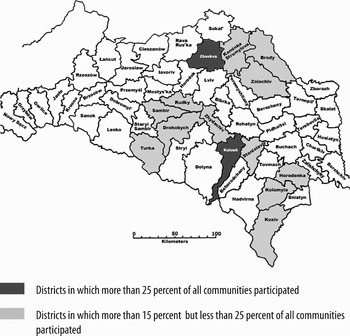
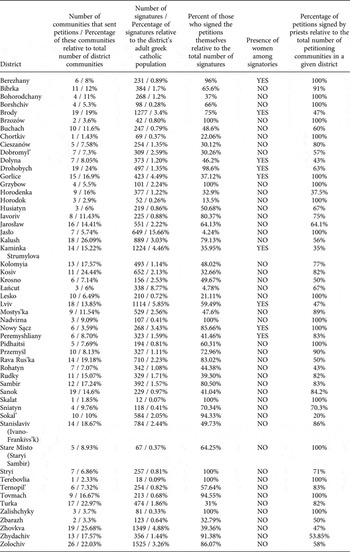
Let us start with the ratio between the number of communities from which the petitions came and the total number of communities in a given district. Such a calculation will help us see to what extent a district's communities came within the orbit of Russophile activities. The ratio shows (Table 1, first column) that there were only two districts in which slightly more than a quarter of all the district communities participated in this campaign: Kalush and Zhovkva. Then, there were districts in which more than 15 percent but less than 25 percent of communities sent petitions—Brody, Drohobych, Horodenka, Kaminka Strumylova, Kolomyia, Kosiv, Rudky, Sambir, Stanislaviv, Turka, Zhydachiv, and Zolochiv. We see that the western Lemko and Boiko districts, with a significant Polish population, despite producing large number of petitions could not compete in this respect against the districts with the Ruthenian majority. Districts of the “northern belt” are in both these groups, as are districts from around Stanislaviv and southern Carpathians, and some districts from the central region (Figure 2).
Districts with the highest ratios of communities participation in the campaign. Adapted from the Tatra Area Research Group map by Timothy C. Parrot.

Aggregate data on petitions according to the “political” districts.

The districts with the smallest number of communities involved were again the districts of the Galician Podillia. We should also note the absence of Lviv district among those with a high ratio of communities that signed the petitions. This can be explained both by the significant number of ethnically Polish communities in the district and by the fact that a large number of petitions in this case were produced by the single municipality—the city of Lviv itself.
The ratio between the number of communities that sent petitions and the total number of communities in a district reveals the intensity of Russophile activity in that area. However, this ratio does not tell us anything about the extent of support for the campaign inside the communities. Some of the petitions are signed just by a handful of people; a very common pattern is to have the signatures of a priest and two to three people from his entourage. It is true that the priest was a figure of significant authority in the village and could influence his parishioners. At the same time, the conflicts between priests and peasants were far from uncommon; and, by the end of the nineteenth century, they tended to divide communities into the priest's supporters and opponents. Therefore, petitions signed by a priest and a handful of villagers could indicate that the majority of the villagers did not support the petition.
To have some idea about the strength of Russophilism in districts, we should also take into account the degree of support among the Ruthenian population. The ratio between signatories and general Ruthenian population will show how resonant the campaign was among the Ruthenians. The problem of the absence of the category of ethnicity in the Galician statistics is well known. For pragmatic reasons, this article takes confessional allegiance as an indicator of ethnicity and treats Greek-Catholics as Ruthenians, although the author is well aware that there were Greek-Catholics who believed themselves to be Polish and Roman-Catholics who saw themselves as Ruthenians. Because the campaign was represented as an intervention of concerned citizens (although there were two petitions that included signatures of schoolchildren), we shall calculate the ratio between those who actually signed petitions and the adult Greek-Catholic population of the district. As adults, in this case, we take all those aged 20 and above.Footnote 70 In the villages, the marriage age for young males started approximately at 20. Once married, young male peasants were expected to become independent farmers and to participate in the community's affairs.
Women were excluded from the institutionalized political sphere on every level, be it political organizations, national elections, elections to the community council or positions in community administration. Inside the Ruthenian national movement, only its radical wing was seriously concerned with feminism, although the movement often used women in its representations—to demonstrate the completeness of the national community and to strengthen the emotional appeal of these representations. This situation is well reflected in the petitions against orthography. Women who signed petitions were, as a rule, educated women from cities and towns (there was one separate petition from the Russophile Society of the Ruthenian women in Lviv), members of priests' households, and only exceptionally villagers. This also reflects cultural differences between middle-class and peasant societies in relation to the expectations about women's public roles. Middle-class society, seeing women as personifications of domesticity, also expected them to have a say in the issues of childrearing and children's education. With peasants this was not the case. Despite the fact that by the 1890s the female village teacher was no longer something extraordinary, only male teachers' signatures can be found under these petitions.
All in all, the number of women who have signed the petitions is so negligible that in the aggregate statistics for the separate districts, I have only included information on the presence or absence of female signatories. This systemic exclusion of women should also be taken into account while assessing the scope of the Ruthenian mobilization for this campaign. The targeted citizenry or active public was adult male Ruthenians, and the mobilization ratio in respect of this targeted public would be twice as high as one calculated in respect to the districts' adult population of both genders.
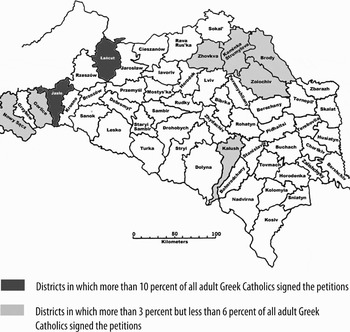
The highest mobilization rates are shown by two western districts, in which Greek-Catholics were a minority. There the threshold was close to, or even crossed, 10 percent of the total Greek-Catholic adult population: in Jasło it was 15.66 percent; in Łańcut, 8.77 percent. These numbers become even more impressive if we take into account the fact that the second highest district ratios are below 6 percent. If we look at the ratio of petitions to male adult Greek-Catholic population—and there were no women signatories in these two districts anyway—then the numbers are 32 percent and 17 percent, respectively. This suggests that along the ethnolinguistic border, in the areas with a Polish majority, the threat of innovation was more acutely felt that in Galicia's Ruthenian heartland. Here the visible markers of difference, like alphabet and rituals, were of greater importance. To the same category of border districts, we can also include two from the group that follows with respect to the intensity of mobilization (more than 3 percent but less than 6 percent of all adult Greek-Catholics): Gorlice (4.49 percent) and Nowy Sącz (3.03 percent). These are largely Lemko districts that would become the base of Russophilism in interwar Poland, after it had all but disappeared in the rest of the Galician countryside after World War I.
The Lviv district (5.85 percent) takes third place in the ranking of the Ruthenian population's mobilization. Here the number can be explained by the high number of educated and nationally minded Ruthenians in the capital city itself. Other districts in which the mobilization rate was more than 3 percent but less than 6 percent were the districts from the by now familiar northern belt—Zhovkva (4.88 percent), Zolochiv (3.26 percent), Kaminka Strumylova (4.46percent), and Brody (3.4 percent). The only other district with a comparable ratio of Greek-Catholic rural population signing the petition was the district of Kalush (3.03 percent) (Figure 3).
Districts with the highest mobilization ratios. Adapted from the Tatra Area Research Group map by Timothy C. Parrot.

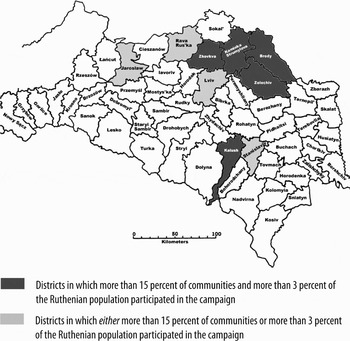
If we combine districts where both ratios were high—more than 15 percent for participating communities and more than 3 percent for population mobilization—we shall have the districts in which the campaign was especially successful. These districts can also be seen as the territorial base of the Russophile movement. These were: Zhovkva (25.7 percent and 4.88 percent, respectively), Zolochiv (22.03 percent and 3.26 percent), Brody (19 percent and 3.4 percent), Kaminka Strumylova (15.2 percent and 4.46 percent), and Kalush (26 percent and 3.03 percent). With the exception of Kalush, all of them belong to the northern belt we have identified. These are the areas where Russophile sympathies were both strong inside the village communities and covered a large number of these. These would be the districts where the Russophiles were most likely to succeed in elections and in building up mass organizations.
There is also a group of districts where only one of the two ratios belongs among the highest—either the ratio in regard of communities or of adult Greek-Catholics. These are: Rava Rus'ka (19.2 percent and 2.23 percent), Jarosław (14.4 percent and 2.22 percent), Stanislaviv (18.7 percent and 2.44 percent), and Lviv (13.85 percent and 5.85 percent) (Figure 4).
The territorial base of the Galician russophilism. Adapted from the Tatra Area Research Group map by Timothy C. Parrot.

These calculations demonstrate that the Russophiles' campaign was more successful in some districts and less successful in others. What could account for these differences? Formal Russophile village organizations were equally weak in all the districts. Only in two rural petitions did reading clubs figure as separate organizations in whose name the petitions were signed. But in the more successful districts, the campaign seems to have relied less on rural priests, the movement's traditional agents, and more on the peasant activists. Greater reliance on priests in the case of districts with low mobilization levels was accompanied by the indifference of a large part of the population.
The relative importance of the priests' role in the respective districts can be inferred from their presence among the petitions' signatories. There are 18 districts where priests are present among signatories in all communities that sent petitions. In contrast to this, in the districts where the campaign was most successful—Zhovkva, Zolochiv, Brody, Kaminka Strumylova, and Kalush—the priests are present, respectively, only in 47 percent, 58 percent, 47 percent, 35 percent, and 56 percent, respectively, of all petitions (the average is 48.6 percent). In the second tier of districts (Lviv, Jarosław, Rava Rus'ka, Stanislaviv), the ratio of priests' presence among signatories ranges from 47 percent to 86 percent of petitions, with an average of 76 percent. It was 47 percent in the case of Lviv, with its concentration of Ruthenian secular intelligentsia, and it was 50 percent in the case of Rava Rus'ka, which followed the pattern of the “northern belt” districts.
I have also tried to calculate signatories' literacy levels. This is the most tentative quantification of all undertaken here. It was not always easy to decide whether the same or different people signed names. Another difficulty was presented by the petitions where several people signed the names of others. Sometimes two or three people signed dozens of names (large blocks), but sometimes signatures in the same handwriting consist of only several names (small blocks). In the latter case, the same surname often indicated familial bonds between those signed, and the same person may have signed names as a matter of convenience. In the case of large blocks, those signed in the same handwriting were counted as illiterates; whereas in the case of small blocks, I divided signatories into literates and illiterates by half and half.
No direct correspondence between the level of literacy and the level of mobilization for the campaign could be established. Among our top districts, in one case, the literacy level in petitions corresponds with those of the district in general: Kaminka Strymylova (35.95 percent among petitioners and 34.2 percent among males above the age of 6 for the district in general); in another one, it is slightly higher: Zhovkva (39.36 percent against 22.62 percent); and in the rest, it is higher in inverse proportions: Brody (75 percent literate petitioners against 78.37 percent illiterates in the district), Zolochiv (86.07 percent against 77.47 percent), and Kalush (79.13 percent against 77.47 percent). As a rule, the literacy level among signatories was much higher than literacy levels in the districts in general, suggesting that the villagers involved in the campaign were better educated and, likely, more exposed to the printed word. Higher literacy levels of the signatories can be seen as another probable indication that villagers' involvement in the campaign in most cases was voluntary.
Conclusions
Let us return to the larger question about the Russophile orientation in Galicia in the early 1890s. First of all, the petitions show that Galician “Russophilism” enjoyed genuine popular support. At the same time, this “Russophilism” did not necessarily imply identification with the Russian Empire or Russian nation. The “Russophile” option used by and large the “Old Ruthenian” idiom; it appealed to tradition, the preservation of which was represented as essential for the survival of a distinct Ruthenian culture. Such “Russophilism” is an umbrella term for an aggregation of cultural and political sentiments sharing enmity to both the Ukrainophile innovations and to the Polish and Roman Catholic cultural option.
The petitions show significant regional variations in the popular support the Russophile cultural message enjoyed. Only in the five most active districts did the campaign mobilize 15 percent to 25 percent of district communities and more than 6 percent of adult male Ruthenian peasants. In these districts, village networks of Russophile activists and supporters were no longer centered exclusively on local priests. In the Lemko districts, strong involvement of the Ruthenian villagers still went hand in hand with reliance on local clergy. In both areas by the 1890s, Russophilism had the potential to withstand the offensive mounted by the competing Ukrainophile project and administrative pressure from the authorities.
Such an interpretation of the campaign's data is supported by the outcomes of the 1907 parliamentary elections, which followed the introduction of universal male suffrage. From each electoral district, two candidates were elected—the so-called majority and minority deputies. The only electoral district in which both deputies elected were Russophiles was located in the “northern belt” we have identified. The other districts of the Russophile “northern belt” elected a Russophile majority candidate, whereas the western Lemko districts elected a Russophile minority deputy. Political success of the Russophiles in these elections is congruent with the territories where Ruthenians en masse participated in the petition campaign of 1892. Although the Lemko districts, because of the events immediately preceding and following World War I, have been known as strongholds of Russophilism, the preponderance of Russophiles in the northern Galician districts has not been discussed in the historiography. There is sufficient evidence to claim that in the late nineteenth and early twentieth centuries these northern districts were the most important base of the Russophiles.
In 1893, Anatol' Vakhnianyn, a Ukrainian national-populist, one of the architects and a staunch supporter of the Ukrainian-Polish compromise, ran as a candidate in the electoral district Zhovkva-Rava Rus'ka-Sokal'. If achieved, his victory in the area would have symbolized the defeat of the Russophile movement in its most important stronghold. However, already during the electoral campaign, it became clear that the Russophile movement was far from dead in the area and uprooting it here would “require prolonged and systematic work.”Footnote 71 Vakhnianyn failed in this election. The Russophile candidate, a little-known local priest, received 161 votes as compared with 88 that went for Vakhnianyn. The real irony was that the Zhovkva district captain Łanikiewicz won the election with 341 votes. Afterwards the captain resigned and asked his voters to support Vakhnianyn in the subsequent election. Instead of offering decisive proof of victory over the Russophiles, Vakhnianyn's election turned into a political farce, a rude reminder about the provincial administration's ability to rig elections even in the areas known as the domain of the Ruthenian politicians.Footnote 72
It is tempting to advance some hypotheses explaining the strength of Russophilism in these northern districts. The area had an uninterrupted tradition of voting for Ruthenian candidates that dated back to 1848. The Zhovkva district (Kreis) in 1848 was the only district that produced a peasant correspondent to the first Ruthenian newspaper published in Galicia. It was also the district about whose voting preferences the Ruthenian activists were most sure in 1848—Governor Franz Stadion was successfully elected there in two electoral districts. Because the Russophiles used the “Old Ruthenian” cultural code and presented themselves as direct successors to the 1848 Ruthenians patriots, the continuity of tradition in this case worked to their benefit.
This area also bordered Russia. Moreover, just across the border (several kilometers from the Brody district) there was an important sacred center and place of pilgrimage for both Orthodox from the Russian Empire and Greek-Catholics from Galicia—the Pochaïv monastery. It was an important cultural center, with its own printing press, and a center of traditional schooling, where peasants from Galicia studied throughout the nineteenth century, returning to their villages as cantors and schoolteachers. The language and themes of the text cited above, by the village teacher Svydnyts'ky that accompanied the petition from Iaseniv, Brody district, may be an example of this Pochaïv influence. As late as the early twentieth century, the Austrian authorities suspected that Pochaïv was the hub of Russian espionage networks where young peasants from Galicia were recruited into the Russian secret service.Footnote 73
There seems to be a marked difference between these districts and the districts of Galician Podillia, which also bordered the Russian Empire, but where, according to our analysis of petitions, the Russophile influence was almost nil. The answer may lie in the different structure of land ownership in the two regions. Podillia was a major grain-producing region, where the Polish aristocracy's largest landed estates were located. Podillia villagers were more dependent on seasonal work on the landlords' estates than those in Galicia's other regions. Even the Greek-Catholic clergy's income in this area was reportedly larger than in other regions of Galicia; it was based on agriculture and dependant on good relations with local landlords. Contemporaries complained that these priests stayed away from politics and were concerned only with their well-being, in marked contrast to the “poorer” areas of Galicia.Footnote 74
Petitions from the campaign against the phonetic orthography also show that except for the districts of “northern belt,” Lemko districts, Lviv and Kalush districts, the Russophiles did not secure a mass following among the Galician Ruthenians. In the 1907 elections, Ukrainophiles won everywhere except for the “northern belt” and Lemko regions. But in 1893, an alternative petition campaign organized by the Ukrainophiles in favor of universal male suffrage had returned fewer petitions than the Russophile one. Significantly, the Ukrainophiles in Podillia fared equally poorly—among the seven districts that had not produced a single petition in the first month of this campaign, three were from Podillia. The three districts with the highest return of petitions were Stryi (14), Stanislaviv (13), and Kalush (12).Footnote 75 The available data on this campaign is so incomplete that any detailed comparison with the Russophile campaign is impossible. Nonetheless, it seems to demonstrate that in the early 1890s the Russophiles' potential for mobilization was greater than that of the Ukrainophiles. Both movements relied on personal networks and lacked mass organizations.
The turning point must have occurred in the 1890s–1900s, with the establishment in the villages of the Ukrainophiles' mammoth organizational network of reading clubs, cooperatives, and linked voluntary associations. Even areas dormant in 1892, like Podillia, were mobilized by the Ukrainophiles in the 1900s. The Ukrainophile “conquest” of Podillia was connected with the 1902 agricultural strikes. Ukrainian political parties supported the strike almost unconditionally and helped to organize it, whereas the Russophiles opposed the strike and “their” communities did not participate in it (not a single community in the Zhovkva district and only few in the Brody one).Footnote 76
Nonetheless, wherever the Russophiles had managed to activate mechanisms of popular support by the 1890s, these mechanisms endured throughout the 1900s and effectively defied the Ukrainophile onslaught. The Russophiles' problem was that this popular support was limited to certain regions and relied on personal networks of sufficient density. Except for the limited area identified in the article, in the 1890s village priests who styled themselves as intellectual, cultural, and political leaders of their communities remained the backbone of rural Russophilism. With hindsight we may identify this as the movement's major weakness. The absence of Russophile mass organizations, and of autonomous peasant politics as part of these, allowed the Ukrainophiles to overcome the sparser personal networks of the Russophiles with mass organizations of their own and eventually to secure the support of the majority of the Ruthenian villagers.