1. Introduction
Over the last 20 years, there have been considerable advances in vocabulary learning and writing tools, including learners’ dictionaries and corpus-based referencing tools. Language learners now have more tools at their disposal, and yet finding information on collocations, word patterns, and usages for productive use remains a challenge due to the limitations of the content and layout of the information provided. In the following, we will discuss the strengths and weaknesses of current dictionaries and corpus tools and introduce a new type of corpus tool that solves collocation problems through pattern-based searches.
1.1 Dictionaries and vocabulary learning
Dictionaries are essential tools for foreign or second language (L2) learners (Hyland, Reference Hyland2003). There has been much discussion on which types of dictionaries benefit L2 learners more (Laufer & Levitzky-Aviad, Reference Laufer and Levitzky-Aviad2006; Nation, Reference Nation2003; Tono, Reference Tono, Heid, Evert, Lehmann and Rohrer2000). In general, bilingual dictionaries are more accessible and convenient for L2 learners, as they provide information in bilingual form, which makes interpretation easier and faster for the first encounter and for receptive use of the vocabulary. However, due to the fact that a bilingual dictionary often provides less detail and fewer example sentences in comparison with a monolingual dictionary (Nesi & Haill, Reference Nesi and Haill2002), if learners are looking up words for productive use, a learners’ dictionary is often recommended (Nation, Reference Nation2003).
Even with the support of various dictionaries, finding information on collocations and lexical grammar in a bilingual or a learner’s dictionary is not always easy. The presentation of information in dictionaries sometimes makes it difficult for L2 learners to find the usage of the words quickly. For example, if learners want to find an appropriate verb to go with “v. advantage of something” to mean “make use of something well” using the online Oxford Advanced Learner’s Dictionary (OALD),Footnote 1 after typing the word advantage, they need to read through several lines before finally finding take advantage of something in the idiom section. Sometimes the dictionaries fail to provide the information needed due to the arrangement of the content. For example, if students want to find a verb to go with pressure to mean “to take appropriate action to face pressure,” they may find idioms like under pressure or to put pressure on somebody, but may not find any instances of verb + pressure if they type the keyword pressure in either the Cambridge or Oxford Learner’s Dictionary search box. In fact, to deal/cope with pressure are very common expressions and patterns; in the dictionaries, students need to type deal with or cope with to find the phrase deal/cope with pressure. As pointed out by Frankenberg-Garcia (Reference Frankenberg-Garcia2014), dictionaries in their current form might be sufficient for language comprehension, but for language production, they should also focus on collocation and colligation. Arguably, there is a need for supplementary referencing tools, such as corpus tools that provide information on collocations and vocabulary patterns.
1.2 Corpora and language learning
A corpus is a large and principled collection of natural texts in digital format (Biber, Conrad & Reppen, Reference Biber, Conrad and Reppen1998). With a computer program, the data can be processed and rearranged to provide information on frequency, phraseology, and collocation, offering new perspectives and adding understanding to language.
Teaching and learning vocabulary using corpora is often associated with “data-driven learning” (DDL; Johns, Reference Johns1991) and corpus-based language learning (Johns, Hsingchin & Lixun, Reference Johns, Hsingchin and Lixun2008). It refers to the ability to use corpus data to figure out what words mean and how they are used in context (Boulton, Reference Boulton and Goźdź-Roszkowski2011; Johns, Reference Johns1991), with either direct consultation of corpora via concordancers (e.g. Dolgova & Mueller, Reference Dolgova and Mueller2019; Li, Reference Li2017; Liou, Reference Liou2019; O’Sullivan & Chambers, Reference O’Sullivan and Chambers2006; Quinn, Reference Quinn2015; Sun, Reference Sun2003; Tono, Satake & Miura, Reference Tono, Satake and Miura2014; Yoon, Reference Yoon2008; Yoon & Hirvela, Reference Yoon and Hirvela2004) or indirect use of corpora using teacher-prepared printed materials (e.g. Boulton, Reference Boulton and Lewandowska-Tomaszczyk2008, Reference Boulton2009, Reference Boulton2010).
Engaging learners in DDL facilitates language learning (Boulton, Reference Boulton2017; Boulton & Cobb, Reference Boulton and Cobb2017), especially vocabulary learning. Research findings have indicated at least three major benefits of DDL for vocabulary learning: (1) observing concordance outputs raises learners’ lexical and contextual awareness (Frankenberg-Garcia, Reference Frankenberg-Garcia2012; Tribble, Reference Tribble and Flowerdew2002); (2) the process of corpus observation, hypothesis-making, and testing encourages autonomous learning and improves critical thinking skills (Kirk, Reference Kirk, Kettemann and Marko2002; O’Sullivan, Reference O’Sullivan2007; Yoon, Reference Yoon2008); and (3) observing concordances helps L2 learners see the relationships and new connections between forms and meanings, which leads to knowledge reconstruction (Sinclair, Reference Sinclair and Sinclair2004).
1.3 Limitations of the direct use of corpora
Despite the advantages of DDL and the affordances of concordance tools, there are challenges involved. Learners’ direct and independent use of corpora and concordance lines often requires considerable language proficiency so they can formulate questions, decide on the keyword to search, and observe the examples to find patterns (Chang, Reference Chang2014; Kennedy & Miceli, Reference Kennedy and Miceli2010).
When using a corpus tool as a writing reference, concordance lines could be effective feedback forms, providing authentic examples for error detection and revision (Dolgova & Mueller, Reference Dolgova and Mueller2019; Gaskell & Cobb, Reference Gaskell and Cobb2004; Liou, Reference Liou2019; Sun, Reference Sun2003). It may be useful at the final proofreading or revision stage to improve the naturalness of writing (Gilmore, Reference Gilmore2009). However, if learners are at the stage of writing the first draft, observing a large number of authentic sample sentences to generate word patterns and usages can be time-consuming and frustrating (Yoon, Reference Yoon2016; Yoon & Hirvela, Reference Yoon and Hirvela2004). At the initial writing stage, any interruption may disrupt the flow of words and thoughts (Frankenberg-Garcia, Reference Frankenberg-Garcia2020; Frankenberg-Garcia et al., Reference Frankenberg-Garcia, Lew, Roberts, Rees and Sharma2019; Yoon, Reference Yoon2008). An ideal referencing tool for word use should be able to provide a quick solution, with explicit patterns, so that writers can focus on the content of their work, quickly solve their word problems, and get back to writing. According to Tarp, Fisker and Sepstrup (Reference Tarp, Fisker and Sepstrup2017: 496),
Any consultation of an external information resource inevitably represents an interruption of the activity in question. It may be assumed that most users of these resources just want to go back, as quickly as possible, to what they were doing in order to maintain the focus.
It is also important to understand that although the features of keywords in context facilitate learning, not all learners are able to induce information from concordance lines (Gabel, Reference Gabel2001; Lai & Chen, Reference Lai and Chen2015); more advanced students may be successful, but students at lower proficiency levels may find this challenging. Also, some concordancing tools are quite complicated; for example, presenting the concordance outputs in formats that learners may find difficult to interpret or generalize (Yoon & Hirvela, Reference Yoon and Hirvela2004). As pointed out by Kennedy and Miceli (Reference Kennedy and Miceli2001: 88), during corpus investigations by language learners, there is indeed “considerable room for error due to lack of knowledge of the target language.” So far, little attention has been paid to the artifact and the interface of the tools that learners interact with (Park, Reference Park2012).
1.4 Corpora and corpus tools
Efforts have been made by researchers, program developers, and teachers to provide language learners with various corpus-based vocabulary tools. How concordance outputs are displayed and the sophistication of concordance functions vary depending on how the tool is programmed and the types of corpora being processed. The tools are therefore assigned different names reflective of these specific functions. In this section, we will briefly introduce the major types of corpus tools to show the development of related tools so far.
A typical concordancer can be used to search, access, and analyze language from a selected corpus. For example, Web Concordancer,Footnote 2 created by Greaves and Cobb in the early 2000s, allows users to enter a word or phrase and search for multiple examples. For L2 learners, however, observing a large number of authentic example sentences can be challenging. Bilingual tools with the concordance lines in the students’ first language (L1) and L2 can ease the corpus observation process. An early attempt was made by Liou et al. (Reference Liou, Chang, Chen, Lin, Liaw, Gao, Jang, Yeh, Chuang and You2006) who developed two user-friendly parallel corpus tools: TotalRecallFootnote 3 and Tango.Footnote 4 In addition to developing bilingual tools to help learners with more limited language proficiency, another research team developed a “non-scary” version of Sketch Engine called SkELL (Kilgarriff, Marcowitz, Smith & Thomas, Reference Kilgarriff, Marcowitz, Smith and Thomas2015: 66), with a user-friendly interface and example sentences that are filtered to show “good examples” only, the so-called GDEX (Kilgarriff, Husák, McAdam, Rundell & Rychlý, Reference Kilgarriff, Husák, McAdam, Rundell, Rychlý, Bernal and DeCesaris2008).
Another line of tool developers focused on tools for English for academic purposes. Word use in general contexts and specialized contexts may be different. In some circumstances, language is “context-sensitive” (Flowerdew, Reference Flowerdew, Bhatia, Flowerdew and Jones2008) or discipline-sensitive. The Prime MachineFootnote 5 allows users to compare words, collocations, and even the same word in two different corpora (Jeaco, Reference Jeaco, Pace-Sigge and Patterson2017). AWSuM,Footnote 6 an academic word suggestion machine, combines rhetorical moves and lexical bundles, and then auto-suggests common lexical bundles for each move in a selected section of a text (Mizumoto, Reference Mizumoto2017). While the tools mentioned in this section require users to type the keyword into the search box, the recent development of the automated proofreading system GrammarlyFootnote 7 is worthy of attention. This system can identify errors at both word and sentence levels and gives real-time feedback.
Advances in natural language processing and machine learning have enabled researchers in computational linguistics and language learning to develop advanced vocabulary learning and writing tools. However, most tools still require learners to observe concordance lines and generate patterns and usages of words by themselves – a bottom-up process. Some tools suggest collocation combinations (e.g. SkELL), but they usually show all kinds of combinations for different patterns. Take pressure as an example. The results of a word sketch showed different categories, such as verbs with pressure as a subject or as an object, adjectives with pressure, and nouns modified by pressure. This interface might be good for vocabulary learning, but if the user’s purpose is to locate a verb to go with pressure, they still need to go through a long list of results first, find the correct category, and then find the correct word to use. To address this issue, the current study introduced a pattern-based tool that allows users to type the search keyword and assign the parts of speech of its collocates to narrow down the search. For ease of observation, this tool displays patterns and their frequency counts in a decontextualized way; if students are interested in the original example sentences, they can click on the “example” button to see more co-texts – a top-down process.
1.5 Toward a pattern-based tool: Linggle
The tool adopted in our study is Linggle,Footnote 8 a free web-based service that automatically generates and displays information of recurring word patterns. It allows writers to retrieve phrases that match a submitted query with parts-of-speech wildcards, accompanied with frequency counts to indicate how common a retrieved phrase is. Linggle facilitates fast and convenient access to a wealth of linguistic information embodied in a web-scale data set, Google Web 1T 5-gramsFootnote 9 (Chang, Reference Chang2013). It also provides example sentences from the New York Times Corpus. The first version was launched in 2013 (Boisson, Kao, Wu, Yen & Chang, Reference Boisson, Kao, Wu, Yen, Chang, Schuetze, Fung and Poesio2013; Chang, Reference Chang2013). Since then, there have been several revisions to improve its usefulness as a pedagogical tool.
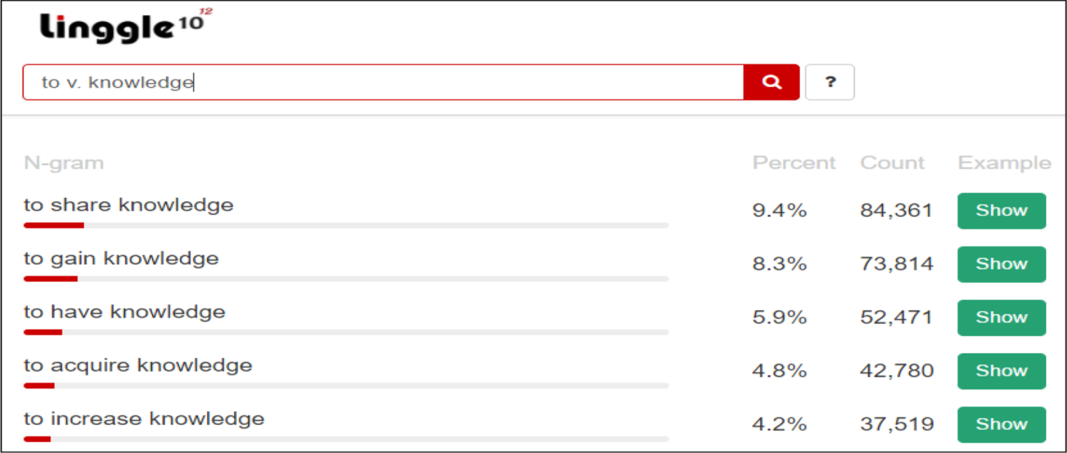
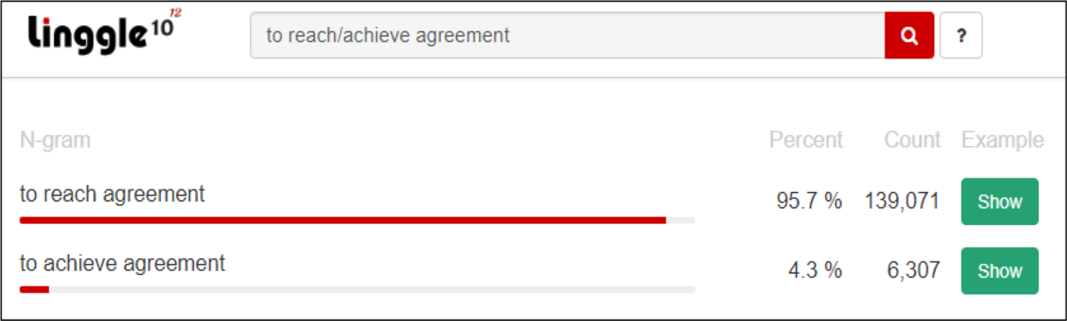
Linggle supports intuitive and powerful queries with keywords, phrases, wildcards, and even parts of speech (see the supplementary materials for a detailed description of Linggle queries). It retrieves phrases that match the query and displays the results (i.e. patterns) in order of decreasing frequency counts. For example, if users want to know the kinds of verbs that collocate with knowledge, they simply type “to v. knowledge” or “v. knowledge” in the search box, and Linggle will display the common verb collocates of “knowledge” (see Figure 1). Linggle also allows users to use wildcards such as “*” (zero or more words) and the underscore “_” (one word) to explore words occurring with other words in a query. If users have two words in mind and are not sure which one is correct or better, they can use a slash (/) to separate them, and Linggle will show the percentage of each matching phrase to help make a better decision quickly. For example, if students are not sure whether to use to reach agreement or to achieve agreement, they can try the search combination “to reach/achieve agreement.” As shown in Figure 2, there are fewer usages of to achieve agreement (4.3%) compared with the correct usage of to reach agreement (95.7%). This pattern-based tool is different from traditional concordancers, as it displays patterns directly and has the potential to make finding information on collocations and common phrases easier. In this study, we addressed the following research questions:
1. How did the students use the new pattern-based tool to solve the collocation questions, and how did they interact with this new tool?
2. How did the students combine the pattern-based tool with the dictionaries to solve the collocation questions?
The search for “to v. knowledge”

The search for “to reach/achieve agreement”

2. Methodology
2.1 Participants
The participants were a class of non-English major students (N = 32) at a public university in northern Taiwan. Each student was assigned a code, from S1 (the highest ranking) to S32 (the lowest ranking), according to their reading scores on the Test of English for International Communication (TOEIC) (ranging from 485 to 25, with a mean of 184 and a standard deviation of 118.2). These codes were used throughout the study for ease of description and to provide information on the students’ language proficiency (see the supplementary materials for detailed information about the participants).
2.2 Design and data collection
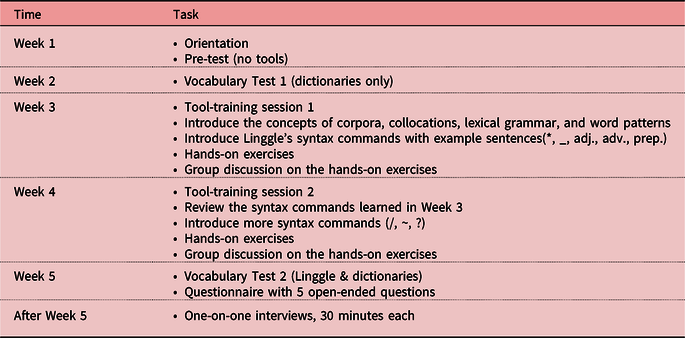
The study was conducted in a freshmen English class. To elicit the students’ tool consultation behaviors, a vocabulary test with collocation questions was designed. Two tool-training sessions were scheduled over two consecutive weeks to ensure that the students were well trained in the use of Linggle before data collection. Their use of the tools to find the answers was screen-recorded for further analysis, serving as the major data source, as real-time data are better suited to answering process-oriented questions compared with retrospective data collected from reflective reports and questionnaires (Lai & Chen, Reference Lai and Chen2015; Park, Reference Park2012; Pérez-Paredes, Sánchez-Tornel, Alcaraz Calero & Aguado Jiménez, Reference Pérez-Paredes, Sánchez-Tornel, Alcaraz Calero and Aguado Jiménez2011). By analyzing the screen-recorded files, the students’ interaction patterns and the difficulties they encountered were revealed. One-on-one interviews with selected students were conducted to help clarify issues related to the study. Table 1 shows the research design and the procedures for the data collection.
Research design

In Week 1, the students were given a pre-test (58 items, 15 minutes) to ascertain their prior knowledge of the vocabulary presented. Without the help of any tools, the overall accuracy rate was only 42% (baseline test). This result suggested that the test was difficult enough, and would elicit some tool consultation behaviors.
In Week 2, they were given the same test again, now labeled Vocabulary Test 1, with the same 58 items but a longer test time of 25 minutes. This time, the students were allowed to consult the dictionaries provided, either the Yahoo! Kimo Bilingual Dictionary or the OALD. Dictionaries for general purposes do not always provide collocation information explicitly; thus students often need to find the information in example sentences, which requires more time. In a test-taking context with a time limit, students can find this challenging. The purpose of Vocabulary Test 1 was to raise students’ awareness of collocations and direct their attention to the limitations of using a general dictionary to solve collocation problems.
In Weeks 3 and 4, two tool-training sessions on Linggle were scheduled, two hours per week. The students were taught the concepts of a corpus, corpus tools, collocation, and pattern grammar. Then, Linggle’s syntax commands were introduced one by one, and were each followed by demonstrations, hands-on exercises, and pair and group discussions. Each week, after the teacher’s demonstration, a hands-on exercise worksheet was distributed. When necessary, they combined Linggle with a dictionary of their choice. The training followed the computer-assisted language learning (CALL) training process suggested by Hubbard (Reference Hubbard2013), which involves strategy training, theory introduction, spiral teaching, and collaborative debriefing.
In Week 5, after two weeks of tool-training sessions, the students were given the same amount of time to finish Vocabulary Test 2, the same test as before. They were encouraged to use the newly learned Linggle tool to solve the collocation problems and were allowed to use the dictionaries if needed. The screen-recording program recorded the students’ online tool consultation behavior for further analysis, including the keywords typed, the syntax commands used, the tools chosen, and the results retrieved. On the same day, a questionnaire with five open-ended questions was distributed, mainly to ask the students about their perceptions of and experiences in using Linggle. One-on-one interviews were conducted with 21 selected students to help clarify issues related to the study. After analyzing students’ performances on the vocabulary tests, those who had the following characteristics were selected: (1) were able to make effective use of Linggle; (2) had great difficulties in using Linggle; (3) provided feedback on the questionnaires that needed further clarification.
2.3 Research instruments
2.3.1 Tools: Linggle and two dictionaries
Although the focus of the study was Linggle, the students could also use the OALD and the Yahoo! Kimo Bilingual Dictionary to solve the given problems or to conduct cross-referencing. The purpose of allowing the students to consult a dictionary was twofold. First, Linggle is a tool that provides information on patterns only, so the students may have needed the help of a dictionary to look up the meanings of the words or phrases retrieved. Second, having a dictionary at their disposal allowed the researchers to observe how the students made use of the two kinds of tools together.
2.3.2 Vocabulary test
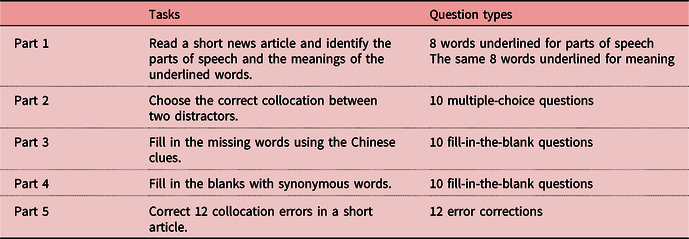
The vocabulary test comprised five parts, with a total of 58 items that were mostly collocation questions that were incongruent in the students’ L1 (i.e. with no direct L1 translation such as fly kites). According to the research, most collocation errors made by learners are L1 based, and incongruent collocations are more challenging for them (Laufer & Waldman, Reference Laufer and Waldman2011; Wolter & Gyllstad, Reference Wolter and Gyllstad2011); thus the test questions with mostly incongruent collocations were designed to prompt more tool consultation behaviors so we could investigate how the students interacted with Linggle. We also ensured that all the questions could be answered by Linggle if it was used appropriately. Table 2 shows a summary of the sections, the types of questions, and their purposes (also see the supplementary materials for the detailed descriptions about the test).
Summary of the tasks on the vocabulary test

3. Results
Although the focus of this study was to explore how students interacted with Linggle, it was still important to know whether they succeeded in finding the answers using the new tool. The first part of the Results section presents the accuracy rates the students achieved in the three vocabulary tests, and then presents the interaction patterns in detail.
3.1 Overall accuracy rates
In this study, the same vocabulary test was given three times: pre-test (baseline test), Vocabulary Test 1, and Vocabulary Test 2. The pre-test (15 minutes) was given before the study began to check students’ prior knowledge of the vocabulary presented. Without the help of any tools, the overall accuracy rate was only 42%. This result suggested that the vocabulary test would elicit some tool consultation behaviors in the next stage of the study.
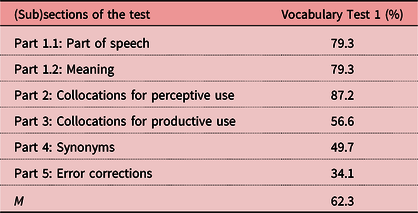
For Vocabulary Test 1, the same items were included, but a longer test time was given as the students were allowed to consult dictionaries only. As shown in Table 3, the mean score reached only 62.3% (SD = 15.1). Ten of the 32 students’ overall accuracy rates were still lower than 50% (see supplementary materials for more details). In terms of each subsection, the accuracy rates for Parts 3, 4, and 5 remained around 50% or lower. After the test, the students were aware of the limitations of the dictionaries and thus were motivated to learn the new tool.
Accuracy rates of each (sub)section

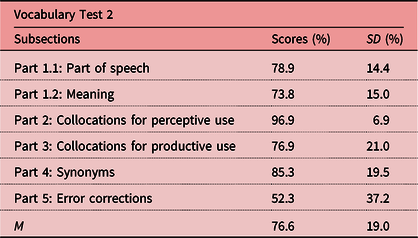
For Vocabulary Test 2, as shown in Table 4, overall accuracy rates reached 76.6% (SD = 14.2) when the students used Linggle as their major vocabulary problem-solving tool. In terms of each student’s performance, the lowest score was 48.3% and the highest score reached 94.8% (see supplementary materials). Most of the students used the new tool; only one student (S29) relied mostly on a bilingual dictionary when a Chinese clue was given to find an equivalent L2 in Part 3 of the vocabulary test. S29 pointed out in her interview that it was difficult for her to learn the syntax commands in Linggle, and deciding on the parts of speech of the words searched for was also difficult.
Results of the t-test by accuracy rates

*** p < .001.
The results of a paired t-test indicated that the scores improved significantly in Vocabulary Test 2 (t = 9.92, p < .001). Although there might have been a practice effect or maturation effect, the improvements some students achieved were so significant that it probably could not be explained by the practice effect only. For example, S5 improved from 48.3 to 82.8; S12 improved from 70.7 to 91.4; and S16 improved from 56.9 to 87.9.
As each subsection shows, in general, the students managed to solve the various vocabulary problems using Linggle, except for the error corrections section (see Table 5). Part 5 reached accuracy rates of only 52.3%; this result will be explained in a later section when analyzing the students’ interaction patterns.
Results of the t-test for each subsection in Vocabulary Test 2

3.2 Consultation patterns
This section reports each part of the test to provide a detailed picture of how the students used and interacted with Linggle (i.e. tool consultation behaviors). The screen-recorded files of the students’ use of Linggle were analyzed along with the students’ interview data. The results showed a general pattern: when looking for information on collocations and synonyms, the students turned to Linggle and assigned different syntax commands to solve the collocation problems. They also conducted cross-referencing, combining Linggle and a dictionary when needed. When looking for the meanings and parts of speech of the keywords only, dictionaries were still the students’ first choice. Part 1 required the students to find the meanings and parts of speech of each keyword, and all the students used dictionaries.
3.2.1 Collocations for perceptive use
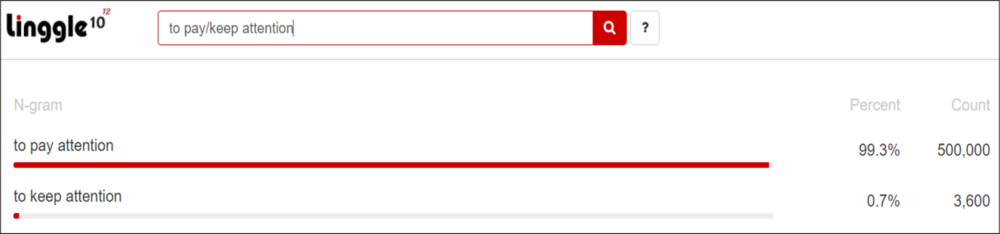
For Part 2, the task was to choose one correct collocation between two options. The syntax command that the students used most was the slash (/). For Question 1, The meeting took almost five hours. It was impossible to (pay/keep) attention all the time, the students typed either “to pay/keep attention” or “pay/keep attention” to retrieve the answer. As indicated by the number of entries (500,000 vs. 3,600) and their percentages (99.3% vs. 0.7%), the students quickly found their answer (Figure 3). A number of studentsFootnote 10 reported that they really liked this feature because this saved them a considerable amount of time.
The search for “to pay/keep attention”

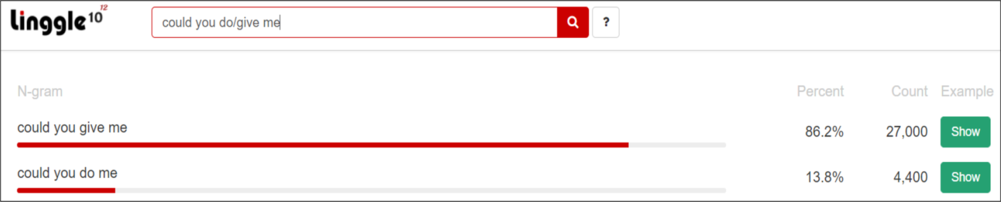
In total, the students missed 10 items in Part 2, and the accuracy rates reached 98.6%. Of the 10 items the students got wrong, seven of them were caused by their incorrect understanding of the collocations; they answered these questions directly without consulting any tools. For the other three items, the students did consult a tool but still failed to answer the item correctly due to the incorrect chunking of the phrase. For example, for Question 5, Could you (do/give) me a favor and post these letters on your way home, instead of typing “do/give me a favor,” S24 and S27 searched for “could you do/give me,” as shown in Figure 4. To avoid this kind of mistake, more guidance is needed to raise students’ awareness of patterns and chunking during the learner training session.
The search for “could you do/give me”

3.2.2 Collocations for productive use
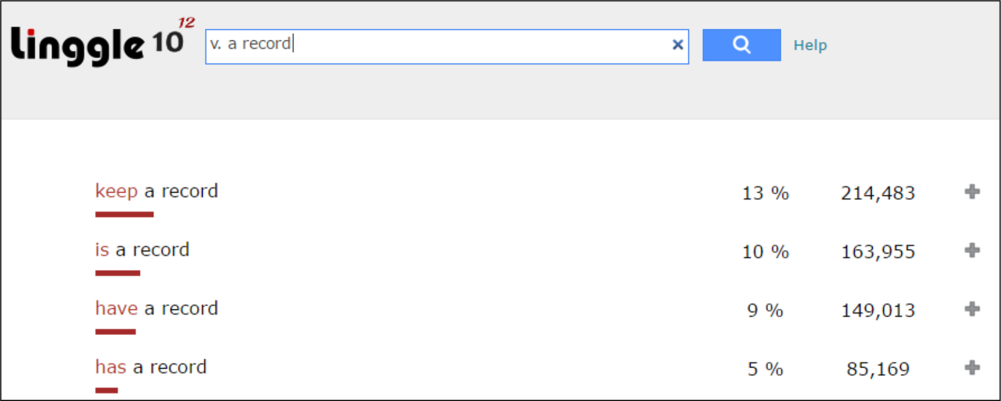
For Part 3, the students needed to fill in the right word using the Chinese clues. All the students’ primary tool of choice was Linggle, except S26 and S29. The students at different language proficiency levels managed to make some use of the syntax command for the parts of speech and assigned the correct keyword to solve their collocation problems. For example, for Question 3, You should _____ a record of your progress. ( ), most students typed “v. a record” in the query box and saw keep a record in the first line of the search results (see Figure 5). The students found this to be a useful and unique feature. As reported by S20, being able to narrow the search by directly assigning the part of speech of the searched word helped to retrieve all the possible combinations quickly. As commented by another student (S4), dictionaries did not always provide as many choices (combinations of words, patterns, etc.) nor frequency counts.
The search for “v. a record”

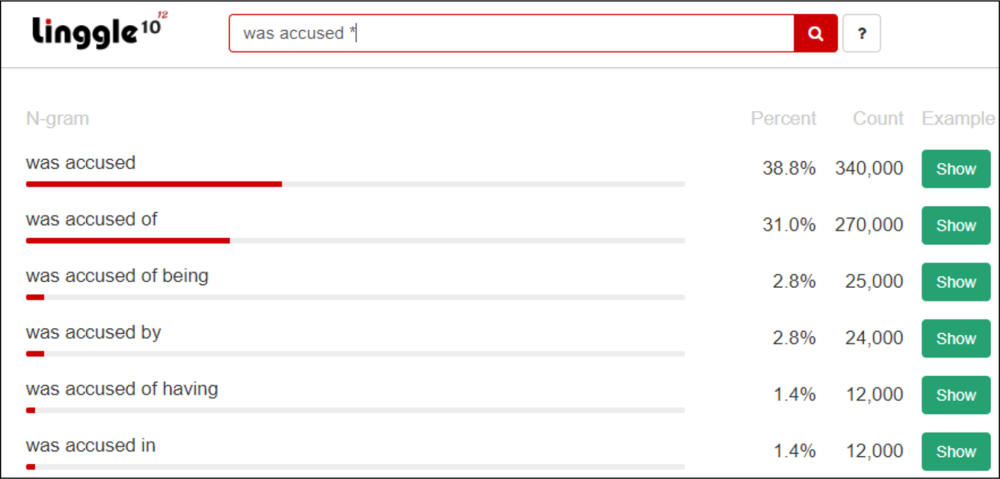
Frequency count also played a role. As Linggle displayed the patterns in order of frequency, the students tended to choose the patterns that had higher frequencies. For example, for Question 9, The local government was accused (of/at) incompetence, S13 typed “was accused *” and quickly decided to choose “was accused of” as it had the next highest frequency after “was accused” (Figure 6).
The search for “was accused *”

With regard to the students’ consultation processes, 10 different combination patterns were revealed (see Table 6 for the top three patterns and the supplementary materials for the complete set of 10 patterns). Pattern 1, Linggle only, showed the highest frequency as the accuracy rate reached 88%. For Pattern 2 (Linggle + Yahoo!), after using Linggle, the students turned to Yahoo! to further confirm or to check the unknown words they retrieved from Linggle. For Pattern 3 (Yahoo! + Linggle), the students tried the Yahoo! bilingual dictionary first and then turned to Linggle if the dictionary did not provide the answer.
Patterns of cross-referencing in Part 3

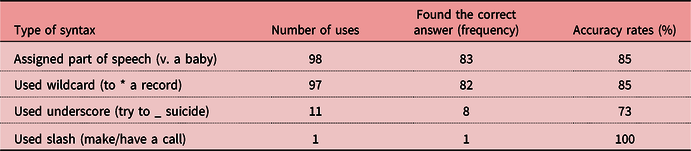
The syntax commands the students applied also showed some variations (see Table 7). The students assigned the part of speech to the searched word (98 times) and wildcards (97 times) to find most of the unknown collocation information, and the success rate reached 85%. The underscore ( _ ) and slash (/) syntax commands were not used often, but the accuracy rates were good, ranging from 73% to 100%. This showed that the students preferred to either assign the part of speech to narrow down the search or use a wildcard to locate possible combinations.
Types of Linggle syntax commands the students used in Part 3

It was interesting to find that there were four students (S2, S5, S14, and S25) who used only the wildcard function in Part 3, and their reasons for doing so were different. The two more proficient students (S2 and S5) favored wildcards because they themselves could quickly sort out the results from the long retrieved list; thus they did not bother to define the part of speech to narrow down the search. On the other hand, the two students with rather limited proficiency (S14 and S25) used more simple commands, such as a wildcard or an underscore, because they found that assigning the part of speech was too challenging.
3.2.3 Consultation difficulties
With regard to the items the students got wrong, consultation difficulties were found. The first difficulty the students encountered was failing to assign the correct part of speech. V + N was easy, but ADV + V and ADV + ADJ were challenging for students. For example, for Question 8, The two events are _____ related and the author wants to stress the relationship. (closely  ), S17 believed that the missing word was an adjective and thus failed to find the answer, probably as a result of negative L1 transfer.
Section 1.1 of the vocabulary test measured whether the students could identify the parts of speech of eight chosen words in a short news article. The data indicated that the students who did not do well in this section encountered more problems when assigning syntax commands to make effective use of Linggle. For example, for Item 8 in Section 1.1 (Identify parts of speech: Over the past week, they’ve blocked key highways and railway lines leading into Delhi), S18, S24, S31, S29, S31, and S32 identified the highlighted word blocked as a noun instead of a verb; S30 even put “adjective” in the answer box. The lack of this ability influenced their Linggle use. As a result, the scores these students achieved in Vocabulary Test 2 were among the lowest as well.
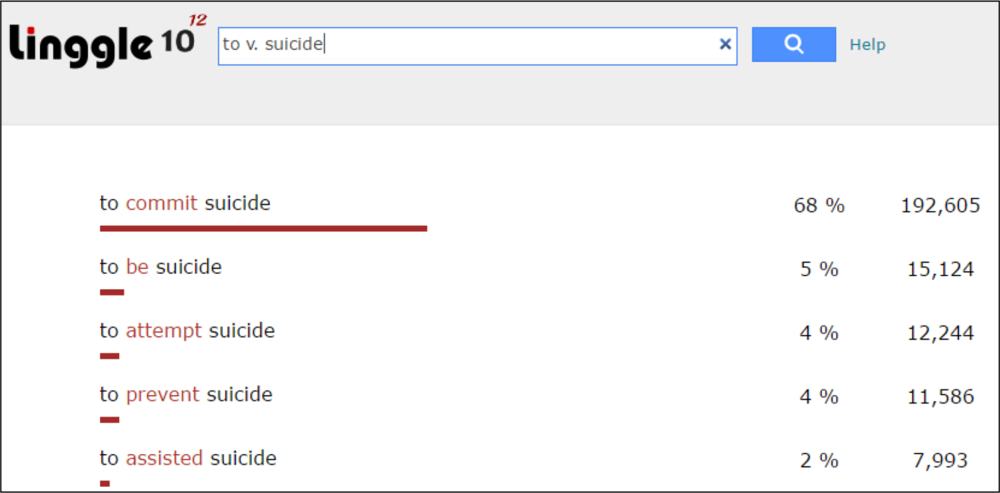
With some questions, the students assigned the correct parts of speech and keyword in the Linggle search box but failed to “see” the answer in the search results; for example, for Question 7, I heard that a woman tried to ______ suicide yesterday. ( ), S24 typed “to v. suicide” in the search box (see Figure 7). The answer appeared on the first line, as shown in Figure 7, to commit suicide, but S24 was not able to “see” it because she did not recognize the word commit. For Question 3, You should ______ a record of your progress. (
 ), S8 tried two searches, “* a record” and “v. a record”; the answers appeared on the screen, but she chose take a record as her answer because she reported that she believed it was correct based on her prior knowledge of the phrase.
The search for “to v. suicide”

In the interviews, the students reported that they tended to choose words they recognized first when locating information from the search results. If their understanding of a word was not correct, or if they did not recognize the word, they failed to locate a correct word to use. Choosing the correct answer also depended on whether they used a dictionary to help them confirm the meaning of unknown words in Linggle. Some students conducted cross-referencing and thus increased their success rates. Two students (S26 and S29) continued to use a dictionary as their major tool for Part 3. S26 reported that his English was not good and had poor grammar skills; thus assigning the correct parts of speech in a Linggle search was difficult, which was why he mostly relied on a dictionary to answer the questions in Part 3. S29 had similar difficulties. She seemed to have no idea about the structure of a sentence, and it appeared to be difficult for her to learn the syntax commands of Linggle as well. Her language proficiency level was low, achieving a score of only 70 in the reading section of the TOEIC test. As reflected in her interview, it was difficult for her to read the bilingual sentences in the dictionary, not to mention in Linggle, a monolingual tool. These results indicated that the students’ language proficiency level influenced how well they were able to use the tool, including assigning the correct keyword and syntax command and “finding” the answer in the list of retrieved patterns.
3.2.4 Finding synonyms
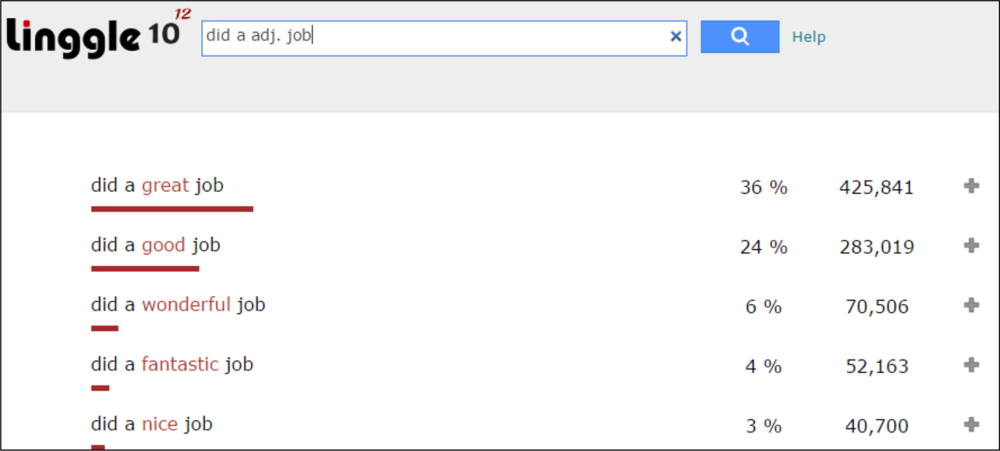
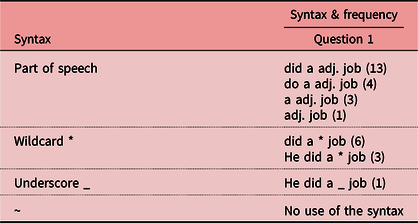
For Part 4, the students needed to find synonyms to fill in the blanks. Most students found this section to be much easier with the help of Linggle, including the students at a very limited proficiency level. Most of them assigned the part of speech or used a wildcard (*) to quickly retrieve possible synonyms. For example, for Question 1, He did a __________ job. (He did a good job.), 13 students typed “did a adj. job” and four students typed “do a adj. job” and successfully found adjectives such as wonderful, fantastic, nice, terrific, and fabulous to fill in the blanks (see Figure 8).
he search for “did a adj. job”

Table 8 shows the types of syntax commands and the number of uses for Question 1 in the synonyms section (see supplementary materials for all the questions). As the frequencies show, most students directly assigned the part of speech of the searched word along with the keywords and collocates, and the accuracy rate reached 85.3% (SD = 19.5).
Types of Linggle syntax commands the students used in Part 4 (Question 1 only)

Note. The numbers in parentheses represent the frequency of uses of the syntax commands.
Taking a closer look, we found two phenomena. First, the students with limited proficiency levels, such as S26, tended to use a wildcard (*) more often. As reported by one student (S12), wildcards were flexible in processing queries. The second phenomenon was that the students tended to choose words from the search results that they were familiar with. Although they took frequency count into consideration, to be on the safe side, they chose words that they were sure about. For example, S30 chose nice, better, and superb from the search results for “did a adj. job,” which ranked fifth, seventh, and ninth in frequency, respectively. The students’ prior knowledge influenced their decisions.
3.2.5 Error corrections
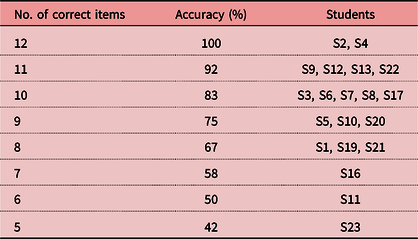
In the last section, the students had to correct 12 highlighted collocation errors in a short article. As this was the last section, 12 of the 32 students were unable to finish the section in the allotted time, which was why the overall accuracy rate was rather low (52.3%; SD = 37.2). For the 20 students who did finish this section, the accuracy rate reached 77.9%. All of these students used Linggle as the major tool to locate collocation information. Two students successfully corrected all 12 errors and nine missed only one or two items. These students’ language proficiency varied, ranging from S2, the most proficient one, to S22, a low-intermediate student (see Table 9). This suggests that students with various language proficiencies all managed to benefit from this pattern-based tool.
Students’ performance in the error correction section

4. Discussion
In this process-oriented study, we examined students’ tool consultation behaviors and search patterns. The students applied both metacognitive and cognitive strategies when solving collocation problems. Metacognitive strategies refer to “higher-order strategies aimed at analyzing, monitoring, evaluating, planning, and organizing one’s own learning process” (Dörnyei, Reference Dörnyei and Dörnyei2005: 169). They decided which tool to begin with (i.e. a dictionary or Linggle), whether they should combine different tools to find the answers, and which syntax commands and keywords they should type into the query box. When reading the long list of retrieved patterns, cognitive strategies were applied. They went through the patterns and located the one that best matched their needs. As the evidence from the screen-recorded files showed, the process was relatively straightforward and required less cognitive load compared with traditional concordancers where students need to read several sentences to assess how words are used. They did not seem to encounter too many difficulties either: only a few students at a lower language proficiency level had difficulties in using the part-of-speech search function and assigning correct keywords.
The data also showed that the students applied several compensation strategies to increase their success rates and make their searches faster. According to Oxford (Reference Oxford1990: 47), “Compensation strategies enable learners to use the new language for either comprehension or production despite limitations in knowledge. Compensation strategies are intended to make up for an inadequate repertoire of grammar and, especially, of vocabulary.” In this study, the action students took to make up for the limitation of the tools and to make up for inadequate grammar knowledge when using the tools were considered as the compensation strategies. When they had no confidence in identifying the parts of speech of the search words, they used the underscore or wildcard syntax commands. When they did not find satisfactory results, they tried different keywords in combination, different parts of speech, and even different tools.
Using Linggle seemed to be “natural” for the participants, as it was very similar to the way they used the Google search engine to locate information. They typed the keyword in the search box and the tool showed the results immediately. Some corpus tools are more sophisticated, requiring users to select the corpus type, set the number of associate words on the left and right, and tell the system to sort the results according to the words on the left or right. With its relatively simple interface, Linggle is easier to use, although tool training is still needed. For most of the participants in this study, the syntax commands were not difficult to learn, although they favored different syntax commands. Examining the results retrieved was not difficult either because Linggle narrowed down the search results and showed the possible patterns “explicitly.” Mistakes happened, though, when the students’ prior understanding of the retrieved words were not correct; this in turn influenced their decision-making.
More importantly, the tool lists patterns in decreasing order of frequency, thus directing the students to “see” the common usages and patterns first, although how much they transferred the input to intake and whether they actually “learned” the patterns is unknown. As a vocabulary problem-solving tool, Linggle was handy and effective as the students’ consultation process and feedback showed good usability of the tool. When designing a tool or CALL program, it is crucial to ensure its usability. According to Hémard (Reference Hémard and Felix2003: 23), a tool needs to be “easy to learn, effective in what it claims to do and sufficiently motivating for the users to work with it and accept its validity.”
The research focus on corpus-assisted language learning has been on DDL in the past few years. Despite its significant contribution to language learning and teaching (Boulton & Cobb, Reference Boulton and Cobb2017), teachers and researchers are aware of its challenges. For instance, it is common that learners experience varying degrees of frustration with respect to cognitive processes (Yoon, Reference Yoon2016), not to mention that autonomous corpus consultation requires long-term training (Chambers & O’Sullivan, Reference Chambers and O’Sullivan2004). It is time to turn our attention to the tools themselves.
In fact, learners need different tools and different methods for different purposes, and it is crucial to consider learners’ needs (Frankenberg-Garcia, Reference Frankenberg-Garcia2020). So far, corpus research has paid little attention to the artifact (Park, Reference Park2012) and the interface the learner is interacting with. The interface of a corpus tool and the features it provides influence how learners interact and how much they benefit from the tool. With a different construct, Linggle as a collocation referencing tool for productive use has shown promise.
4.1 Limitations and further research
Linggle has shown promise, although the study has certain limitations. First, for the purposes of this study, the test items were checked in advance to make sure that all the answers could be found in Linggle. It is very likely that when the students actually start searching for words and phrases on their own, their success rates might be a bit lower. Second, the study was conducted in a test setting. Further research could investigate how learners interact with the tool in a free-writing situation and whether it would help to increase the quality of wording and collocation use. Third, to “disguise the corpus as a dictionary” (Kilgarriff et al., Reference Kilgarriff, Marcowitz, Smith and Thomas2015: 61) and make the tool “non-scary,” Linggle was designed for simplicity and did not, for example, allow users to specify disciplines or genres. This could be a limitation because some collocations and lexical patterns are in fact register- and genre-specific (Biber, Reference Biber2012). Finally, typical concordancers present complete concordance lines, and users need to observe the corpus to formulate the rules. Keywords in context and the experience of observing the output encourage deep processing and increase students’ awareness of context (Kirk, Reference Kirk, Kettemann and Marko2002; Liu & Jiang, Reference Liu and Jiang2009; Schmidt, Reference Schmidt and Robinson2001; Tribble, Reference Tribble and Flowerdew2002). Linggle, on the contrary, is a decontextualized tool that displays patterns and frequency counts directly. It is not clear whether the ease of using Linggle reduced retention rates due to shallow processing. Comparing students’ vocabulary learning in a contextualized and a decontextualized situation would be an interesting topic to explore further.
5. Conclusion
This process-oriented study introduced a new pattern-based corpus tool and documented how students interacted with the tool to solve collocation problems. With its new interface and features, the consultation process is smooth and the search for collocation information is easier. If pattern-based tools can complement dictionaries and traditional concordancers, tool developers might consider developing tools of this kind for other languages to benefit more learners.
As students need collocation tools to compensate and complement the limitations of dictionaries, teachers probably need to introduce different kinds of vocabulary and writing tools to offer learners more support. Moreover, although Linggle is easy to use, appropriate training is still needed to help students make effective choices. Finally, as Linggle is in fact a tool that reveals patterns and n-grams, it can help learners to visualize the patterns and raises their attention to collocations. Integrating the tool into vocabulary and collocation teaching is worth trying.
Supplementary material
To view supplementary material for this article, please visit https://doi.org/10.1017/S0958344020000105
Acknowledgements
We would like to thank the editor and the three anonymous reviewers for their constructive and invaluable feedback on the earlier drafts of this paper. We are also thankful to the students who participated in the study. Our thanks are also extended to the Linggle developers for designing a helpful tool and generously making it available for all users. Further information about the tools developed by Linggle team is available at https://home.linggle.com.
Ethical statement
The study was original, and we followed the institutional requirements in conducting research. Before the study began, the first author explained the purpose and the procedure of the study to the participants. Effort was made to ensure the participants’ anonymity. There is no conflict of interest.
About the authors
Shu-Li Lai is an assistant professor in the General Education Center at National Taipei University of Business, Taiwan. Her research interests include computer-assisted language learning, second language acquisition, and EFL writing.
Jason S. Chang is a professor at the Department of Computer Science at National Tsing Hua University, Taiwan, where he directs a Natural Language Processing Group. His research interests include natural language processing, digital learning, and machine translation. The NLP lab has developed a battery of tools for language learners.
Author ORCIDs
Shu-Li Lai, https://orcid.org/0000-0002-9976-9279
Jason S. Chang, https://orcid.org/0000-0002-8227-7382