Introduction
Several studies have observed that consumers have grown somewhat tired of broiler meat. This attitude is often expressed in the mass media through criticism of the production methods used. Furthermore, the relatively stable European economic situation and the higher income of most of the population have resulted in consumers becoming more demanding in their choice of products, seeking good quality and the characteristics that they prefer.
Removal of the testes produces a change in the animal’s metabolism that affects the growth, behaviour, tissue composition, chemical composition and organoleptic quality of the meat. Chickens with reproductive organs undergo changes depending on their age and growth. Muscle fibres grow considerably and connective tissue increases its quantity and toughness, resulting in more-fibrous and less-tender meat. Castration alters the sexual maturity rhythm, and castrated poultry are more tender and more succulent than those of entire males (Mast et al., Reference Mast, Jordan and Macneil1981), becoming a product in high demand from consumers. The main effect of castration is the increase in fat deposits, both intramuscular fat (a very important characteristic for consumer acceptance) and abdominal fat (Cason et al., Reference Cason, Fletcher and Burke1988).
Regulation 1538/91 EEC fixes the minimum slaughter age for capons at 150 days. At this age, capons from heavy breeds may reach 5 or 6 kg, which exceeds the commercial weight for home consumption. That is the reason why slow-growing breeds are often used; they reach more suitable weights for selling at slaughter age and they can be reared in a free-range system, since the usual rearing time ranges between approximately 210 and 230 days. At these ages, the meat usually has some sexually determined odour and flavour, as has been demonstrated by tasting trials carried out with restaurateurs and housewives at the Animal Production Section of the Soria University College of Agricultural Engineers.
Presently in Spain, native breeds such as Catalana del Prat, Penedesenca Negra or Eusko Oiloa are used to achieve these high-quality products (García Martín et al., 1995; Cubiló et al., 1999). It is in this context that we envisage the use of Castellana Negra breed, which is extremely hardy and disease resistant; it therefore offers good possibilities for alternative production methods.
The purposes of this study were (1) to determine the growth parameters of capons and thus make it possible to predict them with mathematical models; and (2) to study how castration influences the carcass and the chemical, physical and sensorial characteristics of Castellana Negra meat. As a result, we should be able to provide a distinctive product based on native genetic material and thus contribute to the conservation of the breed.
Material and methods
This study was performed entirely under the supervision of the Ethics Committee for Animal Experimentation at the University of Valladolid, College of Agricultural Engineers in Soria, Spain, and in accordance with the rules laid down by them.
Animal and management
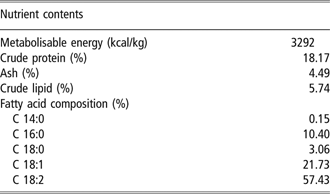
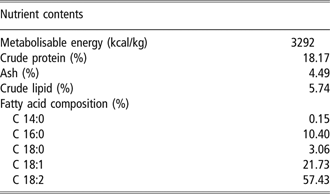
The Castellana Negra breed belongs to the class of slow-growing light lines. In all, 110 Castellana Negra males were individually identified and divided into two lots. The first was composed of castrated animals (55 birds) and the other one of uncastrated animals (55 birds), the latter acting as the control group. The animals were housed under free-range conditions in two 13 m2 pens with a density of four animals per m2. The same type of commercial growth feed was made freely available to both groups (Table 1). All the animals were weighed biweekly from 4 to 29 weeks.
Estimated nutrient content of diet fed during the trial
Castration was performed at 8 weeks, after a 2-day fasting period prior to surgery and anaesthesia, and according to the method described by Cubiló and Tor (Reference Cubiló and Tor1996).
Slaughtering and deboning
At 29 weeks, 10 cocks and 10 capons were chosen at random for us to study their carcass traits. They were slaughtered after fasting for 16 h. The slaughtering was done in a commercial slaughterhouse. They were bled and plucked, but left whole with their heads and shanks remaining and not eviscerated.
Carcasses were deboned according to the method described by the Working Group 5 of World Poultry Science Association (WPSA, 1984), in order to obtain the main commercial parts: thighs + drumsticks, wings and breasts. All these parts and the rest of the carcasses were weighed.
Chemical analysis
Dry matter, total nitrogen and fat contents were determined according to the Spanish Official Methods of Analysis (BOE 29/8/1979) and International Standards ISO R-1442 (moisture), ISO R-936 (ash), ISO R-1443 (fat) and ISO R-937 (total nitrogen).
The lipid extraction method used was as described by Bligh and Dyer (Reference Bligh and Dyer1959). Methylation of the fatty acids for the gas chromatography was then carried out as specified in Morrison and Smith (Reference Morrison and Smith1964). For chromatographic analysis of the lipid samples, a model GC 8000 Top Gas Chromatograph was used, with flame-ionisation detection (FID) and the AS 8000 autosampler.
Physical analysis
For pH recording, a Crison 507 portable pH meter (Crison Instruments, Barcelona, Spain) was used. It was fitted with a 6 mm Crison penetration electrode (Crison Instruments) and a temperature probe, using a buffer solution of pH 4.00 and 7.02 for calibration. For colour analysis, a Model 200 Minolta spectrophotometer (Konica Minolta Holdings, Inc., Tokyo, Japan) was used. Coordinates for L* (lightness), a* (red component) and b* (yellow component) (CIE, 1976) were calculated. The pH0, pH24 and colour measurement were carried out for pectoralis major and biceps femoralis.
Hardness was measured with a TA-XT2 Texture Analyser and computed with the Texture Expert program (Stable Micro System, 1995).
Water-retention capacity was determined by two calculations: loss of water in cooking (the samples were weighed and cooked at 70°C for 45 min) and water loss from pressure (the Grau and Hamm (Reference Grau and Hamm1953) technique was used; approximately 5 g of nosedive meat is submitted to a weight of 2250 g between two filter papers for 5 min).
The following measures on the carcass were determined. Breast angle (°): thickness measured in degrees with a goniometer, parameter related to the muscular development. Total length (cm): measure from the top of the peak to the top of the nail of a totally stretched animal, with metrics tape. Extremities length (cm): distance of the joint of the femur with the back and the extreme of the nail, with metrics.
Sensorial analysis
The cooking preparations of the samples and the arrangements for the tasting tests were carried out as recommended by Working Group 5 (Poultry Meat Quality) of the European Federation of WPSA (1987).
Sensory analysis of the meat was conducted by a panel of eight tasters, and the tasting was done in three sessions over 2 days. Samples of both cock breast and capon breast were analysed. Attributes to be assessed were odour, tenderness, juiciness, fibrousness, residue (amount of conjunctive tissue), flavour intensity, flavour quality and overall quality. Each variable was scored on a scale of 1 to 10.
Statistical analysis
To describe and predict animal growth over time, the growth data were fitted to the Gompertz–Laird model (Laird et al., Reference Laird, Tyler and Barton1965) by the non-linear regression procedure in Statistical Packages for the Social Sciences (SPSS, 1999) software package:

where Wt is body weight at time t (g), W 0 is initial body weight (g), L is the maximum relative growth (per time) (t −1) and K is percentage decline of L after the point of inflection (t −1).
From the previously estimated parameters for the model, we can derive the following: ti, age at point of inflection (weeks); Wi, live weight at point of inflection (g); and W a, weight at maturity or asymptotic weight (g). The degree of maturity at 29 weeks (Gm) was calculated as the ratio of body weight at 29 weeks to WA.
The following model was used to analyse carcass quality parameters:

where yijk is observations (carcass quality parameters), μ is minimum quadratic mean, Si is sexually determined fixed effect (i = 1, cocks; i = 2, capons) and eik is random residual effect.
The following model was used for the analysis of meat quality parameters:

where yijk is observations (meat quality parameters), μ is minimum quadratic mean, Si is sexually determined fixed effect (i = 1, cocks; i = 2, capons), Pj is part-determined fixed effect (j = 1, thigh + drumstick; j = 2, breast), (S × P)ij is interaction between sex and part and eijk is random residual effect.
All analyses were performed using the Statistical Packages for the Social Sciences (1999) general linear model procedure. The analyses provided estimates of treatment contrasts. Statistical significance of the differences was determined by the t-test.
Results
The mortality caused by castration surgery was 1.8%. Testicular regeneration took place in 15 of the castrated birds, which were identified by live observation and later checked after slaughter.
Growth
Table 2 shows the estimated and derived parameters from the Gompertz–Laird function for Castellana Negra cocks and capons.
Estimate of parameters of Gompertz–Laird model and coefficient of determination (R 2) for cocks and capons of Castellana NegraFootnote †

† Abbreviations are: W 0 = initial live weight (g); L = instantaneous growth rate (by time) (t −1); K = rate of exponential decay of the initial specific growth rate (t −1); ti = age in the inflection point (weeks); Wi = live weight in the inflection point (g); WA = live weight to the maturity (g); Gm = degree of maturity to 29 weeks (weight 29 weeks/WA).
Neither the initial weight (W 0) nor the maximum relative growth per week (L) nor the percentage decline of L after the point of inflection (K) showed differences. Capons reached sexual maturity first (point of inflection on the growth curve). Likewise, the estimated asymptotic weight and the degree of maturity at 29 weeks were slightly higher in cocks than in capons.
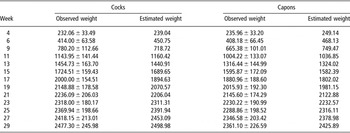
Table 3 shows the observed and estimated weights after modelling growth with the Gompertz–Laird function. An important reconciliation between the observed and estimated weights was observed.
Least-squares mean ± s.e. of observed and estimated weight from different ages for cocks and capons of Castellana Negra

Carcass composition by parts
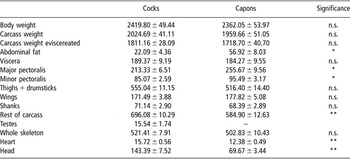
There were no differences in carcass weight and yield between the two types; however, there were differences in abdominal fat content, which was higher in capons than in cocks. There were no differences in viscera content either (Table 4).
Least-squares mean ± s.e. of carcass composition (in grams) in cocks and capons of Castellana Negra

n.s. = not significant (P > 0.05); *significant difference (P ⩽ 0.05); **significant difference (P ⩽ 0.01).
Pectoral muscles showed a higher yield in capons than in cocks. This higher pectoral content in capons was balanced by a lower content in carcass remains (i.e. the weight of the eviscerated carcass with head, but without wings, shanks, pectoral muscles, thighs and drumsticks). Thigh and drumstick weight showed no significant differences, although the highest weights were of cocks, and the lowest were of capons.
There were no differences in the deboned carcass weight (i.e. the weight of the carcass without wings, pectoral muscles, thighs, drumsticks, viscera and head). Heart weight was greater in cocks than in capons. The head (including the comb) was larger in cocks (as was to be expected).
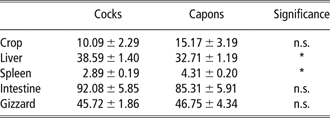
Liver content was higher in cocks than in capons, as opposed to spleen, which was lower (Table 5).
Least-squares mean ± s.e. of weight of viscera (grams) in cocks and capons of Castellana Negra
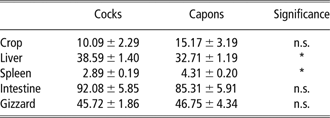
n.s. = not significant (P > 0.05); *significant difference (P ⩽ 0.05).
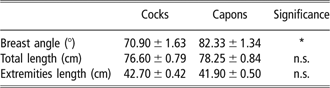
Regarding carcass biometrics (Table 6), there were no significant differences in length measures, although differences might be expected when bone growth decreases due to caponisation. In breast angle, there were some significant differences in favour of capons. These differences eventually translated into different pectoral muscle weight.
Least-squares mean ± s.e. of measures of carcass in cocks and capons of Castellana Negra
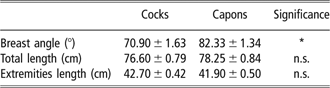
n.s. = not significant (P > 0.05); *significant difference (P ⩽ 0.05).
Meat characteristics
Chemical analysis. As can be seen in Table 7, protein content was significantly higher in breast than in thigh and drumstick for both types. Capon fat content was found to be higher than that of uncastrated birds. Higher fat content was found in thighs and drumsticks than in breasts for all the birds.
Least-squares mean ± s.e. of content in protein, fat, ash and of dry matter of the meat of thighs + drumsticks and breast in cocks and capons of Castellana Negra

n.s. = not significant (P > 0.05); *significant difference (P ⩽ 0.05); **significant difference (P ⩽ 0.01).
a,bDifferent superscript letters in the same string indicate significant differences between animal types at P ⩽ 0.05.
1,2Different superscript numbers in the same string indicate significant differences between parts at P ⩽ 0.05.
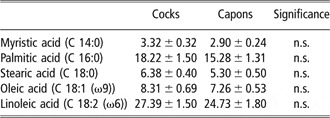
Linoleic acid (C 18:2) was the most plentiful fatty acid in both cocks and capons, with no differences between the types (Table 8). Of the saturated fatty acids, the most abundant in both types was palmitic acid (C 16:0), with no significant differences. Furthermore, there were no differences between cocks and capons for the rest of fatty acids analysed: myristic (C 14:0), stearic (C 18:0), oleic (C 18:1) and linoleic (C 18:2).
Least-squares mean ± s.e. of fat acids content in cocks and capons of Castellana Negra (g/100 g from extracted fat)

n.s. = not significant (P > 0.05).
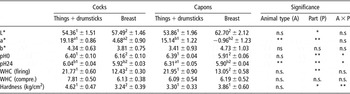
Physical analysis. Breast colour was always lighter than thigh, with no differences between types of poultry. Red components were major in cocks than capons, and yellow components showed no differences between castrated and uncastrated birds (Table 9).
Least-squares mean ± s.e. of colour, pH, water-holding capacity (WHC) and hardness of the meat of thighs + drumsticks and breast in cocks and capons of Castellana Negra

n.s. = not significant (P > 0.05); *significant difference (P ⩽ 0.05); **significant difference (P ⩽ 0.01).
a,bDifferent superscript letters in the same string indicate significant differences between animal types at P ⩽ 0.05.
1,2Different superscript numbers in the same string indicate significant differences between parts at P ⩽ 0.05.
pH at slaughter (pH0) was found to be lower in pectoral muscles than in thighs and drumsticks both in capons and in uncastrated animals. Regarding pH at 24 h post mortem (pH24), the thighs and drumsticks of uncastrated birds showed a lower value than those of capons. In the breasts, pH24 was the same for cocks and capons. Thighs were tougher than breasts in cocks, while there were no differences in capons.
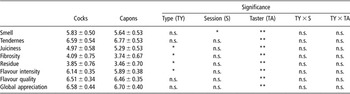
Sensorial analysis. According to the findings reported in Table 10, capons were juicier and more tender than uncastrated birds. This might be due to the higher fat content in capons. Conversely, uncastrated animals were found to have more flavour and more residue (amount of conjunctive tissue) than castrated ones.
Least-squares mean ± s.e. of sensorial analysis of breast meat in cocks and capons of Castellana Negra

n.s. not significant (P > 0.05); *significant difference (P ⩽ 0.05); **significant difference (P ⩽ 0.01).
In all cases, there were significant differences depending on the taster performing the test. Regarding aroma, there were also significant differences between one tasting session and another.
Discussion
Upon comparing Castellana Negra capons and entire males’ growths with those of some commercial lines (Pasternak and Shalev, Reference Pasternak and Shalev1983; Barbato, Reference Barbato1991; Hancock et al., Reference Hancock, Bradford, Emmans and Gous1995), it is observed that L as well as K are inferior to that found in those; in these lines the maximum growth age was obtained earlier. In races not selected, similar results are reported (Barbato, Reference Barbato1991; Mignon-Grasteau et al., Reference Mignon-Grasteau, Beaumont, Le Bihan-Duval, Poivey, De Rochambeau and Ricard1999).
Francesch et al. (1998), using Prat Leonada, found that castrated and uncastrated birds did not show any difference up to 27 weeks. On the other hand, this was not true of Penedesenca Negra and Empordanesa Roja, the results for which were more in accordance with Cubiló et al. (1999 and Reference Cubiló, Villalva, Estany, Francesch and Tor2000). In trials conducted with Penedesenca Negra castrated at 4 weeks (early castration) and at 10 weeks (traditional castration), Cubiló et al. (1999 and Reference Cubiló, Villalva, Estany, Francesch and Tor2000) found that their weights were equal at 19 weeks. From then on, weights became significantly higher in castrated and regenerated animals (with no differences between the two) than in uncastrated animals. Conversely, our results indicate that from the moment the weights were equal (at 23 weeks), the capons were not superior at any time in the trial.
Sánchez (2001) worked with the Mos breed to obtain ‘Villalba capon’ (a product typical of Galicia in northern Spain). When he studied the growth of animals castrated at 60 to 70 days (depending on when they reached 1000 to 1500 g), he found that capons were lighter throughout the study. Muriel (2003) studied the growth of Extremeña Azul free-range poultry. The birds were castrated at 60 to 64 days, and they weighed less than the other birds immediately after surgery. However, the difference eventually disappeared and capons weighed more at 20 weeks. At 32 weeks slaughter, the capons weighed only slightly more than the cocks and the difference was not significant. These findings are consistent with Zanusso et al. (Reference Zanusso, Remignon, Auvergne, Mollete, Manse and Babile2001).
More fat was deposited in castrated animals. This fact has been widely reported by a large number of researchers, both for broilers (Yoshitaka et al., Reference Yoshitaka, Hisao, Hitoshi and Masao1979; Chen et al., Reference Chen, Wu and Hong2000; Zanusso et al., Reference Zanusso, Remignon, Auvergne, Mollete, Manse and Babile2001) and for native breeds with slower growth (Tor et al., Reference Tor, Estany, Villalva, Molina and Cubiló2002).
As in our research, Cubiló et al. (1999) and Tor et al. (Reference Tor, Estany, Villalva, Molina and Cubiló2002), in different studies of Penedesenca Negra, found significant differences in pectoral muscle content in favour of capons. These findings are in line with those of Francesch et al. (1998), who studied other native breeds. However, Sánchez (2001), working with the Mos breed, did not find differences in breast content between cocks and capons. Similarly, Cubiló et al. (1999) did not find significant differences in what they called hindquarter weight when they analysed Penedesenca Negra cocks and capons. Tor et al. (Reference Tor, Estany, Villalva, Molina and Cubiló2002) investigated the same breed and reported a higher thigh weight but a lower drumstick weight in capons. With the Mos breed, Sánchez (2001) found a greater proportionate weight of thighs and drumsticks in uncastrated than in castrated birds.
Our meat colour results agree with those of Sánchez (2001) for Mos, where he found more luminosity in breasts than in thighs, breast differences were indeed significant, and his values were lower than what we obtained in animals younger than those slaughtered at 33 weeks. García Martín et al. (1995) compared the meat of label chickens slaughtered at 14 weeks with that of capons slaughtered at 19 weeks, focusing on the rearing system used (open-air or indoor). They found that capons had lower luminosity and a higher level of red and yellow components, both in thighs and in breasts. However, these divergences might have been more influenced by the difference in age at slaughter and the increase in pigments with age (Touraille and Ricard, 1981; Delpech et al., 1983; Bastiaens et al., 1992). This might account for the absence of such differences in our own study, since the birds were all slaughtered at the same age.
Water-retention capacity measured as cooking loss showed higher values in thighs than in breasts in all cases. This is consistent with the findings of García Martín et al. (1995) with capons and label chickens. These investigators also found no differences between castrated and uncastrated animals, which agree with our own research. Our water-loss values were appreciably higher than those of Sánchez (2001) in Mos. However, as we said earlier, muscle water-holding capacity is related to pH, and in our case pH24 values were too high. Sánchez (2001) reported differences in breasts – capon breast was tougher (the birds were older at slaughter) – but not in thighs. García Martín et al. (1995) found that thigh muscle in capons was tougher than in label chickens, the former likewise being older at slaughter (19 weeks) than the latter (14 weeks). Greater meat toughness in older animals is related to an increase in collagen and a decrease in solubility.
Capons were juicier and less fibrous than cocks, which might be due to the higher fat content in the former. García Martín et al. (1995) found the opposite when comparing label chickens. They found that the cocks were juicier, but we have to take into account that the comparison was made between birds slaughtered at different ages. Conversely, we found that uncastrated animals had higher flavour intensity and more residue than castrated birds. These results are in keeping with those of Ricard and Touraille (Reference Ricard and Touraille1988) as well as of García Martín et al. (1995), who also found higher flavour intensity in uncastrated label chickens than in capons.
Both juiciness and flavour intensity might be enhanced in this case by the late age at slaughter, which is standard in Spain for this type of product. Muscle mass colour darkens with age, as it contains more myoglobin (Touraille et al., Reference Touraille, Lassaut and Sauvageot1985); there is an increase in its proportion of IIa muscle fibre, whose metabolism is oxidative, and a decrease in IIb type, which has glycolytic metabolism. This reduces the possibility of oxidative changes (Ono et al., Reference Ono, Iwamoto and Takahara1993). Coma and Piquer (1999) suggest that a higher sex hormone concentration in fatty tissue would result in a more intense flavour.
Conclusions
Our conclusion in the light of these results is that castration of Castellana Negra breed does not cause its weight to increase. This confirms what has been reported by several researchers in other native breeds.
The most significant castration effect observed was greater abdominal fat content in capons. Capons also showed a wider breast angle, as well as greater breast content than cocks. However, no differences were found in thighs and drumsticks.
As expected, there was a higher fat content in the meat of capons than in that of cocks. The result was that capon meat was juicier and less fibrous, as the sensory analysis showed. No differences were found in fatty acid content.
Toughness was lower in capon thighs and drumsticks than in those of cocks, although their breasts did not differ.