Significant outcomes and Limitations
The results of our study indicate that aripiprazole administered intraperitoneally to alcoholised rats had no effect on improving the long-term memory in study animals; however, after single and repeated administration of ARI to non-alcoholised rats caused a statistically significant improvement in spatial memory. It can be evidence that the exposure to Et-OH in study animals is the cause of changes in the receptor level and neuroadaptive changes in dopamine (DA) and 5-HT systems. In addition, interactions occur both in the pharmacodynamic and pharmacokinetic phase between ARI and ethanol (drug accumulation), which may significantly affect the elimination of the procognitive effect of ARI. Acute and repeated administration of ARI and fluoxetine (FLX) in alcoholised rats did not show any antidepressant effect.
Probably the lack of antidepressant effect of combined ARI and FLX administration is associated with too high dose of ARI in our study, which might have been a consequence of pharmacokinetic interaction of ARI with FLX. Potential antidepressant, anxiolytic and procognitive properties of this drug resulting from its mechanism of action encourage attempts (design) of further research aimed at developing a dose, which will show such effects in alcoholised animals.
Introduction
The treatment of alcohol (Et-OH)-dependent patients with comorbid mood symptoms remains a major clinical challenge. Et-OH-dependence rates are substantially elevated among individuals with major depression, and depression rates are increased among Et-OH-dependent individuals (Reference Conway, Compton and Stinson1–Reference Sullivan, Deshmukh and De Rosa3).
Chronic Et-OH abuse leads to brain damage and also deteriorates its function, which is manifested in cognitive functions impairment: mostly the visuo-spatial abilities (e.g. perception and memorising of objects’ location relative to each other in a two- and three-dimensional space) and higher cognitive skills (e.g. the ability of abstract thinking essential in planning to perform various operations, as well as their adaptation to the changing conditions) (Reference Nordmann4,Reference Ratti, Giardini and Soragna5).
A unique receptor profile of ARI and some preclinical results tends to take the studies in a direction of applying this drug in pharmacotherapy of alcoholism (Reference Marder, McQuade and Stock6). Some references also indicate a positive impact of the drug on cognitive functions impaired in mental illnesses (Reference Potkin, Saha and Kujawa7).
Results of many studies show that, for ARI's antidepressant effect to manifest itself, it is necessary to use a combined therapy with another antidepressant drug (even sub-effective doses) from the selective serotonin reuptake inhibitors (SSRI) group. This effect failed to be observed in the case of combining ARI with other antidepressants with mechanism of action not related to 5-HT reuptake inhibition (Reference Renard, Fiocco and Clenet8–Reference Kamei, Miyata and Sunohara10).
The aim of this paper was to assess the antidepressant drug, ARI, and its impact on spatial memory in EtPRs. The tests were carried out with reference to FLX and combined administration of both drugs to alcoholised animals. Therefore, no drug has been developed that would help people get addicted to Et-OH permanently, reduce the amount of Et-OH consumed and at the same time have a beneficial effect on impaired cognitive function in these patients or on comorbidities such as depression or anxiety disorders. Currently, none of the pharmacotherapies of alcoholism is effective because of the lack of a comprehensive effect. Therefore, it seems justified to search for new therapeutic options aimed at primarily the restoration of these people to social life and performing family functions.
Materials and methods
Animals
Male Wistar rats, 180–200 g, obtained from a licensed breeder (Sadowski, Poznan, Poland – Poznan University of Medical Sciences, Poland, Department of Toxicology; licensed by Ministry of Agriculture in Warsaw, Poland), were used in the study. The animals were housed in standard laboratory conditions with a 12 h light/dark cycle, light on at 06:00 a.m., in a temperature-controlled room 21–20°C, at 60% humidity with free access to granulated standard food and tap water.
All procedures related to the use of animals in these experiments were performed with due respect to ethical principles regarding experiments on animals. The study protocol was approved by the Local Ethical Commission for Research on Animals in Poznań (Number Opinion 2/2010, Number of individual licenses 34/2009).
To evoke alcohol dependence, rats were forced to drink only ethanol solution (12% solution) for the time of 3 months (∼9 g/kg/day) according to the scheme: Et-OH for 4 weeks, water for 2 weeks, Et-OH for 4 weeks and water for 2 weeks. During the next 4 weeks, the animals were presented with a free choice paradigm between tap water and ethanol. This procedure led to a distinction between the two groups of ethanol-treated animals: (1) rats with a mean intake of ethanol exceeding 50% of their total fluid (>4 g/kg/day), that is, ‘preferring’ (EtPRs); and (2) rats for which alcohol solution constituted <50% of total fluid intake, that is, ‘non-preferring’ (EtNPRs). In addition, for comparative purposes throughout the whole period of chronic ethanol treatment, an ethanol-naïve control group of animals (NEtRs) received only tap water (Reference Miko̡ajczak, Okulicz-Kozaryn and Kaminska11,Reference Okulicz-Kozaryn, Miko̡ajczak and Kamińska12).
For the conducted experiment we chose EtPRs. The rats were housed 10 per cage. Each test involved two groups of rats: the experimental group (10 rats) and the control group (10 rats). Moreover, behavioural tests used in the study were conducted on a control group of non-alcoholised rats (NEtRs).
Total number rats used in behavioural test = 160 animals.
Drugs
Carboxymethylcellulose sodium (CMC)-pure B.P.C. was obtained from Koch-Light Laboratories (London, England).
ARI (6 mg/kg; Abilify, Otsuka Pharmaceutical Europe, Bristol-Myers Squibb Polska) was administered (i.p.) in rats as a drug or vehicle for 14 days. In the conducted experiment, the dose of 6 mg/kg ARI was used, selected from six different doses tested, from 1 to 12 mg/kg (dose response). The dose of 6 mg/kg was selected (unpublished studies) as a dose not adversely affecting animal mobility in the activity meter test and showing antidepressant effect in sub-acute administration in the Porsolt's test. The volumes that were administered to rats were calculated on the basis of their body weight, for example. When the body weight was 200 g, a rat was administered 0.8 ml of the solution.
The test was carried out on days 1, 7 and 14. On each test day, the treatment would be given 30 min before the test. Between the tests with different assays, there was a 24-h washout period. The controls were given CMC only (2 ml/kg i.p.) according to the same schedule. Separate groups of animals were used for different tests.
FLX (5 mg/kg; Fluoksetyna, Anpharm Pharmaceutical Poland) was suspended in a solution of CMC and administered (p.o.) 60 min before the tests and for a period of 7 and 14 days. The volumes that were administered to rats were calculated on the basis of their body weight, for example. When the body weight was 200 g, a rat was administered 1.0 ml of the solution.
Before the first day of testing, there was a washout period. The control groups were given CMC only (2 ml/kg p.o.) according to the same schedule. Separate groups of animals were used for different tests.
Et-OH (10%; Podlaska Wytwórnia Wódek Polmos S.A w Siedlcach) was suspended in a water solution and administered throughout the duration of the experiment.
Behavioural tests
Measurement of immobility time (IT) in the Porsolt's forced swimming test (FST) (Reference Porsolt, Anton and Blavet13)
(a) Pretest: 24 h before the experiments, the rats were placed individually in Plexiglas cylinders (height 40 cm, diameter 18 cm) containing water at 25°C up to 17 cm of the cylinder's height, and 15 min later they were removed to a 30°C drying room for 30 min.
(b) Test: the drugs were administered 24 h after the pretest, and 30 min later the animals were placed once again in the cylinders and immobility would be measured for 5 min. A rat was judged to be immobile when it remained floating in the water, in an upright position, making only very small movements necessary to keep its head above water. The total duration of immobility over 5 min was recorded by an observer unaware of the treatment applied to the rats.
(c) After a prolonged administration (7 and 14 days), the drug effect was tested as under (b). The water was changed after the observation of each rat.
Morris water maze test (Reference Morris14)
The apparatus was a circular basin (diameter = 180 cm, height = 50 cm) filled with water (∼22–24°C) to the depth of 24 cm, with pieces of Styrofoam hiding an escape platform (diameter = 8 cm) placed 1 cm below the water surface (learning place, invisible condition). Many extra-maze visual cues surrounding the maze were available, and the observer remained in the same location for each trial.
The rats were placed in the water close to and facing the midpoint section of the wall at one of four equally spaced locations: North (N), East (E), South (S) and West (W). The pool was divided into four quadrants: NW, NE, SE and SW. The rats were allowed to swim freely until they found the platform on top of which they could climb. If a rat failed to locate the platform within 60 s, it was placed on the platform where it remained for 5 s. Each rat would be submitted to six trials per day and at each trial the starting position would be changed (starting on the N side, followed by E, S and W sides, in that order). The inter-trial interval was 5 min between trials 1–3 and 4–6 and 10 min between trials 3 and 4. For the first 3 days of maze testing, the submerged platform was placed in the NW quadrant and then in the SE quadrant for the following 2 days. After these 5 testing days, there was a period of 7 days without any testing. On day 6, the rats were retested with the platform located as on day 5. On day 7 (one day later), the platform was lifted above water level and placed in the SW quadrant. On the test day, each rat was subjected to an acute probe trial swim (six trials). The total number of times each rat crossed the probe target area and the time of probe trial swim were recorded by the observer. The time of each of the six trials was noted and a mean value for each rat was calculated. The same procedures were followed in the chronic experiments.
The drug, ARI, was administered on day 7, 30 min before the test (acute administration). After prolonged administration of ARI (7 and 14 days), the drug effects were tested as described for the seventh day of the Morris water maze test procedure.
Statistical analysis
The data are shown as mean values ± SEM. Data distribution pattern was not normal (unlike Gaussian function).
Statistical analyses for the memory test, two + compartment exploratory tests and an antidepressant test were carried out using the non-parametric Mann–Whitney U test for unpaired data and ANOVA Friedman test for paired data. Statistical significance was then tested in the post-hoc Dunn test.
Results
Effect of alcohol on spatial memory functions in the Morris test in alcohol-preferring rats compared with the non-alcoholised rats.
Number of escaped latencies
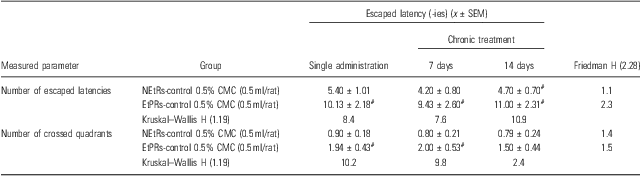
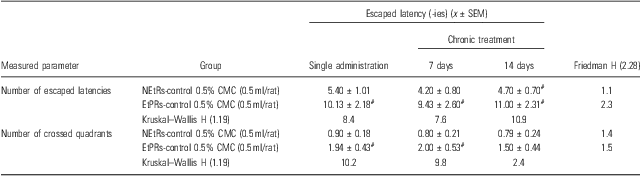
A statistically significant extension of the time spent in the test by EtPRs compared with NEtRs was shown on days 1 and 7 of the test. Furthermore, a statistically significant extension of the measured parameter on days 7 and 14 of the test was seen in EtPRs compared with the results obtained on day 1 (Table 1). The obtained data may be an evidence of memory impairment in study animals (EtPRs) owing to Et-OH administration.
Effect of alcohol on spatial memory functions in the Morris test in alcohol-preferring and non-alcoholised rats: number of escaped latencies and number of crossed quadrants
CMC, carboxymethylcellulose.
Number of haused animals = 10.
#Statistically significant difference p < 0.05 versus control group.
Number of crossed quadrants
A statistically significant increase of the number of crossed quadrants for EtPRs compared with NEtRs was shown on days 1 and 7 of the test (Table 1). The obtained results may be an evidence of memory impairment in study animals (EtPRs) owing to Et-OH administration.
Effects of ARI, FLX and combined administration of both drugs on spatial memory functions in the Morris test in alcohol-preferring rats
Number of escaped latencies
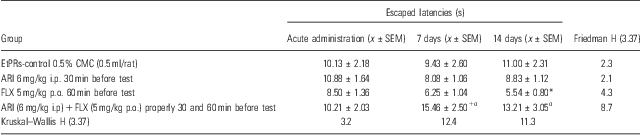
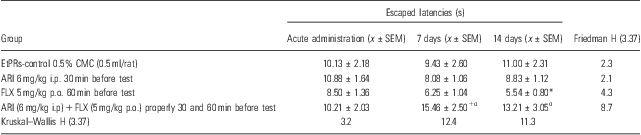
Statistically significant reduction in the number of escaped latencies was observed after 14 days of FLX administration, indicating improved memory function of EtPRs (Table 2).
Effect of ARI, FLX and combined administration of both drugs on spatial memory functions in the Morris test in alcohol-preferring rats (number of escaped latencies)
ARI, aripiprazole; CMC, carboxymethylcellulose; FLX, fluoxetine.
Number of housed animals = 10.
*Statistically significant difference at p < 0.05 versus control group.
+Statistically significant difference at p < 0.05 versus ARI group.
oStatistically significant difference at p < 0.05 versus FLX group.
A statistically significant increase in values of escaped latencies was observed after days 7 and 14 of combined administration of ARI and FLX in EtPRs compared with both ARI and FLX group, indicating impaired spatial memory in rats (Table 2).
Number of crossed quadrants
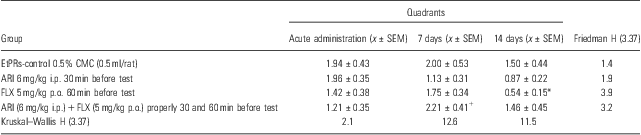
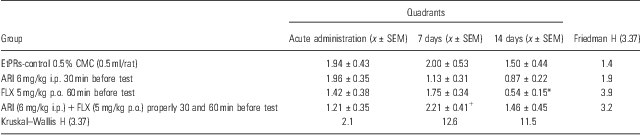
A statistically significant decrease in values of crossed quadrants was observed after 14 days of administration in EtPRs compared with the control group, indicating spatial memory improvement (Table 3).
Effect of ARI, FLX and combined administration of both drugs on spatial memory functions in the Morris test in alcohol-preferring rats (number of crossed quadrants)
ARI, aripiprazole; CMC, carboxymethylcellulose; FLX, fluoxetine.
Number of housed animals = 10.
*Statistically significant difference at p < 0.05 versus control group.
+Statistically significant difference at p < 0.05 versus ARI group.
A statistically significant increase in values of crossed quadrants was observed after 7 days of combined administration of ARI and FLX in EtPRs compared with the control group, indicating spatial memory impairment (Table 3).
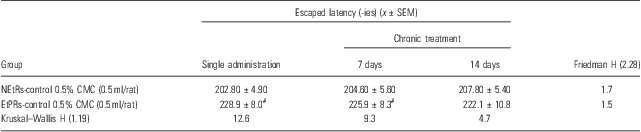
Evaluation of depressant effect of alcohol in the Porsolt's test in alcohol-preferring rats compared with the non-alcoholised rats
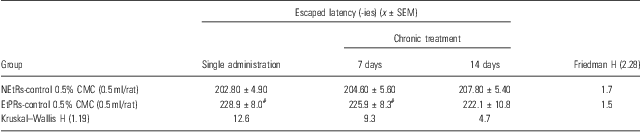
In the EtPR group, a statistically significant increase of the animals’ IT compared with the NetRs group was seen on days 1, 7 and 14 of the test, which may be an evidence of depressive effect of Et-OH administered to rats (Table 4).
Evaluation of the depressant effect of alcohol in the Porsolt's Test in alcohol-preferring rats
CMC, carboxymethylcellulose.
Number of animals = 10.
#Statistically significant difference p < 0.05 versus control group.
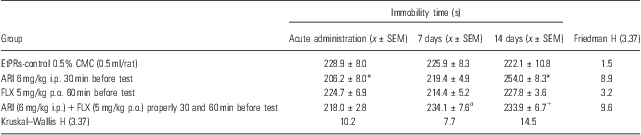
Evaluation of antidepressant effect of ARI, FLX and combined administration of both drugs in the Porsolt's test in alcohol-preferring rats
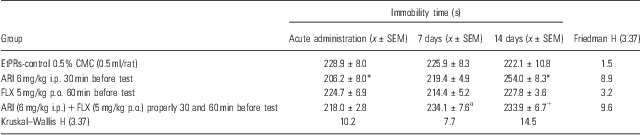
ARI administered in an acute dose caused a statistically significant reduction of the animal's IT compared with the control group, although after 14 days of ARI administration an increase in IT parameter was observed (Table 5).
Evaluation of the antidepressant effect of ARI, FLX and combined administration of both drugs in the Porsolt's Test in alcohol-preferring rats
ARI, aripiprazole; CMC, carboxymethylcellulose; FLX, fluoxetine.
Number of housed animals = 10.
*Statistically significant difference at p < 0.05 versus control group.
+Statistically significant difference at p < 0.05 versus ARI group.
oStatistically significant difference at p < 0.05 versus FLX group.
FLX, both after acute and repeated administration in EtPRs, failed to show antidepressant effect (no IT reduction) in study animals compared with the control group (Table 5).
After 14 days of combined administration of ARI and FLX in EtPRs, a statistically significant reduction of IT of animals was observed compared with the group receiving ARI (Table 5).
The combined administration of ARI and FLX after 14 days of dosing caused an increase in IT compared with the group receiving FLX (Table 5).
Discussion
Alcoholism is a mental disorder in the course of which symptoms such as cognitive deficits, depression and anxiety appear (Reference Weiss and Porrino15). Effective treatment of these symptoms could contribute to enhancing the effectiveness of alcoholism treatment. Results of some preclinical studies (Reference Marder, McQuade and Stock6) indicate that ARI could be an effective agent in alcoholism treatment, although evidence confirms this thesis being ambiguous.
The results of our study indicate that ARI (6 mg/kg) administered intraperitoneally to EtPRs had no effect on the parameters measured in the Morris test. Similar results were obtained by Enomoto et al. (Reference Enomoto, Ishibashi and Tokuda16) that ARI at 0.3 and 1.0 mg/kg has shown no improvement in short-term and spatial memory in animals, and Ishiyama et al. (Reference Ishiyama, Tokuda and Ishibashi17) who also found no long-term memory improvement in rats when administered in doses of ARI 0.3–10 mg/kg. The results of this study indicate that ARI not only has no effect on improving the long-term memory in non-alcoholised rats (NEtRs), but given orally at the dose of 10 mg/kg impairs learning in the passive avoidance test.
The results of our previously conducted studies show that after single and repeated administration of ARI to NEtRs caused a statistically significant improvement in spatial memory (Morris test) in study animals (Reference Burda, Czubak and Kus18). It can be assumed that the absence of such effect in EtPRs is the result of changes in the receptor level and neuroadaptive changes in DA and 5-HT systems, in relation to the animals’ exposure to Et-OH, as well as interactions that occur both in the pharmacodynamic and pharmacokinetic phase between ARI and ethanol, which may significantly affect the elimination of procognitive effect of ARI.
The spatial memory impairment after repeated combined administration of ARI and FLX in EtPRs are probably related to the interactions between ARI and FLX in the pharmacokinetic phase. ARI is metabolised by isozymes CYP2D6 and CYP3A4. FLX, as an inhibitor of CYP2D6 and CYP3A4 by inhibiting the metabolism of ARI, can lead to an increase in the blood levels of ARI. Confirmation of this hypothesis may be the result of a study by Semba et al. (Reference Semba, Watanabe and Kito19). The authors found that administration of ARI in doses of 10 and 40 mg/kg to NEtRs reduced the release of DA in the cortex, which may suggest that the use of excessively high doses of the drug has an agonist effect on DA D2 and D3 receptors located in the striatum. Preskorn (Reference Preskorn20) states that FLX may cause complete inhibition of 5-HT reuptake and inhibition of ARI metabolism, and this may be the cause of complete saturation of DA D2 receptors and serotonine 5-HT1A receptors and blocking serotonine 5-HT2A receptors.
The results of the Porsolt's test indicate that the reduction of IT of EtPRs occurs after acute administration of ARI (6 mg/kg i.p.). However, after 14 days of administration of ARI, a statistically significant prolongation of IT of animals was observed as compared with the control group, which may result from a developing tolerance. Similar results were obtained in our previous studies on NEtRs treated with ARI intraperitoneally at the dose of 6 mg/kg (Reference Burda, Czubak and Kus18). ARI administration in the case of a low DA level may lead to an increased DA release and increased dopaminergic neurotransmission (Reference Weiss and Porrino15). It should also be emphasised that selected preferring rat lines (P) have a physiologically lower levels of this neurotransmitter in the brain compared with non-preferring rat lines (NP) (Reference Dyr, Ćwik and Kostowski21). DA is known to be implicated in the regulation of mood (Reference Maj and Rogoz22) and it has been shown in the rat's FST that extracellular DA levels in the brain are decreased (Reference Pae, Serretti and Patkar23). Therefore, it has been demonstrated that DA is involved in the activity of antidepressants in animal models of depression (Reference Maj and Rogoz22–Reference Renard, Dailly and Nic Dhonnchadha26). The influence of the dopaminergic system in the FST is relatively difficult to study because of an aversive phenomenon developed during the test. In fact, in the FST, the placement of animals in water may produce a spontaneous liberation of DA. The maximum level of DA in the brain is then rapidly attained (Reference Renard, Fiocco and Clenet8). This phenomenon may explain results obtained in this paper, namely, reduced IT only after acute treatment. This effect, though, is of no clinical significance. It may be that the lack of IT reduction evident after ARI administration for 7 and 14 days can be explained with drug accumulation and therefore with adaptive changes in the central nervous system upon chronic administration – an effect not observed upon acute administration.
Results of Snigdha et al. (Reference Snigdha and Neill27) demonstrated that ARI had a beneficial effect in reversing phencyclidine-induced social behaviour deficits. They have previously demonstrated that ziprasidone, which, like ARI, has a partial agonist effect on the 5-HT1A receptor, in addition to D2/5-HT2A receptor antagonism (Reference Sams-Dodd28), improved the social interaction deficits following acute treatment (Reference Urban, Vargas and Zastrow29). However, unlike ARI, ziprasidone is devoid of partial D2 agonism. 5-HT1A receptor activation selectively augments cortical DA levels, which results in improvement in the social behaviour deficits (Reference Sams-Dodd28).
Kamei et al. (Reference Kamei, Miyata and Sunohara10) observed that combined treatment with ARI (at doses of 0.1 and 0.3 mg/kg) and a sub-effective dose of FLX (10 mg/kg) significantly decreased the duration of immobility in the tail suspension test. ARI by itself, though, did not affect the duration of immobility, which is in agreement with results presented in this paper. Kamei hypothesised that this is because of the combined effect of the stabilising activity on the DA system and the activation of the 5-HT1A receptors.
Acute and repeated administration of ARI (6 mg/kg) and FLX (5 mg/kg) in EtPRs did not show antidepressant effect. However, the results of the study by Bourin et al. (Reference Bourin, Chenu and Prica9), similar to the results of the study by Kamei (Reference Kamei, Miyata and Sunohara10), suggest that low doses of ARI (0.03 and 0.06 mg/kg) are responsible for strengthening the antidepressant effect of SSRIs (paroxetine, citalopram). Probably the lack of antidepressant effect of combined ARI and FLX administration is associated with the too high dose of ARI in our study, which might have been a consequence of pharmacokinetic interaction ARI with FLX.
It can be concluded that ARI in the dose of 6 mg/kg applied in the experiment had no antidepressant effect and failed to improve spatial memory in study rats. Potential antidepressant, anxiolytic and procognitive properties of this drug resulting from its mechanism of action encourage attempts (design) of further research aimed at developing a dose, which will show such effects in alcoholised alcohol-preferring animals.
Acknowledgements
This research was supported by the Otsuka Pharmaceutical Europe, Bristol Myers Squibb Polska Sp. z o. o.