

Introduction
Occurrences of soft-tissue and nonmineralized tissue preservation in the fossil record (Konservat-Lagerstätten) can provide a unique window into past diversity and morphology. In recent years, our anatomical knowledge of the taxa preserved within these exceptionally preserved biotas has increased dramatically; however, the drivers behind their preservation and occurrences in specific facies remain opaque. Recent studies of Lagerstätte formation have begun to highlight not only the important role of basin-specific geochemistry on preservation (e.g., Gaines et al. Reference Gaines, Hammarlund, Hou, Qi, Gabbott, Zhao, Peng and Canfield2012) but also the potentially much broader influence of sea-level cyclicity (Brett Reference Brett1995, Reference Brett1998; Brett et al. Reference Brett, Baird and Speyer1997; Patzkowsky and Holland Reference Patzkowsky and Holland2012). These latter studies indicate that, when interpreted within a sequence stratigraphic framework, the distribution of organismal occurrences in the rock record, including those within Lagerstätten, are primarily the result of regular (and predictable) fluctuations in water depth and sedimentation rates. To date, only a few case studies of nonmineralized organisms in early Paleozoic Lagerstätten have explored a sequence stratigraphic control on preservation (Webster et al. Reference Webster, Gaines and Hughes2008; Brett et al. Reference Brett, Allison, DeSantis, Liddell and Kramer2009). Nonetheless, these initial investigations suggest that a predictive approach through a sequence stratigraphic lens can be applied to understanding the formation and paleoecological implications of other Lagerstätten; for example, those containing well-preserved eurypterid faunas in the Silurian–Lower Devonian (Clarke and Ruedemann Reference Clarke and Ruedemann1912; Ciurca Reference Ciurca1978; Kluessendorf Reference Kluessendorf1994).
Eurypterids were a diverse and geographically widespread order of aquatic chelicerate arthropods that existed from the Middle Ordovician until the end-Permian (Tetlie Reference Tetlie2007; Lamsdell et al. 2015). Although this clade was more species-rich than all other Paleozoic chelicerates combined, eurypterids generally have a poor fossil record due to a chitinous, nonbiomineralized exoskeleton that was prone to degradation under normal marine conditions (Dunlop 2010; Cody et al. Reference Cody, Gupta, Briggs, Kilcoyne, Summons, Kenig, Plotnick and Scott2011). Punctuating the poor quality and patchy eurypterid fossil record, however, are eurypterid Lagerstätten, in which many individuals are preserved in remarkable detail. Such sites occur from the Middle Ordovician (Lamsdell et al. Reference Lamsdell, Briggs, Liu, Witzke and McKay2015) onward and across multiple paleocontinents, but perhaps the most well known are those found in nearshore settings in the Silurian of Laurentia and Baltica (Clarke and Ruedemann Reference Clarke and Ruedemann1912; Kaljo Reference Kaljo1970; Kluessendorf Reference Kluessendorf1994). Regular preservation in these marginal, often hypersaline, marine environments has been attributed to various factors, including an ecological preference for restricted settings in which certain groups may have molted and/or mated en masse (Braddy Reference Braddy2001); the prevalence of eurypterid molts, as opposed to more decay-prone carcasses (Tetlie et al. Reference Tetlie, Brandt and Briggs2008); a paucity of biostratinomic activity concomitant with locally restricted environments (e.g., bioturbation, predation; Vrazo and Braddy Reference Vrazo and Braddy2011); and environmental conditions conducive to preservation (e.g., anoxia, hypersalinity; Kluessendorf Reference Kluessendorf1994; Vrazo et al. Reference Vrazo, Brett and Ciurca2016).
Although the broad paleoenvironmental and paleoecological drivers for these eurypterid occurrences are generally understood, inference of specific depositional environments and, in turn, eurypterid habitats in these Lagerstätte deposits typically has been hindered by a lack of sedimentary evidence at the bed level, and coarse lumping of contemporaneous fauna and adjacent stratigraphy (Clarke and Ruedemann Reference Clarke and Ruedemann1912; Alling and Briggs Reference Alling and Briggs1961; Leutze Reference Leutze1961; Selden Reference Selden1984; Feldman et al. Reference Feldman, Archer, Kvale, Cunningham, Maples and West1993; Plotnick Reference Plotnick1999; Vrazo et al. Reference Vrazo, Trop and Brett2014). In considering these past limitations, a growing number of studies suggest that accurate inference of eurypterid habitats and faunal associations within these depositionally ambiguous units can only be made using a high-resolution stratigraphic approach (Ciurca Reference Ciurca1973; Maples and Schultze Reference Maples and Schultze1988; Plotnick Reference Plotnick1999; Tetlie and Poschmann Reference Tetlie and Poschmann2008; Vrazo et al. Reference Vrazo, Trop and Brett2014, Reference Vrazo, Brett and Ciurca2016). Using this approach, Ciurca (Reference Ciurca1973, Reference Ciurca1978) and others (Hamell and Ciurca Reference Hamell and Ciurca1986; Ciurca, Reference Ciurca1990; Ciurca and Hamell Reference Ciurca and Hamell1994) documented cyclicity in eurypterid-rich dolomitic “waterlimes” in northern Appalachian basin Silurian localities. More recently, Vrazo et al. (Reference Vrazo, Trop and Brett2014) revealed a strong stratigraphic and water-depth control on upper Silurian eurypterid occurrences in the central Appalachian basin. Vrazo et al. (Reference Vrazo, Brett and Ciurca2016) subsequently demonstrated that regional sea-level fluctuations in nearshore settings could result in conditions that were conducive first to eurypterid inhabitation (i.e., near-euhaline conditions) and then to preservation (i.e., hypersalinity and/or anoxia).
Taken together, these investigations suggest that inhabitation and eventual preservation of eurypterids in the mid-Paleozoic were dictated by a single overarching control, such as water depth, which resulted in an ecological–taphonomic window that recurred predictably in nearshore, marginal environments during transgressions. In the present study, we tested this hypothesis by performing a taxonomic, environmental, and stratigraphic survey of all eurypterid-bearing localities in the mid-Paleozoic (Silurian–Early Devonian) of the Laurentian Appalachian basin. We overcame challenges encountered by previous studies of eurypterid habitats by focusing on fossil occurrences at the highest possible stratigraphic resolution. Using the results of a multivariate analysis of sedimentological, environmental, and taxonomic data, combined with qualitative observations made within a sequence stratigraphic framework, we propose a preservational model to explain the regular formation of eurypterid Lagerstätten in nearshore settings. In the context of this model, we consider the predictability of eurypterid Lagerstätten and the implications for eurypterid paleoecology and diversity. Ultimately, this study underscores the benefit of considering preservation of nonmineralized tissue in the fossil record within a sequence stratigraphic framework.
Geological Setting
We focus on the eurypterid-rich Silurian–Lower Devonian units deposited on the eastern and northern margins of the Appalachian foreland basin of Laurentia. The Appalachian basin is a northeast–southwest trending trough that extends approximately 300 km from central New York to central West Virginia and was developed initially owing to tectonic loading during the Taconic Orogeny in the Late Ordovician (Brett et al. Reference Brett, Goodman and LoDuca1990). Terrigenous siliciclastic and marine-derived carbonate deposition took place on the shallow basin margins in the early Silurian; in the late Silurian–Early Devonian, calcareous to dolomitic mud deposition dominate the northern and eastern nearshore, while thick evaporite deposits occurred in the basin depocenter (Alling and Briggs Reference Alling and Briggs1961; Rickard Reference Rickard1969). The evaporitic nature of the basin at this time most likely reflects a low paleolatitude, arid climate, and partial restriction from open oceanic circulation (Dennison and Head Reference Dennison and Head1975; Van der Voo Reference Van der Voo1988).
Eurypterids first appeared in the basin during the Late Ordovician, where they were found within siliciclastic facies in open marine environments (Caster and Kjellesvig-Waering Reference Caster and Kjellesvig-Waering1964; Tollerton Reference Tollerton2004). In the latest Ordovician–earliest Silurian, represented by the Whirlpool Formation, of western New York/southwestern Ontario (Schröer et al. Reference Schröer, Vandenbroucke, Hints, Steeman, Verniers, Brett, Cramer and McLaughlin2016), eurypterids began to appear in more nearshore settings with variable salinities (Tetreault et al. Reference Tetreault, Waddington and Rudkin1994). From that time until the Middle Devonian, eurypterids were found locally in most major intervals in the Appalachian basin, but almost never in open-marine, offshore facies (Plotnick Reference Plotnick1999).
Methods
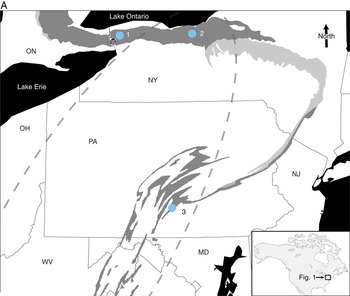
To test the hypothesis that eurypterid preservation is controlled by regional-scale fluctuations in water depth, we first compiled all known Silurian–Lower Devonian eurypterid-bearing localities in the Appalachian basin (i.e., eastern Ohio/southwestern Ontario to easternmost–central New York; central Pennsylvania to southwestern West Virginia and western Maryland) (Fig. 1). Our survey approach builds on that of Plotnick (Reference Plotnick1983, Reference Plotnick1999), who compiled the largest compendium of global eurypterid occurrences to date. In the present study, eurypterid occurrences were exhaustively collated from extensive field observations made by one of us (S.J.C.), accession data from the Yale Peabody Museum Ciurca Collection, observations made by us during field studies in 2013–2015, and then the primary literature, where necessary (see Supplemental Table 1 for all data sources and references). We then restricted our survey to localities and strata where eurypterid occurrences could be identified to the submember level and, preferably, horizon level. This yielded a data set comprising 31 formations, 71 members, and 83 submembers, across 85 localities. From these we obtained 241 bed- or horizon-level samples, of which 111 contain eurypterids. Eurypterid and associated faunal taxonomic occurrence data were compiled primarily at the genus level, but higher taxonomic levels were used for common, generically unidentified taxa (e.g., “high-spired gastropods”). This yielded 18 eurypterid genera and 45 distinct associated taxonomic assignments, roughly a third of which are brachiopods. Prior to multivariate analysis, singleton noneurypterid taxa and samples lacking faunal occurrence data were pruned from the data set. Within the survey, only four formations—the Camillus, Forge Hollow, Oatka, and Akron formations—lack eurypterids, but these were retained in the data set because they are lithologically and environmentally similar to adjacent eurypterid-bearing units. For each sample, sedimentological variables recorded included primary and secondary lithologies and presence of sedimentary features (e.g., ripple marks, desiccation cracks, brecciation), evaporitic structures or minerals, biogenic structures such as stromatolites and thrombolites, and bioturbation. Sedimentary structures such as cross-bedding are typically observed only at the microscale in many upper Silurian units (Ciurca and Hamell Reference Ciurca and Hamell1994) and thus were excluded from the survey (see Supplemental Table 1 for all site, taxonomic, and sedimentogical data).
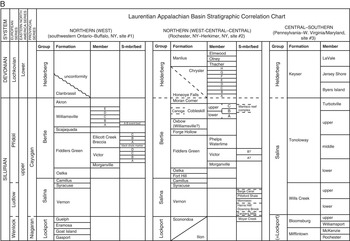
Regional map of North American Appalachian basin and stratigraphic correlation chart for upper Silurian–Lower Devonian surface units in the Appalachian basin. A, Northern, central, and northernmost southern Appalachian basin. Silurian (black) and Lower–Middle Devonian (gray) bedrock exposures are represented by the shaded area. Dashed line represents approximate position of the basin axial area in the Silurian. Numbered localities correspond to stratigraphic columns in B (sites 1–3). B, Representative stratigraphic columns for three regions within the study area in the Appalachian basin. Units are not to scale. Informal unit names are lower case; for clarity, submembers (“S-mbr”) or beds were only included if they have yielded eurypterids or occur within eurypterid-bearing members. Angled boundary lines separate nonadjacent and laterally differentiated (E–W) but isochronous units; dashed lines indicate uncertain boundaries. Stratigraphic data compiled from Ciurca (Reference Ciurca1978, Reference Ciurca1990; unpublished field notes, personal observations), Brett et al. (Reference Brett, Goodman and LoDuca1990, Reference Brett, Tepper, Goodman, LoDuca and Eckert1995), Inners (Reference Inners1997), Laughrey (Reference Laughrey1999, and references therein), and Cramer et al. (2011). Adapted from Lau (Reference Lau2009).

Regional map of North American Appalachian basin and stratigraphic correlation chart for upper Silurian–Lower Devonian surface units in the Appalachian basin. A, Northern, central, and northernmost southern Appalachian basin. Silurian (black) and Lower–Middle Devonian (gray) bedrock exposures are represented by the shaded area. Dashed line represents approximate position of the basin axial area in the Silurian. Numbered localities correspond to stratigraphic columns in B (sites 1–3). B, Representative stratigraphic columns for three regions within the study area in the Appalachian basin. Units are not to scale. Informal unit names are lower case; for clarity, submembers (“S-mbr”) or beds were only included if they have yielded eurypterids or occur within eurypterid-bearing members. Angled boundary lines separate nonadjacent and laterally differentiated (E–W) but isochronous units; dashed lines indicate uncertain boundaries. Stratigraphic data compiled from Ciurca (Reference Ciurca1978, Reference Ciurca1990; unpublished field notes, personal observations), Brett et al. (Reference Brett, Goodman and LoDuca1990, Reference Brett, Tepper, Goodman, LoDuca and Eckert1995), Inners (Reference Inners1997), Laughrey (Reference Laughrey1999, and references therein), and Cramer et al. (2011). Adapted from Lau (Reference Lau2009).

To quantify the likelihood of eurypterids occurring within specific lithologies (e.g., carbonates or siliciclastics), as an indicator of overall environmental preference (or preservational bias), we used the binomial substrate affinity analysis of Kiessling and Aberhan (Reference Kiessling and Aberhan2007), which follows that of Foote (Reference Foote2006; see Simpson and Harnik Reference Simpson and Harnik2009 for a Bayesian inference approach). Both analyses require the number of occurrences associated with one target lithology or type of sedimentary structure, the number of occurrences in alternative lithologies or nonoccurrences with sedimentary structures, and the total number of global occurrences of either lithology or structure. The analysis outputs a probability of affinity and a p-value indicating significance level. Additionally, we tested for an “affinity” of eurypterids toward evaporites and microbial structures, based on the frequent co-occurrence of eurypterids and these sedimentary structures noted by Vrazo et al. (Reference Vrazo, Brett and Ciurca2016). These features are useful as an indication of water depth and minor sea-level fluctuations in facies that otherwise lack sedimentary features.
To assess regional-scale taxonomic and environmental relationships related to water depth, canonical correspondence analysis (CCA; Ter Braak Reference Ter Braak1986) was carried out in the ‘vegan’ package (Oksanen et al. Reference Oksanen, Blanchet, Kindt, Legendre, Minchin, O’Hara, Simpson, Solymos, Stevens and Wagner2015) in the R programming language (R Core Team 2015). CCA is a type of gradient analysis in which taxonomic data are first subjected to a correspondence analysis (CA; Hill 1973) and then “constrained” by explanatory environmental variables. CCA ordination diagrams display taxonomic and site data as points and environmental variables as arrows. Axes depict explained species distribution “inertia” (rather than variance) as measured by an eigenvalue, whereas the inertia of site data scores is weighted equally—species points are positioned at the centroid of their occurrence in the given set of samples, allowing for inference of which species should occur at a specific site (Ter Braak Reference Ter Braak1986). If species distribution can be related to one or more environmental variables, the analysis creates an axis (represented by an arrow) along which species points are distributed as a gradient. Arrow position indicates the direction of maximum correlation, while arrow lengths are scaled to the value of the squared correlation coefficient value (r 2); thus, longer arrows indicate stronger correlation to species distribution and stronger explanatory variables. Environmental variable arrows that are closer together (at low angles) are interpreted as being more positively correlated, whereas arrows that are farther apart (at high angles) or in the opposite direction are considered to be negatively correlated. In this way, it is possible to infer how environment influences faunal composition across a range of sites.
Because all environmental variables in an analysis are initially plotted on the ordination diagram, it can be useful to extract only the significant environmental variables in a data set for visualization and hypothesis testing (Oksanen et al. Reference Oksanen, Blanchet, Kindt, Legendre, Minchin, O’Hara, Simpson, Solymos, Stevens and Wagner2015). Environmental variables that are statistically significant at a specified alpha level can be identified by using the envfit function in ‘vegan,’ which carries out a statistical test similar to an analysis of variance after permuting community data to a high number (9999; Oksanen et al. Reference Oksanen, Blanchet, Kindt, Legendre, Minchin, O’Hara, Simpson, Solymos, Stevens and Wagner2015). In the present analysis, environmental variables significant at the α=0.05 level were retained for CCA plots.
Stratigraphic intervals at some localities in the survey have been heavily sampled (e.g., the Phelps Waterlime Member at Passage Gulf, New York), whereas the same intervals at other localities have not received as much collecting attention. To reduce the potential influence of oversampled localities in the initial horizon/site-level CCA, the data set was aggregated into groupings of submember-level samples (or higher, depending on the stratigraphic subdivisions per unit). Faunal sample occurrences were also aggregated, but counts were retained only as presence/absence data. Following aggregation, we carried out a second CCA on the full data set and a third CCA on only the eurypterid fauna.
An initial exploratory horizon/site-level analysis revealed that the rare eurypterid genus Waeringopterus, which primarily occurs as an isolated taxon in the lowermost Syracuse Formation, represents an extreme outlier. For this reason Waeringopterus was removed from the first horizon/site-level analysis but was retained for subsequent aggregated analyses in which it was no longer an outlier. Additionally, using site longitude as a variable, a subset of the data restricted to New York and Ontario localities was tested for a potential gradient along the east–west outcrop belt strike as it relates to shifts in the basin depocenter over time (Brett et al. Reference Brett, Goodman and LoDuca1990).
Environmental variables that were identified as being statistically significant in the CCAs were subsequently interpreted within a sequence stratigraphic framework with objectively defined flooding surfaces and cycle boundary horizons. Abrupt contacts between such surfaces and overlying facies, commonly with marine fossils, bioturbation, and/or mounded microbial structures, were used to demarcate cycle (parasequence) boundaries or flooding surfaces at the bases of thin, small-scale transgressive deposits (TSTs). Upward appearance of shallower-water facies, including vugs and evaporite molds, was used as evidence for regression in small-scale highstand systems tracts (HSTs) (cf. Handford and Loucks Reference Handford and Loucks1993). Features, such as desiccation cracks and collapse breccias, indicative of subaerial exposure surfaces, record intervals of maximum regression.
Results
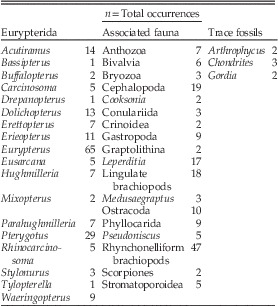
Eurypterids occur in all Silurian–Lower Devonian groups in the Appalachian basin. Geographically, a vast majority of eurypterid occurrences (n=96) are found in the northern Appalachian basin (New York and Ontario). The 18 recorded eurypterid genera and co-occurring fauna at the submember level are presented in Table 1. Leperditia was the single most common taxon to occur with eurypterids (n=17), followed by the lingulate brachiopod Lingula (n=14). Rhychonelliform brachiopods (athyrids, strophomenids) were the single largest combined faunal group in terms of total occurrences, followed by cephalopods. In terms of overall taxonomic composition, associated faunal diversity results obtained from our survey are similar to those of Plotnick (Reference Plotnick1999: Table 10.3), although our results are restricted to occurrence data at the horizon level in the Silurian–Lower Devonian of the Appalachian basin. To determine whether there was a difference in faunal diversity between eurypterid-bearing beds and those lacking eurypterids when the eurypterids themselves were excluded, we compared total noneurypterid faunal diversity within eurypterid-bearing samples with that of total faunal diversity in samples lacking eurypterids, using samples in which there was a noneurypterid faunal taxon count of at least one (n=55, mean=2.61; n=47, mean=1.53, respectively). Mean noneurypterid faunal diversity is significantly greater in eurypterid-bearing beds (Mann-Whitney, p<0.01).
Total eurypterid and associated faunal occurrences from eurypterid-bearing beds in the Silurian–Lower Devonian of the Appalachian basin. Single occurrences of associated, noneurypterid taxa were excluded or grouped at a higher taxonomic level (e.g., rhynconelliform brachiopods).

Lithologically, eurypterids in the survey occurred primarily in cyclic carbonate–dominated or mixed carbonate–mudstone sediments (81%; 90/111 samples). The remaining 21 eurypterid-bearing samples occurred in shales and siltstones. For a eurypterid affinity toward carbonates or siliciclastic substrates, we obtained a high but nonsignificant probability value of 0.81 (p=0.92) for the target carbonate lithology, indicating that there is not a strong substrate bias across the basin. If the sample is reduced to include only the northern basin where carbonates dominate, the probability and p-value remain similar, further supporting a lack of regional substrate bias.
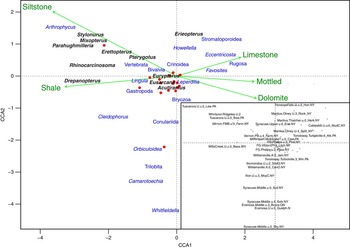
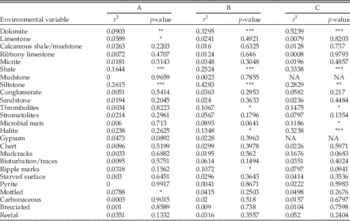
The CCA of all taxa sampled at the horizon level revealed a strong lithologic gradient in terms of faunal associations, with siliciclastic variables (Shale/Siltstone) at one end, and carbonate variables (Dolostone/Limestone/Mottled [limestone]) at the other (Fig. 2; see Table 2 for r 2 and p-values for all environmental variables used in the CCA). Representative stratigraphic units in the upper left quadrant of the plot (Fig. 2, inset), e.g., the Tuscarora or Rose Hill formations, are entirely siliciclastic dominated, whereas representative units in the center and right side of the plot that have positive scores on CCA axis 1 (CCA1), for example, the Cobleskill Formation, are chiefly carbonate dominated. Several eurypterids (e.g., Drepanopterus, Parahughmilleria) show a strong correlation with only siliciclastic facies, whereas only some of the associated fauna (e.g., Favosites, stromatoporoids) show a strong correlation with carbonate facies arrows. A large cluster of both eurypterids and associated fauna occurs in the center of the lithologic gradient, and these are not strongly correlated with either facies.
CCA ordination diagram with Silurian–Lower Devonian fauna from the Appalachian basin and environmental variables. For image clarity, only the most common taxa, based on total abundance across all samples, are named (in blue); remaining taxa are represented as red dots. Eurypterid genera are in bold type. Significant environmental variables (p<0.05) are represented by arrows and indicate direction of increasing correlation relating to faunal distribution (see text for explanation of significance testing). Inset plot shows sample distribution in the CCA (labels composed of stratigraphic and locality data, n=150). Samples with the greatest taxonomic diversity are named; remaining units are represented as gray crosses. Named units include formation, member, submember, and bed level (as number). “U” suffix indicates undifferentiated member; “u” indicates undifferentiated submember; 0, undifferentiated within bed; 1, lowermost; 2, lower; 3, middle; 4, upper; 5, uppermost. (See Supplemental Table 1 for site abbreviation definitions and locality data.)

Squared correlation coefficients (r 2) and significance levels (p-value) of environmental variables from CCAs of eurypterids and associated taxa from the Silurian–Lower Devonian of the Appalachian basin. A, All taxa, samples analyzed at the site/horizon level. B, All taxa, samples analyzed at the submember level (or next highest stratigraphic interval) following aggregation. C, Eurypterid taxa only, samples analyzed at the submember level (or next highest stratigraphic interval) following aggregation. Environmental variables that were not present in analyses are excluded (or labeled as “NA”).

*p<0.05.
**p<0.01.
***p<0.001.
Running orthogonal to the lithologic gradient are two linear groupings of taxa—running positively and negatively along CCA axis 2 (CCA2; Fig. 2)—within which the eurypterid taxon Erieopterus (Lower Devonian Manlius Formation) and rare stenohaline taxa (e.g., rare crinoids and trilobites) occur. Examination of the environmental variable CCA scores and r 2 values indicates that taxa in the positive portion of the plot may correlate to the Reefal variable (CCA1, 0.6187; CCA2, 0.7856; r 2, 0.0351; p=0.1332), whereas there is no single environmental variable that correlates strongly to the grouping of taxa in the negative portion of the plot (Table 2; see Supplemental Table 2 for all CCA scores). In this latter portion, the rare athyrid brachiopod Whitfieldella, which is found in only three samples and occurs primarily in the Victor Member, represents the farthest outlier among the associated fauna.
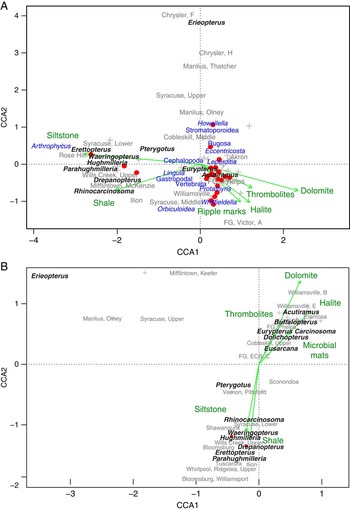
A CCA of all taxa following aggregation of taxa to the submember level (or next highest stratigraphic level) (Fig. 3A) yielded a very similar lithologic gradient to that seen at the horizon level in Figure 2, and faunal distributions remained largely unchanged. Therefore, we will describe only prominent differences following sample aggregation. The explanatory variables Halite, Thrombolites, and Ripple marks are now statistically significant and are displayed in the lower right quadrant of the CCA plot. The Thrombolite variable arrow closely aligns with the longer Dolomite arrow, indicating a strong correlation with the latter, whereas the Ripple marks arrow aligns closely with the longer Halite arrow. Ripple marks are rarely observed in fossiliferous beds; thus, the correlation with Halite in Figure 3A and its statistical significance (Table 2) is likely an artifact of the sample aggregation within the ordination, rather than a reflection of environmental reality. In terms of faunal composition, the large swimming eurypterid Acutiramus now shows a strong correlation with the Halite/Ripple mark variables, followed by Eusarcana (Paracarcinosoma) (not displayed) and Eurypterus. In addition, Erieopterus now represents a stronger outlier along CCA2. Among associated fauna, the athyrid brachiopods Whitfieldella and Protathyris are closely correlated with the Halite/Ripple mark variables. In considering Whitfieldella’s position as an outlier in Figure 2 and strong correlation with the explanatory variables in Figure 3A, it should be noted that Protathyris is often misidentified as Whitfieldella (Tollerton Reference Tollerton1997). Given that Protathyris, like Whitfieldella, is also very common in the Victor Member, it may be that the few examples of Whitfieldella actually represent the former genus, in which case they might lie closer to the center of the plot.
CCA ordination diagram with aggregated Silurian–Lower Devonian fauna and site data (as stratigraphic intervals) from the Appalachian basin, and environmental variables. Faunal presence/absence data are aggregated to the submember level or the next available stratigraphic level. Significant environmental variables (p<0.05) are represented by arrows and indicate the direction of increasing correlation relating to faunal distribution (see text for explanation of significance testing). A, Plot of first two axes of a CCA of all surveyed fauna (n=50) and samples (n=64) and significant environmental variables (p<0.05). Eurypterid genera are in bold type. For image clarity, only the most common taxa, based on total abundance across samples, are named (in blue); remaining taxa are represented as red dots. B, Plot of first two axes of CCA of eurypterid fauna only (n=18) and samples (n=57) and significant environmental variables (p<0.05). For image clarity, only samples (as individual stratigraphic units) with the greatest eurypterid diversity are named (in gray); remaining units are represented as gray crosses. Stratigraphic unit labels are composed of formation and member and submember names (if present and/or necessary for distinguishing units). “FG,” Fiddlers Green Formation; “ECB,” Ellicott Creek Breccia Member; “U” suffix indicates undifferentiated stratigraphic position.

Finally, a CCA of only eurypterid taxa following aggregation to the submember level (or next highest stratigraphic level) yielded similar results to those in the previous CCA, but with the lithologic gradient now lying along CCA2 (Fig. 3B). The representative stratigraphic units with negative CCA2 scores are siliciclastic dominated, whereas those with positive CCA2 scores are carbonate dominated. In the absence of associated fauna, the eurypterid genera show increased correlation with the lithologic variables, and none occur in the center of the CCA2 axis. After lithology, the Halite variable again shows the strongest correlation to taxonomic distribution. Additionally, the Microbial mat variable is statistically significant and is displayed on the plot, showing a similar correlation to that of the Thrombolite variable. As in the CCA of all fauna after aggregation (Fig. 3A; discussed earlier), Erieopterus in Figure 3B continues to be a strong outlier. Results from a CCA of only New York and Ontario samples, which included longitude as a variable, indicate that there is no significant east–west correlation with the overall faunal composition (p=0.181).
Significant Environmental Variables
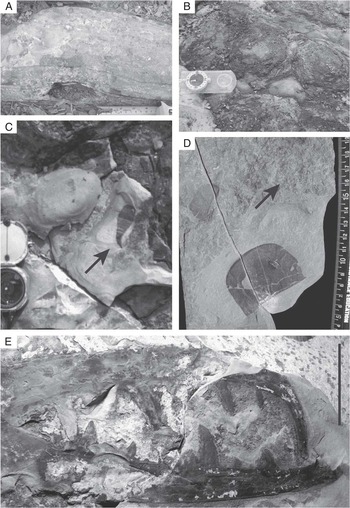
Among all sedimentological and biogenic features recorded in the survey, the CCA results indicate that there is a consistent and strong correlation of eurypterids with evaporitic and/or microbial structures/microbialites. In terms of the actual frequency of co-occurrence with eurypterids, these structures are also the most common. Of 65 samples that contained microbial structures (thrombolites, stromatolites, microbial mats) eurypterids occurred directly within sediments emplaced upon stromatolites, thrombolites, or microbial mats in just under half (42%; n=27). Conversely, of 111 eurypterid occurrences, 36 (32%) were associated with microbial structures. These associations are restricted to samples from New York, Ontario, and Pennsylvania. If the samples are reduced to only those from New York and Ontario, where these microbial structures predominantly occur, they are found in 35% (34/96) of all samples. Ciurca and Domagala (Reference Ciurca and Domagala1988), Ciurca (Reference Ciurca2005, Reference Ciurca2013), and Vrazo et al. (Reference Vrazo, Brett and Ciurca2016) previously noted a close association between eurypterids and microbial structures across the upper Silurian of the northern Appalachian basin (Fig. 4).
Microbial structures and associated eurypterids from the upper Silurian of the Appalachian basin. A, Stromatolite with subjacent evaporitic vugs, Tonoloway Formation, Pennsylvania. Ruler in cm. B, Example of thrombolite mounds and the intermound sediments in which eurypterids are often found, Ellicott Creek Breccia Member, Fiddlers Green Formation, Neid Road Quarry, New York. Compass for scale. After Ciurca (Reference Ciurca2005). C, Thrombolite with eurypterid (indicated by arrow) in intermound sediments, Ellicott Creek Breccia Member, Fiddlers Green Formation, Neid Road Quarry, New York. Compass for scale. D, Isolated eurypterid (Eurypterus) carapace and partial tergite adjacent to thrombolite (indicated by arrow), Williamsville Formation, Ridgemount Quarry, Ontario. Ruler in cm. After Ciurca, Reference Ciurca2013. E, Isolated pterygotid claw in thrombolite intermound sediments, Fiddlers Green Formation, Neid Road Quarry, New York. Scale bar, 5 cm. Modified from Ciurca (Reference Ciurca2005).

This frequent eurypterid–microbialite association is followed closely by a co-occurrence with evaporitic structures (salt hoppers or halite casts/molds). Of 59 samples containing evaporites (i.e., salt hoppers) within the survey, 53% (n=31) also contained eurypterids on the same horizon. This association is entirely restricted to samples from the northern basin (Ontario and New York). Within a given bed, or series of beds, eurypterids were typically subjacent to or co-occur with these structures; they were rarely found above them. A largely similar stratigraphic pattern was noted previously in a survey of eurypterids and evaporites in the basin (Vrazo et al. Reference Vrazo, Brett and Ciurca2016, see for further discussion). This eurypterid–evaporite association is also limited to halite-based evaporites—no eurypterids were found to co-occur in the same horizon as gypsum or other nonhalite minerals or their casts/molds. Other nonmineral evaporitic features and evidence for subaerial exposure (i.e., desiccation cracks) occurred in 22 samples, all within upper Silurian units. Desiccation cracks often occur in supratidal facies associations at the tops of shallowing-up intervals in which eurypterids occur, but no co-occurrences of cracks and eurypterids were observed in the same horizon/sample in the survey.
Having ascertained that microbial structures and evaporitic structures are the most common sedimentary features within eurypterid-bearing samples in the northern Appalachian basin, we carried out a secondary affinity analysis on a subset of the data set restricted to samples from that region. For evaporite–eurypterid associations, the affinity probability value was similar to our raw co-occurrence value and was significant (36%; p<0.05). A similarly significant affinity probability was obtained from the analysis of the eurypterid–microbialite associations (40%; p<0.05). In terms of taxonomic associations, 12 of the 18 (67%) eurypterid genera recorded in the survey occur with or directly above microbial structures in at least one sample. The recurrent microbial/evaporite–eurypterid associations occur in both carbonate and siliciclastic facies and are observed in three of the four end-member depositional cycles described in the following sections.
Depositional Cycles
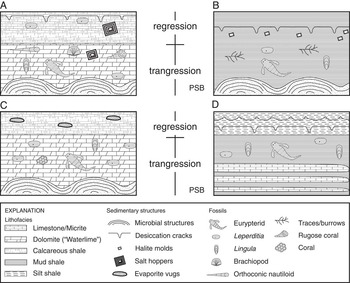
During fieldwork across the basin, several distinct but interrelated types of meter-scale cycles with specific sedimentological and faunal features were observed within eurypterid-bearing lithofacies. These are described briefly here and depicted in Figure 5.
Cartoons of generalized eurypterid-bearing sequences observed in the Silurian–Lower Devonian of the Appalachian basin. Not to scale. Central column depicts relative rise and fall of shoreline; PSB, parasequence boundary. Depositional cycles: A, Bertie Group–Manlius type. B, Vernon (“Pittsford”)–Bloomsburg type. C, Tonoloway Formation type. D, Wills Creek type. See text for cycle descriptions.

Bertie–Manlius Type
Meter-scale cycles are observed in the upper Silurian (Přídolí) Bertie Group and overlying Lower Devonian (Lochkovian) Manlius Formation. These facies are characterized by small cycles that typically commence with thin basal intraclastic packstone lag deposits that may be capped by low relief (2–10 cm relief) microbial buildups composed of stromatolites and/or thrombolites. These are overlain by lime mudstones, “waterlimes” or calcareous shales, which occasionally contain bioturbation and may contain low-diversity faunas of ostracods, leperditians, small gastropods, nautiloid cephalopods, and lingulate and rhynchonelliform brachiopods and, in some cases, abundant, well-preserved, eurypterids. Mineralized fossils show substantial dissolution and are represented by deformed internal/external molds, but organic skeletons, including eurypterid cuticles, may be well preserved. Dolostones with evaporitic features, including salt hoppers, incipient halite casts/molds, gypsum molds, and collapse breccias suggestive of surface evaporation/solution, are typical of upper portions of these cycles (cf. Vrazo et al. Reference Vrazo, Brett and Ciurca2016). In the Bertie Group alone, 43% (26/60) of samples in the present study showed such evaporitic evidence in successions overlying eurypterid-bearing strata.
Vernon (“Pittsford Shale”)–Bloomsburg Type
A type of cycle analogous to the “Bertie–Manlius” is present in more siliciclastic-rich successions in the Ludlow-age upper Bloomsburg (Pennsylvania), McKenzie (Pennsylvania), Illion (New York), and Vernon (New York) formations. These show basal thin carbonates with thin lags and typically low microbial mounds (stromatolites) that pass upward into medium to dark-gray shale with varied fossils including lingulates, bivalves, gastropods, ostracods, and, in some cases, eurypterids. These dark shales pass upward into blue to green to reddish mottled mudstones that contain evidence for subaerial exposure, including evaporites (salt hoppers), paleosols, and/or desiccation features.
Tonoloway Type
Cyclicity in the upper Silurian (upper Ludlow–Přídolí) Tonoloway Formation of Pennsylvania, West Virginia, and Maryland has been well documented elsewhere (Cotter and Inners Reference Cotter and Inners1986; Elick and Siegel Reference Elick and Siegel2009). The successions in this unit are comparable to those of the “Vernon–Bloomsburg” described earlier, but within a more carbonate-dominated lithofacies. Thick micrite beds containing isolated thrombolitic mounds or microbial laminae occur at the base of meter-scale shallowing-up successions. These are overlain by thin- to medium-bedded calcareous shales containing a very low diversity fauna that typically consists only of mass assemblages of leperditians but, rarely, contains a more diverse near-stenohaline marine fauna that includes mollusks, favositid corals, and abundant eurypterids (e.g.,Vrazo et al. Reference Vrazo, Trop and Brett2014). These beds are then overlain by thin-bedded and barren calcareous shales that frequently contain evidence for subaerial exposure, including desiccation cracks, halite casts/molds, and vugs.
Wills Creek Type
Cycles in the Ludlow-age Wills Creek Formation of the central and southern Appalachian basin are comparable to those of siliciclastic-dominated units to the north but have a reduced microbial component (Cotter and Inners Reference Cotter and Inners1986). In the central Appalachian basin, at Allenport, Pennsylvania, 28 shallowing-up cycles have been documented in the Wills Creek Formation (Cotter and Inners Reference Cotter and Inners1986). Eurypterid and ostracod remains have been found at this locality in the thin olive-gray shales overlying carbonate beds (N. Sullivan personal communication 2014). Similarly, in the southern Appalachian basin, near Bass, West Virginia, thin carbonate beds grade into olive-grey shales or red siltstones that may contain a limited fauna comprising lingulate brachiopods, ostracods, and rare fish and eurypterid remains (Kjellesvig-Waering and Leutze Reference Kjellesvig-Waering and Leutze1966). These beds are capped by small-scale desiccation features and ripple marks. Evaporitic structures such as vugs and halite casts occur within the Wills Creek Formation, though these have not been observed in association with eurypterids. This interval represents the southernmost known occurrence of eurypterids within the Appalachian basin.
Tuscarora–Shawangunk Type
The lower Silurian (Llandovery) Tuscarora and Shawangunk formations contain entirely siliciclastic facies, and bed thickness typically varies rapidly across strike. Cycles in these comprise alternating massive, heavily cross-bedded white quartz arenite and thinner coarse-grained black or gray siltstone or mudstone beds. Arthrophycus occurs in both units, but the arenite beds are otherwise depauperate, whereas occasional Lingula and pyritized burrows occur in the silts/muds, as well as fragmentary remains from a diverse eurypterid fauna (e.g., Swartz and Swartz Reference Swartz and Swartz1931).
Discussion
The results of our analyses suggest that there are systemic relationships between eurypterid environmental preference, water-depth fluctuations, and conditions conducive to preservation of eurypterids in the Appalachian basin. In the following section, we will consider the parameters as they relate to the formation of eurypterid Lagerstätten within the basin and the implications for an overarching preservational mechanism dependent on sea-level rise and fall.
Environmental Variables and Faunal Diversity
The substrate affinity analysis indicates that, as a whole, eurypterid occurrences in the Appalachian basin are not biased toward preservation in a single lithology (i.e., carbonates). However, when considering the results from the CCA of only eurypterid taxa (Fig. 3B), a strong correlation between lithofacies and the occurrences of individual genera, and their associations with other eurypterid taxa is evident. Future analyses will consider the ecological niches of specific taxa in detail, but several general inferences can be made here. Some genera are less correlated with a specific lithofacies than others, for example, Dolichopterus and Eurypterus, the latter being the most common genus observed in this study. These two genera along with Eusarcana lie close to the center of the CCA2 axis in Figure 3B, and this may be an indication that they were eurytopic. Further support for eurytopy in these taxa is provided by commonly associated taxa such as Leperditia and Lingula. These two taxa are similar to Eurypterus in that they occur closest to the center of the lithologic gradient, and this supports the traditional view that these are euryhaline, eurytopic taxa. Notable, however, is the negative correlation of Lingula with the Halite variable in Figure 3A. Vrazo et al. (Reference Vrazo, Brett and Ciurca2016) noted that Lingula has not been found in any unequivocally hypersaline depositional settings, and the results of the CCA here support a preference for euhaline or hyposaline conditions.
Regardless of their position, all eurypterid taxa occurring along the main lithologic gradient are ultimately considered to have been deposited in shallow subtidal settings in the basin. Erieopterus, on the other hand, is a strong outlier from this gradient, which implies a different depositional setting. A review of fauna associated with Erieopterus in the survey reveals that it co-occurs with stenohaline corals and stromatoporoids and is found in biohermal deposits (Ciurca Reference Ciurca1978). This faunal association implies deposition under euhaline conditions and in slightly deeper settings than other eurypterid faunas in the basin. Erieopterus is thought to replace Eurypterus in the Early Devonian (Ciurca Reference Ciurca1978), and this may also explain its isolation in Figures 2 and 3.
Sedimentary Associations and the Role of Water-Depth Fluctuations
Northern Appalachian Basin
After lithofacies, eurypterid occurrences in the northern Appalachian basin have the strongest correlation with evaporitic and microbial structures. The close association of eurypterids with or above microbial structures in this region is supported by the substrate affinity analysis, CCA results, and qualitative observations. These structures and associated eurypterids typically occur at the bases of shallowing-up successions (Fig. 5), which we interpret here as parasequence boundary markers and the flooding surfaces associated with small-scale transgressions. In this scenario, the regular occurrence of eurypterids on or directly above these flooding surfaces indicates that eurypterids preferentially entered these nearshore environments during minor transgressive events that brought freshening conditions into nearshore subtidal settings. A return to near-euhaline marine conditions above these microbially dominated beds is inferred from an increase in faunal diversity within eurypterid-bearing horizons that includes both classically euryhaline (Leperditia, Lingula) and more stenohaline taxa (nonlingulate brachiopods, bryozoans, cephalopods, corals).
Chitin degradation is significantly slowed within the sediment (Allison 1990; Boyer Reference Boyer1994; Perga Reference Perga2011), and hence rapid burial of chitinous eurypterid remains would be critical to their long-term preservation. Burial may have occurred during these transgressions via one of two mechanisms. Storm-driven sediment disruption and/or resultant waves from distant storms on the shallow margins of the basin would have promoted rapid burial of eurypterid remains. Storm deposition is inferred in a number of eurypterid-bearing units in this study based on sedimentary structures (e.g., rip-up clasts; Ciurca Reference Ciurca2011), the fragmentary nature of many eurypterid assemblages (Tetlie et al. Reference Tetlie, Brandt and Briggs2008; Vrazo and Braddy Reference Vrazo and Braddy2011; Vrazo et al. Reference Vrazo, Trop and Brett2014), and the close association of terrestrial and marine organisms (Copeland and Bolton Reference Copeland and Bolton1985). Microbial structures in the subtidal and lowermost intertidal zone may have also facilitated burial (and preservation) of nonmineralized tissues through physical baffling of sediments (see Noffke and Awramik 2013). LoDuca and Brett (Reference LoDuca and Brett1997) suggested that the Medusaegraptus Lagerstätte in the Niagara Falls Member of the upper Silurian Goat Island Formation was primarily the result of anoxic conditions that may have developed in between relict biostromes during eustatic transgression. A similar pattern, wherein minor transgressions promoted sedimentation and burial in between small microbial baffles, is suggested here in units containing both microbialites and eurypterids (Fig. 4; see Ciurca Reference Ciurca2005).
The results of the substrate affinity analysis, CCAs, and earlier studies (Vrazo et al. Reference Vrazo, Brett and Ciurca2016) also reveal that there is a close and regular association of eurypterids with evaporites, specifically halite, in the northern basin. This close association has been previously shown to be the result of regression and evaporation in shallow nearshore settings in this region (Vrazo et al. Reference Vrazo, Brett and Ciurca2016). In the present study, we consider the regular occurrence of eurypterids alongside and/or below these evaporitic structures to be a postburial association (cf. Vrazo et al. Reference Vrazo, Brett and Ciurca2016). The presence of salt hoppers in fossiliferous beds reflects in situ formation within the sediment following minor regressions; that is, they are the result of early-stage diagenesis under an extended evaporative regime. Furthermore, the frequency of desiccation cracks at the tops of many eurypterid-bearing beds and the lack of fauna—aside from leperditians—in these intervals confirms the regular regressive and shallowing-up nature of these successions.
Following initial transgressions, shallowing during later HSTs in these shallow nearshore settings fostered environmental conditions that would be conducive to long-term preservation of buried nonmineralized remains. Evaporation, driven by an arid climate on a gentle paleoslope (Alling and Briggs Reference Alling and Briggs1961; Smosna et al. Reference Smosna, Patchen, Warshauer and Perry, W.1977; Belak Reference Belak1980; Cotter and Inners Reference Cotter and Inners1986; Bell and Smosna Reference Bell and Smosna1999), would have increased water temperature, salinity, and coincident dysoxic/anoxic conditions, while a lack of regular oceanic input (Dennison and Head Reference Dennison and Head1975; Dorobek and Read Reference Dorobek and Read1986) would have promoted water column stagnation. These conditions would have resulted in an environment that limited or inhibited bioturbation in the sediment, scavenging of buried remains, and chitinoclastic bacterial decay.
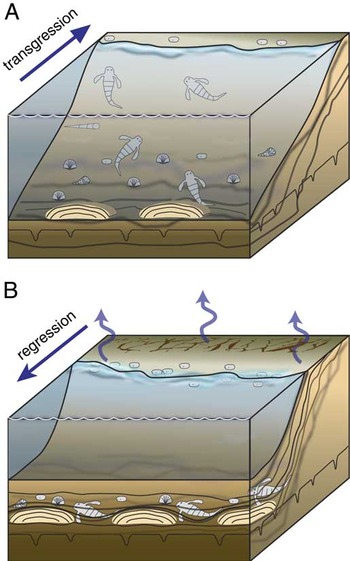
From the environmental parameters discussed above, we propose a generalized preservational model in which (1) eurypterids entered nearshore settings during transgressive freshening conditions; (2) their remains were buried through storm deposition or microbialite sediment baffling; and (3) subsequent evaporation and regression promoted increasingly warm, saline, and dysoxic or anoxic conditions within the water column and pore waters, which promoted chitin preservation (Fig. 6).
Cartoon of generalized preservational model for eurypterid Lagerstätten in the Laurentian Appalachian basin. Not to scale. See Figure 5 for organismal key. Straight arrows indicate respective rise or fall of shoreline. A, Subtidal environment, following transgression. Eurypterids and eurytopic marine fauna are present; stromatolites/thrombolites represent the flooding surface. Eurypterid remains—probably molts rather than carcasses—are buried at this time (see “Discussion”). B, Intertidal–supratidal environment, following regression and/or evaporation (indicated by wavy arrows), during late highstand systems tracts. Evaporation produces desiccation cracks; low circulation creates a stagnant water column. Only eurytopic organisms (e.g., leperditicopids) are present as conditions become increasingly hypersaline and/or dysoxic, and water temperatures rise. If evaporation continues and mineral saturation occurs, evaporites may form (see Vrazo et al. Reference Vrazo, Brett and Ciurca2016: Fig. 3, for examples). Modified from Vrazo et al. (Reference Vrazo, Brett and Ciurca2016).

Central and Southern Appalachian Basin
In the central and southern Appalachian basin, where siliciclastic-dominated facies generally lack microbial structures or obvious evidence for hypersalinity, sea level–dependent controls on eurypterid preservation are still evident. In the upper Silurian Wills Creek Formation, eurypterids occur within fissile mud shales (representing perhaps late TST/early HST conditions) that are bounded by thin subjacent limestone beds and suprajacent horizons that contain desiccation cracks. Eurypterids in the lower Silurian Shawangunk Formation of New York (Clarke and Ruedemann Reference Clarke and Ruedemann1912) and the coeval Tuscarora Formation of Pennsylvania (Swartz and Swartz Reference Swartz and Swartz1930, Reference Swartz and Swartz1931) only occur in arenaceous silt bands interbedded between massive, Arthrophycus-rich, quartz–arenite beds. Here, eurypterids occur within small-scale transgressive beds within a fourth-order deepening sequence. Similarly, in the McKenzie Formation of Pennsylvania, eurypterids are only currently known from transitional shales suprajacent to limestone beds, in some cases with microbial structures. In these units, there are few observed sedimentological or biological features other than rare brachiopods and occasional horizontal and, in some cases pyritized burrows including Chondrites.
The common feature that links these latter occurrences with those to the north is not an association with hypersaline facies but relatively rapid changes in water depth in marginal settings. In both carbonate and siliciclastic successions, eurypterids are selectively preserved in transgressive marine-influenced facies interbedded with marginal marine to nonmarine facies. The associated faunas of these earlier eurypterid assemblages include a low diversity of mollusks, especially bivalves, lingulate and small rhynchonelliform brachiopods, and occasional nautiloids, typically assigned to benthic assemblage 1 or 2 (e.g., Plotnick Reference Plotnick1999); that is, sheltered, low-energy nearshore areas above normal wave base. More typical offshore marine faunas such as diverse brachiopods, bryozoans, echinoderms, and trilobites are absent, except in rare cases. Some of these settings may record estuarine environments and may even have been hyposaline, though evidence for the latter is only circumstantial (e.g., Barnes Reference Barnes1989; Vrazo et al. Reference Vrazo, Brett and Ciurca2016). In either case, a continuous theme among both early and late Silurian occurrences is not the prevalence of hypersaline conditions but rather a propensity of eurypterids to inhabit restricted nearshore settings, perhaps including bays and estuaries. Preservation in these settings may still relate to a strong halocline and low-energy settings in which there was little tendency for water circulation, and it is likely that low oxygen and fluctuating salinity occurred following regressions. In sum, we suggest that in both the northern and central/southern regions of the basin, conditions during small-scale transgressions were conducive to eurypterid inhabitation, while subsequent regressions played a critical role in their long-term preservation.
Beyond the Appalachian Basin
Our model may be applicable to eurypterid-bearing localities in other regions or paleocontinents in the mid-Paleozoic. The qualitative similarity of carbonate facies and shallow nearshore depositional settings at this time suggest a common model that can be tested in these regions. In the upper Silurian Leopold Formation of Somerset Island in the Canadian Arctic, for example, eurypterids occur in beds overlying stromatolites, in a transgressive succession that is overlain by evaporitic and desiccation-cracked beds (Dixon and Jones Reference Dixon and Jones1978; Jones and Kjellesvig-Waering Reference Jones and Kjellesvig-Waering1985). A similar pattern is seen in the shallow carbonate settings that contain eurypterids in the lower Silurian (Wenlock; Homerian) of Saaremaa Island of Estonia (Kaljo Reference Kaljo1970; Viira and Einasto Reference Viira and Einasto2003; Meidla et al. Reference Meidla, Tinn and Männik2014). The association of eurypterids with salt hoppers and/or biostromes or microbial structures also emerges in Upper Ordovician localities in Canada, such as the Georgian Bay and Stony Mountain formations of Manitoulin Island and Manitoba, respectively (Stott et al. Reference Stott, Tetlie, Simon, Nowlan, Glasser and Devereux2005; Young et al. Reference Young, Rudkin, Dobrzanski, Robson and Nowlan2007, Reference Young, Rudkin, Dobrzanski and Robson2012), suggesting similar habitat preferences and/or preservational conditions early in the evolutionary history of eurypterids. Later in the Paleozoic, preservation of eurypterids in estuarine environments may still be the result of regular tidal deposition. For example, in the eurypterid-bearing Hamilton and Mazon Creek Lagerstätten, soft-tissue preservation is thought to have resulted from rapid sedimentation during short, submonthly neap–spring tide cycles (Feldman et al. Reference Feldman, Archer, Kvale, Cunningham, Maples and West1993). Given that eurypterids continued to occur in nearshore fluviatile, floodplain, or deltaic environments through the late Paleozoic, it seems plausible that a similar tidal control on their preservation existed until their extinction at the end-Permian.
Cyclicity and Preservational Facies
The regular occurrence of eurypterids within shallowing-up cycles throughout the Appalachian basin suggests that fluctuations in water depth are due to recurrent changes in basinal sea level rather than localized storm or tidal influence, and thus these occurrences can be predicted over broad regional and temporal scales. The meter-scale cycles observed in the upper Silurian units described earlier are interpreted as largely shallowing-upward parasequences. These cycles are widely correlated (Ciurca Reference Ciurca1978; Anderson and Goodwin Reference Anderson and Goodwin1980; Goodman et al. Reference Goodman, Anderson, Goodwin and Sullivan1986; Elick and Siegel Reference Elick and Siegel2009) and show stacking patterns that may reflect periodic cycles of tens of thousands of years, nested within larger, possibly eccentricity-based cycles of hundred thousand-year durations, and thus most likely reflect allocyclic oscillations of sea level. For example, based on detailed logging of a 230-m-thick succession of the eurypterid-bearing Tonoloway Formation in central Pennsylvania, Cotter and Inners (Reference Cotter and Inners1986) documented around thirty-four 5- to 10-m-scale cycles. Based on the estimated overall duration of the late Silurian Přídolí stage, they argued that these cycles reflect Milankovitch-band and, probably processional, climate/sea-level oscillations that may be bundled in 100-Kyr-scale eccentricity cycles marked by thickest meter-scale cycles passing upward into thinner cycles.
In the context of regular cycling of similar lithofacies across the basin, it is particularly notable that development of more offshore facies in transgressive sections of small-scale cycles was not sufficient, in itself, for production of eurypterid Lagerstätten. In the Tonoloway Formation exposure at Allenport, Pennsylvania, ~25% of the cycles repeatedly show small microbial mounds or laminae near their transgressive bases (Cotter and Inners Reference Cotter and Inners1986). However, in most cases, these facies contain only minor bioturbation or, at most, bedding planes of profuse leperditian assemblages. Ultimately, only one cycle in the uppermost beds of the well-studied Tonoloway Formation was found to contain eurypterids, but they occur in the predicted position, immediately above thrombolitic mounds, and can be broadly correlated (Vrazo et al. Reference Vrazo, Trop and Brett2014). Thus, although small microbial mounds appear frequently in the Tonoloway Formation in deepening successions (cf. Eagan and Liddell Reference Eagan and Liddell1997), ensuing conditions were evidently not adequate for inhabitation by eurypterids. We infer that, in these cases, conditions remained hypersaline throughout the depositional cycle, and evidence for this occurs in the form of evaporite molds and/or vugs and deep desiccation cracks present in these beds (Smosna et al. Reference Smosna, Patchen, Warshauer and Perry, W.1977; Cotter and Inners Reference Cotter and Inners1986). Under these conditions, microbialites flourished and leperditians, considered halotolerant taxa (Vannier et al. Reference Vannier, Wang and Coen2001), were able to proliferate, but salinity remained too high for eurypterids and other less tolerant faunas.
These latter cycles in the Tonoloway Formation, which lack eurypterids in the expected positions, also provide a strong case against a purely taphonomic mechanism for eurypterid preservation. One traditional view is that the association of eurypterids with evaporative facies represented exuviae or carcasses of organisms that either inhabited these environments (e.g., Andrews et al. Reference Andrews, Brower, Gould and Reyment1974) or were washed into hypersaline lagoons, possibly from nearby estuaries (cf. Vrazo and Braddy Reference Vrazo and Braddy2011). If this were true, then the many cycles that show definite evidence of hypersalinity should also yield excellently preserved remains. Instead, eurypterids are absent in a majority of these cycles, especially those with definite evidence of hypersalinity, for example, the evaporitic facies of the Syracuse, Camillus, and Forge Hollow formations, which comprise shales interbedded with anhydrites, gypsum, or halite. Likewise, eurypterids have never been found in further offshore (largely subsurface) evaporite facies within the Salina Group.
Implications for Eurypterid Paleoecology and Evolution
The results of this study confirm the traditional view that a majority of eurypterid occurrences in the Silurian are associated with generally low-diversity marine or hyposaline/brackish faunas in a mixture of siliciclastic and carbonate lithofacies (cf. Plotnick Reference Plotnick1999). Furthermore, we agree with previous suggestions that that these were largely ephemeral communities (e.g., Clarke and Ruedemann Reference Clarke and Ruedemann1912; Leutze Reference Leutze1961), particularly those in nearshore subtidal settings that followed brief intervals of freshening in frequently hypersaline environments (i.e., in the more basinal sections of the foreland basin during much of the Ludlow and Přídolí time).
The important question as to where these communities survived during the long intervening intervals has been considered previously (e.g., Clarke and Ruedemann Reference Clarke and Ruedemann1912; Leutze Reference Leutze1961; Vrazo et al. Reference Vrazo, Brett and Ciurca2016). As noted earlier, evidence from extensive subsurface mapping of the Salina and Bertie groups in New York, northern Pennsylvania, and eastern Ohio (Alling and Briggs Reference Alling and Briggs1961; Rickard Reference Rickard1969) indicates that the deeper areas of the basin were occupied by increasingly hypersaline facies during the late Silurian. Rickard (Reference Rickard1969) maps concentric belts of dolostone in the shallowest areas and anhydrite and halite toward the basin center. Hence, we argue that offshore areas were an extremely unlikely refugium for eurypterid inhabitation during times in which they were absent from nearshore facies, and these saline facies are essentially barren, as would be expected. An alternative refugium may have existed in local regions of reduced salinity near the mouths of rivers flowing from orogenic highlands to the east, if not more open marine conditions to the southwest. The association of eurypterids and other low-diversity marine faunas with presumed terrestrially derived remains—notably the early vascular plant Cooksonia—at several localities within the Bertie Group (e.g., the Williamsville Formation “A” Member; Edwards et al. Reference Edwards, Banks, Ciurca and Laub2004), provides circumstantial evidence that some of these sections had fluviatile influence.
It has been suggested that eurypterids sought out quiet, protected environments in which to molt and/or mate, as represented by the shallow, nearshore, and restricted settings in the Bertie Group in the northern Appalachian basin (i.e., the “mass–molt–mate” hypothesis; Braddy 2001; Vrazo and Braddy 2011), and that this might explain their exceptional abundance in some beds. The largest mass molt assemblages of eurypterids in the basin are dominated by the common genus Eurypterus and are restricted to shallow, carbonate-dominated facies in the central and northern regions (Tetlie et al. 2008; Vrazo et al. 2014). In the context of our preservational model, it seems likely that mass molting or mating behavior took place during opportunistic occupation of these nearshore settings as conditions allowed, that is, following freshening during transgressive events, rather than when conditions were stagnant and hypersaline or briny. Thus, in assemblages where the mass–molt–mate hypothesis may apply, we suggest that the invasion into shallow, nearshore settings was ultimately driven by fluctuations in relative sea-level.
More broadly, our model of inhabitation and preservation has strong implications for understanding the eurypterid marine-to-freshwater transition that took place over the Paleozoic, and post-Silurian eurypterid diversity loss. Nearshore, evaporitic carbonate ramp settings very similar to those in the late Silurian Appalachian basin continued to exist in Laurentia well into the Middle Devonian (Witzke and Bunker Reference Witzke and Bunker2006), and yet eurypterids appear to be entirely absent from these environments by this time. Above the lowermost Devonian in the northern and central Appalachian basin (e.g., the Manlius Formation of New York), eurypterids only occur in siliciclastic facies within increasingly terrestrially dominated environments (Plotnick Reference Plotnick1983, Reference Plotnick1999). This implies that while a taphonomic window for excellent eurypterid preservation continued to exist well into the mid-Paleozoic, eurypterids no longer inhabited these types of nearshore marine environments. Thus, the decline in eurypterid diversity that began toward the end of the Silurian and continued up to the end-Devonian mass extinction may reflect a real biological signal, rather than simply a decrease in conditions conducive to preservation (cf. the Bertie-bias; Plotnick Reference Plotnick1999). Lamsdell and Braddy (Reference Lamsdell and Braddy2010) concluded that an increase in competition and/or predation pressure on more marine-dwelling eurypterid taxa (i.e., the Eurypterina) from increasingly diverse vertebrates may explain the decline of the Eurypteridae at the beginning of the Early Devonian. The absence of eurypterids in nearshore carbonate facies above the Lower Devonian Manlius Formation supports this competition hypothesis or another biological cause.
Conclusions
This study provides the first quantitative support for a sequence stratigraphic control on eurypterid preservation in the mid-Paleozoic. Eurypterids in Silurian–Lower Devonian units in the Appalachian basin frequently co-occur with microbial structures, which we interpret as flooding surfaces within meter-scale shallowing-upward cycles (parasequences). This regular association indicates that eurypterids preferentially moved into marginal, low-diversity nearshore environments during transgressive freshening events, when conditions were near euhaline, rather than hypersaline or briny. These cycles are often capped by sedimentary successions displaying evaporitic features such as desiccation cracks and evaporite deposits, which we interpret as indicative of subaerial exposure during regressions (later highstands). In areas that lack evidence for hypersalinity, eurypterids still frequently occur within shallowing cycles. The cycling between freshening conditions that supported temporary inhabitation and conditions conducive to preservation indicates that eurypterid occurrences within the Appalachian basin were largely controlled by sea-level rise and fall. In our preservational model, the formation of eurypterid Lagerstätten in the Appalachian basin is the result of biotic (ecological preference) and abiotic (environmental) controls, but the conditions that promoted inhabitation and preservation ultimately occurred within the same location, allowing us to predict the occurrence of eurypterid-bearing horizons in similar nearshore environments. The disappearance of eurypterids from carbonate ramp and tidal mudflat settings later in the Paleozoic, despite the continuing occurrence of such settings into at least the Middle Devonian, suggests that their absence in these environments reflects a real biological signal rather than the closure of a taphonomic window at the end of the Silurian. The results of this study illustrate the need for examination of sites of nonmineralized and soft-tissue preservation within a sequence stratigraphic context. Future studies should consider incorporating this currently underutilized approach to better understand the preservational and paleoecological contexts of Konservat-Lagerstätten.
Acknowledgments
We would like to thank Susan Butts and Jessica Utrup (Yale Peabody Museum) for their collections assistance. The authors would like to acknowledge Stephen Bell, Ray Garton, Trent Spielman, Nicholas Sullivan, James Thomka, and Jeffrey Trop for field assistance, specimen collection, and sharing their stratigraphic knowledge. Gene Hunt, João Martins, Joshua Miller, Carl Simpson, and Laura Soul are thanked for their assistance with data manipulation and many thoughtful discussions. Kelsey Feser and Rachel Warnock provided helpful comments and suggestions on an earlier version of this article. We would like to thank the three anonymous reviewers who provided critical and constructive comments that greatly improved the quality of the manuscript. This study was supported by grants from the University of Cincinnati chapter of Sigma Xi and the Geological Society of America to M.B.V.
Supplementary Material
Data available from the Dryad Digital Repository: http://dx.doi.org/10.5061/dryad.386mr