Introduction
Supplementation of domesticated grazing animals with Duddingtonia flagrans (Dudd.) R.C. Cooke 1969 has been shown experimentally to be effective in the control of gastrointestinal parasites. The supplementation is based on the fact that chlamydospores of D. flagrans fed to animals are eliminated in the faeces, where the fungus develops and preys on larvae of parasitic nematodes (Larsen, Reference Larsen1999). The environmental consequence of the massive presence of chlamydospores and, later on, mycelial mass in animal faeces is a key question to address (Fernández & Saumell, Reference Fernández, Saumell, Paz-Silva and Sol2012). Since nematophagous fungi do not possess selective predatory activity towards nematodes, i.e. do not discern between soil nematodes and animal parasitic nematodes as a source of nutrients, the soil nematodes colonizing livestock faeces could – from the environmental point of view – become an undesirable target for this fungus, thus affecting their populations. Likewise, the interspecific competition of D. flagrans with other nematophagous fungi could be a potential problem, by either hampering the development of the former or preventing the natural faecal colonization process by the latter. The aim of this work was to evaluate the effects of the massive use of two isolates of D. flagrans of different origin for controlling nematode parasites in sheep on the populations of soil nematodes and nematophagous fungi that are natural faecal colonizers, and on the presence over time of D. flagrans in the soil.
Materials and methods
Experimental design
Two studies were conducted from February to April in two different regions, the first one took place at Empresa Brasileira de Pesquisa Agropecuária (Embrapa), Bagé, Brazil (31°21′01″S, 54°00′59″W), and used a Brazilian isolate of D. flagrans (C. Saumell, pers. comm.). The second study took place at the Faculty of Veterinary Sciences, Tandil, Argentina (37°19′18″S, 59°04′49″W), and used a local isolate of the same fungus (Saumell et al., Reference Saumell, Fernández, Fusé, Rodríguez, Sagüés and Iglesias2015).
Brazilian study
Twenty 6- to 8-month-old Corriedale sheep supplemented with D. flagrans and 20 non-supplemented sheep were kept in separate 4-ha paddocks and fed a diet containing 10.5% crude protein and 77% total digestible nutrients at 1% of body weight (bw). The supplemented group received 250,000 D. flagrans chlamydospores per kg bw daily for 90 consecutive days from February to April. Faeces were collected from each animal directly from rectum at the end of every month, individually deposited on delimited plots, and covered with properly labelled wire cages to avoid disturbance by birds and other small animals. Samples from these monthly faecal deposits were collected 7 and 14 days post-deposition. Two grams of faeces per sample were cultivated in agar-water (2%) with Panagrellus spp. as bait to verify the presence of D. flagrans and other nematophagous fungi, which were identified using the keys of Cooke & Godfrey (Reference Cooke and Godfrey1964) and Rubner (Reference Rubner1996). Scientific names were updated when needed according to the latest nomenclatural changes (IndexFungorum.org, 2014). Five grams of faeces per sample were used to extract soil nematodes using Baermann funnels (Soulsby, Reference Soulsby1982), by leaving the sample in the funnels in contact with water at 37°C for 24 h. The soil nematodes recovered were counted in graduated Petri dishes, and the results expressed as number of soil nematodes per gram of wet faeces.
Samples of the topsoil in contact with the faeces (to depth 1 cm) were collected 1, 2, 3 and 4 months post-deposition from both supplemented and non-supplemented groups and placed in agar-water (2%) with Panagrellus spp. to establish the presence of D. flagrans over 4 months.
The data obtained were analysed by a Median Test using the PROC NPAR1WAY procedure, while the variable of absence or presence of fungi was analysed by Fisher Exact Test using PROC FREQ (SAS, 1989). The diversity of nematophagous fungi was assessed based on the Simpson and Shannon diversity indices and the species richness index using the PAST v.3 software (Hammer et al., Reference Hammer, Harper and Ryan2001).
Argentinian study
Ten Corriedale sheep supplemented with D. flagrans and 10 non-supplemented sheep were kept in separate paddocks of 2 ha each. The supplemented group received 250,000 D. flagrans chlamydospores per kg bw daily for 90 consecutive days. The procedures for faecal and soil sampling and processing, as well as data analysis, were the same as described for the Brazilian study.
Results
Brazilian study
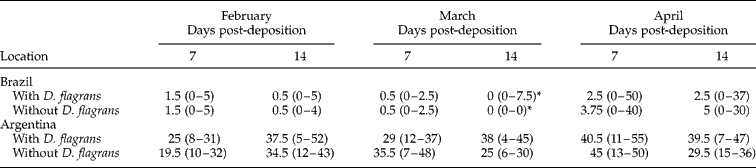
Duddingtonia flagrans was observed in all faecal samples of the supplemented group but not in the faecal samples of the non-supplemented group. No significant differences (P > 0.05) were observed between both groups in the population of soil nematodes colonizing the faeces after deposition, except in samples collected 14 days post-deposition (P= 0.02) in March (table 1).
Median numbers (with ranges in brackets) of soil nematodes/g wet faeces isolated 7 and 14 days post-deposition from faeces of sheep with/without supplemental D. flagrans in Brazil and Argentina.

Levels of significance: *, P < 0.05.
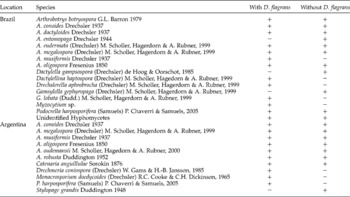
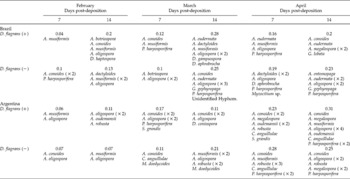
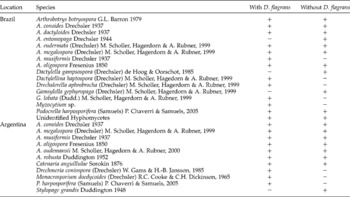
A total of 14 species of nematophagous fungi were isolated and identified from faeces of the supplemented (25 isolates) and non-supplemented (31 isolates) groups, plus one unidentified Hyphomycetes and one fungus identified up to genus level (tables 2 and 3). The diversity of the fungal species colonizing sheep faeces – excluding D. flagrans – after 7 and 14 days post-deposition, respectively, were: Simpson's diversity index: 0.8333 and 0.831, and Shannon's diversity index: 1.864 and 1.986 for the non-supplemented group; and Simpson's: 0.75 and 0.8927, and Shannon's: 1.494 and 2.313 for the supplemented group. The species richness values of the same fungal groups at day 7 and 14 post-deposition, respectively, were 7 and 9 for the non-supplemented group, and 5 and 11 for the supplemented group. No significant differences (P > 0.05) were observed between the two groups in the population of nematophagous fungi that colonized faeces after deposition (table 3).
Species of nematophagous fungi isolated from sheep faeces supplemented with/without D. flagrans in Brazil and Argentina.
Relative frequency of nematophagous fungi isolated from faecal samples in the presence or absence of D. flagrans. Each number represents the relative frequency, i.e. number of individual fungal species/total number of fungal species, of fungal isolates detected in 20 samples (Brazil) or 10 samples (Argentina) at each sampling point; ×2–×4 indicate that those individual species were found 2–4 times at the specified sample point. No significant differences (P > 0.05) were observed between groups at each location.

Hyphom. = Hyphomycetes.
Duddingtonia flagrans was isolated from soil samples only in the supplemented group in the first (30 days) and second (60 days) months post-deposition in seven and three samples, respectively.
Argentinian study
Duddingtonia flagrans was observed in all faecal samples of the supplemented group but not in the faecal samples of the non-supplemented group. No significant differences (P > 0.05) were observed between both groups, either in the population of soil nematodes that colonized faeces after faecal deposition at any stage of the study (table 1) or in the population of nematophagous fungi colonizing the faeces after deposition (table 3). Eleven species of other nematophagous fungi were isolated from sheep faeces of the supplemented (35 isolates) and the non-supplemented (28 isolates) groups (tables 2 and 3). The fungal diversity indexes for 7 and 14 days post-deposition, respectively, were Simpson's: 0.8284 and 0.8178, and Shannon's: 1.845 and 0.807 for the non-supplemented group; and Simpson's: 0.8516 and 0.8033, and Shannon's: 2.047 and 1.908 for the supplemented group. The species richness values for the same time points were 7 and 7 for the non-supplemented group, and 9 and 9 for the supplemented group.
Duddingtonia flagrans was isolated from soil samples only in the supplemented group in the first (30 days), second (60 days) and third (90 days) months post-deposition, in eight, five and one samples, respectively.
Discussion
The massive presence of D. flagrans in sheep faeces does not seem to affect the faecal colonization process by soil nematodes and other nematophagous fungi and, moreover, it does not seem to affect the survival of these organisms for long periods in the environment. According to the results of the diversity indexes used, a high diversity of nematophagous fungi would colonize sheep faeces up to 14 days in both locations, when the dominance of certain fungal species is considered (Simpson's index). This diversity, however, might be diminished when the Shannon's index is taken into account, but it should be considered that this index can be highly influenced by the most abundant species (Villareal et al., Reference Villareal, Álvarez, Córdoba, Escobar, Fagua, Gast, Mendoza, Ospina and Umaña2004).
The absence of negative effects on faecal-colonizing soil nematodes could be attributed to the massive colonization carried out by these nematodes under suitable environmental conditions, thus diluting any detrimental effects on their population by D. flagrans. The significant difference detected in March after 14 days of exposure to the environment in Brazil could be attributed to the scarcity of soil nematodes observed in both groups at this time, since rain was scarce during this experiment (data not shown) and probably led to the reduced colonization of faeces by these organisms. It is important to remark that the faeces with zero counts of soil nematodes in this sampling corresponded to the non-supplemented group and not the supplemented group, as would be expected if indeed the presence of the fungus was affecting the soil nematode population. These results on lack of impact on soil nematodes are in tune with previous studies carried out under very different geographical and climatic conditions, such as in Australia (Knox et al., Reference Knox, Josh and Anderson2002), Sweden (Yeates et al., Reference Yeates, Dimander, Waller and Höglund2002, Reference Yeates, Dimander, Waller and Höglund2003; Waller et al., 2004), New Zealand (Yeates et al., Reference Yeates, Skipp, Chen, Waghorn and Potter2007b) and France (Paraud et al., Reference Paraud, Lorrain, Pors and Chartier2012). In the latter study, although some indication of a possible negative effect was observed when the usual fungal dose was intentionally increased tenfold, neither the number nor diversity indices of soil nematodes could be related to the presence of D. flagrans.
The presence of D. flagrans in all samples of the supplemented group in both locations did not affect the natural colonization of the faeces by other nematophagous fungi, as observed in the faecal cultures set up in Petri dishes. This lack of a deleterious effect of D. flagrans observed in the two different locations studied was also reported by Knox et al. (Reference Knox, Josh and Anderson2002). The present study also shows that different species of nematophagous fungi colonize fresh faeces rapidly. This process can take as little as 3 days, as described by Hay et al. (Reference Hay, Niezen, Miller, Bateson and Robertson1997) in New Zealand and Saumell & Padilha (Reference Saumell and Padilha2000) in Brazil.
Equally important is the finding in this study that the fungus either did not persist (Brazil) or was scarcely detected (Argentina) in soil in contact with fungus-containing faeces beyond 60 days. Knox et al. (Reference Knox, Josh and Anderson2002) found that D. flagrans persisted in the soil below the point of contact with faecal depositions for 8–24 weeks, and concluded that this variation seemed to depend on the season. In the present study, both experiments were initiated in summer and lasted until winter, when the last soil samples were collected, and the results show that the fungus did not become established in the soil. The poor survival of D. flagrans in the environment recorded in both experiments could be due to the presence of fungistatic organisms living in the soil, as well as the possible gradual loss of its nematode-killing capability when the fungus is present in faeces under field conditions (Nansen et al., Reference Nansen, Larsen, Grønvold, Wolstrup, Zorn and Henriksen1995). Whichever the cause, the inability of D. flagrans to colonize the soil surrounding the faecal mass, as also proven by other researchers (Faedo et al., Reference Faedo, Larsen, Dimander, Yeates, Höglund and Waller2002; Yeates et al., Reference Yeates, Skipp, Gray, Chen and Waghorn2007a; Sanyal et al., Reference Sanyal, Sarkar, Patel, Pal and Mandal2008), is another important consideration for the purpose of biological control.
In conclusion, the massive addition of chlamydospores of D. flagrans in feed supplements for the integrated control of gastrointestinal nematodes in sheep seems to have no negative environmental consequences in relation to the natural colonization of faeces by soil nematodes and other nematophagous fungi.
Acknowledgements
The authors wish to thank Professor Peter Purslow for reading and correcting the manuscript.
Financial support
This research was supported partially by Empresa Brasileira de Pesquisa Agropecuária (EMBRAPA), Conselho Nacional de Desenvolvimento Científico e Tecnológico (CNPq), Brazil, and Fondo para la Investigación Científica y Tecnológica (FONCyT-ANPCyT), Argentina.
Conflict of interest
None.
Ethical standards
For the Brazilian study: all animal handling and maintenance was carried out following the Recommendations of Good Practices for the Welfare of Farm Animals and Animals of Economic Interest (Ministério da Agricultura, Pecuária e Abastecimento, 2008). For the Argentinian study: all animal handling and maintenance was carried out following the Animal Procedures and Management Protocols approved by the Ethics Committee according to the Animal Welfare Policy (Act 087/02) of the Facultad de Ciencias Veterinarias (2002).