INTRODUCTION
Women play a prominent role in agricultural production in Africa (Apata, Reference Apata2013). Because they are predominantly involved in the provision of labour for production, harvesting and processing stages, economic empowerment for women is vital to agricultural transformation (AfDB, 2015). This is only possible if gender inequities in markets are addressed by understanding factors such as access to assets, gender-related educational differences and how economic activities affect the ways in which men and women participate and benefit from activities in value chains (Apata, Reference Apata2013; Butterworth et al., Reference Butterworth, Abdulsalam-Saghir and Martin2008; Coles and Mitchell, Reference Coles and Mitchell2011). Improvements in processes, products and functional distribution in value chains are expected to improve chain-level outcomes to empower women and reduce household income poverty. However, the benefits of participating in agricultural value chains for women are determined by their control of productive resources and household-level decisions (Andersson, Reference Andersson2015; Apata, Reference Apata2013; Coles and Mitchell, Reference Coles and Mitchell2011).
Within agricultural value chains with higher economic values, women often perform low-skilled and low-paid work and their participation is less visible, which contributes to a widening economic gap between women and men (Royal Tropical Institute [KIT] et al., 2012). Previous studies have indicated that the highest returns are enjoyed by individuals who could access the most profitable and rewarding functions. Women also tended to earn less than men in similar roles. The lack of gender equality in participation in agricultural value chains may distract from the most important development outcomes such as nutrition and poverty issues, leading to ineffective interventions. The way in which men and women participate in value chains determines how they benefit from economic activities within the household and within the value chain itself (Coles and Mitchell, Reference Coles and Mitchell2011; McNulty and Operinde, Reference McNulty and Oparinde2015). Jeckoniah et al. (Reference Jeckoniah, Mdoe and Nombo2013) revealed that the participation of women in the marketing of onions was constrained by factors such as lack of capital, lack of marketing skills and the dominance of men in decision-making processes. Differences in human capital and productive inputs meant that female farmers achieved 20–30% lower productivity than male farmers in a cassava (Manihot esculenta) value chain in Nigeria (Ahmadu and Idisi, Reference Ahmadu and Idisi2014). Women farmers tended to have a lower output per unit of land and were less likely to be active in commercial farming than men because of gender-specific constraints (Ahmadu and Idisi, Reference Ahmadu and Idisi2014). These constraints included high rates of illiteracy among women, work and family responsibilities for women, limited access to assets and land resources, social restrictions over female mobility, limited access to training as well as to extension services and lack of access to market information.
Women were more likely to manage their own work and income when capital barriers to entry were lower and where physical product transformation involved simple and relatively low-cost equipment (Apata, Reference Apata2013; Coles and Mitchell, Reference Coles and Mitchell2011). In Tanzania, the barriers to entry in the value chain processes result in a sharp contrast between the income-generating and livelihood opportunities of women and men across different agricultural sectors because of gender differences ranging from access, control and ownership of land to marketing of raw and processed produce (CARE, 2010). Despite constitutional proclamations of gender equality and laws that promote equal opportunities for both men and women in Tanzania, men and women carry out different types of farm work with different levels of access to resources. Consequently, they receive unequal rewards for their contributions to the agricultural system, with women typically having less access and lower incomes (Apata, Reference Apata2013; CARE, 2010). This finding is similar to observations in Nigeria by Butterworth et al. (Reference Butterworth, Abdulsalam-Saghir and Martin2008), who stated that because of social and cultural factors, women continue to occupy a subordinate position in society. There is little information available on women's participation in traditional food value chains, specifically regarding the cassava value chain, which is of relatively low value. Most studies on gender and agriculture value chains have focused on market participation (Adjimoti, Reference Adjimoti2015) and on value chains for high value products which generate income such as onions (Jeckoniah et al., Reference Jeckoniah, Mdoe and Nombo2013), coffee (Kasente, Reference Kasente2006), and avocados (Oduol and Mithöfer, Reference Oduol and Mithöfer2014), while food value chains of low economic value such as cassava have been neglected. The emphasis of contemporary food security policy on staple food crop production and processing have placed cassava as a strategic food crop hence the need to address gender inequality within its value chain. Some studies, including those by Siziba and Bulte (Reference Siziba and Bulte2012), Jagwe et al. (Reference Jagwe, Machethe and Ouma2010) and Omiti et al. (Reference Omiti, Otieno, Nyanamba and McCullough2009), have focussed on market participation, without considering the influence of gender on participation in agricultural low value chains. There is little information available regarding the influence of gender on resource ownership and benefit sharing in traditional agricultural value chains of low economic importance, including cassava, at the household and community levels. Of the few studies that have considered gender in their cassava value chain analysis such as Andersson (Reference Andersson2015), none have investigated how gender roles shape and are in turn influenced by how the cassava value chain functions at the household level or how gender roles are influenced by various socio-economic characteristics of household heads, which are the focus of this study.
The Kigoma region of Tanzania has the potential for expanded cassava production, with the product being sold locally and to other cassava-consuming countries such as Burundi and the Democratic Republic of Congo. This study examined gender participation in the cassava value chain in this region to understand how men and women benefit from value chain processes and the underlying factors that influence their participation. Specifically, we assessed the socio-economic characteristics of household heads participating in the cassava value chain and investigated the gender relationships between participation and access to resources (land, credits, extension services and markets), control over resources (land, house and household assets) and benefits (revenue) generated from cassava value chains. The study tested two main hypotheses. The first hypothesis was that the higher socio-economic characteristics of male household heads had a positive influence on their increased participation in the cassava value chain relative to women (Apata, Reference Apata2013; Emerole et al., Reference Emerole, Nwachukwu, Anyiro, Ebong and Osundu2014). The second hypothesis was that access to resources (land, credits, extension services and markets) and control over resources (land, house and household assets) and benefits (revenue) generated from cassava value chains positively influenced women household heads to participate in the cassava value chain (Ahmadu and Idisi, Reference Ahmadu and Idisi2014; Emerole et al., Reference Emerole, Nwachukwu, Anyiro, Ebong and Osundu2014; Waziri, Reference Waziri2013).
MATERIALS AND METHODS
Study area location
The study was carried out in four districts of the Kigoma region of Tanzania. The region was purposefully selected because it is already one of the largest cassava-producing regions in Tanzania (Kapinga et al., Reference Kapinga, Ewell, Jeremiah and Kileo1995) and also has potential for the expansion of cassava production. The major economic activity in the study area is agriculture, mainly crop production with some livestock keeping activities and off-farm business ventures that generate household income. The Kigoma region is one of the poorest regions in Tanzania, located on the shores of Lake Tanganyika in northwest Tanzania. It is situated between 29.5° and 31.5° E and 3.5° and 6.5° S. It shares boundaries with Burundi and the Kagera region to the north, Shinyanga and Tabora regions to the east, Democratic Republic of Congo to the west and the Rukwa region to the south. The entire region has an area of 45 066 km2 or 4.8% of the total area of Tanzania. Of the 45 066 km2, 17.8% is covered by water, 45.2% is covered by natural forests, while 27.1% is land for grazing and crop production. The economy of the Kigoma region is primarily based on agriculture. About 90% of the region's population is engaged in subsistence agriculture farming with some other activities such as fishing, beekeeping and timber. The main staple crop is maize, followed by cassava. Other crops include beans, bananas, sugar cane and oil palm. Sorghum/millet, tobacco and coffee are grown in some parts of the region depending on the agro-ecological conditions. Although the region has about 1 200 000 ha of potentially cultivable land, only 280 000 ha (23.3%) is under cultivation. Cassava production is labour intensive, entailing a variety of activities such as land clearing, and tillage, planting, weeding, harvesting and processing. In Tanzania, about 80% of land preparation for cultivating cassava is done by the men within a household. Planting and weeding are done jointly by women, men and by children.
Research design, sampling and data collection
The study employed a cross-sectional research design. Cross-sectional design enables researchers to address the study objectives while saving time during the data collection process (Kothari, Reference Kothari2004). The sampling frame was the cassava producing farmers in the Kigoma region. A multi-stage sampling method was used to select two villages from each of the Uvinza, Kasulu, Buhigwe and Kibondo districts. This sampling technique was applied by Komen et al. (Reference Komen, Mutoko, Wanyama, Rono and Mose2006) in a survey carried out on maize in the Trans Nzoia and Uasin Gishu districts of North West Kenya, and also in a study conducted in the semi-arid parts of Eastern (Machakos and Mwingi districts) and Central Kenya (Kirinyaga district). From each village, cassava farmers, traders and key informants were randomly selected. Structured questionnaires with both closed and open-ended questions, group discussions and direct observations were employed for collecting primary data.
Simple random sampling was used to select a total of 384 households from a population of 850 farmers for structured interviews, 93 traders and key informants were interviewed. Agriculture extension officers in the respective study sites were recruited and trained to administer the structured questionnaires during face-to-face interviews. The respondents were required to first sign the consent form and agree to be interviewed. Participants for the focus group discussions (FGDs) were selected based on their experience and engagement in cassava production. The focus groups included both men and women and on average they had about 8–10 participants. Key informants were selected from each village for their knowledge of the research topic and interviewed face-to-face. These key informants included village leaders, agricultural extension officers, traders, agro dealers and local council administrative personnel. Guiding open-ended questions were drafted but the respondents could bring out other important relevant discussion points without being limited by the guiding questions. The key variables included the farmers’ household characteristics, household sources of income and quantitative and qualitative losses experienced by cassava farmers from production to marketing of the crop and its products. These data were collected as part of a larger project focussed on cassava as a strategic food crop and applying a gendered approach in Tanzania.
Questions were also asked about the participation of men and women in the cassava value chain in the region. The key variables were the participation of household heads (disaggregated by age group) in cassava value chain stages and data on cassava production, processing, marketing, access to market and control over resources and production-related equipment. FGDs in this study were also used to interview respondents since these are one of the most common methods of data collection used in qualitative socio-economic research to explore the views, experiences, beliefs and motivations of individual participants using group dynamics to generate qualitative data. An FGD was done in each village with both men and women in each discussion group. A total of four FGDs were done in the Kigoma region. A checklist was used to guide FGDs, and an experienced FGD moderator (agricultural extension officer) was engaged to facilitate the discussion.
Data analysis
Data processing involved coding, data entry and analysis using the SPSS programme version 16.0. Descriptive statistics were generated as frequencies and means for socio-economic and demographic data. The chi-square test was used to determine the significance of relationships between the variables of interest at 5% significance level.
 $$\begin{equation}
{\rm{Chi - square}}\;({\chi ^2}) = \sum {{{({O_i} - {E_i})}^2}/{E_i}}
\end{equation}$$
where Oi is the observed frequency of the variables, Ei is the expected frequency of the variables, χ 2 is the chi-square statistic and n is the number of observations.
RESULTS AND DISCUSSION
Socio-economic characteristics of household heads participating in the cassava value chain
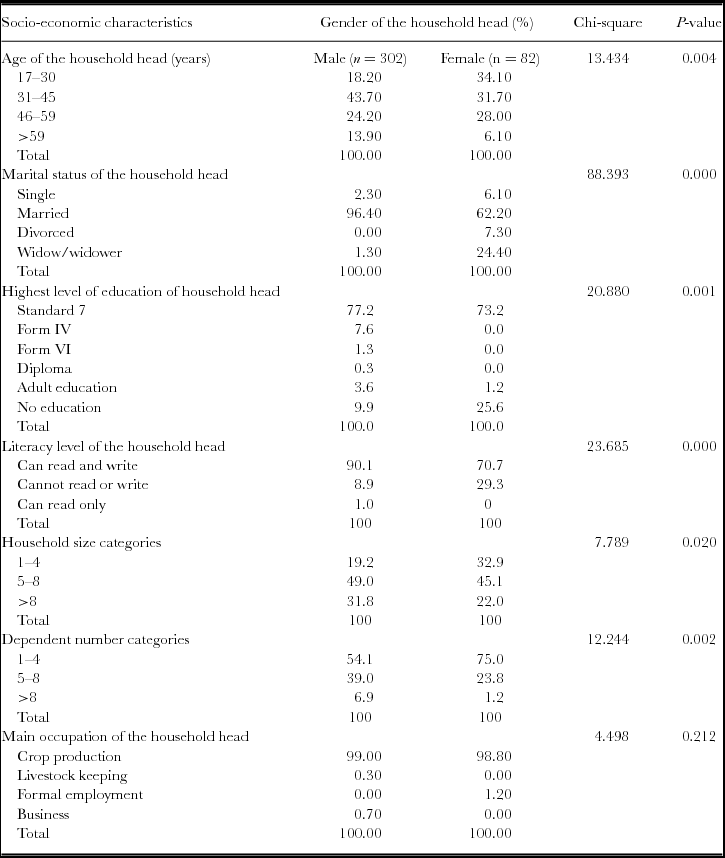
The findings were based on 302 male and 82 female household heads. Most female household heads were aged 17–30 years (34.1%) and 31–45 years (31.7%). Of the 302 male household heads, the majority (43.7%) were aged 31–45 years. There were few men (13.9%) or women (6.1%) over 59 years in charge of households. This implies that most of the farmers who engaged in cassava production were energetic individuals who had the ability to carry out the various farm operations required in the field (Table 1). This finding is similar to that of Waziri (Reference Waziri2013) in a study on cassava and potato value chains in which the majority (63.2%) of the respondents involved in the cassava value chain were aged 21–30 years. According to a study by CARE (2010) on women and agriculture in Tanzania, the majority (60%) of women in the two regions were aged 15–35 years, whereas most (55.3%) men were aged 36–55 years. Furthermore, people aged 15–55 were the economically active age group (CARE, 2010). Our study concurred with the findings of Coulibaly et al. (Reference Coulibaly, Arinloye, Faye and Abdoulaye2014) and the Foundation for Partnership Initiatives in the Niger Delta (PIND) (2011) that the cassava value chain is dominated by men. However, the findings by Waziri (Reference Waziri2013) on gender differ from this study's findings in that there were more women (64.7%) than men who participated in the cassava value chain. Similarly, the study by Emerole et al. (Reference Emerole, Nwachukwu, Anyiro, Ebong and Osundu2014) on cassava entrepreneurship and gender participation revealed that there were more (51%) women than men participating in cassava entrepreneurship activities.
Socio-economic characteristics of the household head by gender.

The key informant interviews revealed that the reasons for having female household heads in a predominantly patriarchal society included divorce, becoming widowed or losing one's parents and having very young male children in the family. The chi-square test results indicated that although both categories had many individuals in the age categories below 45 years, women and men who participated in cassava value chain processes differed significantly by age (χ 2 = 13.434; P = 0.004). Cassava production as an income-generating activity attracted both men and women, and even teenagers below the age of 17 voluntarily engaged in cassava production because of the potential to earn income for their household.
Most male (96.4%) and female (62.2%) household heads were married. However, over 30% of female household heads were widowed or divorced, although only (1.3%) of men were widowers (Table 1). These results agree with the findings of Emerole et al. (Reference Emerole, Nwachukwu, Anyiro, Ebong and Osundu2014) that 90 and 80% of the respective female and male household heads participating in the cassava value chain were married. However, the chi-square test results revealed that marital status was significantly related to gender (P < 0.05). Having a spouse was important for men because it reduced the work load of many cassava value chain processes such as peeling, washing and drying, which are labour intensive (CARE, 2010; Emerole et al., Reference Emerole, Nwachukwu, Anyiro, Ebong and Osundu2014). In addition, marriage in the study area signifies that an individual has a responsibility to his or her household and thus requires additional income to support the family. This finding is in agreement with the contention of Emerole et al. (Reference Emerole, Nwachukwu, Anyiro, Ebong and Osundu2014) that ‘Majority of cassava entrepreneurs being married suggest that, activities involved in the enterprise on one side requires support of household labour and on the other side, the enterprise generates attractive returns enough to help households cushion effects of food and financial insecurity associated with married life’. This finding is also similar to that of Waziri (Reference Waziri2013), who reported that 82.4% of the household heads participating in cassava and potato value chain were married.
Most participants (77.2% of male and 73.2% of female household heads) had attained the primary level of education (standard seven) (Table 1). However, 25.6% of women had no formal schooling compared with 9.9% of the male household heads, and nearly 30% of female household heads were illiterate compared with 9% of men. This indicated that any planned intervention in the study area that involved written advice on technical innovation would be of little benefit to a quarter of the female household heads who were active in the crop value chain process. This difference was supported by the chi-square test results that showed education level was significantly related to the gender of an individual household head (p = 0.001). Similarly, there was a statistically significant relationship between gender and the household head's level of literacy (P = 0.000). This finding agrees with Ahmadu and Idisi (Reference Ahmadu and Idisi2014) where it was found that education level and participation in the value chain were significant factors. While Waziri (Reference Waziri2013) reported higher illiteracy (42.1%) among the male household heads than the females, CARE (2010) reported the opposite which is similar to the findings of this study.
More female household heads were part of small households (1–4 members) compared with male household heads (32.9 and 19.2%, respectively). The percentage was similar for households of between of 5–8 members, with 49% of men versus 45.1% of women heading households in this category. There were much higher numbers of female household heads with 1–4 dependants (75%) compared with 54.1% of male household heads in this category. However, there were more (39%) male household heads than the female (23.8%) household heads with 5–8 dependants. These findings revealed that there were significant gender differences in relation to household size and number of dependants (P < 0.05) implying that male-headed households had more dependants than female-headed households above the average of 1–4 household members, which could lead to higher burdens to provide food, shelter and health services.
This study revealed that no significant relationships existed between gender and the household head's major occupation (χ 2 = 4.498; P < 0.212). Table 1 shows that crop production was the major occupation for both women and men (99% of men and 98.8% of women, respectively). No women were involved in a business other than crop production. Cassava production was found to be the major means for female household heads to generate the income required to sustain their households (Mtambo, Reference Mtambo2007). This is similar to the findings of Apata (Reference Apata2013), Emerole et al. (Reference Emerole, Nwachukwu, Anyiro, Ebong and Osundu2014) and Ahmadu and Idisi (Reference Ahmadu and Idisi2014) that cassava is an important crop that the rural farming community depends upon and that it requires minimal capital investment to produce – thus, cassava can be termed a ‘poor person's crop’.
Relationships between gender and access to and control over resources and benefits generated from cassava value chains
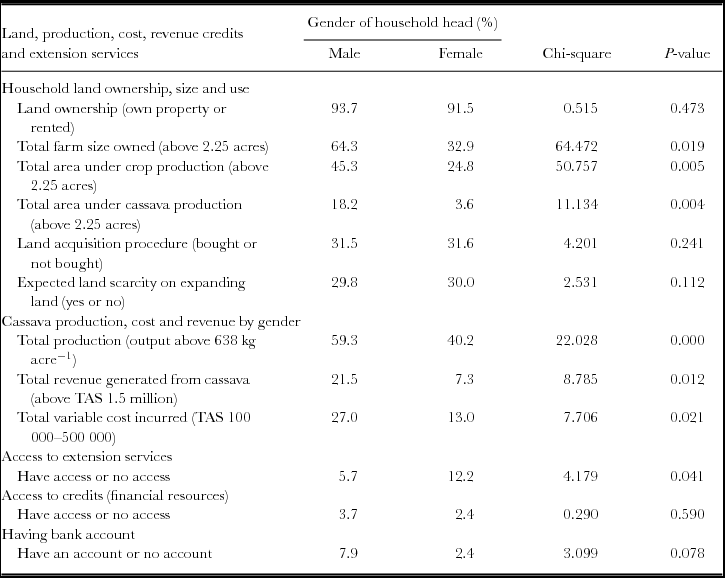
Gender difference is a significant attribute in agriculture from access, control and ownership of land to marketing of raw and processed produce because on both smallholder farms and large plantations, men and women carry out different types of work, have different levels of access to resources, and are unequally rewarded for their contributions to the agricultural system, with women typically having less access and lower incomes than men (CARE, 2010; PIND, 2011). In this study, it was hypothesised that there is a significant association between access to and control over production resources according to the gender of those involved in the cassava value chain in Kigoma. The chi-square test supported this showing a significant association between household heads’ gender and access to and control over production resources (Table 2).
Access and control over production resources and benefits by gender of household head.

Gendered participation in access to resources (land, credits and extension services)
Although access to land ownership showed no significant differences between men and women, there were significant differences regarding the total area of cropland owned, the area cultivated for general crop production and the area under cassava production by gender. Over 45% of male household heads owned farms of more than 2.25 acres while only 24.8% of female household heads owned the same amount of land. Similarly, very few (3.6%) women were able to cultivate more than 2.25 acres of cassava compared with 18.2% of men. This suggests that there were production and revenue differences between men and women participating in the cassava value chain in the study area. This result can also be attributed to the effect of household size and the availability of labour. Similar variations among genders were found for the revenue generated from cassava sales, in which 21.5% of male household heads had generated more than 1.5 million Tanzanian shillings (TAS; equivalent to US$694.44, based on the exchange rate of US$1 = TAS 2160) versus only 7.3% of female household heads in this income category. This shows that the genders differed significantly in access to resources and control over the benefits generated along the cassava value chain. This is because many women, especially those who are poorer, less educated and living in rural areas are often unaware of their rights (Haddad and Hoddinot, Reference Haddad and Hoddinot1994). The current findings indicated that land is owned mainly by the male members of the family. The overriding factors for this are the cultural practices and customary laws, which are responsible for the subordination of women in social, political and economic life (CARE, 2010; KIT et al., 2012). In relation to gender equality, cultural norms are still the primary influence on daily life, even though Tanzania has adopted many conventions and passed gender positive legislation. Thus, women's access to land and productive resources are restricted by custom, and implementation of women's rights under the land laws is often difficult at local levels (CARE, 2010).
There were significant differences between gender and costs incurred along the cassava value chain. About 27% of men incurred costs of between TAS 100 000 and 500 000, while only 13% of women incurred the same amount of costs for the same level of output (Table 2). This implies that most of the women depended on family labour with little or no expenditure on hired labour compared with male household heads (CARE, 2010; Emerole et al., Reference Emerole, Nwachukwu, Anyiro, Ebong and Osundu2014). Another significant association among the gender categories and access as well as use of extension services was observed (P = 0.04). Only 5.7% of male household heads accessed the services versus 12.2% of female household heads. Although absolute figures of men and women were relatively low, this finding suggests that more women were interested in services and information on better production and marketing methods. CARE (2010), Apata (Reference Apata2013), Emerole et al. (Reference Emerole, Nwachukwu, Anyiro, Ebong and Osundu2014) and Coulibaly et al. (Reference Coulibaly, Arinloye, Faye and Abdoulaye2014) also found that access to markets and control over resources were associated with gender. Our findings could be used to select individual household heads to be considered in cassava value chain development and for upgrading intervention programmes applied in the study area by development agencies. In addition, there were no significant associations in access to credit and holding a bank account among the genders participating in the cassava value chain processes. This implies that both men and women find it hard to access credit because many financial institutions and lenders believe that crop production is a high-risk undertaking and are reluctant to provide credit for agricultural production. Findings revealed that only 3.7 and 2.4% of respective female and male household heads had access to credit and only 7.9% of the male household heads and 2.4% of the female household heads had bank accounts, suggesting that households participating in the cassava value chain were not able to save the income they generated from crop sales (CARE, 2010; Coulibaly et al., Reference Coulibaly, Arinloye, Faye and Abdoulaye2014; Emerole et al., Reference Emerole, Nwachukwu, Anyiro, Ebong and Osundu2014). This indicates that producers live a hand-to-mouth or subsistence lifestyle, although some may not be aware of the importance of saving income in the bank.
Household participation through access to cassava markets and price information by gender
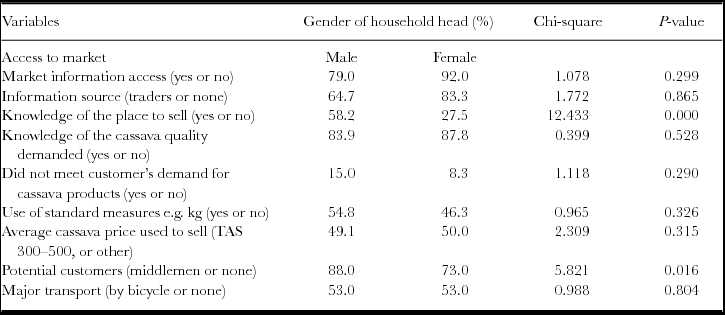
This study revealed that 83.9 and 87.8% of men and women, respectively, knew about the quality of cassava that their customer wanted (Table 3). Although both women and men had knowledge of product quality required by customers, there were significant differences in access to market information. This could have arisen from the increased prevalence of market information barriers for women than for men owing to cultural mobility barriers, as it is less acceptable in rural Tanzania for women to travel far from the home (CARE, 2010; KIT et al., 2012). The study also revealed significant differences between gender categories among the study sites. Market information access by gender showed significant differences between men and women; that is, 58.2% of male household heads knew where to sell cassava while only 27.5% of the female household heads knew where to sell cassava. This implies that most women tend to sell their agricultural produce at the farm gate due to cultural mobility barriers imposed by men, often resulting in lower prices for cassava sold by women than men. Thus, women generate less revenue from cassava sales (CARE, 2010; KIT et al., 2012). Moreover, the findings revealed that there were significant differences in the type of customers to whom the farmers sold according to the seller's gender. More men (88%) sold cassava to traders or middle men, who are major customers, than did women (73%). Both women and men were equally constrained with regard to the major means of transport.
Market access along the value chain by gender of household head.

Household participation relating to cassava tuber flesh losses along the value chain stages by gender
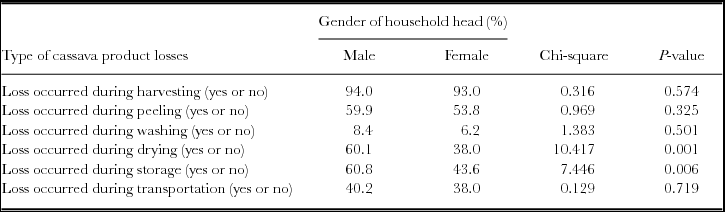
Study findings revealed that there was a significant relationship between gender and the amount of cassava tuber flesh losses experienced at various value chain process stages (Table 4). Losses occurring during drying were reported by 60.1% of the male respondents but only by 38% of the female respondents (Table 4). Likewise, 60.8% of male household heads claimed to have experienced cassava losses during storage, while only 43.6% of the female household heads reported cassava losses during this process. This might be because men are mostly involved in the storage and drying processes of cassava than women; hence, a greater proportion of men reported cassava losses in these phases of the value chain. However, it may also mean that women are more careful to minimise losses in these stages (CARE, 2010).
Cassava losses experienced along the value chain process by gender of household head.

Access to and control of household assets in the cassava value chain
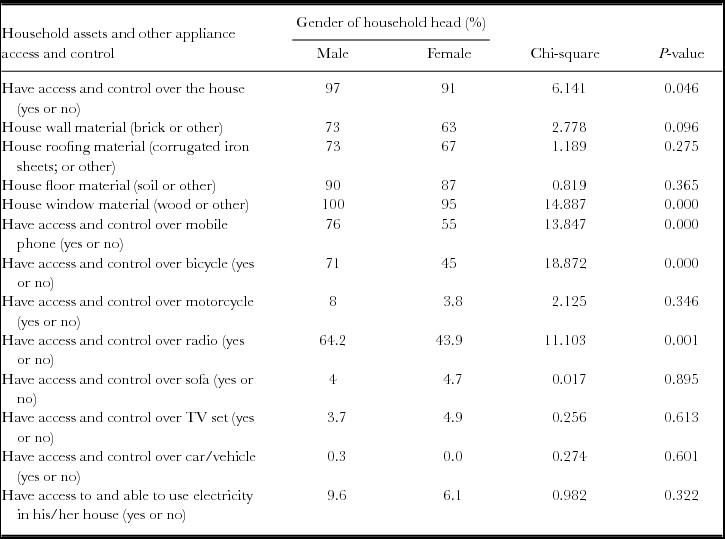
There were significant relationships between gender and access to/control over the house and household assets within the households participating in the cassava value chain (Table 5). This was observed in regard to questions on house ownership, to which 97% of the male household heads reported they owned houses versus 91% of the female household heads. All the male household heads had houses with wooden windows versus 95% of the female household heads, suggesting that the houses of male-headed households tended to be of higher quality than those of the female-headed households. This supports the existence of income disparity among genders (see Apata, Reference Apata2013; Cole and Mitchell, Reference Coles and Mitchell2011). Female- and male-headed households showed statistically significant relationships with the ownership of household assets (Table 5). For example, access to and control over a mobile phone, bicycle or radio was higher for male household heads (76, 71 and 64.2%, respectively) than for female household heads (55, 45 and 43.9%, respectively). This implies that women were at a disadvantage in terms of access to information owing to limited possession of communication devices such as radios and mobile phones and also that many lacked access to the most common form of transport within the study area (the bicycle). KIT et al. (2012) suggested that this lack of mobility may help account for women's lower participation in searching for new markets and customers. We found that other variables related to higher standards of living, such as access to motorcycles, cars, refrigerators and electricity were limited for all the households interviewed in the Kigoma region, regardless of gender.
Access to and control of assets in the cassava value chain by gender of household head.

Recommendations
Because there were significant relationships between socio-economic characteristics and the gender of the household heads, this study recommends that any intervention in the study area to improve the equitableness of the cassava value chain benefits should consider gender differences among cassava producers and actors along the value chain. Failure to consider gender issues will result in further disparities in terms of the expected and real economic and social benefits from the value chain. Thus, central and local governments and any other development stakeholders must ensure that both women and men are involved and considered in any project undertaking. Considering the high illiteracy rates among female household heads, we recommend that specific efforts should be made by the government to ensure that this figure is reduced within the study area by establishing adult learning platforms for those who did not attend formal education institutions. Such changes, combined with other important aspects, such as land availability, will increase participants’ ability to comprehend information on technical innovations with regard to cassava production in particular and will result in increased production and household incomes. Educating women has been shown to contribute to the education of the whole family and the nation at large. Accelerating action towards female education to help Tanzania reach the related Sustainable Development Goals so that girls and women can actively and knowledgeably interact in the global community can make an important contribution to short- and long-term outcomes for the girls/women, families and the broader society. Thus, the benefits of providing girls/women with education extend beyond personal welfare and development and well beyond their childhood.
We found that gender was significantly related to access to resources (land, credits, extension services and markets) and control over resources (land, house and household assets) and benefits (revenue) generated from cassava value chains, and, in many respects, women lagged behind men. These findings also buttressed the hypothesis that access to resources and control over resources and benefits positively influence female household heads to participate in cassava value chains. Thus, we recommend that deliberate efforts should be made through legal reforms of the patriarchal system regarding land ownership, marriage laws and agricultural policy to remove gender barriers to increase women's participation in and benefit from income generation. Such changes could be enabled through increased awareness, provision of input subsidies to farmers, provision of credit at low interest rates, formation of propagation-inclusive farmer groups, linking producers to markets and providing information on where to sell products and on customers’ quality requirements.
Cassava farmers need to be encouraged to open and use saving accounts so that banks may be persuaded to advance them credit for buying inputs and paying for hired labour in crop production.
CONCLUSIONS
We found some significant differences between men and women that may affect the ability of women to participate equally in all aspects of the cassava value chain. This result supported our hypothesis that men's greater socio-economic privileges positively influenced their higher participation in the cassava value chain relative to women. One major factor in this discrepancy was the high proportion of single female household heads, mainly through divorce or from being widowed. Although women tended to have smaller numbers of dependents, single parents are likely to have many additional responsibilities that would affect the time available for cassava production and marketing. Women were also less likely to have finished primary education, and their literacy levels were lower than those of male household heads. This lack of education most likely affects the ability of women to improve productivity and to research new markets and higher value cassava products that may be in demand. Women also tended to have smaller plots of land and produce less cassava per acre than the men in our study, which meant the women received a smaller amount of income overall. In addition, we found that women may be more interested in learning how to improve their production methods through access to extension services and that they spent less money on cassava production and took more care to limit losses during processing and storage. These findings suggest that if the right programmes are made available to educate women in aspects of more efficient production methods and alternative markets and end-products, female household heads would be eager to participate and increase the amount of income they receive along the cassava value chain.
COMPLIANCE WITH ETHICAL STANDARDS
All procedures performed in studies involving human participants were in accordance with the ethical standards of the institutional and/or national research committee and with the 1964 Helsinki declaration and its later amendments or comparable ethical standards.
INFORMED CONSENT
Informed consent was obtained from all individual participants included in the study.