Reading involves the decoding of language forms from written forms. Reading research has made great progress during the past decade thanks to theoretical debates contrasting the parallel distributed processing (Plaut, McClelland, Seidenberg, & Patterson, Reference Plaut, McClelland, Seidenberg and Patterson1996) and dual route (Coltheart, Rastle, Perry, Langdon, & Ziegler, Reference Coltheart, Rastle, Perry, Langdon and Ziegler2001) models of reading. However, all of these models are predominantly concerned with the reading of monosyllabic words, whereas orthographies convey not only phonological but also morphological information. An important question is thus what role morphological representations play in the processes of reading and learning to read. Morphological information includes word roots, syntactic inflections, and derivational affixes. The extent to which and just how morphological information is processed during the reading of polysyllabic words is far from clear. From a theoretical point of view, morphological effects in visual word recognition can be explained as the convergence of codes (cf. Plaut & Gonnerman, Reference Plaut and Gonnerman2000; Seidenberg & Gonnerman, Reference Seidenberg and Gonnerman2000). From such a perspective, morphology can be viewed as a graded, interlevel representation that develops during the course of lexical development. Morphology thus involves the encoding of regularities within and between orthographic and phonological codes in addition to information from the context. Morphology can be given a statistical interpretation reflecting the regularities in the mappings between orthographic and phonological units on the one hand and meaning on the other hand. Thus, morphology is no different than the other levels of linguistic representation.
In line with dual route accounts, it can be assumed that there are two processing routes involved in the reading of complex words (see Bertram, Baayen, & Schreuder, Reference Bertram, Baayen and Schreuder2000). One route processes the full word form and the other route decomposes it in constituent morphemes. Full word frequency effects in lexical decision would point to processing of the former route and morphemic frequency effects to the latter. It can be assumed that high-frequency complex words will be processed as full forms whereas low-frequency ones will be decomposed. Alternatively, it can be hypothesized that the two routes run in parallel and that both full form frequency and morpheme frequency account for the identification of complex words (Schreuder & Baayen, Reference Schreuder and Baayen1997; Verhoeven, Schreuder, & Baayen, Reference Verhoeven, Schreuder and Baayen2006). In such parallel cascaded dual route model it is presupposed that after a first step of orthographic analysis frequently encountered word forms are processed via the direct route while infrequent word forms are processed via the parsing route, which is construed as a backup route. It is then assumed that via the direct route, a full-form representation is accessed and mapped onto its associated lemma node, which then activates the relevant representations from the semantic system. In a parallel parsing route, the representations of morphological units (i.e., stem and plural ending) can be activated through a process of segmentation. The meaning of the complex word can then be computed from the meanings of its constituents so that a lexical decision can be made. Effects of both root morpheme and whole-word frequency in lexical decision have been used to provide insight into the representation and processing of morphologically complex words in normal readers (see Ford, Marslen-Wilson, & Davis, Reference Ford, Marslen–Wilson, Davis, Baayen and Schreuder2003) and dyslexic readers (Rastle, Tyler, & Marslen-Wilson, Reference Rastle, Tyler and Marslen-Wilson2006).
From a computational point of view, morphological processing can be characterized as a word experience model that accounts for morpheme frequency effects (cf. Reichle & Perfetti, Reference Reichle and Perfetti2003). It is assumed that word knowledge accumulates with experiences with individual word forms. The frequency of word forms is seen as an index of how well a word is established in a reader's mental lexicon. The more often words are experienced, the more familiar they will be to the reader. It is also assumed that the capacity to decode the word and decide whether it has a meaning depends on the ability to use a given orthographic form as a cue to retrieve its pronunciation and its meaning. It can be hypothesized that certain orthographic patterns may function as morphological units and facilitate the process of word identification. By means of a series of simulations, Reichle and Perfetti were able to model frequency and consistency effects in the reading of morphologically complex words.
In the research on reading complex words conducted so far, a developmental perspective is generally lacking. A prominent incremental acquisition model of reading and word recognition is Perfetti's restrictive–interactive model (Perfetti, Reference Perfetti, Gough, Ehri and Treiman1992, Reference Perfetti, Reitsma and Verhoeven1998) in which the reader's ability to correctly identify a word is assumed to depend on the quality of the underlying representation, which is characterized in terms of precision and redundancy. Phonological recoding is seen as a self-teaching device (cf. Share, Reference Share1995) which provides children with feedback for each attempt they make to phonologically decode words, thus incrementally building up the orthographic representation of specific words. The more frequent a word has been encountered the more precise and redundant its representation will be. For phonological recoding to be successful, children need to uncover shared units in the orthography and phonology of their language in order to be able to develop sublexical strategies at larger grain sizes, such as rimes, syllables, and morphemes (cf. Duncan & Seymour, Reference Duncan and Seymour2003; Verhoeven & Perfetti, Reference Verhoeven and Perfetti2003). The quality of orthographic representations thus relates directly to the number and strength of the connections between graphemes and phonemes, or subword units as morphemes when it comes to the reading of more complex words (cf. Ziegler & Goswami, Reference Ziegler and Goswami2005). It can be predicted that developing readers have stored less word-specific representations simply due to limited experience with words in written text. Moreover, it can be assumed that because of phonological deficits it will be hard for dyslexic children to build up fully specified lexical representations that may prevent them to profit from the frequency of both full words and constituent morphemes (Ramus, Reference Ramus2003). However, the extent to which and just how the identification of morphological constituents may influence the identification of complex words in the course of normal and deviant reading development remains unclear.
In the present study, the role of singular root frequency in reading plural word forms in Dutch is examined. Given that the Dutch language is highly transparent, the impact of various analogy mechanisms on the reading of words can provide considerable insight (see Verhoeven & van Leeuwe, Reference Verhoeven and van Leeuwe2009). The conversion rules for Dutch orthography apply to phonemes and thus have morphemes as their main domain. Dutch phoneme to grapheme conversion rules apply to morphemes but are based on the phonological context. The conversion rules are fairly consistent. The spelling of plural word forms provides a case in point. The productive and most frequently used plural morpheme for nouns is the suffix -en to be added after the singular noun stem. An example is given in (1).

Word frequency is generally modeled in terms of the resting activation level of a word's access representation. There is general consensus that frequency-sensitive access representations are crucially involved in the recognition of words (cf. Andrews, Reference Andrews1989; McCann & Besner, Reference McCann and Besner1987). Thus, it can be expected that the reading of the plural word form will be facilitated by its frequency in written language. However, a more intriguing question is to what extent the frequency of the singular root form will also have an impact on the identification of the plural word form. If this is the case, it can be concluded that besides the full form access a parsing route would also apply to the identification of the plural word form.
In the present study, a developmental perspective will be taken by contrasting Dutch word identification data from both adult readers and children learning to read. We start out with a study on adult readers in order to examine the role of root frequency effects in the reading of plural word forms of varying surface frequency.
EXPERIMENT 1: ROLE OF ROOT FREQUENCY IN READING PLURAL WORDS IN ADULT READERS
In this experiment, we want to find out to what extent plural word form and root form frequencies show an effect in the reading of plural word forms of experienced readers of Dutch.
Method
Participants. Twenty-two adult participants, mostly undergraduates at Radboud University Nijmegen, were paid to take part in the experiment. All participants were native speaker of Dutch.
Materials and procedure. On the basis of frequency counts from the CELEX database (Baayen, Piepenbrock, & van Rijn, Reference Baayen, Piepenbrock and van Rijn1993), four sets of 20 bisyllabic plural nouns were selected: one set with words with relatively high plural word form frequencies and singular root from frequencies (in both cases log frequency > 5), for example, plank–planken (“plank–planks”); one set with words with relatively high plural word form frequencies (log frequency > 5) and relatively low root form frequencies (log frequency < 5), for example, kers–kersen (“cherry–cherries”); one set with words with relatively low plural word form frequencies (log frequency < 5) and relatively high root form frequencies (log frequency > 5), for exampkle, start–staarten (“tail–tails”); and one set with words with relatively low plural word form frequencies and singular root from frequencies (in both cases log frequency < 5), for example, klont–klonten (“lump-lumps”). For all nouns the plural consisted of the orthographic form of the singular with the plural marker -en added. No other orthographic changes due to plural formation were involved. All noun stems being selected are unambiguously concrete nouns. Nouns that can be derived from verbs without overt affixation were left out. All of the stimulus words were used within the context of primary education (Schaerlaekens, Kohnstamm, & Lejaegere, Reference Schaerlaekens, Kohnstamm and Lejaegere1999; Staphorsius, Krom, & Geus, Reference Staphorsius, Krom and Geus1988).
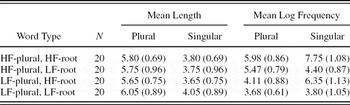
The frequencies of the root and plural forms of the stimulus words were the sum of the frequencies of occurrence in a corpus of 42 million written word tokens. In order to control for frequency of occurrence of letter units in these words, all items in the four sets (both root forms and plurals) were also matched with respect to frequency of constituent bigrams (groups of two letters in the word). In Table 1, the means and standard deviations of the log frequency counts and word lengths for the four sets of stimulus words are presented. For plural and root forms, an analysis of variance showed the differences in word length to be not significant. The difference between the log frequency counts of high- versus low-frequency plural forms was significant, however, t (78) = 10.19, p < .001. The same was true for the differences between high- versus low-frequency root forms within the set of high-frequency plurals, t (38) = 10.76, p < .001, and within the set of low-frequency plurals, t (38) = 7.36, p < .001.
Numbers of items, mean length, and mean logarithm of frequencies of plural and singular root forms as a function of word type

Note: HF, high frequency; LF, low frequency.
The total number of stimuli consisted of 80 plural word forms. For each of the test items, a pseudoword was derived by changing two letters in the root forms of the stimulus words. This resulted in an additional set of 80 items. All pseudowords consisted of orthographically and phonotactically legal letter strings. The pseudowords in the lists were compared with regard to their bigram frequencies, which were found to be highly similar across the lists with no exceptional bigram sequences occurring within the lists. Finally, 20 practice items (10 words, 10 pseudowords) were selected to precede the test materials.
Participants were tested in individual noise-proof experimentation booths. They received a standard lexical decision instruction with 20 practice items, specifying that they had to decide as quickly and as accurately as possible whether a presented letter string was a Dutch word or not. If the string was a word, they had to press the right key; if the string was not a word, they had to press the left key. For left-handed participants, the order of the response buttons was reversed. An asterisk was presented in the middle of the screen as a fixation mark for each trial. Stimuli were presented on Nec Multisync color monitors in white letters (76 point Courier New Bold) on a dark background. After 500 ms it was followed by the stimulus centered at the same position with a maximum duration time of 2 s. The total duration of the experimental session was approximately 15 min.
For each participant, proportion correct scores and mean latencies were computed to assess the relative facility with which words with varying plural word form and singular root frequencies are retrieved. In addition, general linear model (GLM) analyses were conducted to establish effects for plural word form frequency (high vs. low) and singular root frequency (high vs. low) and their interactions.
Results
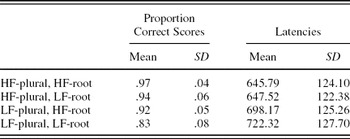
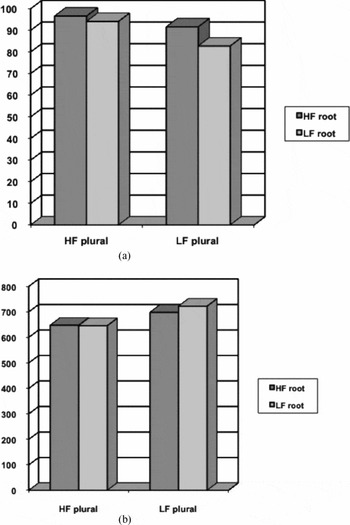
Table 2 and Figure 1 provide the proportion correct scores and mean reaction times for the different test conditions.
Mean proportion correct scores and latencies of plurals as a function of word form and root frequency in adults

Note: HF, high frequency; LF, low frequency.
(a) Mean proportion correct scores and (b) mean latencies of word form and root frequency in adults; HF, high frequency; LF, low frequency.

GLM analysis with word form frequency, and root frequency as factors and percentage correct responses as the dependent variable showed the effects of word form frequency, F (1, 21) = 46.52, p < .001, and root frequency, F (1, 21) = 34.91, p < .001, to both be significant along with the interaction between word form frequency and root frequency, F (1, 21) = 9.09, p < .01. Follow-up analysis showed that the difference in mean correct scores in high and low root frequency word forms was significant in the lower word form frequency domain, t (21) = 5.77, p < .001, but not in the higher word form frequency domain.
Another GLM analysis with word form frequency, and root frequency as factors and reaction times as the dependent variable revealed significant effects for word form frequency, F (1, 21) = 73.26, p < .001, but not for root frequency, whereas the interaction between word form frequency and root frequency showed a tendency to be significant, F (1, 21) = 3.18, p < .10. Like we found for correct scores, follow-up analysis showed that the difference in reaction times in high and low root frequency word forms was significant in the lower word form frequency domain, t (21) = 2.36, p < .05, but not in the higher word form frequency domain.
Conclusions
The results of this experiment show that the accuracy and speed of lexical decision is determined by the surface frequency of the plural word form. We also found the frequency of the constituent root form to play a role as well. However, closer inspection of the data showed this effect to be the case in the domain of lower frequency plural word forms and no longer in the higher frequency ones. In a follow-up experiment, an attempt will be made to find out whether similar effects can be found in children learning to read and in children with reading problems.
EXPERIMENT 2: ROLE OF ROOT FREQUENCY IN READING PLURAL WORDS IN CHILDREN LEARNING TO READ
The basic task for children learning to read Dutch is to progress from the sequential grapheme–phoneme decoding of words to the fast, parallel, and largely phonology based processing of different word classes (cf. Verhoeven & van Leeuwe, Reference Verhoeven and van Leeuwe2009). Initial reading instruction in The Netherlands already involves a large amount of phonics instruction with a focus on the decoding of regular consonant–vowel–consonant word patterns. In a period of about 4 months, all of the regular grapheme–phoneme correspondences are taught within the contexts of words and small bits of text. In the subsequent months, the instruction is extended to include the reading of monosyllabic words with consonant clusters. By the end of first grade, Dutch children are expected to be able to decode simple and regularly written Dutch words. In second grade, the length of the words is increased and irregularities or specific context-sensitive conversion rules for sounds to letters and letters to sounds are introduced. In subsequent years, the automatization of word decoding is further enhanced via a variety of book reading routines, whereas at the same time instruction time is allotted to the reading of complex, polymorphemic words. Given the role of instruction in reading development, we contrasted children from Grade 3 and Grade 6. Third graders have just started to automatize their basic word decoding and are just to begin decoding complex word forms, whereas sixth graders have become more or less proficient in the segmentation of complex words into their constituent morphemes. These groups of normal readers will also be contrasted with a group of dyslexic readers. Dyslexic children in The Netherlands are at the same age levels of the sixth graders but normally show decoding levels at two to three grades below normal standards (Messbauer & de Jong, Reference Messbauer and de Jong2003).
A comparison of frequency effects in complex word identification processes in the three groups allows us to examine the role of instruction-based experience in the transition from third to sixth grade, and the role of word decoding ability by contrasting normal and dyslexic readers. In this experiment, primary school children from the intermediate and upper grades as well as dyslexic children are confronted with high-frequency and low-frequency Dutch plural word forms in a lexical decision task. The correctness and latency of word identification can thus be seen as an index of lexical retrieval capacity. Half of the words within each category contained high-frequency singular roots, the other half low-frequency singular roots. Our hypothesis is that the accuracy and latencies of word identification will be dependent not only on the surface frequency of the plural word forms but also on the frequency of their singular roots. We expect this effect to become more prominent in the more advanced readers from sixth grade, but not so in the case of dyslexic children, due to lack of basic decoding skills.
Method
Participants. The participants were 37 monolingual third-grade children (mean age = 8 years, 11 months) and 43 sixth-grade children (mean age = 11 years, 10 months) from the classrooms in a middle-class elementary school located in the east of The Netherlands. For these children no reading problems were reported. A group of 33 dyslexic children (mean age = 11 years, 9 months) participated as well. They were recruited from special education classes that were connected to the same schools. Compared to their sixth grade peers, all of these children were at least 2 years behind on a standardized test for word decoding (Verhoeven, Reference Verhoeven1991), with an average arrears of 3 years. The experiment was conducted in the middle of the school year. All of the participants were native speakers of Dutch and had a written consent from their parents to participate.
Materials and procedure. The same sets of stimuli as in Experiment 1 were used for the children. They were tested individually in a separate room within the school. The standard instructions for a lexical decision task were again provided; participants were instructed to decide as quickly and as accurately as possible whether a presented letter string was a Dutch word or not. The experimenter explained the task and checked with a series of 20 practice items to see that the participant understood the instructions. The words and pseudowords were presented in a random order for each child. A short break was included in the experiment halfway through the test list. After the break, the participants were asked to continue whenever they were ready. The total duration of the experimental session was approximately 25 min.
For each trial, an asterisk was presented in the middle of the screen as a fixation mark. After 750 ms, the stimulus centered at the same position was presented. Stimuli were presented on Nec Multisync color monitors in white letters (76 point Courier New Bold) on a dark background. The stimulus disappeared after the participant pressed one of the two response buttons or, in the case of no response, for 5 s. A new trial started 1 s after disappearance of the previous stimulus.
In analyzing the data we decided to include response latencies for both correct and incorrect responses in order to avoid that the different age groups are being compared on different sets of words. For each participant, proportion correct scores and mean latencies were computed to assess the relative facility with which words with varying plural word form and singular root frequencies are retrieved. In addition, GLM analyses were conducted to establish effects for group (Grade 3 vs. Grade 6 vs. dyslexics), plural word form frequency (high vs. low), and singular root frequency (high vs. low) and their interactions.
Results
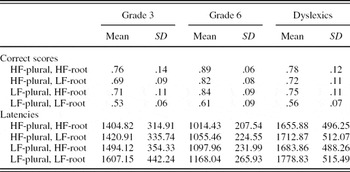
In Table 3, the mean proportion correct scores and latency scores for the four sets of plural word forms are presented.
Proportion correct scores and latencies of plurals as a function of word form and root frequency and group

Note: HF, high frequency; LF, low frequency.
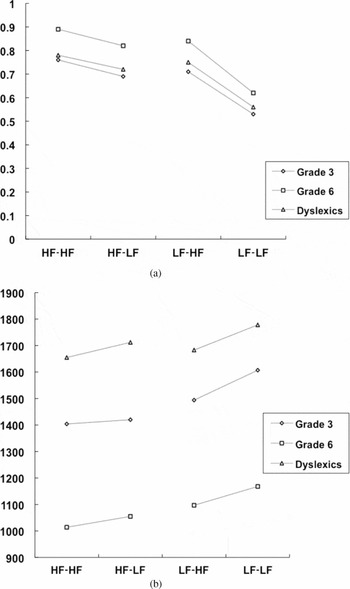
In Figure 2a, the means for the proportion correct scores are graphically displayed. It can be seen that the Grade 6 children seem to outperform the third graders and dyslexic children but that the structural response pattern for the three groups is highly comparable. GLM analysis with group, word form frequency, and root frequency as factors and percentage correct responses as the dependent variable showed the effects of group, F (2, 99) = 28.52, p < .001, word form frequency, F (1, 99) = 182.87, p < .001, and root frequency, F (1, 99) = 228.66, p < .001, to be significant. The contrast analyses for group showed the differences between the Grade 3 and Grade 6 children (p < .001) and the Grade 6 children and the dyslexic children (p < .001) to be significant. The interaction between word form frequency and root frequency, F (1, 99) = 106.40, p < .01, was also significant, whereas the three-way interaction among word form frequency, root frequency, and group was not, showing that the effect was equally valid in all three groups. Inspection of Figure 2 further shows the effect of root frequency on proportion correct scores to be stronger for low-frequency word forms compared to high-frequency word forms. However, follow-up analyses showed that the root frequency effect turned out to be significant in both the high-frequency and low-frequency plural word form domain (p < .001) with no interactions with group.
(a) Mean proportion correct scores and (b) mean latencies of plurals as a function of word form and root frequency and group; HF, high frequency; LF, low frequency.

Figure 2b graphically displays the mean latency scores. It can be seen that the dyslexic children are slowest on all word types, followed by the Grade 3 and the Grade 6 children. GLM analysis with group, word form frequency, and root frequency as factors and latency scores as the dependent variable showed significant effects for group, F (2, 99) = 28.19, p < .001, word form frequency, F (1, 99) = 43.08, p < .001, and root frequency, F (2, 99) = 17.22, p < .001. The contrast analyses for group showed the differences between the Grade 3 and Grade 6 children (p < .001), the Grade 3 children and the dyslexic children (p < .05), and the Grade 6 children and the dyslexic children (p < .001) to be significant. The interaction between word form frequency and group was also significant, F (2, 99) = 3.17, p < .05. There was also a clear tendency of significance of a stronger effect of root form frequency for the low-frequency word forms compared to high-frequency word forms (p = .06). Furthermore, inspection of Figure 3 shows the effect of word form frequency on latency scores to be stronger for the normal reading compared to the dyslexic children. Post hoc analysis showed that the word frequency effect was stronger in normal reading children compared to dyslexic children (p < .05).
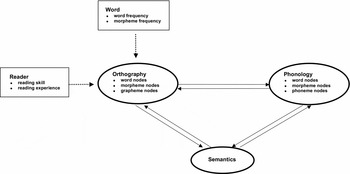
Complex word form identification according to the word-experience model.

Conclusions
The results of Experiment 2 show the accuracy and latency of lexical decisions for plural words to be determined by the frequency of the full word patterns, as well as the frequency of the root forms. Words tend to be recognized more accurately and faster as the frequencies of the plural and singular word forms increase. This result was found for both beginning readers and more advanced readers, and also for dyslexic children. A strong developmental effect was found between third- and sixth-grade children that can be explained from a more endured experience of words in the latter group. Although the dyslexic children do not seem to profit from such experience over the years, their reading also seem to be influenced by the frequency of occurrence of both plural word and root forms. It can thus be tentatively concluded that reading processes are favored by overall word frequencies and by the frequency of morpheme-based constituents from an early age on and may also have an effect on the reading of dyslexic students.
DISCUSSION
From the present research, it can be concluded that the accuracy and speed of lexical decision of inflected words is related to the surface frequency of the full word forms, as well as the constituent root frequency, pending developmental constraints. For the adult data, we found that the accuracy and speed of lexical decision of plural nouns is determined by the surface frequency of the full word patterns. However, the role of root form frequency has become less critical in word identification. For accuracy, we found root frequency to be significant in the low-frequency domain of plural word forms only. For speed, we found no significant role of root form frequency at all. It can tentatively be concluded that adult readers have built up so much experience with the latter category of words that a root form frequency effect no longer applies.
The children's data revealed a clear developmental effect in that the correct scores and speed increased from third to sixth grade. The greater reading experience in the latter group may account for this effect. The dyslexic children with the same reading experience of the sixth graders showed accuracy scores at the level of third grade and latencies even beyond this level. However, it is interesting to note that in the three groups of children the structural pattern of the accuracy and speed data turned out to be highly similar. For both accuracy and speed, we found comparable significant effects of word form frequency and root frequency, indicating that in their lexical decision children in the three groups were equally sensitive to the frequencies with which plural word forms and their singular constituents occur in the written language. The interaction between word form frequency and root frequency shows the singular root effect to be greater in the low-frequency word form domain indicating that singular root familiarity is even more helpful in identifying low-frequency plural word forms.
The results from the experiment with adults can be explained in terms of the parallel cascaded dual route model proposed by Schreuder and Baayen (Reference Schreuder and Baayen1997) and Verhoeven et al. (Reference Verhoeven, Schreuder and Baayen2006). In this model, it is assumed that after a first step of orthographic analysis frequently encountered word forms are processed via the direct route, whereas infrequent word forms are processed via the parsing route, which is construed as a backup route. It is then assumed that via the direct route, a full-form representation is accessed and mapped onto its associated lemma node, which then activates the relevant representations from the semantic system. In a parallel parsing route, the representations of morphological units (i.e., stem and plural ending) can be activated through a process of segmentation. The meaning of the complex word can then be computed from the meanings of its constituents so that a lexical decision can be made.
However, the question is whether a dual route perspective is necessary to explain the data. The children's data show that a root frequency effect is evident in beginning and more advanced readers as well in poor readers even in the high-frequency word domain. The finding that the frequency of full word forms as well as their morphemic constituents account for the accuracy and speed of plural word identification provides evidence that experience with (sub)lexical units is critical for lexical retrieval. Some tacit knowledge about morphology can thus be implied among readers form an early age on. According to this view, differences in reading skill arise from differences in word knowledge, which in turn arise from differences in the frequency of (sub)lexical word units, including morphemes. In Figure 3, a word experience model is proposed to display the identification of complex words as a function of reader and word characteristics. The formal representation of words is defined in terms of connections at the level of grapheme–phoneme nodes (morphoorthographic and morphophonological), morpheme nodes, and full-form nodes that may function simultaneously to map onto semantics. With respect to the reader, a distinction can be made between different levels of reading skill as well as different levels of reading experience. The better the reading skill and the more experience the reader has, the better the specificity and redundancy of individual word forms. With regard to word characteristics, the frequency of complex word forms and their constituent morphemes also determine the degree to which words are specified in the mental lexicon.
The present data are also fully commensurate with the simulated word experience model put forward by Reichle and Perfetti (Reference Reichle and Perfetti2003). The comparison of data among beginning, advanced, and adult readers make it clear that the basic task confronting children to become fluent readers of Dutch is to make the progression from slow and error-prone word decoding to fast and parallel morpheme-based word decoding and processing. With this transition, children go from partially specified to fully specified representations of written words with the strength of the association between print, sound, and meaning of constituent morphemes also becoming increasingly automated. It can be assumed that with sufficient reading practice, even complex words are recognized by sight and the direct route to word decoding without the need for sublexical letter–sound conversion is opened up (Coltheart et al., Reference Coltheart, Rastle, Perry, Langdon and Ziegler2001). Moreover, the children appear to be sensitive to sublexical units, that is, constituent root morphemes. In a distributed representation approach to polymorphemic word decoding and reading, familiar entities may be encoded by alternative patterns of activity involving the same set of morphemic units with each unit participating in the representations of many other entities. The quality of morphemic representations may thus relate directly to the number and strength of the connections between the relevant graphemes and phonemes (cf. Hinton, McClelland, & Rumelhart, Reference Hinton, McClelland, Rumelhart, Rumelhart, McClelland and Group1986). It can tentatively be concluded that progress in word decoding development often reflects the adoption of increasingly sophisticated sublexical decoding strategies such as the search for units already available within a phonological domain (e.g., rimes, syllables, morphemes). Along these lines, Ziegler and Goswami (Reference Ziegler and Goswami2005) have argued that, across orthographies, children learning to read need to overcome the granularity problem, reflecting that the efficiency of using smaller grain sizes may facilitate the decoding process of more complex orthographic patterns.
The present research results have some important educational implications. Our study shows that acquiring skill in reading requires multiple encounters with words that build up representations reflecting familiarity and knowledge of lexical elements. The evidence of root identification during the reading of plural word forms in developing readers as well as dyslexics makes it clear that attention should be drawn to the two, often complementary, processing routes in teaching children to read. Children should be taught the relevant grapheme–phoneme correspondence rules and given sufficient practice with these to automatize the relevant rules. Computer-based flash card programs with words of various lengths appear to be particularly well suited for this purpose (see Torgeson, Reference Torgeson and Fawcett2001). In contrast, children's awareness of the constituent parts of longer words should be enhanced. Morphological skills are of particular relevance when complex word patterns are addressed within the reading curriculum. In addition, the results of the present research make it clear that children must also learn that orthographic rules may determine the morphophonological structure of complex words at times. In previous studies, it has been shown that morphological awareness contributes significantly to not only the reading abilities of beginning readers (Carlisle, Reference Carlisle and Feldman1995, Reference Carlisle2000; Carlisle & Nomanbhoy, Reference Carlisle and Nomanbhoy1993) but also more advanced readers (Leong, Reference Leong2000; Nagy, Diakidoy, & Anderson, Reference Nagy, Diakidoy and Anderson1993). Finally, children should be given abundant opportunities to read to achieve fluency in identifying complex word forms. It is only by providing access to a wide range of well-written and graded text materials that children can make the transition from the slow cognitively demanding attack of individual words to the effortless identification of words in context (cf. Snow, Burns, & Griffin, Reference Snow, Burns and Griffin1998; Verhoeven & Snow, Reference Verhoeven and Snow2001).