Introduction
There is evidence suggesting that major depressive disorder (MDD) is a syndrome with multiple factors playing a role in the genesis and presentation of the disorder resulting from significant interactions between genetic and environment factors (Mill & Petronis, Reference Mill and Petronis2007). The construct of depression is heterogeneous (Alexandrino-Silva et al., Reference Alexandrino-Silva, Wang, Carmen Viana, Bulhões, Martins and Andrade2013) and different subtypes can predict different outcomes (Hybels et al., Reference Hybels, Landerman and Blazer2013). In cases of more severe depression (often classified as endogenous and difficult to predict), genetic and environmental factors appear to be better predictors than other models (Gorwood, Reference Gorwood2009). Regarding environmental factors, life stress and life events seem to be the most relevant factor (Monroe & Redi, Reference Monroe and Reid2008). Within this context of investigation of environmental and genetic factors, there is uncertainty on the role of family history of mental disorders (i.e. depression, alcohol use disorders) for the development of MDD (Ohannessian et al., Reference Ohannessian, Hesselbrock, Kramer, Kuperman, Bucholz, Schuckit and Nurnberger2004; Lee & Williams, Reference Lee and Williams2013).
Several studies identified family history of depression (FHD) as a risk factor for MDD (Hirata et al., Reference Hirata, Lima, de Bruin, Nóbrega, Wenceslau and de Bruin2007; Colvin et al., Reference Colvin, Richardson, Cyranowski, Youk and Bromberger2017; Cléry-Melin et al., Reference Cléry-Melin, Gorwood, Friedman and Even2018; Ramo-Nava et al., Reference Romo-Nava, Bobadilla-Espinosa, Tafoya, Guízar-Sánchez, Gutiérrez, Carriedo and Heinze2019). This pre-disposition was found in different age groups and for diverse types of depression (Hirata et al., Reference Hirata, Lima, de Bruin, Nóbrega, Wenceslau and de Bruin2007; Colvin et al., Reference Colvin, Richardson, Cyranowski, Youk and Bromberger2017; Cléry-Melin et al., Reference Cléry-Melin, Gorwood, Friedman and Even2018; Ramo-Nava et al., Reference Romo-Nava, Bobadilla-Espinosa, Tafoya, Guízar-Sánchez, Gutiérrez, Carriedo and Heinze2019). However, the relationship between family history of alcohol problems (FHAP) and MDD is unclear. Some studies investigated the relationship between FHAP and MDD. Lee and Williams (Reference Lee and Williams2013) used path-analysis models to examine the role of mediators between FHAP and depression using data from a web-based survey with Korean adults. They found that sense of belonging, along with social support and resilience, may protect the individual from the effect of parental alcoholism on depression. Ohannessian et al. (Reference Ohannessian, Hesselbrock, Kramer, Kuperman, Bucholz, Schuckit and Nurnberger2004) studied the relationship between parental alcohol dependence (with and without comorbid psychopathology) and adolescent psychopathology in a sample of 665 adolescents aged 13–17 years and their parents. They found that adolescents who had alcohol-dependent relatives did not differ from those who had parents with no psychopathology in regard to any of the measures of depressive symptomatology assessed.
Professionals who work in the health care system have higher vulnerability both to depression and alcohol disorders, especially those working in hospital shift schedules (Marshall, Reference Marshall2008; Schwenk et al., Reference Schwenk, Gorenflo and Leja2008; Jungeman et al., Reference Jungerman, Palhares-Alves, Carmona, Conti and Malbergier2012). Furthermore, shift work can be an important additional influencing factor on the genesis of mental health problems (Eldevik et al., Reference Eldevik, Flo, Moen, Pallesen and Bjorvatn2013; Oyane et al., Reference Oyane, Pallesen, Moen, Akerstedt and Bjorvatn2013). Therefore, they can be an interesting subpopulation for investigating MDD, FHAP and FHD. Hence, we decided to study the influence of FHAP on depressive symptoms, using a clinical sample of employees from a general hospital in Brazil.
Methods
Sample
The present study included all 337 employees from the Mário Covas Hospital (HEMC), Santo André, SP, Brazil, who sought for treatment in the occupational mental health service (OMHS) since 2005 when this service was established in HEMC. Employees who sought for treatment in OMHS sought this service on their own or were referred by the occupational doctor or other specialty doctors of the hospital. In addition, any employee could seek the service directly without the need of medical referral. Data were collected between 2005 and 2012. Two individuals conducted all the initial interviews (a certified psychiatrist and a psychologist specialised in cognitive-behavioural therapy with a master’s degree in Psychiatry, both being part of OMHS-HEMC staff). The head of the OMHS-HEMC, who is a psychiatrist with a PhD in Psychiatry, having a long experience in measuring depression (Castaldelli-Maia et al., Reference Castaldelli-Maia, Martins, Bhugra, Machado, Andrade, Alexandrino-Silva, Baldassin and de Toledo Ferraz Alves2012; Baldassin et al., Reference Baldassin, Alves, de Andrade and Nogueira Martins2008; Reference Baldassin, Silva, de Toledo Ferraz Alves, Castaldelli-Maia, Bhugra, Nogueira-Martins, de Andrade and Nogueira-Martins2013), trained both interviewers. The data used in this study were collected immediately before the first consultation of the employees in OMHS-HEMC. The employees did not routinely visit OMHS-HEMC at the time they were hired. HEMC employees who were included in the present study could have been referred to the OMHS-HEMC by the occupational physician, other physicians or psychologists working at HEMC, or could have sought the OMHS-HEMC by themselves. Four subjects were excluded from the present study (n = 333) because there was missing information in their protocols.
Measures
The measures were assessed in a form approved by the Ethics in Research Committee.
Exposure variables
Information regarding the FHAP and FHD was assessed without structured instruments. The subjects were asked about family history and if any members had presented with MDD or alcohol dependence. Living with the respondent or not, the father, mother, son, daughter, husband and wife of the respondent were considered family. If the subject did not know exactly what was meant by these disorders, the psychiatrist/psychologist gave them an explanation about the ICD-10 criteria for MDD and/or alcohol dependence (WHO, 1992). Socio-demographic and occupational variables were collected as outlined below:
Covariates
Socio-demographic variables:
Gender: male or female;
Age: included as a continuous variable;
Educational level: ‘Up to 11 years’ or ‘More than 11 years’ (High-school education covers a 11-years cycle in Brazil);
Marital status: ‘Married/living together’, ‘Never married’, or ‘Widow/divorced/separated’;
Ethnic group (self-declared): ‘White’, ‘Black’, or ‘Mixed-race’;
Place of birth: split into ‘Hospital metropolitan area’ and ‘Other areas’.
Occupational variables:
Living city: split into ‘Hospital city’ and ‘Commuting’;
Area: ‘Health practitioners’ and ‘Other’;
Type of referral to the occupational mental health outpatient service: ‘By the occupational doctor’ and ‘Other/none’.
Outcome: Beck Depression Inventory (BDI)
The Portuguese version of the BDI, validated by Gorenstein & Andrade (Reference Gorenstein and Andrade1996), was employed to all the subjects enrolled in the study. We chose to use BDI, because in occupational health, it can be used as a screening tool to detect depression in normal populations or as a tool to assess symptom severity in clinical populations (Jackson-Koku, Reference Jackson-Koku2016). The internal consistency of the Portuguese version of the BDI agrees with the literature (0.81 for non-depressed subjects and 0.88 for depressed patients – Gorenstein & Andrade, Reference Gorenstein and Andrade1996). In particular, we were interested in cluster analysis of BDI, which has been shown to be helpful in obtaining clusters of symptoms (Fleck et al., Reference Fleck, Chaves, Poirier-Littré, Bourdel, Loo and Guelfi2004). Such cluster analysis can also be helpful in describing the particular set of depressive symptoms in a more differentiated manner than the total BDI score, which can help minimise the number of correlations and enable us to understand specific subtypes, thereby reducing the risk of committing a Type I error. In order to avoid the intrinsic disadvantages of factor analysis outlined earlier, the factors were derived by using cluster analytical techniques, following results from a previous study conducted with a sample of medical students (Baldassin et al., Reference Baldassin, Alves, de Andrade and Nogueira Martins2008). The first is the Affective cluster (it is the sum of scores reported at item B1, sadness; item B4, dissatisfaction; item B10, episode of crying; item B11, irritability; and item B12, social withdrawal from the BDI), which represents the core symptoms of depression. The second is the Cognitive cluster (based on the cumulative score of item B2, pessimism; item B3, sense of failure; item B5, guilt; item B6, expectation of punishment; item B7, dislike of self; item B8, self-accusation; item B9, suicidal ideations; item B13, indecisiveness; item B14, change in body image and item B20, somatic preoccupation). The third is the Somatic cluster with accumulative score of item B15, slowness; item B16, insomnia; item B17, fatigue; item B18, loss of appetite; item B19, loss of weight and B21, loss of sexual interest). In addition, cluster scores were computed as the mean scores across all items assigned to a particular cluster. Following is the clusters scores range: affective cluster 0–30, cognitive cluster 0–60 and somatic cluster 0–36 (Baldassin et al, Reference Baldassin, Alves, de Andrade and Nogueira Martins2008).
Statistical analysis
All analyses were performed using Stata version 11 (StataCorp, College Station, TX, USA). First step was to ascertain the chi-squared and the t-tests that were used to explore the differences in distribution and means of the variables of interest (BDI total score and BDI cluster scores) and all the other variables between individuals with and without FHAP. Secondly, we conducted univariate ANOVA and ANCOVA models in order to explore the correlation between outcome variables – BDI total score and BDI cluster scores – and the other categorical and continuous variables, respectively. As recommended in the previous studies, significant variables considered to be relevant for depressive symptoms were studied. These included gender (Clap et al., Reference Clapp, Grubaugh, Allen, Mahoney, Oldham, Fowler, Ellis, Elhai and Frueh2013), age (Sutin et al., Reference Sutin, Terracciano, Milaneschi, An, Ferrucci and Zonderman2013), marital status (Li et al., Reference Li, Zhang, Shao, Qi and Tian2013), educational level (Kok et al., Reference Kok, Avendano, Bago d’Uva and Mackenbach2012) and ethnic group (Gayman et al., Reference Gayman, Pai, Kail and Taylor2013). These variables were used in the multivariate ANCOVA models. Also, we conducted t-tests to explore each BDI Affective Cluster symptoms mean score by the variable FHAP. Level of significance was considered at p < 0.05.
Results
Table 1 shows the distribution of variables by FHAP status. Most of variables analysed did not significantly differ by FHAP. However, there were statistically significant differences between FHD and FHAP (p < 0.001) variables. A quarter of the individuals with FHD had FHAP, whereas almost 50% of the individuals with no FHD had FHAP. Also, a trend of association between FHAP and the lowest educational level (p = 0.067) was found. T-test showed statistically significant difference (p = 0.030) between the mean score on the BDI Affective Cluster in individuals with FHAP (6.44) and individuals without FHAP (5.77). Furthermore, we found a trend (p = 0.078) of differences between the mean BDI total score in individuals by FHAP status.
FHAP distribution among 333 workers from a general hospital who searched for an OMHS in Santo André, SP, Brazil, 2005–2012

*Chi-squared tests.
**T-test.
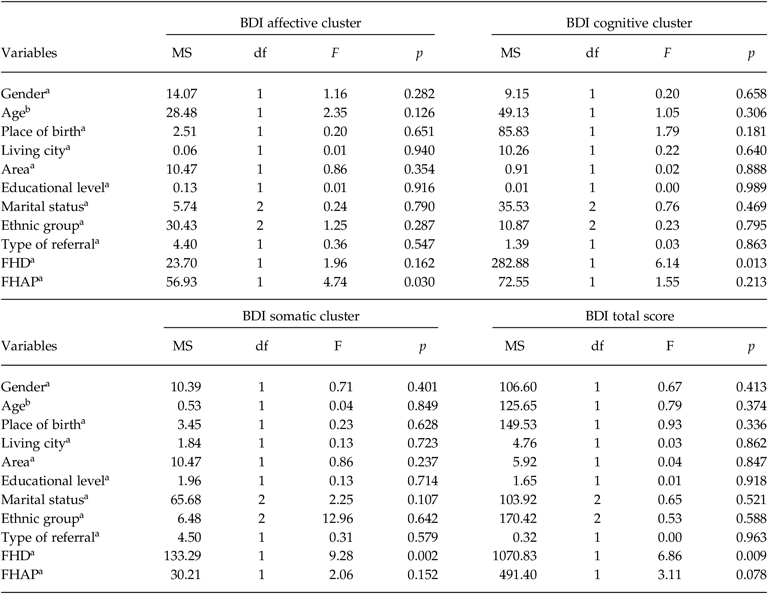
Table 2 shows ANOVA and ANCOVA univariate models for all the analysed variables in relation to the four outcomes of interest (BDI total score and BDI score per cluster). Most of variables had no significant differences. However, we found statistically significant differences in the variable FHD using BDI total score, BDI Somatic Cluster and Cluster Cognitive score, (MS = 1070.83, F = 6.86, p = 0.009; MS = 133.29, F = 9:28, p = 0.002; MS = 282.88, F = 6.14, p = 0.013, respectively). Moreover, as expected, significant differences were found in t-tests analysis for the variable FHAP, using BDI total score, and BDI Affective Cluster total scores were retained in the ANOVA models (MS = 491.40, F = 3.11, p = 0.078; and MS = 56.93, F = 4.74, p = 0.030, respectively).
Results from ANOVA and ANCOVA models analysis on BDI total mean score and by affective, cognitive and somatic cluster among 333 workers from a general hospital who searched for an OMHS in Santo André, SP, Brazil, 2005–2012 (univariate analysis)

MS, Mean Square; FHD, Family history of depression; FHAP, Family history of alcohol problems.
aANOVA models.
bANCOVA model.
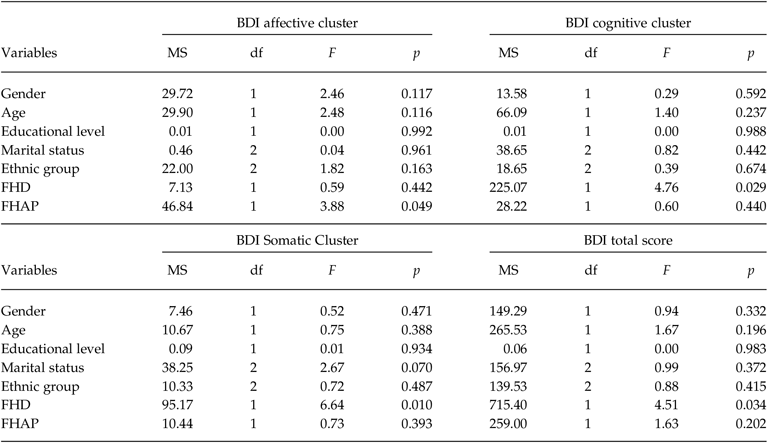
Table 3 shows multivariate models ANCOVA for the four outcomes of interest. Again, most of the variables had no significant differences. The variable FHD showed statistically significant differences in association with BDI total score, BDI Somatic Cluster score and BDI Cognitive Cluster score (MS = 715.40, F = 4.51, p = 0.034; MS = 95.17, F = 6.64, p = 0.010; MS = 225.07, F = 4.76, p = 0.029, respectively). The variable FHAP was associated with BDI Affective Cluster score (MS = 46.84, F = 3.88, p = 0.049). However, the trend of BDI total score difference of the variable FHAP was not significant (MS = 259.00, F = 1.63, p = 0.202). In addition, the variable marital status was significantly associated with the average BDI Somatic Cluster score (MS = 38.25, F = 2.67, p = 0.070).
ANCOVA models for BDI Affective Cluster and BDI total scores among 333 employees from Mario Covas State Hospital, who searched for an OMHS in Santo André, SP, Brazil, 2005–2012 (multivariate analysis)

FHD, Family history of depression; FHAP, Family history of alcohol problems.
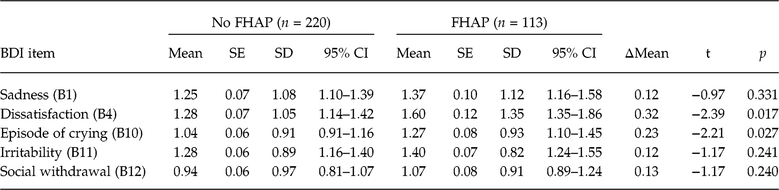
Table 4 and Figure 1 present the distribution of the average BDI Affective Cluster score per each item (labeled as B1, B4, B10, B11 and B12) of the variable FHAP. Differences in scores were found in items B4 and B10 (‘dissatisfaction’ and ‘episodes of crying’). T-test showed statistically significant difference in the mean scores of these two items (B4 – 1.60 v. 1.28, p = 0.017; B10 – 1.27 v. 1.04, p = 0.027). Figure 1 shows the average sum of each item totaling the average overall score of the BDI Affective Cluster. It also shows how the five items contributed to a final difference of 0.87 between the individuals with and without FHAP.
Comparison of BDI Affective Cluster items score means by FHAP among 333 employees from a general hospital who searched for an OMHS in Santo André, SP, Brazil, 2005–2012

FHAP, Family history of alcohol problems.
BDI affective cluster mean score by the variable FHAP among 333 employees from a general hospital who searched for an OMHS in Santo André, SP, Brazil, 2005–2012.

Discussion
The main finding of this study is a significant correlation between FHAP and a higher score in BDI Affective score. This result remained significant even after adjustment for other variables that are considered as important factors for MDD, such as gender (Clap et al., Reference Clapp, Grubaugh, Allen, Mahoney, Oldham, Fowler, Ellis, Elhai and Frueh2013), age (Sutin et al., Reference Sutin, Terracciano, Milaneschi, An, Ferrucci and Zonderman2013), marital status (Li et al., Reference Li, Zhang, Shao, Qi and Tian2013), education (Kok et al., Reference Kok, Avendano, Bago d’Uva and Mackenbach2012), ethnic group (Gayman et al., Reference Gayman, Pai, Kail and Taylor2013) and FHD (Watters et al., Reference Watters, Gotlib, Harris, Boyce and Williams2013). More specifically, FHAP was correlated with dissatisfaction and episodes of crying. FHAP showed no statistical difference in any of the other clusters score or in the BDI total score.
The relationship between depression and FHAP has previously been investigated in adolescents (Ohannessian et al., Reference Ohannessian, Hesselbrock, Kramer, Kuperman, Bucholz, Schuckit and Nurnberger2004) and spouses of individuals with alcohol problems (Tempier et al., Reference Tempier, Boyer, Lambert, Mosier and Duncan2006; Dawson et al., Reference Dawson, Grant, Chou and Stinson2007; Chedraui et al., Reference Chedraui, Pérez-López, Morales and Hidalgo2009; Moos et al., Reference Moos, Brennan, Schutte and Moos2010). However, types of depressive symptoms associated with FHAP were not explored in these studies (Alexandrino-Silva et al. Reference Alexandrino-Silva, Wang, Carmen Viana, Bulhões, Martins and Andrade2013; Hybels et al., Reference Hybels, Landerman and Blazer2013). Interestingly, we found that FHD shows no significant association with depressive symptoms of BDI Affective Cluster, which further highlights the main finding. FHD seems to influence BDI Somatic Cluster, Cognitive Cluster and total score. FHD was also significantly associated with no FHAP, which contradicts the hypothesis of a general and broad association between depression and alcohol problems. However, it gives even more specificity to the association between FHAP and BDI Affective Cluster.
Such findings may contribute towards our understanding of etiological implications, with a specific correlation between FHAP and type of depressive symptoms. There is indeed evidence of common genetic/neurobiological predisposition to depressive symptoms and alcohol misuse (Crews, Reference Crews2012; Sjoerds et al., Reference Sjoerds, Van Tol, van den Brink, Van der Wee, Van Buchem, Aleman, Penninx and Veltman2012; Procopio et al., Reference Procopio, Saba, Walter, Lesch, Skala, Schlaff, Vanderlinden, Clapp, Hoffman and Tabakoff2013). More specifically, dissatisfaction and episodes of crying would be a common type of reaction to individuals with this phenotype, which would be shared by depression and alcoholism. It would be interesting to investigate the possible genetic basis for this correlation.
The findings are also interesting from an etiological point of view. The environmental influence of the presence of an individual struggling with alcohol could generate considerable stress in people living with this individual, as wives, children and parents. This negative influence has been shown and confirmed in several studies (Ohannessian et al., Reference Ohannessian, Hesselbrock, Kramer, Kuperman, Bucholz, Schuckit and Nurnberger2004; Tempier et al., Reference Tempier, Boyer, Lambert, Mosier and Duncan2006; Dawson et al., Reference Dawson, Grant, Chou and Stinson2007; Chedraui et al., Reference Chedraui, Pérez-López, Morales and Hidalgo2009; Moos et al., Reference Moos, Brennan, Schutte and Moos2010). This environmental influence could be the reason for the association between FHAP and just the affective symptoms of depression. The high score at BDI Affective Cluster or the presence of symptoms of dissatisfaction and episodes of crying may be a common depressive/affective reaction to those living with a relative affected by alcohol dependence, who can present the following symptoms: much time spent in activities necessary to use alcohol or recover from its effects; important social, occupational or recreational activities may be given up or reduced because of alcohol use, or continued use of alcohol despite having persistent or recurrent social or interpersonal problems caused or exacerbated by the effects of alcohol (WHO, 1992).
Considering day-to-day clinical practice, FHAP should be routinely investigated in individuals presenting with depressive symptoms. This is especially important in cases presenting with dissatisfaction and episodes of crying in patients who do not endorse criteria for MDD. Patients who have a predominance of symptoms of BDI Affective Cluster should be treated for depression if they meet the criteria for MDD, after following appropriate guidelines (Lam et al., Reference Lam, Kennedy, Grigoriadis, McIntyre, Milev, Ramasubbu, Parikh, Patten and Ravindran2009; Parikh et al., Reference Parikh, Segal, Grigoriadis, Ravindran, Kennedy, Lam and Patten2009; Patten et al., Reference Patten, Kennedy, Lam, O’Donovan, Filteau, Parikh and Ravindran2009). However, many of them might not meet the MDD criteria, despite fulfilling the symptoms of BDI Affective Cluster. Interventions for the management of psychiatric symptoms in the relatives of patients with alcohol dependence seem to be effective for the patients themselves and their family (Son & Choi, Reference Son and Choi2010).
Finally, as expected, FHD has been correlated with higher levels of almost all BDI scores – BDI Cognitive Cluster, Somatic Cluster and total score. The DSM-5 states that the first-degree family members of the individuals with MDD have two- to four-fold higher risk of MDD than the general population, with a heritability of approximately 40% (APA, 2013). However, DSM-5 does not focus on any familial subtype of symptomatology of depression, but only states a higher correlation with early-onset depression and recurrent forms. Some cognitive symptoms of depression are related to FHD (Field et al., Reference Field, Diego and Sanders2001; Tozzi et al., Reference Tozzi, Prokopenko, Perry, Kennedy, McCarthy, Holsboer, Berrettini, Middleton, Chilcoat and Muglia2008). Feelings of guilt, included in the cluster of cognitive BDI, were associated with FHD in a sample of people with recurrent MDD (Tozzi et al., Reference Tozzi, Prokopenko, Perry, Kennedy, McCarthy, Holsboer, Berrettini, Middleton, Chilcoat and Muglia2008). FHD was also related to a higher overall level of guilt in depressed patients in a case-control study (Jarrett & Weissenburger, Reference Jarrett and Weissenburger1990). Suicidal ideation was correlated with FHD in adolescents (Field et al., Reference Field, Diego and Sanders2001). However, there is no study stating any relationship between FHD and BDI Somatic Cluster symptoms, nor between FHD and BDI Affective Cluster symptoms.
Limitations
This study has several limitations. The main one refers to the fact of FHAP and FHD variables have been collected as self-reports of patients only. Despite self-reporting of FHD and FHAP being adopted in many studies (Nayak et al., Reference Nayak, Lown, Bond and Greenfield2012; Kang et al., Reference Kang, Kim, Lee, Kim, Bae, Kim, Shin, Kim, Shin and Yoon2013) and the professionals of OMHS-HEMC trying to make this variable more sensible by offering additional explanation on diagnosis criteria for MDD and Alcohol Use Disorder (AUD), a more accurate assessment of family history of MDD and AUD would be ideal. The sample did not include individuals who were not receiving psychiatric consults. This can be an important limitation given the stigma for people affected by depression (Castaldelli-Maia et al., Reference Castaldelli-Maia, Scomparini, Andrade, Bhugra, de Toledo Ferraz Alves and D’Elia2011). Disentangling possible explanations for the results was difficult limiting the interpretation of the findings (i.e. affective symptoms could be caused by alcohol consumption or abuse). Unfortunately, we did not assess alcohol use, which could be also an important confounder for depressive symptoms. Thus, the association between FHAP and depression may be mediated by alcohol consumption and not only by the genes but the environment and culture. Finally, since this is a cross-sectional study from just one site, no causal relationship can be established.
Conclusion
In this study, we found a relationship between FHAP and affective depressive symptoms of BDI in a clinical sample after adjusting for FHD and other socio-demographic variables that are considered to be important for depression (such as gender, age, education level, marital status and ethnic group). This relationship was confirmed specifically for symptoms of dissatisfaction and episodes of crying. These results might be factors of a specific common phenotype for MDD and AUD and environmental predisposition to MDD in individuals who live with people with AUD. There may be clinical implications, since it would be useful to support relatives of AUD patients with specific group therapies. Dissatisfaction and episodes of crying may be specifically related to living with a patient with AUD. Moreover, as expected, we found a correlation between FHD and BDI total score and Somatic and Cognitive clusters. However, due to study limitations, the findings required replication by neurobiological, epidemiological and clinical studies.
Conflict of interest
Dr Castaldelli-Maia has been awarded with a Pfizer Independent Grant for Learning and Change (IGLC) managed by Global Bridges (Healthcare Alliance for Tobacco Dependence Treatment) hosted at Mayo Clinic, to support free smoking-cessation treatment training in addiction/mental health care units in Brazil (Grant IGLC 13513957) and Portugal (Grant IGLC 25629313), which had no relationship with the present study. Dr Andrade is the Executive President of Center for Information on Health and Alcohol (CISA), which had no funding relationship with this project. All other authors have no conflicts of interest.
Financial support
This research received no specific grant from any funding agency, commercial or not-for-profit sectors.
Ethical standards
The authors assert that all procedures contributing to this work comply with the ethical standards of the relevant national and institutional committee on human experimentation with the Helsinki Declaration of 1975, as revised in 2008. The present study was approved by the Ethics in Research Committee of Medical School of Fundação do ABC, Santo André, SP, Brazil.