





Non-technical Summary
Some plants and insects such as the cockroach Diploptera are today restricted to the tropics not for need of high temperatures, but because they cannot withstand the cold winters outside of the tropics. However, in the “greenhouse” global climate of the Eocene (about 50 million years ago), winters were mild, with few or no frost days even in high latitudes and elevations with temperate climates. Unlike in today’s “icehouse” world, many tropical organisms could range into regions of cooler climates to form mixed communities with animals and plants that are today restricted to temperate climates. An alternative explanation for these mixed communities is that Eocene plants and animals did not have tropical or temperate identities as we characterize them today as Earth had not experienced an icehouse climate with cold winters since the late Paleozoic over 250 million years ago. Therefore, thinking of them as tropical or temperate organisms in the greenhouse Eocene is not appropriate. Only after global cooling along with colder winters were established outside of the tropics around the Eocene/Oligocene boundary (about 34 million years ago) did some animals and plants evolve greater cold tolerance, creating the modern split between tropical and temperate species. Those that did not adapt to cold winters retreated to climatic refugia most similar to their Eocene ecosystems, went extinct, or, like Diploptera, were restricted to the present-day tropics.
Introduction
The global distributions of terrestrial organisms and the composition of the communities that they form are affected by many environmental factors, prominently including components of climate such as mean annual temperature (MAT) and coldest month mean temperature (CMMT). Separating their relative effects is difficult using modern systems as MAT and its relationship to CMMT (temperature seasonality) broadly covary with latitude. However, examining community composition in deep time under climatic conditions unlike those found in the modern world can be informative.
William Morton Wheeler (Reference Wheeler1908, Reference Wheeler1910, Reference Wheeler1914) could not explain why the ant assemblage of late Eocene Baltic amber includes taxa that are today restricted to hot tropical latitudes together with those of circumpolar regions. Heer (Reference Heer1860) had suggested that the amber forest covered a large area and range of elevations, with cooler climate upland and northern taxa being transported by rivers postmortem in amber to mix with southern, tropical taxa in a high-MAT lowland depositional environment. He also speculated that the amber forest biota represents a time-averaged assemblage preserved during intervals of different climates. Wheeler (Reference Wheeler1914) rejected these proposals as tropical and temperate taxa occur at times in the same amber piece and was left without an explanation. Such Eocene tropical/temperate mixed insect communities are now known from many localities (brief review: Archibald and Farrell, Reference Archibald and Farrell2003).
This pattern was also seen in Eocene plants, for example, in the Bembridge Beds (Reid et al., Reference Reid, Chandler and Groves1926, p. 29: “We cannot pretend to explain such discrepancies. We can only state them.”) and the London Clay (Reid and Chandler, Reference Reid and Chandler1933, p. 63: “The most vexed of climatological problems”). Lower-latitude plants such as palms (Arecaceae) are now known to have inhabited the cooler MAT and mild winters of the Eocene high Arctic (e.g., Wing and Greenwood, Reference Wing and Greenwood1993; Greenwood and Wing, Reference Greenwood and Wing1995; Sluijs et al., Reference Sluijs, Schouten, Donders, Schoon, Röhl, Reichart, Sangiorgi, Kim, Sinninghe Damsté and Brinkhuis2009, Reference Sluijs, Frieling, Inglis, Nierop, Peterse, Sangiorgi and Schouten2020; Eberle et al., Reference Eberle, Fricke, Humphrey, Hackett, Newbrey and Hutchison2010; Siver et al., Reference Siver, Reyes, Pisera, Buryak and Wolfe2025, and see discussion of Arctic vertebrates by Eberle and Greenwood, Reference Eberle and Greenwood2012).
Daley (Reference Daley1972) proposed that such assemblages could be explained by an equable Eocene climate without modern analogue that combines extra-tropical temperate MAT with mild winters of higher CMMT than would be expected in regions of equivalent MAT today. We now know that such a climate existed in the Eocene, during the “greenhouse world” global climatic regime of high atmospheric carbon, increased MAT, a lower latitudinal MAT gradient with unglaciated poles, and reduced temperature seasonality with mild winters of few or no frost days extending into microthermal higher latitudes and elevations (e.g., West et al., Reference West, Greenwood, Reichgelt, Lowe, Vachon and Basinger2020). By Daley’s model, cryophobic (cold-winter intolerant) “tropical” taxa could range into cooler extra-tropical and upland Eocene regions, which would still exclude hot climate requiring “tropical” taxa, creating the community mixtures that surprised Heer, Wheeler, Reid, Chandler, and others.
For example, the Okanagan Highlands series of fossiliferous lacustrine shale deposits in far-western North America (review: Archibald et al., Reference Archibald, Greenwood, Smith, Mathewes and Basinger2011a) were deposited through the later half of the Ypresian during the greenhouse world climate. These high-elevation localities (e.g., Wolfe and Wehr, Reference Wolfe and Wehr1987; Wolfe et al., Reference Wolfe, Forest and Molnar1988; Tribe, Reference Tribe2005; estimates vary, but all are high) preserve mostly microthermal temperate montane forest communities (Greenwood et al., Reference Greenwood, Archibald, Mathewes and Moss2005; Lowe et al., Reference Lowe, Greenwood, West, Galloway, Sudermann and Reichgelt2018; mesothermal at Quilchena: Mathewes et al., Reference Mathewes, Greenwood and Archibald2016) deposited episodically across about 1,400 kilometers from northern British Columbia to northern Washington (a few degrees farther north in the Eocene by plate rotation: Andrews, Reference Andrews1985).
A putative mousebird (Coliiformes) known from the Okanagan Highlands at microthermal Driftwood Canyon (Mayr et al., Reference Mayr, Archibald, Kaiser and Mathewes2019) is today restricted to warm climates of sub-Saharan Africa. Temperate flora such as maples (Acer, Sapindaceae), birch (Betula, Betulaceae), and spruce (Picea, Pinaceae) grew in Okanagan Highlands forests together with palms, the banana relative Ensete (Musaceae), and a cycad (Cycadales) (Erwin and Stockey, Reference Erwin and Stockey1991; Greenwood et al., Reference Greenwood, Archibald, Mathewes and Moss2005; Archibald et al., Reference Archibald, Morse, Greenwood and Mathewes2014a). Insects are found there that today live in temperate mid to higher latitudes such as snakeflies (Raphidioptera: Archibald and Makarkin, Reference Archibald and Makarkin2021), giant casemaker caddisflies (Trichoptera, Phryganeidae: Archibald and Mathewes, Reference Archibald and Mathewes2000), clubhorn sawflies (Hymenoptera, Cimbicidae not Pachylostictinae: Archibald and Rasnitsyn, Reference Archibald and Rasnitsyn2023), and nothochrysine green lacewings (Neuroptera, Chrysopidae, Nothochrysinae: Archibald et al., Reference Archibald, Makarkin, Greenwood and Gunnell2014b) together with those that are now restricted to or predominate in low latitudes such as weaver ants (Hymenoptera, Formicidae, Oecophyllini: Archibald et al., Reference Archibald, Mathewes and Perfilieva2024), mastotermitid termites (Isoptera, Mastotermitidae: Wilson, Reference Wilson1977), Megymenum Guérin-Méneville bugs (Hemiptera, Dinidoridae: Archibald and Mathewes, Reference Archibald and Mathewes2000), and the “beetle cockroach” Diploptera de Saussure, Reference de Saussure1864 (Blattodea, Blaberidae, Diplopterinae: Archibald and Mathewes, Reference Archibald and Mathewes2000), providing a clear example of Eocene mixing of biota that today occupy temperate and subtropical to tropical biomes.
The Daley model does not, however, explain Eocene communities with temperate taxa mixed with tropical taxa in high MAT climates. For example, the upper mesothermal to megathermal (Grein et al., Reference Grein, Utescher, Wilde and Roth-Nebelsick2011; Tütken, Reference Tütken2014; see below) Lutetian sediments of the Messel pit fossil site have yielded a multitude of fossils that document a high biodiversity (overviews: Schaal and Ziegler, Reference Schaal and Ziegler1988; Gruber and Micklich, Reference Gruber and Micklich2007; Smith et al., Reference Smith, Schaal and Habersetzer2018, Reference Smith, Collinson, Folie, Habersetzer and Hennicke2024). Messel, located in the middle of Germany, was some 500 km south in the Eocene (Büchel and Schaal, Reference Büchel, Schaal, Smith, Schaal and Habersetzer2018).
Wilde (Reference Wilde, Smith, Schaal and Habersetzer2018) characterized the Messel flora as mainly tropical to subtropical, with a few taxa that are distributed in temperate climates today. Palm fruits and flowers are among the most common macroscopic plant fossils there. He reports many other plants that today have or mainly have a tropical or subtropical distribution, for example, Panama hat “palms” (Cyclanthaceae), the ginger family (Zingiberaceae), moon seeds (Menispermaceae), white pears (Icacinaceae), cashews (Anacardiaceae), engelhardioid Juglandaceae, Sloanea (Elaeocarpaceae), and Gleichenia ferns (Gleicheniaceae).
Temperate elements are present at Messel but less common, such as macrofossils of magnolia (Magnolia, Magnoliaceae), tapiscia (Tapiscia, Tapisciaceae), grapevine (Vitis, Vitaceae), parthenocissus (Parthenocissus, Vitaceae), and maple (Acer, Sapindaeae) (Wilde, Reference Wilde1989, Reference Wilde, Smith, Schaal and Habersetzer2018; Collinson et al., Reference Collinson, Manchester and Wilde2012). Temperate Pinaceae such as fir (Abies), spruce (Picea), and pine (Pinus) and angiosperms such as elms (Ulmus, Ulmaceae), alders (Alnus, Betulaceae), and linden (Tilia, Malvaceae) are known from pollen, indicating that they were regional, probably not growing close to Lake Messel (Bouchal et al., Reference Bouchal, Geier, Ulrich, Wilde, Lenz, Zetter and Grímsson2024; Smith et al., Reference Smith, Collinson, Folie, Habersetzer and Hennicke2024). The Messel region was not mountainous, so their pollen was not transported downslope; these plants, therefore, likely experienced the same hot climate.
Messel insects were recently reviewed by Wedmann (Reference Wedmann, Smith, Schaal and Habersetzer2018), mostly above the genus level. Temperate and predominantly temperate taxa include the horntail wood wasp (Hymenoptera, Siricidae) genus Xoanon? Semenov, Reference Semenov1921 (Wedmann et al., Reference Wedmann, Pouillon and Nel2014) and an unpublished specimen tentatively belonging to Urocerus Geoffroy, Reference Geoffroy1762 (S. Wedmann, personal observation, 2025), possibly Limnephilidae, and ichnofossils of Phylloxeridae (Smith et al., Reference Smith, Collinson, Folie, Habersetzer and Hennicke2024). Tropical to warm climate insect genera include March flies (Plecia Wiedemann, Reference Wiedemann1824, Diptera, Bibionidae) (Skartveit and Wedmann, Reference Skartveit and Wedmann2015), weaver ants (Oecophylla Smith, Reference Smith1860, Hymenoptera, Formicidae) (Dlussky et al., Reference Dlussky, Wappler and Wedmann2008), amber javelin ants (Gesomyrmex Mayr, Reference Mayr1868, Formicidae) (Dlussky et al., Reference Dlussky, Wappler and Wedmann2009), the leaf insect Eophyllium Wedmann et al., Reference Wedmann, Bradler and Rust2007 (Phasmatodea), and the mantidfly Symphrasites Wedmann and Makarkin, Reference Wedmann and Makarkin2007 (Neuroptera, Mantispidae, Symphrasinae).
The fossiliferous early Eocene Green River Formation shales were deposited in an extensive upper mesothermal to megathermal lake system at a similar latitude as today in southwest Wyoming, northwest Colorado, and northeastern Utah (Smith and Carroll, Reference Smith, Carroll, Smith and Carroll2015). Palms are well known in the formation (e.g., Allen, Reference Allen2015). Brown (Reference Brown1929, Reference Brown1934) and MacGinitie (Reference MacGinitie1969) reported such temperate plants as birch, poplar (Populus, Salicaceae), and spruce, but these identifications are considered in need of re-evaluation. Grande’s (Reference Grande2013) summary of the Green River flora is the only currently reliable and conservative review, listing many previously identified taxa as unknown. He includes the mostly tropical climbing fern (Lygodium, Lygodiaceae) and established tropical and subtropical taxa, for example, palms (Arecaceae), as well as temperate taxa such as poplar and sweetfern (Comptonia, Myricaceae). A comprehensive revision is needed to resolve the systematics of many Green River plants of uncertain affinity. The Green River insects are understudied, and many of the taxa described as long ago as the nineteenth century (Scudder, Reference Scudder1878, Reference Scudder1890) are also in need of revision, particularly at lower taxonomic levels. Some, however, have recently been confidently established there, such as temperate snakeflies (Archibald and Makarkin, Reference Archibald and Makarkin2021) and the tropical cockroach Diploptera (Vršanský et al., Reference Vršanský, Šmídová, Valaška, Barna and Vidlička2016).
Here we describe new Eocene species of the extant tropical cockroach Diploptera from Messel and the Okanagan Highlands and compare the communities and paleoclimates of these localities and the Green River Formation with the modern climatic envelope of Diploptera. This is expected to clarify the separate effects of MAT and CMMT governing their distribution and help us better understand general change in community composition through time from the Eocene greenhouse, across the Eocene/Oligocene boundary, into the modern icehouse world climate.
Localities information
Ping Chau Formation, Hong Kong
A single tegmen treated as Diploptera sp. is known from the Ping Chau Formation (Lin and Lee, Reference Lin and Lee1997), then thought to be Early Cretaceous but now considered Paleogene (Yao et al., Reference Yao, Hu, Chen, Zhu and Xue2005).
Green River Formation, western USA
Green River lacustrine shale was deposited in the later half of the Ypresian in an extensive lake system in Wyoming, Colorado, and Utah (Smith et al., Reference Smith, Carroll and Singer2008, Reference Smith, Chamberlain, Singer and Carroll2010, and references therein). Diploptera are known from the Anvil Points locality of collector David Kohls and the Forked Gulch locality in the Piceance Creek Basin, both in Colorado (Vršanský et al., Reference Vršanský, Šmídová, Valaška, Barna and Vidlička2016).
Grube Messel, Germany
The earliest Lutetian lacustrine oil shale of the Messel Formation near Darmstadt filled a maar lake formed by volcanism. Fossil excavation is possible only in the uppermost sediment layers, so its fossils are a bit older than the youngest age estimate of 47.22 Ma immediately above it (Kaboth-Bahr et al., Reference Kaboth-Bahr, Schmitt, Bauersachs, Zeeden and Wonik2024). The specimen described here is the only reported Diploptera occurrence at Messel.
Okanagan Highlands
A series of upland late Ypresian lacustrine shale basins occurring across about 1,400 kilometers from northwest British Columbia, Canada to northcentral Washington, USA (summary including map: Archibald et al., Reference Archibald, Greenwood, Smith, Mathewes and Basinger2011a). All known Okanagan Highlands Diploptera specimens are described here, some of which have been briefly reported previously as cited below. Okanagan Highlands localities with Diploptera are as follow.
Quilchena, British Columbia, Canada
Coldwater beds of Kamloops Group lacustrine shales near Nicola Lake, British Columbia, Canada (Mathewes et al., Reference Mathewes, Greenwood and Archibald2016) dated at 51.5 ± 0.4 Ma by 40Ar/39Ar analysis (Villeneuve and Mathewes, Reference Villeneuve and Mathewes2005).
McAbee, British Columbia, Canada
Hoodoo Face beds of the McAbee, an unnamed formation of Kamloops Group lacustrine shale about 8 kilometers east of the village of Cache Creek, British Columbia, Canada, with a U–Pb age of 52.10 ± 0.26 Ma (Rubino et al., Reference Rubino, Leier, Cassel, Archibald, Foster-Baril and Barbeau2021).
Republic, Washington, USA
Tom Thumb Tuff Member of the Klondike Mountain Formation within and surrounding the village of Republic, Washington, USA. Diploptera were recovered from exposures A0307, dated as 51.45 ± 0.12 Ma, and B4131, dated as 51.18 ± 0.09 Ma, both by U–Pb analysis of zircons (Rubino et al., Reference Rubino, Leier, Cassel, Archibald, Foster-Baril and Barbeau2021).
Materials and methods
We examined one mostly complete fossil from Messel, Germany, deposited in the collection of Messel invertebrate fossils of the Senckenberg Forschungsinstitut und Naturmuseum Frankfurt/M. (SF), Germany, housed at the Senckenberg Forschungsstation Grube Messel, and 16 in Okanagan Highlands lacustrine shale: one rather complete specimen and three isolated tegmina from McAbee and tegmina of three individuals from Quilchena, both localities in British Columbia, Canada, and nine tegmina from Republic, Washington, USA. We also examined new high-resolution photographs of the holotype and paratype of D. gemini Barna in Vršanský et al., Reference Vršanský, Šmídová, Valaška, Barna and Vidlička2016 from the Green River Formation of Colorado.
Photographs of Okanagan Highlands specimens were made in the laboratories of Parks Canada and the Beaty Biodiversity Museum, both in Vancouver, Canada, with various equipment. The Messel specimen was photographed with a Leica MZ12.5 stereomicroscope and an attached Nikon D300 digital camera, and drawings were done with an attached camera lucida. Figures were prepared using Adobe Photoshop and Illustrator.
Assigning fossils to Diploptera
Diploptera species are cockroaches with sclerotized tegmina and pronota, giving them a distinctive beetle-like appearance; hence, the common name “beetle cockroaches” (e.g., Li et al., Reference Li, Li and Wang2017). They are also known as “origami cockroaches” for the distinctive manner of their hind-wing folding (see diagnoses of Li and Wang, Reference Li and Wang2015 and Vršanský et al., Reference Vršanský, Šmídová, Valaška, Barna and Vidlička2016). Their tegmina and sometimes pronota are covered with cup-like punctae called bunky (see Vršanský et al., Reference Vršanský, Šmídová, Valaška, Barna and Vidlička2016). Diploptera species are the only cockroaches with hind wings that have fully formed veins in an appendicular field (their uniquely large, developed apical field) distad a transverse fold. In other genera, the hind wings fold with a different manner of folding mechanisms, and veins of the apical field are strongly reduced or absent. Cockroach heads are beneath their pronota, further differing from some taxa with tegmina that might appear similar as fossils in shale depending on preservation.
Tegmina of the Mesozoic superfamily Umenocoleoidea, an enigmatic taxon now thought to be cockroaches (Nel et al., Reference Nel, Prokop, Grandcolas, Garrouste, Lapeyrie, Legendre, Anisyutkin and Kirejtshuk2014; Vršanský et al., Reference Vršanský, Šmídová, Valaška, Barna and Vidlička2016), are also sclerotized, beetle-like, and have bunky, and so might be confused with those of Diploptera. They differ, however, by the diagnostic presence of an adsutural line (Lee et al., Reference Lee, Nam, Nel and Park2025), the sub-marginal anal vein along the entire posterior edge (examples illustrated by Nel et al. Reference Nel, Prokop, Grandcolas, Garrouste, Lapeyrie, Legendre, Anisyutkin and Kirejtshuk2014, figs. 1, 3, 4, 6–9), which is absent in Diploptera.
Tegmina of the extant Neotropical cockroach family Oulopterygidae possess bunky and are (Rehn, Reference Rehn1951, p. 16) “somewhat thickened, leathery, or coriaceous,” and the “venation while still discernible is not prominent.” Whereas in Diploptera (Rehn, Reference Rehn1951, p. 42), “the densely coriaceous tegmina which lack distinct venation, appear superficially to resemble beetle elytra” and (Rehn, Reference Rehn1951, p. 16) “an extreme condition is to be found in Diploptera in which the venation is subobsolete, the vein disposition being indicated by a few tracheae and the clear areas between punctures.” Although venation may be distinct in a few Diploptera, for example, the Messel species described here, it is obscured as described by Rehn (Reference Rehn1951) in all Okanagan Highlands tegmina but not in Oulopterygidae. The possibility that these disarticulated tegmina belong to Oulopterygidae is very small, and we confidently assign them to Diploptera.
While some character states of forewing venation are established as diagnostic, phylogenetically reliable in fossil cockroaches, details can vary even between the left and right wings of the same individual and so must be used with caution at lower taxonomic levels (Li, Reference Li2024). For the Messel specimen, we emphasize the stable characters of forewing and pronotum coloration and shape, supported by distinctive extensive cross-venation.
Composition of Diploptera
We follow Li and Wang (Reference Li and Wang2015) as modified by Li et al. (Reference Li, Li and Wang2017) in recognizing eight extant species: D. punctata (von Eschscholtz, Reference von Eschscholtz1822), D. elliptica Li and Wang Reference Li and Wang2015, D. erythrocephala Princis, Reference Princis1950, D. maculata Hanitsch, Reference Hanitsch1925, D. minor (von Wattenwyl, Reference von Wattenwyl1865), D. naevus Li and Wang, Reference Li and Wang2015, D. nigrescens Shiraki, Reference Shiraki1931, and D. parva Princis, Reference Princis1963. We recognize two named fossil species: D. vladimir Vršanský in Vršanský et al., Reference Vršanský, Šmídová, Valaška, Barna and Vidlička2016 and D. savba Šmídová in Vršanský et al., Reference Vršanský, Šmídová, Valaška, Barna and Vidlička2016 from the Green River Formation.
The diagnosis of Diploptera gemini from the Green River Formation is that it has a “bell-shaped pronotum and specific vein fusions” (Vršanský et al., Reference Vršanský, Šmídová, Valaška, Barna and Vidlička2016, p. 5). However, the authors note that the edges of the holotype (University of Colorado Museum of Natural History UCM 67624) and paratype pronota (UCM 86301) are too damaged or covered by matrix for accurate measurements and that “due to incomplete preservation of tegmina, it is hard to determine which of the remaining veins belong to which vein system” (Vršanský et al., Reference Vršanský, Šmídová, Valaška, Barna and Vidlička2016, p. 5). We examined new photographs of the fossils (Fig. S1) and found that the damaged pronotum of neither specimen can be clearly distinguished from those of some other Diploptera species. We agree that the identities of the diagnostic veins are unclear. As the diagnosis is based on ambiguous character states, and considering the caveats of Li (Reference Li2024) (above), we treat D. gemini as a nomen nudum and UCM 67624 and UCM 86301 as Diploptera sp.
The single fossil from the Paleogene of Hong Kong is also treated as Diploptera sp. (Lin and Lee, Reference Lin and Lee1997).
Climate terminology and analysis
MAT is mean annual temperature, CMMT is coldest month mean temperature, WMMT is warmest month mean temperature, and MAP is mean annual precipitation. For climatic analyses, NLR is the nearest living relative bioclimatic coexistence method (Kershaw and Nix, Reference Kershaw and Nix1988; Kershaw, Reference Kershaw1996; Mosbrugger and Utescher, Reference Mosbrugger and Utescher1997), LMA is leaf margin analysis (e.g., Wolfe, Reference Wolfe1979), and CLAMP is the Climate Leaf Analysis Multivariate Program (Wolfe, Reference Wolfe1995). We use the MAT categories of Wolfe (Reference Wolfe1975): microthermal = ≤13 °C; mesothermal = >13 °C, <20 °C; megathermal = ≥20 °C.
To generate the climatic profile of modern Diploptera, we downloaded 226 occurrences from the Global Biodiversity Information Facility (GBIF) with coordinates (GBIF.org, 2025). We rejected duplicates, those with a coordinate uncertainty greater than 1 km, those that were obviously misleading (e.g., at the location of a museum), and fossil occurrences (Green River Formation and Hong Kong), resulting in a dataset of 157 records (Table S1). All were occurrences of D. punctata except three of D. erythrocephala and one each of D. nigrescens, D. maculata, D. elliptica, and D. parva. We estimated CMMT, WMMT, MAT, and MAP for these locations using the WorldClim climate dataset (Fick and Hijmans, Reference Fick and Hijmans2017) at 30 seconds resolution using Python 3.12 (Python Software Foundation, 2025). The GBIF occurrence dataset is consistent with localities of published Diploptera distribution maps not used in our analysis by having uncertainty greater than 1 km (Li and Wang, Reference Li and Wang2015; Vršanský et al., Reference Vršanský, Šmídová, Valaška, Barna and Vidlička2016; Li et al., Reference Li, Li and Wang2017).
Repositories and institutional abbreviations
The Diploptera reticulata n. sp. holotype SF-MeI17183 is housed in the Senckenberg Research Institute and Natural History Museum Frankfurt/M. at Senckenberg Forschungsstation Grube Messel, Germany. All Canadian specimens (McAbee and Quilchena) are housed in the Beaty Biodiversity Museum (BBM), University of British Columbia, Vancouver, British Columbia, Canada (none in the collections of the Museum of Comparative Zoology, Cambridge, Massachusetts, USA as reported by Vršanský et al., Reference Vršanský, Šmídová, Valaška, Barna and Vidlička2016). All specimens from the Klondike Mountain Formation are housed in the Stonerose Interpretive Center (SR and SRUI), Republic, Washington, USA. The Green River Formation specimens discussed are housed in the National Museum of Natural History (NMNH), Washington, D.C., and the University of Colorado Museum of Natural History (UCM) in Boulder, Colorado, USA (see Vršanský et al., Reference Vršanský, Šmídová, Valaška, Barna and Vidlička2016).
Archibald SBA- collector numbers for McAbee specimens and Mathewes Simon Fraser University Q- numbers for Quilchena specimens are provided below in parentheses with current BBM numbers as some of these fossils have been previously published with those identifiers.
A0307 and B4131 are exposure codes of the Burke Museum of Natural History and Culture (Seattle, Washington) for outcrops of the Klondike Mountain Formation at Republic, Washington, also used by the Stonerose Interpretive Center in Republic.
Systematic paleontology
Order Blattodea von Wattenwyl, Reference von Wattenwyl1882
Family Blaberidae de Saussure, Reference de Saussure1864
Subfamily Diplopterinae Princis, Reference Princis1950
Genus Diploptera de Saussure, Reference de Saussure1864
Type species
Prosoplecta (Diploptera) silpha Saussure, 1864 [now a junior synonym of Diploptera punctata (von Eschscholtz, Reference von Eschscholtz1822)] by monotypy.
Diploptera reticulata new species
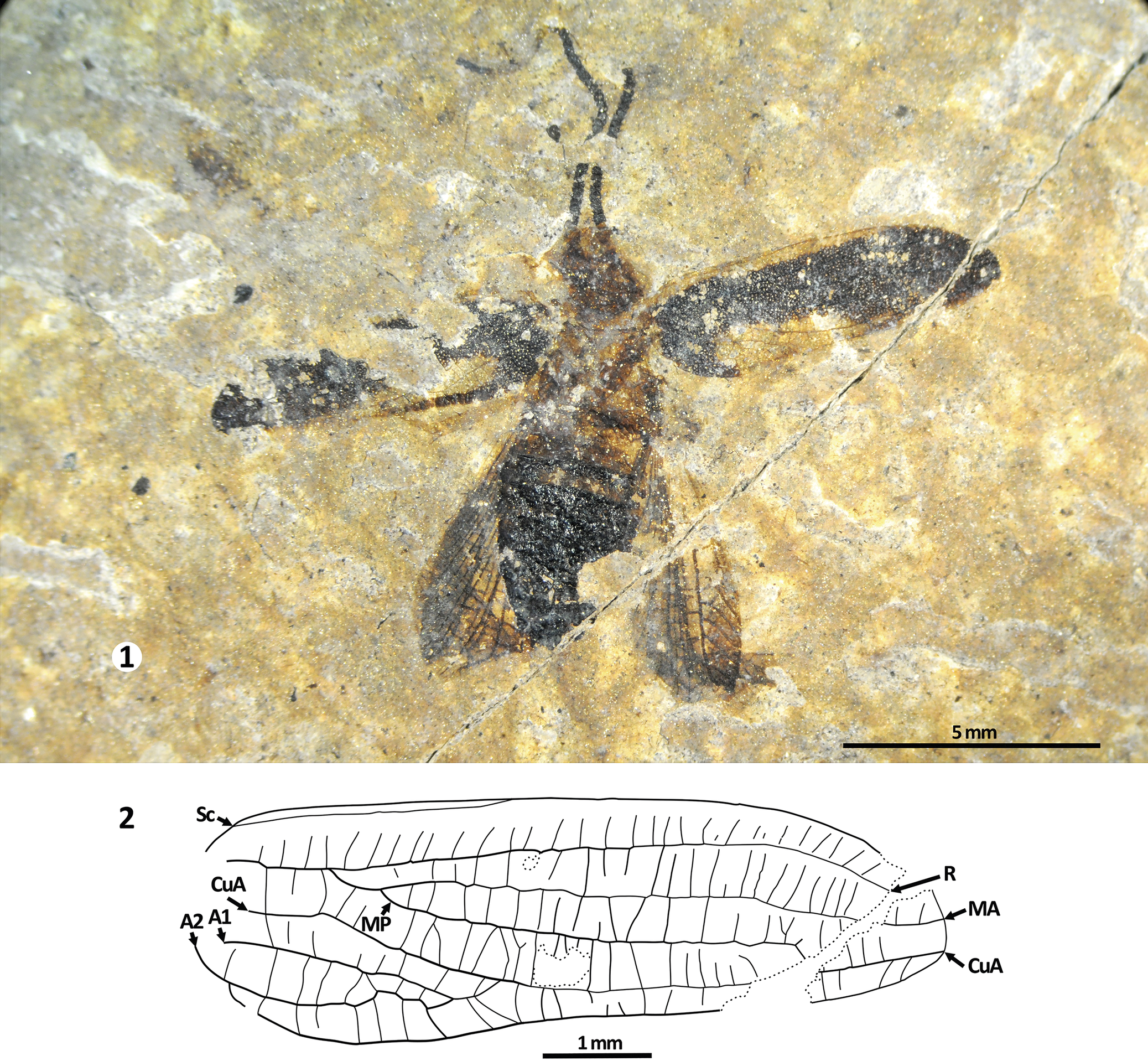
Diploptera reticulata n. sp. holotype SF-MeI17183. (1) Photograph. (2) Drawing of right tegmen venation: A1, A2 = the first and second anal vein; CuA = anterior branch of the cubitus; MA = anterior branch of the media; MP = posterior branch of the media; R = radius; Sc = subcosta.

Figure 1. Long description
Panel 1 is a photograph of a dark brown insect fossil embedded in light tan rock. The insect is positioned vertically with its head at the top, showing two antennae, a segmented abdomen, and partially preserved wings extending laterally. A 5 millimeter scale bar is in the bottom right.
Panel 2 is a scientific line drawing of the right tegmen wing venation with a 1 millimeter scale bar. Labels indicate specific veins using arrows:
* S c is at the top left anterior margin.
* R is at the far right distal tip.
* M A is just below R on the right edge.
* C u A is labeled in two places: once near the proximal base on the left and once at the bottom right edge.
* M P is located in the upper-middle section of the wing.
* A 1 and A 2 are at the bottom left proximal corner.
The drawing shows a complex network of longitudinal veins connected by numerous short, vertical cross-veins, forming a grid-like pattern across the wing surface.
Holotype
SF-MeI17183 from the Messel pit.
Diagnosis
May be separated from all extant and extinct species of Diploptera by distinctive tegmen coloration (dark with light region in posterior half basally except basal-most portion and light along anterior margin except near apex) or by tegmen with extensive cross-venation. Further distinguished from D. savba by normal-sized bunky (D. savba is notably large). Further separated from Okanagan Highlands species as in their diagnoses, below.
Occurrence
Messel pit, Germany, Eocene, Lutetian; layers 2.05 to 2.5 meters above local marker horizon alpha in local grid square F 8/9 of the Messel pit.
Description
Holotype SF-MeI17183: sex undetermined. As in diagnosis and the following. Wingspan 15.6 mm. Length, anterior of pronotum to posterior of terminal segment, 8.3 mm. Head completely concealed by pronotum. Pronotum oval, 1.8 mm long, 2.4 mm wide. Antennae moniliform, dark, with light-colored portion in area of approximately fortieth antennomere. Hardened tegmina, elytron-like: 7 mm long, 2.3 mm wide, with bunky, distinct coloration, see diagnosis. Subcosta roughly half wing length; radius simple, radial sector branching anteriorly; media briefly joined to radius basally, branching to anterior branch of the media, posterior branch of the media close to separation from radius; anterior branch of the cubitus originates from wing base, same shape as clavus, parallel to and close to posterior margin in apical wing half. Anal area about one-third wing length, consisting of first anal vein, second anal vein with irregular shape. Many cross-veins forming fenestrations. Hind wing with cross-veins, folded transversely with associated appendicular field. Seven sternites, maximum width 2.7 mm.
Etymology
The specific epithet is formed from the Latin reticulata, referring to the pattern formed by the numerous cross-veins of the tegmina.
Remarks
The Diploptera reticulata and D. rothi fossils are the only ones that preserve the distinctive Diploptera hind-wing folding, unique within the Blattodea.
Diploptera rothi new species
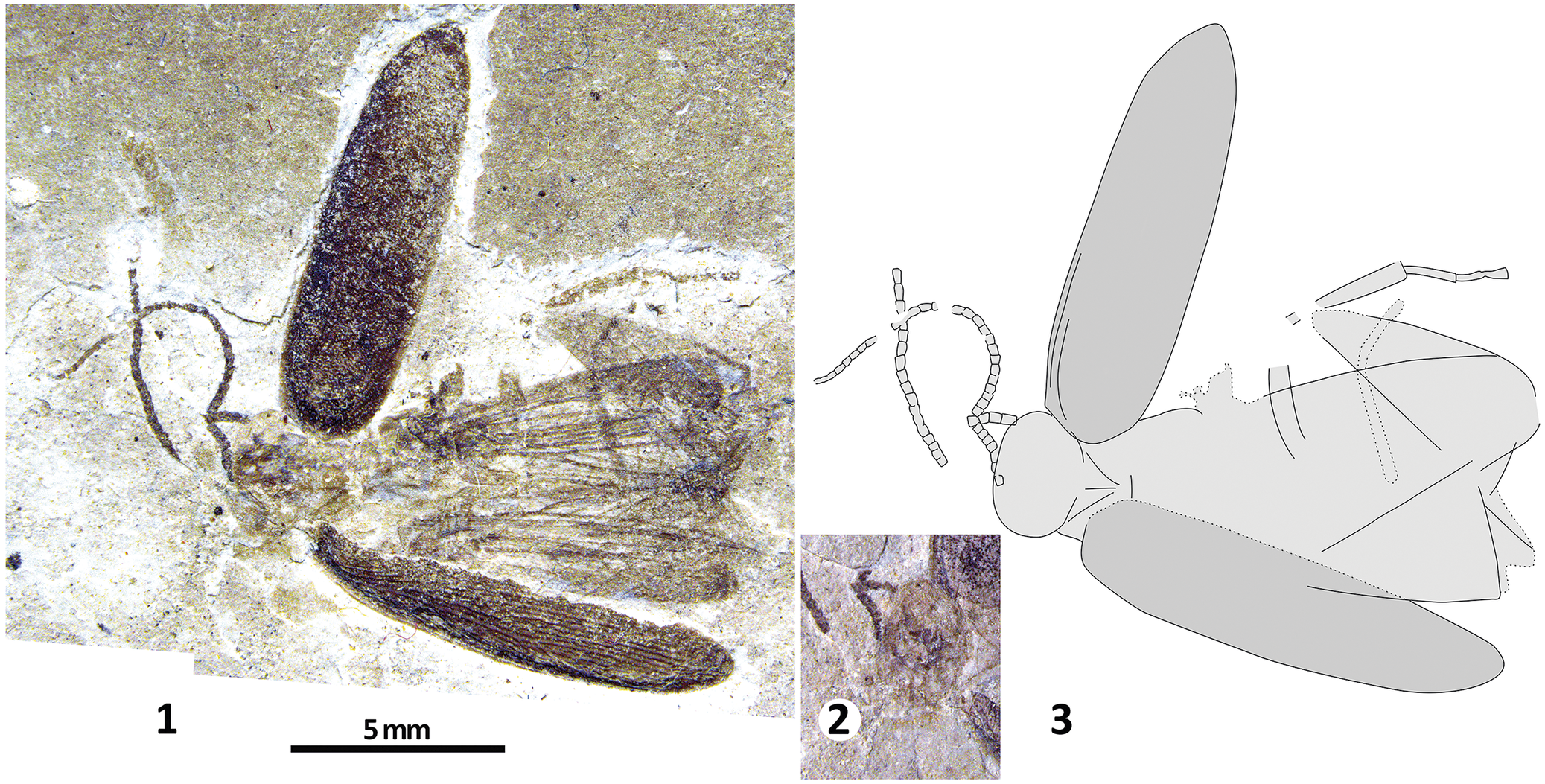
Diploptera rothi n. sp. holotype BBM P014400. (1) Photograph of the part. (2) Pronotum of the counterpart wetted with ethanol. (3) Drawing from both the part and counterpart.

Figure 2. Long description
Panel 1 is a photograph of the fossil specimen on a light-colored rock matrix. The insect is oriented horizontally with its head to the left. It features long, segmented antennae curving upward and downward. Two large, dark, oval-shaped tegmina (forewings) are visible, with one extended upward and the other downward. The hindwings are partially preserved and spread out behind the body. A scale bar at the bottom indicates 5 mm.
Panel 2 is a small, square inset photograph showing a close-up of the pronotum, which is the dorsal plate of the prothorax. The surface appears textured and was wetted with ethanol to enhance contrast.
Panel 3 is a gray-shaded line drawing that synthesizes features from both the part and counterpart of the fossil. It clearly outlines the head, the segmented antennae, the large oval tegmina, and the underlying wing venation. Dotted lines indicate areas where the structure is inferred or less distinct. The drawing provides a clear anatomical map of the holotype B B M P 0 1 4 4 0 0.
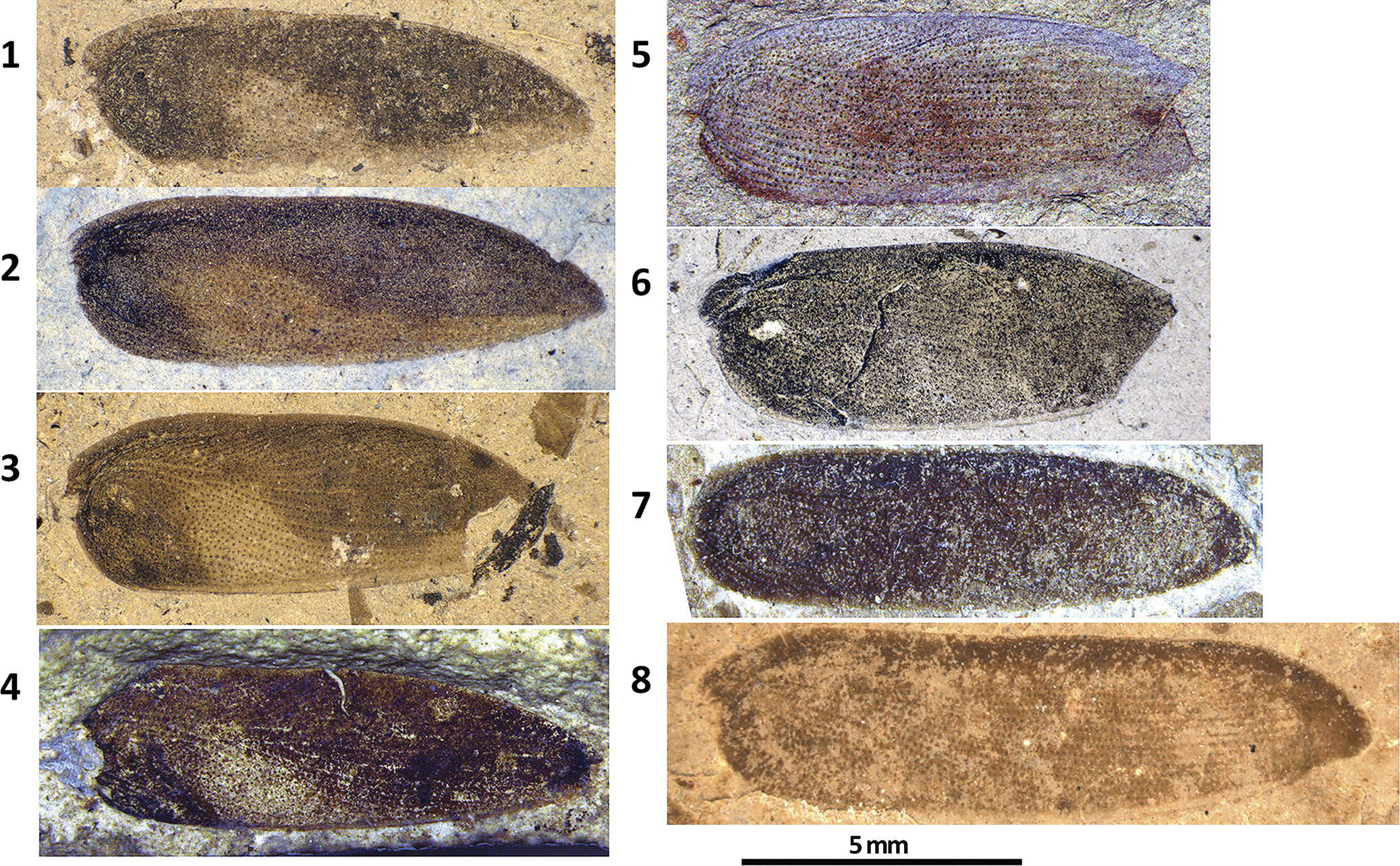
Okanagan Highlands Diploptera tegmina assigned to species. (1–4) D. simeoptera n. sp.: (1) SR 06-01-10; (2) SRUI 99-78-87; (3) SR 01-01-01; (4) SR 99-89-52. (5, 6) D. praecisus n. sp.: (5) BBM P014407; (6) SRUI 09-95-01A. (7) D. rothi n. sp., BBM P014400. (8) Tentatively D. rothi n. sp., BBM P014399.

Figure 3. Long description
The photo consists of eight panels arranged in two columns. A 5 mm scale bar is located at the bottom center.
Left Column:
* Panel 1: Diploptera simeoptera specimen S R 06-01-10. An elongated, dark brown fossil wing with a rounded apex on a light tan matrix.
* Panel 2: Diploptera simeoptera specimen S R U I 99-78-87. Similar in shape to panel 1 but with a darker, more uniform brown coloration.
* Panel 3: Diploptera simeoptera specimen S R 01-01-01. A lighter tan wing showing distinct punctation patterns across the surface.
* Panel 4: Diploptera simeoptera specimen S R 99-89-52. A dark, highly textured wing fossil embedded in a rough, greyish-white rock matrix.
Right Column:
* Panel 5: Diploptera praecisus specimen B B M P 0 1 4 4 0 7. A reddish-brown wing with very clear, dense rows of small pits or punctations.
* Panel 6: Diploptera praecisus specimen S R U I 09-95-01 A. A dark grey to black wing fossil with a visible crack running vertically through the center.
* Panel 7: Diploptera rothi specimen B B M P 0 1 4 4 0 0. A dark, oval-shaped wing with a lighter, speckled border.
* Panel 8: Tentatively Diploptera rothi specimen B B M P 0 1 4 3 9 9. A light brown, translucent wing fossil showing faint longitudinal venation.
Reference Greenwood, Archibald, Mathewes and Moss2005 Diplopterinae, probably Diploptera; Greenwood et al., p. 175, fig. 4A.
Reference Archibald, Cover and Moreau2006 Diplopterinae; Archibald et al, p. 515.
Reference Archibald2007 Diplopterinae; Archibald, vol. 1, p. 8, vol. 2, p. 456.
Reference Archibald, Greenwood and Mathewes2013 Diplopterinae; Archibald et al., p. 3.
Reference Vršanský, Šmídová, Valaška, Barna and Vidlička2016 Diploptera species; Vršanský et al., p. 1, 3, 12, fig. 4.
Reference Archibald and Makarkin2021 Diplopterinae; Archibald and Makarkin, p. 71.
Holotype
BBM P014400A, B. (SBA-999A, B) collected 21 May 2001 by S.B.A. at McAbee (Hoodoo Face).
Diagnosis
Diploptera rothi is distinct from extinct and extant species of Diploptera as follows.
Tegmen coloration
Uniformly dark (possibly slightly lighter apically, but likely artifact) with pronotum notably lighter (others: either pronotum and tegmina similarly colored or tegmina light and pronotum light with dark patterns [see, e.g., Li and Wang Reference Li and Wang2015, D. maculata fig. 66 and greater dark area in fig. 69]; D. reticulata coloration as in its diagnosis above; D. savba with light macula located around two-thirds wing length; D. vladimir with pale stripe on posterior margin; from other Okanagan Highlands species and all unnamed tegmen specimens as below).
Tegmen shape
Rather rounded rectangular, anterior and posterior margins subparallel for much of length, not long-tapered distally (Figs. 2, 3), comparatively long, narrow, maximum width 0.28 of length (holotype and BBM P014399), without distinct clavus (all other Okanagan Highlands specimens width 0.31 to 0.41 of length, Green River Formation specimens 0.37 to 0.42, D. reticulata 0.32, extant species 0.30 to 0.42; either tapered to apex from about mid-length, some with anterior margin broadly curved and posterior margin more straight, or D. praecisus with apex “clipped” [Fig. 3]; D. reticulata: widest in basal third, middle third slightly narrower, similar width, tapering in apical third; D. vladimir with distinct clavus).
Pronotum shape
Oval, posterior margin curved, not straight (“bell-shape” of Vršanský et al., Reference Vršanský, Šmídová, Valaška, Barna and Vidlička2016); without posterolateral angles (pointed projections); width ~1.4 length (bell-shaped, with posterolateral angles in D. punctata, D. minor, D. erythrocephala, D. parva, D. naevus, D. nigrescens; oval/suboval without posterolateral angles in D. reticulata, D. vladimir, D. savba, D. elliptica, D. maculata [extant species pronotum shapes see Lee and Wang, Reference Li and Wang2015, figs. 2–16; D. “bicolor” = D. maculata]; width to length of species with oval/suboval pronota: D. elliptica, D. maculata, D. reticulata ~1.3, D. vladimir, D. savba, a bit wider, ~1.4)
Further distinction from D. savba
Normal-sized bunky (D. savba: large).
Occurrence
Okanagan Highlands McAbee locality of unnamed formation, late Ypresian.
Description
Holotype BBM P014400A, B, sex undetermined. As in diagnosis and the following. Head completely concealed by pronotum; antennae moniliform, dark, long, but incompletely preserved; pronotum light colored, oval, 2.0 mm long, 2.8 mm wide; tegmina sclerotized, dark, shape as in diagnosis, 10.0 mm long, 2.8 mm wide; with bunky throughout arranged in rows, but venation generally obscured. Hind wing partially folded transversely, with cross-veins, appendicular field present with fully formed veins. Legs, disarticulated portions preserved. Abdomen poorly to not preserved.
Etymology
The specific epithet is a patronymic formed from the surname of the late Louis Roth, recognizing his contributions to our knowledge of cockroaches.
Remarks
The shape and coloration of tegmen BBM P014399 is close to that of the D. rothi holotype; however, it is larger, 12.0 mm long versus 10.0 mm. This might be a larger female and the holotype a smaller male, but the sex of neither is known. We tentatively associate it with this species.
Diploptera simeoptera new species
Holotype
SRUI 99-78-87 from Republic, Washington, collected 1 July 2007 by Karl Volkman.
Materials
The holotype (Fig. 3.2) and paratypes SR 06-01-10 (Fig. 3.1) collected by Gregg Wilson, 27 August 2005; SR 01-01-01 (Fig. 3.3), collected by Stonerose staff, 15 September 2001; and SRUI 99-89-52 (Fig. 3.4), collected by Gregg Wilson, 25 June 2009. All are from Klondike Mountain Formation exposure B4131 at Republic, Washington, and are housed in the collections of the Stonerose Interpretive Center.
Diagnosis
Separated from other Diploptera species by coloration (Fig. 3): dark tegmina with light spot on the posterior side at about basal second fifth, evenly diminishing to light line along posterior margin to apex.
Occurrence
Klondike Mountain Formation exposure B4131 at Republic, Washington, USA; Ypresian.
Description
Tegmina as in diagnosis, Figure 3, sclerotized with dense bunky.
Etymology
The specific epithet is derived from the Greek σημείο πτέρυγας (simeío ptérygas), meaning “wing spot,” referring to their distinctively colored tegmina.
Remarks
Specimens SRUI 99-78-87 and SRUI 99-89-52 are very similar in shape (Fig. 3), consistent with their belonging to the same species. Precise measurements of SR 06-01-10 are not possible by preservation; however, it bears the same distinctive coloration of specimens assigned to the species and appears similarly shaped. SR 01-01-01 also shares this distinctive color pattern but is notably wider, with an otherwise similar shape, which might be explained by sexual dimorphism.
Diploptera praecisus new species
Reference Archibald and Mathewes2000 Diplopterinae Archibald and Mathewes, p. 1441, 1447, 1457, fig. 15.
Reference Archibald and Farrell2003 Diplopterinae; Archibald and Farrell, p. 20.
Reference Makarkin, Archibald and Oswald2003 Diplopterinae; Makarkin et al., p. 644.
Holotype
BBM P014407A, B (Q-0040A, B) (Fig. 3.5, collected by R.W.M. at Quilchena between 1995 and 2000.
Materials
The holotype and SRUI 09-95-01.5A, B (Fig 3.6), collected 23 April 2009 by Joanne West at Republic A0307.
Diagnosis
Separated from all other Diploptera species by tegmina with sharp, straight, cross-tegmen angle near apex (“clipped”).
Occurrence
Coldwater beds at Quilchena, British Columbia, Canada, and Klondike Mountain Formation exposure A0307 at Republic, Washington; Ypresian.
Description
Tegmen sclerotized, with dense bunky, uniformly dark; with distinctive apical angle as in diagnosis. General shape otherwise as in diagnosis and Figure 3.
Etymology
The specific epithet praecisus is Latin for “cut or broken off,” referring to the diagnostic shape of the tegmina.
Remarks
This tegmen shape is not an artifact as it is identically present in both overlapping forewings of the holotype from Quilchena and in SRUI 09-95-01.5 from Republic (Fig. 3).
Diploptera sp. indet.
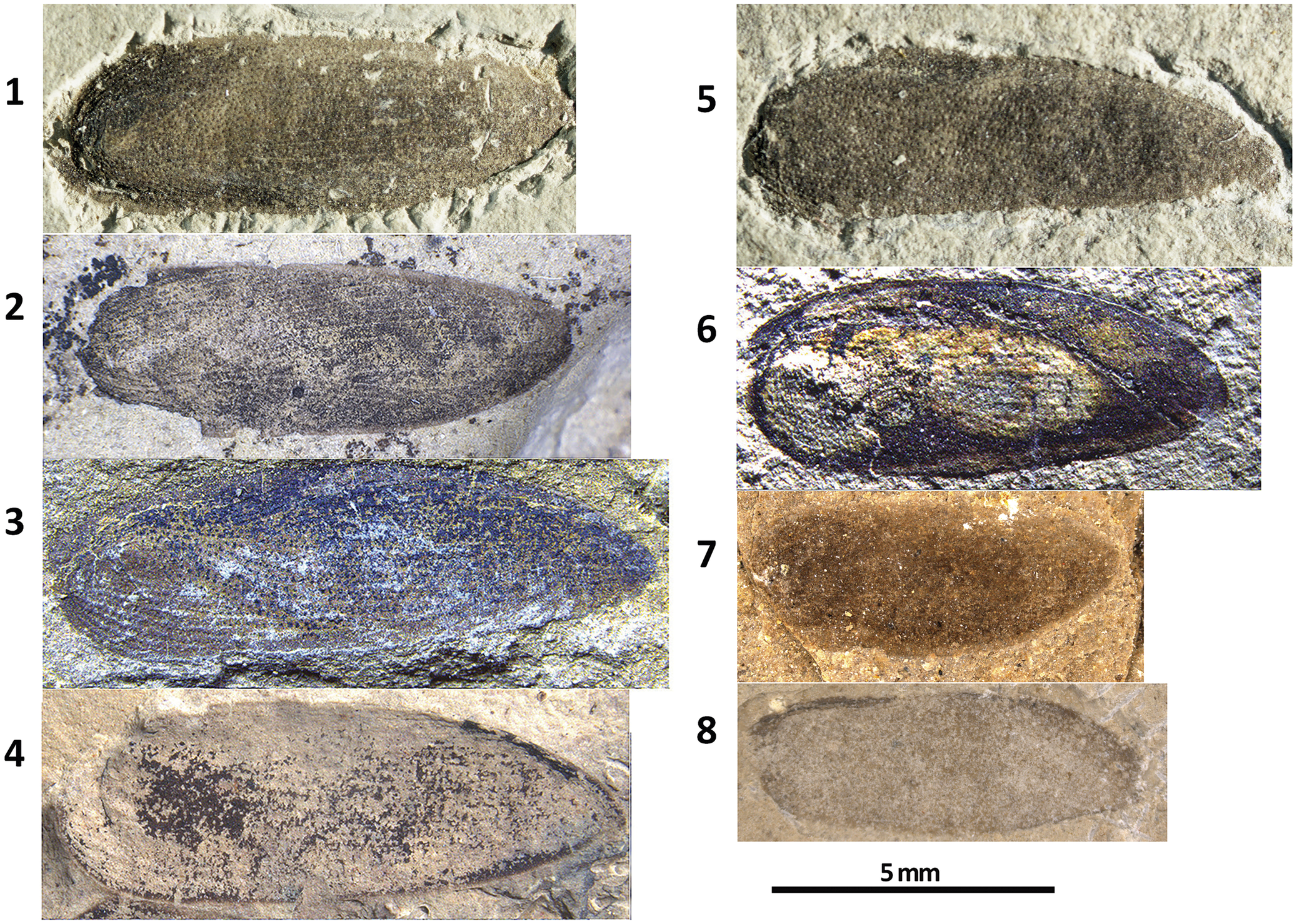
Okanagan Highlands Diploptera incertae sedis tegmina. (1) SRUI 09-96-79. (2) SRUI 99-81-43. (3) BBM P014408A. (4) BBM P014406. (5) SRUI 99-90-21. (6) SRUI 99-50-48A. (7) BBM P014403. (8) BBM P014402.

Figure 4. Long description
The eight panels display fossilized tegmina preserved in rock matrix. Each wing is roughly elliptical or elongated in shape.
Left column:
1. S R U I 09-96-79: A dark brown, textured wing with visible venation patterns against a light grey matrix.
2. S R U I 99-81-43: A mottled grey and brown wing with a slightly more rounded posterior end.
3. B B M P 014408 A: A wing with a distinct blue-grey hue and fine granular texture.
4. B B M P 014406: A light tan wing featuring dark, speckled carbonaceous remains concentrated in the center.
Right column:
5. S R U I 99-90-21: A dark, elongated wing with a pointed apex.
6. S R U I 99-50-48 A: A highly detailed wing with iridescent gold and dark purple tones, showing clear structural veins.
7. B B M P 014403: A reddish-brown wing with a smooth, uniform texture.
8. B B M P 014402: A pale, translucent wing impression with faint outlines.
At the bottom right, a black scale bar indicates a length of 5 mm.
Reference Archibald and Mathewes2000 Diplopterinae (Q-0048), Archibald and Mathewes, p. 1442, 1448, fig. 15.
Materials
All tegmina only. McAbee: BBM P014403 (SBA-142) (Fig. 4.7), collected 21 June 2000 by S.B.A.; BBM P014402 (SBA-2468) (Fig. 4.8) collected 25 June 2000 by S.B.A. Quilchena: BBM P014406A, B (Q-0048A, B) (Fig. 4.4); BBM P014408A, B (Q-0516A) (Fig. 4.3), all collected between 1995 and 2000 by R.W.M. Republic: SRUI 99-50-48 (Fig. 4.6) collected 20 September 2022 by Karl Volkman at A0307; SRUI 99-81-43 (Fig. 4.2), collected 20 May 2009 by Gregg Wilson at B4131; SRUI 09-96-79 (Fig. 4.1), collected 19 April 2009 by Peg Johnson at B4131; SRUI 99-90-21 (Fig. 4.5) collected 20 June 2009 by Gregg Wilson at B4131.
Remarks
These Diploptera tegmina cannot be placed in any extant or extinct named species of the genus and do not have distinctive enough character states in common to support grouping one or more into new species. SRUI 09-96-79 and SRUI 99-81-43 from Republic might be conspecific (Fig. 4.1, 4.2), as might be BBM P014408A and BBM P014406 from Quilchena (Fig. 4.3, 4.4) and BBM P014403 and BBM P014402 from McAbee (Fig. 4.7, 4.8), but we treat them all as Diploptera sp. indet. awaiting clarification from new fossils.
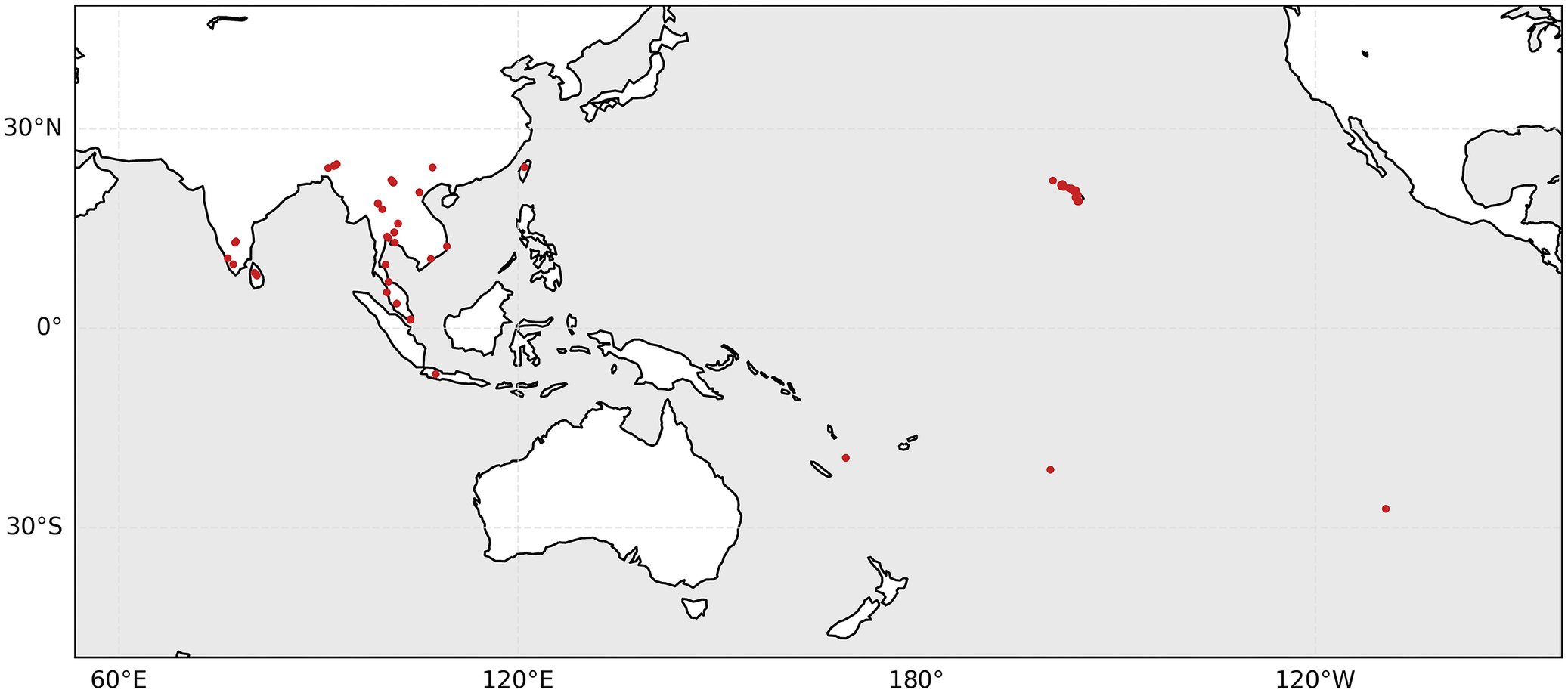
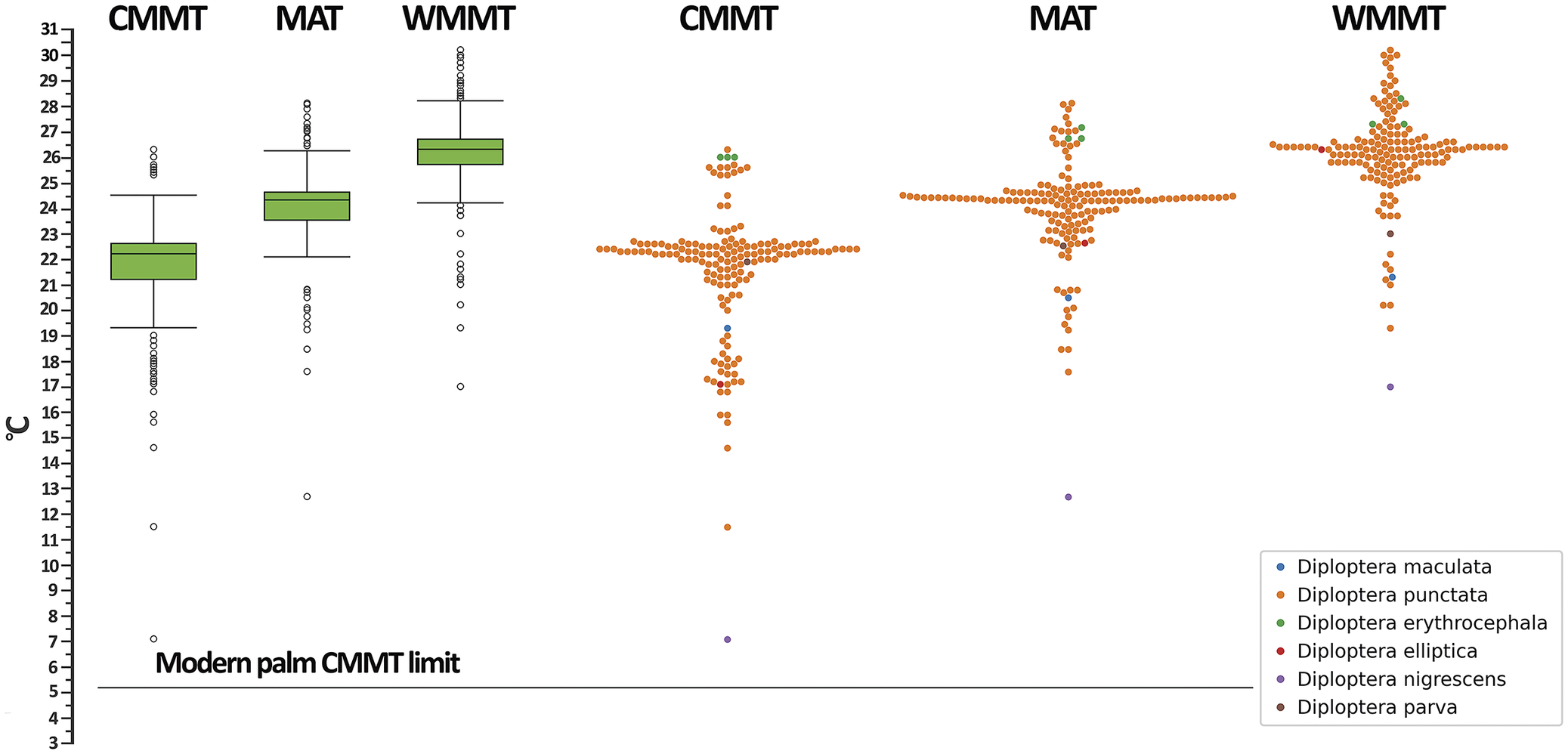
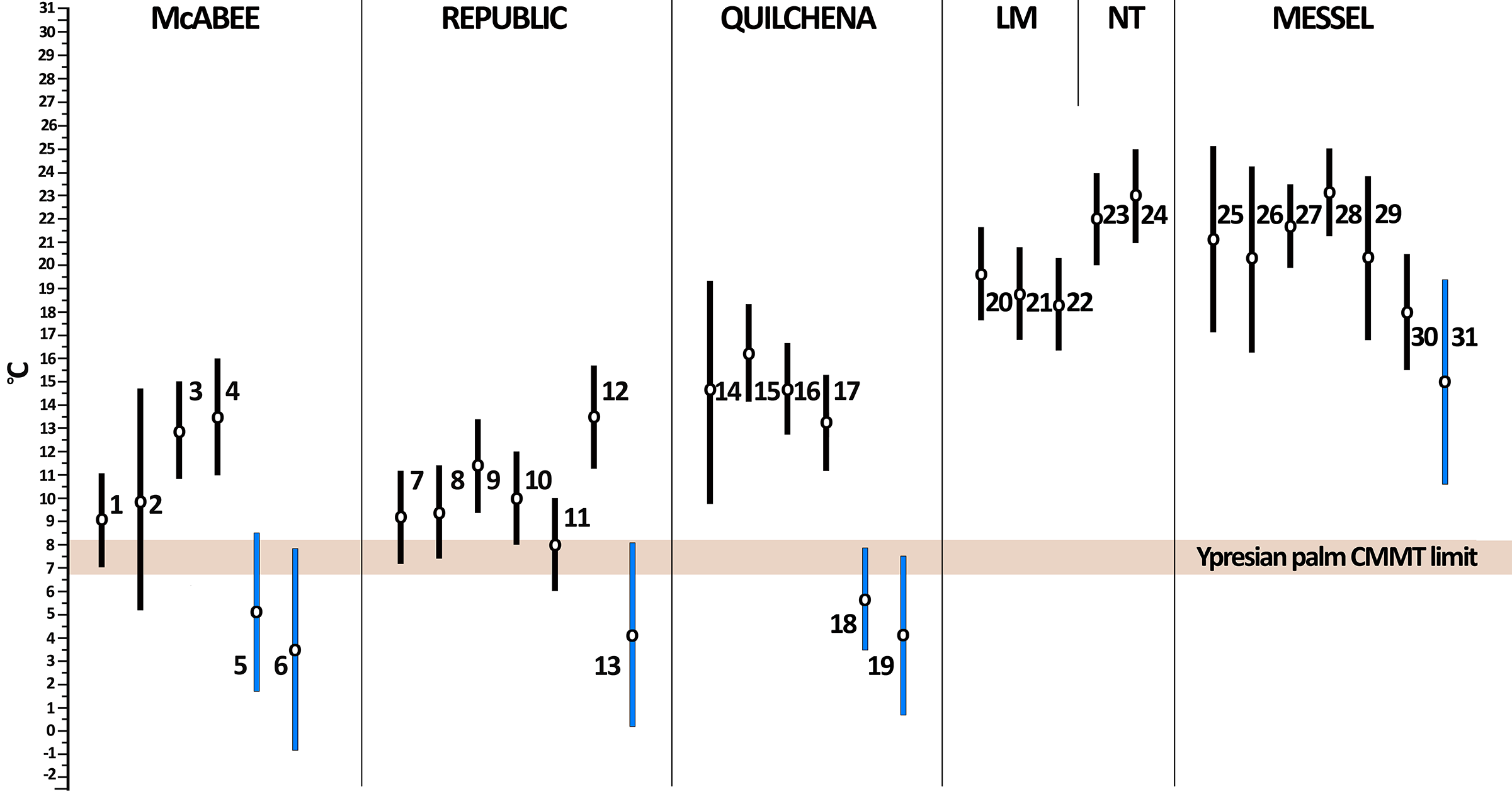
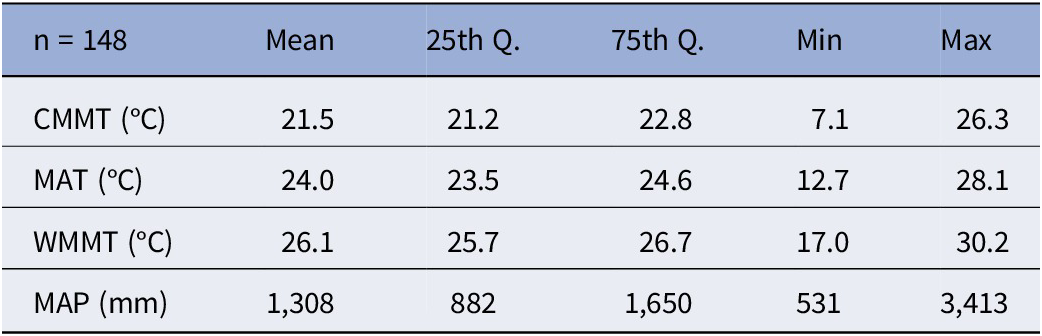
Diploptera distribution and climate
Today, Diploptera species inhabit parts of the Sino-Japanese, Oriental, and Oceanian Realms (Holt et al., Reference Holt, Lessard, Borregaard, Fritz and Araújo2013) (Fig. 5, Table S1). They almost entirely inhabit regions of megathermal MAT, with a few in upper mesothermal MAT, all with CMMT well above frost days (Fig. 6). Fossil Diploptera range in microthermal to megathermal climates (Fig. 7) (climate analysis has not been published for the Ping Chau Formation). They inhabit regions of mesic to moist MAP today (Table 1, Table S1) and in the Eocene: Messel, 803–2,540 mm/year (Grein et al., Reference Grein, Utescher, Wilde and Roth-Nebelsick2011); Republic, 1,150 ± 390 mm/year (Greenwood et al., Reference Greenwood, Archibald, Mathewes and Moss2005); Quilchena, 1,030–1,570 mm/year (Mathewes et al., Reference Mathewes, Greenwood and Archibald2016); and McAbee, >1,000 mm/year (Gushulak et al., Reference Gushulak, West and Greenwood2016).
Map of extant Diploptera species occurrences from GBIF data used in our climate analysis.

Figure 5. Long description
A geographical map with a coordinate grid. The Y axis shows latitude from 30 degrees South to 30 degrees North. The X axis shows longitude from 60 degrees East to 120 degrees West. Red dots representing species occurrences are distributed as follows.
* In the West, points are located along the southern coast of India and Sri Lanka.
* Moving East, a high concentration of points is found across Southeast Asia, including Myanmar, Thailand, Vietnam, and the Malay Peninsula.
* Further East, points appear in Taiwan and the northern Philippines.
* In the Southern Hemisphere, isolated points are located in Java, Indonesia, and near the islands of Fiji and Tonga.
* In the Central Pacific, a dense cluster of points is located around the Hawaiian Islands.
* The easternmost point is an isolated occurrence in the South Pacific, West of South America near 30 degrees South and 100 degrees West.
Box plots and swarmplots of extant Diploptera specimen localities by their CMMT, MAT, and WMMT values (box plots: minimum 25%, median 75%, and maximum values). The modern palm lowest CMMT limit is 5.2 °C, below which their seeds and seedlings cannot survive (Reichgelt et al., Reference Reichgelt, West and Greenwood2018).

Figure 6. Long description
The Y-axis represents temperature in degrees Celsius, ranging from 3 to 31. A horizontal black line at 5.2 degrees Celsius is labeled Modern palm C M M T limit.
On the left, three green box plots represent C M M T, M A T, and W M M T from left to right.
- C M M T: Median is approximately 22.2, with a box spanning 21 to 22.8 and outliers extending down to 7.
- M A T: Median is approximately 24.3, with a box spanning 23.5 to 24.8 and outliers down to 12.5.
- W M M T: Median is approximately 26.3, with a box spanning 25.8 to 26.8 and outliers down to 17.
On the right, three swarmplots correspond to the same categories. The data points are primarily orange, representing Diploptera punctata, with scattered points in other colors.
- C M M T swarm: Dense cluster between 21 and 23, with a long tail of outliers reaching down to 7.
- M A T swarm: Dense horizontal cluster around 24.5, with outliers down to 12.5.
- W M M T swarm: Dense horizontal cluster around 26.5, with outliers down to 17.
A legend in the bottom right identifies the species by color:
- Blue: Diploptera maculata
- Orange: Diploptera punctata
- Green: Diploptera erythrocephala
- Red: Diploptera elliptica
- Purple: Diploptera nigrescens
- Brown: Diploptera parva
Temperature variables for Eocene Diploptera. MAT (black) and CMMT (blue). Abbreviations of climate analysis methods: NLR = bioclimatic nearest living relative method; LMA = leaf margin analysis; CLAMP = Climate Leaf Analysis Multivariate Program. McAbee (1–3, 5: Gushulak et al., Reference Gushulak, West and Greenwood2016; 4, Greenwood et al., Reference Greenwood, Archibald, Mathewes and Moss2005): 1, 2 LMA; 3, CLAMP; 4, NLR; 5, CLAMP; 6, NLR. Republic (all Greenwood et al., Reference Greenwood, Archibald, Mathewes and Moss2005): 7, 8, LMA; 9–11, CLAMP; 12, NLR; 13, NLR. Quilchena (all Mathewes et al., Reference Mathewes, Greenwood and Archibald2016): 14, 15, LMA; 16, NLR; 17, NLR; 18, NLR; 19, CLAMP. Green River Formation Little Mountain (LM) (20, Wilf, Reference Wilf2000: 21, 22, Archibald et al., Reference Archibald, Johnson, Mathewes and Greenwood2011b): 20–22, LMA; Niland Tongue, Wasatch Formation, in the Green River Basin, coeval with the Green River Formation (NT) (23, Archibald et al., Reference Archibald, Johnson, Mathewes and Greenwood2011b; 24, Wilf, Reference Wilf2000): 23, 24, LMA. Messel (25, 26, Archibald et al., Reference Archibald, Johnson, Mathewes and Greenwood2011b; 27–29, 31, Grein et al., Reference Grein, Utescher, Wilde and Roth-Nebelsick2011; 30, Tütken, Reference Tütken2014): 25–28 LMA; 29, NLR; 30, isotope analysis of vertebrate bones; 31, NLR. Ypresian palm CMMT lower limit (brown) is between 6.7 and 8.2 °C (Reichgelt et al., Reference Reichgelt, West and Greenwood2018).

Figure 7. Long description
A line graph with a Y-axis representing temperature in degrees Celsius, ranging from negative 2 to 31. The X-axis is divided into six vertical panels separated by thin lines. A horizontal tan-colored band spans the width of the graph between 6 and 7.5 degrees Celsius, labeled Ypresian palm C M M T limit.
* Panel 1, McAbee: Contains six data points. Points 1 through 4 are black, ranging from 8 to 13 degrees. Points 5 and 6 are blue, located below the tan band between 2 and 4 degrees.
* Panel 2, Republic: Contains seven data points. Points 7 through 12 are black, ranging from 7 to 13 degrees. Point 13 is blue, located below the tan band at approximately 3 degrees.
* Panel 3, Quilchena: Contains six data points. Points 14 through 17 are black, ranging from 12 to 16 degrees. Points 18 and 19 are blue, located below the tan band between 3 and 5 degrees.
* Panel 4, L M: Contains three black data points, 20 through 22, clustered between 17 and 19 degrees.
* Panel 5, N T: Contains two black data points, 23 and 24, clustered between 21 and 22 degrees.
* Panel 6, Messel: Contains seven data points. Points 25 through 29 are black, ranging from 19 to 22 degrees. Point 30 is black at 17 degrees. Point 31 is blue at 14 degrees.
Black bars represent M A T and blue bars represent C M M T. All data points feature vertical error bars indicating the range of temperature estimates.
Climate data for extant Diploptera localities.

Table 1. Long description
The table consists of six columns: Variable (n = 148), Mean, 25th Q. (Quartile), 75th Q. (Quartile), Min, and Max.
* C M M T (degrees Celsius): Mean 21.5, 25th Q. 21.2, 75th Q. 22.8, Min 7.1, Max 26.3.
* M A T (degrees Celsius): Mean 24.0, 25th Q. 23.5, 75th Q. 24.6, Min 12.7, Max 28.1.
* W M M T (degrees Celsius): Mean 26.1, 25th Q. 25.7, 75th Q. 26.7, Min 17.0, Max 30.2.
* M A P (mm): Mean 1,308, 25th Q. 882, 75th Q. 1,650, Min 531, Max 3,413.
Microthermal localities
McAbee
MAT estimated by LMA is 9.2 ± 2.0 °C and 9.9 ± 4.8 °C using different equations, and by CLAMP is 12.9 ± 2.1 °C. CMMT has a CLAMP estimate of a minimum 5.1 ± 3.4 °C (Gushulak et al., Reference Gushulak, West and Greenwood2016); NLR analysis gives MAT of 13.5 ± 2.5 °C and CMMT of 3.5 ± 4.4. CMMT (Greenwood et al., Reference Greenwood, Archibald, Mathewes and Moss2005) is limited, however, to no colder than 6.7–8.2 °C by the presence of palms (Reichgelt et al., Reference Reichgelt, West and Greenwood2018, see below) as indicated by obligate palm-feeding beetles (Coleoptera, Chrysomelidae, Pachymerina; Archibald et al., Reference Archibald, Morse, Greenwood and Mathewes2014a).
Republic
MAT estimated by differing LMA equations of 9.1 °C and 9.4 °C and by CLAMP of 11.4 °C, 10.0° C, and 8.0 °C (all ±2.0 °C); NLR analysis gives a MAT of 13.5 °C ± 2.2 and a CMMT of 4.1 °C ± 4.0 (Greenwood et al., Reference Greenwood, Archibald, Mathewes and Moss2005), but limited to no lower than 6.7–8.2 °C as at McAbee by the presence of Pachymerina (Archibald et al., Reference Archibald, Morse, Greenwood and Mathewes2014a).
Low to mid-mesothermal locality
Quilchena
MAT of 14.6 ± 4.8 °C and 16.2 ± 2.1 °C by LMA using differing equations, and an NLR MAT of 12.7–16.6 °C with a CMMT of 3.5–7.9 °C (Mathewes et al., Reference Mathewes, Greenwood and Archibald2016). CLAMP gives a slightly cooler MAT of 13.3 ± 2.1 °C. CMMT is 4.1 ± 3.4 °C by CLAMP but limited to 6.7–8.2 °C by Pachymerina as above (Archibald et al., Reference Archibald, Morse, Greenwood and Mathewes2014a).
Upper mesothermal to megathermal localities
Green River Formation
MAT estimates by LMA of exposures at Little Mountain, Wyoming, are 19.6 °C, 18.8 °C, and 18.3 °C, and at Niland Tongue, Wyoming (Wasatch Formation in the Green River Basin, coeval with the Green River Formation), are 22.0 °C and 23.0 °C (all ±2 °C) (Archibald et al., Reference Archibald, Johnson, Mathewes and Greenwood2011b).
Messel
MAT of 21.1 °C and 20.3 °C, both ± 2.0 °C, by different LMA equations (Archibald et al., Reference Archibald, Johnson, Mathewes and Greenwood2011b). Grein et al. (Reference Grein, Utescher, Wilde and Roth-Nebelsick2011) estimated a MAT using LMA of 21.7 ± 1.8 °C to 23.1 ± 1.9 °C (mean value: 22.4 °C) and using NLR of 16.8–23.9 °C, with a CMMT of 10.6–19.4 °C and a WMMT of 24.7–27.9 °C. Their combined data indicates a MAT of about 22–24 °C, CMMT above 10 °C. Tütken (Reference Tütken2014) reconstructed a MAT of about 18 °C ± 2.5 °C for Messel by isotope analysis of vertebrate bones
Establishing Eocene winter temperatures
Palms have received particular attention as minimum CMMT indicators in fossil communities as they lack seasonal dormancy, and their soft, water-rich tissues make them highly vulnerable to freezing, particularly their seeds and seedlings (e.g., Van der Burgh, Reference Van der Burgh1984; Wing and Greenwood, Reference Wing and Greenwood1993; Greenwood and Wing, Reference Greenwood and Wing1995; Royer et al., Reference Royer, Osborne and Beerling2002; Sluijs et al., Reference Sluijs, Schouten, Donders, Schoon, Röhl, Reichart, Sangiorgi, Kim, Sinninghe Damsté and Brinkhuis2009; Archibald et al., Reference Archibald, Bossert, Greenwood and Farrell2010, Reference Archibald, Morse, Greenwood and Mathewes2014a; Greenwood and West, Reference Greenwood and West2017; Reichgelt et al., Reference Reichgelt, West and Greenwood2018; Greenwood et al., Reference Greenwood, Conran and West2022; Siver et al., Reference Siver, Reyes, Pisera, Buryak and Wolfe2025). Reichgelt et al. (Reference Reichgelt, West and Greenwood2018) considered the caveats of preceding authors and set a conservative CMMT lower limit for Ypresian palms at between 6.7 and 8.2 °C.
Palms have been found in the highest mesothermal to megathermal Messel (Wilde, Reference Wilde1989; Collinson et al., Reference Collinson, Manchester and Wilde2012 and references therein) and Green River (Allen, Reference Allen2015) formations. In the Okanagan Highlands, the palm Uhlia allenbyensis Erwin and Stockey, Reference Erwin and Stockey1994 (Arecaceae) is known from the microthermal Allenby Formation Princeton Chert (British Columbia) (Erwin and Stockey, Reference Erwin and Stockey1991), although their macrofossils are not known from coeval Allenby Formation lacustrine shale or any other Okanagan Highlands locality. This could be explained as a taphonomic artifact. Plants are preserved in situ in Allenby Formation chert, whereas to be preserved in lacustrine shale, their leaves or other organs must be moved from their life location to an offshore depositional environment. While this is easy for deciduous leaves that abscise and are transported by winds, the dead leaves of palms remain attached to the plant to form a skirt and so are difficult to transport over a lake. Furthermore, Uhlia is reconstructed as growing close to the ground, not with leaves on top of tall trunks, decreasing the chance of them breaking free and being transported in a storm. Pollen thought to be that of the palm Sabal granopollenites Rouse, Reference Rouse1962 is present in some Okanagan Highland shales; however, this might be confused with some pollen of the lily family (Liliaceae) (Archibald et al., Reference Archibald, Morse, Greenwood and Mathewes2014a). Palms are, however, established at Quilchena, McAbee, and Republic by the presence of obligate palm-feeding beetles of the subtribe Pachymerina (Coleoptera, Chrysomelidae, Bruchinae, Pachymerini) (Archibald et al., Reference Archibald, Morse, Greenwood and Mathewes2014a), limiting CMMT there to no lower than 6.7–8.2 °C, as above.
Diploptera, climate and biogeography
Our findings support the range of Diploptera, Eocene and modern, as limited by CMMT, not MAT. Diploptera are cryophobic, intolerant of cold temperature, but eurythermic, found in a wide range of MAT. Their presence in microthermal as well as meso- to megathermal climate communities is then consistent with Daley’s (Reference Daley1972) model of tropical/temperate mixed communities enabled in cooler climates by greenhouse mild Eocene winters. This would also allow them to spread across microthermal but frost-free (Eberle and Greenwood, Reference Eberle and Greenwood2012) high-latitude intercontinental dispersal corridors in the Late Cretaceous through the Ypresian (Brikiatis, Reference Brikiatis2014) in whatever direction to inhabit East Asia, North America, and Europe.
However, Daley’s (Reference Daley1972) model does not account for temperate elements in high MAT communities such as those of the Messel and Green River formations. This might be explained by cold tolerance in temperate-associated taxa—the basis of their temperate identities—being selected for only after the modern temperate zone climate with cold winters came into existence in the post-Eocene icehouse world. Cold tolerance may have evolved among taxa that in the Eocene inhabited a wide range of MAT. A “tropical/temperate mix” of elements in Eocene communities of whatever MAT then has no meaning in the greenhouse world. It identifies only communities with a portion of taxa that would later acquire tolerances that separated them from those that did not by future contingent conditions. We cannot then know whether Wheeler’s (Reference Wheeler1908, Reference Wheeler1910, Reference Wheeler1914) “tropical/temperate mix” of ant taxa in Baltic amber results from inhabiting a microthermal climate with mild winters as in Daley’s (Reference Daley1972) model or a microthermal, mesothermal, or megathermal climate by the presence of taxa that would only later take a particular evolutionary pathway in response to an unpredictable abiotic contingency. We must rely on other methods to characterize MAT. Plants such as palms remain useful indicators of CMMT in the greenhouse world as well as the icehouse world by their particular physiology.
At the Oligocene onset of our current icehouse world, patterns of oceanic heat transport changed by tectonic plate movement, for example, the sufficient separations of Australia and South America from Antarctica to allow the formation of the circumpolar current, sequestering southern cold waters around thermally isolated Antarctica; Antarctic ice-sheet formation and lowered sea level; increased continentality; and reduction of atmospheric pCO2 (e.g., Zachos et al., Reference Zachos, Dickens and Zeebe2008; Eldrett et al., Reference Eldrett, Greenwood, Harding and Huber2009; Liu et al., Reference Liu, Pagani, Zinniker, DeConto and Huber2009). This is concomitant with a precipitous drop in global MAT (e.g., decrease of 8.2 ± 3.1°C in continental North America over ~400,000 years; Zanazzi et al., Reference Zanazzi, Kohn, MacFadden and Terry2007) and increase in temperature seasonality outside of the tropics (i.e., a greater drop in CMMT than in MAT, which may have been caused by a combination of the preceding factors [Toumoulin et al., Reference Toumoulin, Tardif, Donnadieu, Licht, Ladant, Kunzmann and Dupont-Nivet2022] and an increase in the pole-to-equator MAT gradient with growth of Antarctic ice sheets beginning in the late Eocene and the Northern Hemisphere ice sheets of the Ice Age later [e.g., Zachos et al., Reference Zachos, Dickens and Zeebe2008]).
In high northern latitudes, the Eocene–Oligocene transition saw a loss of plants such as palms and cycads and from the late Eocene through Oligocene a rise to community dominance of cold-tolerant Pinaceae (Eldrett et al., Reference Eldrett, Greenwood, Harding and Huber2009; Liu et al., Reference Liu, Pagani, Zinniker, DeConto and Huber2009). The appearance and diversification of more cold-tolerant Trachycarpeae palms in the Miocene dropped the lower-limit CMMT for the survival of palms from the Ypresian 6.7–8.2 °C to the modern 5.2 °C (Reichgelt et al., Reference Reichgelt, West and Greenwood2018). There were large-scale extinctions and range changes of many vertebrates and invertebrates (e.g., Kemp, Reference Kemp1978; Ivany et al., Reference Ivany, Patterson and Lohmann2000; Kobashi et al., Reference Kobashi, Grossman, Yancey and Dockery2001; Smith and Pickering, Reference Smith and Pickering2003; Coxall and Pearson, Reference Coxall, Pearson, Williams, Haywood, Gregory and Schmidt2007; Archibald et al., Reference Archibald, Bossert, Greenwood and Farrell2010; Hrena et al., Reference Hrena, Sheldonc, Grimes, Collinson, Hooker, Buglerd and Lohmannc2013; Scotese, Reference Scotese2015).
Insects had a variety of possible responses. For example, the green lacewing (Neuroptera, Chrysopidae) subfamily Nothochrysinae dominated the family in the Eocene but declined following the onset of the icehouse world in the Oligocene (Archibald et al., Reference Archibald, Makarkin, Greenwood and Gunnell2014b; Chen et al., Reference Chen, Gao, Makarkin and Liu2023). It appears that their climatic tolerances were conservative, and so in the icehouse world they became mostly trapped in extra-tropical Mediterranean climate refugia, temperate, with relatively mild winters (Archibald et al., Reference Archibald, Makarkin, Greenwood and Gunnell2014b; i.e., most like the known climates of most of their Eocene habitats).
The chrysopid subfamily Chrysopinae first appears in late Eocene Baltic amber and diversified in the icehouse world to comprise more than 1,200 species today, over 97% of the family. They had expanded climatic tolerances, allowing them to thrive in regions inhospitable to the Nothochrysinae across the globe to above the Arctic tree line, including the coldest regions of Siberia with winters reaching –68 °C (Archibald et al., Reference Archibald, Makarkin, Greenwood and Gunnell2014b). While a Red Queen interaction (Van Valen, Reference Van Valen1973) appears to have been involved in the initial Nothochrysinae to Chrysopinae overturn, the great subsequent icehouse world diversification of Chrysopinae and their expansion across latitudes and climates is consistent with a Court Jester adaptation (Barnosky, Reference Barnosky2001) of cold tolerance.
The evolution of cold tolerance in Chrysopinae then fits the concept of a key innovation: an evolutionary change in cold tolerance causally linked to diversification, taking advantage of ecological opportunity in the post-Eocene icehouse world global climate in which its sister taxon, the Nothochrysinae, which lacked this adaptation, could not, reducing its diversity along with the reduced range of its necessary climate (Heard and Hauser, Reference Heard and Hauser1995).
This new climatic regime opened new niches that Chrysopinae were able to exploit as new community types emerged in an icehouse climate that had not existed since the late Permian. Eocene insects would have been naïve to cold winters.
The onset of the post-Eocene icehouse world would then have been a crisis that sorted insects and other terrestrial organisms in different ways to form the beginnings of modern taxon ranges and community compositions. Some evolved tolerance to colder winters (e.g., Raphidioptera, Chrysopinae) and thrived outside of low latitudes, while those that were climatically conservative and did not adapt to icehouse extra-tropical conditions were trapped in diminished climatic refugia (e.g., Nothochrysinae), went extinct, or, like Diploptera, moved to or reduced their ranges to lower latitudes.
Acknowledgments
We thank G. Rose (deceased) for Quilchena access, administrators of McAbee for access, P. Johnson, G. Wilson, K. Volman, and J. West for donating Republic specimens to the Stonerose Interpretive Center, and M. Rourke (president) and T. Wellman (managing director) for making them available to us; M. Pellatt of Parks Canada (Vancouver, BC), and K. Golinski (curator, bryophytes and lichens), and K. Needham (curator, entomology) for use of their microscopes with cameras and A. Sasmaz for assisting in photography at the Beaty Biodiversity Museum (Vancouver, Canada). We thank T. Karim (collection manager invertebrate paleontology, University of Colorado Museum of Natural History) for photographs of UCM 67624 and UCM 86301. We thank the late L. Roth for discussions of Okanagan Highlands specimens. We thank the Senckenberg excavation teams for their sharp eyes for insects, and U. Kiel (preparator, Messel) for skillful preparation. Research of S.B.A. and R.W.M. was in part funded by Natural Sciences and Engineering Research Council of Canada Grant 2020-05026 to R.W.M.
Competing interests
The authors declare none.
Data availability statement
Supplementary data are available from the Zenodo Digital Repository: https://doi.org/10.5281/zenodo.19392871.

 Open access

