INTRODUCTION
Cognitive impairment due to traumatic brain injury (TBI) may lead to limitation in vocational, recreational, and social areas of functioning (Ponsford, Draper, & Schonberger, Reference Ponsford, Draper and Schonberger2008; Sherer et al., Reference Sherer, Novack, Sander, Struchen, Alderson and Thompson2002a). Recent studies of outcome after TBI have tended to focus on functional difficulties such as disruption in psychosocial functioning, independency, and adaptation to community (Andelic et al., Reference Andelic, Hammergren, Bautz-Holter, Sveen, Brunborg and Røe2009; Hammond, Hart, Bushnik, Corrigan, & Sasser, Reference Hammond, Hart, Bushnik, Corrigan and Sasser2004; Lehtonen et al., Reference Lehtonen, Stringer, Millis, Boake, Englander and Hart2005; Ponsford et al., Reference Ponsford, Draper and Schonberger2008; Temkin, Machamer, & Dikmen, Reference Temkin, Machamer and Dikmen2003). A broad range of demographic, injury related, and cognitive factors have been investigated as predictors of outcome (Ownsworth & McKenna, Reference Ownsworth and McKenna2004). Some authors have identified preinjury employment (Atchison et al., Reference Atchison, Sander, Struchen, High, Roebuck and Contant2004; Machamer, Temkin, Fraser, Doctor, & Dikmen, Reference Machamer, Temkin, Fraser, Doctor and Dikmen2005; Sherer et al., Reference Sherer, Sander, Nick, High, Malec and Rosenthal2002b), age (Machamer et al., Reference Machamer, Temkin, Fraser, Doctor and Dikmen2005; Ponsford, Olver, Curran, & Ng, Reference Ponsford, Olver, Curran and Ng1995), and education (Ponsford et al., Reference Ponsford, Draper and Schonberger2008; Sherer et al., Reference Sherer, Sander, Nick, High, Malec and Rosenthal2002b) as important predictors, in addition to the injury severity assessed by the Glasgow Coma Scale (GCS). Severity of TBI is classified by GCS as mild, moderate, or severe (Teasdale & Jennett, Reference Teasdale and Jennett1974). Cognitive deficits after mild TBI are usually resolved within 3 months postinjury (Belanger, Curtiss, Demery, Lebowitz, & Vanderploeg, Reference Belanger, Curtiss, Demery, Lebowitz and Vanderploeg2005). Cognitive recovery after moderate-to-severe TBI follows an accelerating curve that is more rapid the first 5 months after injury and continues at a slower rate the next 7 months (Christensen et al., Reference Christensen, Colella, Inness, Hebert, Monette and Bayley2008), even showing improvements 5 years postinjury (Hammond et al., Reference Hammond, Hart, Bushnik, Corrigan and Sasser2004; Temkin et al., Reference Temkin, Machamer and Dikmen2003).
Duration of posttraumatic amnesia (PTA) represents one of the most reliable indices of outcome prediction, related to both earlier and later stages after injury (Ownsworth & McKenna, Reference Ownsworth and McKenna2004; Ponsford et al., Reference Ponsford, Olver, Curran and Ng1995; Sherer et al., Reference Sherer, Sander, Nick, High, Malec and Rosenthal2002b). Other measures of trauma severity such as the Head Abbreviated Injury Scale (AIShead) and the Injury Severity Score (ISS) have been found to outperform the GCS as predictors of functional outcome (Foreman et al., Reference Foreman, Caesar, Parks, Madden, Gentilello and Shafi2007). Computed tomography (CT) brain scan has been important for predicting cognitive recovery and functional outcome, but findings vary (Hanlon et al., Reference Hanlon, Demery, Martinovich and Kelly1999; Lehtonen et al., Reference Lehtonen, Stringer, Millis, Boake, Englander and Hart2005). Hanlon et al. (Reference Hanlon, Demery, Martinovich and Kelly1999) found that brain pathology was related neither to employment nor to neuropsychological status after mild TBI. Lehtonen et al. (Reference Lehtonen, Stringer, Millis, Boake, Englander and Hart2005) reported that persons with frontal brain lesions after TBI had poorer community participation outcome and worse performance on tests of executive function than those with nonfrontal lesions.
Intellectual functioning, perceptual ability, and executive function are recognized as being most supportive for employment outcome (Ownsworth & McKenna, Reference Ownsworth and McKenna2004). In their review, Sherer et al. (Reference Sherer, Novack, Sander, Struchen, Alderson and Thompson2002a) found conclusive evidence to support the relationship between early neuropsychological assessment and late employment outcome following moderate-to-severe TBI (e.g., Boake et al., Reference Boake, Millis, High, Delmonico, Kreutzer and Rosenthal2001; Machamer et al., Reference Machamer, Temkin, Fraser, Doctor and Dikmen2005; Sherer et al., Reference Sherer, Sander, Nick, High, Malec and Rosenthal2002b). Studies were more inconclusive regarding the relationship between late or concurrent cognitive assessment and outcome, because of variations in TBI severity and methodological limitations (Sherer et al., Reference Sherer, Novack, Sander, Struchen, Alderson and Thompson2002a). Recent studies, however, have found a positive relationship when cognitive status and functional outcome are assessed at the same time (Atchison et al., Reference Atchison, Sander, Struchen, High, Roebuck and Contant2004; Ponsford et al., Reference Ponsford, Draper and Schonberger2008; Temkin et al., Reference Temkin, Machamer and Dikmen2003). Atchison et al. (Reference Atchison, Sander, Struchen, High, Roebuck and Contant2004) found that verbal memory was strongly associated with concurrent productive activities in the first year after injury and that inability to complete neuropsychological tests was related to nonproductive outcome. Numerous studies supporting cognitive functions in relationship to outcome are based on moderate-to-severe TBI populations (Boake et al., Reference Boake, Millis, High, Delmonico, Kreutzer and Rosenthal2001; Scheibel, Levin, & Clifton, Reference Scheibel, Levin and Clifton1998; Sherer et al., Reference Sherer, Sander, Nick, High, Malec and Rosenthal2002b), whereas findings based on mild TBI are more controversial (Hanlon et al., Reference Hanlon, Demery, Martinovich and Kelly1999; Ponsford et al., Reference Ponsford, Willmott, Rothwell, Cameron, Kelly and Nelms2000; Stulemeijer, Vos, Bleijenberg, & van der Werf, Reference Stulemeijer, Vos, Bleijenberg and van der Werf2007).
This prospective study had two objectives. First, we examined cognitive recovery in the domains of memory function, reasoning, verbal fluency, and processing speed from 3 to 12 months postinjury. Clinical neuropsychologists often base their recommendations for employment and interventions on current neuropsychological assessment. However, cognitive functions in relationship to concurrent functional outcome are not well documented. The second objective, therefore, was to investigate the utility of neuropsychological tests in predicting functional outcome at the same point in time. The Glasgow Outcome Scale-Extended (GOSE), assessing functions in the context of activity and participation restrictions, is a recommended outcome measure for TBI and was used (Wilson, Pettigrew, & Teasdale, Reference Wilson, Pettigrew and Teasdale1998). It was hypothesized that cognitive functioning assessed at 12 months would help to explain the variation in outcome, in addition to demographic and injury severity variables. Additionally, the predictive value of cognitive performance on functional outcome after mild TBI will be examined.
METHOD
Participants
This prospective study was undertaken in Eastern Norway at Norway’s largest Level I Trauma Centre, Oslo University Hospital, Ulleval. Recruitment began on May 15, 2005, and continued until May 14, 2007. Patients admitted to the hospital were selected as having acute TBI if there was loss of consciousness or PTA, skull fracture, or objective neurological findings (Andelic, Sigurdardottir, Brunborg, & Roe, Reference Andelic, Sigurdardottir, Brunborg and Roe2008). The initial severity of TBI was assessed by the GCS either at the time of emergency admission to hospital or preintubation values assigned at the site of injury; GCS 13–15 represents mild TBI, GCS 9–12 moderate TBI, and GCS 3–8 severe TBI (Teasdale & Jennett, Reference Teasdale and Jennett1974). The predictive value of GCS is based on the accuracy of recordings, and we sometimes found different ratings in medical records, depending on the time of rating on admission. In five participants with a GCS score of 13 and 14 on admission, their condition got worse during the next 24 hr. Therefore, we used the lowest unsedated GCS scores in this study.
Table 1 illustrates the cohort of TBI who met the inclusion criteria: (a) persons 16–55 years of age; (b) admitted within 24 hr of injury; (c) CT brain scan performed within 24 hr postinjury; and (d) fluent Norwegian speakers. Patients with a diagnosis expected to interfere with TBI-related outcome were excluded: (a) previous neurological disorders; (b) associated spinal cord injuries; and (c) severe psychiatric or substance use disorders. Twenty-one survivors were dismissed at 6 months postinjury because they were still in PTA (n = 11) based on the Galveston Orientation and Amnesia Test (GOAT) score <75, or preferred phone interview (n = 8), and two persons were in a vegetative state (GOSE = 2). In all, 115 persons were eligible for the study. Nine participants (7.8%) dropped out from the study at 12 months follow-up. Variables in drop-outs with mild TBI (n = 7) did not differ (data not shown), except for significantly lower AIShead (p = .009) and shorter duration of PTA (p = .004).
Full cohort of TBI and number of participants and non-participants

Note
Persons with mild TBI were included during a 1-year period and persons with moderate and severe TBI included during a 2-year period. TBI = traumatic brain injury; GCS = Glasgow Coma Scale.
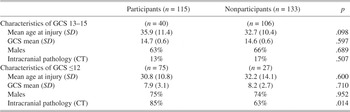
Comparison between participants and nonparticipants is shown in Table 2. Participants with mild TBI (n = 40) did not differ in age, gender, GCS, cause of injury, loss of consciousness, duration of PTA, and intracranial pathology as revealed by CT scans. Participants with moderate-to-severe TBI (n = 75) did not differ in demographic and injury characteristics except that a significantly higher number of participants than nonparticipants had intracranial pathology (χ2(1) = 6.0; p < .05).
Comparison of characteristics of participants and nonparticipants

Note
GCS = Glasgow Coma Scale; SD = standard deviation.
Measures
Demographic measures
Age, education, gender, marital status, and preinjury employment were used to evaluate their relationship to functional outcome at 12 months. Marital status was defined as either married/living with a partner, or single. Employment status was categorized into full-time work/study (≥30 hr a week), part-time work/study (<30 hr a week), or not working/studying (Wehman, Targett, West, & Kregel, Reference Wehman, Targett, West and Kregel2005).
Trauma scores
Trauma scores were obtained from the hospital’s Trauma Register. The Head Abbreviated Injury Scale (AIShead) version 1998 (Association for the Advancement of Automotive Medicine, 1990) was used to describe the anatomical severity of injury. AIS classifies injuries to body region on an ordinal scale ranging from minor (1) to fatal (6). An AIShead score from 3 to 5 indicates intracranial pathology. The total trauma scores were calculated by Injury Severity Score (ISS). ISS is a composite measure (from 1 to 75) of the sum of squares of the highest AIS scores of the three most severely injured of six defined body regions (Baker, O’Neill, Haddon, & Long, Reference Baker, O’Neill, Haddon and Long1974). Higher ISS scores indicate worse injury; an ISS of 15 or greater is accepted as definition of a major trauma patient.
CT and MRI scans
All participants underwent a CT brain scan within 24 hr postinjury. Magnetic resonance imaging (MRI) brain scan, using a system with a 1.5 Tesla MRI unit (Siemens), was performed in 88% of the participants at 12 months follow-up. MRI data were not available for nine mild cases, four moderate cases, and one severe TBI. In this study, intracranial pathology on brain scans (CT and/or MRI) was defined as the presence of edema, contusion, epidural hematoma, subdural hematoma, subarachnoid hemorrhage, or diffuse axonal injury. Intracranial pathology was dichotomized into presence/absence of abnormality.
Galveston Orientation and Amnesia Test
The GOAT is a 10-item scale to measure orientation and length of PTA (Levin, O’Donnell, & Grossman, Reference Levin, O’Donnell and Grossman1979). GOAT was administered to all participants at 3 months follow-up. PTA was assessed on a daily basis during rehabilitation in most cases with severe TBI. Four of these had PTA lasting longer than 3 months and were, therefore, assessed with neuropsychological measures at 5 months. For other participants, duration of PTA was obtained from medical records.
Neuropsychological assessment
Neuropsychological measures were administered at 3 and 12 months follow-up. These measures included the California Verbal Learning Test-II (CVLT-II; Delis, Kaplan, Kramer, & Ober, Reference Delis, Kaplan, Kramer and Ober2000); Rey-Osterrieth Complex Figure Test (ROCF; Meyers & Meyers, Reference Meyers and Meyers1995); Letter-Number Sequencing (LN), Similarities (SIM), and Matrix Reasoning (MR) subtests of the Wechsler Adult Intelligence Scale-Third Edition (WAIS-III; Wechsler, Reference Wechsler1997); Color-Word Interference Test (CWIT) from the Delis-Kaplan Executive Function System (Delis, Kaplan, & Kramer, Reference Delis, Kaplan and Kramer2001); Trail Making Test (TMT) of the Halstead-Reitan Neuropsychological Test Battery (Reitan & Wolfson, Reference Reitan and Wolfson1985); and Controlled Oral Word Association Tests (COWAT; Benton & Hamsher, Reference Benton and Hamsher1976). Neuropsychological variables were measured as raw scores or as number of seconds, except for subtests of the WAIS-III scales where standard age scores were used. Higher raw and age scores indicate better performance, and higher number of seconds indicate worse performance.
Symptom validity measures
Symptom or test validity was assessed by the Test of Memory Malingering (TOMM) and Rey’s 15 Item Test (FIT) at 3 and 12 months. If scores were below 45/50 on Trial 1 on TOMM, Trial 2 was administered, if scores were below 45/50 on Trial 2, the retention Trial was given. FIT is scored by total items correctly completed (range, 0–15), regardless of spatial location. Poor effort or malingering was defined as TOMM scores <45 on the retention Trial (Tombaugh, Reference Tombaugh1996) or as FIT scores of 8 or lower (Taylor, Kreutzer, & West, Reference Taylor, Kreutzer and West2003).
Fatigue and substance use
The Fatigue Severity Scale (FSS) is a nine-item instrument used to assess fatigue related to daily activities (Krupp, LaRocca, Muir-Nash, & Steinberg, Reference Krupp, LaRocca, Muir-Nash and Steinberg1989). All items are rated on a Likert scale ranging from 1 (completely disagree) to 7 (completely agree). The sum score for the nine items is divided by the number of items. Higher scores indicate more fatigue (range, 0–7). The frequency of alcohol and drug consumption was assessed at 12 months by means of question one on the Alcohol Use Disorders Identification Test (Saunders, Aasland, Babor, de la Fuenta, & Grant, Reference Saunders, Aasland, Babor, de la Fuenta and Grant1993). Participants were asked to rate their alcohol/drug use over the last month on an ordinal scale ranging from 0 (never) to 4 (more than 4 times per week).
Glasgow Outcome Scale-Extended
Functional outcome was determined by the GOSE defining areas of independence, work, social and leisure activities, family, and return to normal life (Wilson et al., Reference Wilson, Pettigrew and Teasdale1998). GOSE is an 8-point ordinal scale with higher scores associated with better outcome. Categories are divided into upper and lower levels of “good recovery” (7, 8), “moderate disability” (5, 6), “severe disability” (3, 4), as well as “vegetative state” (2) and “dead” (1). In this study, GOSE was rated by two examiners following medical and neuropsychological evaluations, using structured interviews in accordance with guidelines. We found a satisfactory interrater reliability for GOSE at 12 months (κ = 0.85) in 106 participants.
Procedure
The Regional Committee for Medical Research Ethics, East-Norway, and the Norwegian Data Inspectorate approved the study. Written consent was obtained from all participants. All consecutive persons with TBI received a letter containing information about the study 4–6 weeks after injury. Persons were invited to participate in a follow-up study that would include an interview and neuropsychological assessment. All neuropsychological tests were administered by the first author. Evaluations were performed at 3 and 12 months after injury.
Data Analysis
Data analyses were performed using SPSS software version 16.0 (SPSS Inc., Chicago, IL). Parametric statistics were chosen because most of the variables were normally distributed (except TMT, CWIT, ROCF, and WAIS-III LN). Five participants with severe TBI were outliers on the TMT Part B due to slow performance. Their scores were replaced with a value of 300 seconds. Two participants were unable to complete the CWIT, resulting in missing values. Chi-square (χ2) and Pearson χ2 analyses were used for categorical variables. Analysis of variance (ANOVA) was used for between-group comparisons (mild, moderate, severe) on demographic and injury-related variables. Cognitive recovery (from 3 to 12 months) was investigated by repeated-measures ANOVA. It was necessary to reduce the data to decrease the number of predictors in multiple regression analysis. Hence, 13 neuropsychological variables assessed at 12 months were submitted to principal components analysis with varimax rotation. Three components with eigenvalues higher than 1 (eigenvalues = 6.18, 1.37, 1.11) were entered into the regression analysis after demographic (step 1) and injury severity (step 2) predictors. A multiple regression analysis was performed with enter selection of variables. The variables that remained as statistically significant in the first two steps were included in the final model. The dependent variable was GOSE score at 12 months. Using Green’s formula (Green, Reference Green1991): N> 50+8k (where k is the number of predictors), a maximum number of seven variables were entered. Ideally, AIShead would have been included in the regression analysis. However, due to high correlation (r > .70) between AIShead with ISS, GCS and brain scans, AIShead was excluded. A significant level of p < .05 (two-tailed) was selected. Bonferroni corrections were applied for significant tests with multiple comparisons. A post hoc regression analysis was undertaken in the mild TBI group to explore the effects of cognitive functioning on GOSE.
RESULTS
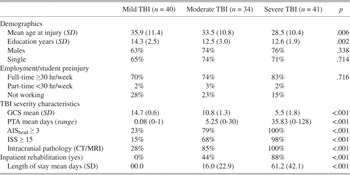
The demographic and severity characteristics of the TBI groups are shown in Table 3. The groups differed significantly regarding age (F(2,112) = 5.3; p = .006) and education (F(2,112) = 6.5; p = .002). At the time of injury, 78.3% of all participants were employed or in school. The mean duration of PTA differed significantly F(2,110) = 41.7; p < .001: more than 3 hr (M = 3.3; SD = 12.5) in the mild group, approximately 5 days (M = 5.25; SD = 7.07) in the moderate group, and nearly 36 days (M = 35.83; SD = 30.06) in the severe group.
Demographics and severity characteristics of participants by TBI groups

Note
N = 115. TBI = traumatic brain injury; GCS = Glasgow Coma Scale; PTA = posttraumatic amnesia; AIShead = Head Abbreviated Injury Scale; ISS = Injury Severity Score; CT = computed tomography; MRI = magnetic resonance imaging; SD = standard deviation.
The AIShead and ISS mean scores were 2.2 (SD = 0.8) and 9.7 (SD = 7.8) in the mild group; 3.7 (SD = 1.2) and 23.2 (SD = 13.9) in the moderate group; and 4.8 (SD = 0.5) and 32.9 (SD = 10.8) in the severe group. Brain scans revealed TBI-related intracranial pathology in 28% with mild TBI, in 85% with moderate TBI, and in all cases with severe TBI. The total length of stay in rehabilitation hospital/units during the first year postinjury ranged from 0 to 63 days in the moderate group and from 0 to 171 days in the severe group (Table 3).
The FSS mean scores between TBI groups were nonsignificant at 12 months. The mean for the entire sample was 4.0 (SD = 1.8). At 1-year postinjury, frequency of consuming alcohol more than monthly was 48% in both the mild and moderate groups, and 27% in the severe group (χ2(8) = 24.1; p < .01). Among the 106 participants, 13% were consuming alcohol and/or drugs 2–3 times a week, and 7% at least 4 times a week.
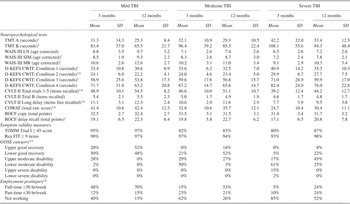
Neuropsychological, symptom validity, and outcome measures at 3 and 12 months are summarized in Table 4. As poor effort may affect neuropsychological performance, symptom validity measures were included to detect malingerers. Among 115 participants, 8.7% (n = 10) failed to pass either TOMM or FIT. To determine whether the inclusion of malingerers biased neuropsychological results, t test analyses were performed. Malingerers with moderate TBI (n = 6) performed significantly worse than other participants with moderate TBI (n = 28) on 11 of the 15 neuropsychological measures at 3 months, and on 10 of 15 measures at 12 months. All malingerers (mild TBI = 1, moderate TBI = 6, severe TBI = 3) were, therefore, excluded from neuropsychological data. In the mild group, 5 of 33 participants (15.2%) were involved in litigation or compensation at 12 months follow-up.
Means and standard deviations on neuropsychological tests and functional and employment outcome for TBI groups at 3 and 12 months postinjury

Note
N = 115 at 3 months; N = 106 at 12 months. Neuropsychological tests results: 10 cases taken out due to fail to pass symptom validity measures. TBI = traumatic brain injury; SD = standard deviation; TMT = Trail Making Test; WAIS-III = Wechsler Adult Intelligence Scale-Third Edition; LN = Letter-Number Sequencing; SIM = Similarities; MR = Matrix Reasoning; D-KEFS = Delis-Kaplan Executive Function System; CWIT = Color-Word Interference Test; CVLT-II = California Verbal Learning Test-II; COWAT = Controlled Oral Word Association Tests; ROCF = Rey-Osterrieth Complex Figure Test; TOMM = Test of Memory Malingering; Rey FIT = Rey’s Fifteen Item Test; GOSE = Glasgow Outcome Scale-Extended. Bonferroni correction: α = .05/15.
* Significant group effect (Repeated-measures ANOVA; p ≤ .003).
† Significant time effect (Repeated-measures ANOVA; p ≤ .003).
‡ Significant group differences at 3 months postinjury (Chi-square; p < .001).
§ Significant group differences at 12 months postinjury (Chi-square; p < .001).
For repeated-measures ANOVA, age and education were entered as covariates in all analyses, except for WAIS-III subtests, where only education was entered as a covariate. Main effects between TBI groups were revealed on four measures (Table 4), with Bonferroni corrected significance levels (α = 0.05/15 = 0.003). Better performance was found in the mild group on CWIT Condition 2, CVLT-II Total trials, CVLT-II Long delay, and COWAT (all ps < .001); with the lowest F(2,93) = 8.28, and the highest F(2,93) = 13.16. Significant time effects were found on 11 measures (ps < .003); with the lowest F(1,93) = 9.51 for CWIT Condition 2, and the highest F(1,93) = 43.16 for CVLT-II Total trials. No significant time × TBI severity interaction effects were found on any neuropsychological measures.
Table 4 shows that there were statistical differences between TBI groups on GOSE at 12 months (χ2(6) = 47.7; p < .001). Among 106 participants, 64% had good recovery (24% upper vs. 40% lower), and 36% had moderate recovery (26% upper vs. 10% lower). Repeated-measures ANOVA revealed a significant time effect for GOSE (F(1,103) = 169.53; p < .001). The mean GOSE for the TBI sample was 5.89 (SD = 1.09) at 3 months, and 6.78 (SD = 0.94) at 12 months. Within the mild group, a post hoc analysis using t tests showed no differences on functional outcome between persons with intracranial pathology and those without pathology.
At 3 months, 37% of the total TBI sample were employed (full- or part time), compared to 68% at 12 months. A significant difference was found on employment (full- or part time) between TBI groups at 12 months (χ2(2) = 11.6; p < .01).
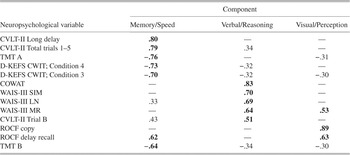
Table 5 contains the factor loadings of the three cognitive components of 13 neuropsychological variables at 12 months. The Kaiser-Mayer-Olkin measure of sampling adequacy was 0.84, and Bartlett’s test of sphericity was significant at p < .001. The three components explained 31.3%, 21.7%, and 13.5% of the total variance for the neuropsychological variables. Measures of memory loaded on the first component, as well as CWIT and TMT, which require processing speed. Thus, component 1 was termed Memory/Speed. All the WAIS-III variables loaded on the second component, together with the two variables COWAT and CVLT-II trial B. Most of these variables shared language or reasoning abilities. Component 2 was, therefore, named Verbal/Reasoning. The third component comprised perceptual organization and visual memory. Thus, component 3 was labeled Visual/Perception. The principal components analysis was repeated for neuropsychological measures at 3 months (data not shown) to explore the effects of cognitive functioning at 3 months on GOSE at 12 months.
Principal components analysis with varimax rotation of the neuropsychological variables at 1 year postinjury

Note
Values greater than .50 are bold. Dashes indicate values less than .30. CVLT-II = California Verbal Learning Test-II; TMT = Trail Making Test; D-KEFS CWIT = Delis-Kaplan Executive Function System Color-Word Interference Test; COWAT = Controlled Oral Word Association Tests; WAIS-III = Wechsler Adult Intelligence Scale-Third Edition; ROCF = Rey-Osterrieth Complex Figure Test.
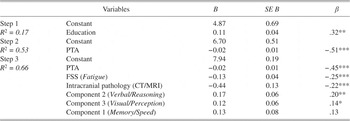
The results of the regression analysis are shown in Table 6. Age, education, gender, marital status, preinjury employment, and alcohol/drug use were entered at the first step. Only education had a statistically significant effect, explaining 9% of the total variance (17%) in GOSE at 12 months. When the injury related variables GCS, PTA, CT/MRI and ISS were entered into the analysis, the amount of explained variance improved (R2 = 0.53; p < .001). Only PTA showed significant effects; education no longer remained significant. Two final models were then tested. The first final model (not shown) explored the effects of cognitive components and fatigue at 3 months, together with PTA and intracranial pathology. All variables except the Visual/Perception component (p = .47) were identified as significant predictors of GOSE at 12 months (R2 = 0.61; p < .001). The second final model (Table 6) included cognitive components and fatigue at 12 months together with PTA and intracranial pathology. All independent variables except the Memory/Speed component (p = .09) were identified as statistically significant predictors (R2 = 0.66; p < .001). The collinearity diagnostic in this model (Table 6) indicated acceptable degree of multicollinearity (all variance inflation factors <1.70). The TBI sample was then divided into mild TBI versus moderate-to-severe TBI to perform post hoc regression analyses of the final model. In mild TBI, only the FSS was a significant predictor of outcome (R2 = 0.47; p < .01), explaining 23% of the total variance in GOSE at 12 months. For the moderate-to-severe TBI, all the independent variables, except the Memory/Speed component and intracranial pathology, were found to be significant predictors of GOSE (R2 = 0.58; p < .001).
Results of regression analysis for concurrent cognitive components and other predictors of the GOSE at 1 year postinjury

Note
N = 96. GOSE = Glasgow Outcome Scale-Extended; SE = standard error; PTA = posttraumatic amnesia; FSS = Fatigue Severity Scale; CT = computed tomography; MRI = magnetic resonance imaging.
* p < .05.
** p < .01.
*** p < .001.
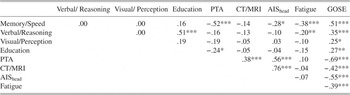
Pearson correlations were used to illustrate the relationships between the cognitive components and injury severity variables and functional outcome (Table 7). Significant correlations were found between the Memory/Speed component with PTA, AIShead, and fatigue, with strongest correlation with GOSE. The Verbal/Reasoning component was related to education and fatigue, as well as to GOSE. The Visual/Perception component was only correlated with GOSE.
Correlations (Pearson coefficients) of predictor variables of the GOSE at 1 year postinjury

Note
N = 96. GOSE = Glasgow Outcome Scale-Extended; PTA = posttraumatic amnesia; CT = computed tomography; MRI = magnetic resonance imaging; AIShead = Head Abbreviated Injury Scale.
* p < .05.
** p < .01.
*** p < .001.
DISCUSSION
This prospective study provides estimates of cognitive and functional outcomes the first year after mild, moderate, and severe TBI. In general, there was evidence of neuropsychological and functional recovery within all groups from 3 to 12 months postinjury. The usefulness of concurrent neuropsychological functioning in predicting outcome was investigated at 12 months. As expected, cognitive functions added substantially to the predictive value of injury related variables to functional outcome.
Improvements were observed on 11 of the 15 neuropsychological measures from 3 to 12 months. It is noteworthy that the severe TBI group was not found to have a steeper recovery curve than the mild and moderate groups. Several studies have found improvements in memory functioning and processing speed the first year after TBI (Atchison et al., Reference Atchison, Sander, Struchen, High, Roebuck and Contant2004; Hammond et al., Reference Hammond, Hart, Bushnik, Corrigan and Sasser2004), suggesting that cognitive recovery may have gainful effects on long-term functional status. In the study by Christensen et al. (Reference Christensen, Colella, Inness, Hebert, Monette and Bayley2008), recovery of cognitive domains was not found to be uniform from 5 to 12 months postinjury; recovery slopes for manual motor and visuospatial functions showed a faster rate of recovery than the slopes for memory and processing speed.
Cognitive recovery also occurred within the mild group after 3 months, in contrast to the literature indicating that cognitive deficits resolve in the first 3 months (Belanger et al., Reference Belanger, Curtiss, Demery, Lebowitz and Vanderploeg2005). It was, therefore, assumed that recovery of those with intracranial pathology in this study (28%), that is, “complicated mild” TBI, had an effect on improvements in mean values. Consistent with prior findings (Hanlon et al., Reference Hanlon, Demery, Martinovich and Kelly1999; Iverson, Reference Iverson2006), inspection of means revealed no differences on neuropsychological measures in “complicated mild” TBI compared with no intracranial pathology. Other studies have shown that recovery after “complicated mild” TBI is similar to that after moderate TBI (Kennedy et al., Reference Kennedy, Livingston, Marwitz, Gueck, Kreutzer and Sander2006; Temkin et al., Reference Temkin, Machamer and Dikmen2003; Williams, Levin, & Eisenberg, Reference Williams, Levin and Eisenberg1990).
For predicting functional outcome at 12 months, the Verbal/Reasoning and Visual/Perception components, identified by principal components analysis, were useful. The Memory/Speed component showed a near-significant relationship to outcome. These effects were present after controlling for demographic and injury related variables. However, the strength of the correlation between Memory/Speed and PTA may suggest that they interacted in predicting the outcome, suppressing the effect of Memory/Speed. Shorter duration of PTA, absence of CT/MRI findings, and less fatigue were also significantly related to better functional outcome. Age, gender, marital status, concurrent alcohol/drug consumption, preinjury employment, GCS, and ISS had no predictive ability to GOSE. The final model was also able to fit the same variables at 3 months. However, the Memory/Speed component at 3 months had a significant predictive value on outcome at 12 months, and the Visual/Perception component did not reach statistical significance. Taken together with findings from Christensen et al. (Reference Christensen, Colella, Inness, Hebert, Monette and Bayley2008), our results suggest that visuospatial functions may continue to show significant improvement and be more sensitive to outcome with passing of time.
Intracranial pathology only contributed to functional outcome across the entire TBI sample and not when the groups were analyzed separately. This agrees with other studies on mild TBI (Hanlon et al., Reference Hanlon, Demery, Martinovich and Kelly1999) and “complicated mild” to severe TBI (Temkin et al., Reference Temkin, Machamer and Dikmen2003).
Recent studies have found evidence for the predictive value of concurrently assessed cognitive measures to outcome after TBI (Atchison et al., Reference Atchison, Sander, Struchen, High, Roebuck and Contant2004; Ponsford et al., Reference Ponsford, Draper and Schonberger2008; Temkin et al., Reference Temkin, Machamer and Dikmen2003). In one study with 80% moderate-to-severe TBI, current cognitive functioning was found to be an important predictor of continuing disability 10 years after injury (Ponsford et al., Reference Ponsford, Draper and Schonberger2008). However, with moderate-to-severe TBI and good functional recovery, the prognostic value of concurrent cognitive measures was found to be limited and emotional status was found to be more effective in predicting the long-term outcome (Temkin et al., Reference Temkin, Machamer and Dikmen2003).
The association between early neuropsychological assessments on later outcome has been found for persons who received inpatient rehabilitation after TBI (Boake et al., Reference Boake, Millis, High, Delmonico, Kreutzer and Rosenthal2001; Sherer et al., Reference Sherer, Sander, Nick, High, Malec and Rosenthal2002b). The most consistent predictors in these studies were shown by tests of orientation, verbal memory and processing speed, thus confirming our finding of the predictive ability of the Memory/Speed component at 3 months.
There is little doubt that cognitive functioning is associated with outcome after moderate-to-severe TBI. In the literature on mild TBI, there is more controversy. Studies indicate that cognitive deficits after mild TBI are present the first 90 days postinjury (Belanger et al., Reference Belanger, Curtiss, Demery, Lebowitz and Vanderploeg2005) and that baseline levels of cognitive functioning are resumed within 3 months (Belanger et al., Reference Belanger, Curtiss, Demery, Lebowitz and Vanderploeg2005; Ponsford et al., Reference Ponsford, Willmott, Rothwell, Cameron, Kelly and Nelms2000). Another study noted that memory functions assessed later than 3 months after mild TBI were significantly associated with employment 1-year postinjury (Hanlon et al., Reference Hanlon, Demery, Martinovich and Kelly1999). Persons with mild TBI often complain of cognitive problems (Stulemeijer et al., Reference Stulemeijer, Vos, Bleijenberg and van der Werf2007) and most research suggests that neuropsychological measures do not predict the outcome (Belanger et al., Reference Belanger, Curtiss, Demery, Lebowitz and Vanderploeg2005; Ponsford et al., Reference Ponsford, Willmott, Rothwell, Cameron, Kelly and Nelms2000; Stulemeijer et al., Reference Stulemeijer, Vos, Bleijenberg and van der Werf2007). Based on this inconsistency in the literature, we tested whether the relationship between cognitive functioning and outcome applied to the mild group in our study, and found no association. The small number of persons in this group with a statistical power in the regression analysis of only 57% (α = 0.05, moderate effect size with G*Power 3; Faul, Erdfelder, Lang, & Ober, 2007) limit us from drawing conclusions. In future research, it will be important to investigate how cognitive deficits relate to functional outcome following “complicated mild” TBI.
Functional improvements were found in all TBI groups over time. Approximately half those with “complicated mild” TBI reported functional disability (GOSE ≤ 6) at 3 months. In these persons, GOSE may be a useful detector of functional disability and may signify need for treatment. No participant in our study had severe disability at 12 months, which disagrees with another outcome study on TBI where nearly 29% had severe disability 1-year postinjury (Whitnall, McMillan, Murray, & Teasdale, Reference Whitnall, McMillan, Murray and Teasdale2006). Other studies have reported that 5–8% of persons with GCS < 9 had severe disability 10 years after TBI (Andelic et al., Reference Andelic, Hammergren, Bautz-Holter, Sveen, Brunborg and Røe2009; Ponsford et al., Reference Ponsford, Draper and Schonberger2008). This difference is probably because we dismissed 22% of the survivors with severe TBI due to PTA or vegetative state at 6 months postinjury. Scheibel et al. (Reference Scheibel, Levin and Clifton1998) have noted the same frequency of cases with prolonged PTA following severe TBI.
The employment rate in Norway for full-time work (age 15–74) was 73.1% in 2007 (Statistics Norway, 2008). This is approximately the same rate as in the mild group in our study, but three times higher than 24% in the severe group. Employment rates (full- or part time) were found to be 85% in the mild group, 74% in moderate, and 48% in severe TBI groups at 12 months, or approximately the same rates as in a large population-based study (Whiteneck et al., Reference Whiteneck, Brooks, Mellick, Harrison-Felix, Terrill and Noble2004).
Fatigue related to functional outcome has seldom been investigated. In our study, less fatigue predicted better outcome. Furthermore, no significant effects of gender, education, or TBI severity were found on fatigue at 12 months, consistent with findings in a mixed population of TBI (Ziino & Ponsford, Reference Ziino and Ponsford2005). The mean FSS score for the total TBI sample was the same as that in the Norwegian population (Lerdal, Wahl, Rustoen, Hanestad, & Moum, Reference Lerdal, Wahl, Rustoen, Hanestad and Moum2005) and similar to mean values in other TBI samples (Ziino & Ponsford, Reference Ziino and Ponsford2005), but lower than in other groups with neurological etiology (Krupp et al., Reference Krupp, LaRocca, Muir-Nash and Steinberg1989). Ziino and Ponsford (Reference Ziino and Ponsford2005) reported that the longer since injury, the more impact fatigue has on daily functioning. Bushnik, Englander, and Wright (Reference Bushnik, Englander and Wright2008) found that excessive fatigue 2 years after moderate-to-severe TBI was associated with poorer outcomes in general functioning and cognitive status.
None of the mild cases involved in litigation (15.2%) were suspected of poor effort in this study. Malingering has been shown to be related to psychiatric comorbidity and litigation after mild TBI (Belanger et al., Reference Belanger, Curtiss, Demery, Lebowitz and Vanderploeg2005). An incidence of malingering has been noted in 8–30% of broad clinical cases in a survey by clinical neuropsychologists (Mittenberg, Patton, Canyock, & Condit, Reference Mittenberg, Patton, Canyock and Condit2002), which is higher than 8.7% found in our study.
One caveat of our study is that no control group was used to compare improvements with the effect of practice (test–retest). The use of control group would permit stronger conclusions regarding cognitive recovery in the mild group. In addition, sample sizes were relatively small. Another limitation is that we excluded severe TBI cases who were in PTA at 6 months postinjury. Our findings may, therefore, offer more insight into severe TBI injuries with initial better cognitive recovery. The strengths of our study are that neuropsychological assessments were administered by the same person, and MRI scans were routinely performed 1 year after injury.
In the current TBI sample, only 44% of cases with moderate TBI received inpatient rehabilitation and none of those with “complicated mild” TBI. Thus, some cases in need for treatment and rehabilitation after discharge from the acute hospital did not receive training in cognitive skills, which might have lead to better recovery and perhaps to improvements in employment and functional outcome. Future studies should aim at offering rehabilitation to improve cognitive and functional outcomes across TBI severity.
To summarize, improvements were observed on most neuropsychological measures and the severe TBI group was not found to have a steeper recovery curve from 3 to 12 months than the mild and moderate groups. Concurrent cognitive status contributes significantly to the prediction of functional outcome not accounted for by the injury severity, demographics, or trauma variables. In addition, shorter duration of PTA, less fatigue, absence of intracranial findings, and higher education, contribute to a better outcome. These determinants as a whole might serve as important tools for clinicians in assessing the long-term outcome predictions after TBI.
ACKNOWLEDGMENTS
This study was supported by grants from the South-Eastern Norway Regional Health Authority. Special thanks to Ivar Reinvang, Professor, University of Oslo, for valuable comments; to Tone Jerstad, neuroradiologist, Department of Neuroradiology, Oslo University Hospital, Ulleval, for the CT and MRI evaluations; to Morten Hestnes and Nils Oddvar Skaga from the Oslo University Hospital’s Trauma Registry, Ulleval, for the extraction of trauma scores; to Katrine Frey Froslie, The National University Hospital, for statistical assistance; and to Susan Schanche for the proof reading the English text. Competing interests: None.