The demand for knee and hip arthroplasty continues to increase in North America. Between 2017 and 2018, nearly 130,000 surgeries were performed, accounting for more than $1.2 billion in inpatient hospital costs in Canada. 1 In the United States, >800,000 hip and knee replacement surgeries are performed annually, with future projections estimating a quadrupling of procedures by the year 2030. Reference Singh, Yu, Chen and Cleveland2 Although these procedures improve quality of life by reducing pain and improving mobility, infectious complications are a source of morbidity and mortality. Approximately 1%–2% of hip and knee arthroplasties will develop a postoperative surgical site infection (SSI). Reference Miletic, Taylor, Martin, Vaidya and Kaye3–Reference Triffault-Fillit, Ferry and Laurent5 These infections are classified into superficial incisional, deep incisional, and organ-space infections by the Center for Disease Control and Prevention (CDC), and the latter 2 are considered complex SSIs. Reference Horan, Andrus and Dudeck6 Although superficial infections can be managed with antibiotics with or without local debridement, surgical intervention in combination with antimicrobial therapy is necessary in complex SSIs. Reference Osmon, Berbari and Berendt7
Overall, 4 surgical strategies are utilized for management of complex SSIs: 1-stage revision, 2-stage revision, debridement with antibiotics and implant retention (DAIR) and DAIR with liner exchange. Reference Osmon, Berbari and Berendt7,Reference Minassian, Osmon and Berendt8 The decision regarding which procedure to undertake is made based on patient and disease-related factors such as duration of symptoms, stability of the implant, conditions of the soft tissue and bone stock, patient comorbidities, and causative pathogen. Reference Osmon, Berbari and Berendt7,Reference Tande, Gomez-Urena, Berbari and Osmon9 Prior studies report success rates between 86.9% to 91.8%, and 85% to 92.1% for 1-stage and 2-stage revisions, respectively. Reference Lange, Troelsen, Thomsen and Soballe10–Reference Silvestre, Almeida, Renovell, Morante and López12 Successful outcomes with DAIR and DAIR with liner vary widely between 31% and 100%. Reference Tsang, Ting, Simpson and Gaston13,Reference Qasim, Swann and Ashford14 These procedures, however, have inherent differences in healthcare-associated cost as a result of differences in resource utilization, duration of hospitalization and perioperative complications. Considering the variability in success, evaluation of costs may assist clinicians in the decision-making framework when determining what procedure to undertake. To date, no studies of which we are aware have evaluated the comparative costs of these procedures in Canada. In the current study, we evaluated and compared the economic burden of 1-stage and 2-stage revisions, DAIR and DAIR with liner exchange.
Methods
Overview
We conducted a population-based cohort study of patients undergoing surgical intervention for complex hip or knee SSI in Calgary, Alberta, Canada. Calgary has a population of ˜1.5 million people and is serviced by the sole healthcare system of Alberta: Alberta Health Services (AHS).
Patient cohort
We identified a cohort of adults 18 years or older who were admitted to a hospital in Calgary zone for a first complex SSI of a prosthetic hip or knee within 90 days of primary arthroplasty between April 1, 2012, and March 31, 2019. The cohort was then separated based on the surgical intervention received for management of their complex SSI (ie, DAIR, DAIR with liner exchange, 1-stage revision, and 2-stage revision). The type of surgical management was identified through chart review for all patients identified in the base cohort.
Data sources
AHS infection prevention and control (IPC)
The AHS IPC surveillance group collects data on all first complex SSIs that occur within 90 days following hip and knee replacements in Alberta. They complete comprehensive IPC surveillance and have a data quality working group to verify the integrity of the data. These data had been entered into a database from which our base cohort was extracted.
AHS analytics
The AHS analytics service provided healthcare utilization data on all patients in our cohort from the discharge abstract database (DAD) and the National Ambulatory Care Reporting System (NACRS). Hospital admissions that occurred in the 12- and 24-month periods following date of initial arthroplasty were included from DAD. Patients with infection identified in 2019 were only followed for 12 months for all outcomes due to availability of data. Elixhauser comorbidities were also defined from DAD for all patients. Outpatient visits to an AHS facility in the 12 and 24 months following the initial arthroplasty were included from the NACRS.
Costing data
Microcosting data for surgical procedures and inpatient hospitalizations were obtained from AHS corporate finance data in Calgary. Microcosting data are considered the gold standard of costing data providing specific patient-level costs where each component of resource use is estimated and a unit cost is derived for each. Reference Clement, Ghali, Donaldson and Manns15 Microcosting data were not available for outpatient visits; therefore, gross-costing methods were utilized for these visits estimated from AHS analytics. Costs were collected from a public healthcare payer perspective.
Outcomes
The primary outcome was all 12- and 24-month cumulative direct healthcare costs from time of initial arthroplasty. These costs included admission for complex SSI (ie, surgical costs, nursing costs, bed costs, inpatient antibiotic and medication costs, diagnostic imaging and laboratory testing), subsequent hospitalizations and emergency room visits, and outpatient clinic visit costs. The outpatient costs included any visits to nursing facilities or the home parenteral intravenous therapy program for administration of intravenous antibiotics and ongoing follow-up care. Outpatient antibiotic costs were not included because these are incurred by patients and therefore are not part of the public healthcare payer perspective. Physician billing costs were not included. As a secondary outcome, we assessed mean total length of stay (LOS) in days in hospital at 12 and 24 months, as well as the associated mean number of hospitalizations. All costs were inflated to 2019 Canadian dollars using the consumer price index and converted to United States Dollars (USD). 16
Statistical analyses
We assessed mean cost for the initial admission and revision procedure. Mean LOS was calculated for each patient. All patient hospitalizations, emergency room visits, and outpatient visits in the 12 and 24 months following the initial hospital admission for arthroplasty were assessed. A cumulative mean total 12- and 24-month cost was calculated for each of the 4 revision strategies within our cohort (ie, DAIR, DAIR with liner exchange, 1- and 2-stage procedures). If an individual had a revision procedure for a complex SSI followed by a second surgery for a failed revision (eg, a DAIR followed by 2-stage revision) within the total 24-month period analyzed, all costs, including the cost of the second revision, were reflected in the initial revision cohorts. For those who had an SSI in 2019, only the first 12 months (until December 31, 2019) were included for analysis due to data availability. Stratified analyses were completed comparing 12- and 24-month costs of those aged <65 or ≥65 years of age in addition to Elixhauser comorbidity count stratified as none, 1–2, or 3 or greater. Both inverse Gaussian distribution and γ regression analysis were performed to determine adjusted costs controlling for age, sex, diabetes and hypertension with and without chronic complications, and number of Elixhauser comorbidities. All statistical analyses were conducted using STATA/MP version 16.0 software (StataCorp, College Station, TX). The University of Calgary Health Research Ethics Board approved this study.
Results
Patient characteristics
In total, 142 patients were identified with a mean age of 66.8 years (SD, ±10.5); males accounted for 57.8% of the cohort. Most participants (51.4%) had no comorbidities with 28.9% and 19.7% accounting for 1–2 and 3 or more Elixhauser comorbidities, respectively. In total, 12 deaths (8.5%) occurred. The most common procedure performed was a DAIR with liner exchange (66.9%) (Table 1.)
Baseline Characteristics

Note. DAIR, debridement, antibiotic and implant retention.
Base costs
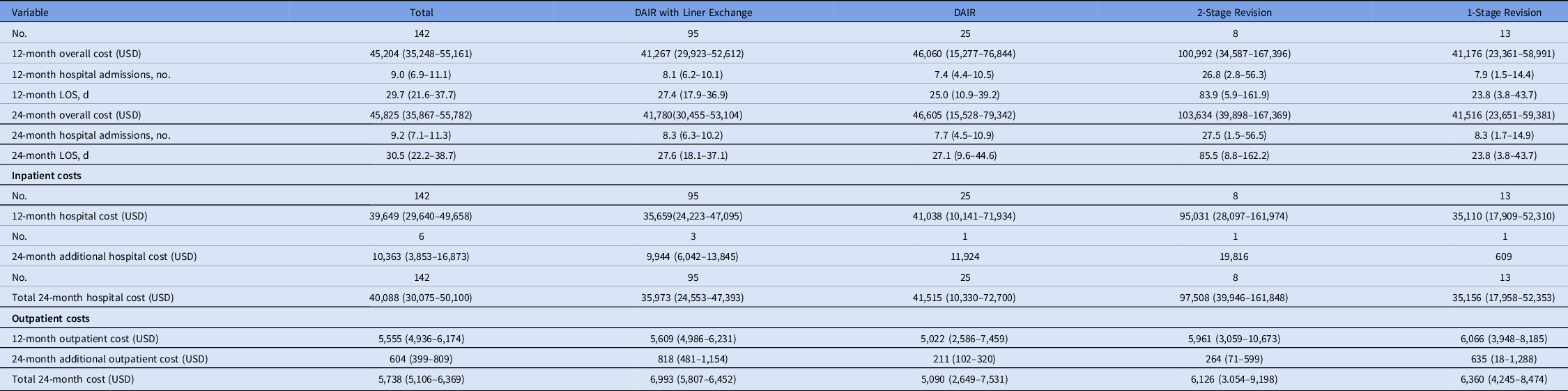
The cumulative mean 12- and 24-month costs for the overall cohort were $45,204 (95% CI, 35,248–55,161) and $45,825 (95% CI, 35,867–55,782), respectively. The 2-stage revisions were the costliest, with total mean costs of $100,992 (95% CI, 34,587–167,396) at 12 months and $103,634 (95% CI, 39,898–167,369) at 24 months followed by DAIR, with total mean costs of $46,060 (95% CI, 15,277–76,844) at 12 months and $46,605 (95% CI, 15,528–79,342) at 24 months. The least costly interventions at 12 months were 1-stage revisions at $41,176 (95% CI, 23,361–58,991) and DAIRs with liner exchange at $41,267 (95% CI, 29,923–52,612). Cost was primarily driven by inpatient hospitalizations (Table 2). Surgical intervention to manage complex SSI accounted for 8.1% of the total admission costs for DAIR to 24.1% of the total admission costs for 2-stage revision (Table 3). Regardless of procedure, most costs accrued in the first 12 months.
Total Mean Costs, Mean Length of Stay and Mean Number of Hospitalizations at 12 and 24 Months a

Note. LOS, length of stay; DAIR, debridement, antibiotic and implant retention.
a Data shown with 95% confidence intervals when available using a truncated normal distribution for clinical plausibility.
Mean Costs and Length of Stay for Initial Admission and Revision for Complex SSI Stratified by Surgical Management a

Note. LOS, length of stay; DAIR, debridement, antibiotic and implant retention.
a Data shown with 95% confidence intervals when available using a truncated normal distribution for clinical plausibility.
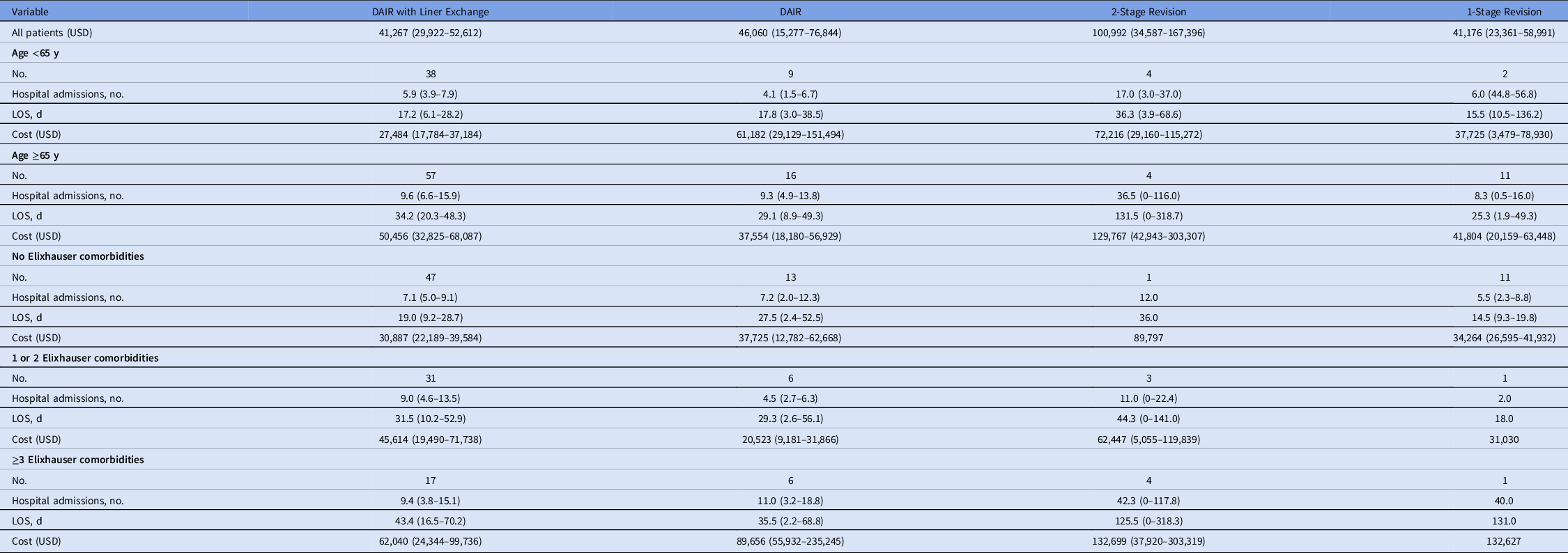
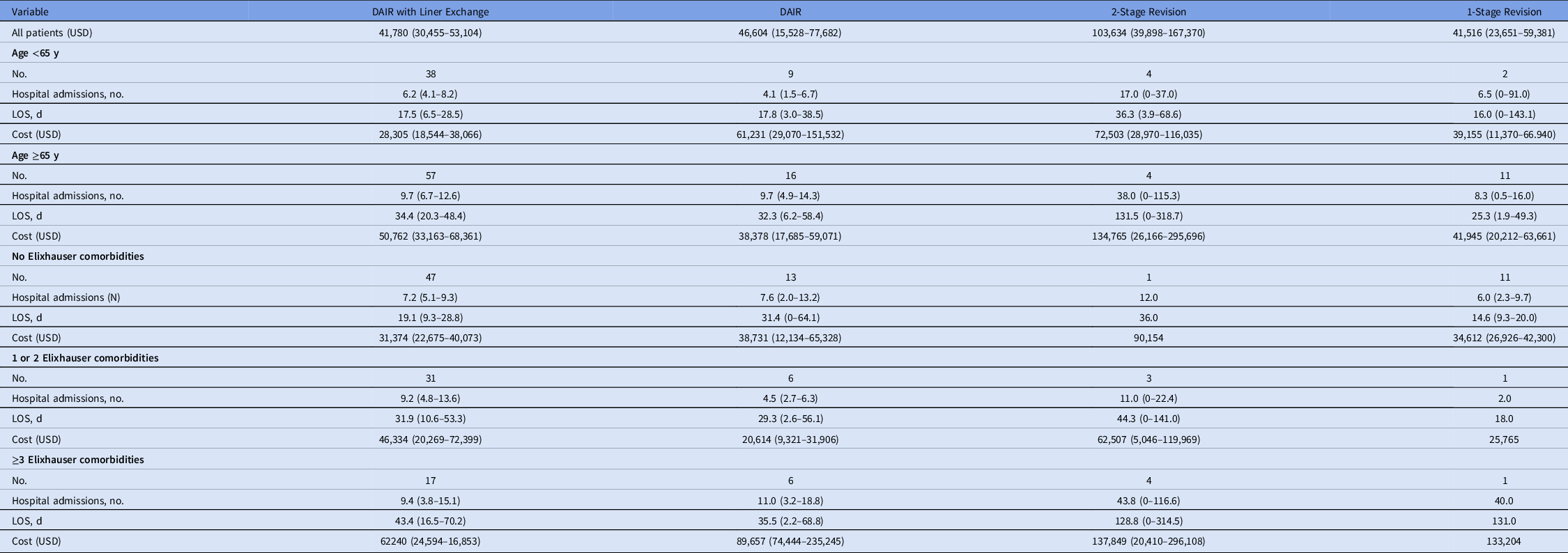
At 12 months, subgroup analysis revealed that those aged ≥65 years (vs <65 years) had higher associated mean cost for DAIR with liner exchange ($50,456 [95% CI, 32,825–68,087] vs $27,484 [95% CI, 17,784–37,184]) and 2-stage revisions ($129,767 [95% CI, 42,943–303,307] vs $72,216 [95% CI, 29,160–115,272]). Those with ≥3 Elixhauser comorbidities had similar mean costs between 1-stage and 2-stage revisions 12 months following their procedures at $132,627 and $132,699, respectively (only 1 patient fell into this category for the 1-stage revision). Generally, increased costs were associated with increased comorbidity index (Table 4). Again, a slight incremental increase in mean cost was seen at 24 months relative to 12 months (Table 5).
Subgroup Analysis of Mean Cost, Mean Number of Hospitalizations, and Mean Length of Stay 12 Months Postoperatively a

Note. LOS, length of stay; DAIR, debridement, antibiotic and implant retention.
a Data shown with 95% confidence intervals when available using a truncated normal distribution for clinical plausibility.
Subgroup Analysis of Mean Cost, Mean Number of Hospitalizations, and Mean Length of Stay 24 Months Postoperatively a

Note. LOS, length of stay; DAIR, debridement, antibiotic and implant retention.
a Data shown with 95% confidence intervals when available using a truncated normal distribution for clinical plausibility.
Adjusted costs
After adjustment by inverse Gaussian and γ regression, respectively, those with diabetes without chronic complications had mean costs that were $31,549 (P = .041) and $33,997 (P = .018) less compared to those with diabetic-associated chronic complications. In addition, those with Elixhauser comorbid index of ≥3 had a statistically significant increased cost at $51,655 (P = .03) by inverse Gaussian regression and $52,892 (P = .006) by γ regression when compared to those without comorbidities (Table 6).
Inverse Gaussian and Gamma Regression Adjusted Costs

Length of stay and number of hospital admissions
The mean LOS in days overall and for each type of surgical management at 12 and 24 months, as well as associated mean number of hospitalizations, can be found in Table 2. The mean LOS for the revision admission was 14 days (95% CI, 12–17) for all procedures. The longest LOS was with 2-stage revisions at 36 days (95% CI, 9–63), and LOS was the shortest with DAIR with liner exchange at 13 days (95% CI, 10–15) followed by 1-stage revisions (15 days). The DAIR procedure resulted in an LOS of 13 days (95% CI, 6–21) (Table 3). LOS and associated number of hospital admissions stratified by subgroups at 12 and 24 months postoperatively can be seen in Tables 4 and 5.
Discussion
Our study identified 142 individuals with complex SSIs requiring revision between April 1, 2012, and March 31, 2019. DAIR with liner exchange was the most performed procedure followed by DAIR, 1-stage revision, and finally 2-stage revision. The 12- and 24-month mean costs were highest in those with 2-stage revisions and lowest in 1-stage revisions and DAIR with liner exchange. Most costs were accrued in the first 12 months; chronic diabetic complications and patients with 3 or more Elixhauser comorbidities were associated with higher mean costs.
Our analysis showed that 2-stage revision was associated with the highest overall mean cost and LOS. This is not surprising because 2-stage revisions require 2 procedures—the first to remove all infected hardware, followed by an antibiotic administration period and subsequent reimplantation of hardware. Reference Charette and Melnic17 In contrast, DAIR and 1-stage revision were the least costly interventions. Both procedures occur within a single hospital admission and subsequent care is conducted in the outpatient setting. Reference Rowan, Donaldson, Pietrzak and Haddad18,Reference Sendi, Lotscher, Kessler, Graber, Zimmerli and Clauss19 Considering the surgical procedure itself accounted for 19.3% and 23.6% of the entire initial hospital admission in DAIR and 1-stage revision, respectively, most costs accrued during the hospitalization were unrelated to the surgical procedure.
Prior studies evaluating costs in surgical patients have also noted this finding. A study by Klouche et al Reference Klouche, Sariali and Mamoudy20 found higher costs associated with 2-stage versus 1-stage revisions driven predominantly by the need for a second admission, increased LOS, and longer rehabilitation necessitating increased resource utilization in the former. Furthermore, in 2013, Peel et al Reference Peel, Dowsey, Buising, Liew and Choong21 found that >50% of total hospital costs in patients admitted for surgical intervention of SSIs were unrelated to the surgical procedure. Given that our findings similarly suggest that increased LOS is associated with greater costs, there may be a benefit from exploration of programs designed to expedite discharge from hospital for those who develop a SSI post hip or knee replacement. A recent study explored the use of a fast-track model to discharge patients more quickly from hospital with prosthetic joint SSIs. Reference Goodson, Kee and Edwards22 The authors found that by utilizing an infectious diseases physician in conjunction with the joint arthroplasty service to streamline discharge of hip and knee SSI patients, they were able to significantly reduce patient LOS safely which will reduce healthcare costs. Reference Goodson, Kee and Edwards22
In previous work done on costs of infection following arthroplasty in Canada, minimal incremental cost accrued between 12 and 24 months following the initial procedure for all interventions. Reference Rennert-May, Conly and Smith23 This literature is consistent with our finding of low numbers of hospitalizations between 12 and 24 months across all subgroups. Although we do not definitively know whether every admission in the first 12 months postoperatively was related to arthroplasty and infection, the decline in admissions after 12 months suggests that this was potentially the case. The temporal association of postoperative complications has been well described with most SSIs occurring within 30 days following a procedure. Reference Thompson, Baxter, Allison, Johnson, Lee and Park24,Reference Hartzler, Li, Geary, Odum and Springer25 The risk of postoperative SSI decreases with time; almost all occur within the first year following surgery. Reference Hartzler, Li, Geary, Odum and Springer25 As such, emergency room visits, hospital readmission, and resource utilization is increased in the immediate perioperative period, increasing healthcare costs. Reference Bozic, Stacey, Berger, Sadosky and Oster26
Our regression analysis revealed that those with chronic complications of diabetes or those with ≥3 Elixhauser comorbidities had a significantly higher cost compared to those without comorbidities. Postoperatively, diabetic patients have increased risk of cardiovascular, cerebrovascular, and renal complications as well as abnormal healing of surgical incisions are also common. Reference Wang, Chen and Li27 These complications require intervention and resource utilization, leading to increased cost. Reference Khan, Quan, Bugar, Lemaire, Brant and Ghali28 Similarly, those with multiple comorbidities are also at elevated risk of postoperative complications, leading to increased LOS, resource utilization, and intervention. Reference Visser, Geboers, Gouma, Goslings and Ubbink29
Although our study describes variable increased costs associated with different surgical management strategies, it is important to evaluate the impact of different surgical management strategies for SSIs on quality of life and clinical outcomes in addition to economic burden. The outcomes of the different surgical management strategies are somewhat controversial, with varying levels of success in preventing relapsed infection and improving functional outcomes for patients. Reference Cahill, Shadbolt, Scarvell and Smith30 A systematic review comparing clinical outcomes of 1- and 2-stage exchanges found low-quality heterogenous results. Reference Masters, Smith, Foguet, Reed, Parsons and Sprowson31 Small studies have shown DAIR to be fairly successful following acute infections at restoring patient functionality and preventing infection, Reference Barros, Barbosa, Esteves, Abreu, Soares and Sousa32 but further work comparing each surgical strategy and its impact on patient quality of life and ability to prevent further infection is necessary.
Our study has multiple strengths. It is the first study to evaluate comparative healthcare costs of procedures utilized in revision of prosthetic joint infections in Canada. Because most costs incurred were from hospitalizations, high-quality microcosting data, which are not readily available in many jurisdictions, increased the precision of our estimates. We identified the cost components of an admission for complex SSI revision including the revision procedure itself. Finally, we identified that most accrued costs for patients who develop complex SSI occur within 12 months following arthroplasty. Policies and interventions are needed to mitigate these postoperative complications.
Our study has several limitations. Our cohort was identified using the IPC database, which only captures those with SSIs within 90 days of the original procedure. Those with infectious complications after 90 days were not included; therefore, our results are applicable to acute infections. This limitation is somewhat mitigated by the fact that most SSIs do occur within 90 days after arthroplasty. Reference Rennert-May, Bush, Vickers and Smith33 Gross costing was utilized for all outpatient costs, which does not precisely estimate true costs, and it is possible that our outpatient costs are imprecise. However, most costs were driven by hospitalizations; therefore, this factor was unlikely to substantially impact our findings. Furthermore, physician-associated costs, such as surgical billing fees and consultation services, were not included in the study. These costs may account for up to 10% additional costs depending on the revision in question. Although we did include patient comorbidities and demographic information, we were not able to include all clinical characteristics of the patient population, including causative pathogen for infection and presence of other conditions such as sepsis. These findings may have differed between the groups and may influence costs. Finally, our study included relatively small numbers and mean costs may be more likely to be influenced by outliers. Future work should aim to increase the sample size and strive to include further clinical characteristics of patients.
Our study contributes to understanding the economic burden of different types of surgical management for prosthetic hip and knee SSIs, and our findings suggest that certain strategies, such as DAIR with liner exchange, could potentially reduce costs. To fully understand the impact of these costs and establish a decision-making framework, a full economic evaluation must be undertaken. Future work should explore the clinical outcome of each surgical strategy including relapse versus cure of infection, as well as the impact of each surgical strategy on patient quality of life. This information could then be combined with our costing data to complete a robust cost-effectiveness analysis to determine which surgical strategy is the most cost-effective, which will both enhance patient quality of care and reduce costs.
Complex SSI is a serious complication following joint replacement necessitating surgical intervention and antimicrobial therapy. Our study has highlighted the economic burden of these infections specifically exploring the role of different types of surgical management. Our work also identified that early recognition of infectious complications qualifying patients to undergo DAIR with liner exchange could potentially reduce healthcare costs. Our findings suggest the need for interventions that reduce the risk of perioperative complications to reduce overall costs. Such interventions may include preoperative interventions that have been shown to be cost-effective in this population, such as decolonization to reduce the risk of postoperative SSIs, Reference Rennert-May, Conly and Smith34 optimizing general health, and reducing immunosuppressive medications. Reference Solarino, Abate, Vicenti, Spinarelli, Piazzolla and Moretti35 Intraoperative considerations may include the use of regional rather than general anesthesia, which has recently been shown to reduce postoperative complications following hip and knee replacements. Reference Matharu, Garriga, Rangan and Judge36 Postoperative strategies that could be considered include rigorous wound care because wound leakage is associated with increased infection risk following hip and knee replacements. Reference Kremers, Leijtens, Camps, Tostmann, Koëter and Voss37
Acknowledgments
The authors acknowledge the AHS IPC for their assistance with data collection.
Financial support
No financial support was provided relevant to this article.
Conflicts of interest
All authors report no conflicts of interest relevant to this article.