Introduction
Firewood is used by billions of people throughout the world for cooking, heating, and lighting (World Health Organisation 2016). Even in developed countries, such as Canada and the United States of America, firewood is used in tens of millions of households (Skog and Watterson Reference Skog and Watterson1984; Borchert et al. Reference Borchert, Newton, Culliney, Hartzog, Ahern and Garrett2010; Warde Reference Warde2019). Moreover, in North America, firewood is commonly transported by the public to recreation sites such as campgrounds (Borchert et al. Reference Borchert, Newton, Culliney, Hartzog, Ahern and Garrett2010; Jacobi et al. Reference Jacobi, Goodrich and Cleaver2011; Gagné et al. Reference Gagné, Al Zayat and Nisbet2017; Daigle et al. Reference Daigle, Straub, Leahy, De Urioste-Stone, Ranco and Siegert2019; Solano et al. Reference Solano, Rodriguez, Greenwood, Dodds and Coyle2021).
Firewood is recognised as a potential pathway for both the domestic and international movement of insects and disease organisms (Food and Agriculture Organisation of the United Nations 2011; Meurisse et al. Reference Meurisse, Rassati, Hurley, Brockerhof and Haack2019; Solano et al. Reference Solano, Rodriguez, Greenwood, Dodds and Coyle2021). Using North American camper reservation data, Koch et al. (Reference Koch, Yemshanov, Magarey and Smith2012) estimated that 53% of campers visited campgrounds less than 100 km from their homes, but about 10% travelled over 500 km to campgrounds. A wide variety of bark- and wood-infesting insects have been collected from firewood (Todd and Horwitz Reference Todd and Horwitz1990; Haack et al. Reference Haack, Petrice and Wiedenhoeft2010; Jacobi et al. Reference Jacobi, Hardin, Goodrich and Cleaver2012; Dodds et al. Reference Dodds, Hanavan and DiGirolomo2017). In addition, many other insects that do not develop in wood will oviposit on tree bark or overwinter in tree bark and can be inadvertently moved to new areas on transported firewood (Bigsby et al. Reference Bigsby, Tobin and Sills2011; Morrison et al. Reference Morrison, Sweeney, Hughes and Johns2017; Urban Reference Urban2020).
Worldwide, thousands of insect species develop in tree bark and wood. These include ambrosia beetles, bark beetles, and borers. (All groups will be referred to as borers in this paper.) For example, considering some North American beetle (Coleoptera) families that are mostly borers, there are about 788 species of Buprestidae, 958 species of Cerambycidae, and 572 species of Scolytinae in the continental United States of America and Canada (Evans Reference Evans2014; Atkinson Reference Atkinson2021). Many borers infest trees that are stressed, dying, or recently dead (Haack and Slansky Reference Haack, Slansky, Slansky and Rodriguez1987; Solomon Reference Solomon1995; Hanks Reference Hanks1999). Firewood that is transported by the public is frequently cut from recently dead and dying trees, often has attached bark, and is seldom dried (Haack et al. Reference Haack, Petrice and Wiedenhoeft2010; Jacobi et al. Reference Jacobi, Goodrich and Cleaver2011). For example, Haack et al. (Reference Haack, Petrice and Wiedenhoeft2010) recorded that 73% of firewood carried by the public had attached bark, 47% of the firewood was transported within one year of tree death, and another 35% was aged for one to two years before being transported.
Development times vary within and among different borer families. For example, most scolytines are univoltine or multivoltine, whereas most buprestids and cerambycids have one- to three-year-long life cycles (Solomon Reference Solomon1995; Evans et al. Reference Evans, Moraal, Pajares, Lieutier, Day, Battisti, Gregoire and Evans2004; Sauvard Reference Sauvard2004; Haack Reference Haack and Wang2017). Moreover, regarding buprestids and cerambycids from temperate regions, those that develop mostly in the cambial regions of tree trunks and branches tend to be univoltine, those that develop mostly in sapwood require one to two years to complete one generation, and those that develop mostly in heartwood usually require two to three or more years (Haack and Slansky Reference Haack, Slansky, Slansky and Rodriguez1987). Given such extended life cycles, it is clear why firewood can serve as a pathway for the movement of both native and exotic wood-infesting insects.
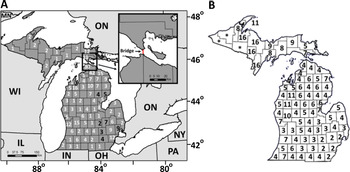
The Asian beetle known as the emerald ash borer, Agrilus planipennis Fairmaire (Coleoptera: Buprestidae), was first discovered in southeastern Lower Michigan, United States of America and neighbouring Ontario, Canada in 2002 (Haack et al. Reference Haack, Jendek, Liu, Marchant, Petrice, Poland and Ye2002; Fig. 1B). Ash trees, Fraxinus Linnaeus (Oleaceae), are the principal larval hosts of A. planipennis (Herms and McCullough Reference Herms and McCullough2014; Poland et al. Reference Poland, Chen, Koch and Pureswaran2015; European and Mediterranean Plant Protection Organisation 2021). The life cycle of A. planipennis is usually completed in one to two years. Larvae feed in trees’ cambial region during the summer months, construct pupal cells in the outer bark or outer sapwood in late summer or fall, and pupate the following spring. Therefore, the risk of transporting A. planipennis in firewood would be greatest during the first year after wood is cut from currently infested trees (Petrice and Haack Reference Petrice and Haack2006) and to a lesser degree during the second year, given that some adults can emerge from firewood two years after cutting (Petrice and Haack Reference Petrice and Haack2007). Moreover, A. planipennis can be transported in bark-free ash firewood because mature larvae often overwinter and pupate in the outer sapwood.
A, Number of private vehicles (N = 400) that surrendered firewood that had originated in Michigan, United States of America when travelling northwards across the Mackinac Bridge (see bridge location in inset) between Lower and Upper Michigan in 2005–2011, by county where the firewood originated. The seven Michigan counties with values shown in black were the sources of Fraxinus firewood that had the evidence of Agrilus planipennis galleries and exit holes. B, County outline map of Michigan showing the year when each county was first quarantined for A. planipennis (Emerald Ash Borer Information Network 2021). Each number represents the last one or two digits of each year: that is, 2 = 2002 through 16 = 2016. The three counties in Upper Michigan marked with * indicate counties where A. planipennis had never been trapped as of 2018, when Michigan’s internal quarantine for emerald ash borer was repealed. Geographic coordinates are shown in degrees North latitude and degrees West longitude. Abbreviations for the states and provinces surrounding Michigan include: IL, Illinois; IN, Indiana; MN, Minnesota; NY, New York; OH, Ohio; ON, Ontario; PA, Pennsylvania; and WI, Wisconsin.

In 2003, both Canada and the United States of America enacted federal quarantines aimed at reducing A. planipennis spread by regulating the movement of ash logs, nursery stock, and firewood. Michigan borders four of the five Great Lakes and consists of two major peninsulas (Lower and Upper Michigan) and several islands. Lower and Upper Michigan are connected by the 8-km-long Mackinac Bridge (Fig. 1A). In Michigan, A. planipennis was only known to occur in the Lower Peninsula as of early 2005. Therefore, starting in March 2005, the Michigan Department of Agriculture & Rural Development prohibited northward movement of firewood of all hardwood (dicot or broad-leaved) tree species across the Mackinac Bridge in hopes of delaying the arrival of A. planipennis in Michigan’s Upper Peninsula. Although A. planipennis was later found in Upper Michigan in July 2005 (Storer et al. Reference Storer, Marshall, Philip, McCullough and Siegert2009; Fig. 1B), the prohibition on transporting firewood was maintained for several years, during which drivers of both private and commercial vehicles were asked to surrender all hardwood firewood as they travelled north across the Mackinac Bridge. Drivers were informed about the firewood restrictions by signage near the south end of the Mackinac Bridge, as well as at toll booths located at the north end of the bridge. Firewood could be surrendered at driver rest areas at both the southern and northern ends of the bridge. On the south side, firewood of all tree species was collected, but on the north side, where driver interviews were conducted, drivers were given the option to keep any firewood of conifer species after inspection. In 2005–2011, Michigan Department of Agriculture & Rural Development staff interviewed several hundred drivers as they surrendered firewood and recorded several details about the driver and their firewood. This paper summarises the information recorded during those interviews.
Methods
Inspectors from the Michigan Department of Agriculture & Rural Development with experience in identifying A. planipennis signs and firewood species were permanently stationed at the firewood drop-off site on the north side of the Mackinac Bridge from September 2005 through August 2011. Large, secure metal containers were used to hold the surrendered firewood until disposal. Inspectors conducted detailed interviews with as many drivers as possible when they were stopped to surrender firewood. Although only hardwood firewood was prohibited from entering Upper Michigan, all drivers with firewood were requested to stop and have the wood inspected. If drivers had only conifer firewood, they were allowed to keep it or surrender it, and no interviews were recorded. However, for drivers with only hardwood firewood or with a combination of hardwood and conifer firewood, full interviews were conducted. The details recorded for each interview included: (a) date of the interview, (b) if the vehicle was private or commercial, (c) the home state or province of the driver, (d) their destination, (e) the purpose for transporting firewood, (f) the origin of the firewood, (g) the number of individual pieces of firewood, and (h) the genus of the firewood. For any firewood identified as Fraxinus, additional information was recorded regarding whether any A. planipennis life stages (e.g., larvae, pupae, or adults) or their signs (e.g., galleries or exit holes) were present.
When inspectors were not able to interview all drivers, such as when multiple vehicles arrived at about the same time, they recorded the vehicles’ licence plate information and instructed the drivers to place their firewood on the ground. Later, the inspectors counted the firewood pieces, identified the woody taxa, and recorded any evidence of A. planipennis. All interview reports were sent to the head office of the Michigan Department of Agriculture & Rural Development in Lansing, Michigan, where the authors were given access to the reports. We reviewed each report, entered all pertinent data into a spreadsheet, and analysed the data.
Results
In 2005–2011, 581 vehicles were recorded transporting firewood northwards across the Mackinac Bridge. Of these, interviews were conducted with 11 drivers of 13 vehicles classified as commercial. The commercial vehicles were transporting either whole logs – ash, aspen (Populus Linnaeus) (Salicaceae) and maple (Acer Linnaeus) (Sapindaceae) – to sawmills in Upper Michigan or dimensional lumber – all ash – to various locations in Upper Michigan or the neighbouring state of Wisconsin, United States of America. Nearly all commercial vehicles had the proper phytosanitary certificates that indicated the origin of the logs or lumber and any treatments that had been applied. One commercial vehicle with ash lumber was required to return to Lower Michigan because it lacked a phytosanitary certificate. Given this high level of compliance by the wood industry, the remainder of this paper will focus on firewood transported by the public.
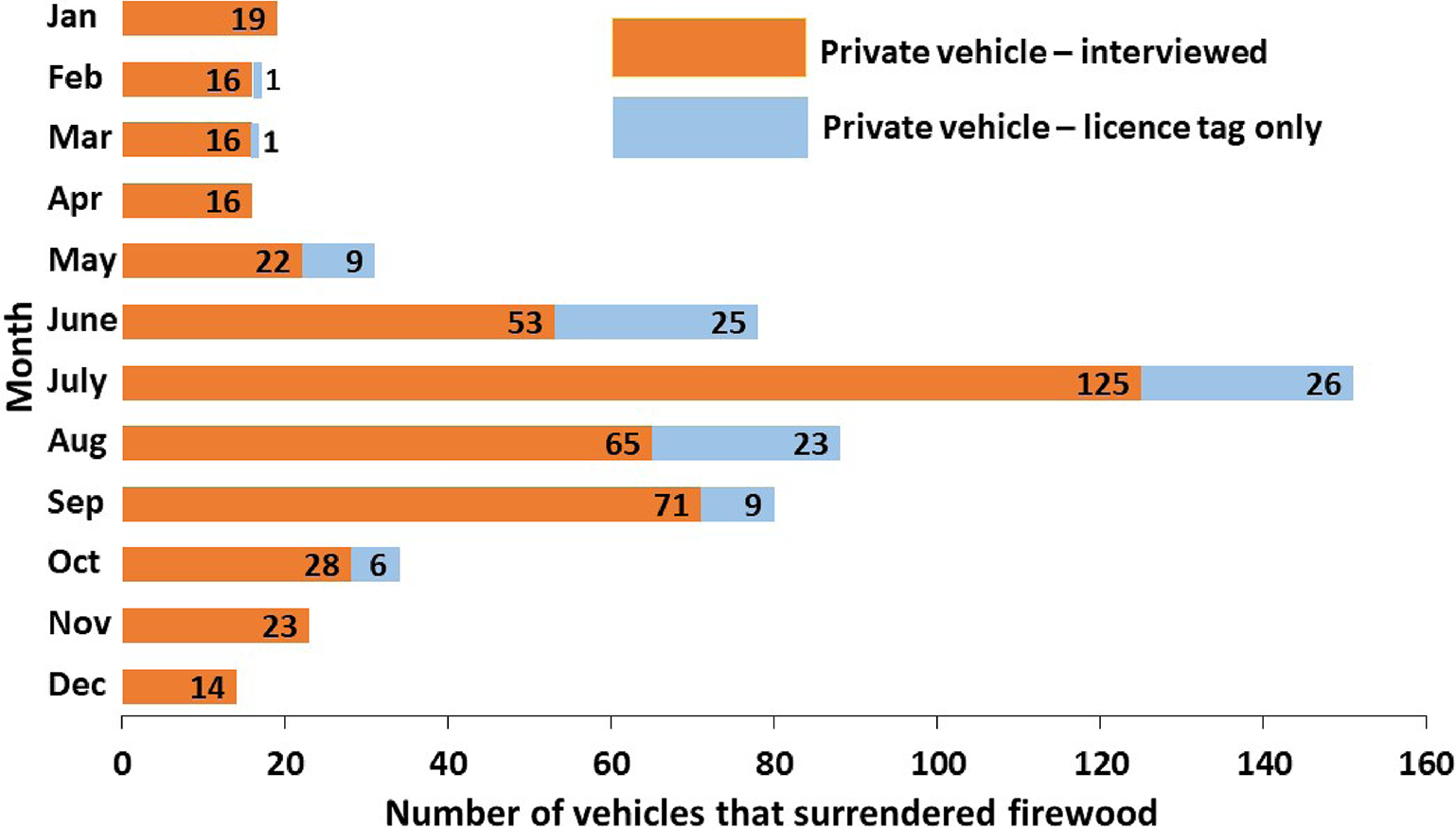
Of the 568 private vehicles, interviews were made with 468 drivers. For the 100 other vehicles, only licence tag details were recorded consistently for each vehicle. From the 468 vehicles where driver interviews occurred, firewood was collected in all months of the year, but most was collected in June–September, peaking in July (Fig. 2). The seasonal pattern was similar for the 100 private vehicles where no interviews occurred; that is, the most firewood was collected in June–August (Fig. 2).
Number of private vehicles (N = 568) that surrendered firewood after crossing the Mackinac Bridge between Lower and Upper Michigan, United States of America in 2005–2011, separately for vehicles for which full interviews were made with drivers (N = 468) and for vehicles where only the licence tag was recorded (N = 100) by month.

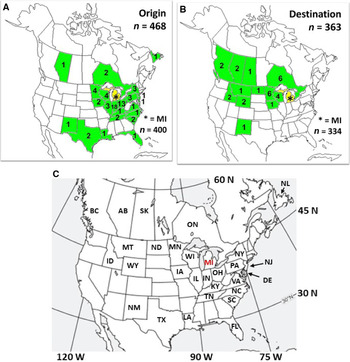
Of 468 interviews with drivers of private vehicles, 400 of the drivers were carrying firewood that originated from Michigan, 64 were carrying firewood from 19 other American states (Delaware, Florida, Iowa, Illinois, Indiana, Kentucky, Louisiana, Minnesota, North Carolina, New Jersey, New Mexico, New York, Ohio, Pennsylvania, South Carolina, Tennessee, Texas, Virginia, and Wisconsin), and four were carrying firewood from three Canadian provinces (Alberta, Ontario, and Newfoundland; Fig. 3A). With respect to Michigan, firewood originated from 75 of its 83 counties (90%), including 64 of 68 (94%) counties in Lower Michigan and 11 of 15 (73%) counties in Upper Michigan (Fig. 1A). It should be noted that southbound drivers on the Mackinac Bridge were not asked to surrender firewood, but later, if they returned with firewood, they were requested to surrender all hardwood firewood, regardless of its origin. In Lower Michigan, the counties with the highest numbers of vehicles recorded carrying firewood were those clustered in northern Lower Michigan near the Mackinac Bridge and those in southern Lower Michigan, near the cities of Detroit and Grand Rapids (Fig. 1A). The 100 private vehicles for which only their licence plate information was recorded represented 10 American states – primarily Michigan (84). Maryland was the only American state not represented among the drivers that were interviewed but which were recorded as transporting firewood (Fig. 3A); however, although this one vehicle had Maryland plates, the origin of the firewood on board was not recorded.
Maps indicating A, the number of private vehicles (N = 468 vehicles) that surrendered firewood when crossing the Mackinac Bridge between Lower and Upper Michigan, United States of America during 2005–2011 that provided the state or provincial origin of their firewood; B, the destination (N = 363 vehicles) given by drivers of private vehicles that surrendered firewood; and C, abbreviations of the states and provinces that were either the source or destination of the surrendered firewood: AB, Alberta; BC, British Columbia; DE, Delaware; FL, Florida; IA, Iowa; ID, Idaho; IL, Illinois; IN, Indiana; KY, Kentucky; LA, Louisiana; MN, Minnesota; MT, Montana; NM, New Mexico; NC, North Carolina; ND, North Dakota; NJ, New Jersey; NL, Newfoundland; NM, New Mexico; NY, New York; OH, Ohio; ON, Ontario; PA, Pennsylvania; SC, South Carolina; SK, Saskatchewan; TN, Tennessee; TX, Texas; VA, Virginia; WI, Wisconsin; and WY, Wyoming.

A clear destination was stated in 363 of the 468 interviews with drivers of private vehicles. Of these 363 drivers, 334 were going to various locations in 12 counties throughout Upper Michigan (Fig. 3B). In addition, 18 drivers stated that their final destinations were in eight other American states (Idaho, Iowa, Minnesota, Montana, New Mexico, North Dakota, Wisconsin, and Wyoming), and 11 drivers were travelling to four Canadian provinces (Alberta, British Columbia, Ontario, and Saskatchewan; Fig. 3B).
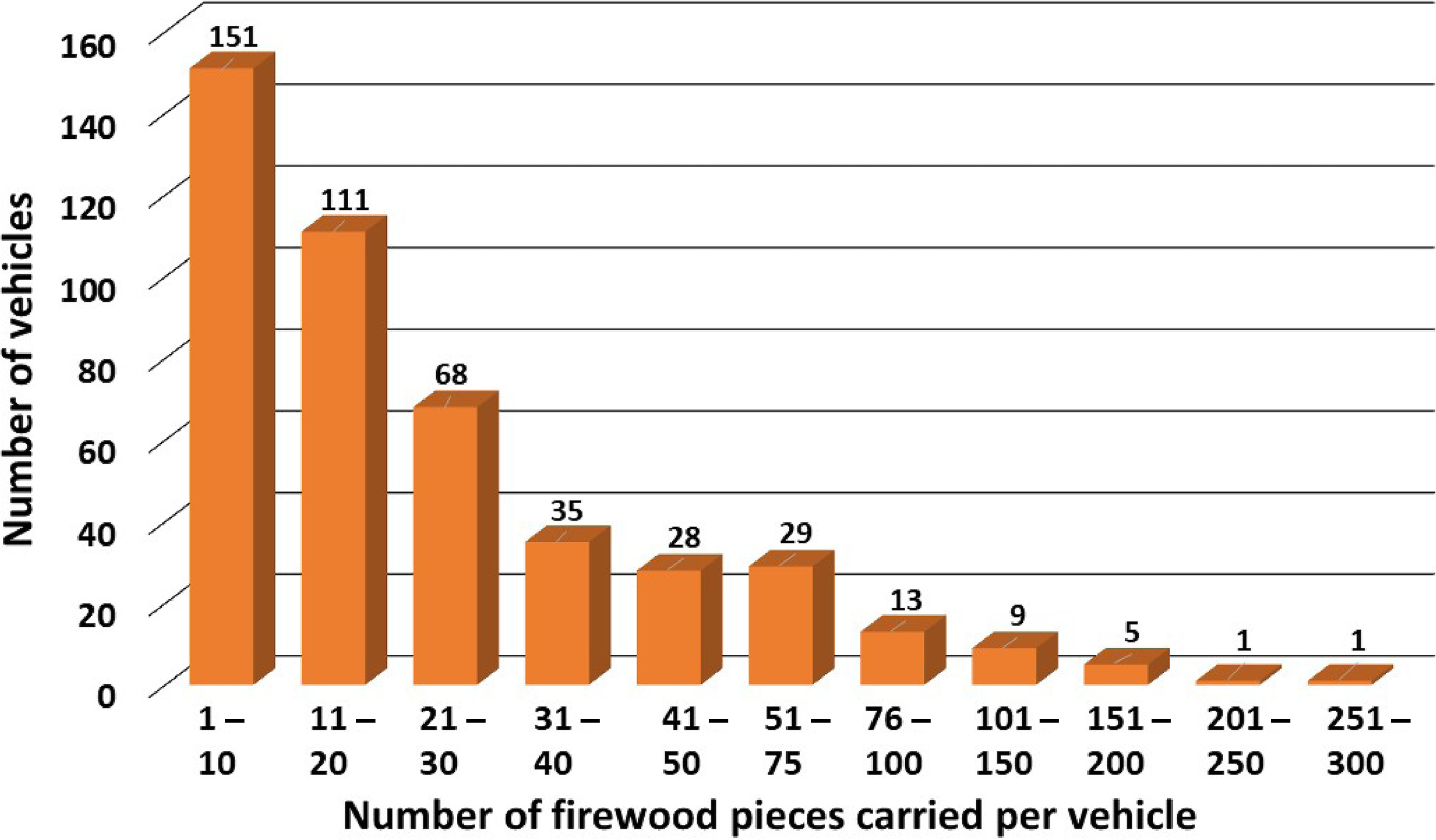
The number of firewood pieces surrendered was counted for 451 of the 468 private vehicles. Of these vehicles, 151 carried 1–10 firewood pieces (33%), and 393 carried 50 pieces or fewer (87%; Fig. 4). The most pieces carried by a single vehicle were 275 pieces (about 1/3 cord, where 1 cord = about 3.6 cubic metres or 128 cubic feet); these were all oak (Quercus Linnaeus) (Fagaceae) firewood from Lower Michigan with a final destination stated as Yellowstone National Park in Wyoming. Individual firewood pieces were not counted for 17 private vehicles; instead, the firewood collected from these vehicles was described as bundles (1–6 bundles per vehicle, with usually 6–9 pieces of firewood per bundle) for 11 vehicles and as cords (1/3 to 1/2 cord per vehicle) for four vehicles. No firewood counts or amount estimates were recorded for the remaining two vehicles.
Frequency diagram for the number of private vehicles (N = 451) that surrendered firewood when crossing the Mackinac Bridge between the Lower and Upper Michigan, United States of America in 2005–2011, categorised by the number of individual pieces of firewood transported per vehicle.

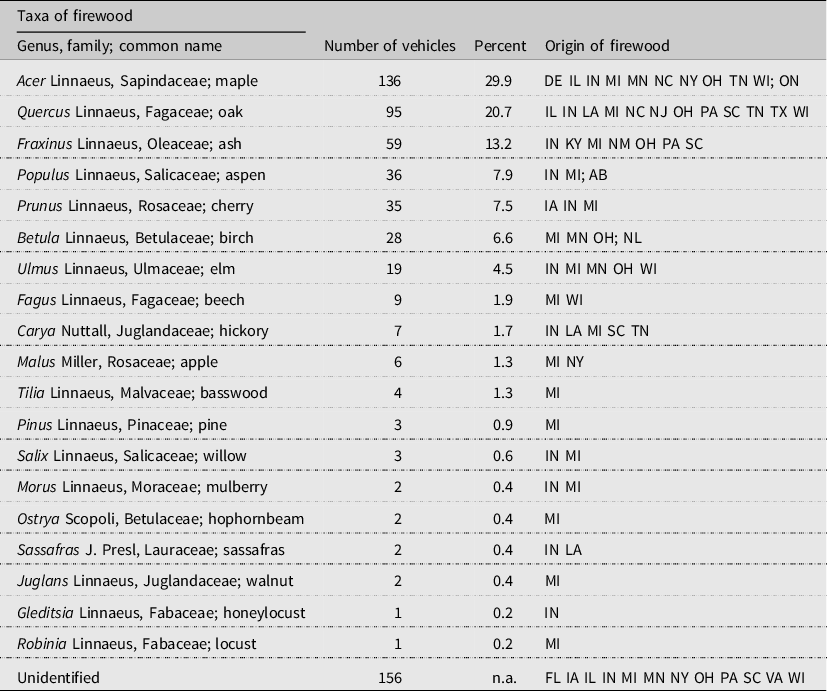
Firewood pieces were identified to genus level for 312 of the 468 private vehicles where the drivers were interviewed (Table 1). Of these 312 vehicles, 206 vehicles carried only one genus of firewood, 74 carried two genera, and 32 carried three or more genera. No more than three genera was recorded for any of the 312 vehicles. Overall, these 450 samples [450 = (206 × 1) + (74 × 2) + (32 × 3)] were identified to 19 genera, with the top five genera being Acer (30%), Quercus (21%), Fraxinus (13%), Populus (8%), and Prunus Linnaeus (Rosaceae) (8%; Table 1). The greatest diversity of woody taxa was carried by drivers who had acquired firewood in Michigan (16 genera), Indiana (eight genera), Ohio (five genera), and Wisconsin (four genera; Table 1). For firewood that originated in Canada, all firewood from Alberta was Populus, all wood from Newfoundland was Betula Linnaeus (Betulaceae), and all wood from Ontario was Acer (Table 1). The interview notes with the driver from Newfoundland (from September 2006) indicate that the vehicle was a motorhome with Newfoundland plates and that the driver had spent the summer in Newfoundland and was still carrying firewood from Newfoundland while camping in the Great Lakes region before driving south to Florida for the winter months.
Number of private vehicles (N = 312 vehicles) that surrendered firewood when crossing the Mackinac Bridge between Lower and Upper Michigan, United States of America in 2005–2011 for which firewood was identified to genus; percent of all firewood samples identified to genus (N = 450 woody taxa samples identified from 312 vehicles); and the state or province of origin of the surrendered firewood by genus.

Abbreviations for state and provinces: AB, Alberta; BC, British Columbia; DE, Delaware; FL, Florida; IA, Iowa; ID, Idaho; IL, Illinois; IN, Indiana; KY, Kentucky; LA, Louisiana; MN, Minnesota; MT, Montana; NM, New Mexico; NC, North Carolina; ND, North Dakota; NJ, New Jersey; NL, Newfoundland; NM, New Mexico; NY, New York; OH, Ohio; ON, Ontario; PA, Pennsylvania; SC, South Carolina; SK, Saskatchewan; TN, Tennessee; TX, Texas; VA, Virginia; WI, Wisconsin; and WY, Wyoming. n.a. = not applicable.
Of the 59 private vehicles that carried Fraxinus firewood (Table 1), signs of A. planipennis (galleries and exit holes) were found on firewood carried by 15 vehicles from three states, including Indiana (N = 1 vehicle in 2009), Michigan (N = 13; 2–3 vehicles per year in each of 2006–2011), and Ohio (one vehicle in 2009). No living life stages of A. planipennis were found during the inspections. For the 13 vehicles from Michigan with Fraxinus firewood that had signs of A. planipennis, the firewood originated from seven Michigan counties, five of which were in southeastern Michigan where A. planipennis was first found in 2002 and 2003 and the other two of which were counties where A. planipennis was first found in 2004 (Fig. 1A, B). The firewood destination and purpose for transporting it were recorded for 14 of these 15 vehicles; all were going to sites in Upper Michigan, with 13 camping and one going to their cottage. Of the seven states represented by private vehicles with Fraxinus firewood (Table 1), A. planipennis was first confirmed to be present in Michigan in 2002, Ohio in 2003, Indiana in 2004, Pennsylvania in 2007, Kentucky in 2009, and South Carolina in 2017 (Emerald Ash Borer Information Network 2021); A. planipennis was not yet detected in New Mexico as of early 2021.
The purpose for transporting firewood or for travelling to Upper Michigan was recorded for 395 of the 468 private vehicles. The main purpose noted was for camping (301 of 395 vehicles; 76%). Camping was given as a reason by at least one driver in every month of the year except January. During the three summer months of June–August, 96% of the drivers reported transporting firewood to camping sites. The few drivers who transported firewood in the winter months to camping sites were going on fishing or hunting trips. Two of the campers stated that their firewood would be used to smoke fish, with one New York state driver bringing Malus firewood in July and one Louisiana driver bringing a mixture of Carya (Juglandaceae), Quercus, and Sassafras (Lauraceae) firewood in July. The second most common reason given was using firewood for extra weight to increase tire traction (60 vehicles, or 15%), especially during the winter months; 55 of 60 drivers used firewood for weight during the snowy months of November–March. The third most common reason was taking firewood to the driver’s cottage (18 vehicles, or 5%); this reason was given in every month except February. Of these 18 vehicles on cottage trips, 16 carried firewood from Michigan, one carried wood from Florida, and one carried wood from Ohio. Of the 18 vehicles, 17 were destined for cottages in Upper Michigan, and one was bound for Minnesota. For six additional vehicles, the drivers stated they were returning home to Upper Michigan after camping in Lower Michigan. For the remaining 10 vehicles, the purpose given for going to Upper Michigan had little connection to firewood; the drivers reported they were doing activities such as visiting friends, shopping, making a day trip to Upper Michigan, or travelling to a truck show, a casino, or to work.
Discussion
This study took advantage of a geographic pinch-point where all northbound traffic in Lower Michigan had to cross over the Mackinac Bridge to reach Upper Michigan and therefore provided a unique opportunity to investigate firewood transport by the public. Our findings indicate that firewood, representing several woody taxa, is moved by campers mostly within-state but also cross-country and between countries at times. Similarly, in a camper survey at 13 national parks in five western states, Jacobi et al. (Reference Jacobi, Goodrich and Cleaver2011) reported that 39% of campers had arrived with out-of-state firewood. In another camper survey, conducted in three northeastern American states, about 25% of campers brought their own firewood (Daigle et al. Reference Daigle, Straub, Leahy, De Urioste-Stone, Ranco and Siegert2019). Moreover, during 2006–2009, firewood was confiscated from private vehicles that represented nearly every state in the continental United States of America at border inspection stations along California’s major highways (Borchert et al. Reference Borchert, Newton, Culliney, Hartzog, Ahern and Garrett2010).
In the present study, nearly all (99%) surrendered firewood was from hardwood tree species, representing 18 genera with only one conifer genus identified: Pinus Linnaeus (Pinaceae) (Table 1). Given that drivers who had conifer firewood when interviewed on the north side of the Mackinac Bridge were given the option to keep their firewood, it is logical that little conifer firewood would have been collected and recorded. However, in a companion study in 2008, Haack et al. (Reference Haack, Petrice and Wiedenhoeft2010) identified to genus level 1045 pieces of firewood surrendered by drivers at both ends of the Mackinac Bridge and found that 95% of the firewood consisted of hardwood species belonging to 18 genera and 5% was coniferous belonging to four genera – Juniperus Linnaeus (Cupressaceae) (one piece; 0.1%), Picea Miller (Pinaceae) (12 pieces; 1.2%), Pinus (39 pieces; 3.7%), and Thuja Linnaeus (Cupressaceae) (one piece; 0.1%). These additional conifer genera likely resulted from firewood surrendered on the south side of the Mackinac Bridge, where both hardwood and conifer firewood were collected and no interviews were conducted. By contrast, in the western United States of America, Jacobi et al. (Reference Jacobi, Goodrich and Cleaver2011) reported that campers at 13 national parks transported mostly conifer firewood (66%), with the remainder being about 22% hardwood firewood (mostly Populus and Quercus) and 12% unidentified wood. The dominance of hardwood tree species being used for firewood in the Great Lakes region of eastern North America and of conifers in the west reflects, in part, the prevalence of hardwood forest types in the east and of coniferous forest types in the west (Eyre Reference Eyre1980). Moreover, the wide diversity of woody taxa used as firewood suggests that almost any borer, native or exotic, can be moved by the public.
Live borers have been documented in firewood transported by the public. For example, Haack et al. (Reference Haack, Petrice and Wiedenhoeft2010) reported that 23% of 1045 firewood pieces transported by the public in Michigan contained live borers and that an additional 41% showed evidence of previous borer infestation. Borchert et al. (Reference Borchert, Newton, Culliney, Hartzog, Ahern and Garrett2010) reported that more than 1000 interceptions of live insects were made on firewood confiscated from vehicles entering California in 2006–2009. These insects represented 17 orders, including 43 families of Coleoptera such as Cerambycidae (110 interceptions), Curculionidae (86 interceptions, of which 67 were Scolytinae), and Buprestidae (77 interceptions; Borchert et al. Reference Borchert, Newton, Culliney, Hartzog, Ahern and Garrett2010). In Jacobi et al.’s (Reference Jacobi, Goodrich and Cleaver2011) study at 13 western national parks, the presence of live insects in firewood was not recorded; however, evidence of prior borer infestation was found in 53% of the firewood pieces inspected. Live insects have also been detected in firewood transported into the United States of America at international border crossings with Canada and Mexico. For example, in 2006–2010, live insects were intercepted 93 times on firewood from Canada and 17 times from Mexico, with many insects being Buprestidae, Cerambycidae, and Curculionidae (including Scolytinae; Borchert et al. Reference Borchert, Newton, Culliney, Hartzog, Ahern and Garrett2010).
Firewood has been implicated as a likely pathway by which several high-risk invasive borers have spread in the United States of America. For example, the Asian longhorned beetle, Anoplophora glabripennis Motschulsky (Coleoptera: Cerambycidae) in New York (Haack et al. Reference Haack, Law, Mastro, Ossenbruggen and Raimo1997; Koch et al. Reference Koch, Yemshanov, Magarey and Smith2012), A. planipennis in Michigan (Cappaert et al. Reference Cappaert, McCullough, Poland and Siegert2005; Mercader et al. Reference Mercader, Siegert, Liebhold and McCullough2009; Storer et al. Reference Storer, Marshall, Philip, McCullough and Siegert2009), the goldspotted oak borer, Agrilus auroguttatus Schaeffer (Coleoptera: Buprestidae) from Arizona to California (Coleman and Seybold Reference Coleman and Seybold2011), and the walnut twig beetle, Pityophthorus juglandis Blackman (Coleoptera: Curculionidae: Scolytinae) from the southwestern states to several western and eastern states (Newton and Fowler Reference Newton and Fowler2009; Mayfield et al. Reference Mayfield, Fraedrich, Taylor, Merten and Myers2014).
Firewood can be obtained from many sources. Some people cut their own, some buy it from roadside vendors or at campgrounds, and others buy firewood at retail outlets (Borchert et al. Reference Borchert, Newton, Culliney, Hartzog, Ahern and Garrett2010). When not treated, and sometimes even when treated, retail firewood can harbour live borers (Jacobi et al. Reference Jacobi, Hardin, Goodrich and Cleaver2012). To standardise effective sanitisation of retail firewood, both the Canadian and the United States governments have adopted similar regulations for retail firewood treatment and movement between countries (Wang et al. Reference Wang, Bergman, Brashaw and Myers2014; Gagné et al. Reference Gagné, Al Zayat and Nisbet2017).
The fact that firewood is moved primarily by campers warrants current education campaigns that target campers with public service announcements such as “Don’t move firewood” and “Buy it where you burn it” (Gagné et al. Reference Gagné, Al Zayat and Nisbet2017; Diss-Torrance et al. Reference Diss-Torrance, Peterson and Robinson2018; Solano et al. Reference Solano, Rodriguez and Coyle2020). In Diss-Torrance et al.’s (Reference Diss-Torrance, Peterson and Robinson2018) study based on five surveys conducted in 2006–2015, compliance by campers at Wisconsin state campgrounds with the state’s firewood regulations increased over time and was attributed to (a) producing consistent public service messages regarding firewood, (b) improving reliability of high-quality firewood at a fair price at campgrounds, (c) adding information on availability of firewood on campground websites, and (d) offering firewood to campers from certified sources. Similarly, in Canada, Gagné et al. (Reference Gagné, Al Zayat and Nisbet2017) listed several national and provincial efforts at reducing long-distance movement of firewood by the public, such as (a) providing firewood disposal bins along major highways at international and provincial crossings, (b) offering firewood exchanges or free firewood at campgrounds, (c) listing registered firewood vendors on provincial campground websites, and (d) offering provincial and national educational campaigns on “Don’t move firewood.” Although there will likely always be some firewood movement by the public, if many of the above recommendations and activities are continued and strengthened, the frequency of transported firewood serving as a key pathway in the spread of pests should be greatly diminished.
Acknowledgements
The authors thank several current and former employees of the Michigan Department of Agriculture & Rural Development who conducted or supervised the driver interviews at the Mackinac Bridge (Susan Bagley, John Hill, Anthony Johns, and Steve Maniaci) and provided the authors with access to the reports (John Bedford); and Andrea Diss-Torrance (Wisconsin Department of Natural Resources), Houping Liu (Pennsylvania Department of Conservation and Natural Resources), and two anonymous reviewers and the journal’s editorial staff for commenting on an earlier draft of this paper. This research was supported in part by the United States Department of Agriculture Forest Service.