Some studies have proposed that people with specific learning disabilities such as reading disability or dyslexia show a propensity for different talents linked to creativity (Ehardt, Reference Ehardt2009; La France, Reference La France1997; West, Reference West1997; Reference West2008). Davis and Braun (Reference Davis and Braun1994) suggested that people with dyslexia tend to be more intuitive, to more often experience insight, to preferentially utilize visual strategies in problem-solving, and to take a more holistic view in order to comprehend a problem. These traits, frequently associated with dyslexia, were derived from clinical observation, retrospective studies, and simple anecdotal observation (Davis & Braun, Reference Davis and Braun1994; Ingesson, Reference Ingesson2006; Rack, Reference Rack1981).
Studies exploring the relationship between creativity and dyslexia have produced inconsistent results. One piece of evidence for this relationship is the finding that certain populations recognized for their creativity and innovation exhibit a higher proportion of dyslexics than populations not known for those traits. Wolff and Lundberg (Reference Wolff and Lundberg2002) reported a greater incidence of dyslexia among students majoring in art than in other fields. Utilizing Vinegrad’s (Reference Vinegrad1994) Revised Adult Dyslexia Checklist, Logan (2008) found that the percentage of participants with dyslexia among business people and entrepreneurs in the United Kingdom and the United States was higher than in those countries’ general populations. According to Karen and Howard (Reference Karen and Howard2011), people with dyslexia and entrepreneurs have traits in common, like persistence, intuition, and curiosity; furthermore, they develop stronger visuo-spatial and oral communication skills.
Another line of research has assessed the performance of people with dyslexia on creative tasks, most often utilizing Torrance Tests and/or adaptations of them. La France (Reference La France1997) examined creativity in three groups of children: children with dyslexia, gifted children, and gifted children with dyslexia. Her results showed that children with dyslexia were more creative and scored higher on fantasy than other groups on an adaptation of the Future Scenario Writing test (Torrance & Torrance, Reference Torrance and Torrance1978). Tafti, Hameedy, and Baghal (Reference Tafti, Hameedy and Baghal2009) assessed the performance of children with dyslexia and normally reading children on the Torrance Creativity Test, reporting that the former scored significantly higher than the control group on the criteria of originality and synthesis. In studies of adults and young people alike, Everatt (Reference Everatt1997) reported that college students diagnosed with dyslexia outperformed a normal reader group on verbal and figurative creativity tests, while the two groups performed the same on spacial reasoning tests. In another study, Everatt, Steffert, and Smythe (Reference Everatt, Steffert and Smythe1999) found that young participants diagnosed with dyslexia performed better than their peers on the Drawing Production and Alternative Uses tasks, while the two groups fared the same on visuospatial tests of mental representation and mental rotation.
The link between dyslexia and creativity, particularly in terms of improved performance on visuospatial tasks, has been attributed to several compensatory mechanisms. These mechanisms consist of developing skills, strategies, or functions in the service of everyday problem-solving, or otherwise serve some function through an unconventional pathway. For example, Bacon, Handley, and McDonald (Reference Bacon, Handley and McDonald2007) explored the kinds of cognitive strategies utilized by college students with dyslexia versus normal readers on a syllogistic reasoning task. Due to the nature of the task, the authors expected participants with dyslexia to more often utilize abstract verbal strategies, which people use to draw connections between statements and later extract conclusions. It turned out, however, that students with dyslexia most often used strategies involving visuospatial representations of the problem. In a subsequent study, Bacon and Handley (Reference Bacon and Handley2010) confirmed those results and proposed that using visuospatial strategies in problem-solving could be considered a compensatory strategy that emerges in response to the difficulty people with dyslexia have with verbal representations and verbal memory tasks.
Hypotheses have been made as to the biological basis of compensatory strategies. They have come from studies showing that people with dyslexia rely on different areas of the brain than normal readers on both word and non-word reading tasks (Shaywitz, Reference Shaywitz1998; Shaywitz & Shaywitz, Reference Shaywitz and Shaywitz2008), and from studies indicating that people with dyslexia show abnormally high or low hemispheric asymmetry in the parietal-temporal area (Leonard & Eckert, Reference Leonard and Eckert2008). The latter has been linked to predominance of visual thinking and greater ability to manipulate three-dimensional images, both associated with dyslexia (Leonard & Eckert, Reference Leonard and Eckert2008).
Chakravarty (2010) posited that the low left hemisphere activity exhibited by participants with dyslexia during linguistic tasks would boost right hemisphere activity. This would, in turn, allow for more creative associations to be expressed given the right hemisphere’s involvement in drawing distant semantic relationships. In effect, Everatt (Reference Everatt1997) previously reported higher performance on creative tasks among adults with dyslexia and children. Yet Everatt et al. (Reference Everatt, Steffert and Smythe1999) found that those results could not be connected to specific right hemisphere functioning, because outcomes on creativity tests were not linked to cerebral lateralization as measured by a handedness questionnaire. Along those lines, von Károlyi (Reference von Károlyi2001) utilized an impossible figures recognition task, which is tied to overall right hemisphere processing and functioning, as well as a Celtic figure-matching task, which is linked to local processing of visual information and left hemisphere activity. Their results showed that although participants with dyslexia recognized impossible figures faster than non-dyslexics, they were no more precise in doing so von Károlyi, meanwhile, reported that participants with dyslexia scored lower than non-dyslexics on a Celtic figure-matching task. Wang and Yang (Reference Wang and Yang2011) reported similar results on a three-dimensional mental rotation task.
Participants with dyslexia do not outperform non-dyslexics on all visuospatial and creative tasks. Their strengths seem to be more closely aligned with global information processing than more local information processing (Schneps, Brockmole, Sonnert, & Pomplun, Reference Schneps, Brockmole, Sonnert and Pomplun2012; von Károlyi & Winner, 2004; von Károlyi, Winner, Gray, & Sherman, Reference von Károlyi, Winner, Gray and Sherman2003). This could explain why participants with dyslexia perform similarly to normal readers on some mental rotation and visual search tasks (Göbel & Snowling, Reference Göbel and Snowling2010; von Károlyi, Reference von Károlyi2001; Winner et al., Reference Winner, von Karolyi, Malinsky, French, Seliger, Ross and Weber2001). As far as creative tasks, it has been reported that participants with dyslexia and non-dyslexics perform similarly on Drawing Production tasks (Everat, Steffert, & Smythe, Reference Everatt, Steffert and Smythe1999).
Considering the controversy surrounding this area of literature, the present study aimed to explore the connection between verbal ability, creativity, and insight in a group of college students. Toward that end, we proceeded to conduct a study of Chilean students. It is important to highlight that admission to Chilean universities is a highly selective process, so those who attend college are higher-achieving than the general population in several areas. Nevertheless, some exhibit lower verbal ability, an area that might not necessarily affect college admissions and overall achievement during college, especially at less selective universities. Their ability to perform on par with their peers could be explained by the development of compensatory strategies, which may also be associated with enhanced creative performance, as mentioned above. Specifically, based on the hypothesis that dyslexia is tied to creative behavior, especially of a visuospatial sort, we expected students with low verbal ability and reporting a specific learning disability of reading, to score higher than their peers on creativity- and insight-based tasks.
Method
Participants
Participating in this study were 259 first-year college students at three universities in Metropolitan Santiago, Chile. The sample was not entirely homogenous in that one university had more selective admissions requirements than the other two. In other words, students at one of the three universities were higher-achieving in school prior to college, and scored higher on college admissions tests, than students at the other two universities. The students came from different majors and programs, which were classified into three groups: a) arts majors: these included Design and Architecture students (22.4% of the sample); b) social science majors: these included Psychology (27.8%), Social Work (9.7%), and Education (13.9%) students; c) applied science majors: these were students from the Engineering (5.3%) and Nutrition (20.8%) programs. Of the total sample, 81.5 % were women and 18.5% men. The group ranged in age from 17 to 38 years old (M = 20.69; SD = 3.09).
Instruments
Homophone/Pseudohomophone Decision task (HPD)
This test assesses orthographic word recognition (phonological awareness). Respondents are asked to indicate whether the stimulus presented is a word (e.g. cabeza [head]) or a pseudo-word homophone (e.g. cabesa). Respondents have two seconds to read the projected word, and then 2 seconds to answer. The test consists of 35 words and 35 pseudoword homophones. Scores are the simple sum of correct responses. As for reliability, the test has a Cronbach’s alpha of .80. This test and the next one were taken from the UGA Phonemic/Orthographic Battery, adapted into Spanish by Jiménez, Gregg, and Díaz (Reference Jiménez, Gregg and Díaz2004).
General Rhyming (GR)
This test taps respondents’ ability to identify and produce rhymes, a skill that has been associated with phonological awareness. It asks them to generate three words that rhyme with the word-stimulus, which is presented within a sentence (e.g. “salt, as in sea salt”). The word-stimuli appear for 2 seconds, after which point the screen goes blank for 6 seconds and participants respond. Total scores on the test are the sum of correct responses on the 8 items. Its reliability, measured using Cronbach’s alpha, was .72.
Reading Comprehension task (RC)
This consists of reading a short text, then answering eight multiple-choice questions. The text and questions are all part of the Language and Communication section of the Prueba de Selección Universitaria (PSU) (University Admissions Test), which is required for all applicants to universities in Chile. A description of this test and other similar ones can be found at www.demre.cl/temario.htm. The PSU Language and Communication section evaluates various language skills, including reading comprehension (Manzi, Bosch, Bravo, Del Pino, & Pizarro, Reference Manzi, Bosch, Bravo, Del Pino and Pizarro2010; Velásquez, Cornejo, & Roco, Reference Velásquez, Cornejo and Roco2008). Specifically, questions on this test evaluate analysis, synthesis, inference, and local/global information processing. Scores are obtained by summing correct responses to the test’s 8 items. Students were given 8 minutes to read and complete the test. Its reliability, measured using Cronbach’s alpha, is .518.
Adult Reading History Questionnaire – Revised (ARHQ-R)
This is a self-report questionnaire adapted from the original, created by Parrila, Corkett, Kirby, and Hein (Reference Parrila, Corkett, Kirby and Hein2003). It includes 27 questions that aim to assess reading-related learning disabilities. The questionnaire is organized into three parts. The first is comprised of 8 items that assess students’ difficulties in learning to read when they were children (ARHQ-R_DI). The second is made up of 11 items and addresses current reading disability (ARHQ-R_DA). The third has 7 items that capture current motivation to read (ARHQ-R_MO). Answers are given on a Likert scale with 5 options for each item, with 0 indicating no reading disability, or high motivation to read; and 4 corresponding to a great deal of reading disability, or very low motivation to read. The reliability of each part of the test, measured using Cronbach’s alpha, was: ARHQ-R_DI = .776; ARHQ-R_DA = .706; ARHQ-R-MO = .643; and ARHQ-R (test total) = .840.
Compound Word Association task (CWA)
The test’s objective is to evaluate people’s ability to draw relationships between semantically distant words. This ability has been tied to creative thinking, because the relationship between stimulus words is not necessarily derived from each word’s individual meaning; it is gleaned through various cognitive strategies (Bowden & Jung-Beeman, Reference Bowden and Jung-Beeman2003a). The test includes 14 items that have to be solved in 10 minutes. Each item includes three stimulus words, to which respondents generate a response word. The response word should relate to the other three such that one word of the three can be used to compose a sensical, 3-word phrase (stimulus word, response word, and a preposition), the second forms a compound word, and the third is a synonym. It is worth noting that on the Spanish-language test, to complete the task and compose a new word requires a preposition to join the stimulus and response words. On the other hand, the English-language version of the test involves 2-word phrases only (stimulus word and response word) (Bowden & Jung-Beeman, Reference Bowden and Jung-Beeman2003b). For example, if the following stimulus words were given: sol (sun), estudio (study), and voltea (flip), the correct response word would be gira (turn). In Spanish, estudio can be combined with gira to form “gira de estudio” (field trip). Additionally, it can be compounded with sol to produce girasol (sunflower). Last, gira is a synonym of voltea. Each item asks respondents to provide a response word and to indicate what strategy they used to arrive at their answer (analytical or insight). The test’s reliability, measured with Cronbach’s alpha, was .675. Total scores on this test were the sum of correct responses on each item.
Rebus puzzles (RE)
A rebus is an image whose elements (shapes and letters) appear in such a way that some well-known phrase or saying can be extracted from it that is neither explicitly written nor immediately available (e.g. R/E/A/D = read between the lines) (Cunningham & MacGregor, Reference Cunningham and MacGregor2008). The task is to indicate the saying hidden in the combination of images, like an encrypted message. The test is made up of 14 items. Besides answering each item, students have to indicate what type of strategy they used to find that answer. Total scores are the sum of correct responses on the various items. Students had 10 minutes to complete the test. Its reliability, measured by Cronbach’s alpha, was .859.
Strategy report
To better understand the strategies students utilized to solve the CWA’s and RE’s items, participants were asked to indicate what strategy they used to solve each one. They reported their strategies on a 5-point Likert-type scale where the alternatives meant the following problem solving strategies: 1, an entirely analytical strategy; 2, a mostly analytical strategy; 4, a mostly insight-based strategy; 5, an entirely insight-based strategy. Participants mark 3 if they are unclear about what strategy was dominant. As insight experiences are common in everyday life, students were prompted to recall one such experience. Then participants filled out a strategy report after completing each item, so the test captured insight-associated emotional experiences as well as the problem-solving process.
Classic Insight Problems (CIP)
Like other insight tasks, the four problems we used pose problems that must be restructured in order to be solved (Knoblich, Ohlsson, Haider, & Rhenius, Reference Knoblich, Ohlsson, Haider and Rhenius1999). The problems used here –the coin problem, the glasses problem, triangles, and squares– were taken from Ash and Wiley (Reference Ash and Wiley2006). Solving two of them – coin and glasses – requires three-dimensional representation, while other two – triangles and squares – require respondents to form a new figure in a one-dimensional space. Students had 2 minutes to complete each exercise. In this study, we calculated one score for the coin and glasses tests (IN3D), and another for the triangles and squares tests (IN2D). Both scores corresponded to the number of correct responses. Cronbach’s alpha index was .692 for IN3D and .840 for IN2D.
Drawing Production (DP)
The students were tasked with creating as many drawings as they could in 90 seconds. They were given a sheet of paper with a printed series of squares (four in a row), a small circle inside each one; this is where they gave their answers. Correct answers were considered those with recognizable drawings, that is, ones where the object being drawn could be identified. This task was used in prior studies to measure figurative creativity, specifically fluency in the figurative modality (Everatt, Reference Everatt1997; Everatt et al., Reference Everatt, Steffert and Smythe1999; Wallach & Kogan, Reference Wallach and Kogan1965).
Alternative Uses (AU)
The task was to write down as many possible yet unusual uses for an everyday object, a spoon for instance. The new uses had to be plausible, but depart from the utensil’s typical use. We only counted responses that met those criteria when calculating scores on this test. Students had two minutes to complete the task (Everatt, Reference Everatt1997; Everatt et al., Reference Everatt, Steffert and Smythe1999; Tarver, Buss, & Maggiore, Reference Tarver, Buss and Maggiore1979; Wallach & Kogan, Reference Wallach and Kogan1965). A team was formed to evaluate the appropriateness of answers on the Alternative Uses and Drawing Production tasks.
Procedure
The tests were administered to groups of 20 to 40 students at their respective universities. They were all administered in a single session lasting 90 minutes at most. Each test was assigned a particular duration, as described above. Since the assessment was administered to groups, the Homophone/Pseudohomophone Decision (HPD) and General Rhyming (GR) tasks were adapted, projecting each item on a screen for a certain amount of time so that students could respond on a sheet of paper created for that purpose. Words on the HPD test were presented one at a time. The General Rhyming (GR) test followed the same procedure, and four items were added to it.
Data Analysis
Several multivariate analyses (MANOVAs) were conducted to compare college students’ performance on the tests of reading, creativity, and insight. Bivariate correlations were computed between tests to measure their association. Later, exploratory factor analysis was used to ascertain how many latent factors were associated with the tests administered. Multiple regression analyses were conducted to estimate to what extent performance on creativity and insight tests was explained by reading test scores. In these analyses, creativity and insight test scores were the dependent variables and reading test scores the independent variables, which were introduced into the model using a step-wise method. In all analyses, we controlled for gender and age.
To classify students into three groups according to performance – high, average, and low – a factor reduction was performed on the tests of creativity and insight, and of reading separately. To obtain factor loadings, a principal components analysis with Varimax rotation was carried out. Students with factor scores 1.3 SDs below the mean were classified into the low-achievement group, those situated 1.3 SDs above the mean and higher were classified into the high-achievement group. Students who scored between those two groups were placed in the average performance group, which was not used in our analyses. In order to compare performance on different tasks across groups, an ANOVA was conducted. Finally, an analysis of proportions was performed in order to establish the differences in insight experience across groups.
Results
Characterizing the Sample Using Tests of Creativity, Insight, and Verbal Ability
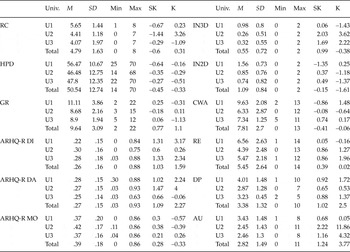
Table 1 displays descriptive statistics pertaining to each test at the three universities. Differences in the selectiveness of each university (U) were reflected in significantly different outcomes on the reading tests (Wilks’ λ = .250, F(6,508) = 12.889, p < .001, η p 2 = .132), as well as creativity and insight tests (Wilks’ λ =. 572, F(12,502) = 12.081, p < .001, η p 2 = .244). Differences were observed on every reading test (F RC(2,256) = 26.638, η p 2 = 175; F PASHO(2,256) = 19.491, η p 2 = 145, F GR(2,256) = 20.351, η p 2 = 149, ps < .001). Multiple comparisons, applying the Bonferroni correction, indicated that U1 outperformed U2 and U3 on every reading test (ps < .001), while U2 and U3 scored similarly. The same was true on creativity and insight tests. The Us differed significantly in outcomes on all tests (F IN3D(2, 256) = 36.431, η p 2 = .222, F IN2D(2, 256) = 29.819, η p 2 = .189, F CWA(2, 256) = 53.345, η p 2 = .294, F RE(2, 256) = 16.105, η p 2 = .130, F DP(2, 256) = 22.079, η p 2 = .147, F AU(2, 256) = 14.277, η p 2 = .100, ps < .001). Pairwise comparison using the Bonferroni correction revealed that participants from U1 outperformed participants from U2 and U3 on all tests (ps < .05), and that the other two scored the same on all tests except the CWA, on which U2 students outperformed U3 students (p = .02). Participants from the different Us also showed significantly different self-reported reading disability, specifically on the dimension of childhood learning disability (F ARHQ-DI(2,256) = 5.753, η p 2 = .047; p = .004). Pairwise comparisons revealed that U3 students reported greater reading disability than U1 (p = .004), and similar disability as U2. No arts majors reported having a reading disability.
Descriptive Statistics for Tests of Creativity, Insight, and Reading Skills at Three Universities

Note: RC = Reading Comprehension; HPD = Word and Pseudoword Decision task; GR = General Rhyming; ARHQ-R_DI = Adult Reading History Questionnaire – Revised, specific learning disability of reading in childhood; ARHQ-R_DA = Adult Reading History Questionnaire – Revised, current reading disability; ARHQ-R_MO = Adult Reading History Questionnaire – Revised, level of motivation to read; IN3D = three-dimensional insight tasks; IN2D = two-dimensional insight tasks; CWA = Compound Word Association; RE = Rebus Puzzle; DP = Drawing Production; AU = Alternative Uses; SK = skewness index; K = kurtosis.
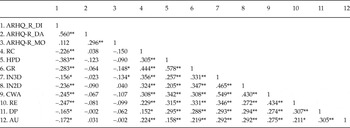
Table 2 reports the correlations between results on the reading, creativity, insight, and ARHQ-R tests. Significant, negative correlations were observed between the language skills tests and the ARHQ-R. This indicates that students who reported childhood learning disability now scored lower on reading tests. A stronger correlation was observed between the ARHQ-R_DI questionnaire and the HPD test (r = –.387, p < .001); that is, students who currently exhibited more difficulty with orthographic word recognition had a greater tendency to report specific learning disability of reading during childhood. All correlations between the tests of reading, creativity, and insight were found to be positive and significant. That is, students who scored higher on reading tests also scored higher on creativity and insight tests. Furthermore, higher correlations were found between reading skills and insight tests (IN2D, IN3D, CWA, RE) than between reading skills and creative fluency tests, both in the verbal and figurative modalities (DP and AU).
Bivariate Correlations between Reading, Creativity, and Insight Tests

Note: ARHQ-R_DI = Adult Reading History Questionnaire – Revised, reported learning disability of reading in childhood; ARHQ-R_DA = Adult Reading History Questionnaire – Revised, current reading disability; ARHQ-R_MO = Adult Reading History Questionnaire – Revised, level of motivation to read; RC = Reading Comprehension; HPD = Word and Pseudoword Decision task; GR = General Rhyming; IN3D = three-dimensional insight tasks; IN2D = two-dimensional insight tasks; CWA = Compound Word Association; RE = Rebus Puzzle; DP = Drawing Production; AU = Alternative Uses. **p < .001, *p < .05.
How Much Did Reading Test Scores Predict Creativity and Insight Test Scores?
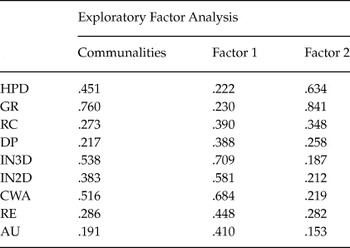
As similar correlations were found among the tests of language, creativity, and insight, exploratory factor analysis (EFA) was conducted to determine whether or not the study’s variables constitute independent factors. For this analysis, the principal axis extraction method was utilized, along with Varimax rotation. This yielded two factors with eigenvalues greater than 1, which together explained 40.162% of the variance (KMO = .828; Bartletts’s test of sphericity χ2(36) = 581.013, p < .001). Table 3 reports each test’s communalities and factor loadings. Factor 1 grouped together the creativity and insight tasks; it was labeled the creativity factor. Factor 2 encompassed the reading tests and was labeled the verbal factor. Factors 1 and 2 had a correlation of .168 (p < .007). Thus, while the tests of reading skills, creativity, and insight were associated, they preferentially evaluated distinct latent variables. Adequate factor loadings were obtained for most of the tests, except for RC and DP, whose factor loadings were below 0.4.
Factor Loadings and Communalities for Creativity, Insight, and Reading Tests

Note: HPD = Word and Pseudoword Decision task; GR = General Rhyming; RC = Reading Comprehension; DP = Drawing Production; IN3D = three-dimensional insight tasks; IN2D = two-dimensional insight tasks; CWA = Compound Word Association; RE = Rebus Puzzle; AU = Alternative Uses.
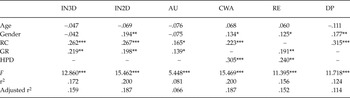
In order to determine to what extent reading test scores predicted creativity and insight test outcomes, multiple regressions were carried out. In all analyses, we controlled for the gender and age variables. Table 4 displays standardized regression coefficients from each analysis. The RC test proved to be a significant predictor of scores on every test but RE. Meanwhile, the GR test, associated with phonological awareness, was significantly correlated with all tests but the CWA and DP. The HPD, however, which is tied to orthographic awareness skills, was a stronger predictor of CWA and RE outcomes. Finally, the AU test of creative fluency, which requires multiple verbal responses, was the most weakly associated with reading test scores.
Standardized Regression Coefficients (β) for Creativity and Insight Tests

Note: HPD = Word and Pseudohomophone Decision task; GR = General Rhyming; RC = Reading Comprehension; DP = Drawing Production; IN3D = three-dimensional insight tasks; IN2D = two-dimensional insight tasks; CWA = Compound Word Association; RE = Rebus Puzzle; AU = Alternative Uses. Boxes left blank represent variables that were excluded from the model. ***p < .001 **p < .01, *p < .05.
Creative Performance in High- and Low-achievement Groups Based on Reading Tests
According to the literature (Wang, Reference Wang2012), higher performance on creativity tests is linked to poorer performance on reading skills tests; this correlation occurs at the low end of reading skills distributions. To test that hypothesis here, students were classified into three groups: low, average, and high reading test scores. To classify participants, factor scores were used, which were gleaned from principal components analysis.
According to students’ self-report on the ARHQ-R_DI, the lowest-achieving group on reading tests, presently, reported greater learning disability of reading as children (M = .34, SD = .17) compared to the high achievement group (M = .12, SD = .09; t(51) = 5.714, p < .001 d = 1.59).
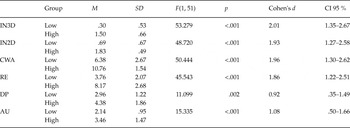
When we compared the low- and high-achievement groups on reading tests using univariate analysis, we found that the high-achievers scored highest on all creativity tests. Table 5 lists the descriptive data and statistics on the differences between these groups. We later explored whether the groups of students differed in how frequently they used insight-based vs. analytical strategies to solve items on the CWA and RE tests. Not all students provided their strategies, however. On the CWA, the low-achievement group answered the question about their strategy 44% of the time they solved an item, while the high-achievement group did so 95.4% of the time. On the same test, the low-achievement group used insight 53% of the time they correctly solved an item, while the high-achievement group did so 63% of the time. No differences were found between groups (z = –0.617, p = ns). On the RE test, students in the low-achievement group reported their strategy 72.4% of the time – either insight or analysis – whereas the high-achievement group did so 91% of the time. On the same test, the low-achievement group reported having experienced insight 44% of the time, while the high-achievement group did so 55% of the time on items they answered correctly. Again, differences were not observed between groups (z = –0.766, p = ns). Finally, no differences were found in the use of insight vs. analytical strategies within each group (CWAz Low = –0.617, CWAz High = 1.474; REz Low = –0.926, REz High = 0.603, ps = ns).
Descriptive Statistics for the Low (n = 29) and High (n = 24) Achievement Groups on Reading Tests, and Comparative Statistics

Note: IN3D = three-dimensional insight tasks; IN2D = two-dimensional insight tasks; CWA = Compound Word Association; RE = Rebus Puzzle; DP = Drawing Production; AU = Alternative Uses; Cohen’s d = Effect Size; CI 95% = confidence interval of 95% for effect size.
Conclusions
This study explored the relationship between outcomes on tests of reading skills, creativity, and insight, and self-reported specific learning disability of reading during childhood. The results indicate a positive correlation between performance on reading skills, creativity, and insight tasks such that students who scored high on one also scored high on the others. In light of that finding, these results did not support the hypothesis that students with a specific learning disability of reading would score higher on creativity and insight tasks.
The different processes underlying these tests could explain the positive correlations between the tests of creativity, insight, and reading. For example, the creativity and insight tests' correlation with reading comprehension scores could be explained by the variety and complexity of the skills that are the basis for reading comprehension. One consequence of that complexity is that several reading comprehension tasks are moderately correlated with a range of other tasks that have some skill or process in common with reading comprehension (Ketabi, Zabihi, & Ghadiri, Reference Ketabi, Zabihi and Ghadiri2012). For example, there is a positive correlation between overall intellectual performance and reading comprehension processes (Keenan & Meenan, Reference Keenan and Meenan2012). Specifically, in this study, the verbal component of creativity and insight-based tasks – associating words according to several criteria, and reading and understanding instructions – led them to be positively correlated with reading comprehension test scores. On the other hand, the observed association between scores on certain tests of creativity and insight (Word Association and Rebus Puzzle) and the phonological awareness task could be due to the fact that they all require a combination of verbal and visual cues to be solved.
The relationship between creativity and specific learning disability of reading has been mainly attributed to compensatory mechanisms, both cognitive and anatomical-functional (Chakravarty, 2010; Leonard & Eckert, Reference Leonard and Eckert2008). These mechanisms generate biased information processing, which is expressed as a preference for certain types of problem-solving strategies (Bacon, et al., Reference Bacon, Handley and McDonald2007; Bacon & Handley, Reference Bacon and Handley2010). In this study, we could not conclude that low-achieving students on reading tests have an information-processing bias, because the low- and high-achievement groups on reading tests showed the same pattern of use of analytical and insight strategies to answer Rebus puzzles and the word association test (although students in the high-achievement group more often reported what strategy they preferred to solve the problems). Other studies that have utilized these tests have shown that the general population does not exhibit differences in the frequency of use of different types of problem-solving strategies (Ash & Wiley, Reference Ash and Wiley2006; Bowden & Jung-Beeman, Reference Bowden and Jung-Beeman2003b).
Previous studies have reported a greater proportion of dyslexics in certain groups (e.g. art students and entrepreneurs, see Logan, Reference Logan2008; Wolff & Lundberg, Reference Wolff and Lundberg2002). Conversely, in the present study, no students majoring in an arts discipline reported considerable learning disability of reading during childhood. This was likely due to the fact that in this case, arts majors came from the most selective university, so as a group, they were less likely to exhibit considerable learning disability of reading.
As indicated above, this study’s results do not support the findings of authors who have reported a positive correlation between specific learning disability of reading, and creativity (Everatt, Reference Everatt1997; Everatt et al., Reference Everatt, Steffert and Smythe1999; von Károlyi, Reference von Károlyi2001). Our results instead showed a positive correlation between overall academic achievement and creativity, which other studies have likewise reported (Kuncel, Hezlett, & Ones, Reference Kuncel, Hezlett and Ones2004).
Lastly, it is important to note certain limitations of the present study. The first is regarding the tests chosen to assess reading skills. On the one hand, the tests administered only covered a small portion of the processes involved in reading and verbal information processing. Therefore, it may be that other processes are more strongly associated with creativity and insight tasks, or that reading skills’ correlation with creativity and insight is weaker in the presence of other variables. On the other hand, unlike in this study, research reporting a link between dyslexia and higher achievement on creative or visuospatial tasks has utilized individually administered tests to evaluate the connection between phonological processes and creative or visuospatial skills. Administering the tests as a group, then, may have had an impact on students’ performance. These two aspects, restricting the skills evaluated here and administering the tests collectively, may have generated a bias in identifying students with specific learning disability of reading.
On another note, while the population to which these participants belonged was relatively heterogeneous, it was a set of students pursuing higher education, so members of the sample who did exhibit specific learning disability must, to some extent, compensate for that challenge. Given the limited range in which we observed this phenomenon, certain associations may have come across weaker than they really are.
Another important limitation of this study is that the reading skills tests were not standardized, so students could only be classified by performance in comparison to their reference group. Currently in Chile, no group-administered standardized tests are available for adults that assess linguistic processes and skills associated with specific reading disability. In that sense, this study is a first step toward describing the reality of this population. Future studies should be geared toward standardizing observation tools, and should utilize samples with more heterogeneous verbal ability than this study’s sample.
This study was funded by the Programa de Apoyo a la Realización de Tesis Doctorales [Program to support doctoral thesis completion], CONICYT n° 24100111. David D. Preiss’s contribution to this paper was supported by Grant 1100580, provided by FONDECYT-CONICYT.