Microorganisms in milk can cause physical and chemical changes limiting its durability and compromising the quality of the product. Although the contamination of milk is usually associated with bacteria, reports point to the fact that yeasts play an important role in the dairy industry because they can metabolize a variety of milk constituents and promote degradation of dairy products (Bullerman, Reference Bullerman1981; Fleet & Mian, Reference Fleet and Mian1987; Déak, Reference Déak1991; Jakobsen & Narvhus, Reference Jakobsen and Narvhus1996; Roostita & Fleet, Reference Roostita and Fleet1996; Minervini et al. Reference Minervini, Montagna, Spilotros, Monaci, Santacroce and Visconti2001). From the standpoint of public health, little is known about the importance of the presence of yeasts in dairy products (Melville et al. Reference Melville, Ruz-Peres, Yokoya and Benites2006; Ruz-Perez et al. Reference Ruz-Peres, Yokoya, Benites and Melville2010).
Prolonged storage of milk before and after pasteurization has resulted in new challenges for maintaining the quality of the product. The extended storage at refrigeration temperatures favours the growth of psychrotrophs, many of which have the ability to produce lipolytic and proteolytic thermoresistant enzymes that may degrade milk components affecting the quality of the product (Sorhaug & Stepaniak, Reference Sorhaug and Stepaniak1997). There are few references to the occurrence of yeasts in milk and dairy products kept at refrigeration temperatures (Chavan et al. Reference Chavan, Prajapati, Jana, Hingu, Chavan and Khedkar2010).
Temperature has an important influence on the activity of fungi. The growth of microorganisms at 37°C reveals its ability to develop in human and animal organisms, and this characteristic may be considered a pathogenic factor (McDonald & Odds, Reference Macdonald and Odds1983). Some authors suggest that the ability of fungi to produce enzymes, such as phospholipases and proteinases, can also be associated with pathogenicity. These enzymes may help in the spread of fungus allowing invasion by degradation of the skin or mucosa (McDonald & Odds, Reference Macdonald and Odds1983; Khozel, Reference Khozel1995; Koga-Ito et al. Reference Koga-Ito, Lyon, Vidotto and Resende2006; Kumar et al. Reference Kumar, Kumar and Menon2006). According to Kumar et al. (Reference Kumar, Kumar and Menon2006), the transformation from a saprophytic microorganism to a pathogen in unbalanced conditions of the defence system of the host can be attributed to a wide repertoire of expression of virulence determinants, including the production of enzymes such as proteinases and phospholipases.
This study was designed considering that the presence of yeasts in milk may impair the quality of the product, mainly when they have the ability to produce enzymes that degrade proteins and lipids. The importance of yeasts as causative agents of diseases in humans was also considered, particularly regarding the ability of these microorganisms to grow and produce enzymes at 37°C, i.e. the same as a human host. Therefore, this study aimed to verify whether different species of yeasts isolated from bovine raw milk have psychrotrophic behaviour and/or ability to grow at 37°C, as well as have proteinase and phospholipase activities at different temperatures.
Materials and Methods
Strains
Two hundred and twenty (n=220) strains of yeasts isolated from bovine raw milk samples were used in this study: Aureobasidium sp. (n=4), Candida albicans (n=2), Cand. krusei (n=38), Cand. parapsilosis (n=16), Cand. kefyr (n=21), Cand. guilliermondi (n=30), Cand. lusitaniae (n=11), Cand. tropicalis (n=30), Rhodotorula spp. (n=27), Geotrichum spp. (n=30) and Trichosporon spp. (n=11). These strains were isolated from 70 raw milk samples obtained from refrigerated tanks or cans from farms located in different regions of São Paulo, Brazil. The milk came predominantly from crossbred and black and white Holsteins.
All strains were identified according to Kurtzman & Fell (Reference Kurtzman and Fell1998) and Kreeger-Van-Rig (Reference Kreeger-Van-Rig1984). These strains are kept frozen under liquid nitrogen at the Bacteriology and Mycology Laboratory of the Department of Preventive Veterinary Medicine, Faculty of Veterinary Medicine and Zootechny, University of São Paulo (USP), Brazil.
Determination of psychrotrophic behaviour and growth at 37°C
To analyze the ability to grow at 37°C, 0·01 ml from a suspension of each strain in Sabouraud liquid medium (SLM, Oxoid Ltd., London, UK) with 48 h of growth corresponding to the turbidity equivalent of tube 5 on the McFarland scale (Murray et al. Reference Murray, Baron, Pfaller, Jorgensen and Yolken2003), was plated onto Sabouraud dextrose agar (SDA, Oxoid) and incubated at 37°C. Two different plates were used for each strain. The same procedure was used for the observation of growth at room temperature (25 °C ±1°C) which is the temperature in which they have optimum growth. The comparative development was based on the evaluation of presence or absence of growth of colony-forming units at the different temperatures and was analyzed over a period of up to 7 d.
To evaluate the presence of psychrotrophic behaviour, 0·01 ml from a suspension of each strain in SLM with 48 h of growth corresponding to the turbidity equivalent to tube 5 of the McFarland scale, was plated onto SDA and incubated under refrigeration (4°C ±1°C). Two different plates were used for each strain. The same procedure was used for the incubation of the strains at room temperature (25°C ±1°C). The comparative development (presence or absence of growth of colony-forming units) at the different temperatures was analyzed over a period of up to 14 d.
Enzymes production
To evaluate proteinase and phospholipase production, tests were performed in triplicate. A 48-h culture of each isolate on SDA was suspended in 3 ml sterile saline, adjusted to a turbidity equivalent to tube 0·5 of the McFarland scale (Murray et al. Reference Murray, Baron, Pfaller, Jorgensen and Yolken2003). Test strains were spot inoculated (∼6 mm) onto three plates which were incubated at 37°C, three plates at room temperature (25°C ±1°C) and three under refrigeration (4°C ±1°C). The strain was considered positive for production of enzymes in each of the temperatures measured when the enzyme activity was detected in all three plates tested.
The evaluation of presence of proteinase was assayed according to Lacaz et al. (Reference Lacaz, Porto, Martins, Heins-Vaccari and Melo2002). The test medium (casein medium) consisted of plates containing skim milk (10%) and agar (2%). The medium containing skim milk (10%) was sterilized by autoclaving and added to autoclaved 2% agar. Each isolate was tested and the plates were observed during a period of 15 d. Determination of phospholipase activity was performed using the base medium according to Koga-Ito et al. (Reference Koga-Ito, Lyon, Vidotto and Resende2006). The diameter of colony and total diameter of colony and precipitation zone (Pz) were measured and proteinase/phospholipase activity were scored according to the method by Price et al. (Reference Price, Wilkinson and Gentry1982). The Pz value representing the ratio of the diameter of the colony alone to the total diameter of the colony plus precipitation zone, was determined and scored as follows into five categories: Pz=1 (negative); 0·99−0·90 (1+); 0·89−0·80 (2+); 0·79−0·70 (3+); ⩽0·69 (4+). Accordingly, a low Pz value indicated stronger enzyme activity. The lack of precipitation zone indicated the absence of proteinase/phospholipase activity.
Statistics
Statistical analysis were performed with the Fisher and Mann Whitney tests using the software GraphPad InStat 1992–98 to achieve them.
Results and Discussion
The importance of the presence of yeasts and molds in milk was underscored by Fleet & Mian (Reference Fleet and Mian1987), whose report linked the ingestion of food contaminated by fungi with occurrence of diseases in humans. Todd (Reference Todd1983), in a survey about illnesses associated with consumption of food, mentioned a total of 51 cases in which fungi would be suspected.
All strains tested in this study are usually associated with opportunistic mycoses which consist of cosmopolitan infections caused by fungi of low virulence which peacefully coexist with the host, but when favourable conditions occur, such as immune system disorders, they develop their pathogenic potential invading the tissues (Kwon-Chung & Bennett, Reference Kwon-Chung and Bennett1992). Thus, the consumption of milk contaminated with yeasts could lead to diseases, considering that these microorganisms are able to cause several kinds of infections in humans (Todd, Reference Todd1983; Fleet & Mian, Reference Fleet and Mian1987; Jakobsen & Narvhus, Reference Jakobsen and Narvhus1996; Melville et al. Reference Melville, Ruz-Peres, Yokoya and Benites2006; Ruz-Perez et al. Reference Ruz-Peres, Yokoya, Benites and Melville2010).
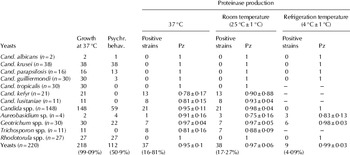
Different virulence factors present in yeasts may contribute to their pathogenicity and among them, the ability to grow at 37°C (McDonald & Odds, Reference Macdonald and Odds1983). In the present study 99·09% (n=218) of the isolates grew at this temperature (Table 1). The importance of testing at 37°C refers to the fact that this is the condition present in most host organisms.
Results of occurrence of growth at 37°C, psychrotrophic behavior, proteinase production at 37°C, room and refrigeration temperatures, and means and standard deviations of Pz for proteinase production considering the values obtained for each yeast species isolated from bovine raw milk samples

† –=absence of yeast growth
Categories for Pz: 1 (negative); 0·99−0·90 (1+); 0·89−0·80 (2+); 0·79−0·70 (3+); ⩽0·69 (4+)
Psychr. behav.=psychrotrophic
The ability to produce extracellular enzymes is also considered an important virulence factor, considering that these enzymes may contribute to the invasion and spreading of the microorganism inside the host (Koga-Ito et al. Reference Koga-Ito, Lyon, Vidotto and Resende2006; Kumar et al. Reference Kumar, Kumar and Menon2006). In the present study 86 strains (39·09%) had two virulence factors: 69 strains (31·36%) grew at 37°C and produced phospholipase; 17 isolates (7·72%) grew at 37°C and produced proteinase. Fourteen strains (6·36%) had three virulence factors (growth at 37°C as well as proteinase and phospholipase production). The parasite-host relationship depends on a balance between the virulence of the microorganism and host defences. In the case of fungi, it is known that deficiencies in immune response are usually present for the occurrence of the disease, and also the ability to secrete hydrolytic enzymes which seems to be the most important virulence factor for yeasts (Barrett-Bee et al. Reference Barret-Bee, Hayes, Wilson and Ryley1985; Dolan et al. Reference Dolan, Bell, Hube, Schaller, Warner and Balish2004).
The production of proteinase and phospholipase by yeasts, besides playing an important role in terms of pathogenicity as virulence factors, represents an important impact on the quality of dairy products because it contributes to spoilage (Roostita & Fleet, Reference Roostita and Fleet1996; Minervini et al. Reference Minervini, Montagna, Spilotros, Monaci, Santacroce and Visconti2001). Several yeast species are capable of using a wide variety of constituents of milk as substrates to grow (Roostita & Fleet, Reference Roostita and Fleet1996). Among other factors, proteolytic and lipolytic activities that occur in milk are caused by enzymes produced by microorganisms and released into the milk, contributing significantly to the degradation of proteins and lipids and compromising the quality and shelf life of the product (Chen et al. Reference Chen, Daniel and Coolbear2003).
The percentage of isolates in which proteinase activity was detected was similar at 37°C (16·81%) and room temperature (17·27%) and were both higher (P<0·05) than the percentage obtained at refrigeration temperature (4·09%) (Table 1). Proteinase activity at 37°C and room temperature was detected in isolates of Aureobasidium sp. (except for two strains which produced proteinase only at room temperature), Cand. kefyr, Cand. lusitaniae, Geotrichum spp. and Trichosporon spp. (except for one strain which only produced proteinase at 37°C). Only Geotrichum spp. and Aureobasidium sp. produced proteinase under refrigeration (Table 1).
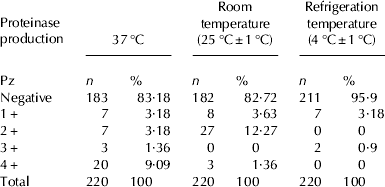
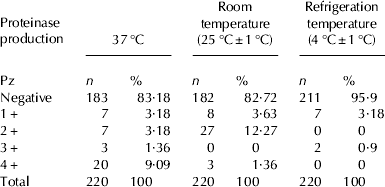
From a total of 37 proteinase-producing strains at 37°C, 23 (62·16%) showed strong enzyme activity (Pz 3+ and 4+; Table 2). From a total of 38 proteinase-producing isolates at room temperature, 35 (92·10%) showed low enzyme activity (Pz 1+ and 2+). For the 9 proteinase positive strains under refrigeration temperature, the Pz scores were 1+ or 3+ (Table 2). The different temperatures did not interfere with the number of negative Pz results considering that their frequencies were similar (P<0·05; Table 2). Twenty (9·09%) isolates produced 4+ proteinase activity at 37°C, a higher frequency (P<0·05) than all other conditions with the exception of Pz 2+ at room temperature (Table 2). It can be concluded that a more intense proteinase production occurs at higher temperatures such as 37°C and that the isolates which failed to produce proteinase at room and refrigeration temperatures could produce this enzyme inside human hosts where the temperature rises to 37°C.
Distribution of the amount of yeasts strains according to their scores of Pz for proteinase production at 37°C, room and refrigeration temperatures
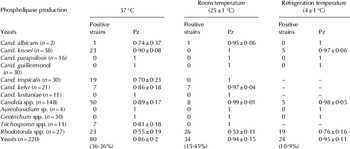
Phospholipase activity was detected in 36·36% (n=80), 15·45% (n=34) and 10·9% (n=24) of the isolates incubated, respectively at 37°C, room and refrigeration temperatures. The occurrence of phospholipase-producing strains at 37°C was higher (P<0·05) than at the other incubation temperatures (Tables 3 & 4). The production of enzymes at 37°C could contribute to the in vivo virulence of the microorganism.
Results of occurrence of phospholipase production at 37°C, room and refrigeration temperatures and means and standard deviations of Pz for phospholipase production considering the values obtained for each yeast species isolated from bovine raw milk samples

† –=absence of yeast growth
Categories for Pz: 1 (negative); 0·99−0·90 (1+); 0·89−0·80 (2+); 0·79−0·70 (3+); ⩽0·69 (4+)
Room temperature did not inhibit proteinase and phospholipase production and consequently, when yeasts are present in milk kept at this temperature, there may be a lose in its quality. However, it should be noted that there was a significant (P<0·05) reduction in the amount of phospholipase-producing strains at this temperature. Room temperature usually reflects the ideal condition for fungal development and allows the evaluation of the occurrence of enzyme secretion in favourable growing conditions, although at least regarding phospholipase production, a lower number of producing strains were observed at room temperature (n=34) than at 37°C (n=80; Tables 3 and 4).
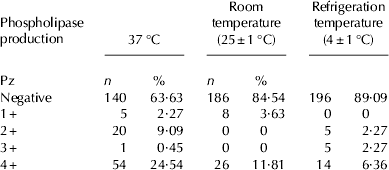
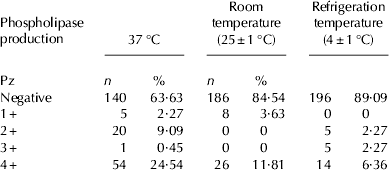
Distribution of the amount of yeasts strains according to their scores of Pz for phospholipase production at 37°C, room and refrigeration temperatures
Phospholipase activity at 37°C and room temperature was detected in isolates of Cand. albicans, Cand. kefyr and Rhodotorula spp. (except for three isolates which produced phospholipase only at room temperature). Phospholipase production at 37°C was also observed by Cand. krusei (60·52% of the strains), Cand. tropicalis (63·33%) and Trichosporon spp. (63·63%). Only Cand. krusei (13·15% of the isolates) and Rhodotorula spp. (70·37% of strains) produced phospholipase under refrigeration (Table 3).
From a total of 80 phospholipase-producing strains at 37 °C, 55 (68·75%) showed strong enzymatic activity (Pz 3+ and 4+; Table 4). Regarding incubation at room temperature, 26 (76·47%) showed strong enzymatic activity (Pz 4+). At refrigeration temperature 19 (79·16%) isolates showed strong enzymatic activity (Pz 3+ and 4+) (Table 4). Fifty four (24·54%) isolates produced 4+ phospholipase activity at 37°C, a much higher frequency (P<0·05) than any other condition (Table 4).
Considering the 220 strains tested and the four conditions analysed 33·18% (n=73) showed three of these characteristics.
Spanamberg et al. (Reference Spanamberg, Hartffelder, Fuentefria and Valente2004) reported that 6% and 79% of yeasts isolated from milk samples showed, respectively, proteolytic and lipolytic activities at 22°C. The difference between their results and those of the present study is significant (P<0·05), both for the production of proteinase and phospholipase at similar temperatures (22°C and 25 °C). Most of the species isolated in both studies are distinct and, since their results were not presented as specific to each species, it was not possible to establish a more detailed and insightful analysis.
While freshly milk may not contain detectable levels of psychrotrophs, they are almost always present in raw milk stored under refrigeration. Several yeasts are able to grow at low temperatures (Roostita & Fleet, Reference Roostita and Fleet1996). In this study, 50·9% of the isolates showed psychrotrophic behaviour (Table 1). It was also found that 4·09% and 10·9% of strains were positive for proteinase and phospholipase production respectively under refrigeration (Tables 1 and 3). This temperature inhibited proteinase production of all Candida spp. isolates. The lytic capacity of these enzymes could influence the physico-chemical properties of milk and dairy products, particularly those which need a longer time to mature. In this study the reduction in temperature was associated with a reduction in the amount of phospholipase and proteinase-producing strains showing that cooling is an effective procedure to inhibit the production of these enzymes.
The possibility of the persistence of fungi in pasteurized and/or boiled milk should also be considered as observed by Ruz-Perez et al. (Reference Ruz-Peres, Yokoya, Benites and Melville2010). This may represent a risk to the consumer and may also change the characteristics of the product. In general, many proteinases present in milk are not liable to destruction by heat treatments applied during milk processing and will remain in the final product even in milk powder for long periods of storage. According to Chen et al. (Reference Chen, Daniel and Coolbear2003) proteinases and lipases produced by microorganisms may be present in raw and pasteurized milk, as well as UHT milk and milk powder. Therefore it would be interesting the conduction of surveys for fungi and their enzymes in heat-treated products.
In conclusion the results indicate that yeasts may play a role in dairy industry as they might produce enzymes (proteinases and phospholipases) as well as have the ability to develop under different temperatures, contributing to spoilage and compromising the quality of milk and dairy products. The persistence of these microorganisms and their enzymes in milk may also represent a risk to public health as they may cause diseases in consumers.
The study was financially supported by the Fundação de Amparo a Pesquisa do Estado de São Paulo (FAPESP grant 07/57861-7).