INTRODUCTION
Fisheries by-catch has been singled out as an important factor involved in population decline among sea turtles and other marine megafauna worldwide (Lewison et al., Reference Lewison, Crowder, Read and Freeman2004a, Reference Lewison, Freeman and Crowderb), including the Mediterranean Sea (Camiñas et al., Reference Camiñas, Báez, Valeiras and Real2006). In this context, incidental catches of sea turtles in drifting longline fisheries have attracted international attention (e.g. Lewison et al., Reference Lewison, Freeman and Crowder2004b; Camiñas et al., Reference Camiñas, Báez, Valeiras and Real2006). In the Mediterranean Sea, surface drifting longlines mainly target three different species: albacore Thunnus alalunga, bluefin tuna Thunnus thynnus and swordfish Xiphias gladius.
One of the major recommendations to reduce sea turtle by-catch relates to modifications of the fishing gear, such as using circular hooks and fish bait (e.g. Watson et al., Reference Watson, Epperly, Shah and Foster2005; Gilman et al., Reference Gilman, Zollet, Beverly, Nakano, Davis, Shiode, Dalzell and Kinan2006, Reference Gilman, Kobayashi, Swenarton, Brothers, Dalzell and Kinan-Kelly2007; Piovano et al., Reference Piovano, Swimmer and Giacoma2009). The implementation of these recommendations, based on experimental fishing surveys, has significantly reduced income from this fishery in some cases (Watson et al., Reference Watson, Epperly, Shah and Foster2005; Serna et al., Reference Serna de la, Ortiz de Urbina and García-Barcelona2006; Read, Reference Read2007), although it has not occurred in other cases (Kerstetter & Graves, Reference Kerstetter and Graves2006; Gilman et al., Reference Gilman, Kobayashi, Swenarton, Brothers, Dalzell and Kinan-Kelly2007). Therefore, manipulation of current fishing gears could affect the economic profit from longline fisheries (see Báez et al., Reference Báez, Real, Macias, De La Serna, Bellido and Camiñas2010).
Báez et al. (Reference Báez, Real, García-Soto, de la Serna, Macias and Camiñas2007a) studied sea turtle by-catch during longline fishing targeting swordfish in the western Mediterranean Sea and showed that sea turtle by-catch is independent of the fishing effort and other technological factors. Loggerhead by-catch showed a close relationship with the mean value of the nearest distance to the coast at the beginning and end of gear setting (referred to as distance to the coast, hereafter). When the distance to the coast increases, there is a higher probability of catching a loggerhead turtle. The authors observed that 65% of incidental sea turtle catches occurred further than 35 nautical miles (nm) (approximately 65 km) from the coast. In addition, only 17% of catches of swordfish occurred in the same area, which is in line with the expected percentage under the assumption that swordfish catches are independent of this distance threshold; hence Báez et al. (Reference Báez, Real, García-Soto, de la Serna, Macias and Camiñas2007a) proposed to avoid fishing further than 35 nm from the coast. The reduction in target species catches and the corresponding economic loss under this management proposal was considered to be low, although the real effect on total captures and revenue for the whole Mediterranean Spanish fleet needed evaluation before adopting such measures. If such losses in revenues are assumed by the fleet or the administration, this management recommendation could be implemented with the collaboration of the fishing sector, given that the running costs of fishing far from the coast (more than 35 nm) are higher than those of fishing at moderate distances. However, the proposed 35 nm limit could be useful where the continental shelf is narrow but useless where it widens.
Ecological model validation is considered essential for management application (Rykiel, Reference Rykiel1996). Shugart (Reference Shugart1984) defined the ecological model validation as ‘procedures in which a model is tested on its agreement with a set of observations that are independent of those observations used to structure the model and estimate its parameters’. The specific aim of the present paper is to validate the new fisheries loggerhead by-catch model in areas with continental shelves wider than those in the Balearic Sea. The overall aim is helping to maintain a sustainable fishing activity compatible with the conservation of the loggerhead populations.
MATERIALS AND METHODS
Study areas selected were the Alborán Sea (Mediterranean Sea) and Gulf of Cadiz (Atlantic Ocean), including adjacent waters. Both areas represent an important outstanding zone for the western Atlantic loggerhead populations that use the western Mediterranean Sea as a feeding area, as they connect the western Mediterranean Sea with the Atlantic Ocean (e.g. Camiñas et al., Reference Camiñas, Báez, Valeiras and Real2006, and references therein). The Alborán Sea broadly extends from the Strait of Gibraltar to an adopted line from Cape of La Nao (Spain) to Cape of Oran (Algeria), and is limited by the Gulf of Cadiz with the Strait of Gibraltar to the east and by Cape of Saint Vicente (Portugal) to the west, including the Spanish exclusive economic zone and adjacent international waters. We selected these areas because in both of them the continental shelf is wider than in the Balearic Sea (Sobrino et al., Reference Sobrino, Baro and Cumbreras1994; Bas, Reference Bas2000).
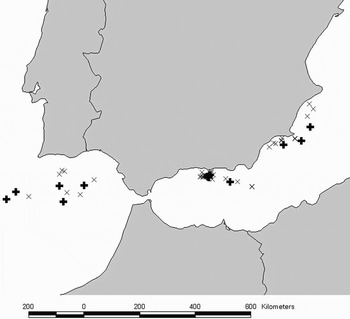
The Andalusian and Murcian surface long-line fleet, which fishes in the study areas, consists of 78 vessels from 12 to 27 m total length, fishing all year round. We observed 7 boats with length from 10.4 to 22.43 m (14.16 m on average) targeting swordfish. A total of 58 fishing operations targeting swordfish were observed onboard from 27 July to 8 November 2004 (Figure 1). For more details on data collection and boat description see Báez et al. (Reference Báez, Camiñas, Sagarminaga, Torreblanca and Real2007b).
Distribution map of the observed fishing operation. The cross points represent sets with at least one catch of turtle, while sets in X represent sets without loggerhead catch.

We tested whether the probability of catching at least one loggerhead increased with the distance to the coast using logistic regression as in Báez et al. (Reference Báez, Real, García-Soto, de la Serna, Macias and Camiñas2007a). We divided the predictive variable into 3 classes and tested differences in catch per fishing operation among these classes by means of the Kruskal–Wallis test. Groups included fishing grounds at less than 10 nm (18,500 m), between 10 and 34.99 nm (equivalent to 18,520 m and 64,801 m), and farther than 35 nm (64,820 m) from the coast, as in Báez et al. (Reference Báez, Real, García-Soto, de la Serna, Macias and Camiñas2007a).
RESULTS AND DISCUSSION
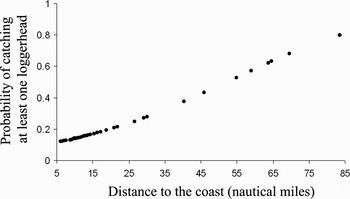
We observed a relationship between distance to the coast and probability of catching at least one loggerhead (Logit function: Y = –2.235 + 0.43*(distance to the coast); Wald test = 6.499; df = 1; P = 0.011) (Figure 2). We also observed an increase in the average number of loggerhead captured per fishing operation as a function of the distance to the coast (Kruskal–Wallis H test = 7.757; df = 2; P = 0.021).
Adjusted probability of catching at least one loggerhead during a fishing operation as a function of distance to the coast.

The present results validate the fisheries loggerhead by-catch model proposed by Báez et al. (Reference Báez, Real, García-Soto, de la Serna, Macias and Camiñas2007a), although the relation between distance to the coast and loggerhead by-catch is not exactly the same. It is possible that the width of the continental shelf modulates the influence of the distance to the coast on loggerhead–longline interactions. Eckert et al. (Reference Eckert, Moore, Dunn, van Buiten, Eckert and Halpin2008), for example, observed that the turtles using oceanic habitats of the Balearic Sea were more likely to exhibit ‘intensive search’ behaviour as might occur during foraging. Thus, presumably conditions in oceanic waters are more suitable to the feeding ecology of pre-neritic juveniles, which according to Cardona et al. (Reference Cardona, Revelles, Carreras, San Felix, Gazo and Aguilar2005) and Revelles et al. (Reference Revelles, Cardona, Aguilar, San Felix and Fernández2007) avoid both the continental shelf and the slope. However, Cardona et al. (Reference Cardona, Revelles, Parga, Tomás, Aguilar, Alegre, Raga and Ferrer2009) observed numerous immature loggerheads in aerial surveys over the continental shelf of eastern mainland Spain.
In conclusion, the distance to the coast could be useful whether the continental shelf is narrow or it widens. The combination of the previous recommendation with others related to soaking time (Báez et al., Reference Báez, Real, García-Soto, de la Serna, Macias and Camiñas2007a, Reference Báez, Real and Camiñasc) could help policy makers to implement new fishery management regulations to preserve a high number of loggerheads without meaningfully reducing the fishing activity, jobs at sea and economic profit. Surface longline gear should be retrieved before dawn when operated further than 35 nm from the coast (e.g. see Báez et al., Reference Báez, Real and Camiñas2007c), whereas it could be considered less dangerous for loggerheads when operated in areas closer to the coast. However, further studies should be undertaken in order to confirm the economic feasibility of these regulations, to check their usefulness to reduce loggerheads by-catch, and to test their possible long-term effect on the target species and other species of the pelagic ecosystem.
ACKNOWLEDGEMENTS
We would like to acknowledge Daniel Carrera-Martínez for his knowledge of veterinary subjects and comments. This study was supported by the European Union project Panlandalife (Conservation of cetaceans and sea turtles in Murcia and Andalucía, LIFE02NAT E/8610), and by the Spanish Ministry of Science and Innovation and FEDER (project CGL2009-11316).