INTRODUCTION
Organizations often encourage employees to express their suggestions and concerns about work-related issues to improve work processes and innovation, decision quality, and organizational performance – called ‘voice’ (LePine & Van Dyne, Reference LePine and Van Dyne1998; Morrison, Reference Morrison2011). Employees, however, often have concerns about doing so. One of their concerns is that their voicing behavior may embarrass their bosses or create a negative image about their supervisors (Detert & Edmondson, Reference Detert and Edmondson2011), such as being less capable because employees’ comments and suggestions mean that the supervisor's work should be improved. Facing the simultaneous consequences of improving organizational functioning and possibly harming the image of their supervisors, employees may refrain from delivering their voice to supervisors directly. Thus alternatively, as we demonstrate in this article, employees may choose to express voices implicitly to their supervisors in the workplace.
We define implicit voice delivery[Footnote 1] as a kind of voice tactic in which employees express their comments and suggestions to their supervisors using indirect, circuitous, and implicit language, such as hinting or implying. Thus, their true intended meaning (or ‘speaker meaning’) needs to be inferred by their supervisors. In other words, the true meaning is different from, but is partially built upon, the literal meaning (or ‘sentence meaning’) when they ‘voice’ (Holtgraves, Reference Holtgraves1997: 626).
Compared to direct or explicit ways of conveying a voice message, implicit voice delivery may be characterized by employees’ consideration of their supervisors’ ‘face’, which refers to ‘the positive social value a person effectively claims for himself [sic] by the line others assume he has taken during a particular contact’ (Goffman, Reference Goffman1955: 213). ‘Face’ captures the value associated with a person's public image, reputation, and status vis-à-vis other people in an interaction (White, Tynan, Galinsky, & Thompson, Reference White, Tynan, Galinsky and Thompson2004). One of the authors, who teaches an Organizational Behavior course at the MBA level for a renowned university in Northern China, conducted a course survey on their voice behavior at work. Results from 138 MBA students, with an average of 9 years working experience, revealed that 48.6% of them had chosen to voice implicitly to their supervisors. Among them, 24% said that they voiced implicitly in order to protect their supervisors’ face. These results confirmed that employees may actually voice implicitly to their supervisors, with the purpose of protecting their supervisors’ face.
Therefore, our study aims to answer the following research questions: (1) What is subordinates’ implicit voice delivery and how to measure this construct? (2) Will face concern encourage subordinates to use implicit voice delivery, and if so, what are the boundary conditions? (3) How do supervisors respond to implicit voice delivery in terms of their subsequent voice endorsement? To answer the first question, we explore the nature and manifestations of this construct in a qualitative study and develop a scale to measure it. Then in the quantitative study, we draw on face theory to propose that subordinates’ other-face concern (i.e., concern for the face of supervisors) is a major predictor of implicit voice delivery, and supervisors’ self-face concern (i.e., concern for their own face) magnifies the relationship. In addition, we propose that the use of implicit voice delivery positively predicts supervisors’ support for the content expressed in subordinates’ voice (i.e., voice endorsement). The aforementioned positive effects would further be strengthened by the supervisor's ability to infer meaning embedded in the implicit voice.
This article makes three contributions to the literature on voice. First, we define a new construct of implicit voice delivery and develop a measure on it. The content of the voice message as well as the delivery approach employed in voicing per se both convey important information and influence supervisors’ responses (Brown & Levinson, Reference Brown and Levinson1987; Holtgraves, Reference Holtgraves1997). Current literature on voice mostly focuses on what drives or hinders employees to voice in terms of voice content (i.e., promotive and prohibitive voice), such as situational factors and their motivation (cf. Morrison, Reference Morrison2011). But as Morrison (Reference Morrison2011) points out, an important direction for future research on voice is ‘to provide better understanding of employees’ choice about how to communicate concerns and suggestions’ (399; italics added). In other words, even after employees make the decision to voice, they still need to choose whether to voice in a straightforward manner or speak in a more implicit and roundabout approach. Our construct of implicit voice delivery captures this approach of voice and the measure we developed in the current research can be used in future studies exploring new phenomena relevant to voice.
Second, by applying face theory, we introduce a new theoretical perspective on voice-relevant phenomena. Face is a prevalent aspect of interactions between supervisors and their subordinates. Although face theory has widely been used in interpersonal communication (e.g., Ting-Toomey, Reference Ting-Toomey, Kim and Gudykunst1988; Ting-Toomey et al., Reference Ting-Toomey, Gao, Trubisky, Yang, Kim, Lin and Nishida1991), it has received little attention in the voicing situation. The relationships we propose in the model demonstrate how concerns about face (i.e., other-face concern and self-face concern) shape implicit voice delivery, which in turn affects outcomes at work (e.g., voice endorsement). The results will enrich the literature of voice, especially on how to deliver suggestions and concerns through a new perspective of face theory.
Third, we enrich the literature on voice by studying when and why employee voice is supported by their supervisors. Supervisors sometimes perceive employee voice as a threat to their own status and authority, and thus they could be reluctant to endorse employees’ ideas coming from their voice (Detert & Burris, Reference Detert and Burris2007). Although recent research shows that engaging in supportive forms of voice can increase the possibility of endorsement (Burris, Reference Burris2012), more effort needs to be made to identify crucial factors that encourage supervisors to endorse employees’ voice. This article makes contributions to this line of research by revealing that supervisors’ voice endorsement is related to both voice content and how that voice is delivered. The chance of endorsement could increase when employees voice in a more implicit manner, which can be perceived as face protection and thus less threatening. Figure 1 summarizes our theoretical model.
The theoretical model

THEORETICAL BACKGROUND AND HYPOTHESES DEVELOPMENT
Construct of Implicit Voice Delivery
After Morrison's (Reference Morrison2011) call for better understanding on how employees voice, researchers have started to pay more attention to this issue. How employees voice can be studied through many different perspectives. For example, Brooks (Reference Brooks2017) focused on the formality of voice communication channel and regarded formal voice mechanisms as designed by the organization, such as suggestion systems and grievance procedures. Xu and colleagues studied whether the voice message is delivered through formal work settings such as meetings or through informal settings or behind-the-scenes negotiation (Xu, Huang, Ouyang, Liu, & Hu, Reference Xu, Huang, Ouyang, Liu and Hu2020). In our study, we focus on the crafting of voice language such that implicit voice delivery represents the hinting or implying of the true message in the language sent. Such crafting can happen in either formal procedures and structures, such as in presentation and suggestion systems, or in informal situations, such as via text messaging and social media.
As we previously suggested, implicit voice delivery is a kind of voice tactic in crafting the language of voice when employees express their voices to supervisors, using indirect, circuitous, and implicit methods, such as hinting or implying. The true meaning they want to express is embedded or hidden in the literal sentence and they expect their supervisors can infer the underlying true meaning. Implicit voice delivery is different from indirect communication, though both can happen in interpersonal communication. First, implicit voice delivery involves suggestions to improve, or concerns to change the status quo; whereas indirect communication is a general communication style and is a ‘meta-message that contextualizes how individuals should accept and interpret a verbal message’ (Gudykunst, Ting-Toomey, & Chua, Reference Gudykunst, Ting-Toomey and Chua1988: 100). Although both involve using words that are less direct, less explicit, and less sender oriented (e.g., Von Glinow, Shapiro, & Brett, Reference Von Glinow, Shapiro and Brett2004), indirect communication could happen in various interpersonal communication situations, such as feedback giving, negotiation, and decision making; whereas implicit voice delivery is only constrained to a voice situation, such as when an employee has thoughts about work. Second, the motivation for them is different. An individual will choose indirect communication in order to create strong interpersonal relationships with the other party, and/or to build a harmonious social structure (Ding, Reference Ding2006). Yet an employee usually chooses implicit voice delivery with the aim to reduce ‘face threat’ to the supervisor associated with challenging the status quo, or because he/she is not confident about the suggestion or concern. The employee may also want to maintain harmony between him/herself and the supervisor, but more importantly, the employee hopes that the supervisor could infer her/his true meaning and is willing to endorse and implement the content of their voice. Even if the supervisor could not infer her/his true meaning or will not endorse the implicit voice, the subordinate does not threaten the supervisor's face and will not suffer from any negative consequences.
In addition, implicit voice delivery is similar, but distinct from voice directness, recently proposed by Lam, Lee, and Sui (Reference Lam, Lee and Sui2019), which refers to the extent to which employees explicitly express their voice. Voice directness and implicit voice delivery should not be simply regarded as two opposite ends of one continuum. Although both constructs discuss the tactic or approach employees may choose when they voice, they capture different focuses of voicing behavior. By voice directness, employees need to decide how direct they should be, for the reason of communication clarity and psychological threat it may cause to the voice receiver (Lam et al., Reference Lam, Lee and Sui2019). But by implicit voice delivery, employees choose to be implicit for the sake of ‘harmony’ and ‘others’ face’, and they need to decide to what extent this implicitness should be. So, employees may have different motives when choosing a specific voicing tactic. That is, the two constructs are similar in that both involve the construct domain of ‘method of voicing’. Yet they differ in how they conceptualize ‘the method of voicing’. Besides the differences in the definition, the measures are distinct. Lam et al. (Reference Lam, Lee and Sui2019) adopted 4 items from Holtgraves's (Reference Holtgraves1997) conversational directness scale (e.g., ‘What I suggested was straightforward and to the point’, pp. 648–649). But in our research, we first investigated the phenomenon of implicit voice delivery and then developed our own measure (e.g., ‘I talked to my supervisor about issues relevant to what I meant to suggest, intending that my supervisor get my real point’, Table 2). The two measures are quite different and cannot be simply regarded as the opposite of each other. For instance, the opposite item of Lam et al.'s (2019) example item above would be ‘What I suggested was indirect and not to the point’. It does not reflect our measures of implicit voice delivery, which is to voice by ‘offering facts to hint’; ‘offering examples’; ‘citing the words of peers’; and ‘asking questions’ (Table 1).
Comparisons between explicit and implicit voice delivery tactics (pilot study)

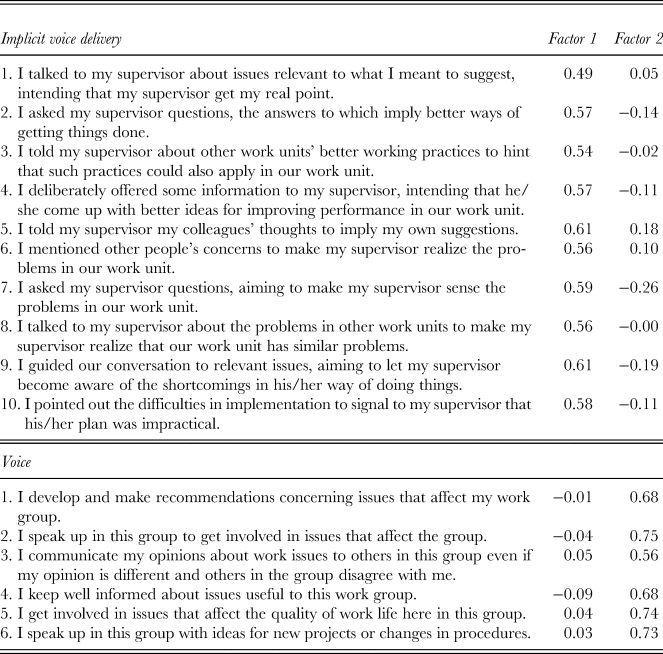
Pattern matrix of exploratory factor analysis on implicit voice delivery and general voice (Study 1)

Notes:
1. In the survey, in order to make sure we measured ‘implicit voice delivery’, which is related to voice rather than indirect communication, we put a short instruction before the items of implicit voice delivery. Specifically, we stated that, ‘In the workplace, employees may sometimes provide suggestions and offer opinions to their supervisors. During the last six months, when you provide suggestions or offer opinions to your supervisors regarding improving your department work, to what extent does each of the following statements apply to you’?
2. Principal axis factoring method was used in extraction, with direct oblimin rotation (with Kaiser standardization). Results obtained after 12 iterations.
In summary, implicit voice delivery differs from other related constructs. First, it captures a voice tactic from the perspective of language crafting and is different from informal voice as a tactic which focuses on procedure choice (Xu et al., Reference Xu, Huang, Ouyang, Liu and Hu2020), or informal voice as a mechanism focusing on whether the voice channel is formally designed in the organizational structure (Brooks, Reference Brooks2017). In addition, it distinguishes from voice directness (Lam et al., Reference Lam, Lee and Sui2019) with different focuses, motives, and measures. Nonetheless, all these relevant yet distinct constructs enrich our understanding of the complexity of how employees communicate suggestions and concerns to their supervisors.
Implicit Voice Delivery and Face Theory
According to face theory, social interactions comprise how individuals help or harm one another to sustain positive images and feelings (Ting-Toomey, Reference Ting-Toomey, Kim and Gudykunst1988; Ting-Toomey et al., Reference Ting-Toomey, Gao, Trubisky, Yang, Kim, Lin and Nishida1991). Face is embedded in interactions such that message senders often consider how their message and delivery methods can avoid threatening the face of message receivers. Face threat toward the receiver occurs when the message communicated addresses the shortcomings of the receiver (Goffman, Reference Goffman1955, Reference Goffman1967). In such situations, the receiver tends to feel that the person sending the message looks down on them or even holds a negative attitude towards them. Face theory has been used to study interactions such as conflict management in different cultures (e.g., Ting-Toomey & Oetzel, Reference Ting-Toomey and Oetzel2001), negotiation on joint gains (White et al., Reference White, Tynan, Galinsky and Thompson2004), and online mediation resolution (e.g., Brett, Olekalns, Friedman, Goates, Anderson, & Lisco, Reference Brett, Olekalns, Friedman, Goates, Anderson and Lisco2007). All these studies find that face-threatening actions deteriorate interpersonal relationships and can lead to vengeful responses. It is therefore suggested that message senders pay attention to how they deliver the message, in addition to the message content, out of concern regarding face.
Thus, face theory can shed light on implicit voice delivery. Voice is sometimes seen as challenging authority, even when it only suggests improvement (Detert & Edmondson, Reference Detert and Edmondson2011; Milliken & Morrison, Reference Milliken and Morrison2003). The supervisors might feel that their face is threatened and the relationship between the voicing employee and supervisor could deteriorate subsequently (LePine & Van Dyne, Reference LePine and Van Dyne1998; Seibert, Kraimer, & Crant, Reference Seibert, Kraimer and Crant2001). The reason is that voice usually points out a need for improvement over the status quo (Detert & Burris, Reference Detert and Burris2007) and voicing to the supervisor may imply that the supervisor's job should improve. Thus, in order to avoid the negative consequences of voicing and to increase the likelihood of voice being endorsed, reducing this face-threatening effect is a major concern for subordinates who engage in voice.
One specific way to avoid threatening the face of another is to speak implicitly or indirectly. Speaking in a direct manner can be perceived as ‘rude and pushy’ (Holtgraves, Reference Holtgraves1997: 624), whereas speaking indirectly is ‘a primary linguistic mechanism for politeness and face management’ (Holtgraves, Reference Holtgraves1997: 633). Thus, the extent to which a speech is threatening the face of any of the parties is lessened when it is done implicitly. For example, one way to express indirectly or implicitly is to distance the receiver from the message. When the speaker refers to ‘some people’ instead of ‘these people’, he or she is using less direct language, which creates distance between the receiver and the people referred to (Wiener & Mehrabian, Reference Wiener and Mehrabian1968). This way, the receiver would not perceive the message as threatening their face and would regard the speaker as being more polite. Verbal indirectness can be achieved using spatiotemporal categories (distancing the topic in space or time) or denotative specificity (under- or over-inclusiveness) (Bavelas, Black, Chovil, & Mullett, Reference Bavelas, Black, Chovil and Mullett1990). In terms of voicing, employees may talk about other people, teams, departments, or even other firms’ examples to create distance between the topic and their own situation, thus making it less face-threating to the supervisor.
Brown and Levinson (Reference Brown and Levinson1987), in extending face theory to focus on politeness in interactions, delineated two underlying assumptions: (1) All competent adult members of a society care about face and expect others to care about face too; and (2) all competent adult members of a society have certain rational capacities and methods to achieve these ends. In short, during interpersonal interactions, people choose to speak in indirect ways so as to protect their audiences’ face (Holtgraves, Reference Holtgraves1997). Regarding voicing their concerns about an organization issue or providing suggestions for improvement from the status quo, implicit voice delivery is politer, and therefore less face threatening to others than direct voice delivery (Brown & Levinson, Reference Brown and Levinson1987; Ting-Toomey, Reference Ting-Toomey, Kim and Gudykunst1988).
However, individuals differ in their concern for others’ face (Ting-Toomey & Oetzel, Reference Ting-Toomey and Oetzel2001). Other-face concern captures the degree to which individuals are sensitive to the image of other people involved in social interactions (Brew & Cairns, Reference Brew and Cairns2004). Individuals with high other-face concern are more likely to perceive a possible threat to the face of their audience in social interactions (Ting-Toomey & Oetzel, Reference Ting-Toomey and Oetzel2001). Some empirical studies indicate that some message senders use an indirect or implicit approach because of their concerns over the message receivers’ face (Brown & Levinson, Reference Brown and Levinson1987). Employees with high other-face concern thus deliver their voice using implicit methods to reduce face threat to those to whom they are speaking, such as supervisors. For example, when voicing to their supervisors, subordinates engage in distancing by talking about their peers’ ideas or other companies’ problems, which reduces immediacy and thereby reduces face threat to the supervisor. Whereas for employees with low other-face concern, they do not perceive a threat to their supervisor's face when talking about the current problem or suggesting a way for improvement. Consequently, they do not see a need to use an implicit voice delivery approach.
In sum, subordinates with the intention to voice tend to evaluate the potential for threatening the face of their supervisors. Those with high other-face concern are more willing to exert greater effort to craft a message that is less face-threatening to their supervisors through implicit approach. Therefore, we propose:
Hypothesis 1: Subordinates’ other-face concern is positively associated with their use of implicit voice delivery.
Voice involves interaction between at least two parties: subordinates who speak up and supervisors to whom they express themselves. On one hand, subordinates differ in their concern for supervisors’ face, and those with a high other-face concern may be more likely to use implicit voice delivery. On the other hand, supervisors also differ in their concern for their own face (i.e., self-face concern) (Ting-Toomey & Oetzel, Reference Ting-Toomey and Oetzel2001). Self-face concern represents individual preferences for keeping their image unchallenged by others (Ting-Toomey & Oetzel, Reference Ting-Toomey and Oetzel2001) and the degree to which individuals are sensitive to communications that can harm their own self-image in the presence of others (Brew & Cairns, Reference Brew and Cairns2004).
Individuals who are sensitive about a threat to their own face are less likely to exchange information in confrontational situations (White et al., Reference White, Tynan, Galinsky and Thompson2004). In addition, such individuals put greater importance on protecting their own image than on other aspects of gains, and thus self-face concern may also drive them to avoid potentially profitable cooperation when the other party is disrespectful of their face (Ting-Toomey & Kurogi, Reference Ting-Toomey and Kurogi1998). Therefore, when perceiving that the recipient of their message prefers to maintain unchallenged authority, message senders might use more implicit ways to deliver their ideas out of concern that those message recipients see it as a potential face threat toward themselves (Sypher & Zorn, Reference Sypher and Zorn1988) and might be less cooperative.
At the workplace, subordinates interact with their supervisors on a daily basis. Thus, they are usually familiar with their supervisors’ characteristics, such as the level of their self-face concern. With that knowledge, the employees’ calculation of the extent to which a potential face threat to their supervisors exists will also be influenced by their supervisors’ self-face concern. Ting-Toomey and Kurogi (Reference Ting-Toomey and Kurogi1998) found that when message senders are aware that the recipient of their message has high self-face concern, they tend to be more cautious in crafting their message so that it will be less face-threatening. This is because when their supervisors are the kind of people with high levels of self-face concern, subordinates may anticipate a high likelihood that their supervisors will perceive a face threat during interpersonal communication. The context of working with a high self-face concern supervisor makes subordinates more vigilantly consider how to voice, especially for those with high other-face concerns. When the supervisor has low self-face concern, even high other-face concern employees may expect less threat to the supervisor and less need to craft the message in an implicit way.
Considering the characteristics of the message receivers creates an interactive model of face threat and face consideration. Consequently, we expect that the relationship between subordinates’ other-face concern and implicit voice delivery will be strengthened when supervisors have high rather than low levels of self-face concern. Therefore, we hypothesize:
Hypothesis 2: Supervisors’ self-face concern moderates the relationship between subordinates’ other-face concern and subordinates’ use of implicit voice delivery, such that the relationship is stronger when supervisors’ self-face concern is high rather than low.
Supervisors’ Responses to Implicit Voice Delivery
Next, we examine managerial responses to subordinates’ implicit voice delivery: supervisors’ voice endorsement. The extent to which a supervisor may endorse or accept employees’ ideas is an important factor in employees’ decisions about speaking up (Deter & Trevino, Reference Detert and Trevino2010; Dutton, Ashford, O'Neill, Hayes, & Wierba, Reference Dutton, Ashford, O'Neill, Hayes and Wierba1997).
We argue that supervisors tend to respond positively to subordinates who engage in implicit voice delivery for three reasons. First, supervisors’ decisions to endorse voice are influenced by their perceptions of subordinates’ loyalty to and benevolence toward them (Petty & Cacioppo, Reference Petty, Cacioppo and Berkowitz1986). When voice intention is interpreted as benevolent and prosocial, supervisors are likely to be persuaded by the voice (cf. Bolino & Grant, Reference Bolino and Grant2016). Implicit voice delivery demonstrates subordinates’ intention to protect the face and reputation of their supervisors, instead of directly confronting them. Therefore, supervisors tend to believe that such subordinates want to improve the organization, rather than simply criticize the status quo (Burris, Reference Burris2012), and perceive these subordinates as loyal and committed to the organization and supervisors. In other words, consistent with face theory, engaging in voice in ways that are less face threatening is doing a favor in interpersonal interactions (Ting-Toomey & Oetzel, Reference Ting-Toomey and Oetzel2001). This interpersonal favor requires the recipient of the favor, the supervisor, to reciprocate (Brett et al., Reference Brett, Olekalns, Friedman, Goates, Anderson and Lisco2007). Consequently, implicit voice delivery tends to make supervisors respond favorably to subordinates who initiate this favor (Brown & Levinson, Reference Brown and Levinson1987). In this way, implicit voice delivery may improve supervisors’ assessment of the content of voice as less threatening and more persuasive, and thus, increase the likelihood of supervisors’ voice endorsement.
Second, implicit voice delivery offers a chance for supervisors to partially ‘own’ the good ideas implicitly proposed by their subordinates. This is because that implicit voice delivery enables supervisors to elaborate and even expand on the ideas of their subordinates. If the message is delivered using subtle cues, then the core idea in the suggestions might need to be interpreted and expanded on to be complete, making the supervisors’ effort necessary to make sense of the voice message (Brown & Levinson, Reference Brown and Levinson1987). After engaging in interpreting the voice message, they feel even more that they psychologically own the idea, and this in turn makes them more likely to accept or endorse ‘their own ideas’ in the end.
Third, subordinates who voice using subtle cues are also perceived as mindful of preserving organizational harmony and possessing relevant skills to achieve the goal the supervisor wants to achieve at work. Maintaining harmonious relationships in organizational functioning is critical but often not easy (Fiol, Pratt, & O'Connor, Reference Fiol, Pratt and O'Connor2009). Nor is it easy to encourage employees to express their opinions to supervisors (Morrison, Reference Morrison2011). Face theory suggests that an implicit message is less threatening to the faces of any of the parties involved and is helpful to maintain relational harmony at work (Ting-Toomey et al., Reference Ting-Toomey, Gao, Trubisky, Yang, Kim, Lin and Nishida1991). Thus, subordinates who not only submit their opinions but also do it in a harmonious way by expressing them indirectly are obviously capable and cooperative, regarded as valuable assets for organizations. Such behaviors require particular skills and supervisors could identify them as having desirable qualities (Salamon & Deutsch, Reference Salamon and Deutsch2006). Subordinates who engage in implicit voice delivery can skillfully craft messages that enable their supervisors to comprehend their intended meaning and convey the message in a diplomatic manner that demonstrates respect for organizational harmony. Consequently, supervisors are more likely to respond to these subordinates more favorably in voice endorsement. Overall, we propose that,
Hypothesis 3: Subordinates’ implicit voice delivery is positively associated with supervisors’ voice endorsement.
Supervisors’ Ability to Infer Meaning
Implicit voice delivery involves ideas that are not expressed overtly and requires the message receiver to go beyond the literal meaning of the message (Holtgraves, Reference Holtgraves1997). Face theory also addresses the core process of inferring meaning in communications that preserve face. The ability to infer meaning refers to individuals’ ability to ascertain the true meaning intended by the speaker from indirect communication (Adair, Buchan, & Chen, Reference Adair, Buchan and Chen2016). Implicit voice delivery involves hints, oblique suggestions, or ambiguous message strategies (Brew & Cairns, Reference Brew and Cairns2004), and its real message differs from the literal meaning of an utterance (Holtgraves, Reference Holtgraves1997). Message senders use ‘verbal messages that camouflage and conceal speakers’ true intentions in terms of their wants, needs and goals’ (Gudykunst et al., Reference Gudykunst, Ting-Toomey and Chua1988: 100). All these characteristics differ from direct communication, which is forthright, straightforward, and unambiguous (Brew & Cairns, Reference Brew and Cairns2004) and in which message senders express their true intentions in terms of wants, needs, and goals, all embodied in discourse (Gudykunst et al., Reference Gudykunst, Ting-Toomey and Chua1988).
When the true message embedded in implicit voice is delivered ambiguously, the degree to which the supervisors can comprehend and respond to the message depends on their ability to decode the literal words received (Berlo, Reference Berlo1960). Because indirect communication is common, people develop the capacity not only to deliver the message indirectly but also infer the meaning of indirect messages (Gudykunst et al., Reference Gudykunst, Ting-Toomey and Chua1988). A sentence uttered in a context has both a sentence meaning and a speaker meaning (Holtgraves, Reference Holtgraves1997: 626). The sentence meaning is the literal meaning of the words that make it up; the speaker meaning includes information ‘between the lines’ or unspoken. For instance, one of the implicit voice examples in Table 1 is ‘The other work unit had very good work morale after their team-building activity’. The sentence meaning is simply stating the fact that work morale of another work unit improved after their team building activity. But the speaker meaning or unspoken message is that ‘I suggest our unit have a team building activity to increase our morale’. In the process of socialization, individuals learn the difference between sentence meaning and speaker meaning. Thus, mature and capable receivers will search for and decode the intended implicit meaning as well as the literal one (Adair et al., Reference Adair, Buchan and Chen2016).
Successful communication involves the ability to correctly interpret speakers’ indirect meaning (Holtgraves, Reference Holtgraves1997). In an empirical test, Park and Kim (Reference Park and Kim2008) found that the ability to infer meaning is positively correlated with communication success among Asian Americans as well as among European Americans. In the context of voice, voicing tends to be challenging to supervisors. Derived from the face theory (Ting-Toomey, Reference Ting-Toomey, Kim and Gudykunst1988; Ting-Toomey et al., Reference Ting-Toomey, Gao, Trubisky, Yang, Kim, Lin and Nishida1991), when employees voice implicitly, they help to protect supervisors from disgrace. But at the same time, when such implicit or indirect communication is used, there is a need for the supervisor to be sensitive toward the message communicated and be able to infer the true meaning from the message (Gao, Reference Gao1998). Therefore, if supervisors have the ability to ‘read minds’, they are more likely to ascertain what subordinates are actually thinking and proposing, and perceive the real message in implicit voice (Frank & Goodman, Reference Frank and Goodman2014). Consequently, supervisors can actually evaluate and decide whether to endorse employees’ voice. Based on previous discussion, they are more likely to perceive the voicing employees’ loyalty and benevolence, feel psychological ownership of the idea, and appreciate employees’ behavior to maintain harmonious relationship. This could consequently increase their responses toward employees’ implicit voice delivery. As a result, the supervisors’ ability to infer meaning can strengthen the relationship between subordinates’ implicit voice and supervisors’ responses.
Hypothesis 4: Supervisors’ ability to infer meaning moderates the effects of subordinates’ implicit voice delivery on supervisors’ voice endorsement, such that the effect is stronger when supervisors’ ability to infer meaning is high rather than low.
PILOT STUDY: PHENOMENOLOGICAL EXPLORATION OF IMPLICIT VOICE DELIVERY
In this research, we aimed to have a clear and comprehensive understanding of the construct domain on implicit voice delivery at the workplace. We first conducted a pilot study with critical incidents method to explore how subordinates deliver their voice message using subtle approaches.
Participants and Procedures
We invited 68 experienced managers with different organizational backgrounds to participate in our research when they attended an executive training program at a prestigious business school in China. The managers consisted of 34% females, with an average age of 41.1 years (SD = 6.5) and 19.4 years of working experiences (SD = 6.7). The participants were assured that their participation was anonymous and voluntary and that their responses were confidential. After being briefed on the idea of voice, participants were asked to list up to five incidents in which they spoke up to their supervisors. They were also asked to offer details of their authentic intentions to voice, as well as the words and context used when speaking up. We collected 176 incidents, among which 40 were illegible or identified as unfit in terms of the definition of voice (e.g., offering excuses for one's own poor performance). These incidents were excluded, leaving 136 for further analysis.
Analysis
Following Morrison's (Reference Morrison2006) procedure, two research assistants blind to the research purpose coded each incident. The two coders first independently read all the incidents and generated categories that describe ‘how employees deliver voice at work’. They were told to categorize the incidents based on the approach of delivering voice information, rather than intentions, implications, or responses of their supervisors. As our research is interested in the implicit voice delivery approach, we asked the coders to put all direct voice into one category. During the first round, one coder generated five categories while the other coder generated six categories. Then, one of the authors, who was also ‘blind’ at the time, discussed the categories generated with the two coders and reached agreement on five categories. Each incident was then read again by another two coders independently and matched with one of the five categories identified. Interrater agreement between the two coders was 84%, which was deemed satisfactory (Miles & Huberman, Reference Miles and Huberman1994). After extensive discussion with the author, all disagreements were resolved.
Results
The final coding results and the major differences between explicit and implicit voice delivery tactics are reported in Table 1. One category (42%, or 57 incidents) represents delivering voice with direct approaches, and all the other categories fit our definition of implicit voice delivery. Specifically, the incidents in the explicit delivery category describe employees’ behaviors of offering clear suggestions or challenging the current status straightforwardly. For example, ‘I told my boss that the current plan has a fatal mistake and needs to be discarded’, and ‘I recommended to my supervisor that a better operating machine needs to be purchased just like many of our competitors’.
The other four categories (58%, or 79 incidents) represent behaviors of delivering voice with implicit expressions. The four categories include (1) citing the words of their peers, (2) offering relevant information to imply suggestions or concerns, (3) asking the supervisor questions to suggest ideas, and (4) using examples that inherently suggest new ways of getting things done. For example, a middle manager said to her supervisor, ‘The employees in my work unit have done a good job recently and are exhausted’. The real meaning implied was ‘I suggest that you reward them for their hard work and good performance’ because she offered relevant information, and the true meaning can be inferred based on the context.
Discussion
Implicit voice delivery captures delicate subordinate behaviors intended to reduce the face threat to supervisors, and they are ‘subtle’ in this sense. The categories match well the distancing or polite approaches described in face theory (Bavelas et al., Reference Bavelas, Black, Chovil and Mullett1990; Brown & Levinson, Reference Brown and Levinson1987; Wiener & Mehrabian, Reference Wiener and Mehrabian1968). In order to maintain others’ face, people often adopt ‘the use of certain communication strategies to defend and support the other person's need for inclusion and association’ (Ting-Toomey, Reference Ting-Toomey, Kim and Gudykunst1988: 219). In the workplace, making suggestions may make managers ‘feel as if they are losing standing or status in their unit because others are challenging their authority or competence in some domain’ (Burris, Reference Burris2012: 855). To reduce the face threat to supervisors, subordinates can encode their language to be polite and respectful (Holtgraves, Reference Holtgraves1997) or distant (Bavelas et al., Reference Bavelas, Black, Chovil and Mullett1990). For example, employees can talk about facts or ask questions to hint to their leaders and distance themselves as the agent of the suggestion or concern. In addition, talking about practices at other companies spatially separates the suggestion and makes it more inclusive. Citing the words of peers also separates the agent and the content of the voice.
All these approaches match our definition of implicit voice delivery and help reduce the face threat to the message receivers, that is, supervisors. As delineated by face theory, communication indirectness is often the approach that best reduces face threat (Ting-Toomey, Reference Ting-Toomey, Kim and Gudykunst1988). Specifically, implicit voice delivery can avoid undermining the autonomy and capacity judgment about the recipient of the message, thus protecting their face. These findings demonstrate that implicit voice delivery is pervasive in organizations.
STUDY 1: SCALE DEVELOPMENT FOR IMPLICIT VOICE DELIVERY
With the understanding of implicit voice delivery gained in the pilot study, we developed a scale to measure it, following Hinkin's (Reference Hinkin1998) procedures of scale development. We generated original items using an inductive approach. We invited 46 middle managers from different organizations and explained the definition of implicit voice delivery at work. Then, they were asked to generate simple sentences about it. We obtained 80 usable items. After combining similar statements, we subjected 36 items representing implicit voice delivery to a substantive validity test (Holden & Jackson, Reference Holden and Jackson1979), with 21 items rated as matching the definition of implicit voice delivery by at least 80% of the raters. These 21 items cover all four categories of implicit voice delivery summarized in Table 1. Next, we surveyed 227 employees[Footnote 2] on these items and LePine and Van Dyne's (Reference LePine and Van Dyne1998) 6-item voice scale. Based on the screen plot, loading patterns of exploratory factor analysis (EFA), and reliability (Nunnally, Reference Nunnally1978), we concluded that 10 out of 21 items are the best solution in the sample. The Cronbach's alpha of the 10-item scale was 0.82. The correlation between LePine and Van Dyne's measure on voice and our implicit voice delivery scales was 0.43, p < 0.01, indicating that implicit voice delivery is relevant to but still different from voice behavior. This evidence demonstrates convergent and discriminant validity of the newly developed scale. The final 10 items and their factor loadings from EFA results are listed in Table 2.
To further test the distinctiveness of implicit voice delivery with other related constructs, namely, indirect communication and voice directness, we recruited a separate sample of 213 participants online and surveyed them on these constructs. Among them, 42% were male; they had an average age of 32 years old and had been working with the current supervisor for an average of 3.9 years. They worked in various firms and industries. Implicit voice delivery was measured with 10 items we developed in the current study (α = 0.86). Indirect communication was measured with 5 items from Gudykunst (Reference Gudykunst2001) (α = 0.87). Voice directness was measured with 4 items from Lam et al. (Reference Lam, Lee and Sui2019) (α = 0.86). Results show that implicit voice delivery was significantly correlated with indirect communication (r = 0.19, p < 0.01) and voice directness (r = 0.24, p < 0.01). Indirect communication was also significantly correlated with voice directness (r = −0.38, p < 0.01).[Footnote 3] Confirmatory factor analyses show that the three-factor model fits the data best and is significantly better than other alternatives (χ2 = 233.61, df = 149, CFI = 0.95, TLI = 0.94, NFI = 0.87, RMSEA = 0.05; Appendix). These results demonstrate the distinctiveness among the three relevant yet different constructs.
STUDY 2: TESTING THE HYPOTHESES
Sample and Procedures
We collected data from employees and their immediate supervisors at a company in North China. The company develops technology and manufactures equipment in steelmaking. The company employed around 900 employees. A human resources manager at the company offered us the roster of all departments, and we randomly selected 313 subordinates and their 48 immediate supervisors from different divisions. The subordinates answered questions about their own other-face concern at time 1 (T1) and about voice and implicit voice delivery at time 2 (T2) with one month apart. Their supervisors responded to our survey about their own self-face concern and ability to infer meaning at T1 and their voice endorsement at T2.
One of the authors distributed the questionnaires to the subordinates on site. The subordinates’ survey was conducted during their work break, and they were invited to meeting rooms in groups of up to 15 people. The supervisor survey was conducted during a break in the in-house training sessions. We informed the respondents of the voluntary nature of participation and assured confidentiality of their responses. Completed questionnaires were returned directly to the researcher on site. We used a coding scheme to ensure matched supervisor-employee data.
After deleting surveys with missing data and unrecognized names or divisions, complete and matched data were obtained from 256 subordinates and 45 supervisors (with a response rate of 82% at employee level and 94% at supervisor level). The subordinates reported an average age of 33.4 years (SD = 9.2) and had worked for the company for an average of 7.4 years (SD = 7.9). The majority (67%) were male. Half (51.6%) had bachelor's degrees, and 10.9% had master's degrees. Their supervisors reported an average age of 43.3 years (SD = 6.4) and had worked for the company for 19.2 years (SD = 8.9).
Measures
With the exception of scales of implicit voice delivery and voice endorsement, the measures were originally constructed in English. We followed the standard translation and back-translation procedures (Brislin, Reference Brislin, Triandis and Berry1980) to obtain the Chinese version. Unless otherwise indicated, response options ranged from ‘1 = strongly disagree’ to ‘7 = strongly agree’.
Subordinate survey (T1). Other-face concern was measured using eight items (Ting-Toomey & Oetzel, Reference Ting-Toomey and Oetzel2001). A sample item is ‘Helping to maintain the other person's pride is important to me’ (α = 0.87).
Supervisor survey (T1). Supervisors’ self-face concern was measured using seven items from Ting-Toomey and Oetzel (Reference Ting-Toomey and Oetzel2001). A sample item is ‘I am concerned about protecting my self-image’ (α = 0.97). Ability to infer meaning was measured with a three-item scale by Adair et al. (Reference Adair, Buchan and Chen2016). A sample item is ‘I catch on to what others mean even when they do not say it directly’ (α = 0.77).
Subordinate survey (T2). Implicit voice delivery was measured using 10 items developed in Study 1 (‘1 = does not fit my case at all’ to ‘7 = fits my case very well’; α = 0.89).
Supervisor survey (T2). Voice endorsement was measured using a six-item scale that we generated for another study.[Footnote 4] The items are ‘I considered his/her suggestions when making decisions’, ‘I referred to valuable approaches he/she mentioned when making decisions’, ‘I considered some of the concerns he/she expressed’, ‘There were cases that I adjusted my work according to his/her ideas’, ‘I adjusted my work based on his/her comments’, and ‘I improved my work by considering cautions from his/her words’ (α = 0.91).
Control Variables
In the T1 survey, we measured the control variables because of their potential effects on implicit voice delivery and outcomes (see Detert & Edmondson, Reference Detert and Edmondson2011). These include supervisors’ age (in years), organizational tenure (in years), and education (coded as 1 for middle school or lower and 6 for postgraduate degree). We also controlled for subordinates’ gender (male = 0, female = 1), age (in years), organizational tenure (in years), education, voice, belief in negative career consequences of voice, and a few relevant personality variables, including extraversion, agreeableness, conscientiousness, assertiveness, and proactivity. Extraversion, agreeableness, and conscientiousness were measured using five items each (Howard, Medina, & Howard, Reference Howard, Medina, Howard and Pferffer1996), and respondents were asked to circle a position that represents their self-evaluation of personality between a series of antonyms. Examples of descriptions include ‘social’ (vs. ‘nonsocial’) for extraversion, ‘trustworthy’ (vs. ‘susceptible’) for agreeableness, and ‘clean’ (vs. ‘chaos’) for consciousness. The reliabilities were 0.79, 0.88, and 0.82, respectively. Assertiveness was measured with a 10-item scale from the International Personality Item Pool (IPIP) (see Detert & Edmondson, Reference Detert and Edmondson2011). A sample item is ‘I seek to influence others’ (α = 0.70). Proactive personality was measured with a six-item scale by Li, Liang, and Crant (Reference Li, Liang and Crant2010). A sample item is ‘If I see something I don't like, I fix it’ (α = 0.79).
Another control variable, employee voice, was measured with LePine and Van Dyne's (Reference LePine and Van Dyne1998) six-item scale (α = 0.88). Belief in negative career consequences of voice represents employees’ utilitarian consideration for protecting themselves in deciding whether to voice (Detert & Edmondson, Reference Detert and Edmondson2011). Possibly underlying employees’ beliefs regarding negative career consequences of voice is the identification of a face threat (Detert & Edmondson, Reference Detert and Edmondson2011). We used four items from Detert and Edmondson (Reference Detert and Edmondson2011) to measure it. A sample item is ‘If you want advancement opportunities in today's world, you have to be careful about pointing out needs for improvement to those in charge’ (α = 0.72).
Results
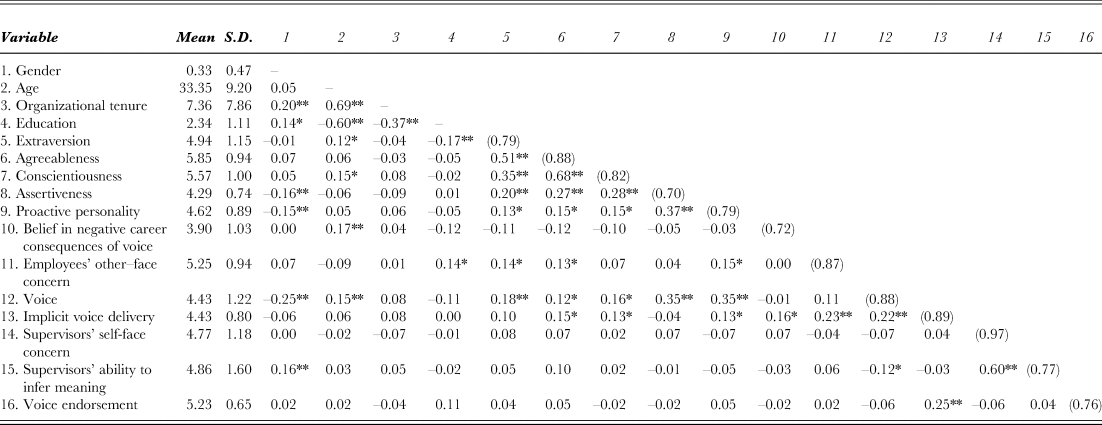
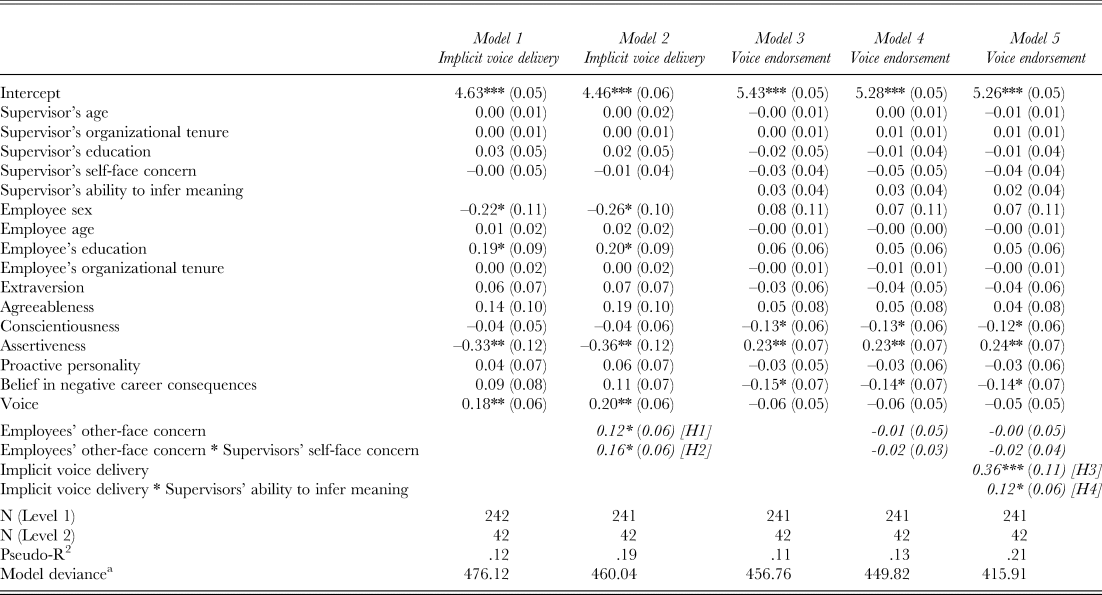
Table 3 reports descriptive statistics of the variables. We used hierarchical linear modeling (HLM) (Bryk & Raudenbush, Reference Bryk and Raudenbush2002) to test our hypotheses because the subordinates in our sample were nested in groups under different supervisors.[Footnote 5] Before running our HLM model, we analyzed the variance distributions of the dependent variable, voice endorsement. Results indicate that it is necessary and appropriate to run HLM (ICC(1) = 0.04, χ2[32] = 47.05, p < 0.05). Following the convention, we grand-mean-centered all level-2 variables and group-mean-centered level-1 variables (Hofmann & Gavin, Reference Hofmann and Gavin1998). Table 4 reports the HLM results.
Means, standard deviations, and correlations of variables in Study 2

Notes: N = 256. **p < 0.01, *p < 0.05 (two-tailed). Variables 1 to 13 were level 1 variables, reported by subordinates. Among them, variables 1 to 11 were measured at T1 and variables 12 and 13 at T2. Variables 14 to 17 were level 2 variables, reported by supervisors. Variables 14 and 15 were measured at T1, and the other two at T2. Gender was coded as M = 0 and F = 1.
Results of HLM analyses in Study 2

Notes: a Deviance = -2 × log-likelihood of the full maximum-likelihood estimate, which is a measure of model fit; the smaller the deviance is, the better the model fits. * p < 0.05, ** p < 0.01, *** p < 0.001 (two-tailed).
Table 4 reports the HLM coefficients regarding our hypotheses. Model 1 shows that employees’ other-face concern predicts the use of implicit voice delivery, b = 0.12 (s.e. = 0.06), p < 0.05, supporting Hypothesis 1. Hypothesis 2 posits that the relationship between employees’ other-face concern and the use of implicit voice delivery is stronger when supervisors’ self-face concern is high. In the slope-as-outcome model, the interaction term has a b = 0.16 (s.e. = 0.06), p < 0.05, and Hypothesis 2 is also supported.
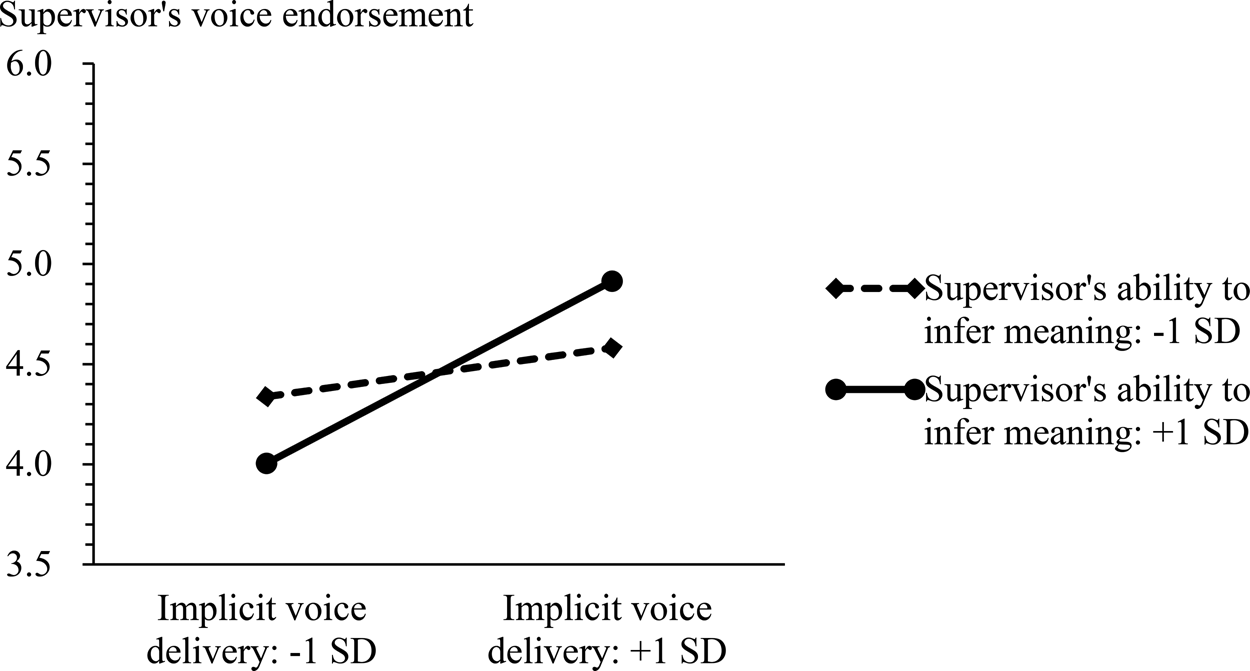
Further, results in Model 5 indicate that, consistent with Hypothesis 3, implicit voice delivery is positively related to voice endorsement, b = 0.36 (s.e. = 0.11), p < 0.001. Hypothesis 4 posits that the relationship between implicit voice delivery and voice endorsement is stronger when supervisors’ ability to infer meaning is high. Results in Model 5's slope-as-outcome analyses support Hypothesis 4, and the interaction term has a b = 0.12 (s.e. = 0.06), p < 0.05.[Footnote 6]
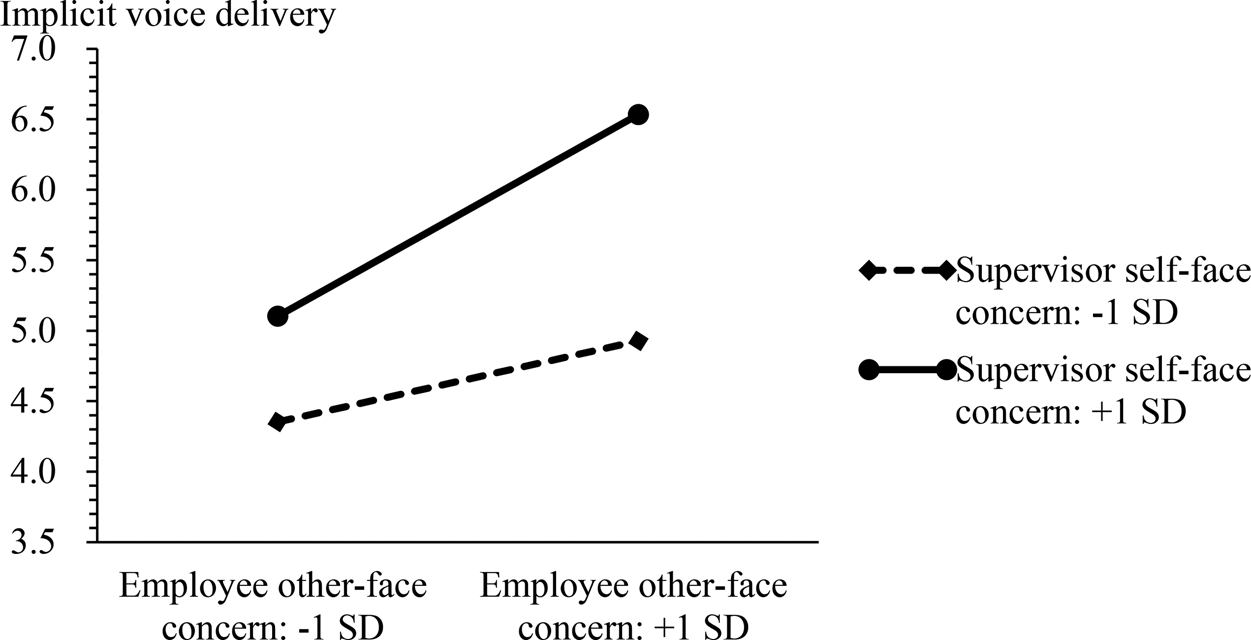
Following the procedures recommended by Preacher, Curran, and Bauer (Reference Preacher, Curran and Bauer2006), we plotted the nature of the two significant moderating effects in Figures 2 and 3. The high and low levels of the independent variables and of the moderators were at one standard deviation above and below the variables’ mean level. The simple slope analyses indicated that, for Hypothesis 2, employees’ other-face concern is significantly related to implicit voice delivery when supervisors’ self-face concern is high (b = 1.08, s.e. = 0.29, z = 3.70, p < 0.01); and the relationship is still significant when supervisors’ self-face concern is low (b = 0.40, s.e. = 0.18, z = 2.22, p < 0.05), but at a smaller magnitude. In addition, employees’ implicit voice delivery can predict supervisors’ voice endorsement when supervisors’ ability to infer meaning is high (b = 1.13, s.e. = 0.37, z = 3.07, p < 0.01), but becomes smaller (b = 0.44, s.e. = 0.19, z = 2.32, p < 0.05) when supervisors’ ability to infer meaning is low. These results are consistent with Hypothesis 4.
The moderating effect of supervisors’ self-face concern on employee other face concern and implicit voice delivery

The moderating effect of supervisors’ ability to infer meaning on employee implicit voice delivery and supervisors’ voice endorsement

DISCUSSION
The current study advances research on employee voice by investigating voice tactics and focusing on implicit voice delivery in organizations. Using qualitative methods in Study 1, we show that subordinates sometimes adopt implicit voice delivery by using an approach that distances the content from themselves, from the working divisions, or from the responsibility of their supervisors. Further, we defined and clarified the new construct and developed a scale to measure it. Next, in the quantitative study, we examined a theoretical framework guided by face theory, to explain the antecedents and outcomes of implicit voice delivery, as well as the relevant boundary conditions. The results indicate that subordinates are more likely to engage in implicit voice delivery when they are more concerned with other people's face. This positive relationship becomes stronger when their supervisors have higher self-face concern. In addition, implicit voice delivery wins voice endorsement, and the effect on voice endorsement is especially strong when their supervisors possess the ability to infer meaning from subtle messages.
Theoretical Contributions
The findings in our study have several theoretical implications. First, by applying face theory, the present research enriches the theoretical perspectives studying voice-relevant phenomena, in particular, how to deliver voice messages. Face theory has been demonstrated to be a meaningful theory for guiding studies in conflict resolution, cooperation, and negotiation (e.g., Brett et al., Reference Brett, Olekalns, Friedman, Goates, Anderson and Lisco2007). We analyze voice from the perspective of its potential to pose a face threat to supervisors, making message delivery a critical issue in the process. Our study reveals that implicit voice delivery represents a series of implicit and circuitous approaches of sending recommendations or raising concerns to supervisors, actions that clearly differ from explicit voice delivery. Implicit voice delivery fits the face theory in that it decreases the potential for face threat to supervisors – the audience of voice. Also informed by face theory, we analyzed the antecedents and consequences of implicit voice delivery. In the workplace, voice is a sensitive matter that has the potential to make supervisors feel uncomfortable and/or challenged; as a result, subordinates who are sensitive to that potential often resist expressing their ideas to their supervisors (Detert & Edmondson, Reference Detert and Edmondson2011). Face theory suggests an approach to make employees both able to voice and at the same time reduce the face threat to the supervisor. Therefore, applying face theory broadens our perspectives on how to voice more effectively.
Second, our research responds to a recent call for investigating how employees voice their ideas (Morrison, Reference Morrison2011). Voice behaviors involve communication between subordinates and supervisors and studying voice tactics in organizations where subordinates depend on their supervisors to gain valuable rewards is useful. We focus on implicit voice delivery because it involves the mindful crafting of messages by subordinates and subsequent interpretation by supervisors. Our first study reveals that implicit voice delivery is prevalent in organizations and offers promise for investigating voice tactics. The scale of implicit voice delivery developed captures the domain of this construct, enabling future empirical studies to further advance this line of research.
By focusing on the voice tactic of implicit voice delivery, our research also advances the study of managerial responses to voice. Previous studies yielded mixed results on supervisor responses to voice. For example, in some studies voice was found to be associated with faster promotion and better performance evaluations by supervisors (e.g., Whiting, Podsakoff, & Pierce, Reference Whiting, Podsakoff and Pierce2008), yet other studies had contradictory findings with the same outcome variables (e.g., Burris, Reference Burris2012; Seibert et al., Reference Seibert, Kraimer and Crant2001). Burris (Reference Burris2012) argued that one of the major reasons for this inconsistency could be that in previous studies the types of voice studied were not clearly differentiated. Our results suggest that such inconsistency could be attributed to the way in which the voice is delivered, in addition to the content that is delivered (Morrison, Reference Morrison2011). In fact, our results indicate that implicit voice delivery is positively related to voice endorsement. This suggests that implicit voice delivery is more likely to gain supervisors’ endorsement because the face of these supervisors is protected, so they will ‘listen and take appropriate action’ (Morrison, Reference Morrison2011: 383).
Third, this article exemplifies the fusion of Chinese context and universal theoretical development. Consistent with the major theorists who developed face theory, we theorize that face as well as implicit voice delivery are universal phenomena. Although the concept of face originated in East Asian countries, face concern is universal. For example, research conducted in America also shows individuals’ concern for their positive image and favor positive image presented in social interactions (White et al., Reference White, Tynan, Galinsky and Thompson2004). Similarly, indirect communication also exists in other cultural contexts (Mouton, Reference Mouton2020). Thus, we expect that implicit voice delivery and the relationships we hypothesize in this article can hold true in other contexts as well. Nonetheless, it should be noted that in Chinese culture, there is a much stronger emphasis on ‘face’ and ‘face concern’ (Ting-Toomey & Kurogi, Reference Ting-Toomey and Kurogi1998), which makes it a suitable context to examine our framework. We hope that the current research represents an effort of linking the Chinese specialty with the universal phenomenon.
Practical Implications
The results of our research indicate that voice can be delivered in subtle ways, which can be helpful for organizations. First, when employees believe they have some valuable suggestions or important concerns regarding their work or the organization, they need to think about how to express their voice, in order to improve the likelihood of being endorsed. Voicing involves challenging the status quo and could be regarded as threatening (Detert & Edmondson, Reference Detert and Edmondson2011; Milliken & Morrison, Reference Milliken and Morrison2003), especially to the person receiving the voice, usually managers. Yet, as our research suggests, in such situations, a useful approach is to voice implicitly because it is less face threatening, helps to keep harmony in the workplace, and it may make managers partially feel they ‘own’ the idea as they have to put in some effort to understand the hidden message. This is particularly true if the manager has a high level of self-face concern. So, before voicing, employees need to carefully consider the approach they should take in order to increase subsequent endorsement.
At the same time, managers also need to be more mindful of their interactions with employees such that they do not ignore the voice message being subtly or implicitly delivered. The implicit message needs to be interpreted and elaborated to ascertain information that is much richer than that in the literal meaning. If managers pay attention only to literal meaning, they can easily miss valuable chances for picking up good ideas from their employees. Organizations can choose managers who have higher emotional intelligence or, more specifically, who are better at inferring other people's true meaning in interactions or provide necessary training on implicit communication to current managers. Supervisors with a better ability to understand employees’ subtle meaning in voice can identify the true content more effectively and are more likely to endorse it (Holtgraves, Reference Holtgraves1997), which helps to improve organizational performance.
Limitations and Future Research Directions
The present research has a number of limitations that should be addressed in future research. First, we build our theoretical analyses based on the mechanism of anticipated face threat to supervisors in our model, but we did not measure face threat explicitly. In other words, we argued that employees’ implicit voice delivery may be perceived as more polite and less face threatening to supervisors, and thus, increase the likelihood of being endorsed. Yet we did not actually test the mediating effect of perceived politeness or face threat. Future research can advance this stream of research by measuring supervisors’ perceived face threat. In addition, in the domain of face theory, the use of implicit voice delivery can be influenced by the relationship quality or dyadic tenure between supervisors and subordinates. For example, Ward and colleagues (Ward, Ravlin, Klaas, Ployhart, & Buchan, Reference Ward, Ravlin, Klaas, Ployhart and Buchan2016) found that when LMX was low, employees’ contextual communication orientation had a negative impact on their promotive voice. We suggest future research to investigate how the relationship between the employee and supervisor may influence this interpersonal process.
Second, the empirical studies were conducted in a Chinese setting, and future research should test our current findings by conducting cross-cultural research in other countries before any meaningful generalizations can be made. We expect the relationships hypothesized in the article hold true in other cultures as well. However, we admit that the Chinese care more about face and adopt indirect communication approaches (Ting-Toomey & Kurogi, Reference Ting-Toomey and Kurogi1998). Future studies should test the validity of our model by conducting empirical work in other countries, especially those sharply different from China, and find out how the current findings may vary under other cultural characteristics. In addition, though ‘face concern’ is universal, people may employ different behaviors to protect their face, especially in ‘low-context cultures’. This could be a fruitful future research avenue.
Third, this article focuses on implicit voice delivery, but we did not include a parallel construct of explicit voice delivery. Lam et al. (Reference Lam, Lee and Sui2019) recently proposed a construct of voice directness, or the extent to which employees explicitly express their voice. It is similar to our construct in that both focus on tactics or approaches employees choose when they voice, though they have different focus. It would be interesting to examine and compare the relationships between supervisors’ responses toward implicit and explicit voice delivery (i.e., voice directness) and find out whether these responses differ. In addition, it would further enrich our understanding about voicing tactics if researchers can investigate the conditions for each tactic to be effective. For instance, would it be more effective to use direct voice when the voicing employee has a good relationship with the manager, and voices in a private situation, even if the manager has a high level of self-face concern? Because in a private situation, the manager could lessen the concern about their image, and a good relationship with the employee suggests that the manager is certain that the voicing employee has a genuine intention to help him or her.
Further, although our theoretical focus in this research is the implicit delivery of the voice content, instead of the voice content per se, it is possible that implicit voice delivery may include two dimensions: implicit prohibitive voice delivery and implicit promotive voice delivery. Our supplementary analyses showed that in our study, the two dimensions yielded exactly the same results as the overall construct of implicit voice delivery. But they might have different antecedents as prohibitive voice involves more challenge to the status quo and thus involves more risk than promotive voice (Liang, Farh, & Farh, Reference Liang, Farh and Farh2012). So, we encourage future research to investigate different antecedents of these two dimensions of implicit voice delivery. Another issue related to characteristics of voice involves the amount of information a voice message carries. Current research has examined voice from its content (e.g., prohibitive and promotive), and voicing approaches (e.g., Brooks, Reference Brooks2017; our implicit voice delivery; voice directness, Lam et al., Reference Lam, Lee and Sui2019; (in)formal voice, Xu et al., Reference Xu, Huang, Ouyang, Liu and Hu2020), but less is known about how an employee decides how much information to convey in a voice message and how this information richness in a voice may influence voice endorsement or other outcomes. Both explicit and implicit voice delivery can carry more or less information. Apart from this tactic of implicit voice delivery, future research should also pay more attention to the information richness embedded in a voice message.
Last but not least, although our mediator of implicit voice delivery was reported by employees and voice endorsement by supervisors, they were collected at the same time. This may weaken the causality between implicit voice delivery and our dependent variable. However, the endorsement of voice usually happens after the employee voices. We also tested the reverse causality by switching implicit voice delivery and voice endorsement, and results show no significant effects of voice endorsement on implicit voice delivery, providing some evidence on our proposed relationship. Nonetheless, future research may collect the mediator and the dependent variable separately in order to provide stronger support for the proposed causal relationship.
CONCLUSION
The article theorizes implicit voice delivery and empirically builds a construct and model of it. We find that subordinates who decide to voice can choose to deliver their voice subtly using various approaches, making implicit voice delivery an intriguing phenomenon to explore. Using face theory, we find that employees who have high other-face concern are more likely to deliver their voice subtly, and this relationship is stronger when their supervisors have high self-face concern. Implicit voice delivery leads to favorable voice endorsement from their supervisors. Voice endorsement based on implicit voice delivery is especially likely when the supervisors possess high, rather than low, ability to infer meaning. Our construct of implicit voice delivery shed new light on understanding the complex phenomenon of voice at work.
APPENDIX I
Results of Confirmatory Factor Analyses on Implicit Voice Delivery, Indirect Communication, and Voice Directness