Introduction
Obsessive–compulsive disorder (OCD) is related to abnormal activity in fronto-striatal brain loops (Saxena et al. Reference Saxena, Brody, Schwartz and Baxter1998; Aouizerate et al. Reference Aouizerate, Guehl, Cuny, Rougier, Bioulac, Tignol and Burbaud2004; Maia et al. Reference Maia, Cooney and Peterson2008; Menzies et al. Reference Menzies, Chamberlain, Laird, Thelen, Sahakian and Bullmore2008; Brem et al. Reference Brem, Hauser, Iannaccone, Brandeis, Drechsler and Walitza2012; Walitza et al. Reference Walitza, Brem, Hauser and Grünblatt2014). These loops represent segregated, recurrent neural networks (Alexander et al. Reference Alexander, DeLong and Strick1986) between cortical regions, such as the anterior cingulate cortex (ACC), and subcortical areas including the striatum. Fronto-striatal loops are crucial for many cognitive domains involving the maintenance and selection of information (Alexander & Brown, Reference Alexander and Brown2011; Maia & Frank, Reference Maia and Frank2011; Hauser et al. Reference Hauser, Fiore, Moutoussis and Dolan2016b ) and are closely interconnected with other cortical and subcortical systems (Doya, Reference Doya2008). The activity of these loops is to a large extent modulated by catecholaminergic neurotransmitters, such as dopamine (Frank et al. Reference Frank, Santamaria, O'Reilly and Willcutt2007). Dopamine influences the neural gain in the system, changing the information conveyed in the network (Fiore et al. Reference Fiore, Sperati, Mannella, Mirolli, Gurney, Friston, Dolan and Baldassarre2014, Reference Fiore, Rigoli, Stenner, Zaehle, Hirth, Heinze and Dolan2016; Hauser et al. Reference Hauser, Fiore, Moutoussis and Dolan2016b ). Impairments in these networks can change decision making and learning (Maia & Frank, Reference Maia and Frank2011; Cavanagh & Frank, Reference Cavanagh and Frank2014) – processes found to be impaired in OCD (Fear & Healy, Reference Fear and Healy1997; Sachdev & Malhi, Reference Sachdev and Malhi2005; Nielen et al. Reference Nielen, den Boer and Smid2009; Gillan & Robbins, Reference Gillan and Robbins2014).
Fundamental to learning and decision making is the expression of reward prediction error (RPE; Montague et al. Reference Montague, Dayan and Sejnowski1996; Schultz et al. Reference Schultz, Dayan and Montague1997) signals. These signals indicate the mismatch between expectations and experiences – such as outcomes – and drive reinforcement learning and goal-directed behaviour (Schultz et al. Reference Schultz, Dayan and Montague1997; Glimcher, Reference Glimcher2011). RPE signals are known to be encoded by the dopaminergic midbrain (Schultz et al. Reference Schultz, Dayan and Montague1997) and are processed in fronto-striatal loops, such as the ACC (Kennerley et al. Reference Kennerley, Behrens and Wallis2011; Hauser et al. Reference Hauser, Iannaccone, Stämpfli, Drechsler, Brandeis, Walitza and Brem2014b , Reference Hauser, Hunt, Iannaccone, Walitza, Brandeis, Brem and Dolan2015a ), the striatum (Rutledge et al. Reference Rutledge, Dean, Caplin and Glimcher2010; Daw et al. Reference Daw, Gershman, Seymour, Dayan and Dolan2011) and the ventromedial prefrontal cortex (vmPFC) (Kennerley et al. Reference Kennerley, Behrens and Wallis2011; Hauser et al. Reference Hauser, Hunt, Iannaccone, Walitza, Brandeis, Brem and Dolan2015a ). Changes in RPE processing have a direct impact on fronto-striatal loop activity and thus alter decision making and learning (Fiore et al. Reference Fiore, Sperati, Mannella, Mirolli, Gurney, Friston, Dolan and Baldassarre2014, Reference Fiore, Rigoli, Stenner, Zaehle, Hirth, Heinze and Dolan2016; Hauser et al. Reference Hauser, Fiore, Moutoussis and Dolan2016b ).
There is relatively consistent evidence that areas involved in RPE processing, such as the ACC, vmPFC and striatum, are impaired in OCD patients (van den Heuvel et al. Reference van den Heuvel, van der Werf, Verhoef, de Wit, Berendse, Wolters, Veltman and Groenewegen2010; Stern et al. Reference Stern, Welsh, Fitzgerald, Gehring, Lister, Himle, Abelson and Taylor2011; Brem et al. Reference Brem, Hauser, Iannaccone, Brandeis, Drechsler and Walitza2012, Reference Brem, Grünblatt, Drechsler, Riederer and Walitza2014; Becker et al. Reference Becker, Nitsch, Schlösser, Koch, Schachtzabel, Wagner, Miltner and Straube2014; Grünblatt et al. Reference Grünblatt, Hauser and Walitza2014; Walitza et al. Reference Walitza, Brem, Hauser and Grünblatt2014; Hauser et al. Reference Hauser, Eldar and Dolan2016a ). Electrophysiological studies further suggest that internal error signals, such as the error-related negativity (ERN; Falkenstein et al. Reference Falkenstein, Hohnsbein, Hoormann, Blanke, Brunia, Gaillard and Kok1990), are increased in OCD patients (Gehring et al. Reference Gehring, Himle and Nisenson2000; Johannes et al. Reference Johannes, Wieringa, Nager, Rada, Dengler, Emrich, Münte and Dietrich2001; Endrass et al. Reference Endrass, Klawohn, Schuster and Kathmann2008; Gründler et al. Reference Gründler, Cavanagh, Figueroa, Frank and Allen2009; Cavanagh et al. Reference Cavanagh, Gründler, Frank and Allen2010; Riesel et al. Reference Riesel, Endrass, Kaufmann and Kathmann2011, Reference Riesel, Endrass, Auerbach and Kathmann2015; Xiao et al. Reference Xiao, Wang, Zhang, Li, Tang, Wang, Fan and Fromson2011; Endrass & Ullsperger, Reference Endrass and Ullsperger2014). Although these internal error signals have been related to RPE processing in the ACC (Holroyd & Coles, Reference Holroyd and Coles2002), no study has yet directly investigated RPE signals in OCD patients. Increased RPE signals could also explain patients’ subjective ‘not just right’ (NJR) experiences (Coles et al. Reference Coles, Frost, Heimberg and Rhéaume2003) and thus favour avoidance and checking behaviour, as these NJR experiences have been suggested to reflect mismatch signals, similar to RPEs (Pitman, Reference Pitman1987).
In this study, we investigated learning and decision-making mechanisms in 33 subjects with OCD and 34 matched controls. The adolescent and adult participants played a probabilistic reversal learning task which is known to be sensitive to detect fronto-striatal impairments in OCD (Remijnse et al. Reference Remijnse, Nielen, van Balkom, Cath, van Oppen, Uylings and Veltman2006, Reference Remijnse, Nielen, van Balkom, Hendriks, Hoogendijk, Uylings and Veltman2009; Chamberlain et al. Reference Chamberlain, Menzies, Hampshire, Suckling, Fineberg, del Campo, Aitken, Craig, Owen, Bullmore, Robbins and Sahakian2008; Valerius et al. Reference Valerius, Lumpp, Kuelz, Freyer and Voderholzer2008; Freyer et al. Reference Freyer, Klöppel, Tüscher, Kordon, Zurowski, Kuelz, Speck, Glauche and Voderholzer2011). We used reinforcement learning models (Sutton & Barto, Reference Sutton and Barto1998) to infer underlying learning mechanisms via a model-derived RPE signal measured using functional magnetic resonance imaging (fMRI). We hypothesized that OCD patients would show an increased RPE signal in fronto-striatal areas, related to abnormal decision making and learning.
Method
Subjects
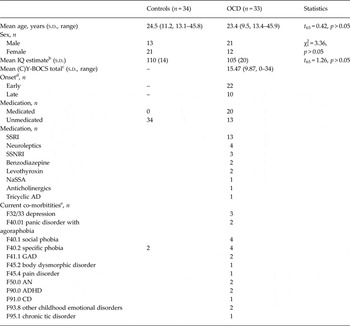
A total of 67 adolescent and adult subjects participated in this fMRI study. We compared 33 OCD patients (mean age 23.4, s.d. = 9.5, range 13.4–45.9 years) with 34 healthy, matched controls (mean 24.5, s.d. = 11.2, range 13.1–45.8 years; for detailed group descriptions, see Table 1). Patients were recruited from public and private health care services as well as through public advertisement. Controls were recruited from the general population. Both groups, OCD patients and controls, underwent a structured psychiatric interview (Structured Clinical Interview for DSM-IV or Kiddie Schedule for Affective Disorders and Schizophrenia for School-Age Children – Present and Lifetime, German versions; Wittchen et al. Reference Wittchen, Zaudig and Fydrich1997; Delmo et al. Reference Delmo, Weiffenbach, Stalder and Poustka2001) and all co-morbidities are listed in Table 1. All OCD patients fulfilled the Diagnostic and Statistical Manual of Mental Disorders, 4th edition, text revision (DSM-IV-TR) and DSM-5 criteria for OCD at least once in their lifetime and were diagnosed with either early-onset (EO: disorder onset <18 years) or late-onset (LO) OCD. To investigate the role of variability in current OCD severity, we also included five patients who were in remission at the time of the study, but previously met a primary diagnosis of OCD. Symptom severity was assessed using the (Children's) Yale–Brown Obsessive Compulsive Scale [(C)Y-BOCS] interview (Goodman et al. Reference Goodman, Price, Rasmussen, Mazure, Fleischmann, Hill, Heninger and Charney1989). None of the controls reported any major psychiatric disorder (psychosis, depression, autism spectrum disorder, substance abuse), but two controls reported specific phobias (spiders, syringes) without clinical relevance or any daily life impairments. Of the 33 patients, 20 were medicated and 13 were not medicated at the time of the study (Table 1). One OCD patient had to be excluded prior to analysis due to a task performance at chance level. Data from some of the healthy controls has been reported previously (Hauser et al. Reference Hauser, Iannaccone, Ball, Mathys, Brandeis, Walitza and Brem2014a , Reference Hauser, Iannaccone, Stämpfli, Drechsler, Brandeis, Walitza and Brem b , Reference Hauser, Hunt, Iannaccone, Walitza, Brandeis, Brem and Dolan2015a , Reference Hauser, Iannaccone, Walitza, Brandeis and Brem b ). The study was approved by the local ethics committee and complied with the declaration of Helsinki, and all participants (and if under 18 years: their legal guardians) gave written informed consent.
Characteristics of the participantsa

OCD, Obsessive–compulsive disorder; s.d., standard deviation; IQ, intelligence quotient; (C)Y-BOCS, (Children's) Yale–Brown Obsessive Compulsive Scale; SSRI, selective serotonergic reuptake inhibitors; SSNRI, selective serotonergic and noradrenergic reuptake inhibitors; NaSSA, noradrenergic and specific serotonergic antidepressants; AD, antidepressants; GAD, generalized anxiety disorder; AN, anorexia nervosa; ADHD, attention-deficit/hyperactivity disorder; CD, conduct disorder; K-SADS-PL, Kiddie Schedule for Affective Disorders and Schizophrenia for School-Age Children – Present and Lifetime; SCID, Structured Clinical Interview for DSM-IV.
a Groups were matched for age, sex and intelligence. This Table includes all subjects; please note that one OCD patient was excluded from analysis due to performance on chance level.
b Waldmann (Reference Waldmann2008), model 65.
c Goodman et al. (Reference Goodman, Price, Rasmussen, Mazure, Fleischmann, Hill, Heninger and Charney1989).
d Early onset was clinically diagnosed when patients received a diagnosis under the age of 18 years or when they retrospectively reported having clinically relevant symptoms under the age of 18 years. One OCD patient performing on chance level was not reported.
e Assessed using the K-SADS-PL or SCID (both German version) in patients and controls.
Reversal learning task
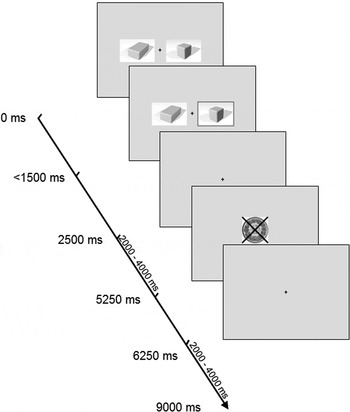
All participants played a probabilistic reversal learning task (Fig. 1) (Hauser et al. Reference Hauser, Iannaccone, Ball, Mathys, Brandeis, Walitza and Brem2014a , Reference Hauser, Iannaccone, Stämpfli, Drechsler, Brandeis, Walitza and Brem b , Reference Hauser, Iannaccone, Walitza, Brandeis and Brem2015b ) consisting of 120 trials (divided into two runs), while fMRI was recorded. The subjects were instructed to win as much money as possible. They had to learn the reward contingencies based on trial and error. One of the stimuli was assigned with a win probability of 80%, whereas the second stimulus had a punishment probability of 80%. After six to 10 correct responses, the reward probabilities reversed (for the exact reversal rules, see Hauser et al. Reference Hauser, Iannaccone, Stämpfli, Drechsler, Brandeis, Walitza and Brem2014b ). The subjects were informed beforehand about the probability of reversals occurring, but no further information about the reversal contingencies was provided. As outcomes, either a reward (+50 Swiss centimes) or a punishment (−50 Swiss centimes) was presented. To prevent misses, we punished late answers with −100 Swiss centimes. The location of the stimuli was randomly determined on each trial to prevent motor perseveration.
Probabilistic reversal learning task. Subjects performed a probabilistic reversal learning task while functional magnetic resonance imaging was recorded. The participants had to learn which of the stimuli had the higher reward probability in order to earn a maximal amount of money. Every now and then, the reward contingencies changed and the subjects had to adjust accordingly.

Computational modelling
To understand the mechanisms underlying the subjects’ choices, we compared two different anticorrelated Rescorla–Wagner learning models (Gläscher et al. Reference Gläscher, Hampton and O'Doherty2009; Reiter et al. Reference Reiter, Koch, Schröger, Hinrichs, Heinze, Deserno and Schlagenhauf2016), one with a common learning rate alpha for positive and negative RPEs, the other with separate learning rates (Niv et al. Reference Niv, Edlund, Dayan and O'Doherty2012; Hauser et al. Reference Hauser, Iannaccone, Walitza, Brandeis and Brem2015b ). Each of the models was combined with two different softmax choice models. We used a standard softmax choice rule with the stochasticity (inverse temperature) parameter beta, and an extended softmax function with an additional perseveration parameter gamma to capture potential differences in the participants’ tendency to repeat a given action independent of its value (Lau & Glimcher, Reference Lau and Glimcher2005; Daw et al. Reference Daw, Gershman, Seymour, Dayan and Dolan2011). We determined the best models using Bayesian model selection (Stephan et al. Reference Stephan, Penny, Daunizeau, Moran and Friston2009). The parameters and RPEs from the winning model were then used for fMRI analyses and further behavioural comparison (using independent-sample t tests). Detailed descriptions of the models and procedures are provided in the online Supplementary material.
fMRI: preprocessing and group comparisons
fMRI was recorded in a 3 T Philips Scanner (Philips Medical Systems, the Netherlands). Echo planar imaging (EPI), optimized for maximal orbitofrontal signal sensitivity (repetition time: 1850 ms, echo time: 20 ms, 15° tilted downwards of anterior commissure–posterior commissure, 40 slices, 2.5 × 2.5 × 2.5 mm voxels, 0.7 mm gap, flip angle: 85° field of view: 240 × 240 × 127 mm), was used. Additionally, a T1-weighted structural image was recorded.
SPM8 (http://www.fil.ion.ucl.ac.uk/spm/) standard procedures were used for preprocessing and analysis. The raw data were realigned, resliced and co-registered to the T1 image. For normalization, the deformation fields were used, which were obtained using ‘new segmentation’. This resulted in a new standard voxel size of 1.5 × 1.5 × 1.5 mm. Subsequently, the data were spatially smoothed [6 mm full width at half maximum (FWHM) kernel].
Based on our hypothesis that OCD patients show increased RPE signals, we compared the neural responses to RPEs during outcome presentation. On the first level, we entered model-derived RPEs as a parametric modulator at the time of feedback onset. Several other regressors were entered as nuisance regressors: cue onsets and value of chosen option at this time, movement parameters and pulsatile artefacts (Kasper et al. Reference Kasper, Bollmann, Diaconescu, Hutton, Heinzle, Iglesias, Hauser, Sebold, Manjaly, Pruessmann and Stephan2016). At the second level, we compared the RPE effects between the groups using independent-sample t tests. Group differences are reported on p < 0.05, whole-brain corrected using cluster-based family-wise error correction (height threshold p < 0.005).
fMRI: further analyses (age of onset, symptom severity)
Because of the large age range of our participants, we reanalysed the same fMRI models by entering age, as well as log-transformed age (natural logarithm), as a covariate – although age did not differ between the groups – to control for more subtle effects which would be driven by age.
To determine whether these group differences were modulated by age of onset or symptom severity, we correlated the mean activation in the significant group-difference clusters with the age of onset as well as with symptom severity as measured by the (C)Y-BOCS using t tests and multiple regression analyses.
Results
Behavioural group differences
We found no difference between the groups in whether they were able to learn the stimulus–valence associations. Both groups performed similarly well in terms of winnings (control: 16.80 Swiss francs, s.d. = 4.81; OCD: 16.60 Swiss francs, s.d. = 6.32, t 64 = 0.15, p = 0.885), number of rewarded trials (control: 77.62, s.d. = 4.51; OCD: 77.50, s.d. = 5.84, t 64 = 0.09, p = 0.927), number of punished trials (control: 40.74, s.d. = 4.52; OCD: 40.56, s.d. = 5.07, t 64 = 0.15, p = 0.884), number of misses (control: 1.65, s.d. = 1.92; OCD: 1.88, s.d. = 2.09, t 64 = 0.46, p = 0.646) and the number of reversals in the stimulus–valence mapping (control: 7.26, s.d. = 1.33; OCD: 7.06, s.d. = 1.56, t 64 = 0.57, p = 0.573). We found that the groups differed marginally in how often they switched between the stimuli (control: 22.62, s.d. = 7.84; OCD: 26.34, s.d. = 9.79, t 64 = 1.71, p = 0.092). We then calculated the stay probability, separately for trials with positive and negative feedback. A repeated-measures analysis of variance with within-subject factor valence (reward, punishment) and between-subjects factor group (control, OCD) confirmed a marginally significant difference in the group main effect (F 1,64 = 3.70, p = 0.059), more evident in a lower stay-probability after rewards in OCD (control: 0.97, s.d. = 0.02; OCD: 0.94, s.d. = 0.08, t 64 = 2.05, p = 0.045) than after punishments (control: 0.48, s.d. = 0.16; OCD: 0.43, s.d. = 0.12, t 64 = 1.41, p = 0.165).
Computational modelling reveals altered perseveration
Between the four different model combinations, the anti-correlated Rescorla–Wagner model with the perseveration parameter and an identical learning rate for positive and negative RPEs outperformed all other models (online Supplementary Table S2). Consequently, we used this model for all further behavioural and fMRI analyses.
To better understand the decision-making mechanisms in OCD, we compared the model parameters between our OCD patients and healthy controls. The winning model contained three free parameters which were estimated for each subject independently. The learning rate alpha determines how quickly a participant learns from new evidence. The inverse temperature parameter beta describes how stochastic or exploratory the subjects make their decisions. Lastly, the perseveration parameter gamma accounts for the tendency of choosing the same stimulus again, independently of the assigned values.
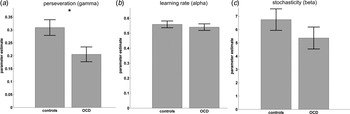
We did not find any difference between the groups in the learning rate alpha (control: 0.56, s.d. = 0.13; OCD: 0.54, s.d. = 0.12, t 64 = 0.59, p = 0.560, Fig. 2) or in the choice stochasticity parameter beta (control: 6.75, s.d. = 4.70; OCD: 5.36, s.d. = 4.66, t 64 = 1.20, p = 0.234). However, we found a significant difference in the perseveration parameter gamma (control: 0.308, s.d. = 0.177; OCD: 0.205, s.d. = 0.161, t 64 = 2.47, p = 0.016). The difference remained significant when controlling for age [multiple regression, age: t 64 = 2.43, p = 0.018; log(age): t 64 = 2.48, p = 0.016]. Interestingly, the OCD patients had a lower perseveration parameter compared with the matched controls. This means that they are less likely to repeat the same action again, independent from the stimulus value.
Comparison of the model parameters. Obsessive–compulsive disorder (OCD) patients had a significantly lower perseveration parameter gamma (a). The subjects did not differ in their learning rate alpha (b) or in the choice stochasticity beta (c). * p = 0.016.

In a subsequent exploratory analysis, we assessed whether there was a relationship between symptom severity and model parameter gamma within the patient group. We did not find any effect of symptom severity on any scale [(C)Y-BOCS total: r = 0.170, p = 0.352; obsessions: r = 0.152, p = 0.407; compulsions: r = 0.157, p = 0.392]. This suggests that gamma is not an indicator of symptom severity per se.
Increased RPEs in OCD
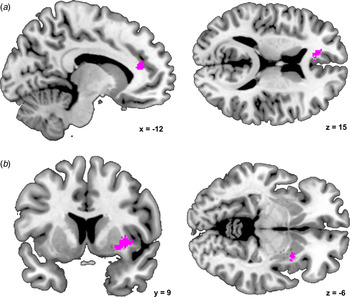
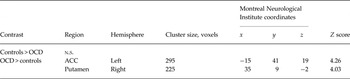
Based on our hypothesis of increased RPE signals in OCD patients, we compared the RPE signals during outcome processing between OCD and healthy controls. We found that OCD patients showed increased RPE-related activation in the ACC (Fig. 3, Table 2) and right putamen. Both areas have also been found to be activated as a main effect of RPE (see online Supplementary material, Fig. S1, Table S1). There was no region that showed an increased response in healthy controls compared with OCD patients.
Reward prediction error (RPE) changes in obsessive–compulsive disorder (OCD). OCD patients showed significantly increased RPE activations in the anterior cingulate cortex (a) and in the putamen (b).

RPE differences between OCD patients and healthy controlsa

RPE, Reward prediction error; OCD, obsessive–compulsive disorder; n.s., non-significant; ACC, anterior cingulate cortex.
a OCD patients showed increased RPE activations in the ACC and putamen (p < 0.05, cluster-extent family-wise error corrected). No area showed increased activation for controls.
To control for potential age-dependent effects in our sample, we additionally entered age as a covariate in our second-level analysis (see online Supplementary material). The same two clusters remained significant when regressing out age [OCD > control: ACC: Montreal Neurological Institute (MNI) coordinates −15, 41, 19, k = 331, Z = 4.21; putamen: MNI coordinates 36, 8, −3, k = 261, Z = 4.05] and log-transformed age (OCD > control: ACC: MNI coordinates −15, 41, 19, k = 327, Z = 4.23; putamen: MNI coordinates 35, 9, −2, k = 250, Z = 3.98). We are thus confident that the group differences in these clusters are not influenced by any age effects.
In order to understand how the group differences in fMRI were linked to our model parameter differences, we performed an exploratory correlation analysis of the perseveration parameter gamma and the mean response of the putamen and ACC, independently for each group. There was a significant correlation between the perseveration parameter gamma and the putamen in OCD patients, but not in controls (OCD: r = 0.486, p = 0.005; controls: r = 0.089, p = 0.617, online Supplementary Fig. S3). There was no correlation between gamma and the ACC in any of the groups (OCD: r = 0.073, p = 0.693; controls: r = 0.007, p = 0.970).
No relationship between symptom severity and putamen or ACC activity
To understand whether regions that showed increased activation in OCD were also related to patients’ symptom severity, we extracted the mean effect size of these areas (see online Supplementary material) and correlated them with symptom severity scores as measured with the (C)Y-BOCS interview. There was no correlation of either the ACC or putamen with the total (C)Y-BOCS score (putamen: r = 0.125, p = 0.496; ACC: r = 0.160, p = 0.380). There was also no correlation with the obsessions (putamen: r = 0.232, p = 0.202; ACC: r = 0.240, p = 0.186) or compulsions subscales (putamen: r = −0.006, p = 0.976; ACC: r = 0.051, p = 0.783). There was no correlation between disorder duration and putamen or ACC activity (putamen: r = 0.122, p = 0.520; ACC: r = −0.042, p = 0.825). These findings suggest that the increased activation in the ACC and putamen reflect a trait-like property of obsessive–compulsive behaviour, rather than a marker of the disorder severity.
Age of onset related to putamen activation
Previous findings of bimodally distributed incidence rates in OCD and behavioural, genetic and neural differences in EO and LO OCD patients (Walitza et al. Reference Walitza, Wendland, Gruenblatt, Warnke, Sontag, Tucha and Lange2010, Reference Walitza, Brem, Hauser and Grünblatt2014; Grünblatt et al. Reference Grünblatt, Hauser and Walitza2014; Boedhoe et al. Reference Boedhoe, Schmaal, Abe, Ameis, Arnold, Batistuzzo, Benedetti, Beucke, Bollettini, Bose, Brem, Calvo, Cheng, Cho, Dallaspezia, Denys, Fitzgerald, Fouche, Giménez, Gruner, Hanna, Hibar, Hoexter, Hu, Huyser, Ikari, Jahanshad, Kathmann, Kaufmann, Koch, Kwon, Lazaro, Liu, Lochner, Marsh, Martínez-Zalacaín, Mataix-Cols, Menchón, Minuzzi, Nakamae, Nakao, Narayanaswamy, Piras, Piras, Pittenger, Reddy, Sato, Simpson, Soreni, Soriano-Mas, Spalletta, Stevens, Szeszko, Tolin, Venkatasubramanian, Walitza, Wang, van Wingen, Xu, Xu, Yun, Zhao, Thompson, Stein and van den Heuvel2016) suggest that there might be differences between EO and LO OCD patients (details of the patient subgroups are listed in online Supplementary Table S3). EO in comparison with LO might represent a more severe specific developmental subtype of OCD with increased heritability and differences in the nature of OCD symptoms, the illness course and the pattern of co-morbidity (Walitza et al. Reference Walitza, Melfsen, Jans, Zellmann, Wewetzer and Warnke2011). Therefore we compared ACC and putamen activity between the two onset subgroups and found a significant difference in the putamen (EO = −0.23, s.d. = 1.07; LO = 1.31, s.d. = 0.98, t 30 = 3.89, p = 0.001, online Supplementary Fig. S2), but not in the ACC (t 30 = 1.16, p = 0.256). However, because both groups showed significant differences in their age as well as in their intellectual abilities (online Supplementary Table S3), we additionally controlled for these factors using multiple regression. The association between putamen activity and age of onset remained significant even after controlling for these other factors (t 28 = 2.37, p = 0.024), which themselves did not have an effect on putamen activity [age: t 28 = 0.70, p = 0.490; intelligence quotient (IQ): t 28 = 0.27, p = 0.790].
Because of the difference in putamen activity between the age-of-onset groups, we also compared the perseveration parameter gamma between the two age-of-onset groups and indeed found a significant difference (EO: γ = 0.17, s.d. = 0.15; LO: γ = 0.29, s.d. = 0.16, t 30 = 2.22, p = 0.034). This, however, did not remain significant when controlling for age and IQ (t 28 = 1.54, p = 0.134). Additional exploratory analyses of age of onset and the other model parameters did not reveal any significant effect (all p’s > 0.05). Generally, it should also be noted that the LO group with 10 subjects was markedly smaller than the EO group (n = 22).
Effects of medication on behaviour and RPEs
Because the majority of our patients were being treated with medication, we investigated whether the effects reported above might be related to the patients’ medication status (medicated/non-medicated) using independent-sample t tests. There was no significant difference in the model parameters (alpha: non-medicated: 0.56, s.d. = 0.15; medicated: 0.53, s.d. = 0.11, t 30 = 0.59, p = 0.560; beta: non-medicated: 4.6, s.d. = 4.3; medicated: 5.9, s.d. = 4.9, t 30 = −0.75, p = 0.462; gamma: non-medicated: 0.21, s.d. = 0.20; medicated: 0.20, s.d. = 0.14, t 30 = 0.14, p = 0.892). Likewise, there was no difference in the ACC (non-medicated: 0.25, s.d. = 0.73; medicated: 0.47, s.d. = 0.70, t 30 = −0.84, p = 0.407) or putamen (non-medicated: 0.22, s.d. = 1.17; medicated: 0.28, s.d. = 1.34, t 30 = −0.145, p = 0.886) cluster.
Discussion
Neuroimaging studies of OCD patients have reported activation differences in fronto-striatal areas, such as the ACC or striatum (van den Heuvel et al. Reference van den Heuvel, van der Werf, Verhoef, de Wit, Berendse, Wolters, Veltman and Groenewegen2010; Brem et al. Reference Brem, Hauser, Iannaccone, Brandeis, Drechsler and Walitza2012; Walitza et al. Reference Walitza, Brem, Hauser and Grünblatt2014; Hauser et al. Reference Hauser, Eldar and Dolan2016a ). Because of the importance of these areas in OCD, they have often been selected as target regions for invasive OCD treatments such as cingulotomy or deep brain stimulation (DBS) in severe refractory patients (Greenberg et al. Reference Greenberg, Rauch and Haber2010; Figee et al. Reference Figee, Luigjes, Smolders, Valencia-Alfonso, van Wingen, de Kwaasteniet, Mantione, Ooms, de Koning, Vulink, Levar, Droge, van den Munckhof, Schuurman, Nederveen, van den Brink, Mazaheri, Vink and Denys2013). Both areas are known to be responsive to RPEs and are critically involved in decision making (Rushworth et al. Reference Rushworth, Noonan, Boorman, Walton and Behrens2011; Haber & Behrens, Reference Haber and Behrens2014) which in turn is impaired in OCD patients.
To understand the mechanisms underlying such decision-making impairments in OCD, we investigated the neural correlates of RPE signals during a reversal learning task. We found that the striatum as well as the ACC expressed an RPE across all subjects (online Supplementary Fig. S1). When comparing the OCD patients with the healthy controls, we found an increased RPE signal in the ACC as well as in the putamen for the OCD patients, meaning that OCD patients have increased expression of an RPE in these areas.
To our knowledge, this is the first study to investigate RPE signals in OCD patients. Our findings extend a relatively consistent literature reporting increased internal error signals in OCD patients (Gehring et al. Reference Gehring, Himle and Nisenson2000; Johannes et al. Reference Johannes, Wieringa, Nager, Rada, Dengler, Emrich, Münte and Dietrich2001; Endrass et al. Reference Endrass, Klawohn, Schuster and Kathmann2008; Gründler et al. Reference Gründler, Cavanagh, Figueroa, Frank and Allen2009; Cavanagh et al. Reference Cavanagh, Gründler, Frank and Allen2010; Riesel et al. Reference Riesel, Endrass, Kaufmann and Kathmann2011, Reference Riesel, Endrass, Auerbach and Kathmann2015; Xiao et al. Reference Xiao, Wang, Zhang, Li, Tang, Wang, Fan and Fromson2011; Endrass & Ullsperger, Reference Endrass and Ullsperger2014). This is crucial, because these signals have been related to RPEs (Holroyd & Coles, Reference Holroyd and Coles2002), but previous attempts to indirectly measure RPEs using feedback-related signals in event-related potentials, such as the feedback-related negativity (FRN; Walsh & Anderson, Reference Walsh and Anderson2012; Hauser et al. Reference Hauser, Iannaccone, Stämpfli, Drechsler, Brandeis, Walitza and Brem2014b ), have remained inconclusive (Nieuwenhuis et al. Reference Nieuwenhuis, Nielen, Mol, Hajcak and Veltman2005; Gründler et al. Reference Gründler, Cavanagh, Figueroa, Frank and Allen2009; O'Toole et al. Reference O'Toole, Weinborn and Fox2012; Endrass et al. Reference Endrass, Koehne, Riesel and Kathmann2013). This might be due to the unclear relationship between RPEs and the FRN (Talmi et al. Reference Talmi, Atkinson and El-Deredy2013; Hauser et al. Reference Hauser, Iannaccone, Stämpfli, Drechsler, Brandeis, Walitza and Brem2014b ; Sambrook & Goslin, Reference Sambrook and Goslin2014) and the limited spatial specificity of the latter. Our findings thus support the theory that patients with OCD have a hyper-responsive learning and monitoring system (Ullsperger et al. Reference Ullsperger, Fischer, Nigbur and Endrass2014) that causes these regions to be more responsive if errors occur (i.e. higher ERN) or if adjustments in behaviour are needed (i.e. stronger RPEs).
OCD patients have previously been suggested to show impairments in cognitive flexibility tasks, such as reversal learning (Remijnse et al. Reference Remijnse, Nielen, van Balkom, Cath, van Oppen, Uylings and Veltman2006, Reference Remijnse, Nielen, van Balkom, Hendriks, Hoogendijk, Uylings and Veltman2009; Chamberlain et al. Reference Chamberlain, Menzies, Hampshire, Suckling, Fineberg, del Campo, Aitken, Craig, Owen, Bullmore, Robbins and Sahakian2008; Valerius et al. Reference Valerius, Lumpp, Kuelz, Freyer and Voderholzer2008; Freyer et al. Reference Freyer, Klöppel, Tüscher, Kordon, Zurowski, Kuelz, Speck, Glauche and Voderholzer2011; Endrass et al. Reference Endrass, Koehne, Riesel and Kathmann2013). However, the mechanisms and processes of these impairments remained unclear. Here, we used reinforcement learning models to better understand the neurocognitive mechanisms and processes involved. By analysing the model-derived parameters, we found that the OCD patients significantly differed in the perseveration parameter gamma. This change in perseveration was also reflected by a lower stay probability in the behavioural analysis. This might be surprising at first, because OCD has previously been associated with an increase in perseveration and excessive habit formation (Gillan et al. Reference Gillan, Papmeyer, Morein-Zamir, Sahakian, Fineberg, Robbins and de Wit2011, Reference Gillan, Apergis-Schoute, Morein-Zamir, Urcelay, Sule, Fineberg, Sahakian and Robbins2015, Reference Gillan, Kosinski, Whelan, Phelps and Daw2016; Voon et al. Reference Voon, Derbyshire, Rück, Irvine, Worbe, Enander, Schreiber, Gillan, Fineberg, Sahakian, Robbins, Harrison, Wood, Daw, Dayan, Grant and Bullmore2015; Hauser et al. Reference Hauser, Eldar and Dolan2016a ). However, these studies often used over-trained and/or speeded tasks which do not involve learning and uncertainty as in our task. Additionally, perseveration parameters have previously been used in different learning tasks where the parameter had a slightly different function (Lau & Glimcher, Reference Lau and Glimcher2005; Daw et al. Reference Daw, Gershman, Seymour, Dayan and Dolan2011). In the context of probabilistic reversal learning models, a decreased perseveration parameter may reflect a form of ‘checking’ behaviour. A lowered perseveration behaviour in OCD could reflect an obsessive need for certainty, which can only be satisfied by making sure that an alternative stimulus indeed reveals the predicted outcome. An alternative explanation of a worse learning in OCD patients seems less likely because both groups performed the task equally well (e.g. money won, number of rewarded trials, number of reversals), and a failure of learning would have been reflected in either a lower learning rate alpha or an altered choice stochasticity parameter beta. It should also be noted that a decreased perseverative behaviour does not affect task performance in trivial ways, as there was also no difference in earnings between the groups. Interestingly, a similar switching behaviour as in our OCD patients has been observed in non-human primates after ACC lesioning (Kennerley et al. Reference Kennerley, Walton, Behrens, Buckley and Rushworth2006) – consistent with our finding of an altered RPE signal in the ACC.
The finding of increased RPEs in OCD fits well with decreased perseveration. For example, if one constantly experiences that ‘something is wrong’ one might feel tempted to double-check whether the alternative option really conveys the predicted outcome, and thus to switch more frequently. This relationship between the perseverative behaviour and the RPE signals is also reflected in a significant correlation between the perseveration parameter and RPE activity in the putamen in the OCD patients (online Supplementary Fig. S3). It is noteworthy that patients that are more different from controls in their striatal response show more similar perseveration parameter values. Although counterintuitive at first, one could speculate that this might reflect a compensatory process. A strong link between the striatum and ACC through fronto-striatal loops (Alexander et al. Reference Alexander, DeLong and Strick1986; Frank et al. Reference Frank, Santamaria, O'Reilly and Willcutt2007; Haber & Behrens, Reference Haber and Behrens2014; Hauser et al. Reference Hauser, Fiore, Moutoussis and Dolan2016b ), for example, could suggest that an increased striatal activity counterbalances a hyperactive ACC signal and thus ‘normalizes’ the behavioural output of this loop.
It was previously suggested that OCD patients are loss avoidant (Carr, Reference Carr1974; Kaufmann et al. Reference Kaufmann, Beucke, Preuße, Endrass, Schlagenhauf, Heinz, Juckel and Kathmann2013) and thus show compulsion-like behaviours. However, loss aversion is generally difficult to dissociate from a valence-independent need for making correct decisions. Our decreased perseveration parameter favours the latter hypothesis, because OCD patients sacrifice small punishments for being reassured that they know which of the stimuli currently depicts the ‘correct’ one. If OCD patients were to be loss avoidant, this would have been reflected in an increased learning rate for punishments and more switches after losses, but not wins.
RPE signals are well known as markers of the dopaminergic system (Pessiglione et al. Reference Pessiglione, Seymour, Flandin, Dolan and Frith2006; Chowdhury et al. Reference Chowdhury, Guitart-Masip, Lambert, Dayan, Huys, Düzel and Dolan2013). Our findings of hyperactive RPE signals thus support recent genetic and other findings that suggest the dopaminergic system being involved in OCD pathogenesis (Denys et al. Reference Denys, van der Wee, Janssen, De Geus and Westenberg2004a , Reference Denys, Zohar and Westenberg b ; Brem et al. Reference Brem, Grünblatt, Drechsler, Riederer and Walitza2014; Pauls et al. Reference Pauls, Abramovitch, Rauch and Geller2014). Moreover, our findings may also help to explain why an augmentation of the first-line treatment (serotonergic medication) with neuroleptic medication (with mainly dopaminergic effects) as well as invasive treatments such as DBS targeting dopaminergic areas (Rück et al. Reference Rück, Karlsson, Steele, Edman, Meyerson, Ericson, Nyman, Asberg and Svanborg2008; Figee et al. Reference Figee, Luigjes, Smolders, Valencia-Alfonso, van Wingen, de Kwaasteniet, Mantione, Ooms, de Koning, Vulink, Levar, Droge, van den Munckhof, Schuurman, Nederveen, van den Brink, Mazaheri, Vink and Denys2013) can have beneficial effects, especially in severe refractory OCD. However, RPEs and phasic dopamine is known to also interact with other neurotransmitter systems, such as serotonin (Doya, Reference Doya2008; Maia & Cano-Colino, Reference Maia and Cano-Colino2015). It is thus likely that increased RPEs are caused by complex interaction between multiple neurotransmitters. Likewise, it should also be noted that the majority of our patients were treated with (serotonergic) medications and that serotonin also affects decision making (Seymour et al. Reference Seymour, Daw, Roiser, Dayan and Dolan2012). However, we did not observe any difference between the medicated and non-medicated OCD patients, neither in behaviour nor in the fMRI activation. It is thus unlikely that the medication was driving the differences that we found in this study.
To test whether our differences in RPE processing reflected severity of OCD symptoms, or rather an obsessive–compulsive trait independent of severity, we correlated the (C)Y-BOCS symptom scores with the RPE difference clusters and model parameters. We did not find any significant correlation. This – together with the fact that we also included participants who were currently in remission and on medication – suggests that the altered RPE responses may reflect a trait rather than a symptom severity marker. Again, medication of our patients might have confounded our symptom severity analysis to a certain extent, despite symptom severity not being significantly different between medicated and non-medicated patients [(C)Y-BOCS total: t 30 = 1.49, p = 0.146; obsessions: t 30 = 1.86, p = 0.073; compulsions: t 30 = 0.86, p = 0.398]. An additional caveat is that the severity of the disease [as measured by the (C)Y-BOCS] may be underestimated – especially in adolescents –, depending on the degree of insight of the patients.
RPEs have been shown to have specific developmental trajectories in healthy participants (Hauser et al. Reference Hauser, Iannaccone, Walitza, Brandeis and Brem2015b ). Because we were interested in determining disorder-specific differences in OCD independent of developmental effects, we additionally controlled for age. The clusters in the ACC and putamen remained significant, supporting a notion that these OCD-related differences are not influenced by age and consistent with a similar RPE activation across adolescence and adulthood in these regions (Hauser et al. Reference Hauser, Iannaccone, Walitza, Brandeis and Brem2015b ). However, a significant age-of-onset difference in the putamen suggests that the putamen effect is particularly pronounced in LO patients.
In this study, we report data from a relatively large group of OCD patients. Several limitations, in particular related to the patient sample, apply. Our patient group is relatively heterogeneous with several subjects being in remission at the time of scanning. Moreover, a majority of the patients was treated with medication and suffered from additional co-morbidities. Although controlling for age in our analyses, it would be desirable to have a more narrow patient age range. Lastly, our post-hoc comparison between EO and LO patients revealed interesting differences, but a marked difference in group size as well as a difference in IQ and age demands for a replication in better controlled subgroups.
In summary, this study investigated the mechanisms underlying the decision-making and learning impairments in OCD patients. We found increased RPE signals in the ACC and putamen in patients. As an RPE signal is influenced by a dopaminergic system this can be seen to support the idea that OCD may be linked to a dysregulation in this neuromodulatory system (Denys et al. Reference Denys, Zohar and Westenberg2004b ). Additionally, we found that decision making in OCD was characterized by a change in perseverative behaviour. Together, the behavioural and neural findings support the idea of a hyperactive monitoring system that is crucial not only for error monitoring but also for learning and decision making.
Supplementary material
The supplementary material for this article can be found at https://doi.org/10.1017/S0033291716003305
Acknowledgements
This study was supported by the Swiss National Science Foundation (no. 320030_130237, principal investigator: S.W.) and the Hartmann Müller Foundation (no. 1460, principal investigator: S.B.). T.U.H. was supported by the Swiss National Science Foundation (no. 151641). R.J.D. holds a Wellcome Trust Senior Investigator Award (098362/Z/12/Z). The Wellcome Trust's Cambridge–UCL Mental Health and Neurosciences Network grant 095844/Z/11/Z supported R.J.D. and T.U.H. The Max Planck UCL Centre is a joint initiative supported by UCL and the Max Planck Society. The Wellcome Trust Centre for Neuroimaging is supported by core funding from the Wellcome Trust (091593/Z/10/Z). We would like to express our gratitude to Carolin Knie, Helene Werner, Maya Schneebeli, Julia Frey and David von Allmen for their support during data collection. We thank the Department of Child and Adolescent Psychiatry of the University Bern and the Praxis für Entwicklungsförderung PfEF Aarau for the help in recruiting OCD patients.
Declaration of Interest
S. W. received speakers’ honoraria from Eli Lilly and OPO-Pharma in the last 5 years. M. R. received speaker honoraria from AstraZeneca and Lundbeck Institute and research grants from the Gottfried and Julia Bangerter-Rhyner Foundation and the Novartis Foundation for medical–biological research. J. H. received lecture honoraria from AstraZeneca, Eli Lilly, Lundbeck and Servier in the last 5 years. The other authors declare no competing financial interests.