Introduction
Next to psychotic symptoms cognitive impairments are considered to be core features of schizophrenia. They have been shown to exert a greater influence on social and vocational functioning than the presence or severity of positive or negative symptoms (Palmer et al. Reference Palmer, Dawes and Heaton2009). Clearly, the discovery of first-generation antipsychotics in the early 1950s represented a medical and scientific landmark as it was for the first time possible to treat the positive symptoms of schizophrenia. These treatments, however, are generally not thought to be very effective at treating the negative and cognitive symptoms of the disorder, which may be one possible reason for the lack of improvement in functional outcomes associated with these older compounds (Fleischhacker et al. Reference Fleischhacker, Hummer, Hofer, Holsboer, Gründer and Benkert2008). There is some evidence for the superiority of new-generation antipsychotics in improving negative and cognitive symptoms, but the effect size of these differences is not large and the results are inconsistent (Harvey et al. Reference Harvey, Green, Keefe and Velligan2004; Keefe, Reference Keefe2007; Fleischhacker et al. Reference Fleischhacker, Hummer, Hofer, Holsboer, Gründer and Benkert2008).
Given ambiguous findings of such treatment studies, there has also been a discussion of relevant outcome measures. Accordingly, the definition of remission proposed by American (Andreasen et al. Reference Andreasen, Carpenter, Kane, Lasser, Marder and Weinberger2005) and European expert groups (van Os et al. Reference van Os, Burns, Cavallaro, Leucht, Peuskens, Helldin, Bernardo, Arango, Fleischhacker, Lachaux and Kane2006) has become increasingly used. In this concept, remission is determined according to a threshold of symptom severity (mild or less) on eight items out of the Positive and Negative Syndrome Scale (PANSS; Kay et al. Reference Kay, Fiszbein and Opler1987) that represent the core features of schizophrenia according to DSM-IV and ICD-10 criteria. These eight items are: P1, delusions; P2, conceptual disorganization; P3, hallucinatory behaviour; N1, blunted affect; N4, social withdrawal; N6, lack of spontaneity; G5, mannerisms/posturing; G9, unusual thought content. In addition, 6 months was identified as the minimum period that a patient had to sustain this low level of symptomatology to be considered as in remission. However, remission cannot be equated with recovery, which implies the ability to function in the community, socially and vocationally. As stated above, both being relatively free of disease-related psychopathology and cognitive performance are of special relevance in this context. On the other hand, patients with greater cognitive abilities may have a higher likelihood of achieving remission (Kopelowicz et al. Reference Kopelowicz, Liberman, Ventura, Zarate and Mintz2005; Helldin et al. Reference Helldin, Kane, Karilampi, Norlander and Archer2006). Therefore, one purpose of the present study was to explore a potential association between remission status and neurocognitive functioning. We hypothesized that patients who had achieved remission would show a superior performance profile on a comprehensive battery of cognitive tests covering domains known to be impaired in schizophrenia. In addition, we investigated the joint effect of remission status and neurocognitive functioning on functional outcome by assessing the patients' marital and employment status, and by assessing their living situation.
Method
A total of 140 patients with schizophrenia from public out-patient mental health services between the ages of 19 and 60 years were included in a cross-sectional study. At the time of the study, patients had been clinically stable for a period of at least 6 months as judged by the treating psychiatrist, i.e. all patients were treated as out-patients, treatment regimens had not been modified, and there was no essential change in psychopathology during this period. All patients met the diagnostic criteria of schizophrenia spectrum disorders according to ICD-10. They did not suffer from any other axis I disorders, including substance abuse. Diagnoses were confirmed using chart information and reports from clinicians who had treated these patients.
Ratings were completed by psychiatrists belonging to a trained schizophrenia research team, and cognitive assessments were done by masters-level psychologists who were supervised by a neuropsychology Ph.D. All participants signed informed consent forms in accordance with the ethics committee of the Medical University Innsbruck.
Psychopathological symptoms were rated by means of the PANSS (Kay et al. Reference Kay, Fiszbein and Opler1987), with symptom remission being assessed by applying the severity, but not the time component of the remission criteria (Andreasen et al. Reference Andreasen, Carpenter, Kane, Lasser, Marder and Weinberger2005; van Os et al. Reference van Os, Burns, Cavallaro, Leucht, Peuskens, Helldin, Bernardo, Arango, Fleischhacker, Lachaux and Kane2006).
Pre-morbid intelligence was measured by using the German adaptation of the National Adult Reading Test (Nelson, Reference Nelson1982), the Mehrfachwahl-Wortschatz-Intelligenztest Test B (MWT-B; Lehrl, Reference Lehrl1977), a reliable and valid multiple-choice vocabulary test. The items of the MWT-B consist of 37 lines, each comprising five words. One is an authentic word from the dictionary, while four are fictitious. The participant is asked to find the correct word and to underline it. Each word correctly recognized scores one point.
Executive functioning was assessed with the 64-card computerized Wisconsin Card Sorting Test (WCST; Heaton et al. Reference Heaton, Chelune, Taley, Kay and Curtiss1993), a commonly used test to measure cognitive flexibility and problem-solving skills. Participants are asked to match a series of stimulus cards to a set of four target cards that differ by form, colour and number. They are provided with feedback on each item after they sort each of the cards. After they determine one of the correct dimensions, referred to as ‘categories’, ten correct responses are required before the category is shifted to the next one. Continued matching to a category that is no longer correct is considered a perseverative error. The variables of interest were the number of categories achieved and the percentage of perseverative errors.
To investigate verbal fluency, participants were asked to generate as many words as possible within the category of animals and as many words as possible that start with ‘s’ in each of two 60 s trials (Aschenberger et al. Reference Aschenberger, Tucher and Lange2000). The number of correct words generated in each category was measured.
Verbal learning and memory were assessed with a German version of the California Verbal Learning Test (Delis et al. Reference Delis, Kramer, Kaplan and Ober1987), the Münchner Gedächtnistest (MGT; Munich Memory Test). The test comprises two word lists consisting of names of common items that are semantically related to four conceptual categories (beverages, clothing, fruits, and tools), which are read to the patient. After each presentation, the patient must recall as many words as possible. The first list is presented five times, enabling learning, and then the second list is presented once. This presentation is followed by free and cued recall trials of the first list. At the end of the test, another word list, consisting of the items in the first list and various distraction items, is presented; participants must decide whether the items were included in the first list, using responses of yes or no (recognition). The variables of interest were the total number of words recalled in the most productive of the five learning trials of the MGT (MGT max), acquisition, retention and recognition. Acquisition was determined by the total number of words recalled in the most productive of the five learning trials minus the total number of words recalled in the first trial. Retention was defined as the percentage of words recalled in the free-recall condition after a delay of 20 min based on the total number of words recalled in the most productive of the five learning trials.
Alertness was assessed by using subtest 1 of the Test of Attentional Performance (TAP; Zimmermann & Fimm, Reference Zimmermann and Fimm2002), which measures reaction times with or without an acoustic signal (‘tonic alertness’). A cross (2 cm) appears in the middle of the screen and the participant has to press a button as rapidly as possible. The interval between the warning and the imperative stimulus varies randomly between 300 ms and 700 ms. The experiment is carried out via an ABBA design (A, without acoustic signal; B, with acoustic signal), with 20 stimuli per condition. The median reaction times in both conditions and their difference divided by the median reaction time of the total test are then calculated (‘phasic alertness’, representing the ability to enhance the level of attention, in expectation of a high-priority stimulus).
To test optical vigilance, the version with low frequency of stimuli of subtest 11 of the TAP was used. A lattice pattern jumps to and fro between two squares on top of each other and the participant has to discover an irregularity in the alternating of the pattern between the upper and lower square and to press a button as rapidly as possible. Correct answers and median reaction time were calculated.
To test working memory (TAP, subtest 2), 100 mixed single digits were presented consecutively on the screen. Whenever the participant identified a digit as identical to the penultimate one, a button had to be pressed immediately. Median reaction time, and the number of correct answers (maximum score is 15) were calculated.
Visual memory was assessed with the Benton Visual Retention Test (BVRT; Benton & Spreen, Reference Benton and Spreen1996). The Form F was used with the M administration: it consists of 15 ink figures composed of geometric shapes. Each target is presented to the participant for 10 s. Then, it is hidden, and the participant has to identify the target among three other figures. The four figures of the recognition phase are presented on four squares paired on two lines. Each figure is on a square and each location of the square is identified by the letters A, B, C and D according to the American reading direction. Total score is the sum of good recognition.
The developers of several of these test instruments provide age- and sex-adjusted ‘percentile’ scores based on normative values in the general population. Whenever available, we present these scores rather than the raw scores in order to facilitate interpretation of results. Group means for percentile scores can easily be interpreted by comparison with the mean in the general population, which, by definition, is always 50. Lower (higher) scores indicate poorer (better) test performance.
Statistical analysis
All statistical analyses were performed using SPSS (version 15; SPSS Inc., USA). For the comparison of remitted and non-remitted patients with respect to demographic and clinical patient characteristics the t test for independent samples, the Mann–Whitney U test and the χ2 test were used, depending on the variable type (normally distributed, non-normally distributed metric and categorical, respectively). To compare the two groups with regard to neurocognitive functioning and psychopathology (PANSS subscales) the Mann–Whitney U test was employed, as most of the variables showed departures from a normal distribution. The joint effect of remission status and neurocognitive functioning on functional outcome (marital and employment status, living situation) was investigated by logistic regression. In order to compare remission status, neurocognitive functioning and the combination of both in their ability to predict functional outcome, a blockwise approach was chosen. In the first model only remission status was considered as a predictor, in the second model only the variables of the neuropsychological test battery were taken into consideration, whereas in the third model both remission status and neuropsychological variables were taken into account. Within each of these regression analyses significant predictors were determined by forward stepwise selection (using p<0.05 as a criterion for variable entry).
Results
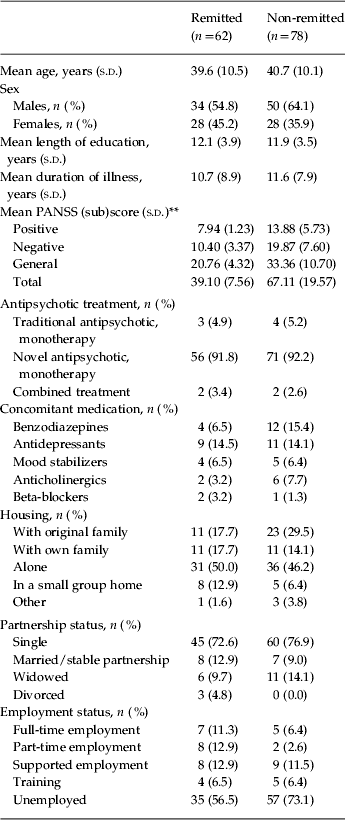
Out of 140 patients included in the study (60% males), 62 (44.3%) were symptomatically remitted. Demographic and clinical characteristics of the two groups are summarized in Table 1. Mean age, education, sex distribution and duration of illness were comparable in remitted and non-remitted patients. As expected, the two groups differed significantly with regard to the PANSS positive, negative and general subscores as well as the PANSS total score. In addition, remission status had a significant effect on the patients' employment status (full-time or part-time competitive employment; 24.2% v. 9.0%, p=0.018, Fisher's exact test).
Demographic and clinical characteristics of 140 patients

s.d., Standard deviation; PANSS, Positive and Negative Syndrome Scale.
** p<0.001.
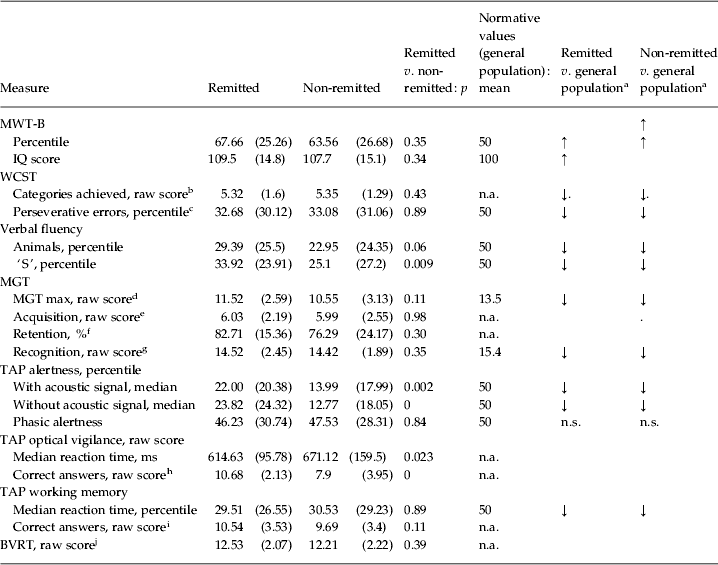
An overview of the patients' cognitive test scores is given in Table 2. The two groups did not differ significantly with respect to pre-morbid intelligence, WCST performance, verbal learning and memory, working memory, visual memory and phasic alertness. However, remitted patients showed a significantly higher level of neurocognitive functioning on tests of verbal fluency (words starting with ‘s’; animals: trend level), alertness with and without acoustic signal, and optical vigilance.
Scores on measures of neurocognition

Data are given as mean (standard deviation).
MWT-B, Mehrfachwahl-Wortschatz-Intelligenztest Test B; WCST, Wisconsin Card Sorting Test, n.a., not available; MGT, Münchner Gedächtnistest; TAP, Test of Attentional Performance; n.s., not significant; BVRT, Benton Visual Retention Test.
a Arrows indicate whether patient values are higher (↑) or lower (↓) than normative values (p < 0.001). b Possible scores range from 0 to 6; higher scores indicate better performance. c Possible scores range from 1 to 99; higher scores indicate better performance. d Total number of words recalled in the most productive of the five learning trials. Possible scores range from 0 to 16; higher scores indicate better performance. e Total number of words recalled in the most productive of the five learning trials minus the total number of words recalled in the first trial. Possible scores range from 0 to 16; higher scores indicate better performance. f Percentage of words recalled in the free-recall condition after a delay of 20 min based on the total number of words recalled in the most productive of the five learning trials. Possible scores range from 0 to 100; higher scores indicate better performance. g Possible scores range from 0 to 16; higher scores indicate better performance. h Possible scores range from 0 to 12; higher scores indicate better performance. i Possible scores range from 0 to 15; higher scores indicate better performance. j Possible scores range from 0 to 15; higher scores indicate better performance.
Both remitted and non-remitted patients showed significantly lower values compared with normative data from the general population regarding executive functioning (WCST perseverative errors), verbal fluency (animals, words starting with ‘s’), verbal learning (MGT max) and memory (MGT recognition), alertness (TAP alertness with and without acoustic signal) and working memory (TAP working memory-reaction time). Patients did not differ significantly from population norms with respect to phasic alertness. Patients' scores on the MWT-B, measuring pre-morbid intelligence, were significantly higher than normative values from the general population.
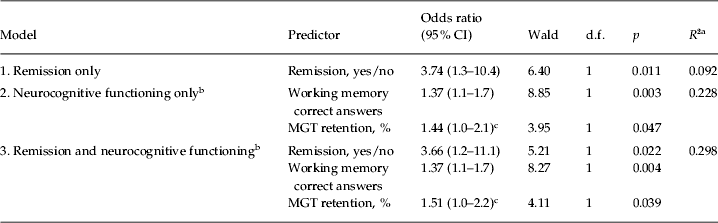
Both remission status and neurocognitive functioning had a significant effect on employment status (competitive employment, yes/no), as shown in Table 3. If only remission status is considered as a predictor (model 1), the effect of this variable is significant (26.3% of the remitted v. 8.7% of the non-remitted patients were competitively employed, odds ratio=3.7), but the overall model determination is fairly low (R 2=0.092). If only the variables of the neuropsychological test battery are used to predict employment status (model 2), model determination is somewhat higher (R 2=0.228). Two variables, namely number of correct answers in the working memory task and MGT retention in the verbal memory task, were selected as significant predictors by the stepwise logistic regression procedure. The best model fit is obtained when combining remission status with neurocognitive functioning (model 3, R 2=0.298). The stepwise regression procedure identified both remission status and the two neuropsychological variables mentioned above as significant predictors.
Effect of remission status and neurocognitive functioning on the patients' employment status (competitive employment, yes/no): results of logistic regression

CI, Confidence interval; d.f., degrees of freedom; MGT, Münchner Gedächtnistest.
a Nagelkerke's R 2;
b All variables listed in Table 2 were considered as potential predictors. However, only those variables selected by the stepwise logistic regression procedure are shown in the column ‘Predictor’.
c Odds ratio per 10% increase in MGT retention.
The only significant predictor of the outcome variable partnership (yes/no) was the percentage of perseverative errors in the WCST (fewer perseverative errors in those having a stable partnership; Wald=8.08, degrees of freedom=1, p=0.004, R 2=0.116), whereas remission status did not have a significant effect on this domain. With regard to the patients' living situation (independent living, yes/no) neither remission status nor neurocognitive functioning was found to be a significant predictor.
Discussion
The present study was conducted to examine the relationship of neurocognitive functioning, assessed by a comprehensive neuropsychological battery, with symptomatic remission from schizophrenia and to examine whether these factors have an impact on functional outcome. Mean age, education, sex distribution and duration of illness were comparable in remitted and non-remitted patients, while, as expected, values on the PANSS were significantly lower in remitted patients. In addition, patients who had achieved remission performed better on tests of verbal fluency, alertness and optical vigilance but did not outperform non-remitted patients with respect to pre-morbid intelligence, WCST performance, verbal learning and memory, working memory, visual memory and phasic alertness.
In general, schizophrenia patients' performance on important components of cognition has been reported to be up to two standard deviations below the mean of healthy control subjects (Harvey et al. Reference Harvey, Green, Keefe and Velligan2004). Accordingly, as shown in Table 2, for the majority of the cognitive domains assessed with the neuropsychological test battery in the present study, mean patient scores were significantly lower than the respective normative values, indicating poorer performance. This finding was independent of the patients' remission status. By contrast, in a study by Kopelowicz et al. (Reference Kopelowicz, Liberman, Ventura, Zarate and Mintz2005), recovered patients with schizophrenia spectrum disorders and healthy control subjects showed comparable performances on tests of executive functioning, verbal working memory, verbal fluency and visuoperceptual skills, while non-recovered patients performed significantly worse than the control group on these domains. However, this study used an extensive recovery concept including symptomatic remission, adaptive social and work functioning, cordial familial and peer relationships, and independent living. Accordingly, the two samples are not entirely comparable. On the other hand, a Swedish study (Helldin et al. Reference Helldin, Kane, Karilampi, Norlander and Archer2006) revealed marked differences in neurocognitive abilities in favour of patients who met the remission criteria as compared with those who did not. Similar to our findings, these differences included the domain of vigilance but also pre-morbid intelligence, WCST performance, verbal learning and memory, working memory, visuomotor speed and cognitive flexibility. At first sight this seems remarkable; however, one cannot rule out the possible impact of higher pre-morbid functioning levels on test performance in remitted patients. Furthermore, neither these nor our data allow for conclusions to be drawn regarding a causal relationship between the patients' remission status and their cognitive abilities given the cross-sectional study designs. Rather, consistent with earlier reports (Keefe et al. Reference Keefe, Bilder, Harvey, Davis, Palmer, Gold, Meltzer, Green, Miller, Canive, Adler, Manschreck, Swartz, Rosenheck, Perkins, Walker, Stroup, McEvoy and Lieberman2006; Buckley et al. Reference Buckley, Harvey, Bowie and Loebel2007), both symptomatic remission and cognitive improvement appear to be aspects of but not equivalents to recovery from schizophrenia.
In general, neurocognitive impairment is known to affect functional outcome in schizophrenia patients (Green et al. Reference Green, Kern, Braff and Mintz2000) and to be of predictive importance in this context (Norman et al. Reference Norman, Malla, Cortese, Cheng, Diaz, McIntosh, McLean, Rickwood and Voruganti1999; Gold et al. Reference Gold, Goldberg, McNary, Dixon and Lehman2002; Bryson & Bell, Reference Bryson and Bell2003; Fujii & Wylie, Reference Fujii and Wylie2003). For example, Velligan et al. (Reference Velligan, Mahurin, Diamond, Hazleton, Eckert and Miller1997) reported that neurocognitive impairments have a greater impact on functional outcome than psychopathological symptoms, and Green et al. (Reference Green, Kern, Braff and Mintz2000) found that 20–60% of the variance in functional outcome can be explained by neurocognition. In the current study, participants who had achieved symptomatic remission performed significantly better than non-remitted patients on tests of verbal fluency, alertness and optical vigilance. Previous research indicates an association between both verbal fluency and vigilance and social competence (Zanello et al. Reference Zanello, Perrig and Huguelet2006; McClure et al. Reference McClure, Bowie, Patterson, Heaton, Weaver, Anderson and Harvey2007; Williams et al. Reference Williams, Withford, Flynn, Wong, Liddell, Silverstein, Galletly, Harris and Gordon2008), independent living skills (Kern et al. Reference Kern, Green and Satz1992; Green et al. Reference Green, Kern, Braff and Mintz2000; Rempfer et al. Reference Rempfer, Hamera, Brown and Cromwell2003; Cervellione et al. Reference Cervellione, Burdick, Cottone, Rhinewine and Kumra2007), as well as quality of life (Wegener et al. Reference Wegener, Redoblado-Hodge, Lucas, Fitzgerald, Harris and Brennan2005). In addition, poor performance on tests of attention has been found to be related to decreased medication compliance (Jarboe et al. Reference Jarboe and Schwartz1999). Therefore, improvement of these neurocognitive domains is likely to correspond to a concomitant gain in subjective and functional outcome.
Next to neurocognitive impairment, psychotic symptoms have been suggested to be responsible for the low probability of gainful employment in patients with schizophrenia (Bond & Drake, Reference Bond and Drake2008). Our finding of symptomatic remission being a predictor for competitive employment outcomes corroborates that of a recent international randomized controlled trial (Catty et al. Reference Catty, Lissouba, White, Becker, Drake, Fiorty, Knapp, Lauber, Rössler, Tomov, van Busschbach, Wiersma and Burns2008). In addition, according to the findings of other researchers (Green et al. Reference Green, Kern, Braff and Mintz2000; Velligan et al. Reference Velligan, Bow-Thomas, Mahurin, Miller and Halgunseth2000; Hofer et al. Reference Hofer, Baumgartner, Bodner, Edlinger, Hummer, Kemmler, Rettenbacher and Fleischhacker2005; Kaneda et al. Reference Kaneda, Jayathilak and Meltzer2010), our data suggest that memory deficits might reduce one's employment prospects. Interestingly, these deficits were not associated with the patients' remission status and one could speculate that neurocognitive functions associated with symptomatic remission are not necessarily related to improvements in the patients' employment status.
The current study also has some limitations. First, we disregarded the potential influence of medication on the outcomes studied. Clearly, the different antipsychotics prescribed to our patients may have had a different impact on outcomes. However, most of the patients were on new-generation antipsychotics, which differ, at the most, in small effect sizes from each other regarding positive symptom relief (Leucht et al. Reference Leucht, Komossa, Rummel-Kluge, Corves, Hunger, Schmid, Asenjo Lobos, Schwarz and Davis2009) and probably not at all regarding the amelioration of cognitive impairment (Keefe et al. Reference Keefe, Bilder, Davis, Harvey, Palmer, Gold, Meltzer, Green, Capuano, Stroup, McEvoy, Swartz, Rosenheck, Perkins, Davis, Hsiao and Lieberman2007; Davidson et al. Reference Davidson, Galderisi, Weiser, Werbeloff, Fleischhacker, Keefe, Boter, Keet, Prelipceanu, Rybakowski, Libiger, Hummer, Dollfus, López-Ibor, Hranov, Gaebel, Peuskens, Lindefors, Riecher-Rössler and Kahn2009). Therefore, we tend to believe that medication may not have had an appreciable influence on our findings. Second, patients were investigated during a clinically defined stable phase of schizophrenia, and the duration of this phase was not registered since each study participant was assessed on one occasion only. In fact, beyond the predefined 6-month period, patients may have experienced different durations of clinical stability, potentially affecting course and psychosocial outcomes. In addition, given that the PANSS remission criteria were applied cross-sectionally, we do not really know when patients had first met these criteria. Again, this entails some degree of uncertainty regarding the time course of illness outcomes. On the other hand, remission status has been shown to be of considerable stability (Ciudad et al. Reference Ciudad, Álvarez, Bobes, San, Polavieja and Gilaberte2009). Third, the fact that some neuropsychological measures of frontal lobe functioning differed between remitted and non-remitted patients while others did not cannot be sufficiently explained. A speculative explanation involves an influence of task demand on the level of performance. However, this topic clearly warrants further study. Last, although we have found substantial correlations between different outcome measures, the design of the current study does not allow for direct causal conclusions regarding the influence of symptomatic remission and neurocognitive functioning on patients' outcome. As this was a cross-sectional study, it will be critical to generate longitudinal follow-up data to determine how the associations of these determinants of functional outcome interact and change over time. In addition, future research is needed to explore the impact of pharmacological and psychosocial interventions on this topic.
Acknowledgements
None.
Declaration of Interest
None.