Adults are differentially successful from one another in their attempts to learn a second language (L2). Individual differences in many domains, including motivation (Fan, Reference Fan2003; Sanaoui, Reference Sanaoui1995), age (Birdsong & Molis, Reference Birdsong and Molis2001; Johnson & Newport, Reference Johnson and Newport1989), working memory (WM; Harrington & Sawyer, Reference Harrington and Sawyer1992; Sunderman & Kroll, Reference Sunderman and Kroll2009), and phonological short-term memory (PSTM; Gathercole & Baddeley, Reference Gathercole and Baddeley1993; Service, Reference Service1992), have all been proposed as reasons for this differential success. This previous research has primarily focused on vocabulary learning, reading comprehension, and fluency development, rather than the learning of grammatical patterns. the current study therefore investigated the roles of WM and PSTM as they separately affect grammar and vocabulary learning in an artificial foreign language.
A DEFINITION OF WORKING MEMORY
Working memory is the ability to mentally store and manipulate information relevant to a task (Baddeley, Reference Baddeley1998, Reference Baddeley2003). There are two broadly separate approaches in the literature, one British and one North American (Baddeley, Reference Baddeley1998; Just & Carpenter, Reference Just and Carpenter1992; van den Noort, Bosch, & Hugdahl, Reference van den Noort, Bosch and Hugdahl2006); however, the distinctions between them are not always made clear (Williams, Reference Williams, Gass and Mackey2012). In this study, WM refers to both storage and processing of information, measured by reading or listening span tasks (Fortkamp, Reference Fortkamp1999; van den Noort et al., Reference van den Noort, Bosch and Hugdahl2006). Phonological short-term memory refers to storage alone, measured by nonword repetition or nonword recognition (van den Noort et al., Reference van den Noort, Bosch and Hugdahl2006).
Working memory is one of the most extensively investigated factors relating to individual differences in cognition. Baddeley’s model of WM (Baddeley, Reference Baddeley1998, Reference Baddeley2003; Baddeley & Hitch, Reference Baddeley, Hitch and Bower1974), which is comprised of the central executive, the phonological loop, and the visuo-spatial sketchpad, is one of the most influential. Baddeley (Reference Baddeley2003; Baddeley, Gathercole, & Papagno, Reference Baddeley, Gathercole and Papagno1998) has proposed that the function of the phonological loop is to support language learning, including vocabulary development, fluency, and some measures of comprehension (e.g., Ellis & Sinclair, Reference Ellis and Sinclair1996; French, Reference French2006; Service, Reference Service1992). Central executive function has also been shown to relate to reading comprehension and global verbal abilities (e.g., Daneman & Carpenter, Reference Daneman and Carpenter1980; Turner & Engle, Reference Turner and Engle1989). It may also account for individual differences in the efficiency of language processing, both in the first language (L1) and L2 (Harrington & Sawyer, Reference Harrington and Sawyer1992; Williams, Reference Williams, Gass and Mackey2012).
PSTM AND L2 LEARNING
A number of studies have shown that PSTM is important in L2 vocabulary learning. Baddeley, Papagno, and colleagues (Baddeley, Papagno, & Vallar, Reference Baddeley, Papagno and Vallar1988; Papagno, Valentine, & Baddeley, Reference Papagno, Valentine and Baddeley1991) studied a neuropsychological patient, PV, who had a selectively damaged phonological loop. She learned pairs of native language words without difficulty but was greatly impaired when attempting to learn foreign language words. The importance of the phonological loop was further supported by Papagno and colleagues (1991), who showed that normal participants were unable to learn foreign language words under articulatory suppression, an interference treatment that selectively affects PSTM, especially when the novel words were very dissimilar from those of their native language.
In addition to vocabulary, PSTM has also been implicated in L2 grammar and fluency development. Service (Reference Service1992) and Service and Kohonen (Reference Service and Kohonen1995) conducted a longitudinal study of foreign language learning in Finnish-speaking primary school children. This study found that English (L2) nonword repetition abilities at the beginning of primary education were a good predictor of success in English learning during the first 2–3 years of formal education (Service, Reference Service1992). Ellis and Sinclair (Reference Ellis and Sinclair1996) tested adults’ ability to learn Welsh as a foreign language and found that participants who repeated the language aloud scored significantly higher on vocabulary, use of phrasal constructions, and the ability to use the Welsh soft mutation, whereby the initial phonemes of nouns change as a function of grammatical context (King, Reference King2003). They concluded that the more often foreign language structures are rehearsed in PSTM, the easier it is to learn them and to generalize rules from them. Kormos and Sáfár (Reference Kormos and Sáfár2008) found similar results—that nonword span correlated with writing, use of English (both vocabulary and grammar constructions), and overall L2 proficiency.
PSTM is important for the development of overall L2 fluency in addition to vocabulary and grammatical structures. French and O’Brien (Reference French and O’Brien2008) found that Time 1 nonword repetition predicted L2 grammar scores at Time 2 (rs between .79 and .82), after a 5-month intensive language program for children. Phonological memory explained almost 30% of the variance in grammar scores at Time 2, even after controlling for vocabulary knowledge. O’Brien and colleagues also found important influences of PSTM on measures of adult L2 learning, including vocabulary, correct use of grammatical structures, and fluency (O’Brien, Segalowitz, Collentine, & Freed, Reference O’Brien, Segalowitz, Collentine and Freed2006; O’Brien, Segalowitz, Freed, & Collentine, Reference O’Brien, Segalowitz, Freed and Collentine2007). O’Brien and colleagues (2006) found that phonological memory correlated with vocabulary scores, narrative abilities, and use of free grammatical morphemes and subordinate clauses, both at the beginning and at the end of a semester of Spanish learning (rs between .30 and .41). O’Brien and colleagues (2007) extended these findings to measures of overall fluency in adult L2 learners.
Speidel (Reference Speidel1993) studied siblings who were native speakers of German and L2 speakers of English. The sibling who had trouble with gender forms and case endings also had trouble with PSTM, and Speidel concluded that PSTM is important in the creation of stable representations of grammatical structures. Difficulties in creating these representations may lead to problems building a storehouse of token phrases from which to generalize grammatical rules. Speidel suggested that PSTM would be especially important for learning material not easily learned through meaningful imagery, such as abstract function words and morphemes (DeKeyser, Reference DeKeyser2005).
Williams and Lovatt (Reference Williams and Lovatt2003) investigated the relationship between PSTM and the ability to generalize grammatical gender. Using a semiartificial foreign language (the structure of the language was that of Italian, but the words were changed to Japanese nonwords, and the letters of the determiners were also changed), they found that phonological memory predicted grammatical generalization abilities at r = .60 and that this correlation was significant across multiple cycles of generalization tests. Similar to Ellis (1996), Williams and Lovatt argued that grammar rules are generalizations of patterns across sequences of words. They reasoned that if PSTM is related to learning words, it should also be related to learning the patterns among them. They suggested that because there appears to be a consistent relationship between PSTM and vocabulary, and between vocabulary and grammar, it is reasonable to assume a connection between PSTM and grammar as well.
WM AND L2 LEARNING
Working memory–impaired children have difficulties parsing and analyzing linguistic structures in their L1 (Marton & Schwartz, Reference Marton and Schwartz2003; Robinson, Mervis, & Robinson, Reference Robinson, Mervis and Robinson2003). Research has also implicated WM in L2 comprehension, reading, and fluency. Harrington and Sawyer (Reference Harrington and Sawyer1992) used a L2 reading span test based on Daneman and Carpenter (Reference Daneman and Carpenter1980), simplified for use with nonnative English speakers. They found that this reading span task correlated with both L2 reading and grammar scores. Fortkamp (Reference Fortkamp1999) replicated these results and also developed a new WM task: speaking span. In this task, participants were briefly presented with a list of words and then had to generate a set of sentences, with one sentence each incorporating one of the words. Scores on this task also correlated with scores of L2 fluency (rs between .61 and .64). Leeser (Reference Leeser2007) found that participants with higher WM capacities were better able to comprehend passages in a foreign language (although only when the participants were familiar with the passage topic). He also found that having a high WM capacity compensated for being unfamiliar with a passage topic on a test of grammatical form recognition.
In addition to their PSTM results, Kormos and Sáfár (Reference Kormos and Sáfár2008) found that WM (measured using backward digit span) correlated with five out of their six measures of L2 ability, including reading, speaking, and listening. Their findings were important and unique because they demonstrated a correlation not only between WM and typical verbal abilities such as reading and listening comprehension but also between WM and vocabulary knowledge as assessed by the Cambridge First Certificate Exam. They argued that this demonstrated a direct connection between WM and both vocabulary and grammar learning that is based on the role of the central executive component of WM in regulating attention (Baddeley, Reference Baddeley2003). Working memory has similarly been proposed as a basic mechanism for learning new rules in a L2 through its involvement in the noticing and encoding of new information (Mackey, Philp, Egi, Fujii, & Tatsumi, Reference Mackey, Philp, Egi, Fujii, Tatsumi and Robinson2002). Working memory is also important for L2 grammar learning across time. Robinson (Reference Robinson and Robinson2002) used a reading span task to measure WM and found it was related to the incidental learning of Samoan grammatical structures. Participants with higher WM scores performed better on sentence-production and receptive grammaticality judgment tasks. This was true not only on immediate posttests (r = .42) but also on 1-week (r = .33–.48) and 6-month (r = .44) delayed posttests.
Sunderman and Kroll (Reference Sunderman and Kroll2009) used a reading span task to investigate the WM capacities of college students who studied abroad and those who did not. Working memory scores correlated significantly with performance on a translation-comprehension task. However, they also found that beneath a minimum WM capacity threshold, students who studied abroad were not able to benefit from that experience. They concluded that individuals with higher WM may be able to attend to more linguistic factors at once and thereby increase their ability to parse grammatical structures. As a whole, this research demonstrates the important role of WM in various domains of L2 learning.
SUMMARY OF PREVIOUS FINDINGS
A large amount of research has indicated that both PSTM and WM are important for various aspects of language-learning ability. Most researchers attribute the connection between PSTM and language learning to the importance of the phonological loop for forming stable, long-term mental representations of novel phonological material. These representations are especially important for knowledge of phonological items, such as individual words and chunks. Connections have also been found between WM and language abilities. These relationships are usually attributed to an individual’s ability to parse, analyze, and effectively manipulate new linguistic items and structures. The attentional aspect of WM has additionally been implicated in allowing learners to attend to multiple aspects of linguistic structure at once.
However, there are still many unanswered questions. Much of the work that investigates PSTM and WM in grammar learning has involved explicit learning conditions, with relatively little research done on implicit or naturalistic learning conditions. Additionally, some authors have suggested that the relationship between PSTM and grammar abilities is mediated by vocabulary knowledge (e.g., Service & Kohonen, Reference Service and Kohonen1995). A large amount of research has been correlational or observational, rather than experimental; further work is necessary to more clearly identify the separate roles of PSTM and WM in vocabulary and grammar learning. The current study intended to address these issues, with a particular focus on uninstructed grammar learning in which patterns are induced from whole sentences.
THE CURRENT STUDY
Three memory tests were used: listening span to measure WM (Harrington & Sawyer, Reference Harrington and Sawyer1992) and nonword repetition (Gathercole, Pickering, Hall, & Peaker, Reference Gathercole, Pickering, Hall and Peaker2001) and nonword recognition (O’Brien et al., Reference O’Brien, Segalowitz, Collentine and Freed2006, Reference O’Brien, Segalowitz, Freed and Collentine2007) to measure PSTM. An artificial language utilizing nonword stimuli was employed for the language-learning tasks (similar to Williams & Lovatt, Reference Williams and Lovatt2003). Participants learned the vocabulary and were then exposed to word order and plural markings in a sentence context, without explicit instructions or explanations. Their knowledge and use of plural markings and word order was measured in a generalization test at the end of the study; these scores reflected not only their knowledge of the structures but also their ability to generalize them to new words and phrases. Three specific hypotheses guided this study:
1. There will be a positive correlation between PSTM and vocabulary scores. This is based on findings, such as Baddeley et al. (Reference Baddeley, Papagno and Vallar1988), of a strong connection between phonological memory and L2 vocabulary learning.
2. There will be a positive correlation between both PSTM and WM and grammar scores. This is based on the fact that grammar learning is a complex process and relies on both memorization of individual items and processing of the relationships among them.
3. There will be a positive correlation between vocabulary and grammar scores. This is based on prior research that demonstrates a relationship between vocabulary knowledge and grammar abilities in L1 (Bates & Goodman, Reference Bates and Goodman1997) and L2 (Service & Kohonen, Reference Service and Kohonen1995).
METHOD
Participants
Fifty monolingual native English speakers were recruited from a large American university in the Midwest. Three participants were excluded because they grew up as bilinguals; there were 7 additional participants who did not return for the second session. This left a total of 40 participants (36 females and 4 males) who completed the entire study and whose data were included. Ages ranged from 18–45, with a mean of 21.5 years. Participants volunteered and were paid $10.00 per session, for a total of $20.00.
Individual Differences Measures
Nonword Repetition. Nonword repetition was used as a test of PSTM. Participants heard a list of 1-syllable nonwords and were asked to repeat them as accurately as possible. There were four lists at each of four lengths: three, four, five, and six words. All participants heard the lists in the same order, beginning with the shortest lists and continuing with lists of increasing length. The nonwords were taken from Gathercole and colleagues (2001). Examples of these stimuli can be found in Appendix A. Participants’ responses for all items throughout the study were recorded using a microphone and the sound-editing software Audacity (Audacity Team, 2008). Scoring was done offline on a phoneme-by-phoneme basis, and the maximum number of phonemes recalled on any one repetition set was calculated for each participant. The maximum possible score for this task was 22 correct phonemes.
Nonword Recognition. Nonword recognition was used as an additional measure of PSTM. It is highly correlated with performance on similar repetition tasks but is less affected by unfamiliar phonotactics and pronunciation difficulties (Gathercole et al., Reference Gathercole, Pickering, Hall and Peaker2001). Participants listened to two presentations of a list of nonwords and decided whether they were the same or different. Participants received 1 point for each correct same or different judgment. Eight lists were used at each of three lengths: five, six, and seven items. There were also four practice trials with four items each. Of the eight lists at each length, four were identical and four were different. For the identical presentations, the same list was presented twice, with a 1,200 ms pause in between. For the presentations that were different, the first presentation of the list was followed by a 1,200 ms pause and a second presentation of the list with two adjacent items transposed. The location of the transposed syllables was randomized, with the exception that the first and last syllables were never transposed. This was to reduce the salience of the transposition and encourage participants to process the entire string (O’Brien et al., Reference O’Brien, Segalowitz, Collentine and Freed2006). The stimuli were taken from Gathercole et al. (Reference Gathercole, Pickering, Hall and Peaker2001) and had also been used by O’Brien et al. (Reference O’Brien, Segalowitz, Collentine and Freed2006). Examples of these stimuli can be found in Appendix A. The maximum possible score for this task was 24 correct recognitions.
Participants began with the practice set of four lists, on which they received feedback (pilot testing revealed this was necessary for learning the task). Test trials began with the five-item lists and then moved on to the six- and seven-item lists, with no feedback. Within each list length, the order of the same and different lists was randomized for each participant. All nonwords used as vocabulary for the artificial language were used as stimuli in this task. This was done to familiarize participants with the phonotactics of the words in the language they would be learning (Brooks, Braine, Catalano, Brody, & Sudhalter, Reference Brooks, Braine, Catalano, Brody and Sudhalter1993; Williams & Lovatt, Reference Williams and Lovatt2003).
Listening Span. Listening span, adapted from similar reading span tasks (e.g., Daneman & Carpenter, Reference Daneman and Carpenter1980; Harrington & Sawyer, Reference Harrington and Sawyer1992), was used to measure WM capacity. Participants heard sentences and had to decide whether or not they made sense as a sentence in English. This is referred to as a grammaticality judgment, even though the judgments were made not on strict grammaticality per se but rather on whether the sentences made sense. The ungrammatical sentences were clearly so because their word orders made them completely nonsensical. This difference was explained to participants. At the end of each set of sentences, participants were asked to recall the final word of each sentence. The number of words correctly recalled in the correct relative order was used as the WM score; the maximum possible score was 31. The grammaticality judgments were not scored but served as a manipulation check to ensure that the participants processed each sentence as a whole (Turner & Engle, Reference Turner and Engle1989). All participants were correct on at least 85% of the grammaticality judgments, and all trials were included in calculating the WM scores. Forty sentences were used and arranged in sets, with the number of sentences in each set increasing from 2 to 6. Two sets of each length were presented. The two sets of two sentences were practice sets; the longer sets were used as test sets. The sentences used as stimuli were from Harrington and Sawyer (Reference Harrington and Sawyer1992)—examples can be found in Appendix A. Half the sentences were grammatical and half the sentences were ungrammatical (the word order was mixed up so that it no longer made sense as a sentence in English).
The Artificial Language
The artificial language consisted of 21 nouns, 10 verbs, 4 adjectives, and 3 prepositions. Each noun and verb had three forms—singular, dual, and plural—marked by a prefix. Nouns had no prefix for the singular form, the prefix zi- for the dual form, and the prefix na- for the plural form, with one sound change in irregular forms. Nouns that began with nasal consonants (/m/ or /n/) took the prefix za- for the dual form and the prefix no- for the plural form. Verbs had no prefix for the singular form, the prefix ta- for the dual form, and the prefix moo- for the plural form, also with one sound change in irregular forms. Verbs that began with nasal consonants took the prefix too- for the dual form and the prefix mi- for the plural form. Adjectives took the same prefixes as the nouns they modified. A complete set of words in all forms can be found in Appendix B. The word order of the artificial language was the same as English, except that adjectives followed the nouns they modified, rather than coming before them.
Sentence (1) demonstrates a singular sentence. Sentences (2) and (3) demonstrate plural forms, in which DF indicates the dual prefix. Sentence (2) demonstrates regular prefixes, and (3) demonstrates their irregular forms.
(1) Lork cham mord kib dook
Cow big is on table
“The big cow is on the table.”
(2) Na-targ moo-dern zi-jick zi-leck
plural-fish plural-throw DF-book DF-red
“Multiple fishes throw two red books.”
(3) No-nog moo-pag za-nart
plural-man plural-catch DF-ball
“Multiple men catch two balls.”
Although it was an artificial language, the language used here was designed on the basis of both other experimental language systems (such as in Daneman & Case, Reference Daneman and Case1981) and attested natural languages. for example, Arabic uses a singular-dual-plural distinction such as the one used here (Haywood & Nahmad, Reference Haywood and Nahmad1965), and Swahili uses prefixes to mark various classes of words (Polomé, Reference Polomé1967). However, the usage of these structural features here is to a certain extent a simplification of their forms and functions in natural languages.
Procedure
The study was completed over the course of two 1-hr sessions in a computer lab. All tasks, except for the participant questionnaires—which were completed on paper—were administered using E-Prime software (Schneider, Eschman, & Zuccolotto, Reference Schneider, Eschman and Zuccolutto2002). During the first 1-hr session, participants completed all three memory tasks and then began learning the artificial language. Participants progressed through the rest of the study at their own pace. The vocabulary for the language was presented aurally through headphones with the corresponding meaning illustrated on the screen. Participants were asked to repeat each word aloud to reinforce its learning (Ellis & Sinclair, Reference Ellis and Sinclair1996). They also heard the translation and were asked to repeat that as well. The singular form of each noun and verb was presented twice. The dual and plural forms of each word were never presented in this phase. Participants never saw the foreign language in written form.
After presentation of the vocabulary, participants listened to 15 sentences in the foreign language that contained this same vocabulary. They also saw an illustration of each sentence and its English translation on the screen and were asked to repeat the sentence (repetition paradigm). An example illustration for the sentence The man throws the egg is provided in Figure 1. After this initial presentation, participants listened to the same 15 sentences a second time. This time, they saw the illustration, heard the English sentence, and were asked to translate into the foreign language (translation paradigm). After each sentence, they pressed a key and heard the correct translation as feedback. These sentences were presented in random order, and some examples can be found listed in Appendix C under Set 1. Vocabulary scores from this session are included in the analyses as initial vocabulary scores. This concluded the first session.
Sample illustration from the training session (Set 1), accompanying the sentence The man throws the egg.

During the second session, 2 to 7 days after the first, participants began with a vocabulary review. They heard a word in the foreign language and saw four illustrations on the screen. They had to choose which illustration matched the word they heard. They were given feedback on whether their answer was correct or incorrect, and the word and its illustration were repeated to reinforce the meaning. This review continued until participants reached 85% correct on a single run-through of all 38 words. After this, participants reviewed the 15 sentences from session 1 (Set 1). Half the sentences were presented using the repetition paradigm, and the other half were presented using the translation paradigm. The sentence order within each half was randomized for each participant.
After the review, participants were presented with 30 entirely new sentences (examples are listed in Appendix C under Set 2). For the first half, participants saw an illustration of the sentence and its English translation. They heard the sentence in the foreign language and were asked to repeat it (repetition paradigm). For the second half, they saw an illustration, heard a different sentence in English, and were asked to translate it into the foreign language (translation paradigm). After their production they heard the correct translation as feedback. Within each half of the stimuli, sentences were presented in a random order for each participant. Twenty-three of these new sentences included at least one unknown plural form of a known vocabulary word. These plural forms had not been previously encountered and were not explicitly taught. The meaning of these new forms could only be deduced from the illustration and the feedback that accompanied each sentence. These provided the data from which participants generalized the grammar rules.
The final phase of the study was the test productions (TP) phase, consisting of 50 sentences. Thirteen sentences were repeated from Set 1, 13 were repeated from Set 2, and 24 were completely novel (examples are listed in Appendix C under Generalization Set [GS]). The novel sentences of the GS each used at least one new plural form that participants had not yet encountered. For half the sentences, participants heard an English sentence, saw an illustration, and were asked to produce the foreign language translation (production scores). For the other half of the sentences, participants heard an utterance in the foreign language and had to translate into English (comprehension scores). During these trials, participants did not see an illustration because this would have allowed them to translate the sentence solely on the basis of the illustration, without necessarily having understood the foreign language. Participants received separate scores for production and comprehension of GS vocabulary and grammar as well as overall TP vocabulary and grammar.
The purpose of the novel sentences was to measure how well participants had abstracted the plural morphology and word-order rules from the sentences presented in Set 2 and how well they could then generalize them to new vocabulary and sentences. This served as a measure of their knowledge of the grammar system. At the end of the second session, participants completed a questionnaire that assessed their explicit knowledge of the language. Although the language was presented with an implicit learning orientation, it is likely that participants attempted to analyze the system explicitly and did not simply rely on implicit learning. Therefore this questionnaire was used to evaluate how much explicit knowledge was gained through the implicit or naturalistic learning environment. The participants were asked to describe the grammar of the language, to give the rule for forming plurals, and to identify whether there were any apparent changes to these rules in any contexts. They were also asked for any additional comments they might like to share regarding how they learned the language.
Scoring
Utterances were scored for both vocabulary and grammatical accuracy. For vocabulary-production scores, participants received 1 point for each word that was produced correctly, .66 points for each word that had only one incorrect phoneme, or 0 points for each word that had two or more incorrect phonemes. For example, if the target word was charb, participants would earn 1 point for producing charb, .66 points for producing chard, and 0 points for producing chob. For grammar-production scores, participants received 1 point for each correct prefix, .25 points for each prefix that was correct in word type (noun, verb, or adjective) but incorrect in plurality (dual vs. multiple), or 0 points for a plural marking that was missing or that was from the wrong word type. For example, if the target word was zi-charb, participants would earn 1 point for producing zi-charb, .25 points for producing na-charb, and 0 points for producing charb or ta-charb. Participants also received 1 point if they were able to produce the correct noun-adjective word order. This partial scoring scale was used to give participants credit for partially learning the vocabulary and morphology system, and similar criteria have been used by other researchers (e.g., Williams & Lovatt, Reference Williams and Lovatt2003).
For vocabulary-comprehension scores, participants received 1 point for each word they correctly translated into English. For grammar-comprehension scores, participants received 1 point for each plural distinction they correctly expressed in English, .25 points if they expressed a multiple-noun meaning but chose the wrong one, or 0 points if they expressed a singular meaning when it should have been a multiple meaning (or vice versa). For example, if a participant produced Many babies eat an apple when the target production was Two babies eat two apples, he or she would receive 3 points (full credit) for vocabulary and .25 points for grammar (.25 for two instead of many and 0 for an instead of two). Scores are labeled according to which stimuli set they belong to: TP scores are the composite scores from the final test phase and combine comprehension and production of both old and new stimuli. GS scores are those earned only on the novel stimuli from the final test phase. For these scores, both the composite scores (just labeled GS) and scores separated out for production and comprehension are reported. Initial vocabulary scores are taken from performance on the Set 1 sentences during the first session. Vocabulary scores consist of accuracy in the vocabulary items, and grammar scores consist of accuracy in the morphology as well as the word order of the language.
Participants’ foreign language learning experience was assessed by calculating the total number of years spent studying foreign languages (M = 6.95, SD = 3.87, range = 1–16.5 years). Responses to the questionnaire assessing participants’ explicit knowledge of the new language were converted to numeric data by a point scale. Participants received 1 point for each unique aspect of the grammar they listed in their description of the overall grammatical structure (labeled “Describe Grammar”) and 1 point for each aspect of the rule for forming plurals or specific example that they listed (labeled “Rule for Plurals”). For example, a participant would receive 1 point each for saying “adjectives come after the noun” and “plurality is indicated by prefixes” in the Describe Grammar section. A participant would also receive 1 point each for listing the plural prefixes no- and na- and labeling them as such.
RESULTS
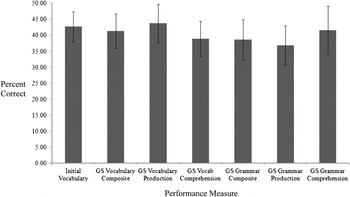
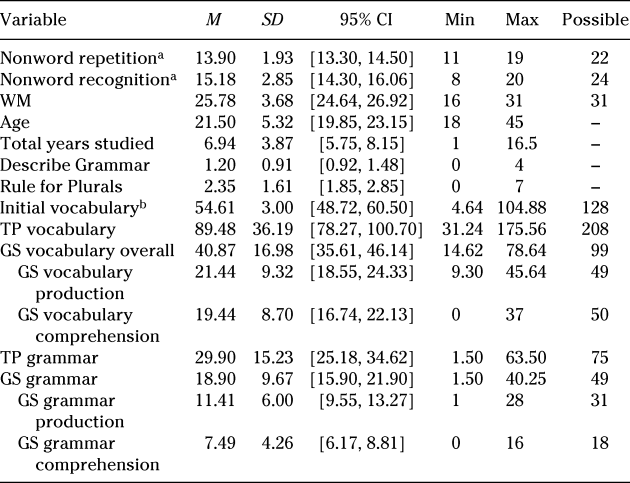
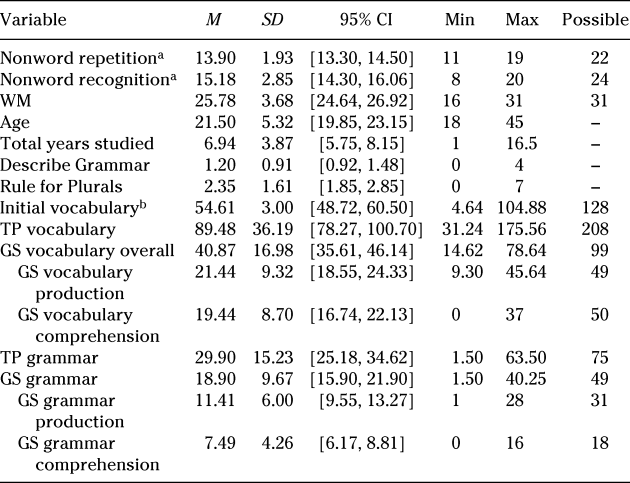
Descriptive statistics for all major variables are listed in Table 1. Figure 2 shows the mean percent correct for vocabulary and grammar scores at various time points during the experiment. Although these average percentages are not high, the extremes of the range of results (listed in Table 1) indicate that some participants were indeed able to learn the language quite accurately. Because of the nature of the production task, it is not possible to compare these results to chance. Nevertheless, from fewer than 2 hr of exposure, the amount of learning demonstrated by the learners is quite substantial.
Average percentage correct on vocabulary and grammar scores from various stages of the study. Note: Error bars are +/-2 standard error.

Descriptive data for variables of interest
Note
GS = generalization set stimuli. TP = test productions stimuli. n = 40. CI = confidence interval.
a These are both measures of PSTM.
b These vocabulary scores are taken from the initial set of sentences (Set 1) presented in the first session of the study.
Correlational Analyses
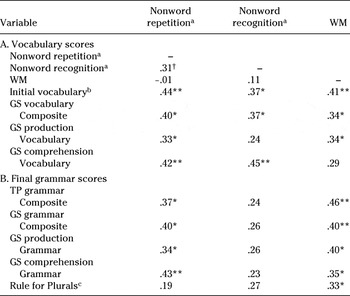
Memory Measures and Vocabulary Scores. Correlations between the memory measures and the vocabulary scores are presented in Table 2, Part A. The PSTM and WM measures do not correlate with each other; this indicates that they measured distinct cognitive abilities.
Correlations between memory measures and vocabulary and final grammar scores

Note
GS = generalization set. n = 40. TP = test productions.
a These are both measures of PSTM.
b Initial vocabulary is a measure of vocabulary knowledge taken from performance on the Set 1 sentences during the first session.
c These are participants’ scores on their ability to explicitly describe the rule for forming plurals.
† p < .10.
* p < .05.
** p < .01.
Nonword repetition correlated with GS vocabulary scores, both in production (r = .33) and comprehension (r = .42). Accuracy on the nonword-recognition task also correlated with comprehension of vocabulary in the GS (r = .45). Overall, these results indicate a significant relationship between phonological memory and vocabulary knowledge during the final phase of the study and are consistent with the previous literature (Baddeley, Papagno, & Vallar, Reference Baddeley, Papagno and Vallar1988; Masoura & Gathercole, Reference Masoura and Gathercole1999).
Working memory also correlated with production of vocabulary in the GS (r = .34). However, it did not correlate with vocabulary comprehension. The finding of a correlation between WM and vocabulary performance is somewhat surprising because it is not commonly reported, although it is not completely without precedent (e.g., Kormos & Sáfár, Reference Kormos and Sáfár2008).
Memory Measures and Grammar Scores. The main purpose of this study was to explore the relationship between PSTM and WM and grammar learning in an artificial foreign language. To do this, correlations were computed between PSTM and WM and various measures of grammatical ability (including both morphology and word order) from the end of the study. These correlations can be found in Table 2, Part B. Nonword repetition correlated with all three grammar scores, from both TP scores and the GS (rs from .34 to .43). Nonword recognition accuracy did not correlate with any measures of grammar ability. Working memory correlated with grammar abilities slightly more strongly than did PSTM, with correlations between WM and all three composite grammar scores ranging from r = .35 to r = .46. Working memory, but not PSTM, also correlated with participants’ scores for describing the rule to form plurals (r = .33). These results indicate that both PSTM and WM have strong relationships with participants’ ability to generalize and apply grammar rules in both production and comprehension.
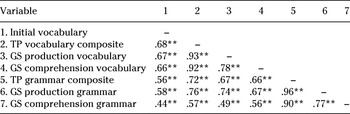
The Relationship between Vocabulary and Grammar. A strong relationship between vocabulary knowledge and grammar abilities has been found in previous literature (e.g., Bates & Goodman, Reference Bates and Goodman1997; Service & Kohonen, Reference Service and Kohonen1995). To determine whether this relationship appeared in the present study, correlations between measures of vocabulary and grammatical ability were calculated and can be found in Table 3. Overall, the relationship between vocabulary and grammar abilities was very strong, with r values ranging from .44 to .76. A series of hierarchical multiple regression analyses was therefore conducted to determine which individual factors contributed to variance in language ability in this study.
Correlations between grammar and vocabulary measures

Note
TP = test productions; GS = generalization set. n = 40.
** p < .01.
Regression Analyses
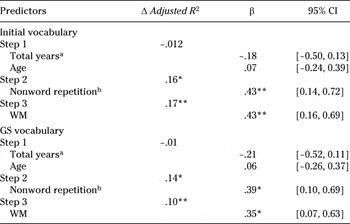
Memory and Vocabulary. Two hierarchical multiple regression analyses were performed with the initial vocabulary scores (performance on vocabulary during the training of Set 1 in the first session) and the GS composite vocabulary scores (production and comprehension combined, from the novel sentences during the final test phase) as the dependent variables, to identify whether PSTM and WM play independent roles in vocabulary learning. The memory measures were used as predictor variables. Details of these analyses can be found in Table 4. For the initial vocabulary score, age and years of language study were forced into the model first to control for their influence but did not account for any significant variance in the vocabulary scores. When nonword repetition was entered into the model, it explained a significant 16% (β = .43) of the variance in vocabulary scores. Working memory contributed a further 17% (β = .43) of the variance. For the GS composite vocabulary score, age and years of language study were again entered into the model first but accounted for no significant variance. When nonword repetition was added to the model, it predicted a significant 14% (β = .39) of the variance in vocabulary scores. Working memory accounted for an additional 10% (β = .35) of the variance. These results demonstrate that PSTM and WM have significant independent influences on vocabulary abilities at multiple beginning stages of language learning.
Regression results from generalization set and initial vocabulary scores

Note
n = 40. GS = generalization set.
a Total years of foreign language study.
b A measure of PSTM.
* p < .05.
** p < .01.
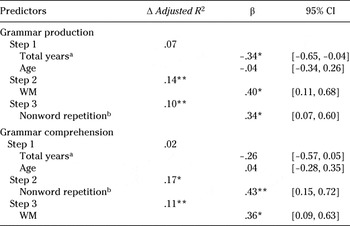
Memory and Grammar. Two hierarchical multiple regression analyses were conducted to determine the relative influences of PSTM and WM on foreign language grammar scores. The dependent variables were GS grammar production and comprehension, and the predictor variables in each analysis were the three memory measures. Detailed results of these analyses are presented in Table 5. For grammar production, age and years of language study were forced into the model first to control for their influence. Although the beta coefficient for years of language study was significant, when combined together in one step, age and years of study failed to account for a significant amount of variance in grammar-production scores. Working memory was entered in the next step and explained a significant 14% (β = .40) of the variance. Nonword repetition contributed an additional significant 10% (β = .34) of the variance in the third step. For grammar comprehension, age, and years of language study were again entered but accounted for no significant variance. Nonword repetition was entered in the next step and explained a significant 17% (β = .43) of the variance, and WM contributed an additional significant 11% (β = .36) of the variance. These analyses supported the finding that PSTM and WM each separately contribute a significant amount of variance to the ability to learn, generalize, and produce correct grammatical structures in a foreign language.
Regression results from generalization set grammar production and comprehension

Note
n = 40.
a Total years of foreign language study.
b A measure of PSTM.
* p < .05.
** p < .01.
Are Effects of PSTM and WM on Grammar Independent or Mediated by Vocabulary? Some researchers have suggested that the relationship between memory measures and grammatical competency is mediated by vocabulary (e.g., Service & Kohonen, Reference Service and Kohonen1995). There are two different ways to operationalize this question. The first involves testing whether there are unique contributions of the memory measures to final attainment grammar over and above the variance explained by final attainment vocabulary. The second concerns whether the contributions of the memory measures to final attainment grammar are entirely mediated by initial vocabulary learning, or whether there are separable memory involvements in inducing grammar above and beyond knowledge of the component lexis. This second analysis relates to the proposal of Service and Kohonen (Reference Service and Kohonen1995) that PSTM does support grammar learning, but that it does so via effects on vocabulary learning rather than directly on grammar learning per se.
To test the first hypothesis, further regression analyses were conducted with both GS grammar production and comprehension as dependent variables. The final state vocabulary score from the GS was forced in as the first predictor variable to control for its influences. This vocabulary score accounted for a significant amount of variance for both grammar variables: production Adjusted R 2 = .55, F(1, 38) = 48.43, p < .001, β = .75, 95% CI [0.54, 0.96], and comprehension Adjusted R 2 = .29, F(1, 38) = 17.16, p < .001, β = .56, 95% CI [0.29, 0.82]. None of the PSTM or WM measures explained any additional variance once vocabulary had been entered into the models. This is in contrast to the previous analysis, which did not consider vocabulary knowledge, and in which WM accounted for a significant 14% (β = .40) of the variance in production, and PSTM, a significant 10% (β = .34). Additional analyses demonstrated that age and foreign language study also did not contribute any unique variance in grammar scores.
A second regression analysis was conducted on the TP grammar scores (performance on both repeated and novel stimuli). Again, age and years of language study were entered first and did not account for any significant variance. Test productions vocabulary was entered next to control for its influences and explained a further 48% of the variance in grammar, F(3, 36) = 41.49, p < .001, β = .72, 95% CI (0.50, 0.94). In this case, however, the addition of WM explained an additional 4% of the variance in grammar scores, beyond that accounted for by vocabulary knowledge, total Adjusted R 2 = .55, F(4, 35) = 24.77, p < .001, β = .24, 95% CI (0.02, 0.46). In contrast, when vocabulary knowledge is not considered, WM accounts for 19% (β = .46) of the variance in overall TP grammar scores, and PSTM accounts for an additional significant 12% (β = .37). These analyses indicate that although the relationship between PSTM and WM and grammar abilities is shared with vocabulary knowledge, WM does still explain a significant additional amount of variance in grammatical abilities beyond that explained by vocabulary.
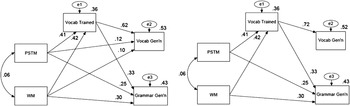
The second operationalization relates to the Service and Kohonen (Reference Service and Kohonen1995) proposal regarding PSTM and grammar learning. Service and Kohonen state that PSTM is involved in the initial learning of vocabulary, and that vocabulary is also involved in learning grammar. Therefore, PSTM is involved in learning grammar, but only indirectly so. To test this hypothesis, causal path analyses were performed using AMOS (Arbuckle, Reference Arbuckle2006) to determine whether there are independent effects of PSTM and WM on ultimate (GS) vocabulary and grammar that are not mediated by explicitly learned vocabulary at the end of the training phase. The causal path model shown in the left panel of Figure 3 investigates the direct effects of PSTM and WM on vocabulary scores at the end of the training session, the direct effects of trained vocabulary on GS vocabulary and grammar, and whether there remain any additional independent direct effects of PSTM or WM on GS vocabulary and grammar. Phonological short-term memory and WM are the exogenous variables; the others are endogenous and, as latent variables, have their associated errors, labeled as e in the figure. The proportion of nonerror variance explained is shown for each endogenous variable (e.g., the model explains 53% of the variance in GS vocabulary). The path weights for all of these effects are shown in the left panel of Figure 3. Some of these paths were significant, some not. A second model was run that specified just the significant paths and recalculated the effects, as shown in the right panel of Figure 3. This demonstrates (a) substantial independent effects of PSTM (.41) and WM (.42) on trained vocabulary, (b) a large autocorrelation between trained vocabulary and later GS vocabulary (.72), (c) an effect of trained vocabulary on GS grammar (.33)—which in turn mediates indirect effects of PSTM (.14) and WM (.14) on GS grammar (i.e., 0.41 x 0.33 and 0.42 x 0.33, respectively)—and (d) direct effects of PSTM (.25) and WM (.30) on GS grammar. These analyses suggest that there are indeed significant independent effects of PSTM and WM on L2 vocabulary learning and on L2 grammar learning, some of which are mediated by vocabulary and some of which are direct effects.
Casual path models fit in AMOS 16 relating PSTM and WM to initial trained vocabulary, trained vocabulary to generalization set vocabulary and grammar, and independent direct effects of PSTM and WM on generalization set vocabulary and grammar. Path weights are standardized regression coefficients. The left panel displays all paths. The right panel illustrates the model only including significant paths.

What Predicts the Emergence of Explicit Meta-Linguistic Knowledge?
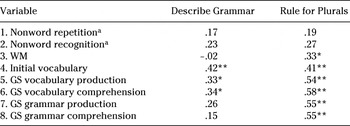
Even though the primary purpose of this study was to explore the connections of both PSTM and WM with learning from naturalistic exposure, it is also possible that PSTM and WM are involved in the emergence of explicit grammar knowledge in this type of learning condition. To explore this possibility, a number of additional analyses were performed. First, correlations were calculated between the memory measures, initial and final vocabulary scores, final grammar scores (both production and comprehension), and participants’ scores on two measures of explicit knowledge taken at the end of the study: Describe Grammar and Rule for Plurals (see the Scoring section for descriptions of these variables). Describe Grammar correlated with the vocabulary scores with rs ranging from .33 to .42 but did not correlate with any grammar scores. Rule for Plurals correlated with vocabulary scores with rs ranging from .41 to .58 and also correlated with grammar scores with rs equal to .55. Details of these correlations can be found in Table 6.
Correlations between explicit knowledge, memory, vocabulary, and grammar measures

Note
GS = generalization set. N = 40.
a These are both measures of PSTM.
* p < .05.
** p < .01.
Given the fact that a number of significant correlations were found, regression analyses were used to further investigate explicit knowledge scores. These analyses focused on the Rule for Plurals measure, as it had the strongest relationship with the other variables. The first analysis explored explicit knowledge as a potential predictor of grammar learning, with GS grammar production and comprehension as the dependent variables. Age and years of language study were entered first to control for their influence but did not account for any significant variance. Rule for Plurals was entered in the next step and accounted for an additional 23% (β = .49) of variance in grammar-production scores, Adjusted R2 = .30, F(3, 36) = 6.43, p < .001. The memory measures did not account for any additional variance in the grammar-production scores. For comprehension scores, Rule for Plurals accounted for a significant 24% (β = .52) of variance, Adjusted R2 = .26, F(3, 36) = 5.64, p < .01. This time, however, nonword repetition (a PSTM measure) accounted for an additional 11% (β = .35) of variance in final grammar-comprehension scores, Adjusted R2 = .37, F(4, 35) = 6.76, p < .001.
Given the clear relationship between explicit grammar knowledge and final vocabulary and grammar scores, the final analysis focused on accounting for variance in the explicit knowledge scores themselves. Rule for Plurals was used as the dependent variable, and the predictor variables were the memory measures and GS vocabulary and grammar scores. Age and total years of study were entered first but did not account for any significant variance. In the next step, GS vocabulary was entered and accounted for a significant additional 31% (β = .57) of the variance, Adjusted R2 = .32, F(3, 36) = 7.06, p < .001. The memory measures and final grammar scores did not contribute any additional variance.
Even though the results of these analyses are interesting, they must be interpreted with extreme caution for the following reasons: (a) although they were analyzed directionally in these two regressions, the patterns are no more than correlations because growth in all of these variables was taking place simultaneously over the second session of the experiment and (b) all of the explicit knowledge measures were taken at the end of the study and were administered using open-ended questions such as “Tell me a little bit about the grammar of the language you just learned,” on which overall scores were extremely low (an average of only 1.2 points, and a mode of 1 point for this question). Because of the limitations of these data and how they were collected and measured, these results are no more than exploratory. However, this is clearly an area in which future research may prove fruitful.
DISCUSSION
The goal of the present study was to explore the relationship between PSTM and WM and the ability to learn grammatical patterns in a foreign language. Participants completed three memory tests: nonword repetition, nonword recognition, and listening span. They learned singular vocabulary words and sentences in a foreign language and were then exposed to plural forms in a sentence context with no instruction on these novel forms. They were then tested on their production and comprehension of 50 sentences that included novel plural expressions. Measures of their language abilities at the end of the study were used as the dependent variables.
Memory Measures and Vocabulary
As predicted, positive correlations between PSTM and final vocabulary were found. The magnitude of these correlations, generally .33–.45, is moderately strong and is consistent with previous findings (e.g., Masoura & Gathercole, Reference Masoura and Gathercole1999). Both nonword repetition and nonword recognition correlated with vocabulary production and comprehension. Working memory also correlated with vocabulary production, although not comprehension. This result was less expected because WM is usually associated with variables such as reading comprehension and fluency, rather than vocabulary (Daneman & Carpenter, Reference Daneman and Carpenter1980; Harrington & Sawyer, Reference Harrington and Sawyer1992; Sunderman & Kroll, Reference Sunderman and Kroll2009; Turner & Engle, Reference Turner and Engle1989; but see Kormos & Sáfár, Reference Kormos and Sáfár2008), albeit the strength of the correlations between WM and vocabulary were weaker than between PSTM and vocabulary.
The regression analyses confirmed that PSTM and WM make independent significant contributions to vocabulary learning. After the influences of age and foreign language study were accounted for, PSTM accounted for 14% (β = .39) of the variance in final vocabulary scores, and WM accounted for an additional 10% (β = .35). It seems, therefore, that PSTM and WM are two related but separable memory constructs that make independent contributions to vocabulary. Although the actual mechanisms underlying the influence of PSTM and WM are still not fully understood, previous research on these constructs allows for a hypothesis to be put forth. Phonological short-term memory likely supports the consolidation of stable phonological representations in long-term memory (Ellis, Reference Ellis1996; Jones, Gobet, & Pine, Reference Jones, Gobet and Pine2007, Reference Jones, Gobet and Pine2008). As an attentional control system, WM may support the maintenance of relevant information and the regulation of processing during complex operations, with any spare capacity allowing for the noticing of novel task-relevant features and their integration into the system (Mackey et al., Reference Mackey, Philp, Egi, Fujii, Tatsumi and Robinson2002).
Memory Measures and Grammar
Previous research has reported correlations between PSTM and L2 grammatical ability and fluency with r values ranging from .30–.80 (Adams & Gathercole, Reference Adams and Gathercole1996, Reference Adams and Gathercole2000; Daneman & Case, Reference Daneman and Case1981; French, Reference French2006; Service, Reference Service1992) and between WM and L2 grammatical abilities and fluency with r values ranging from .30–.65 (Fortkamp, Reference Fortkamp1999; Harrington & Sawyer, Reference Harrington and Sawyer1992; Kormos & Sáfár, Reference Kormos and Sáfár2008). The hypothesis of a relationship between the memory measures and grammar learning was also supported in the present study. A number of significant correlations were found between measures of PSTM and final grammar scores, most with strengths of r = .33–.46. This replicates previous findings of a relationship between PSTM and grammar abilities (e.g., Kormos & Sáfár, Reference Kormos and Sáfár2008; O’Brien et al., Reference O’Brien, Segalowitz, Collentine and Freed2006, Reference O’Brien, Segalowitz, Freed and Collentine2007; Williams & Lovatt, Reference Williams and Lovatt2003). The strengths of the relationships between PSTM and grammar and between PSTM and vocabulary were remarkably similar, underscoring the importance of PSTM for both language domains.
Working memory also correlated with final grammar scores, and the correlations between WM and grammar production were consistently stronger than between PSTM and grammar. This finding was not unexpected. Working memory, by definition, includes both storage and processing of information (Baddeley, Reference Baddeley1998, Reference Baddeley2003). The storage component of WM explains its relationship with vocabulary learning—that is, remembering individual items. Grammar learning, however, depends on much more than just memorizing items. It is also the process of abstracting patterns from across language sequences presented as input (Ellis, Reference Ellis1996; Speidel, Reference Speidel1993). Vocabulary learning involves the sound patterns of words and their arbitrary mapping to meaning; grammatical patterns involve abstracting the relations between vocabulary items and identifying their functional significance. Grammatical patterns are more global and apply to the utterance as a whole, not just the individual word. These more complicated patterns therefore demand more processing capacities, the holding of a greater amount of information over time, and the identification, selection, and correlation of relevant features both in the input and in long-term memory. These are the aspects provided by WM over PSTM.
Using grammatical knowledge to produce novel utterances also requires greater processing. Once learners have understood the input and parsed the utterance into individual units, they must be able to process those units and recombine them in novel ways to generalize grammatical patterns. Although this does require buffer storage capacity for the individual units in formulation, it also depends heavily on the ability to process, manipulate, and recombine these units. Because WM measures both, it should serve as a good predictor of such abilities, more so than PSTM.
The manner in which participants were introduced to the grammatical structures and the way in which they got feedback on their productions may also account for some of the relationship between WM and grammar scores. Mackey (Reference Mackey2006) has suggested that WM is particularly involved in learners’ analysis of the input, especially that which gives feedback on error. Instead of being taught the grammatical morphemes and noun-adjective word order explicitly, as typically occurs in a foreign-language classroom setting, these participants were simply exposed to the structures in a sentence context. This more “naturalistic” way of learning requires much more initiative and effort on the learners’ part and may also require a different type of language processing. Participants also did not get explicit feedback on their productions; instead, they simply heard the correct utterance as feedback. To learn from this information, they had to maintain their own utterance in memory while actively comparing it to the feedback they heard. Such operations, involving both storage and processing, must be heavily dependent on WM capacities.
Vocabulary and Grammar
As hypothesized, a strong relationship was found between vocabulary and grammar scores, with intercorrelations on the order of .44 to .76. Such strong correlations might be surprising if considered in the traditional L1 framework of a words-and-rules system, which posits that grammar and vocabulary are learned separately and rely on different processing mechanisms (Brown, Reference Brown1973; Chomsky, Reference Chomsky1957, Reference Chomsky1965; Katz & Postal, Reference Katz and Postal1964; Pinker, Reference Pinker1991). However, learners clearly cannot understand or induce grammatical patterns unless they can recognize the lexical components of utterances, and, reciprocally, there are clear contributions of grammatical understanding on word learning (e.g., syntactic bootstrapping; Gleitman, Reference Gleitman1990). Bates and Goodman (Reference Bates and Goodman1997) and Marchman and Bates (Reference Marchman and Bates1994) argue that in L1 acquisition, vocabulary and grammar are processed and learned by one unitary system, and that grammar necessarily depends on the vocabulary it organizes. Bates and colleagues call this the critical mass hypothesis because it assumes vocabulary must reach a minimum critical mass size before grammar induction can occur.
This debate has taken place largely in the L1 literature, with few extensions made to L2 learning. Because of this paucity of discussion and relevant data, it is difficult to draw firm conclusions. Some dual-route models of L2 learning (Paradis, Reference Paradis and Ellis1994; Ullman, Reference Ullman2001, Reference Ullman and Sanz2005) nevertheless do allow for the possibility that vocabulary and grammar learning depend on the same mechanisms at the earliest stages of L2 learning. Above and beyond the differences between L1 and L2, however, empirical research demonstrates the intimate interdependencies of lexis and grammar throughout language usage, both at the beginning and at later stages of learning. Corpus linguistics reveals many things about language: that much of communication makes use of fixed expressions memorized as formulaic chunks; that language is rich in collocational and colligational restrictions; that the phrase is the basic level of language representation at which form and meaning meet with greatest reliability; that formulaic sequences play a central role in language acquisition; and that fluent language users have a vast repertoire of memorized language sequences (Pawley & Syder, Reference Pawley, Syder, Richards and Schmidt1983; Sinclair, Reference Sinclair1991, Reference Sinclair2004). Grammar and lexis are not entirely separable (Ellis, Reference Ellis, Meunier and Granger2008; Römer, Reference Römer2009). The recognition of their symbiosis lies at the core of modern developments in construction grammar (see Goldberg, Reference Goldberg1995), cognitive linguistic (e.g., Ellis & Cadierno, Reference Ellis and Cadierno2009; Robinson & Ellis, Reference Robinson and Ellis2008), and input-driven descriptions of language structure, processing, and acquisition (Collins & Ellis, Reference Collins and Ellis2009). Although the possibility of a L2 words-and-rules system is not ruled out by the results presented here, the strong interdependence of vocabulary and grammar, especially at the beginning stages of L2 learning, lead us more naturally to constructionist interpretations of the phenomena investigated.
Vocabulary as a Mediating Factor
Given the strong intercorrelations between grammar and lexis, the possibility of identifying any distinctions in their reliance on PSTM and WM was further investigated. Regression analyses were performed on the final grammar scores to determine whether their relationship with PSTM and WM was mediated by final vocabulary ability. The results showed that once final GS vocabulary scores were accounted for, neither PSTM nor WM contributed unique variance to GS grammar. Given the interactions of grammar and vocabulary in language structure and language processing described previously, it is not surprising that final GS vocabulary and grammar are as interrelated as this. Nevertheless, WM did contribute a unique 4% of variance to the final grammar scores overall (TP scores), which suggests that grammar induction did make more use of WM.
A clearer test of the mediation of vocabulary in the relationships between memory and grammar learning, as suggested by Service and Kohonen (Reference Service and Kohonen1995), involved causal path analysis of vocabulary from the end of the training phase as a mediator between PSTM and WM and final GS vocabulary and grammar. This demonstrated substantial independent effects of PSTM (0.41) and WM (0.42) on trained vocabulary, an effect of trained vocabulary on GS grammar (0.33) that allowed for mediated indirect effects of PSTM (0.14) and WM (0.14) on GS grammar, and direct effects of PSTM (0.25) and WM (0.30) on GS grammar. Thus, there are significant independent effects of PSTM and WM on L2 vocabulary learning and on L2 grammar learning—some of which are mediated by vocabulary and some of which are direct effects. These memory systems are indeed involved in vocabulary learning, but they are also involved in grammar induction from language usage over and above that.
Suggestions for Future Research
As is usually the case, these results warrant replication in other populations and with other languages and language structures. Replicating the study with more complex artificial language systems, such as Brocanto (Friederici, Steinhauer, & Pfeifer, Reference Friederici, Steinhauer and Pfeifer2002; Opitz & Friederici, Reference Opitz and Friederici2004), as well as real languages would allow for converging evidence from various language systems. Although the current research has important implications for understanding language learning, there are limitations to how much the results from laboratory artificial language learning can be generalized to real-life language-learning situations. Future research should also examine the longitudinal development of vocabulary and grammar abilities, rather than just their final attainment and knowledge at one prior stage. Although a longitudinal design was used here, the current study lasted just 2 hr, thus limiting the number of time points to chart development and the conclusions that could be drawn. The value of constructionist accounts of the codevelopment of grammar and lexis would also be informed by assessing phraseological and formulaic knowledge in development, and the degree to which these relied on PSTM and WM. Varying the way in which the language is taught and in which feedback is given is also important to determining whether the relationships found in this study apply across learning conditions. Including grammaticality judgments may also be important to determining whether learners base what is possible on occurrence versus nonoccurrence, or on more abstract knowledge.
One additional question for further research concerns the degree to which the PSTM–language learning correlations observed here are generalizable to other measures of these same skills but with different content. Nonword repetition tests are affected by lexical knowledge—thus Thorn and Gathercole (Reference Thorn and Gathercole1999, Reference Thorn and Gathercole2001) showed that English-French bilinguals are equally good at repeating nonwords conforming to English and French phonotactics, but monolinguals are worse for nonwords conforming to the phonotactics of an unknown language. The PSTM items here and the words in the artificial L2 both conformed to L1-English phonemes and phoneme combinations, and some of the same nonwords were used as stimuli in both nonword-repetition tasks and the artificial language. Phonological-short-term-memory tasks are better predictors of foreign language vocabulary learning when they are more word-like in the foreign language than the native language. One might expect, therefore, that experiments that use different L1 and foreign language phonotactics, as well as PSTM content that is foreign-like, should maximize any relations between PSTM and language learning. This interesting empirical question awaits further research.
Finally, a number of exploratory analyses that involved the explicit knowledge scores were presented. These analyses suggested strong relationships between explicit knowledge and final vocabulary and grammar scores. However, it is important to emphasize that these results must be interpreted cautiously. The scores were compiled from only two open-ended questions, producing low outcome scores. Nevertheless, the analyses suggest that the relations between memory measures, vocabulary, and grammar abilities warrant further investigation in future studies that involve both explicit and implicit learning situations.
CONCLUSIONS
Constructionist accounts naturally allow for a strong relationship between grammar and vocabulary, while acknowledging their differential reliance on PSTM and WM. Vocabulary learning involves the sequential sound patterns of words and their arbitrary mapping to meaning; grammar learning involves the sequential patterns of words and morphemes. Both involve the memorization of phonological sequences in PSTM, yet grammatical patterns are more global. They apply to the utterance as a whole, beyond the individual word, and more than that, they involve the abstraction of patterns over sets of morphemes. These more complicated patterns may demand more processing capacities, the holding of a greater amount of information over time, and the identification, selection, and correlation of relevant features both in the input and in long-term memory. Thus they are likely to be somewhat more reliant on WM. Nevertheless, vocabulary and grammar are highly interrelated in use and learning, and both make substantial demands on PSTM and WM.
APPENDIX A EXAMPLE NONWORD REPETITION STIMULI

These examples were taken from Gathercole et al. (Reference Gathercole, Pickering, Hall and Peaker2001).
EXAMPLE NONWORD RECOGNITION STIMULI

These examples were taken from Gathercole et al. (Reference Gathercole, Pickering, Hall and Peaker2001) and also used in O’Brien et al. (Reference O’Brien, Segalowitz, Collentine and Freed2006).
EXAMPLE LISTENING SPAN STIMULI

These examples were taken from Harrington & Sawyer (Reference Harrington and Sawyer1992).
Grammaticality: G = grammatical; U = ungrammatical
APPENDIX B THE ARTIFICIAL LANGUAGE
Nouns

Verbs

Adjectives

Prepositions

APPENDIX C
The following are example artificial foreign language sentence stimuli (a full list may be obtained on request from the first author).
SET 1

SET 2

GENERALIZATION SET