1. Introduction
Knowledge of the timing of metamorphic processes in combination with pressure and temperature estimates from local mineral equilibria preserved in metamorphic rocks is indispensable for the reconstruction and quantification of geological processes along pressure–temperature–time paths and the understanding of tectonics in three dimensions. Few studies of this type have been conducted in areas with very low- to low-grade (subgreenschist to greenschist facies) metamorphic overprint compared to higher grade regions, because the metamorphic overprint is less obvious compared to primary features. Furthermore, studies of very low- and low-grade metamorphism are generally hampered by small grain size, strong chemical variation and the prevailing idea of ‘disequilibrium’. Here we present the results of a geochronological study that follows up on a detailed petrological investigation of metamorphic processes at very low- to low-grade conditions in the Avalonian Mira terrane of SE Cape Breton Island (Willner et al. Reference Willner, Massonne, Barr and White2013b ).
Isotopic systems available for dating metamorphism at very low- and low-grade conditions are relatively limited, and the systems date very different processes. For dating white mica, the 40Ar/39Ar and Rb–Sr systems are the most suitable. Peak metamorphic temperatures in the study area of 280±30°C in the Mira terrane (Willner et al. Reference Willner, Massonne, Barr and White2013b ) are well below the frequently cited range of white mica Ar closure temperatures of c. 350–420°C (McDougall & Harrison, Reference McDougall and Harrison1999), although it was argued by Villa (Reference Villa1998, Reference Villa2006) that strain and fluid availability are more important in isotope redistribution for the 40Ar/39Ar system and hence that many estimates of its closure temperature are too low. This point was also made by Wijbrans & McDougall (Reference Wijbrans and McDougall1986), who suggested that closure by volume diffusion will only occur in the absence of other faster processes such as strain-induced recrystallization. Crystallization of white mica is dated with the 40Ar/39Ar system at very low and low metamorphic grades, but two processes can also lead to recystallization and resetting of ages at low metamorphic temperatures: deformation (e.g. Müller et al. Reference Müller, Dallmeyer, Neubauer and Thöni1999), fluid access inducing mineral reactions or dissolution-reprecipitation processes (e.g. Willner et al. Reference Willner, Sepúlveda, Hervé, Massonne and Sudo2009, Reference Willner, Massonne, Ring, Sudo and Thomson2012), or a combination of both. These processes can induce age heterogeneity at thin-section and outcrop scale and, if recrystallization or dissolution-reprecipitation of mica is incomplete, also mixing of ages. To detect such potential heterogeneities in the study area, we applied 40Ar/39Ar spot age dating using UV laser ablation techniques (Kelley, Arnaud & Turner, Reference Kelley, Arnaud and Turner1994).
Rb–Sr internal mineral isochron data are particularly suitable to directly date mineral reactions and hence metamorphic equilibrium assemblages, but also ductile deformation in white mica-bearing rocks. Deformation-induced recrystallization of white mica and associated phases will generally lead to complete Sr-isotopic re-equilibration and resetting of ages (Inger & Cliff, Reference Inger and Cliff1994; Müller et al. Reference Müller, Dallmeyer, Neubauer and Thöni1999). Such resetting of ages dates the last recrystallization-inducing process, that is, the waning stages of deformation (Freeman et al. Reference Freeman, Butler, Cliff and Rex1998), providing that no later thermal-diffusive or retrogressive overprint occurred. Diffusional resetting of the Rb–Sr system in white mica is activated only at amphibolite-facies temperatures of >550°C (cf. Villa, Reference Villa1998). In the set of samples used in this study (the properties of which are listed in Table 1), peak metamorphic temperatures were generally lower so that post-crystallization Rb and Sr diffusion processes can likely be ruled out.
Characteristics of analysed samples (sf – strongly foliated; mf – moderately foliated; wf – weakly foliated; nf – non-foliated)

Fission tracks in zircon shorten or anneal with increased temperature and duration of heating. For pristine zircon grains, annealing over geological time begins at 250±20°C with total resetting occurring above 310±20°C (Tagami et al. Reference Tagami, Galbraith, Yamada, Laslett, Van den Haute and De Corte1998), although these temperatures are lower in zircon with high accumulated radiation damage (Rahn et al. Reference Rahn, Brandon, Batt and Garver2004). The typical closure temperature of 280±30°C for fission tracks in zircon at commonly realized moderate-to-fast cooling rates correlates well with the brittle/ductile transition (Brix et al. Reference Brix, Stöckhert, Seidel, Theye, Thomson and Küster2002), and is somewhat lower than peak metamorphic temperatures estimated in the study area (Willner et al. Reference Willner, Massonne, Barr and White2013).
In this paper we apply all three of these dating methods to very low- to low-grade metavolcanic and metasedimentary rocks of the Mira terrane (Willner et al. Reference Willner, Massonne, Barr and White2013b ). Our purpose is to determine where complete isotopic homogenization occurred and where it did not, in order to understand which processes are being dated and which control microchemical and isotopic homogenization. We also aim to derive a history of these processes, contributing to the refinement of current tectonic models.
2. Geological setting and previously published age data
The very low- to low-grade metamorphic rocks of the Mira terrane in SE Cape Breton Island (Barr & Raeside, Reference Barr and Raeside1989) are part of the West Avalonian microplate (Fig. 1). As in other parts of West Avalonia, the Mira terrane is characterized by late Neoproterozoic metavolcanic, metasedimentary and plutonic rocks unconformably overlain by Cambrian sedimentary strata. The terrane consists of five juxtaposed volcanic-sedimentary-plutonic belts with differences in their late Neoproterozoic – early Cambrian history: (1) Stirling; (2) East Bay Hills; (3) Coxheath Hills; (4) Sporting Mountain; and (5) Coastal. These belts are interpreted as originally separate parts of an extended magmatic arc system (Barr, Reference Barr1993; Barr, White & Macdonald, Reference Barr, White and Macdonald1996).
Simplified geological map of southeastern Cape Breton Island after Barr et al. (Reference Barr, White and Macdonald1996), Giles et al. (Reference Giles, Naylor, Teniere, White, Barr, DeMont and Force2010) and McMullin et al. (Reference McMullin, Barr and Raeside2010). The inset map shows the location of the Mira terrane within Avalonia and the terrane assemblage of the northern Appalachian orogen after Hibbard et al. (Reference Hibbard, van Staal, Rankin and Williams2006). Sample locations and derived ages are indicated.

The Stirling belt comprises metasedimentary and metavolcanic rocks (Stirling Group) with protolith ages (U–Pb zircon) of 681–620 Ma (Bevier et al. Reference Bevier, Barr, White and Macdonald1993; Willner et al. Reference Willner, Gerdes, Massonne, Barr and White2013a ) intruded by granodiorite at 620+3/–2 Ma (U–Pb zircon; Barr et al. Reference Barr, Dunning, Raeside and Jamieson1990). The protoliths of the Stirling Group were predominantly andesitic to basaltic lapilli tuff and epiclastic turbiditic deposits (litharenite, siltstone) with subordinate basaltic flows and breccias, rhyolitic lapilli tuff and rhyolite porphyry, intruded by comagmatic gabbroic dykes and sills and including a massive sulphide deposit (Macdonald & Barr, Reference Macdonald and Barr1993a ; Barr, White & Macdonald, Reference Barr, White and Macdonald1996). The Stirling Group likely formed within a calc-alkaline volcanic arc but under marine conditions (Macdonald & Barr, Reference Macdonald and Barr1993a ; Barr, White & Macdonald, Reference Barr, White and Macdonald1996).
The East Bay Hills, Coxheath Hills and Sporting Mountain belts consist mainly of subaerial metavolcanic and metavolcaniclastic rocks of basaltic, andesitic and rhyolitic composition (East Bay Hills, Coxheath and Pringle Mountain groups) with protolith ages of 623–575 Ma (U–Pb zircon; Bevier et al. Reference Bevier, Barr, White and Macdonald1993; Barr, White & Macdonald, Reference Barr, White and Macdonald1996; White, Barr & Ketchum, Reference White, Barr and Ketchum2003; Willner et al. Reference Willner, Gerdes, Massonne, Barr and White2013a ) intruded by c. 620 Ma dioritic to granitic plutons (Barr et al. Reference Barr, Dunning, Raeside and Jamieson1990; Bevier et al. Reference Bevier, Barr, White and Macdonald1993). The three belts are considered to represent a single continental margin volcanic-arc complex (Barr, White & Macdonald, Reference Barr, White and Macdonald1996).
In the Coastal belt, two major metavolcanic-metasedimentary units are distinguished (Barr, White & Macdonald, Reference Barr, White and Macdonald1996). The Fourchu Group dominantly consists of dacitic lapilli and ash tuff as well as subordinate lava flows and basaltic, andesitic and rhyolitic tuff. A dacitic tuff and comagmatic granitic pluton yielded igneous crystallization ages (U–Pb, zircon) of 574±1 Ma and 574±3 Ma (Bevier et al. Reference Bevier, Barr, White and Macdonald1993). In contrast, the Main-à-Dieu Group mainly comprises bimodal tuffaceous sedimentary and epiclastic rocks with subordinate basaltic and rhyolitic flows and tuff. A maximum age of c. 563 Ma was reported by Bevier et al. (Reference Bevier, Barr, White and Macdonald1993) based on U–Pb (zircon) dating of a rhyolite flow, and the minimum age is constrained by overlying lower Cambrian sedimentary rocks (Hutchinson, Reference Hutchinson1952; Landing, Reference Landing1991; Barr, White & Macdonald, Reference Barr, White and Macdonald1996). The Fourchu Group is interpreted to have formed by calc-alkaline volcanism in a continental margin arc and the Main-à-Dieu Group during related intra-arc extension.
Barr, White & Macdonald (Reference Barr, White and Macdonald1996) and Willner et al. (Reference Willner, Gerdes, Massonne, Barr and White2013a ) proposed that the Stirling, East Bay Hills, Coxheath Hills, Sporting Mountain and Coastal belts represent parts of Neoproterozoic continental magmatic arcs which were active during the period 680–550 Ma at the margin of the likely source continent Amazonia, from which they separated to form part of the Avalonia microcontinent.
Upper Ediacaran – lower Cambrian clastic sedimentary rocks overlie the older rocks, slightly disconformably in the case of the older units but perhaps conformably in the case of the Main-à-Dieu Group (Barr, White & Macdonald, Reference Barr, White and Macdonald1996). The Neoproterozoic–Cambrian sedimentary rocks do not form a single stratigraphic succession and have been assigned different (informal) formation names in different areas (Barr, White & Macdonald, Reference Barr, White and Macdonald1996). The Kelvin Glen Group (arkose, conglomerate and siltstone) occurs in the Stirling belt, whereas the Bengal Road formation (conglomerate, quartzite and siltstone) and overlying Sgadan Lake formation (quartz sandstone and conglomerate) are situated mainly in the Coastal belt and in a small area at the NE tip of the East Bay Hills belt. In all three areas, these older units are overlain by a succession of fossiliferous finer grained clastic and minor carbonate rocks of early Cambrian – Early Ordovician age (Hutchinson, Reference Hutchinson1952; Landing, Reference Landing1991; Palacios et al. Reference Palacios, Jensen, Barr and White2009). Sandstone of the Bengal Road formation contains detrital white mica with 40Ar/39Ar ages ranging from 634 to 469 Ma, but dominantly >550 Ma (Reynolds, Barr & White, Reference Reynolds, Barr and White2009).
Potter, Longstaffe & Barr (Reference Potter, Longstaffe and Barr2008) and Potter et al. (Reference Potter, Longstaffe, Barr, Thompson and White2008) detected a pervasive low-δ18O anomaly in Neoproterozoic igneous rocks of the Mira terrane and also in other parts of Avalonia. They interpreted this depletion event as due to an influx of large volumes of post-magmatic meteoric fluids during late Neoproterozoic – early Cambrian trans-tension causing pervasive hydrothermal alteration. Barr, White & Macdonald (Reference Barr, White and Macdonald1996) and Willner et al. (Reference Willner, Gerdes, Massonne, Barr and White2013a ) proposed that the Stirling, East Bay Hills, Coxheath Hills, Sporting Mountain and Coastal belts were mostly juxtaposed by brittle strike-slip processes during middle Cambrian time. Rift basins developed, in which sediments were deposited on the structurally amalgamated belts. The pervasive hydrothermal alteration might also have continued during these processes.
Both the Neoproterozoic volcanic-sedimentary-plutonic belts and the upper Ediacaran – lower Ordovician sedimentary cover rocks were overprinted by very low- to low-grade regional metamorphism and mainly ductile deformation. McMullin, Barr & Raeside (Reference McMullin, Barr and Raeside2010) deduced regional metamorphic conditions transitional between the prehnite-actinolite facies and greenschist facies in the Neoproterozoic volcanic and sedimentary units. In the vicinity of Devonian plutons, amphibolite facies was attained as a result of contact metamorphism (Macdonald & Barr, Reference Macdonald, Barr and Sangster1993b ; McMullin, Barr & Raeside, Reference McMullin, Barr and Raeside2010). Willner et al. (Reference Willner, Massonne, Barr and White2013b ) estimated metamorphic conditions in the range of 3.5±0.4 kbar and 280±30°C in all of the volcanic-sedimentary belts and, in contrast to McMullin, Barr & Raeside (Reference McMullin, Barr and Raeside2010), ascribed regional metamorphism to the collisional assembly of West Avalonia during Devonian time rather than solely to non-orogenic burial.
3. Structural geology and age constraints of deformation and accretion
The Stirling Group is characterized by pronounced NE–SW-trending upright to northwesterly overturned folds of variable scale (centimetre- to kilometre-scale; D1), generally with a moderate plunge to the NE (Macdonald & Barr, Reference Macdonald and Barr1993a ; Barr, White & Macdonald, Reference Barr, White and Macdonald1996). These folds vary in intensity and scale, likely due to competency contrasts between the strongly variable lithologies and the heterogeneous nature of the deformation. Widely spaced axial planar cleavage (S1) defined by white mica and chlorite is associated with the F1 folding in the Stirling Group; deformation is polyphase and possibly of different ages (Macdonald & Barr, Reference Macdonald and Barr1993a ). In the SE part of the belt in particular, more strongly foliated shear zones (D2) up to a few metres in width are locally superimposed on the S1 foliation (Macdonald & Barr, Reference Macdonald and Barr1993 a; Barr, White & Macdonald, Reference Barr, White and Macdonald1996).
In contrast to the Stirling Group, the East Bay Hills, Pringle Mountain, Coxheath and Fourchu groups generally lack evidence of F1 folds and have been overprinted and dissected by prominent steep NE-trending shear zones (D2). These zones have a thickness of hundreds of metres and are characterized by a well-developed continuous steep NW- or SE-dipping foliation (S2). They are also characterized by conspicuous strain gradients at the metre-scale from undeformed to mylonitic and are locally associated with steeply plunging chevron folds and kink bands, which fold S2. Shear-sense indicators suggest that the shear zones mainly accommodated sinistral transcurrent movements. However, some of the major D2 shear zones are markedly curviplanar such that they form restraining bends (Barr, White & Macdonald, Reference Barr, White and Macdonald1996), suggesting that they may have these fault zones may have accommodated a more complex movement history than solely strike-slip. The latter is consistent with the metamorphic evidence for significant tectonic burial (Willner et al. Reference Willner, Massonne, Barr and White2013b ).
In contrast to the Fourchu and older groups described above, the Main-à-Dieu Group and overlying Cambrian cover rocks show open folds broadly concordant with the folds in the Stirling Group. Slaty cleavage is developed only locally in fine-grained rocks, although recrystallization of quartz in the matrix of the clastic fabric in some coarser grained samples suggests a similar metamorphic overprint as in the underlying volcanic and sedimentary rocks (Willner et al. Reference Willner, Massonne, Barr and White2013b ). Hence, both folding and regional low- to very low-grade metamorphism are considered to have occurred during post-Cambrian time. High-level Devonian plutons intruded locally at 378+5/–1 Ma (Lower St Esprit Pluton, U–Pb zircon; Bevier et al. Reference Bevier, Barr, White and Macdonald1993) and 371±1.7 Ma (Gillis Mountain Pluton, U–Pb zircon; unpublished data), although a wider range of 384–342 Ma is indicated by older Rb–Sr and K–Ar dates (Barr & Macdonald, Reference Barr and Macdonald1992; Macdonald & Barr, Reference Macdonald, Barr and Sangster1993b ). Based on their petrological similarities, all of these plutons are likely to have been comagmatic at c. 378–370 Ma (Barr & Macdonald, Reference Barr and Macdonald1992). The plutons have I-type to A-type chemical affinities and are associated with porphyry and skarn-type mineralization; they produced cordierite-bearing contact metamorphic aureoles, which overprinted the regional very low- to low-grade metamorphism and associated structures. They are generally unfoliated, but locally display D2 cataclasis and/or mylonitization (Barr & Macdonald, Reference Barr and Macdonald1992). D1 therefore predated, and D2 partly overlapped with, intrusion of the Late Devonian plutons, assuming that all of the shear zones ascribed to D2 represent a single, likely protracted, event.
The minimum age of juxtaposition of the Avalonian Mira terrane and the now-adjacent Bras d’Or terrane, considered to be part of Ganderia (Raeside & Barr, Reference Raeside and Barr1990; Hibbard et al. Reference Hibbard, van Staal, Rankin and Williams2006), is constrained by the presence of clasts derived from both Mira and Bras d’Or terranes in conglomerate of the Middle Devonian McAdams Lake Formation NW of the Coxheath Hills belt (White & Barr, Reference White and Barr1998). Movement on faults continued at least locally well into Carboniferous time (Gibling et al. Reference Gibling, Culshaw, Rygel and Pascucci2008). Clastic sedimentary rocks and lower Carboniferous (Tournaisian–Visean) limestone of the Horton and Windsor groups unconformably overlie the older rocks of the Mira terrane (Martel & Gibling, Reference Martel and Gibling1995; Boehner, Adams & Giles, Reference Boehner, Adams and Giles2002).
4. Analytical methods
4.a. 40Ar/39Ar geochronology
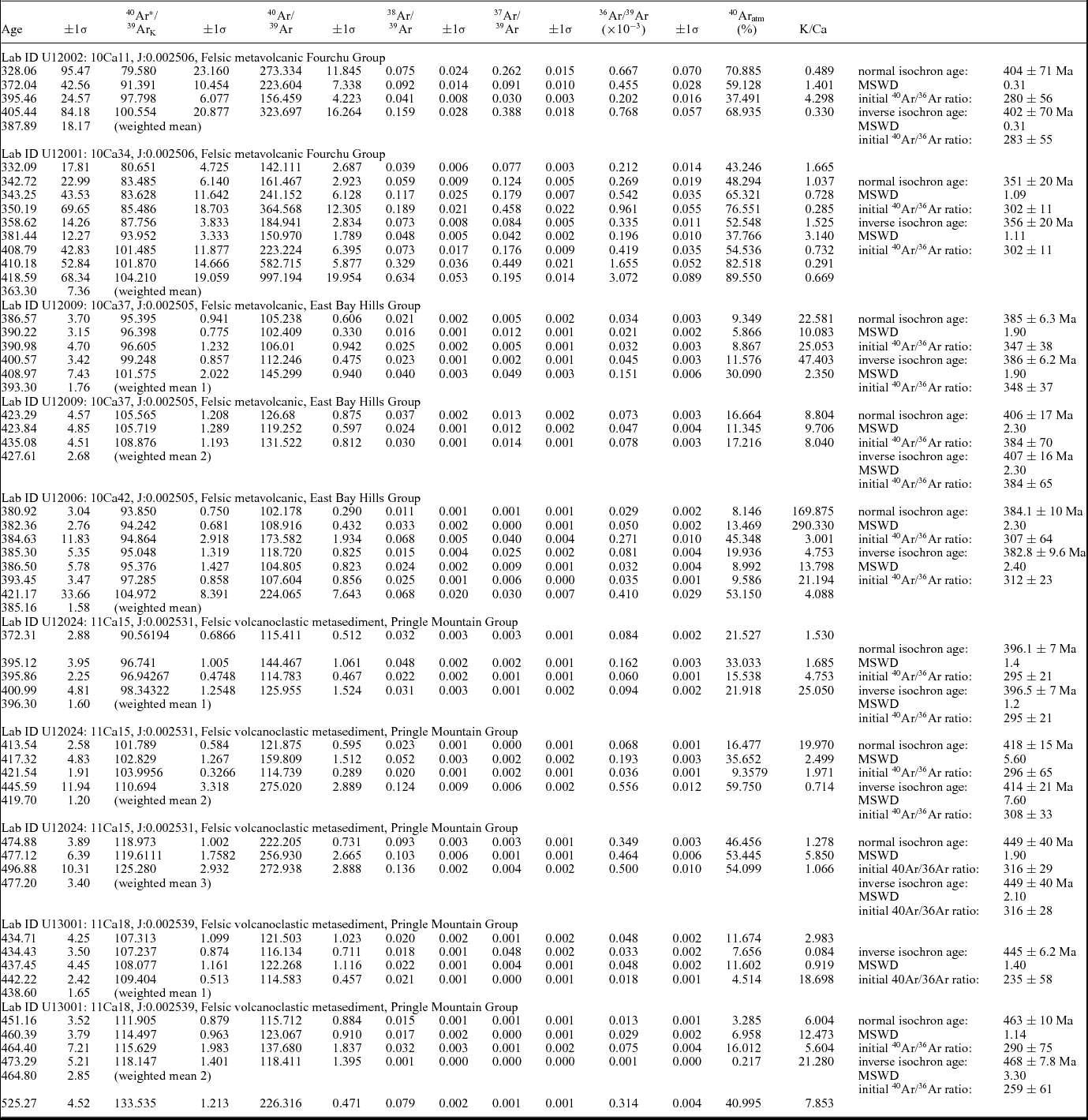
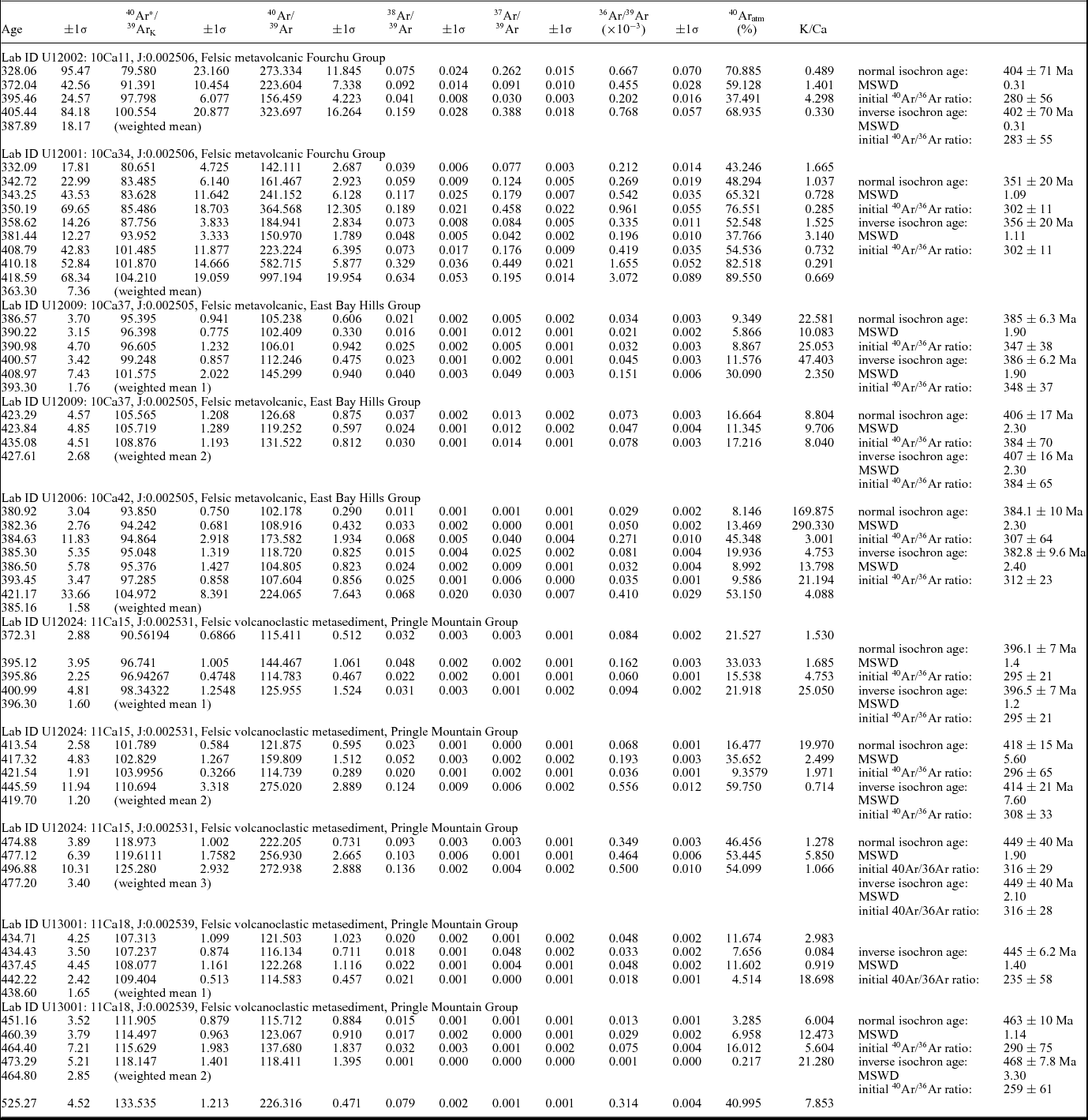
40Ar/39Ar dating was performed in the 40Ar/39Ar geochronology laboratory at Universität Potsdam/Germany after neutron activation on six polished rock sections (8 mm diameter) at the nuclear reactor of NRG (Nuclear Research and Consultancy Group) Petten, The Netherlands. The polished thick sections were wrapped by commercial Al foils and set into a 99.999% pure Al holder of 23 mm diameter and 65 mm height in total. The package was Cd-shielded and irradiated with fast neutrons with a flux of 1×10¹³ neutrons per squared centimetre per second for 10 hours. The Fish Canyon Tuff sanidine (age 27.5 Ma; Uto et al. Reference Uto, Ishizuka, Matsumoto, Kamioka and Togashi1997; Ishizuka, Yuasa & Uto, Reference Ishizuka, Yuasa and Uto2002) was used as a flux monitor during irradiation to obtain the J values which reflect the degree of neutron activation for the irradiated samples. K2SO4 and CaF2 crystals were also irradiated to correct interference of Ar isotopes produced by the reactions on K or Ca in the samples. The Ar isotope analytical system at Universität Potsdam consists of: (1) a New Wave Gantry Dual Wave laser ablation system with a 50 W CO2 laser (wavelength 10.6 μm) and 6 mJ UV pulse laser (wavelength 266 nm, frequency-quadrupled) for heating and extracting gas from the samples; (2) an ultra-high vacuum purification line with SAES getters and a cold trap; and (3) a Micromass 5400 noble gas mass spectrometer with a high sensitivity and a ultra-low background. The mass spectrometer has adopted a pulse counting system with an electron multiplier, which effectively works for the analysis of very small amounts of gas. Fish Canyon Tuff sanidine and the K2SO4 and CaF2 crystals were heated by a defocused continuous CO2 laser beam with a diameter similar to the grain size for 1 min. The unknown samples of the polished thick sections were ablated by the UV pulse laser with 40 μm beam size, 2 min pulsing duration and 10 Hz repetition rate. The extracted gas was exposed to SAES getters and a cold trap, where the metal finger-tube was cooled down to the freezing temperature of ethanol, for 10 min to purify the sample gas to pure Ar gas. Finally, the purified Ar gas was introduced to the noble gas mass spectrometer, Micromass 5400, to determine the Ar isotopic ratios. The Ar isotopic ratios of the sample gas were finally obtained after corrections of blank, mass discrimination by the analytical results of atmospheric argon, interference of the Ar isotopes derived from Ca and K by the irradiation and the decay of the radiogenic Ar isotopes (37Ar and 39Ar) produced by the irradiation. Ages and errors were calculated according to Uto et al. (Reference Uto, Ishizuka, Matsumoto, Kamioka and Togashi1997), probability plots and isochron calculation and plots for weighted means were produced using the program ISOPLOT (Ludwig, Reference Ludwig2009). The data are presented in Table 2. 40Ar/39Ar normal and inverse isochrons are depicted in Figure A1 (see the online Supplementary Material available at http://journals.cambridge.org/geo).
4.b. Rb–Sr geochronology
Rb–Sr isotopic data were obtained at GeoForschungs-Zentrum Potsdam/Germany using a Thermo Scientific Triton thermal ionization mass spectrometer. Sr was measured in dynamic multicollection mode and Rb isotope dilution analysis was performed in static multicollection mode. The value obtained for 87Sr/86Sr in the NIST SRM 987 isotopic standard during the period of analytical work was 0.710255 ± 0.000005 (n = 23). For age calculation, standard errors of ±0.005% for 87Sr/86Sr and ±1.5% for 87Rb/86Sr ratios were assigned to the results, provided that individual analytical uncertainties were smaller than these values. Otherwise, individual analytical uncertainties were used. Handling of mineral separates and analytical procedures are described in more detail in Glodny, Ring & Kühn (Reference Glodny, Ring and Kühn2008). Uncertainties of isotope and age data are quoted at 2σ throughout this work. The program ISOPLOT (Ludwig, Reference Ludwig2009) was used to calculate regression lines. Decay constants are those recommended by Steiger & Jäger (Reference Steiger and Jäger1977). Analytical data are presented in Table 3.
Rb–Sr analytical data and isotopic ratios; m – current range (Å) on a magnetic separator at which a certain fraction of white mica is magnetic; wm – grain size of white mica fraction (μm).

We analysed white mica in different grain size fractions to check for the possible presence of mixed mica populations, that is, for unequilibrated, detrital, pre- or early-deformational white mica relics (cf. Müller et al. Reference Müller, Dallmeyer, Neubauer and Thöni1999), and to detect potentially protracted (re)crystallization or deformation histories of the samples.
4.c. Zircon fission track geochronology
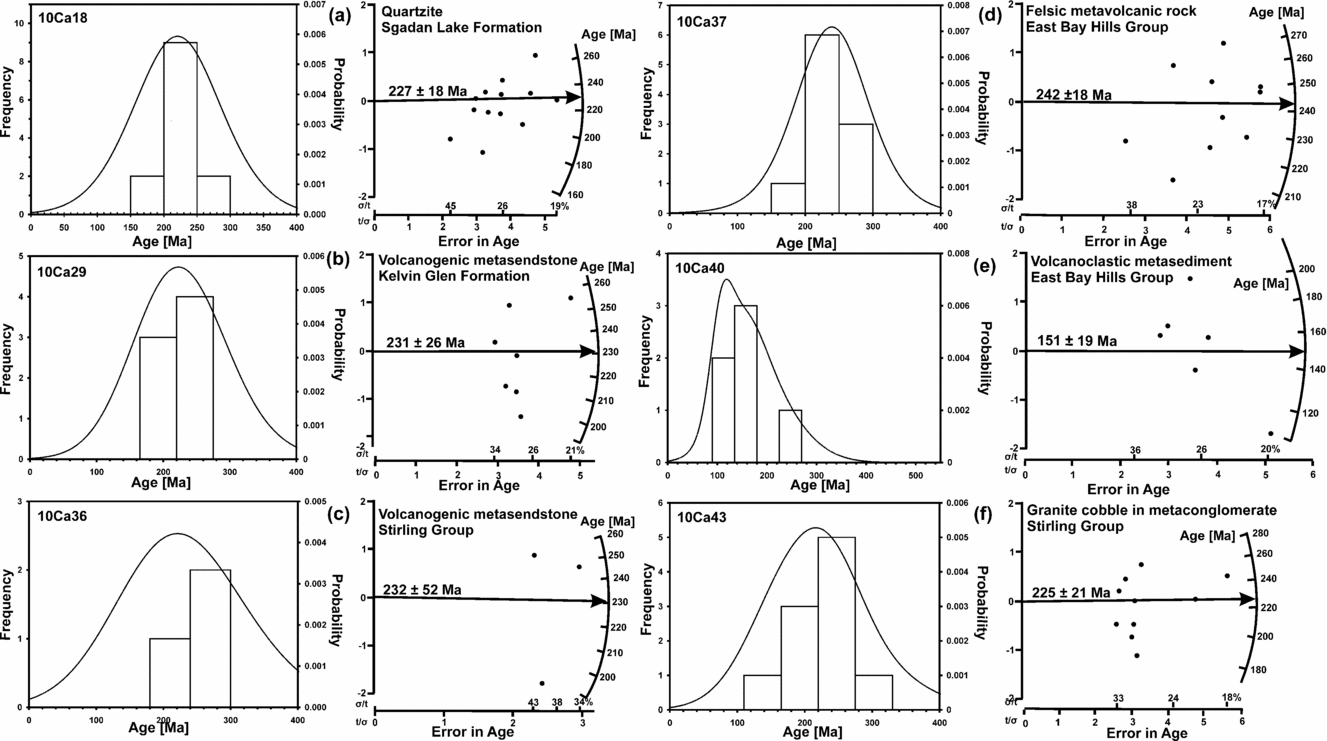
Zircon crystals were separated, mounted, polished and etched according to the techniques outlined by Thomson & Ring (Reference Thomson and Ring2006). The samples were analysed applying the external detector method and irradiated at the Oregon State University Triga Reactor, Corvallis, USA. The neutron fluence for zircon was monitored using the Institute for Reference Materials and Measurements (IRMM) uranium-dosed IRMM-541 glass. Spontaneous and induced fission track (FT) densities were counted using an Olympus BX51 microscope at 1250× magnification. Central ages (Galbraith & Laslett, Reference Galbraith and Laslett1993) were calculated using the IUGS recommended Zeta-calibration approach of Hurford & Green (Reference Hurford and Green1983), which allows for non-Poissonian variation within a population of single-grain ages belonging to an individual sample. The χ2 test indicates the probability that all grains counted belong to a single population of ages. A probability of less than 5% is taken as evidence for a significant spread of single-grain ages. A spread in individual grain ages can result either from inheritance of detrital grains from mixed source areas, or from differential annealing in grains of different composition by heating within a narrow range of temperatures (Green et al. Reference Green, Duddy, Laslett, Hegarty, Gleadow and Lovering1989). An IRMM-541 zeta calibration factor of 121.1±3.5 was obtained by repeated calibration against a number of internationally agreed age standards according to the recommendations of Hurford (Reference Hurford1990). Data are presented in Table 4 (see also Table A1 in the online Supplementary Material available at http://journals.cambridge.org/geo) and Figure 5. Probability plots were produced with the program ISOPLOT (Ludwig, Reference Ludwig2009) and radial plots with the software RadialPlotter (Vermeesch, Reference Vermeesch2009).
Fission track ages of zircon

Micrographs (all crossed polars): (a) σ-clast of plagioclase with brittle internal deformation and crystallization of white mica clusters (sample 10Ca37); (b) σ-clast containing an internally undeformed quartz phenocryst showing a resorption embayment and white mica filled fissures (sample 10Ca37); (c) two oriented slate clasts in a matrix of undeformed mineral clasts in a pyroclastic rock (sample 11Ca18); (d) bands with strongly oriented white mica including quartz and feldspar clasts oriented due to pressure solution (sample 11Ca13); and (e) recrystallization of large white mica in an oriented cluster of fine-grained white mica and recrystallization of quartz (sample 11Ca13).

(a–f) Left: cumulative probability plots for 40Ar/39Ar single-grain laser ablation ages of white mica from rocks of the Mira terrane; (a–f) right: respective weighted mean plots.

Rb–Sr mineral isochrons for two samples from the Mira terrane: data-point error crosses are 2σ; m – current range (Å) on a magnetic separator at which a certain fraction is magnetic.

Combined relative probability plot/histogram (left row) and radial plot representation (right row) of zircon single-grain fission-track age data for selected rocks of the Mira terrane.
5. Sample description and geochronological results
5.a. 40Ar/39Ar dating of white mica
Six samples were selected for 40Ar/39Ar dating, four from the NW and SE parts of the Mira terrane and two from the Sporting Mountain area in the SW part (Table 2; Figs 1, 3).
The four samples (10Ca11, 10Ca34, 10Ca37 and 10Ca42) from the NW and SE parts of the terrane are strongly foliated and sheared felsic metavolcanic rocks, interpreted to have been deformed in the D2 event. They contain the metamorphic mineral assemblage phengite-epidote-chlorite-albite-quartz-titanite. Bands enriched in strongly oriented white mica (and more rarely chlorite) due to pressure solution at quartz/feldspar-phyllosilicate interfaces vary at millimetre to centimetre scale with only a few laminae still showing recognizable relict fabrics such as porphyritic and/or pyroclastic textures (Fig. 2a, b). Hence a strong strain gradient is apparent at microscale. Albitic plagioclase phenocrysts and clasts (0.1–2 mm in size) are abundant as rotated relicts between phyllosilicate bands (σ-clasts) showing considerable brittle internal deformation (Fig. 2a, b). Plagioclase is commonly sericitized, containing clusters of undeformed fine-grained white mica with grain sizes of 5–30 μm (Fig. 2a). At the rims of porphyroclasts, white mica is more abundant and grain size increases up to 100 μm (Fig. 2b). In low-strain laminae, quartz also occurs as primary phenocrysts with corrosion embayments (0.5–1 mm), both with and without minor subgrain formation (Fig. 2b). Fissures are filled by white mica or calcite. Incipient recrystallization of quartz towards a polygonal fabric occurs in the matrix, in fissure fillings and especially in pressure shadows (0.01–0.05 mm). All four of these samples were included in the determination of peak metamorphic conditions in the range of 3.5±0.4 kbar and 280±30°C for the Mira terrane on the basis of mineral composition (Willner et al. Reference Willner, Massonne, Barr and White2013b ). Based on data reported by Willner et al. (Reference Willner, Massonne, Barr and White2013b ), composition of the white mica varies from muscovite to phengite (Si 3.1 to 3.4 atoms per formula unit).
Spot ages of white mica were obtained by laser ablation with 40 μm spot diameter both in high-strain laminae with enriched white mica and in white mica clusters in sericitized plagioclase in low-strain laminae. Only a few (2–4) adjacent grains were analysed, in contrast to conventional step heating of concentrates of multiple grains. Chlorite was not present in the dated clusters. A similar age range was detected among samples as given by the weighted means of the single spot ages (errors are 2σ; Table 2; Figs 1, 3): 388±36 Ma (10Ca11; n = 4); 363±14 Ma (10Ca34; n = 9); 393±9 Ma (10Ca37; n = 5); and 385±5 Ma (10Ca42; n = 7). These ages are corroborated by ages from normal and inverse isochrons which overlap the weighted means within 2σ confidence intervals (Table 2; see also online Supplementary Material Fig. E1, available at http://journals.cambridge.org/geo): 404±71 Ma and 402±70 Ma (sample 10Ca11); 351±20 Ma and 356±20 Ma (sample 10Ca34); 385±6.2 Ma and 386±6.3 Ma (sample 10Ca37); and 384±10 Ma and 383±10 Ma (sample 10Ca42). In three of the samples, the initial 40Ar/36Ar ratios of 280±56 and 283±55 (sample 10Ca11), 302±11and 302±11 (sample 10Ca34) and 307±64 and 312±23 (sample 10Ca42) overlap those of atmospheric Ar (295.5; Table 2; Fig. E1, available at http://journals.cambridge.org/geo), indicating that the presence of excess Ar is unlikely. The fourth sample 10Ca37 has slightly higher initial 40Ar/36Ar ratios of 347±37 and 348±38 (Table 2) and is the only sample in which significant age differences were detected at the 2σ level at thin-section scale, and hence which might contain some inherited (excess) Ar. A spot age peak of 428±17 Ma (weighted mean of three spot ages) was measured in sericitic white mica clusters in plagioclase within low-strain domains, consistent with the normal and inverse isochron ages within 2σ errors (406±35 Ma and 407±32 Ma). The initial 40Ar/36Ar ratios of 384±140 and 384±130 also coincide with atmospheric Ar within their large 2σ errors (Table 2).
The two other dated samples (11Ca15, 11Ca18) are felsic volcanoclastic or metasedimentary rocks from the Pringle Mountain Group in the Sporting Mountain belt (Fig. 1). Metamorphic conditions in the Sporting Mountain belt fall within the range of the remainder of the Mira terrane based on a sample collected from the NW part of the belt (Willner et al. Reference Willner, Massonne, Barr and White2013b ). The SE and likely NW margins of that belt are major shear zones, but the sampled areas appear to have been little or not-at-all affected by shear zones. The dated samples are weakly to moderately cleaved and display incipient recrystallization of quartz in the matrix. They contain slate clasts which are now oriented parallel to the predominant foliation, and the grain size of white mica in the clasts increases at the rims (Fig. 2c). Some veins filled with white mica intersect the foliation.
Sample 11Ca15 yielded a wide spectrum of white mica spot ages (Fig. 3). A dominant age peak (weighted mean; 2σ errors) at 396±3 Ma is defined by only 3 spot ages (normal isochron age 396±7 Ma; inverse isochron age 397±7 Ma; both initial 40Ar/36Ar ratios 295±21; Table 2) and a single spot yielded an age of 372±6 Ma. Only these ages are similar to those from the four samples previously described. Three older apparent age peaks occur at 420±7 Ma (n = 4), 477±18 Ma (n = 3) and 525±10 Ma (n = 1). These ages were measured in the slate clasts as well as in matrix white mica clusters. The weighted means of single age clusters do not overlap within 2σ errors, and are consistent with ages derived from the respective normal and inverse isochrons within 2σ errors (Table 2; Fig. E1, available at http://journals.cambridge.org/geo). The respective initial 40Ar/36Ar ratios (296±65 and 308±33; 316±29 and 316±28) are comparable to that of atmospheric Ar within 2σ errors (Table 2). Excess Ar does not appear to be present in sample 11Ca15.
In sample 10Ca18 three apparent age peaks were detected, none of which is Devonian: 439±7 Ma (n = 4), 451±14 Ma (n = 1) and 465±17 Ma (n = 3). The first weighted mean is consistent with the inverse isochron age (445±6 Ma; Table 2), and the third with both the normal and inverse isochron ages (463±10 Ma and 468±8 Ma; Table 2). The initial 40Ar/36Ar ratios (235±58, 290±75 and 259±61; Table 2) are identical to that of atmospheric Ar within 2σ errors, indicating that the presence of excess Ar is unlikely.
The Sporting Mountain belt samples show strong age heterogeneity both at thin-section scale and between outcrops (i.e. between the two samples), and probably preserve inherited ages. The lack of evidence for a D2 overprint in this area can explain the scarcity (in sample 11Ca15) or lack (in sample 10Ca18) of Middle–Late Devonian ages characteristic of the other four dated samples.
5.b. Rb–Sr mineral isochrons
Two samples, both from areas with prominent D2 sinistral strike-slip deformation, were analysed for Rb–Sr mineral systematics: mafic metavolcanic sample 11Ca05 and felsic metavolcanic sample 11Ca13 (Table 3; Figs 1, 4). In both samples white mica is too fine grained to be conventionally separated as individual crystals, and intimately intergrown with the matrix phases. We therefore separated mica-rich aggregates magnetically and split these aggregates into sieve fractions. Analysed white mica-rich fractions for the Rb–Sr mineral isochrons differ in grain size and in amount and type of admixture, that is, quartz, chlorite, epidote and feldspar. In both samples a pure albite fraction was obtained, and in sample 11Ca05 an almost-pure epidote fraction.
Sample 11Ca05 is likely of pyroclastic origin and dominated by chlorite and epidote. It is slightly foliated and white mica is mainly in 0.5–1 mm clusters parallel to the foliation. A few recrystallized individual grains are up to 100 μm in size. The isochron is defined by seven fractions including one albite fraction, two white mica fractions and four mixed fractions, yielding an age of 364.6±8.4 Ma. This age is the same as the 40Ar/36Ar white mica age of 363±14 Ma from sample 10Ca34 from the same locality.
Sample 11Ca13 is dominated by albite, quartz and white mica. It is strongly foliated with a pronounced non-coaxial fabric (σ-clasts, s-c-fabric) and pressure solution. White mica is oriented parallel to the s-c fabric, and the foliation is crossed by fissures filled by white mica (Fig. 2d). Recrystallization of large white mica in oriented clusters of fine-grained white mica and incipient recrystallization of quartz towards a polygonal fabric in the matrix is prominent (Fig. 2e). The isochron is defined by four fractions including an albite fraction and three mixed fractions containing white mica, and yields an age of 388.6±6.9 Ma. This age is similar to the 40Ar/36Ar white mica age of 385±5 Ma from nearby sample 10Ca42.
5.c. Fission track dating of zircon
Fission tracks were analysed in zircon concentrates from six samples collected from locations throughout the Mira terrane (Fig. 1), including two volcanogenic metasandstone samples (10Ca36, 10Ca40), a felsic metavolcanic sample (10Ca37), a volcanoclastic metasedimentary rock (10Ca40), a granite cobble in a metaconglomerate (10Ca43) and a quartzite sample from the Cambrian cover sequence (10Ca18).
Although single FT ages vary widely between 280 and 158 Ma, the resulting central ages (see Section 4.3; Figs 1, 5; Table 4) yield a more restricted age range between 242 and 225 Ma: 225±21 Ma (10Ca42; n = 6); 227±18 Ma (10Ca18; n = 13); 231±26 Ma (10Ca29; n = 7); 232±52 (10Ca36; n = 3); and 242±18 Ma (10Ca37; n = 10). They show no variation with rock type or with the 40Ar/39Ar white mica and Rb–Sr mineral isochron ages, and are similar to one another within the large 2σ range. An exception is sample 10Ca40 (n = 6) with a much younger age spectrum of single ages between 230 and 107 Ma and a central age of 151±19 Ma.
6. Discussion
6.a. Age of regional metamorphism and deformation
The 40Ar/39Ar age of crystallization of metamorphic white mica in samples 10Ca11, 10Ca34, 10Ca37 and 10Ca42, all with strong D2 overprint, is Middle–Late Devonian, that is, it ranges between 393±9 Ma and 363±14 Ma. This age spectrum is coincident with ages of Rb–Sr mineral isochron ages determined in samples 11Ca05 and 11Ca13 at 365±7 Ma and 389±8 Ma, respectively, both of which also have a strong D2 overprint. Because mineral assemblages are dated with Rb–Sr mineral isochrons, this similarity in ages indicates that Sr-isotopic equilibrium at hand specimen scale was attained in rocks that had also achieved microchemical equilibrium.
Willner et al. (Reference Willner, Massonne, Barr and White2013b ) attributed the microchemical equilibration to very low- to low-grade regional metamorphism, characterized by conditions of 3.5±0.4 kbar and 280±30°C which they corroborated in samples from Neoproterozoic metavolcanic-metasedimentary belts throughout the Mira terrane. According to Willner et al. (Reference Willner, Massonne, Barr and White2013b ), the varying compositions of the metamorphic phases at thin-section scale originated during continuously new nucleation of phases during changing P–T conditions along the late prograde and likely early retrograde P–T path, a kinetic phenomenon characteristic of very low- and low-grade metamorphism. During metamorphism water was present between reactants and reaction products, which mainly precipitated in clusters. As a result, transient equilibrium conditions were present throughout this partial P–T path. Equilibrium conditions are now further corroborated by the Sr-isotopic equilibrium observed at hand specimen scale. The maximum possible change in P–T conditions (c. 50°C, c. 1 kbar) during growth of white mica (Willner et al. Reference Willner, Massonne, Barr and White2013b ) probably occurred in the time recorded by the single Rb–Sr ages and their 2σ errors, that is, within c. 15 Ma. In the four samples which record only Middle–Late Devonian ages (10Ca11, 10Ca34, 10Ca42 and 11Ca05), any older white mica, if present, has been entirely recrystallized. The metamorphic white mica evidently grew and/or recrystallized during deformation and mylonitization related to the formation of prominent ductile sinistral D2 shear zones. The associated metamorphic overprint was pervasive, because mica clusters replacing undeformed parts of feldspar also have the same Devonian age.
The occurrence of very low-grade metamorphic minerals in the Neoproterozoic volcanic-sedimentary-plutonic belts of the Mira terrane was previously ascribed to a pervasive hydrothermal alteration event around 560–550 Ma, detected by depletion in δ18O which characterizes the Avalonian terranes in the northern Applachian orogen (Potter, Longstaffe & Barr, Reference Potter, Longstaffe and Barr2008; Potter et al. Reference Potter, Longstaffe, Barr, Thompson and White2008). No such ages were detected in our samples, although they have commonly been recorded in detrital white mica in Cambrian cover sequences in West Avalonia, including the Mira terrane (Reynolds, Barr & White, Reference Reynolds, Barr and White2009; Barr et al. Reference Barr, White, Hames and Reynolds2014). However, detrital white mica grains are at least an order of magnitude larger than the metamorphic white mica grains in our samples. The metamorphic white mica grains experienced complete or nearly complete re-equilibration during Middle–Late Devonian time, likely related to the fact that they were strongly affected by D2 as a result of concomitant infiltration and channelling of a hydrous metamorphic fluid through the shear zones. Massonne & Willner (Reference Massonne and Willner2008) and Willner et al. (Reference Willner, Massonne, Barr and White2013b ) showed that maximum dehydration under regional metamorphic conditions occurs at 250–350°C depending on pressure. Influx of these internally generated metamorphic fluids would not likely have affected the δ18O anomaly which, by contrast, was originally produced by an influx of external meteoric fluids (Potter, Longstaffe & Barr, Reference Potter, Longstaffe and Barr2008; Potter et al. Reference Potter, Longstaffe, Barr, Thompson and White2008).
An additional concomitant Devonian event in the Mira terrane was the high-level intrusion of a few small granitic bodies (Fig. 1) in the likely age range 380–370 Ma (Barr & Macdonald, Reference Barr and Macdonald1992; Bevier et al. Reference Bevier, Barr, White and Macdonald1993). Potential resetting by fluids generated during this event (magmatic H2O release; small-scale hydrothermal convection) appears to have been rather insignificant as a cause for the ubiquitous Devonian 40Ar/39Ar ages at the locations sampled for this study although, in some areas, contact metamorphic overprinting and skarn development were widespread (Macdonald & Barr, Reference Macdonald, Barr and Sangster1993b ).
6.b. Possible Silurian and Ordovician relict ages
The 40Ar/39Ar age spectra in samples 10Ca37, 11Ca05 and 11Ca13 display inhomogeneous distribution of spot ages at thin-section scale and between outcrops. These spot ages do not display a continuum, as would be expected if they were recording partial resetting of older ages. Instead they cluster around three age peaks: 420–428 Ma, 439 Ma and 465–477 Ma. These possible relict age peaks are similar within error to the respective normal and inverse isochron ages, and the respective initial 40Ar/36Ar ratios are comparable to that of atmospheric Ar within 2σ errors (Table 2), indicating that the presence of inherited (excess) Ar is unlikely. Detrital slate clasts in samples 11Ca15 and 11Ca18 or white mica formed during the pervasive hydrothermal fluid influx around 560–550 Ma (Potter, Longstaffe & Barr, Reference Potter, Longstaffe and Barr2008; Potter et al. Reference Potter, Longstaffe, Barr, Thompson and White2008; Reynolds, Barr & White, Reference Reynolds, Barr and White2009) could be sources for inherited Ar.
Detrital white mica grains from relatively undeformed sandstone of the Lower Cambrian Bengal Road Formation yielded continuous spectra at c. 550–634 Ma with separate minor peaks at 530 Ma and 469 Ma (Reynolds, Barr & White, Reference Reynolds, Barr and White2009). Similar ages were obtained from time-equivalent units in New Brunswick, leading Reynolds, Barr & White (Reference Reynolds, Barr and White2009) to interpret the age spectra as representing a 650–630 Ma proximal detrital source and a resetting event at c. 560–550 Ma. The resetting event was postulated to have been a hydrothermal overprint which may also have produced the pervasive δ18O depletion in Avalonia during the early stages of transtension-related rifting (Potter, Longstaffe & Barr, Reference Potter, Longstaffe and Barr2008; Potter et al. Reference Potter, Longstaffe, Barr, Thompson and White2008).
On the other hand, collision of Avalonia with the leading edge of composite Laurentia (including previously accreted Ganderia) and subsequent related deformation, crustal thickening and metamorphism after closure of the Acadian seaway occurred during the late Silurian – Early Devonian Acadian orogeny between about 421 and 395 Ma, according to several lines of evidence from the collision zones in New Brunswick and Newfoundland (e.g. Murphy, van Staal & Keppie, Reference Murphy, van Staal and Keppie1999; White et al. Reference White, Barr, Reynolds, Grace and McMullin2006; van Staal et al. Reference van Staal, Whalen, Valverde-Vaquero, Zagorevski, Rogers, Murphy, Keppie and Hynes2009; van Staal & Barr, Reference van Staal, Barr, Percival and Cook2012). Water released during early Acadian burial could have been responsible for the 420–428 Ma 40Ar/39Ar spot age peaks detected as relicts in two of the Mira terrane samples (10Ca37 and 11Ca15). More significant is the 40Ar/39Ar white mica age of 396±3 Ma for sample 11Ca15, which could be interpreted to reflect growth of white mica in S1 given that the area around this sample was not noticeably affected by D2. If correct, a progressive D1–D2 transpressive deformation event may have started during late Early Devonian time. This timing suggests that the event was linked to either the end stages of the Acadian orogeny or the onset of the Neoacadian orogeny. In any case, it is clear that a larger database is needed to corroborate the relict 40Ar/39Ar spot age peaks and investigate whether they correspond to fluid influx related to known geological processes or represent incomplete resetting of Neoproterozoic–Cambrian ages by Devonian events.
6.c. Devonian transpressive deformation
The Devonian 40Ar/39Ar spot ages and Rb–Sr ages reported here are interpreted to date prominent sinistral strike-slip deformation in the Mira terrane, although the oldest Devonian 40Ar/39Ar age (396±3 Ma) may date the peak of earlier regional metamorphism. It was argued by Willner et al. (Reference Willner, Massonne, Barr and White2013b ) that the peak metamorphic conditions which correspond to burial under a metamorphic field gradient of 20–25°C km−1 could be detected: (1) in relatively undeformed rocks; (2) in rocks showing only D1 folding; and (3) in rocks strongly overprinted by the D2 sinistral transcurrent shear. Metamorphic conditions are comparable to those present in foreland fold-and-thrust belts elsewhere (e.g. Fielitz & Mansy, Reference Fielitz and Mansy1999) and require moderate tectonic burial during a compressive event. This event probably occurred prior to D2 transcurrent deformation which occurred shortly after maximum burial (11–14 km). We therefore relate burial mainly to D1, but recognize that open to tight upright F1 folding alone is unlikely to have buried the rocks to such depths on a regional scale. More probable is the explanation that F1 folds were initially more inclined (as they still are in places) and locally accompanied by oblique reverse faults. Both the inclined folds and faults were then subsequently rotated into more steep attitudes during progressive transpressive shear, which culminated in D2 sinistral transcurrent movements in the steep shear zones. In such a transposition scenario, the latter therefore incorporated rotated segments of formerly reverse faults. The strike of the transpressive deformation follows the NE trends of the volcanic-sedimentary-plutonic belts of the Mira terrane, which were previously separated by Ediacaran – early Cambrian transtensional movements in the area where the Avalonian microplate was situated at that time.
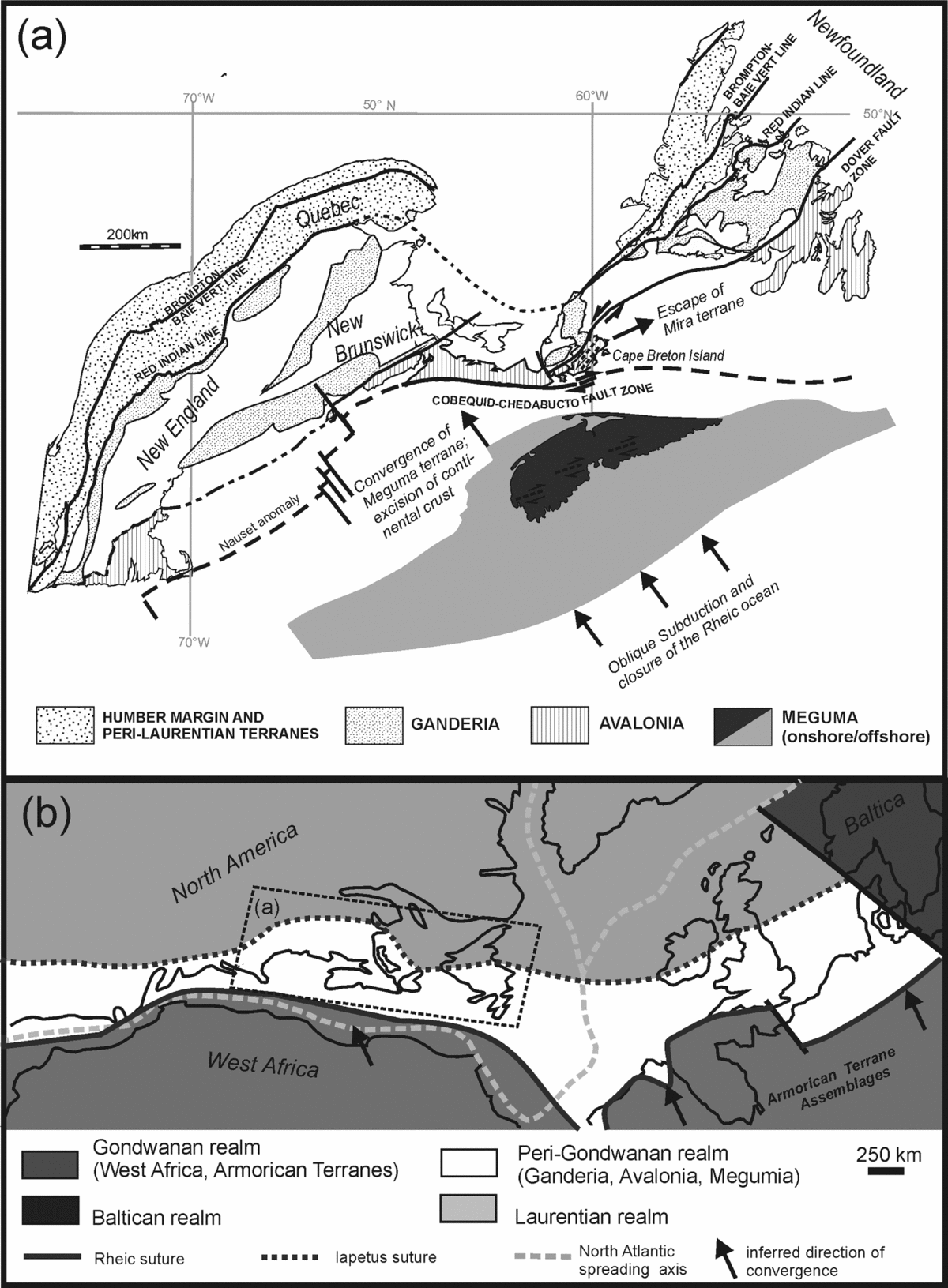
The prominent Devonian transpressive event appears to have been responsible for the final amalgamation of the dispersed slices of the microcontinent after the onset of collision of Avalonia with the Ganderian margin around 421 Ma (e.g. Murphy, van Staal & Keppie, Reference Murphy, van Staal and Keppie1999; van Staal, Reference van Staal and Goodfellow2007; van Staal et al. Reference van Staal, Whalen, Valverde-Vaquero, Zagorevski, Rogers, Murphy, Keppie and Hynes2009). The timing of peak regional metamorphism and the transpressive deformation coincides with Neoacadian events in the now-adjacent Meguma terrane to the south. During the Neoacadian orogeny (400–365 Ma), the Meguma terrane was subjected to widespread collisional deformation and voluminous late- and post-deformational plutonism with related localized high-temperature–low-pressure metamorphism (e.g. White & Barr, Reference White and Barr2012). The Neoacadian orogeny is interpreted to have been the result of oblique convergent movement of the Meguma terrane relative to composite Laurentia (including Avalonia) and the main mass of Gondwana to the present-day southeast (Fig. 6a, b). Neoacadian movement between composite Laurentia and Meguma was dextral and accommodated by the east-trending Cobequid–Chedabucto fault zone in mainland Nova Scotia (e.g. Murphy et al. Reference Murphy, Waldron, Kontak, Pe-Piper and Piper2011). Hence the part of the Meguma terrane now juxtaposed against the Mira terrane was situated farther to the east at the onset of the Neoacadian orogeny, particularly since dextral horizontal translations continued well into the Carboniferous (Murphy et al. Reference Murphy, Waldron, Kontak, Pe-Piper and Piper2011). However, Meguma is a large terrane that extends SW offshore to southern New England (e.g. Pe-Piper & Loncarevic, Reference Pe-Piper and Loncarevic1989; Keen, MacLean & Kay, Reference Keen, MacLean and Kay1991; Pe-Piper & Jansa, Reference Pe-Piper and Jansa1999); the piece of Meguma that initially collided with composite Laurentia may therefore now be situated offshore somewhere between Nova Scotia and southern New England. The Neoacadian sinistral motion in the Mira terrane that is coeval with dextral translation along the east–west-oriented Cobequid–Chedabucto Fault Zone appears to form part of a conjugate fault set, which accommodated escape of the Mira terrane towards the NE following convergence with Meguma (Fig. 6a). The wide ductile D2 shear zones in the Mira terrane developed into more discrete faults in the Carboniferous during exhumation to the surface.
(a) Scenario showing the oblique post-collisional emplacement of the Meguma terrane during the early stages of the Neoacadian orogeny followed by escape of the Mira terrane toward the NE. White areas onshore are mainly Silurian–Carboniferous rock units. (b) Pangean reconstruction showing the approximate locations of the main Iapetus and Rheic sutures.
At the time of maximum burial of the Mira terrane, coarse clastic sediments of the McAdams Lake Formation (White & Barr, Reference White and Barr1998) were deposited in a half-graben at the boundary between the NW Mira terrane and the adjacent Bras d’Or terrane during the latest Emsian – early Eifelian (c. 393 Ma; Cohen, Finney & Gibbard, Reference Cohen, Finney and Gibbard2013). Sedimentation occurred in a lacustrine environment during a supposed increase in topographic relief (White & Barr, Reference White and Barr1998). Subsequently, clastic sediments of the mainly Tournaisian Horton Group (Martel & Gibling, Reference Martel and Gibling1995) were unconformably deposited on the area. Considering an age of the unconformity at the end of the Devonian (c. 359 Ma; Cohen, Finney & Gibbard, Reference Cohen, Finney and Gibbard2013), time-integrated maximum exhumation rates can be deduced for the Mira terrane since the time of maximum burial to 11–14 km depth (calculated on the basis of a mean crustal density of 2.8 g cm−3) at c. 396–385 Ma to exhumation at the surface at c. 359 Ma, a period of c. 37–26 Ma. Based on these data, the time-integrated exhumation rates were c. 0.3–0.5 mm a−1, which is consistent with erosion rates in other tectonically active areas of convergent continental margins (Glodny et al. Reference Glodny, Lohrmann, Echtler, Gräfe, Seifert, Collao and Figueroa2005; Willner et al. Reference Willner, Thomson, Kröner, Wartho, Wijbrans and Hervé2005). However, the well-constrained ages of 363±14 Ma (sample 10Ca34; 40Ar/39Ar) and 365±8 Ma (sample 11Ca05; Rb–Sr) in the SE part of the Mira terrane appear to be in conflict with this calculation, suggesting that exhumation was not uniform. In the SE Mira terrane, the Visean Windsor Group (Boehner, Adams & Giles, Reference Boehner, Adams and Giles2002) unconformably overlies the Neoproterozoic and Cambrian rocks (Fig. 1). This younger unconformity has an approximate age of c. 339 Ma, because the St Peters gabbro and basalt dated by Barr, Grammatikopoulos & Dunning (Reference Barr, Grammatikopoulos and Dunning1994) formed below the base of the Windsor Group. We can therefore derive similar exhumation rates of 0.4–0.6 mm a−1, still consistent with erosion-driven unroofing. In any case, extension-driven unroofing was probably insignificant (if present at all) in the Mira terrane, because brittle-ductile normal faulting has not been recognized in the basement rocks of the Mira terrane and higher exhumation rates exceeding 2 mm a−1 would be expected if such a process predominated during exhumation (Thomson, Stoeckhert & Brix, Reference Thomson, Stoeckhert and Brix1998; Ring et al. Reference Ring, Brandon, Willett, Lister, Ring, Brandon, Lister and Willett1999).
6.d. Significance of the transpressive deformation for the assembly of Pangea
The D2-related transpressive system, which developed during convergence and amalgamation of the Mira and Meguma terranes, is closely related to the closure of the Rheic Ocean, that is the ocean between Laurussia (Laurentia+Baltica+Ganderia+Avalonia+Meguma) and Gondwana (Africa+Armorican terranes). Although strongly overprinted by post-collisional deformation, the approximate location of the Rheic suture has become more apparent in the last decade (e.g. Díez Fernández et al. Reference Díez Fernández, Martínez Catalán, Arenas and Abati2011, Reference Díez Fernández, Foster, Gómez Barreiro and Alonso-García2013; van Staal & Barr, Reference van Staal, Barr, Percival and Cook2012; Kroner & Romer Reference Kroner and Romer2013; Fig. 6b). Optimal separation is best done using detrital zircon age spectra: Palaeoproterozoic–Mesoproterozoic ages at 1.0–1.8 Ga are prominent in detrital zircon age spectra of the Meguma terrane (Murphy et al. Reference Murphy, Fernandez-Suarez, Keppie and Jeffries2004; Waldron et al. Reference Waldron, White, Barr, Simonetti and Heaman2009), as is also typical for Ganderian, Avalonian and Amazonian detrital zircon (e.g. Willner et al. Reference Willner, Gerdes, Massonne, Barr and White2013a ). In contrast, detrital zircon spectra from West Africa (Abati et al. Reference Abati, Aghzer, Gerdes and Ennih2012) and the Armorican terranes (Díez Fernández et al. Reference Díez Fernández, Martínez Catalán, Arenas and Abati2011) show a gap in this age range. The suture of the Rheic Ocean is therefore likely outboard of what is exposed on land in Atlantic Canada. The nearest known exposure of the suture is within an allochthonous nappe pile in NW Spain on the conjugate margin opposite Newfoundland (Díez Fernández et al. Reference Díez Fernández, Martínez Catalán, Arenas and Abati2011, Reference Díez Fernández, Foster, Gómez Barreiro and Alonso-García2013; Fig. 6b). In that area, inferred Rheic oceanic crust is sandwiched between Armorican crust in the bottom and allochthonous crust with inferred North American provenance in the upper part. The closure of the Rheic Ocean, or part of it in NW Spain, at c. 380–370 Ma may have been marked by the arrival of Armorican crust in the subduction-exhumation channel beneath relics of Rheic oceanic crust accreted prior to Laurussia (Díez Fernández et al. Reference Díez Fernández, Martínez Catalán, Arenas and Abati2011, Reference Díez Fernández, Foster, Gómez Barreiro and Alonso-García2013). This also coincided with the onset of continent–continent collision between Laurussia and Gondwana in Central Europe (Massonne, Reference Massonne2005; Zeh & Gerdes, Reference Zeh and Gerdes2010; Kroner & Romer, Reference Kroner and Romer2013). However, the collisional event might have started in this region soon after 400 Ma (e.g. Massonne & O’Brien, Reference Massonne, O’Brien, Carswell and Compagnoni2003; Kroner & Romer, Reference Kroner and Romer2013) as evidenced by the tectonic emplacement of mid-ocean-ridge basalt (MORB) -derived eclogites (e.g. Stosch & Lugmair, Reference Stosch and Lugmair1990) in Armorican crustal rocks. These eclogites, which occur in diverse crystalline complexes of the Bohemian Massif, presumably represent subducted fragments of the Rheic Ocean which yielded metamorphic ages in the range 380–400 Ma (e.g. von Quadt & Gebauer, Reference von Quadt and Gebauer1993; Beard et al. Reference Beard, Medaris, Johnson, Jelinek, Tonika and Riciputi1995). A model for the plate geometry and geographic constellation of Laurussia and Gondwana, which might have been responsible for the aforementioned ages and tectonics also involving the Mira and Meguma terranes, was proposed by Massonne (Reference Massonne2005). In this model, the Rheic Ocean was first completely subducted in the range of central Europe. The continuing movement of Laurussia to the south resulted in the contemporaneous further disappearance of this ocean towards the west and was accompanied by major compressional shear zones trending WSW–ENE.
The NW-directed convergence of Gondwana with Laurussia matches the above inferred direction of convergence between the Meguma and Mira terranes, although during Devonian time the Meguma terrane was located far offshore from its current position relative to the Mira terrane (Fig. 6a). Whether or not oceanic crust existed in the seaway that separated Meguma and Avalonia is not known (e.g. Murphy et al. Reference Murphy, Fernandez-Suarez, Keppie and Jeffries2004; Waldron et al. Reference Waldron, White, Barr, Simonetti and Heaman2009, Reference Waldron, Schofield, White and Barr2011), as is the timing of closure of the Rheic Ocean to the SE of Meguma (van Staal & Barr, Reference van Staal, Barr, Percival and Cook2012). However, towards the SW the Rheic Ocean remained open in the Southern Appalachians until the late Carboniferous Alleghanian orogeny. During that time the kinematic pattern of deformation established during the Devonian period remained in Atlantic Canada as in Armorica due to continuing indentation of Gondwana into Laurussia, when deformation became mainly brittle (Murphy & Collins, Reference Murphy and Collins2008). With these movements the final assembly of Pangea was completed (Fig. 6b).
6.e. Burial and exhumation of the Mira terrane prior to early Atlantic rifting
The fission track (FT) ages obtained in this study from zircon are in the range of 225±21 Ma to 242±18 Ma, except for a younger age of 151±19 Ma from one locality. Because the closure temperature of this system (circa 250–280°C; see Section 1) is close to the peak temperature of metamorphism in the Mira terrane, it is expected that ages would be close to the 40Ar/39Ar and Rb–Sr ages. However, the zircon FT ages are even younger than the Carboniferous sedimentary cover in the Mira terrane. The data indicate that the metamorphic basement was reburied by sediments and reheated to very low-grade conditions during post-Visean time, followed by re-exhumation and/or cooling during Middle Triassic time. These events took place without affecting either the 40Ar/39Ar or Rb–Sr ages. Reheating must therefore have occurred under fluid-absent conditions, as water is essential for element transport, crystallization and recrystallization of mineral phases as well as for isotopic redistribution.
Zircon FT ages were reported previously from the late Palaeozoic rocks in the Minas Basin area in SW Nova Scotia (Ravenhurst et al. Reference Ravenhurst, Reynolds, Zentilli, Krueger and Blenkinsop1989). Here, the Famennian–Tournaisian–Visean succession (Horton and Windsor groups) including clastic, carbonate and evaporitic rocks was affected by basinal brines at c. 330–300 Ma and 250 Ma (K/Ar ages of secondary illite). Zircon in rocks associated with this sequence yielded FT ages similar in part to those in the Mira terrane, but with a wider range from 342±33 Ma to 217±16 Ma (Ravenhurst et al. Reference Ravenhurst, Reynolds, Zentilli, Krueger and Blenkinsop1989). The zircon FT ages were interpreted as being related to the influx of hot hydrothermal brines. However, this explanation is unlikely in the Mira terrane, where no evidence of post-Devonian hydrothermal activity has been detected. The 40Ar/39Ar ages would also have been strongly affected.
Apatite fission track ages in the range of 219–154 Ma were determined in southern Nova Scotia by Ravenhurst et al. (Reference Ravenhurst, Donelick, Zentilli, Reynolds and Beaumont1990) and in the range of 247–181 Ma in granitoid rocks and Permian–Triassic sandstone throughout Atlantic Canada by Grist & Zentilli (Reference Grist and Zentilli2003). These apatite FT ages are very similar to our zircon FT ages. Ravenhurst et al. (Reference Ravenhurst, Donelick, Zentilli, Reynolds and Beaumont1990) estimated that areas of the present Atlantic margin of Canada were buried under c. 4–5 km of strata in upper Palaeozoic intracontinental basins of Pangea and that erosion following basin inversion had removed much of this cover by Late Triassic – Jurassic time. This estimation should be regarded as maximum burial, because the Atlantic margin occurs at the thinned flanks of the Permian–Carboniferous Maritimes Basin with maximum thickness of c. 12 km in the depocentre (Sandford & Grant, Reference Sanford and Grant1990). Similar burial during Permian time and exhumation prior to Late Triassic – Jurassic rifting associated with the opening of the Central Atlantic Ocean was also proposed for the offshore Maritimes Basin by Ryan & Zentilli (Reference Ryan and Zentilli1993), and was shown to be a phenomenon occurring on both sides of the Atlantic.
The high closure temperature of c. 250–280°C for FT in zircon could only be substantially lowered in zircon with high accumulated radiation damage (Rahn et al. Reference Rahn, Brandon, Batt and Garver2004). However, there is little evidence for this effect in the present samples. Because the thickness of the Permian–Carboniferous cover on the Neoproterozoic rocks was only up to 4–5 km, an increased geothermal gradient of 50–60°C km−1 likely prevailed under these cover sediments, which is typical for rift settings. Evidence for these rift processes includes emplacement of mafic dykes in southern Nova Scotia at 230–220 Ma and 203–185 Ma (Ravenhurst et al. Reference Ravenhurst, Donelick, Zentilli, Reynolds and Beaumont1990; Dunn et al. Reference Dunn, Reynolds, Clarke and Ugidos1998). Heating during this period might have been enhanced within the Mira terrane basement rocks, whereby the lower thermal conductivity of the cover sediments (relative to underlying basement rocks) resulted in a much higher geothermal gradient for the given high heat flow under this ‘thermal blanket’. The Central Atlantic Ocean started to open as a westerly extension of the Neotethys (Labails et al. Reference Labails, Olivet, Aslanian and Roest2010; Stampfli & Borel, Reference Stampfli and Borel2002) at c. 190 Ma. At that time the sedimentary cover had largely been eroded and the basement rocks had cooled to temperatures below the closure temperature of the apatite fission track system (Ravenhurst et al. Reference Ravenhurst, Donelick, Zentilli, Reynolds and Beaumont1990; Ryan & Zentilli, Reference Ryan and Zentilli1993; Grist & Zentilli, Reference Grist and Zentilli2003).
7. Conclusions
Using a multi-method dating approach in very low- to low-grade metamorphic rocks we have derived more details of the timing of tectonometamorphic geological processes in the Mira terrane including influx of hydrous fluids, metamorphism, deformation, burial and exhumation.
An age signal related to a penetrative hydrothermal overprint at c. 560–510 Ma as indicated by a regional pervasive δ18O depletion (Potter, Longstaffe & Barr, Reference Potter, Longstaffe and Barr2008; Potter et al. Reference Potter, Longstaffe and Barr2008) was not detected in the samples dated during the present study. White mica, if formed at this stage, must have been completely recrystallized in those samples due to breakdown and production of internally generated metamorphic fluids, which would not have altered the oxygen isotope signature.
Sparse relict 40Ar/39Ar spot age clusters of 465–477 Ma and c. 439 Ma could be related to meteoric fluid influx during extensional events. Spot ages of c. 420–428 Ma could be related to early burial during Acadian collision of Avalonia with the composite Laurussia margin. However, incomplete resetting of older ages cannot be excluded with the present dataset. Evidently, the Mira terrane was situated in the foreland of the Acadian collision and escaped pervasive Acadian tectonometamorphic overprinting. Only 40Ar/39Ar analysis of single spots by laser ablation enables detection of age heterogeneity at thin-section scale at very low- to low-grade metamorphism.
Most 40Ar/39Ar and Rb–Sr ages of white mica fall within the range 396–366 Ma. The oldest age may reflect mineral growth at peak very low- to low-grade metamorphic conditions during a main pulse of influx of internally generated metamorphic fluids, but the bulk of the ages are interpreted to be related to shearing during sinistral transpressive deformation. This deformation was concomitant with dextral transpression of the Meguma terrane with composite Laurentia (including Avalonia), which locally resulted in a conjugate fault set such that Mira and other parts of Avalonia escaped to the NE (Neoacadian event). Exhumation from maximum burial to the surface began at c. 390 Ma in the NW part of the Mira terrane and ended in the SW at c. 340 Ma. Exhumation rates of 0.3–0.6 mm a−1 indicate erosion-driven unroofing. During exhumation, transpressive ductile shear zones became more discrete resulting in a prominent Carboniferous conjugate fault set. Intrusion of A- and I-type granitoids also occurred during this time period. The Neoacadian transpressive event is related to the closure of the Rheic Ocean along a suture outside Atlantic Canada, where Gondwana and Laurussia converged to form the supercontinent of Pangea. The importance of Neoacadian events in Atlantic Canada for the closure of the Rheic Ocean is highlighted here for the first time.
Zircon fission track ages of 225–242 Ma indicate post-collisonal late Palaeozoic reburial of the Mira terrane rocks within intracontinental basins of Pangea under fluid-absent conditions, and date cooling to temperatures <250°C related to elevated geothermal gradients and exhumation during Late Triassic rift events prior to opening of the Central Atlantic Ocean.
Supplementary material
To view supplementary material for this article, please visit http://dx.doi.org/10.1017/S0016756814000508
Acknowledgements
This project was financed by Deutsche Forschungsgemeinschaft (grants Ma1126-27-1,2 and Wi847-9-1,2) to HJM and APW. Geological mapping by SMB and CEW in SE Cape Breton Island was funded by the Geological Survey of Canada through the 1984–1989 Canada – Nova Scotia Mineral Development Agreement and the 1990–1992 Canada – Nova Scotia Cooperation Agreement, as well as by research grants to SMB from the Natural Sciences and Engineering Research Council of Canada. Valuable comments by editor M. Allen and an anonymous reviewer improved the manuscript.